Martin Luther and the Ninety-Five Theses, part 1/3
It may be January 2018 now, but I am finally taking time to post the videos I made of our 2017 DFW Reformation Conference at Mid-Cities Presbyterian Church (OPC) in Bedford, TX the weekend prior to the 500th anniversary of the Protestant Reformation. The camera we used was borrowed from a generous member who did not attend the conference, and we were unable to prevent the camera from shutting off after about 15 or so minutes, so each lecture is uploaded in parts, with only a minute or so of material lost. Today, I am sharing part one of three of Dr. Jonathan Master’s opening lecture, “Martin Luther and the Ninety-Five Theses” along with my own summary which follows.
Background summary of church history.
Rise of Islam (7th-8th centuries) is the most significant event that changed the landscape of the church in history. All the most significant, influential churches, councils and debates, took place in the eastern half of the Roman Empire, centered in Constantinople in Asia Minor (modern day Istanbul, Turkey).
Rise of the Papacy With the fall of Constantinople to Islam, Rome in western Europe arises as the more prominent city among the five Patriarchates across the empire. It is only after this that the Roman Popes begin to assume and claim primacy over other bishops.
Rise of Purgatory Vague references in the ancient era of church history to an intermediate state develop in the Middle Ages to become the penitential system that deals with sins after death. Medieval papal pronouncements establish the teaching of a “treasury of merits” and offer “indulgences” by which the Papacy holds out the hope of a shortened time in Purgatory in exchange for acts of charity. By the time of Luther, this had degenerated to a crass exchange of spiritual benefits for oneself and his loved ones for money.
Background of Martin Luther
Luther’s Father a Successful Entrepreneur who intends to educate his son for a profitable law practice which will not only give Martin a comfortable life, but also benefit the family business. Luther wavers about this life plan before he reaches a crisis point during a lightning storm in a field as he walks one night, pledging to Saint Anne that if he survives, he’ll become a monk.
Our Reformation Party
It’s been a busy October for our little church in the Mid-Cities area of the Dallas/Fort Worth, Texas Metroplex. A few months prior, I spoke with a fellow church member in theory about showing the kids of our church the old 1953 film, Martin Luther, starring Niall MacGinnis. Then, a couple of weeks out, the friend with whom I’d previously spoken asked if we were going to do it. Naturally, I was inclined to do so, but I recalled that in addition to this black and white classic, I also have the brand new Torchlighters cartoon, The Martin Luther Story, produced by the partnership of the Christian History Institute and Voice of the Martyrs. I suggested this video would likely be a little more enjoyable than the older film, and my friend, my wife and our pastor’s wife got to work planning a Reformation party for the weekend prior to our annual Reformation Conference, the DFW Reformation Conference.
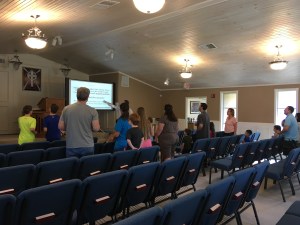 The ladies put together a plan to host a VBS-style party, opening with my own original children’s song about the Five Solas of the Reformation, set to the tune of “Father Abraham.”
Martin Luther nailed, his Ninety-Five!
Ninety-Five Theses, did Luther nail!
I am justified, through FAITH ALONE!
So let’s reform the church!
I’m a sinner and, a saint am I!
A saint and a sinner, at the same time!
I am justified, by GRACE ALONE!
So let’s reform the church!
A believer-priest, that’s what I am!
I can boldly go before the throne!
My only Great High Priest, is CHRIST ALONE!
So let’s reform the church!
Only 66, books in the Word!
39 Old, 27 New!
The Good News is in, SCRIPTURE ALONE!
So let’s reform the church!
I’m unable to, keep God’s commands!
What he wants, he gives me in his Son!
GLORY goes to God, and GOD ALONE!
So let’s reform the church!
Martin Luther nailed, his Ninety-Five!
Ninety-Five Theses, did Luther nail!
I am justified, through FAITH ALONE!
“The just shall live by faith!”
 After the kids got the “wiggle worms” worked out of them, we sat them down and fired up the video projector (and yes, we laid down the $80 for a CVLI license to show my DVD publicly). Then the kids moved on to the stations! One station featured a simple game of shooting a nerf gun to knock down five cups representing the Five Solas, another game was a version of pin the nail on the Theses, for my station, my wife decided that I should teach the kids about the Gutenberg press, and how the printing press was so instrumental in popularizing Luther’s reforms. We tried to locate a good model of the Gutenberg press, but on such short notice, the complex wooden and metal model would arrive with only 24 to prepare it. Of course, I bought it anyway, I just wasn’t able to demonstrate it for the kids. I’ll probably build it during my Christmas break .
 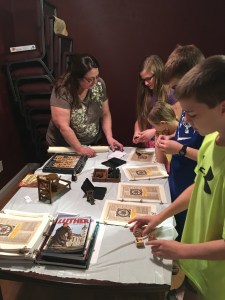 My wife did, however, locate a much simpler model of DaVinci’s modification of the Gutenberg press, and she also found a small, die-cast metal pencil sharpener in the form of the Gutenberg press. These I combined with my Playmobil Martin Luther figure to at least give them a nice arrangement for the children’s young eyes. I also laid out a few books with pictures of sixteenth-century print shops and summarized the process the original generations of printers went through to produce books and pamphlets. In a thrilling turn of providence, when shopping one day at Barnes & Noble, I encountered the Penguin publication, Brand Luther, by St. Andrews University scholar Andrew Pettegree. The first few chapters of this gave me a good grasp of the subject which I was able to boil down to a few salient points without going over the kids’ heads more than the subject matter otherwise would make it so easy to do.
 Finally, our pastor’s wife “voluntold” her husband to lead the final station, during which he donned a Geneva gown and spoke on the subject of the Diet of Worms, while the kids ate the ever-popular Diet of Worms cake—a dirt cake with gummy worms added. This they washed down with root beer, because, you know what a big advocate of the barley brew Dr. Luther was. Pastor Troutman summarized this council, read his famous “Here I Stand” speech, and also the Emperor Charles’ idle threat, the Edict of Worms,
  which called Luther “a notorious heretic.” According to some podcast which slips my mind at the moment, Charles hoped this edict alone would discourage Luther’s followers and end the spread of Luther’s teachings.
“Luther, the Cross & the Word” | DFW Reformation Conference 2017


Martin Luther (1483-1546)
On October 31, 1517, a German monk and professor of theology by the name of Martin Luther posted a notice proposing a public debate to discuss abuses on the part of his Church by which she was taking advantage of the poor, distorting her teachings, and potentially endangering the souls of the faithful. Little did he know that this simple act would spark one of the great historic movements in world history which played a role in bringing the Western world into the modern era, and plant the roots of what would come to be known as the Protestant branch of the Christian Church.
Your neighbors at Mid-Cities Presbyterian Church, along with Protestant churches around the world, are commemorating this event which happened exactly 500 years ago as of this October 31st, by hosting a conference presenting the life of Martin Luther, his posting of the famous “Ninety-Five Theses,” his teachings on the Cross of Christ, and the power of the Holy Scriptures in shaping the Christian life of the believer. We cordially invite you to join us at this special observance of our annual DFW Reformation Conference Friday through Sunday, October 20-22, 2017.

Dr. Jonathan Master
Cairn University Professor of Theology, Dr. Jonathan Master will introduce us to the historic life, theology and spirituality of the Father of the Protestant Reformation, Dr. Martin Luther (1483-1546).
Dr. Master teaches theology, church history, and New Testament at Cairn. He also oversees Cairn’s honors program, part of Cairn’s Center for University Studies.
Dr. Master also serves as executive editor of the online magazine Place for Truth, as well as host of the podcast Theology on the Go (both sponsored by the Alliance of Confessing Evangelicals). He has authored the book A Question of Consensus (Fortress Press) and a number of articles, in addition to editing The God We Worship (P&R). Prior to teaching, he served in pastoral ministry for ten years.
Conference Schedule
Friday 10/20 7:00PM “Martin Luther and the 95 Theses”
Saturday 10/21 9:00 AM “Martin Luther’s Theology of the Cross”
Saturday 10/21 10:30 AM “Martin Luther and a Life Shaped by the Word”
Sunday 10/22 10:30 AM Dr. Master preaches “A Mighty Fortress” in morning worship at Mid-Cities Presbyterian Church
National Tragedy and Repentance
Where is God during catastrophic events like the 9/11 attack? He’s calling sinners to tepent.

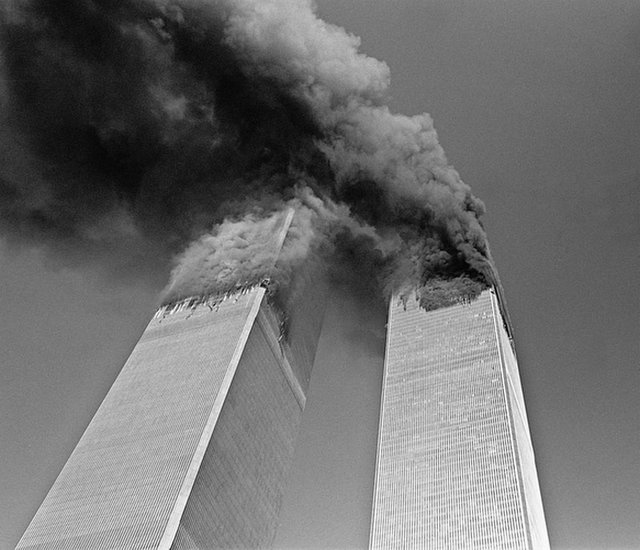 On September 11, 2001, four airliners were hijacked by Islamo-fascist terrorists, and two of them were piloted into the twin towers of the World Trade Center in New York City, killing 2,479 people. Tragedies such as this ofen move people to reflect and ask questions like, “Where is God when bad things happen to good people?” or “What can we learn from a tragedy such as this?”
In Luke 13:4-5, Jesus says, “Or those eighteen on whom the tower of Siloam fell and killed them: do you think that they were worse offenders than all the others who lived in Jerusalem? No, I tell you, but unless you repent, you will all likewise perish.”
What do we learn from a tragedy like the unexpected death of the eighteen in Siloam or the almost 2,500 in New York City? Are we to ask what sins did they commit to deserve such…
View original post 357 more words
Your Life is the Worship of Christ (John 1:1-18)
The Word Became Flesh
In the beginning was the Word, and the Word was with God, and the Word was God. He was in the beginning with God. All things were made through him, and without him was not any thing made that was made. In him was life, and the life was the light of men. The light shines in the darkness, and the darkness has not overcome it.
There was a man sent from God, whose name was John. He came as a witness, to bear witness about the light, that all might believe through him. He was not the light, but came to bear witness about the light.
The true light, which gives light to everyone, was coming into the world. He was in the world, and the world was made through him, yet the world did not know him. He came to his own, and his own people did not receive him. But to all who did receive him, who believed in his name, he gave the right to become children of God, who were born, not of blood nor of the will of the flesh nor of the will of man, but of God.
And the Word became flesh and dwelt among us, and we have seen his glory, glory as of the only Son from the Father, full of grace and truth. (John bore witness about him, and cried out, “This was he of whom I said, ‘He who comes after me ranks before me, because he was before me.’”) For from his fullness we have all received, grace upon grace. For the law was given through Moses; grace and truth came through Jesus Christ. No one has ever seen God; the only God, who is at the Father’s side, he has made him known.
(John 1:1-18 ESV)
Positivity Trumps Pauline Truth

Donald Trump, “Presbyterian” Positive Thinker? (Picture by Thomas Fluharty)
The January 25, 2016 issue of the Weekly Standard profiles “The Religion of Trump: Will evangelicals balk at pulling the lever for him?” In this article, Weekly Standard executive editor Terry Eastman reports that Trump calls himself a Presbyterian, appealing to his family’s long-time association with the Presbyterian Church (U.S.A.). Eastman reveals, however, that Trump personally attends Marble Collegiate Church every Christmas, Easter and “whenever he can.” Marble Collegiate is a congregation of the Dutch Reformed communion known as the Reformed Church in America (RCA).For 52 years, it was pastored by a man who had become a household name during my childhood in the 70’s, Dr. Norman Vincent Peale.
Peale’s claim to fame was his best-selling The Power of Positive Thinking (Prentice Hall Press, 1952; Touchstone, 2003). In 1945, Peale co-founded Guideposts Magazine with his wife Ruth Stafford Peale, a well-known magazine that is still in circulation and online. Fellow RCA minister, the late Dr. Robert H. Schuller, whose services at the Crystal Cathedral (now Christ Cathedral Catholic Church) were televised for decades on The Hour of Power, took the baton from Norman Vincent Peale to build his own ministry-empire on the power of positive thinking. In 1992, Dr. Schuller was interviewed on The White Horse Inn radio show, in which he had what proved to be a revealing and therefore necessarily contentious exchange with Dr. Michael S. Horton, a minister is the conservative Dutch Reformed denomination called the United Reformed Church of North America, on why he preaches positivity like Jesus did, rather than a negative message against sin the way Paul did (read excerpts here).
This positive-thinking distortion to the Reformed Faith is appreciated and affirmed by the infamous “prosperity gospel” televangelists in the Word of Faith movement like Paula White, who, along with a group of fellow televangelists laid hands on Trump, “believing for” success for his campaign. While the prosperity gospel of the Word of Faith movement descends from charismatic faith healer Kenneth Hagin (see A Different Gospel) through Kenneth Copeland to more popular and less obnoxiously money-fixated speakers like Joel Osteen, John Hagee, T.D. Jakes and Joyce Meyer, the Word of Faith movement bears an unmistakable family resemblance to the mainline positive thinking doctrines of Peale and Schuller. I used to watch the love fest between Robert Schuller and Trinity Broadcasting Network founders Paul and Jan Crouch on a regular basis in the late 1980’s.
In those days, Bible believing Christians used to affirm their orthodoxy, or at least their fundamentalism, and disassociate themselves from the American-made heresy of positive thinking with a play on words coined by Adlai Stevenson in 1952 in response to Peale’s criticism of his bid for President (HT: David Stokes): “I find Paul appealing, and Peale appalling!” This slogan calls for a modern re-popularization among Christians, in light of the candidacy of Donald Trump. The problem is that today, so many who consider themselves “Bible believers” are too biblically illiterate and thus uninformed on the false doctrine of positive thinking to know what’s so appalling about Peale and company, much less what’s so appealing about Paul.
What’s so “Appalling About Peale”?

Dr. Norman Vincent Peale (1898-1993). pinterest.com
The positive thinking teachings of Norman Vincent Peale and Robert Schuller, along with the Word of Faith theology of Hagin, Copeland, Jakes, Osteen and Meyer, focus on techniques for attracting success or prosperity to oneself, believing material prosperity to be as much the believer’s right as his spiritual “prosperity” in terms of peace with God by faith in Christ and spiritual growth in grace according to the Word of God with a view to bearing the fruit of the Spirit. Hank Hanegraaff, writing in Christianity in Crisis, characterizes this as “desiring what’s on the Master’s table, rather than the Master Himself.”
In the introduction to The Power of Positive Thinking, Peale points to the successful experimentation in his positive thinking techniques which he demonstrated during his ministry at the church which Trump now occasionally visits:
How can I be so certain that the practice of these principles will produce such results? The answer is simply that for many years in the Marble Collegiate Church in New York City we have taught a system of creative living based on spiritual techniques, carefully noting its operation in the lives of hundreds of people. It is no speculative series of extravagant assertions that I make, for these principles have worked so efficiently for so long a period of time that they are now firmly established as documented and demonstrable truth. The system outlined is a perfected and amazing method of successful living. (Peale, Power of Positive Thinking; Prentice-Hall, Inc., 1952, 1956; N.V.Peale, 1980; Fireside, 2003. Introduction, page xii.)
The closest I come to a thumb-nail sketch of Norman Vincent Peale’s power of positive thinking is drawn by Steven Hein on his website, EQI.org:
1. Picture yourself as succeeding.
2. Whenever a negative thought comes to mind, deliberately voice a positive thought to cancel it out.
3. Do not build up obstacles in your imagination. Instead tear them down by tearing them apart
4. Do not compare yourself to others.
5. Get a competent counselor to help you understand why you do what you do. Learn the origin of your inferiority and self-doubt feelings which often begin in childhood. Self-knowledge leads to a cure.
6. Practice self-affirmations, for example, Yes, I can. or I can do all things through belief in myself [sic]
7. List all the things you have going for you.
It’s not hard to see why billionaire casino tycoon and television personality, Donald Trump, would be attracted to the man-centered techniques of Norman Vincent Peale which view emotional, physical and fiscal success as a sign of spiritual vitality that are the results of pseudo-spiritual practices that amount to self-hypnosis according to some, and New Age occultism according to others.
What’s so “Appealing About Paul”?
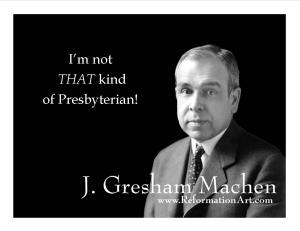
Princeton Seminary New Testament Scholar, Dr. J. Gresham Machen, defrocked by the PCUSA for forming a rival missions board to avoid supporting modernists who denied the fundamentals of the faith.
Contrary to this, the Apostle Paul taught and exemplified a life that majored on contentment regardless of one’s bottom line:
“Not that I am speaking of being in need, for I have learned in whatever situation I am to be content. I know how to be brought low, and I know how to abound. In any and every circumstance, I have learned the secret of facing plenty and hunger, abundance and need. I can do all things through him who strengthens me.” (Philippians 4:11).
The final sentence of this passage of Scripture draws a stark contrast with Peale’s man-centered paraphrase of it in step #6 of his techniques, as described above.
Paul decried those who taught that gain is godly, as do the positive thinking disciples of Peale, and instructed his son in the faith to separate from them:
“If anyone teaches a different doctrine and does not agree with the sound words of our Lord Jesus Christ and the teaching that accords with godliness, he is puffed up with conceit and understands nothing. He has an unhealthy craving for controversy and for quarrels about words, which produce envy, dissension, slander, evil suspicions, and constant friction among people who are depraved in mind and deprived of the truth, imagining that godliness is a means of gain. But godliness with contentment is great gain, for we brought nothing into the world, and we cannot take anything out of the world. But if we have food and clothing, with these we will be content. But those who desire to be rich fall into temptation, into a snare, into many senseless and harmful desires that plunge people into ruin and destruction. For the love of money is a root of all kinds of evils. It is through this craving that some have wandered away from the faith and pierced themselves with many pangs. But as for you, O man of God, flee these things. Pursue righteousness, godliness, faith, love, steadfastness, gentleness.” (1 Timothy 6:3-11)
The appealing doctrine of Paul follows the example of the Lord Jesus Christ, who, as God the Son had every right to hold onto his eternal power and glory he shares with the Father and the Holy Spirit in heaven, yet condescended to give it all up, taking on a human nature to suffer the deprivations of human poverty and suffering, calling his followers to take up their crosses of suffering as well. Paul writes in his great passage on the grace of giving, ““For you know the grace of our Lord Jesus Christ, that though he was rich, yet for your sake he became poor, so that you by his poverty might become rich.” (2 Corinthians 8:9) Paul meant this to be taken in the exclusively spiritual sense of forgiveness of sin and inheriting the Kingdom of God (which is not of this world).
It is not my goal to promote a presidential candidate. It is my goal to teach Christians to be discerning about what is and is not biblical. The modern doctrine of prosperity and positive thinking is not biblical. That’s why the gospel preached by Trump’s church is appalling. The teaching of Paul, our great Christian example, who eschewed prosperity for its own sake in this temporary life to gain an eternal life of reigning with Christ on the right hand of the Father, is much more appealing.
The Great Star Wars Awakening (Spoiler-free)
 I watched Star Wars, Episode VII: The Force Awakens on Saturday of its record-breaking opening weekend. Since late last November, when the first teaser trailer was released, I had been following as many of the details of the production of the film as I could–from the early shots of the animatronic alien creatures to the construction of the Millennium Falcon and Harrison Ford’s injury on the set to the first script read-through by the cast, where the new ensemble of unknown actors took the baton from original trilogy stars Ford, Carrie Fisher and Mark Hamill. This process aroused the Star Wars fanboy in me to the degree of my spending $300 on twelve original Kenner action figures including the very valuable “Blue Snaggletooth” and “Big Head” Han Solo.

Original Kenner Star Wars action figures

George Lucas directs Carrie Fisher and Peter Cushing on the set of Star Wars: A New Hope

Animatronic spacehog on the set of Star Wars: The Force Awakens.
One thing which surprised me about the show was that, despite the many links to the original trilogy scattered throughout the film, I did not find myself overwhelmed with emotion. I’m a sentimental guy, so I was disappointed by this. I don’t fault the film, though, for this may be due more to the fact that I’ve been watching the production very closely all year, so there were fewer surprises for me, other than some of those spoilerific elements of the film which I cannot yet discuss openly. I was happy with the fact that the awkward dialogue and acting so prominent in the prequels was absent in this first installment of the sequel trilogy. Lucasfilm at last has awakened to the fact that George Lucas’s great ideas must be complemented by equally good writing and directing.
I Am the Resurrection and the Life (John 11:17-27)
“Now when Jesus came, he found that Lazarus had already been in the tomb four days. Bethany was near Jerusalem, about two miles off, and many of the Jews had come to Martha and Mary to console them concerning their brother. So when Martha heard that Jesus was coming, she went and met him, but Mary remained seated in the house. Martha said to Jesus, “Lord, if you had been here, my brother would not have died. But even now I know that whatever you ask from God, God will give you.” Jesus said to her, “Your brother will rise again.” Martha said to him, “I know that he will rise again in the resurrection on the last day.” Jesus said to her, “I am the resurrection and the life. Whoever believes in me, though he die, yet shall he live, and everyone who lives and believes in me shall never die. Do you believe this?” She said to him, “Yes, Lord; I believe that you are the Christ, the Son of God, who is coming into the world.””
John 11:17-27 ESV
Pelagianism, Semi-Pelagianism and the Decline of Conciliar Orthodoxy
The term Massilianism is derived from the city of Marseilles, France, where in the early to mid-fifth century, John Cassian first wrote attempting a mediating view between the extremes of the Pelagian denial of original sin and assertion of the primacy of the human will in salvation and the Augustinian priorty of grace in irresistibly regenerating and redeeming the elect. Numerous other writers followed in his efforts for a similar synthesis until the errors were condemned by the second Council of Orange. Centuries later, scholastic theologians would term the system Semi-Pelagianism.
Pneumatomachianism and the Definition of Chalcedon
“The decision of Nicaea related primarily only to the esssential deity of Christ. But in the wider range of the Arian controversies the deity of the Holy Ghost, which stands and falls with the deity of the Son, was indirectly involved. The church always, indeed, connected faith in the Holy Spirit with faith in the Father and the Son, but considered the doctrine concerning the Holy Spirit as only an appendix to the doctrine concerning the Father and the Son, until the logical progress brought it to lay equal emphasis on the deity and personality of the Holy Ghost, and to place him with the Father and Son as an element of equal claim in the Trinity.
“The Arians made the Holy Ghost the first creature of the Son, and as subordinate to the Son as the Son to the Father. The Arian trinity was therefore not a trinity immanent and eternal, but arising in time and in descending grades, consisting of the uncreated God and two created demi-gods. The Semi-Arians here, as elsewhere, approached the orthodox doctrine, but rejected the consubstantiality, and asserted the creation, of the Spirit. Thus especially Macedonius, a moderate Semi-Arian, whom the Arian court-party had driven from the episcopal chair of Constantinople. From him the adherents of the false doctrine concerning the Holy Spirit, were, after 362, called Macedonians; also Pneumatomachi, and Tropici.” (Schaff, Philip; History of the Christian Church, volume 3; 1996, Hendrickson Publishers; pages 663-664.)
A Treatise on the Law and the Gospel
“C. S. Lewis once commented that reading old books was to be preferred to reading new books because old books brought the fresh breeze of the centuries into our minds. They show us truths that might not be prevalent in our own day. The fresh breeze of the centuries comes off the pages of this wonderful reprint of a classic work on covenant theology by nineteenth-century Scottish Presbyterian minister John Colquhoun (1748-1827, ka-hoon).”
Read the rest of John Fesko’s review of this book in Ordained Servant magazine online at http://opc.org/os.html?article_id=196
Obtaining the Blessing (1 Peter 3:8-12)
Finally, all of you, have unity of mind, sympathy, brotherly love, a tender heart, and a humble mind. Do not repay evil for evil or reviling for reviling, but on the contrary, bless, for to this you were called, that you may obtain a blessing. For
“Whoever desires to love life
and see good days,
let him keep his tongue from evil
and his lips from speaking deceit;
let him turn away from evil and do good;
let him seek peace and pursue it.
For the eyes of the Lord are on the righteous,
and his ears are open to their prayer.
But the face of the Lord is against those who do evil.”
(1 Peter 3:8-12 ESV)
The Works Prove the Words (John 10:31-42)
The Jews picked up stones again to stone him. Jesus answered them, “I have shown you many good works from the Father; for which of them are you going to stone me?” The Jews answered him, “It is not for a good work that we are going to stone you but for blasphemy, because you, being a man, make yourself God.” Jesus answered them, “Is it not written in your Law, ‘I said, you are gods’? If he called them gods to whom the word of God came—and Scripture cannot be broken—do you say of him whom the Father consecrated and sent into the world, ‘You are blaspheming,’ because I said, ‘I am the Son of God’? If I am not doing the works of my Father, then do not believe me; but if I do them, even though you do not believe me, believe the works, that you may know and understand that the Father is in me and I am in the Father.” Again they sought to arrest him, but he escaped from their hands.
He went away again across the Jordan to the place where John had been baptizing at first, and there he remained. And many came to him. And they said, “John did no sign, but everything that John said about this man was true.” And many believed in him there.
(John 10:31-42 ESV)


 The Misadventures of Captain Headknowledge
By Grace Through Faith (Galatians 2:15-21)
We ourselves are Jews by birth and not Gentile sinners; yet we know that a person is not justified by works of the law but through faith in Jesus Christ, so we also have believed in Christ Jesus, in order to be justified by faith in Christ and not by works of the law, because by works of the law no one will be justified.
But if, in our endeavor to be justified in Christ, we too were found to be sinners, is Christ then a servant of sin? Certainly not! For if I rebuild what I tore down, I prove myself to be a transgressor. For through the law I died to the law, so that I might live to God. I have been crucified with Christ. It is no longer I who live, but Christ who lives in me. And the life I now live in the flesh I live by faith in the Son of God, who loved me and gave himself for me. I do not nullify the grace of God, for if righteousness were through the law, then Christ died for no purpose.
(Galatians 2:15-21 ESV)
Share this: