John Calvin’s Theology: The Rest of the Story
Those who disagree with the Calvinist view of election and reprobation,
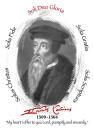
 and object to “Calvinism,” per se, usually seem to not realize just how much more there is to Calvinism than his systematization of the Augustinian (i.e., from the 4th century) doctrine of grace versus the Pelagian notion of free will (which comes complete with its own false gospel of works-righteousness). Baptists in particular, who deny the “doctrines of grace,” don’t realize just how much leftover Calvinism there is in their current theology. Those that do, recognize that they are technically categorized as “moderate Calvinists.” Chief among these is what is nowadays called “eternal security.”
Also, there’s the doctrine of original sin, the Biblical doctrine that Adam’s guilt was imputed to all of his descendants, which sinful condition manifests itself in outward sinful acts. Most Baptists today affirm original sin, and they do so because the Baptists who migrated to America were originally Calvinists. Those “General Baptists,” whom modern anti-Calvinistic Baptists sometimes erroneously look back to as their forefathers in the faith, collectively fell away from the faith, and their theological descendants can be found today among modern Unitarianism.
As a proof for this claim, consider the following words from the Wikipedia entry on the General Baptists, to which I linked above: ” . . . traditionally non-creedal, many General Baptist congregations were becoming increasingly liberal in their doctrine, obliging the more orthodox and the more evangelical among them to reconsider their allegiance during this period of revival (Edward’s, Whitefield’s and Wesley’s 18th century First Great Awakening). Before this re-organisation, the English General Baptists had begun to decline numerically due to several factors linked to non-orthodox ‘Free Christianity’. Early Quaker converts were drawn from the General Baptists, and many other churches moved into Unitarianism. . . “
Those General Baptists denied original sin. For example, John Smyth, (first to pastor a church called “Baptist” shortly before he cast his lot with the Mennonites) wrote in his Confession of Faith in 1609 that, “there is no original sin (lit;, no sin of origin or descent), but all sin is actual and voluntary, viz., a word, a deed, or a design against the law of God; and therefore, infants are without sin.” Modern anti-Calvinistic Baptists generally (no pun intended) affirm original sin, and this is because the Baptists from which you descend were originally Calvinists.
Eternal security and original sin managed to stick around because they weren’t offensive enough to undermine the outward results of mass evangelism, the way the doctrines of grace seem to. We have “revivalism” to thank for that. Read Revival and Revivalism: The Making And Marring of American Evangelicalism, by Iain Murry of Banner of Truth Trust, and you’ll learn how the TULIP got plucked in the wake of the Second Great Awakening as otherwise orthodox Christians began to adopt the methods of arch-Pelagian Charles Finney’s “new measures” in order to maximize the effectiveness of their ginned-up revivals.
But enough introduction. What I wanted to point out was just how pervasive Calvinist theology defines modern Baptist and otherwise Evangelical theology. In my last post, I linked to an essay written by B. B. Warfield entitled “Calvin As A Theologian.” This essay was written to set the record straight about all the common misconceptions that have been fabricated by anti-Calvinists in order to not only disagree with the “five points of Calvinism” (aka, TULIP, the doctrines of grace, etc.) but make those under their spiritual care despise Calvin himself and just about everything he stood for. Read Warfield’s introductory remarks, and then go read the entire article:
I am afraid I shall have to ask you at the outset to disabuse your minds of a very common impression, namely, that Calvin’s chief characteristics as a theologian were on the one hand, audacity—perhaps I might even say effrontery—of speculation; and on the other hand, pitilessness of logical development, cold and heartless scholasticism. We have been told, for example, that he reasons on the attributes of God precisely as he would reason on the properties of a triangle. No misconception could be more gross. The speculative theologian of the Reformation was Zwingli, not Calvin. The scholastic theologian among the early Reformers was Peter Martyr, not Calvin. This was thoroughly understood by their contemporaries.
Among the things that we have inherited from Calvinist theology include the following (as Warfield reports):
-
“In one word, he [Calvin] was distinctly a Biblical theologian, or, let us say it frankly, by way of eminence the Biblical theologian of his age. Whither the Bible took him, thither he went; where scriptural declarations failed him, there he stopped short.”
-
“Calvin marked an epoch in the history of the doctrine of the Trinity, but of all great theologians who have occupied themselves with this soaring topic, none has been more determined than he not to lose himself in the intellectual subtleties to which it invites the inquiring mind; and he marked an epoch i the development of the doctrine precisely because his interest in it was vital (that means “spiritual,” or “devout”) and not merely or mainly speculative.”
-
“The fundamental interest of Calvin as a theologian lay, it is clear, in the region broadly designated soteriological. Perhaps we may go further and add that, within this broad field, his interest was most intense in the application to the sinful soul of the salvation wrought out by Christ, — in a word, in what is technically known as the ordo salutis. . . Its [Calvin’s Institutes]effect, at all events, has been to constitute Calvin pre-eminently the theologian of the Holy Spirit.”
-
“He also marks an epoch in the mode of presenting the work of Christ. The presentation of Christ’s work under the rubrics of the three-fold office of Prophet, Priest and King was introduced by him: and from him it was taken over by the entirety of Christendom, not always, it is true, in his spirit or with his completeness of development, but yet with large advantage.”
-
“In Christian ethics, too, his impulse proved epoch-making, and this great science was for a generation cultivated only by his followers.”
-
“It is probable, however, that Calvin’s greatest contribution to theological science lies in the rich development which he gives–and which he was the first to give–to the doctrine of the work of the Holy Spirit. “
-
Finally, here’s Warfield’s summary of Calvin as a theologian: “It has been common (among academic theologians, not pastors and laity who love to hate Calvin) to say that Calvin’s entire theological work may be summed up in this–that he emancipated the soul from the tyranny of human authority and delivered it from the uncertainties of human intermediation in religious things: that he brought the soul into the immediate presence of God and cast it for its spiritual health upon the free grace of God alone.”
-
And of Calvin’s masterpiece, The Institutes of the Christian Religion, Warfield summarizes: “The Institutes is, accordingly, just a treatise on the work of God the Holy Spirit in making God savingly known to sinful man, and bringing sinful man into holy communion with God.”
Far from being some cold, depressing, rigidly logical and academic murderer (we mustn’t forget Servetus!), Calvin was recognized by his peers and his entire generation as an eminently devout and spiritual biblicist whose development of Protestant theology built on the shoulders of Augustine, Anselm, Hus, Bradwardine, Wycliffe, and Luther and helped make Western Civilization what it became in its historical greatness. All by the grace of God, and for his glory alone!
Reformed Theology Coming to an SBC Church Near You!
On January 11, 2008, the Baptist Press posted a report by Michael Chute, entitled, 
-
“. . . ten percent of Southern Baptist pastors (currently) identify themselves as Calvinists.”
-
“. . . 29 percent of recent SBC seminary graduates espoused Calvinist doctrine.”
-
“. . . a minority of SBC churches are led by Calvinist-leaning pastors, but the number is increasing”
-
“. . . Calvinist-led churches are generally smaller in worship attendance and baptisms than non-Calvinist churches.”
-
“. . . baptism rates between Calvinist and non-Calvinist led churches are virtually identical.”
-
“. . . Calvinistic recent graduates report that they conduct personal evangelism at a slightly higher rate than their non-Calvinistic peers.”
-
A PDF file of the full report is posted here.
Also of interest in the report, Chute quoted Hal Poe, Charles Colson Professor of Faith and Culture at Union University in Jackson, Tennessee, who paints a picture for us of the recent historical trends within the SBC which have led to the current circumstances. “In a broad sense, it’s happening on Christian college campuses too, as Calvinism appeals to young people who are wanting a more intellectual approach to Christianity . . . . Southern Baptists neglected serious Christian education from the early 1960’s, and that’s when all the trouble started. From discipleship training we went to the amorphous youth groups, whose only real good was to keep kids happy until they graduated from high school and graduated from church. Now, you have a generation [of college students] who have come along and want something deeper and they have latched onto Calvinism.”
Poe goes on to site “John Piper, a Reformed Baptist theologian, preacher and author who currently serves as pastor for preaching and vision of Bethlehem Baptist Church in Minneapolis. . . . He’s effective because he’s so passionate. . . He holds huge, stadium-type events that are rip-roaring. There’s nobody else doing anything like this so he becomes [Calvinism’s] expositor. But John Piper’s version of Calvinism is not something John Calvin would espouse, or even that Charles Spurgeon [British reformed Baptist preacher] would espouse.”
It is true that Piper is cut from a different cloth from the great Reformer and the nineteenth-century Puritan “Prince of Preachers.” First of all, it must be noted that Piper is not a Southern Baptist, but a member of the Northern Baptist Convention (Bethlehem Baptist member and Reformed Baptist blogger, Bob Hayton, at Fundamentally Reformed, can correct me on that detail if I’m wrong), where he has been a leader in that denomination’s struggle with the modern heresy known as Open Theism. From my reading of his sermons, Piper may be categorized as a “charismatic Calvinist,” which is more of a doctrinal position than a weekly exhibition of extreme emotionalism in worship, or attempts at exercising the miraculous spiritual gifts of tongues, healing, prophecy, etc., images usually evoked by the term charismatic–though the appeal to emotion seems to be greater in his preaching than in typical Reformed preaching. His experiential emphasis on “desiring God” is in part an application of the answer to the first question in the Westminster Shorter Catechism, which states, “Man’s chief end is to glorify God and enjoy him forever.” But this seems to be little more than a perhaps pietistic reaction against the reputed cold-orthodoxy of many Reformed worship practices.
Another way Calvin would disagree with Piper is in his application of Baptistic principles to Reformed theology, of which, of course, Spurgeon is also guilty. But in this, Piper and Spurgeon are informed by the historic early Baptist confession of faith commonly known as the Second London Baptist Confession of Faith of 1689, which is in large part, a condensing of the Presbyterian Westminster Confession of Faith, with revisions on the statements regarding Baptism. On the other hand, Piper also is embracing the abberant postmodern “emerging” churches–at least the one’s that at least maintain Reformed theology, while seemingly applying seeker-sensitive pragmatic retooling of worship styles to appeal to an “emerging church” demographic. Thus, Piper’s twenty-first century expression of Calvinism does seem to differ from that of Calvin and Spurgeon; however, this Reformed blogger is grateful that such a figure has been able to influence so many Southern Baptists for the doctrines of grace, the biblical emphasis on the sovereignty of God, and his supremacy in all things, including the secular, sacred and even sinful activity of all men.
Audio of Adrian and Dr. Tolar!
May I introduce to you our fascinating tour guide, Adrian?

This interesting little British guy was brought to Israel as a child by his devout, Jewish parents. He works primarily for the Israeli national parks service around the Dead Sea area, but also teaches English as a second language to his fellow Israeli citizens in addition to his brilliant career as a tour guide for eager American evangelicals like myself. He can speak Hebrew, Arabic, and Spanish in addition to his native tongue, the Queen’s English.
I have posted a few recordings of Adrian’s fascinating presentations on the bus and at various sites around Israel on my Box.net account, which can be accessed here, or in the future, from my CHK Multimedia page, on which you can click the “Audio for Mind and Heart” link and listen to the files posted December 12, 2007. Adrian’s talks include info regarding all sides of all issues (as much as he’s aware, anyway, which is quite a bit!), historical, geographical, economic, religious (often representing Christian, Jewish and Muslim views).
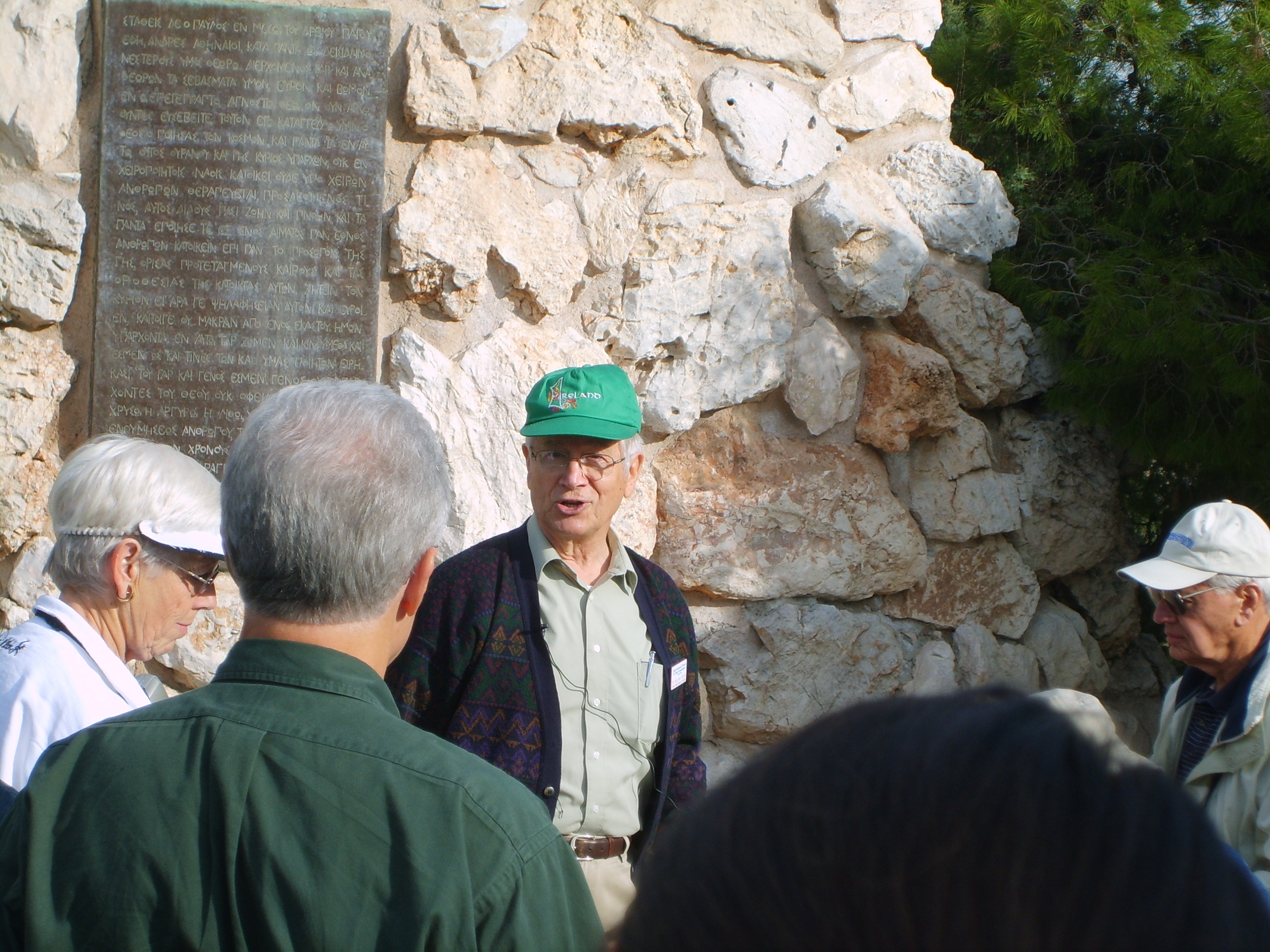
Some of the audio files also include recordings of Dr. William Tolar (more on his credentials later), interspersed throughout. He is equally interesting, considering he is a retired professor of Biblical Backgrounds from Southwestern Baptist Theological Seminary. In the image above, Dr. Tolar is standing at the foot of the Areopagus in Greece, the site where Paul preached the famous sermon about the “Unknown God” of the Athenians (Acts 17:16-34). The Greek text of Paul’s sermon is inscribed on the plaque over Dr. Tolar’s shoulder.
Dr. William Tolar at Corinth part 1
I took this video at the Ancient Corinth Archaeological Site and Museum, the ruins of the New Testament city of Corinth. Dr. Tolar was lecturing on passages relevant to the city. Unfortunately, I didn’t get the entire lecture, but at least you can get a taste of what our group was treated to. Later I’ll post more on Dr. Tolar so you can get to know him better.
There are a couple of other good videos featuring more of the Ancient Corinth Archeological Site at AncientCorinth.net.
Sean Michael Lucas’ Reformation Sunday Sermon Posted!

Go to the “Sermons” page at the website for New St. Peter’s Presbyterian Church to listen to Dr. Sean Michael Lucas, professor of Church History at Covenant Theological Seminary, preach on “The Heart of the Reformation: The Glory of God,” from the text Isaiah 6: 1-7.
Is Reformed Important? Saturday Night Outline
At long last, now that the Sean Michael Lucas conference is a week’s worth of history, here’s the outline he allowed me to publish from his presentation.
Why bother being Reformed as a way of being Christian?
- It is not possible to live a “generic” Christian life
- Historically not possible
- Logically not possible
- The Christian life must be embodied through a particular identity
- Even “Bible churches” communicate a particular identity (beliefs, practices, stories)
- Genuine conversations with others must be rooted in a real sense of knowing who we are.
During this portion of the outline, Dr. Lucas gave the example of the Cane Ridge Revival, explaining how Barton Stone desired to reduce his denominational identity to “Christian.” Out of this revival emerged the Christian denomination (Disciples of Christ), Cumberland Presbyterianism, and others I forgot before I could jot them down. Now back to the outline . . .
- The question becomes, then,
- Which beliefs and practices are most biblical?
- And which communion most closely holds to those beliefs and engages in those practices?
- In the end, the reason it is important to be Reformed (and specifically, Presbyterian) is
- Because Presbyterian beliefs and practices are the closest to the biblical material, and,
- Because they provide the most workable identity for engaging life in this postmodern world.
Presbyterian beliefs
- God is King (the sovereignty of God)
- The Priority of Grace (in salvation, sanctification, consummation)
- God’s story, promises, and reign (covenant and kingdom)
- The nature of the Church (visible/invisible)
- The nature of the sacraments (baptism and Supper)
Presbyterian practices
- Piety
- Centering on worship [corporate, family, and private], stewardship, and service
- Worship
- Centering on its biblical, covenantal, and gospel-driven nature
- Polity
- Centering on a proper balance of church authority and liberty of conscience
Presbyterian stories
- These beliefs and practices make sense to us, in part, because of the stories (positive and negative) that we tell:
- Calvin, Knox and the Westminster divines
- Scots and Scots-Irish Presbyterianism
- Early American Presbyterianism
- 19th Century Presbyterianism
- 20th Century Presbyterianism
- North (PCUSA, OPC, BP, EP, RPCES)
- South (PCUS, PCA)
- Identity
- It is out of this particularly Presbyterian way of speaking the Gospel that we must speak.
- Catholicity
- In order to confess “one holy catholic church,” we must desire relationship and even partnership with other Christians.
- Our relationships with other Christians must be guided by the Gospel and must serve the Gospel.
- Humility
- The most productive partnerships come from recognizing the importance of others in imaging forth the Kingdom of God (Romans 1:11-12).
Check back periodically . . . I’ll post Dr. Lucas’ Reformation Sunday Sermon link when the church posts it.
Martin Luther, or Martin Luther King?

 Every October when I start warming up for the coming of Reformation Day, I start telling friends around me about Martin Luther. I am becoming troubled, however, that the more I talk about him with more and more people, more and more people are not thinking of the German monk who posted his 95 Theses on the Castle Church in Wittenberg, Germany, but when I say the name “Martin Luther,” they hear, “Martin Luther King”! This ought not to be so!

In the interest of raising awareness about the difference between Martin Luther and Martin Luther King, I have written the following quiz. Each question will describe something about one or the other figure, and it is your job to pick the right answer, either A) Martin Luther, B) Martin Luther King, or C) Both. Post your answers, and any comments you may have, in the comments section.
Have fun, and Happy Reformation Day!
1. Which is African-American?
2. Which is German?
3. Which belonged to a religious order that was named after an African theologian?
4. Which delivered his “I have a dream” speech?
5. Which delivered his “Here I stand” speech?
6. Which was born in the 20th Century?
7. Which was born in the 16th Century?
8. Which advocated religious reform?
9. Which advocated civil rights for African-Americans?
10. Which was assassinated?
11. Which was kidnapped?
12. Which authored “Bondage of the Will”?
13. Which likely had ancestors who were literally in bondage?
14. Which translated the New Testament into German?
15. Which was a Baptist?
16. Which founded the Lutheran denomination?
17. The birthday of which can get you a day off work?
18. Which advocated non-violent resistance?
Is Reformed Important? Friday Night Outline
Dr. Sean Michael Lucas
New St. Peters PC, Dallas, TX
October 26-27, 2007
Who Are You?: Understanding Identity
When you think about who you are, what comes to mind?
- Son, upper middle class, suburbs, two parents married 38 years, one sister
- Moved many times, mainly up an ddown the I-95 corridor between Washingong DC, and NYC.
- Husband, married nearly 14 years, four children
- Became a believer when a teenager–unusual religious journey
- Pastor with scholarly bent; historian with a pastor heart
- Writer and reader–love Mark Twain and Wendell Barry
- Gardner
- Avid sports fan–Indiana sports teams
- Springsteen, U2, country music
- Trucks, Fords, but when I follow NAsCAR, I am a Gordon fan.
Three Key Aspects to identify.
Belierfs
- the core understandings that form and motivate what and how I practice; they are also reinforced by these practices and by my stories.
Practice
- The regular activities that I engage in shape my understanding of myself and the world.
Stories
- narratives that help to make sense of what I believe and what I do.
“Identity Crisis”
- When someone is having an “identity crisis,” he/she has become disillusioned or is experiencing dissonance within her core.
- Perhaps produced through a lengthy questionaing of previously held beliefs.
- Perhaps caused through an interruption of key practices that reinforced identity.
- Perhaps result of a disillusionment with the master story
- A version of this identity crisis would be the “mid-life crisis.”
Identity Formation in “Modernity” and “Post-Modernity”
Pre- and Early Modernity
- Social relations and family connections
- Trade generally passed on through generatons.
- Church connections more by birth than over belief.
- Identity fairly stric==pre-determined by others and before birth.
Late and Post-Modernity
- Social mobility, loss of extended and nuclear family.
- Trades determined through interest,
- Church connections determined by belief less than birt; challenge to lay on any type of denominationalism
- Identity radically dynamic-self-created through choices
Forging Christian identity
The transition from “non-religious” [non-Christian] to “religious” (Christian] identity.
- New Beliefs–from Idolatry to faith in Father, Sond, Spirit (1 Thessalonians 1:9)
- New Practices–from non-observent to observant (Ephesians 4:17-24)
- New Stories—from “self-determined” to divinely determined within the story of Israel and the Church as found in the Bible.
- The forging of Christian Identity is varied and common
- Varied:
- No two transitions are exactly the same
- No two experiences of sin, grace, faith, repentance are exactly the same
- Common:
- The need experience by all human beings is the same
- The Gospel embraced by all believers is the same
- The grace granted to believers is the same
- Varied:
- The means for forging Christian identity (Acts 2:42-47)
- Word
- Sacraments
- Prayer
- Fellowship
Tomorrow, I’ll post Saturday night’s outline.
Is Reformed Important?
 A friend of mine (actually, my old boss), is a member of New St. Peter’s (NsP)
  Presbyterian Church in Dallas, Texas. Over this past “Reformation Weekend,” as I call it, NsP hosted a conference by Dr. Sean Michael Lucas of Covenant Theological Seminary in St. Louis, Missouri. The topic of the conference, “Is Reformed Important?” was a Power Point presentation summarizing the material from Dr. Lucas’ book, On Being Presbyterian, which I have not read. I found the conference very interesting, for his approach does not start with a defense of all of the Reformed and Presbyterian controversial, distinctive doctrines. The approach Dr. Lucas took was to deal with what it means to be Presbyterian as a facet of one’s personal identity. In this I think he’s attempting to appeal to, or at least converse with a postmodern worldview, which seems, by and large, skeptical of evangelical theologizing.
The sum of the conference was that a person’s identity is the result of one’s beliefs, practices and stories (bps), which colors his perspective on life, the universe and everything (to borrow from the British theologian, Douglas Adams). Therefore, the basic outline of “Is Reformed Important?” is a look at the beliefs, practices and stories of confessional, Reformed Presbyterianism in particular, rather than merely Reformed in general.One benefit of the format of the two day conference, followed by a Reformation Sunday sermon at NsP (which I did not attend, but the link to which I’ll post if and when it becomes available) lies in the fact that the first night really helps a non-Reformed, non-Presbyterian (like my beloved wife) not have to immediately endure all the stuff he disagrees with, but gently points out that one’s beliefs andpractices are worth taking a critical look at. Dr. Lucas did this by sharing much of his own bps in a rather disarming manner. This is definitely user-friendly material, not fodder for theology geeks, but down-to-earth and practical stuff.
At one point during the second lecture, Dr. Lucas brought up the prospect of what he’d do were he to notice that someone had published a book with the same title as his, On Being Presbyterian, yet noticed that the table of contents seems an awful lot like the one in his own work, and not only that, but that the other author happens to mention that he comes from the same hometown as Dr. Lucas. He said the first thing he’d probably do is punch the guy in the nose. This compelled me to approach him after the lecture to request permission to post his outline on my blog, which permission, Christian man that he is, he graciously granted. Thus, in my next post, I’ll give you Lecture Number One of “Is Reformed Important?”
Hope you all had a pleasant Reformation Sunday!
Reformata Semper Reformanda (”Reformed, Always Reforming”)
update
I just took a look at http://www.newstpeters.org/ and noticed that they give their members something called “Rooster Tracks” which provides short, weekday theological and devotional items to think through and/or study. The one for this week, naturally, introduces us to the Reformers and asks its readers to think through a topic related to the contribution of each individual Reformer which is treated, namely, Luther, Melancthon, Zwingli, Calvin, and Knox.
Letting Horton Out Of The Stable
The following notice was posted on the “News & Events” page at the website for the White Horse Inn radio show–mark your calendars, and set your DVR’s, VCR’s, DVD Recorders, or whatever technology you may have nowadays . . .
Dr. Horton to Appear on CBS’s 60 Minutes
Currently scheduled for Sunday, Oct 14th, the interview will focus on the teaching and ministry of popular televangelist Joel Osteen, author of Your Best Life Now. 60 Minutes airs on CBS Sundays at 7 p.m. ET/PT (check your local listings).
A Life Remembered
from the Haven Today Program Archives for Wednesday, September 12, 2007:
He was all about truth. And the number one truth was God’s grace and that led the late D. James Kennedy to found Evangelism Explosion, a program that taught others how to share their faith in Christ alone. On the day before his memorial service, don’t miss the next HAVEN Today with Charles Morris and a program called “A Life Remembered”.
Also, don’t miss the Live Webcast of Dr. Kennedy’s funeral which will take place at 1pm Eastern, 12pm Central.
Update
Christianity Today has posted an article on the ministry and impact of Dr. D. James Kennedy, including links to many sites around the web regarding his life and his death.
Augustine on the Decrees of God: Roman or Reformed?
 I had to look up what the Roman Catholics claim about Augustine’s views on the sovereign grace of God, and I was surprised by what I found. But not entirely. One, “Albert,” posted the first comment to Bob Hayton’s Fundamentally Reformed post, “Legacy of Sovereign Joy: Augustine,” reviewing John Piper’s book, Legacy of Sovereign Joy, focusing on Piper’s reflections of Augustine, and Albert asked Bob if he was aware of what Augustine believed about grace and free will, and asserted that what he did believe was consistent with present, official Roman Catholic teaching. That’s why I wanted to see what the online Roman Catholic encyclopedia, New Advent, had to say about the matter. The entry entitled, “Teaching of St. Augustine of Hippo,” section II on “His System of Grace,” got into some interesting reading about some details regarding free will which differs from the traditional Reformed view, but what really astounded me was what the online encyclopedia reports was Augustine’s view of how God determined his decrees regarding election and reprobation:
Here is how the theory of St. Augustine, already explained, forces us to conceive of the Divine decree: Before all decision to create the world, the infinite knowledge of God presents to Him all the graces, and different series of graces, which He can prepare for each soul, along with the consent or refusal which would follow in each circumstance, and that in millions and millions of possible combinations. Thus He sees that if Peter had received such another grace, he would not have been converted; and if on the contrary such another Divine appeal had been heard in the heart of Judas, he would have done penance and been saved. Thus, for each man in particular there are in the thought of God, limitless possible histories, some histories of virtue and salvation, others of crime and damnation; and God will be free in choosing such a world, such a series of graces, and in determining the future history and final destiny of each soul. And this is precisely what He does when, among all possible worlds, by an absolutely free act, He decides to realize the actual world with all the circumstances of its historic evolutions, with all the graces which in fact have been and will be distributed until the end of the world, and consequently with all the elect and all the reprobate who God foresaw would be in it if de facto He created it.
If Augustine taught this imaginitive concept of God’s determinate counsel, then he would have gone beyond what is written in order to come up with it. This reminds me of an anecdote of Augustine which is intended to warn of the danger of attempting to explain that which is not revealed in Scripture about spiritual realities, in which someone asks Augustine, “What was God doing before he created the world?” to which Augustine replied, “Creating Hell for the curious.” I think, if Augustine taught what is contained in the paragraph cited above, then he failed to heed his own anecdotal warning. Another thing I found interesting about the presence of this concept in Augustine’s thought is the fact that the first time I’d ever heard of such a concept, it came from someone near and dear to me, who was taking exception to the Reformed view of God’s decrees of election and reprobation, claiming that this divine consideration of all possible realities and settling on the ones that come to pass, leaving folks free (in the sense Adam was) to choose between good and evil as effectually influenced by the particular circumstances and graces God places in the individual’s path, was the more biblical view.
In my opinion, this extra-biblical view is just a more elaborate form of the prescient view of foreknowledge, about which, long before I’d become a Calvinist, when thinking it through, I concluded that in this semi-pelagian system, God was leaving man free to determine his own election, but having looked forward from before the creation in order to ordain it before man made his free choice, thereby cutting man off at the pass for the glory. You could probably say I persuaded myself in favor of Calvinism when I came to that conclusion, but it would be a couple of more years before God would force me to deal with the issues once and for all.
But the final observation I want to make about Augustine’s view of grace and free will, election and reprobation, is that I don’t think the Reformers needed to adopt exactly what Augustine speculated about the doctrine, because, after all, the Reformers were in the business of double checking writers like Augustine with the Scriptures, practicing that more noble virtue of searching the Scriptures to see whether what he taught was so. The Reformation may not have been a pure Augustinian revival, but the Reformers certianly did stand on the shoulders of this theological giant from Africa, Augustine of Hippo.
D. James Kennedy Dies
FT. LAUDERDALE, Sept. 5 – Dr. D. James Kennedy, founder and senior pastor for 48 years of Coral Ridge Presbyterian Church (CRPC) in Fort Lauderdale, Fla., passed away peacefully in his sleep at approximately 2:15 a.m. at his home with his wife and daughter by his bedside, following complications from a cardiac event last December. He was 76. Dates and times for a public viewing and funeral and private interment will be released when available. “There are all kinds of wonderful things I could say about my dad,” said daughter Jennifer Kennedy Cassidy. “But one that stands out is his fine example. He ‘walked the walk’ and ‘practiced what he preached.’ His work for Christ is lasting – it will go on and on and make a difference for eternity.”
Dr. Kennedy, who is survived by Anne, his wife of 51 years, and his daughter Jennifer (Kennedy) Cassidy, preached his last sermon from the pulpit of Coral Ridge Presbyterian Church on Christmas Eve Sunday 2006. He suffered a cardiac arrest four days later on Dec. 28, and has since been unable to return to the pulpit. The church announced his retirement on Aug. 26, beginning a process to choose his successor, and had planned a tribute worship service honoring the extensive ministry of Dr. Kennedy on Sept. 23.
“I would like to thank all of you for your prayers, cards, kindnesses and encouragement over the past nine months,” Mrs. Cassidy said during the retirement announcement. “Our family knows that we have come through this difficult time because of God’s grace and your faithful prayers, and it has brought joy to us to see God’s faithfulness in all of this.”
While hindered by persistent health problems that included asthma, as well as chronic and often severe physical pain from compressed vertebrae due to an injury suffered as a young man, Dr. Kennedy was indefatigable in his ministry work. He said on several occasions how much he looked forward to being free from pain in heaven. He was one of the nation’s leading Christian broadcasters and a vigorous and articulate advocate for Christian involvement in public life.
Regardless of one’s opinion of the amount of politics that comprised Dr. Kennedy’s preaching ministry, we should be grateful for his leadership in lending credibility to the idea that Calvinists can be great evangelists, in his writing Evangelism Explosion, currently used by probably more denominations than any other method of evangelism, from what I’ve heard, anyway. I’m glad they’re continuing to air the broadcasts of the church services–I love the music at the beginning and do appreciate some of the informative programs on current events and issues political and religious.
Roman Truths
Before I elaborate on my “Roman Truths,” please allow me to defend myself with the following quote of Martin Luther on the Book of Romans cited by Dr. Tom Browning on page 3 in the introduction to his series of lessons on “The Pinnacle of Christian Doctrine.”
Browning writes that Luther writes:
This epistle is really the chief part of the New Testament, and is truly the purest gospel. It is worthy not only that every Christian should know it word for word, by heart, but also that he should occupy himself with it every day, as the daily bread of the soul. We can never read it or ponder over it too much; for the more we deal with it, the more precious it becomes and the better it tastes (Martin Luther, Lutherʹs works, vol. 35: Word and Sacrament I edited by J. J. Pelikan, H. C. Oswald & H. T. Lehmann (Fortress Press: Philadelphia, 1960; reprinted 1999), 365).
So, in my own defense, last night I was pondering the precious and delicious letter of Paul to the Romans. In my much pondering of this book, I often attempt to come up with an original outline of the book which will the reader or Bible student remember the broad themes of this revolutionary, reforming and reviving book of Romans. I can’t help it if it came out like this!
Roman Truths
1. The Bad News (Romans 1:1–3:20)
2. The Good News (Romans 3:21-8)
3. Good News and the Jews (Romans 9-11)
4. The Good News Wearing Shoes (Romans 12-16)
Somebody help me! I’m losing control of my homiletics!!!


 The Misadventures of Captain Headknowledge
Righteousness Apart From Law
The Righteousness From God Apart From Law
John Calvin’s Commentary on Romans 3:21-22
21. But now without the law, etc. It is not certain for what distinct reason he calls that the righteousness of God, which we obtain by faith; whether it be, because it can alone stand before God, or because the Lord in his mercy confers it on us. As both interpretations are suitable, we contend for neither. This righteousness then, which God communicates to man, and accepts alone, and owns as righteousness, has been revealed, he says, without the law, that is without the aid of the law; and the law is to be understood as meaning works; for it is not proper to refer this to its teaching, which he immediately adduces as bearing witness to the gratuitous righteousness of faith. Some confine it to ceremonies; but this view I shall presently show to be unsound and frigid. We ought then to know, that the merits of works are excluded. We also see that he blends not works with the mercy of God; but having taken away and wholly removed all confidence in works, he sets up mercy alone.
It is not unknown to me, that Augustine gives a different explanation; for he thinks that the righteousness of God is the grace of regeneration; and this grace he allows to be free, because God renews us, when unworthy, by his Spirit; and from this he excludes the works of the law, that is, those works, by which men of themselves endeavor, without renovation, to render God indebted to them. (Deum promereri — to oblige God.) I also well know, that some new speculators proudly adduce this sentiment, as though it were at this day revealed to them. But that the Apostle includes all works without exception, even those which the Lord produces in his own people, is evident from the context.
For no doubt Abraham was regenerated and led by the Spirit of God at the time when he denied that he was justified by works. Hence he excluded from man’s justification not only works morally good, as they commonly call them, and such as are done by the impulse of nature, but also all those which even the faithful can perform. Professor Hodge very justly observes, “It never was the doctrine of the Reformation, or of the Lutheran and Calvinistic divines, that the imputation of righteousness affected the moral character of those concerned. It is true,” he adds, “whom God justifies he also sanctifies; but justification is not sanctification, and the imputation of righteousness is not the infusion of righteousness.” — Ed. Again, since this is a definition of the righteousness of faith, “Blessed are they whose iniquities are forgiven,” there is no question to be made about this or that kind of work; but the merit of works being abolished, the remission of sins alone is set down as the cause of righteousness.
They think that these two things well agree, — that man is justified by faith through the grace of Christ, — and that he is yet justified by the works, which proceed from spiritual regeneration; for God gratuitously renews us, and we also receive his gift by faith. But Paul takes up a very different principle, — that the consciences of men will never be tranquillized until they recumb on the mercy of God alone. “The foundation of your trust before God, must be either your own righteousness out and out, or the righteousness of Christ out and out. … If you are to lean upon your own merit, lean upon it wholly — if you are to lean upon Christ, lean upon him wholly. The two will not amalgamate together, and it is the attempt to do so, which keeps many a weary and heavy-laden inquirer at a distance from rest, and at a distance from the truth of the gospel. Maintain a clear and consistent posture. Stand not before God with one foot upon a rock and the other upon a treacherous quicksand…We call upon you not to lean so much as the weight of one grain or scruple of your confidence upon your own doings — to leave this ground entirely, and to come over entirely to the ground of a Redeemer’s blood and a Redeemer’s righteousness.” — Dr. Chalmers Hence, in another place, after having taught us that God is in Christ justifying men, he expresses the manner, — “by not imputing to them their sins.” In like manner, in his Epistle to the Galatians, he puts the law in opposition to faith with regard to justification; for the law promises life to those who do what it commands, (Galatians 3:12) and it requires not only the outward performance of works, but also sincere love to God. It hence follows, that in the righteousness of faith, no merit of works is allowed. It then appears evident, that it is but a frivolous sophistry to say, that we are justified in Christ, because we are renewed by the Spirit, inasmuch as we are the members of Christ, — that we are justified by faith, because we are united by faith to the body of Christ, — that we are justified freely, because God finds nothing in us but sin.
But we are in Christ because we are out of ourselves; and justified by faith, because we must recumb on the mercy of God alone, and on his gratuitous promises; and freely, because God reconciles us to himself by burying our sins. Nor can this indeed be confined to the commencement of justification, as they dream; for this definition — “Blessed are they whose iniquities are forgiven” — was applicable to David, after he had long exercised himself in the service of God; and Abraham, thirty years after his call, though a remarkable example of holiness, had yet no works for which he could glory before God, and hence his faith in the promise was imputed to him for righteousness; and when Paul teaches us that God justifies men by not imputing their sins, he quotes a passage, which is daily repeated in the Church. Still more, the conscience, by which we are disturbed on the score of works, performs its office, not for one day only, but continues to do so through life. It hence follows that we cannot remain, even to death, in a justified state, except we look to Christ only, in whom God has adopted us, and regards us now as accepted. Hence also is their sophistry confuted, who falsely accuse us of asserting, that according to Scripture we are justified by faith only, while the exclusive word only, is nowhere to be found in Scripture. But if justification depends not either on the law, or on ourselves, why should it not be ascribed to mercy alone? and if it be from mercy only, it is then by faith only.
The particle now may be taken adversatively, and not with reference to time; as we often use now for but. “The words but now may be regarded merely as marking the transition from one paragraph to another, or as a designation of tense; now, i.e., under the gospel dispensation. In favor of this view is the phrase, “to declare at this time his righteousness (Romans 3:26) .” — Hodge But if you prefer to regard it as an adverb of time, I willingly admit it, so that there may be no room to suspect an evasion; yet the abrogation of ceremonies alone is not to be understood; for it was only the design of the Apostle to illustrate by a comparison the grace by which we excel the fathers. Then the meaning is, that by the preaching of the gospel, after the appearance of Christ in the flesh, the righteousness of faith was revealed. It does not, however, hence follow, that it was hid before the coming of Christ; for a twofold manifestation is to be here noticed: the first in the Old Testament, which was by the word and sacraments; the other in the New, which contains the completion of ceremonies and promises, as exhibited in Christ himself: and we may add, that by the gospel it has received a fuller brightness.
Being proved [or approved] by the testimony, “Testimonio comprobata,” etc., so Beza and Pareus render μαρτυρουμένη; “Being attested,” Doddridge; “Being testified,” Macknight Schleusner gives a paraphrase, “Being predicted and promised;” and this no doubt is the full meaning. — Ed. etc. He adds this, lest in the conferring of free righteousness the gospel should seem to militate against the law. As then he has denied that the righteousness of faith needs the aid of the law, so now he asserts that it is confirmed by its testimony. If then the law affords its testimony to gratuitous righteousness, it is evident that the law was not given for this end, to teach men how to obtain righteousness by works. Hence they pervert it, who turn it to answer any purpose of this kind. And further, if you desire a proof of this truth, examine in order the chief things taught by Moses, and you will find that man, being cast from the kingdom of God, had no other restoration from the beginning than that contained in the evangelical promises through the blessed seed, by whom, as it had been foretold, the serpent’s head was to be bruised, and through whom a blessing to the nations had been promised: you will find in the commandments a demonstration of your iniquity, and from the sacrifices and oblations you may learn that satisfaction and cleansing are to be obtained in Christ alone. Concurrent with what is said here is this striking and condensed passage from Scott, — “It has been witnessed by the law and the Prophets; the ceremonies typified it; the very strictness of the moral law and its awful curses, being compared with the promises of mercy to sinners, implied it; the promises and predictions of the Messiah bore witness to it; the faith and hope of ancient believers recognized it; and the whole Old Testament, rightly understood, taught men to expect and depend on it.” — Ed. When you come to the Prophets you will find the clearest promises of gratuitous mercy. On this subject see my Institutes.
22. Even the righteousness of God, etc. The words which follow, “by or through the faith of Jesus Christ,” mean not the faith which is his, but the faith of which he is the object. They ought to be rendered “through faith in Jesus Christ.” The genitive case has often this meaning: “Εχετε πίστιν Θεοῦ — Have faith in (of) God,” (Mark 11:22); “Εν πίστει ζῶ τὟ τοῦ υἱοῦ τοῦ Θεοῦ — I live by the faith of the Son of God;” [Galatians 2:20;] it should be in our language, “I live by faith in the Son of God.” This genitive case of the object is an Hebraism, and is of frequent occurrence. — Ed. He shows in few words what this justification is, even that which is found in Christ and is apprehended by faith. At the same time, by introducing again the name of God, he seems to make God the founder, (autorem, the author,) and not only the approver of the righteousness of which he speaks; as though he had said, that it flows from him alone, or that its origin is from heaven, but that it is made manifest to us in Christ.
When therefore we discuss this subject, we ought to proceed in this way: First, the question respecting our justification is to be referred, not to the judgment of men, but to the judgment of God, before whom nothing is counted righteousness, but perfect and absolute obedience to the law; which appears clear from its promises and threatenings: if no one is found who has attained to such a perfect measure of holiness, it follows that all are in themselves destitute of righteousness. Secondly, it is necessary that Christ should come to our aid; who, being alone just, can render us just by transferring to us his own righteousness. You now see how the righteousness of faith is the righteousness of Christ. When therefore we are justified, the efficient cause is the mercy of God, the meritorious is Christ, the instrumental is the word in connection with faith. The original is this, “Ut ergo justificemur, causa efficiens est misericordia Dei, Christus materia, verbum cum fide instrumentum — When therefore we are justified, the efficient cause is God’s mercy, Christ is the material, the word with faith is the instrument.” — Ed. Hence faith is said to justify, because it is the instrument by which we receive Christ, in whom righteousness is conveyed to us. Having been made partakers of Christ, we ourselves are not only just, but our works also are counted just before God, and for this reason, because whatever imperfections there may be in them, are obliterated by the blood of Christ; the promises, which are conditional, are also by the same grace fulfilled to us; for God rewards our works as perfect, inasmuch as their defects are covered by free pardon.
Unto all and upon all, Εἰς πάντας και ἐπι πάντας. He makes a similar difference in his expressions in verse 30. This righteousness, as some say, came to the Jews, as it had been promised to them, and upon the Gentiles, as a gift with which they were not acquainted, and it was conferred on them. But the possession was equal and belonged to all who believed, and to none else, whether Jews or Gentiles.
Stuart connects these words with “manifested,” or revealed, in verse 21. It is manifested to all, and manifested for all; that is, for the real benefit of all who believe; in other words, it is offered to all, but becomes of real advantage only to those who believe. But the simpler mode is to consider the words, which is, as in our version, to be understood. ‘Ερχομένη is the word which Luther adopts. — Ed. etc. For the sake of amplifying, he repeats the same thing in different forms; it was, that he might more fully express what we have already heard, that faith alone is required, that the faithful are not distinguished by external marks, and that hence it matters not whether they be Gentiles or Jews.
Share this: