Humility, Prayer, Study and Meditation
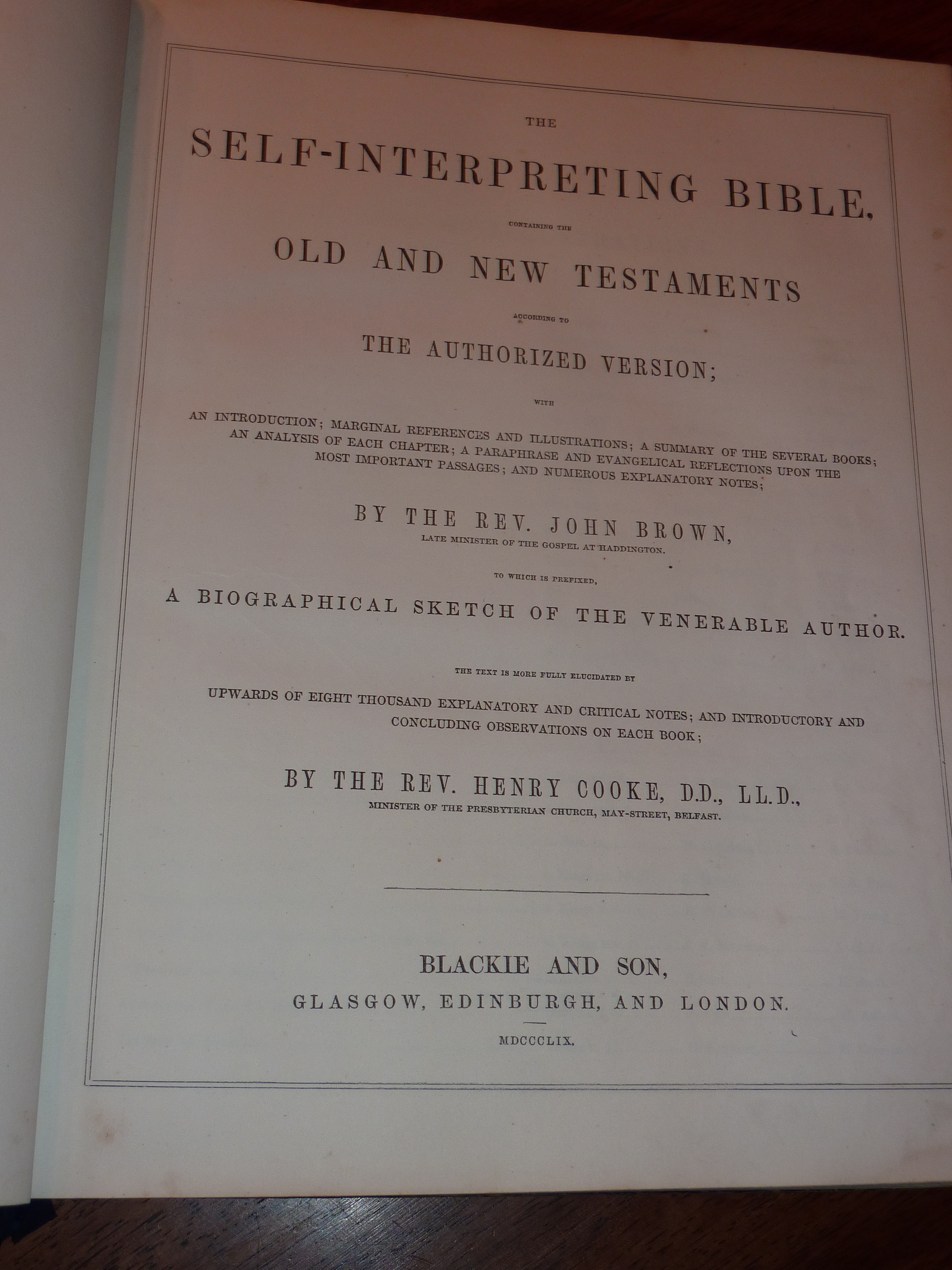
Title Page to Brown’s Self-Interpreting Bible
The following continues a series of excerpts from “An Introduction to the Right Understanding of the Oracles of God,” by the Rev. John Brown of Haddington, as published in his Self-Intepreting Bible (1859 edition). (Punctuation and Scripture references have been modernized).
Chapter II
OF RULES FOR UNDERSTANDING THE SCRIPTURES OF THE OLD AND NEW TESTAMENTS
- Let us labor, in much fervent prayer and supplication, for the powerful influence and inhabitation of the Holy Ghost (who perfectly understands the Scriptures, and indited and appointed them for our spiritual edification,) that he may effectually interpret and apply them to our heart. He is the Spirit of wisdom and revelation in the knowledge of Christ; He it is who searcheth all things, yea, the deep things of God:–He is the Anointing, that is Truth, and teacheth all things. He can enlighten our eyes, and make us to know things freely given us of God, and to see wondrous things out of God’s law; can make us by the Scriptures,–wiser than our teachers—wise unto salvation (Ephesians 1:17-18; 3:16-19; 1 Corinthians 2:10, 12; 1 John 2:20, 27; Psalm 119:18, 96-109; 2 Timothy 3:15-17).
- Being renewed in the spirit of our minds, and having in us the mind of Christ, we ought, under a deep sense of God’s presence and authority in the Scripture, earnestly, and with much self-denial, to search the Scriptures, by much serious reading and meditation thereon; chiefly that we may spiritually know the mind, behold the glory, and feel the effectual power of God therein, in order to our faith in, and obedience to them. The natural man receiveth not the things of the Spirit of God: it is the man who feareth God to whom he will teach his way, and reveal the secrets of his covenant;–it is the man who hat the Spirit of Christ, the mind of Christ–who hath seen the Lord, and tasted that he is gracious—the man who hath had his eyes opened, that can discern, judge of, and understand the matter or manner of Scripture revelations (1 John 2: 20, 27; Psalm 25:12, 14; 1 Corinthians 2:14-16; John 14:21-23; Luke 24:45; Psalm 114:18). A deep sense of our ignorance, and of our absolute need of Scripture influence, must animate us to the earnest study of knowledge. He, who thinks that of himself he knows divine things to any purpose, knoweth nothing as he ought to know—only with the lowly is wisdom. God, who resisteth the proud, giveth grace to the humble: the meek will he guide in judgment; the meek will he teach his way. The mysteries of the kingdom he hides from the self-conceited, wise, and prudent; and reveals them unto babes (1 Corinthians 8:2; Proverbs 11:2; James 4:6; Psalm 25:9; Matthew 13:11; 11:25). Scarcely can anything then more effectually to blind the mind, and harden the heart, than the searching of the Scriptures in a philosophical manner, regarding merely or chiefly the rational sense of the passage. Hence multitudes of preachers, who daily study the Scriptures for the sake of their external performances, are of all men the most ignorant how Christ’s words are spirit and life. The god of this world blinds their minds; so that hearing many things, they never open their eyes; and seeing many things, they never behold one truth, or the subject thereof, in its glory (Isaiah 6:9-10; 42:18-19; 56:9; 2 Corinthians 4:3-4).
“Heart knowledge” of Scripture’s Self-Attesting Evidences Persuades of Its Divine Inspiration and Authority

Brown’s Self-Interpreting Bible (1859 edition)
The following continues a series of excerpts from “An Introduction to the Right Understanding of the Oracles of God,” by the Rev. John Brown of Haddington, as published in his Self-Intepreting Bible (1859 edition).
X. Though the above arguments are sufficient to silence gainsayers, and to produce a rational conviction that the Scriptures are of divine original and authority, it is only the effectual application of them to our mind, conscience, and heart, in their SELF-EVIDENCEING DIVINE LIGHT and POWER, which can produce a cordial and saving persuasion that they are indeed the word of God. But, when thus applied, this word brings along with it such light, such authority, and such sanctifying and comforting power, that there is no shutting our eyes nor hardening our hearts against it; no possibility of continuing stupid and concerned under it: but the whole faculties of our soul are necessarily affected with it, as indeed marked with divine evidence, and attended with almighty power; 1 Thes. 1:5; 2:13; John 6:63.
Memoir of the Rev. John Brown, Part 11

John Brown’s Self-Interpreting Bible (1859)
The Character of John Brown
Among the things which obviously claim our attention in the character of Mr. Brown, we must not pass over the astonishing extent of his scholastic acquirements. Though possessed of no very considerable fund of originality, his capabilities for the acquisition of almost every species of literary knowledge was such, that he outran most of all his contemporaries, though possessing every advantage of a regular education, and that from their infancy. Ordinary attainments, whether in languages or science, could by no means satisfy the ardour of his inquisitive mind. With a memory strongly retentive, a solid and discriminating judgment, and an inflexible and persevering assiduity, with the blessing of God on his labours, he acquired and secured an uncommon share with which, from a child, he had cultivated a very particular acquaintance, so that he could repeat almost every text, and state its meaning and connexion. His feet were early turned into the paths of wisdom. Apprehended by the grace of God while his mind was yet young and tender, he made choice of his law as the rule of his life, and solemnly devoted himself to his service. In prayer, public, secret, or domestic, he overstepped the rules of almost any prescribed routine; even amid the ordinary business of life, the breathings of his soul were continually breaking forth in ejaculations of gratitude and praise, particularly while composing, or committing his discourses to memory. He possessed such an habitual evenness of temper, that hopes realized or disappointed seemed neither to elate nor greatly depress his spirits. He lived always conscious of God’s presence, and as one who had learned to lay down the sinful suspicion that men by nature have of Him. On hearing a peal of thunder he remarked, “that is the low whisper of my God.” His Christian Journal, which presents a good index of the general tone of his mind, bears this inscription, “The soul that is ever attentive to God never hears a voice that speaks not to Him; the soul, whose eye is intent on Him, never sees an atom, in which she does not discern the face of her best beloved.” He was scarcely ever seen to weep, unless it were from the impressions of divine truth on his own heart, or compassion for perishing souls. Bodily pain, or the death of relatives, he suffered without a tear; but when warning sinners to flee from the wrath to come, and, in Christ’s stead, entreating and beseeching them to be reconciled to God, his heart got frequently too big for utterance.
Westminster West–Texas, that is!
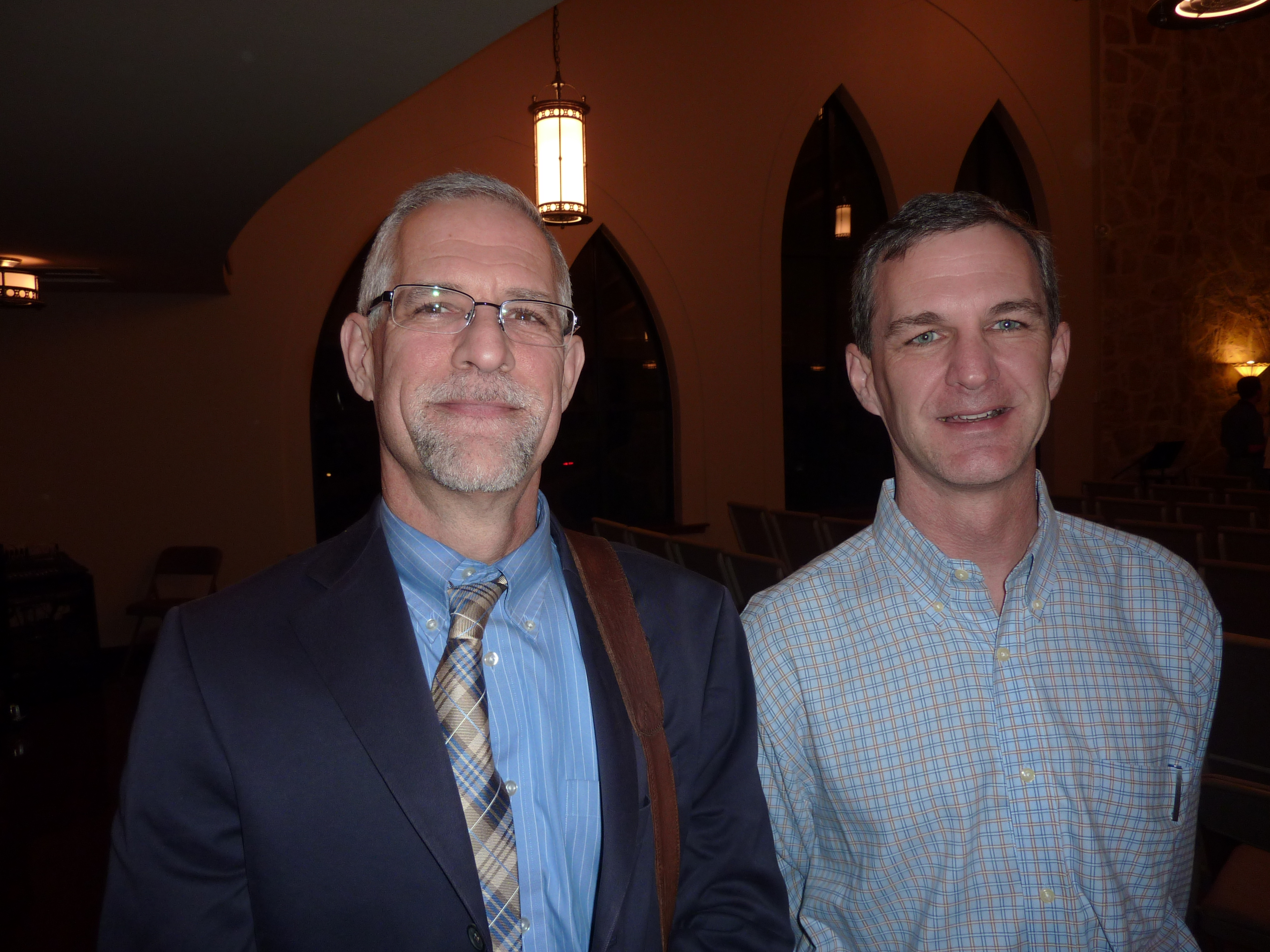
K. Scott and Kyle Oliphint
Congratulations to Rev. Jeremy Boothby, the newly ordained and installed pastor of Christ Covenant OPC in Amarillo, Texas. This is a sister church in my church’s Presbytery of the Southwest, which facilitates the connectedness of our Orthodox Presbyterian congregations located in Texas, Oklahoma and New Mexico. Last Friday was the day of the installation service, where Drs. Lane Tipton and K. Scott Oliphint both spoke. Amarillo is the hometown of Dr. Oliphint, along with his brother, Rev. Kyle Oliphint, who is now pastor of Grace Community PCA on the north side of Fort Worth, near Keller, Texas. I decided to post this playlist because I knew there would be a few of you out there who just have to see Lane Tipton and Scott Oliphint doing what they do. I can’t say that I blame you. The videos are courtesy of Pastor Andrew Moody of San Antonio Reformed Church. Don’t let the YouTube channel confuse you, the events in the videos take place in Amarillo, even though they are posted by a guy from San Antonio.
I got to know Pastor Boothby when my wife and I were counselors at camp down in Leakey, Texas. Jeremy and I led a team of campers in putting together a skit featuring the camp’s theme. Jeremy had the idea to imitate those commercials with the guy sitting at a table asking a group of kids “Which is better?” in which hilarity ensued. We had a unique combination of personalities on our team, which gave us some good “Kids Say the Darnedest Things” moments. I also got to see what a capable athlete he was on the basketball court, which I suppose is why I commented on the video of the newly installed Pastor Boothby giving his first real live benediction that his smile looks like he’s repressing the urge to dance in the end zone or something. I wish I could find those camp pictures but we’ve been slowly transferring files from an old computer to a new one and I haven’t been able to locate them, not even on our Carbonite account. If I find them soon, maybe I’ll update the post.
May Pastor Jeremy Boothby enjoy many fruitful and happy years pastoring Christ Covenant OPC in Amarillo, Texas!
Tullian Brings Reformed Gospel to TBN

The Daily Evangel: A subliminal reminder to preach the gospel to yourself every day.
I guess it had to happen someday. Turns out it did this past summer. Megachurch pastors tend to accept invitations to places where there are TV cameras, and that’s exactly what happened in this case. Tullian’s message of “radical grace” has reached the first family of the Trinity Broadcasting Network. While in many ways, this is an example of worlds colliding, I figure if Peter Lillback can accept an invitation to Glenn Beck’s TV show a few years ago with the intention of making sure the gospel is clearly communicated on his air, then why not Tullian on TBN? The world’s largest Christian television network could do a lot worse, and has built an empire on doing just that.
For those unaware, Tullian Tchividjian is the grandson of Billy Graham and the pastor of Coral Ridge Presbyterian Church in Ft. Lauderdale, Florida. He is a favorite among the New Calvinists and is notorious for his popularization of the Lutheranesque “law-gospel distinction” which is taken by many to his right, myself included, as repeating the mistakes of historic antinomianism in some of his rhetoric and in his application of the otherwise valid hermeneutic pioneered by the Protestant Reformer. Among Tullian’s influences are Steve Brown (RTS Orlando and Key Life) and the theologians associated with Modern Reformation magazine and The White Horse Inn radio show. While I believe Tullian when he says he affirms the Reformed teaching on the third use of the law , I also believe his critics when they say his rhetoric smacks too much of historic antinomianism (read about that here). Tullian’s intention is to minister to those burned by legalism, and I’m all for that, even if he may be pushing the envelope of Reformed theology further to the left than I think he should.
But I like Tullian in small doses. Few and far between. It has been a while since my last dose of Tullian, so I am prepared to have a good attitude about his appearance on TBN to promote his recent book One Way Love. Besides, it would be inconsistent of me to criticize him for accepting an invitation to speak on Word of Faith turf, since the seeds of Reformed theology were planted in my own mind when Michael Horton appeared on TBN to promote his very first book originally entitled Mission Accomplished (now Putting Amazing Back Into Grace) while still a student at the Bible Institute of Los Angeles (BIOLA). The difference between Horton’s and Tullian’s appearances is that the latter they post on YouTube, while the former they immediately erase, cancel the talk show that featured him, and have the host reassigned to a job behind the scenes. This reaction was due to the fact that Horton was a known critic of the Word of Faith heresy who would go on to edit The Agony of Deceit. My hope is that Tullian’s interview will likewise plant and water the seeds of Reformed theology and the true gospel of Christ among today’s regular TBN viewers.
While Tullian admits to being a one-sermon preacher, his message that Christ kept the law perfectly and earned eternal life for those who believe and so frees us to gratefully, though imperfectly, respond to his amazing grace with love toward our neighbors is one we need to be reminded of on a daily basis. In fact, it is this “preach the gospel to yourself daily” notion that motivated me to put “Daily Evangel” on the building in the background of my picture of Captain Headknowledge. We need the Evangel of the free grace of God in Christ every day, and may it spur us on to love and good works, though we’ll never do them as well as Jesus did them for us.
Plain Vanilla Presbyterian Church

The 10 marks of a “plain vanilla” Presbyterian church. Some are tongue-in-cheek–kinda!
- Lectio continua preaching. If you want topical preaching, then preach through the catechism in the evening.
- Is it a sanctuary or an auditorium?
- Evangelism is inherent in #1, while personal witnessing is commended and encouraged.
- Psalms and hymns sung from the Trinity Hymnal (1960, or 1990 edition) to piano accompaniment, at least.
- Resist the trend toward weekly communion, paedocommunion and intinction.
- Deaconess is not an ordained church office; pastors are men, too.
- If the Bible doesn’t say you can do it in the worship service, then you can’t!
- Congregational participation in worship: a) pray along with the elder during his public prayers, b) sing, recite the creed or Lord’s Prayer and responsively read like you mean it, c) actually hear and heed the Word preached.
- No hand raising until the benediction (but only if you know what it means).
- If you call people “Brother” and “Sister,” everyone will know you used to be a Baptist.
What other marks can you think of?
How Christ Restored the Gospel to His Church
I’ve added a link to the top of my sidebar to the right. It links to Post Tenebras Lux, the website of Dr. Thomas R. Browning, Assistant Pastor of Grace Community Presbyterian Church in Fort Worth, Texas. At his site is a lecture series about the life and ministry of Martin Luther and the story of the beginning of the Protestant Reformation. It is the month of October now, and Luther nailed the historic 95 Theses to the door of the Castle Church in Wittenberg, Germany on October 31, 1517, so it is time to begin gearing up to commemorate the Protestant Reformation, which was the providential way “How Christ Restored the Gospel to His Church.”
Countdown to OPC DFW Ref Con 2014!
![image[1]](https://capthk.com/wp-content/uploads/2014/10/image1.jpeg) This morning, my pastor, Joe Troutman, my friend Chris and I erected our conference banner in front of the church. Then we got in the car and drove by the church to see just how visible it is from the road. Pastor Troutman said, “It pops!”
This morning, my pastor, Joe Troutman, my friend Chris and I erected our conference banner in front of the church. Then we got in the car and drove by the church to see just how visible it is from the road. Pastor Troutman said, “It pops!”
![image[1]](https://capthk.com/wp-content/uploads/2014/10/image11.jpeg)
![image[2]](https://capthk.com/wp-content/uploads/2014/10/image2.jpeg) I can’t wait for OPC DFW Reformation Conference 2014!
I can’t wait for OPC DFW Reformation Conference 2014!
Join us by clicking here for free registration. There are 93 seats available at present. I hope you can make it to see Dr. Carl Trueman speak on the biblical case for creeds and probably survey the development of the ancient Apostles’, Nicene and other creeds on Friday night at 7:00pm CT. Then at 9:30am CT Saturday he will survey the confessions of the Protestant Reformation, and finally at 11:00am he will commend the usefulness of creeds and confessions in the life and worship of the Christian church today.
What if “No creed but the Bible” is unbiblical?
Distinctions Regarding Sanctification in the Household Principle

Robert Mossotti, OPC Licentiate
OPC Licentiate Robert Mossotti explores a distinction between the holiness of the children of a believing parent and the way an unbelieving spouse is sanctified by a believing spouse. These remarks conclude his lesson delivered on August 31, 2014 at Mid-Cities Presbyterian Church. Subscribe to Robert’s SermonAudio page for more worthwhile teaching and preaching.
Let’s not forget that in Hebrews 6, there are some who are in the visible church who actually enjoy many spiritual benefits including tasting the heavenly gift, and the good word of God, and the powers of the age to come, and sharing in the Holy Spirit. But not, as we have discussed in a previous lesson, sharing in the Spirit’s work of regeneration, but in other very real, but lesser, blessings of the Holy Spirit, blessings which our Confession calls “common operations of the Spirit” in chapter 10, paragraph 4.
There is one other text that I would like to examine briefly. These are broad brush strokes, these may not even be the best arguments for why we baptize infant children of believers, but I think that they’re fairly good ones: the continuity of the one covenant of grace, the unalterability of covenants once they’re ratified in Abraham, and all the things we’ve gone through so far in this lesson.
Let’s go to 1 Corinthians chapter 7.
For the unbelieving husband is made holy because of his wife, and the unbelieving wife is made holy because of her husband. Otherwise your children would be unclean, but as it is, they are holy (1 Corinthians 7:14 ESV).
In the Greek text of this verse, the children of a believer, whether it’s mother or father, are called saints in the Greek. They are called “holy ones,” that’s what “saints” means. Now, this is a noun, it’s not an adjective, like it appears in the text here in English. It’s not a description of them as an adjective, it is a statement that they are a noun, they are saints; they are holy ones.
Let’s go to chapter 1 and verse 2 of this epistle.
To the church of God that is in Corinth, to those sanctified in Christ Jesus, called to be saints together with all those who in every place call upon the name of our Lord Jesus Christ, both their Lord and ours: (1 Corinthians 1:2 ESV)
It’s not as obvious in the English, here, but in the Greek it is the same noun. It’s not a verb, it’s not an adjective, it’s a noun, they’re being called saints, holy ones. So, let’s go back to chapter 7. The thing is, that although the children seem to be called by the same noun as other members of the visible church, and that is the point that I want to make, nevertheless, it says something odd about the unbelieving spouse as well, doesn’t it? It would seem to create a problem for my thesis because you can’t say that an unbeliever is a member of the church, and it says that he is being sanctified by the believing wife, or vice versa, and the children are called holy ones. That creates an apparent problem, I’m trying to say with this text that children are members of the church just like the ones Paul addresses at the beginning of the epistle, so there is some difficulty there. But I think the explanation is to be found in the grammar. The children, like the visible church members in chapter 1 verse 2 are declared to be saints, holy ones. That is not what happens, here, with the unbelieving spouse. They are not called saints, they are not called holy ones, it’s says with a passive verb, they “are sanctified.” It is a different idea; it’s slight, I admit, but it is a distinction that Paul actually puts in there. He doesn’t say, “the children are saints, and the unbelieving parents are saints, too.” He doesn’t say that the children “are sanctified,” in the Greek, the way the unbelieving parent is sanctified. He makes a distinction. He calls the children “saints” the way he calls all of them saints at the beginning, and with the unbelieving parent, he says that they “are sanctified,” and I think the explanation for this distinction in the grammar is this idea of being sanctified by virtue of being in proximity to something holy.
Let’s go to Matthew 23:17-19.
You blind fools! For which is greater, the gold or the temple that has made the gold sacred? And you say, ‘If anyone swears by the altar, it is nothing, but if anyone swears by the gift that is on the altar, he is bound by his oath.’ You blind men! For which is greater, the gift or the altar that makes the gift sacred? (Matthew 23:17-19 ESV)
The gold was sanctified, not because of what it is, but because of its proximity to something else.
Now let’s go to Exodus 30:29
You shall consecrate them, that they may be most holy. Whatever touches them will become holy (Exodus 30:29 ESV).
You can see it much more clearly in the Septuagint and in the Hebrew text that it is the same idea of sanctifying, but it’s not that these things were holy in themselves, but whatever they touched was holy, so going back to 1 Cortinthians 7, the unbelieving spouse is made holy in that sense, by virtue of their proximity to the believing parent and the child, in their marital and parental relationship to holy ones, they are in a sense sanctified. I can’t do much better than that, I think, in explaining in what sense the unbelieving spouse can be sanctified. It’s not as if they are holy, “holy ones,” but they are sanctified, receiving holiness by the unbelieving spouse’s proximity to holy things.
One more note on the unbelieving spouse being described as being sanctified, if we were to take the time to go to Leviticus 27:28, especially in the Masoretic Hebrew text and the Septuagint, we would see that there is all kinds of sanctifying in the Scriptures. I don’t think this is the kind of sanctifying we’re talking about in Leviticus 27, where it is those that are set apart for God’s destruction are called holy as well, so I don’t mean the unbelieving spouse is sanctified in the sense that he is set apart for destruction. I only introduce this to make the point that in the Scriptures there is more than one meaning for “sanctifying.” It doesn’t always have the meaning of which we typically think.
So, what is the overall argument that I want to make from 1 Corinthians 7:14? It’s not ambitious. I don’t want to make too much out of my grammatical distinctions, but simply that children of believers are to be admitted as members of the visible church, and are to be granted the rite of admission to the same. I think surely the New Testament language stands at least for that. They are called saints just like anybody else in the church at Corinth.
I have said that Genesis 17 makes clear that the household principle is not simply the physical descendants of the believer that are to be included into the visible church. It’s a household principle, not so much a genetic line kind of principle. Now we in the United States of the 21st century don’t have slavery. So how would you apply that? We should keep in mind that they did have slavery in the first century as well as during the time of Abraham. So by the first century, where this principle of admission into the visible church by household would include slaves it is the same as saying that in the twenty-first century the household would not include slaves. Slavery is an historical accident of local, civil law. It’s something that the Bible does not confront head on, nor does it warrant it. That’s how we would apply it today. We would do the same thing, we would admit by households, but since households no longer include slaves we wouldn’t even consider that, but children would still be a part of that, according to Genesis 17.
Inclusion of Whole Households and Covenantal Continuity
Robert Mossotti, OPC Licentiate
The following is part two of a series featuring OPC Licentiate Robert Mossotti’s August 31, 2014 Sunday School Lesson on Why Presbyterians Baptize Children of Believers, taught at Mid-Cities Presbyterian Church in Bedford, Texas. Read Part 1. Subscribe to Robert’s podcast at SermonAudio.
.
“And Abraham said to God, “Oh that Ishmael might live before you!” God said, “No, but Sarah your wife shall bear you a son, and you shall call his name Isaac. I will establish my covenant with him as an everlasting covenant for his offspring after him… Then Abraham took Ishmael his son and all those born in his house or bought with his money, every male among the men of Abraham’s house, and he circumcised the flesh of their foreskins that very day, as God had said to him” (Genesis 17:18-19, 23).
In this passage, we see that Ishmael is commanded to be given the sign of the covenant, even though Abraham knows God’s covenant is actually with Isaac, and not with Ishmael. In other words, Ishmael is admitted into the visible church even though Abraham knows he’s not a member of the invisible church. He knows it—he’s told it by God. God’s covenant is really and truly with Isaac. But since Ishmael is in Abraham’s household, and under Abraham in God’s eyes, he, too is to receive the covenant sign. In other words, if the household principle that we see in Genesis 17 dictates that even definite reprobates like Ishmael are to receive the sign and be admitted into the visible church, then the household principle means that possible reprobates should be given the sign and admitted to the visible church. The greater includes the lesser, if you follow my meaning.
We don’t give children the sign of the covenant because we believe they are elect; we give them the sign of the covenant because that’s what we’re supposed to do, even when it is the case that, even by divine revelation God has told the parent, “My covenant is not with this boy. My covenant is with the boy that Sarah is actually going to have. Now give Ishmael the sign of the covenant.” Abraham knew that Ishmael would not be a member of the invisible church–he was not God’s chosen—Isaac was going to enjoy that position. God told him to circumcise Ishmael, and that’s because of this household principle: the believer is in charge of the household, the parent is a Christian, the parent is in the visible church, and the child is to be admitted into the visible church.
In Genesis 17, in verse 7, we see that the covenant of grace is established on these terms. It is between God and Abraham, and God and his seed after him for an everlasting covenant to be his God, and the God of his offspring. Now in verse 9 of Genesis 17, we can see that Abraham and his offspring are to keep this covenant. Think of Galatians 3:29 here: if we are in Christ, then we are Abraham’s offspring.
Now let’s look at verses 12 and 13 of this chapter.
He who is eight days old among you shall be circumcised. Every male throughout your generations, whether born in your house or bought with your money from any foreigner who is not of your offspring, both he who is born in your house and he who is bought with your money, shall surely be circumcised. So shall my covenant be in your flesh an everlasting covenant.
These verses reveal that the sign and seal of the covenant of grace was not contemplated by God as being only based on the principle of fleshly descent from Abraham, but on a different principle. It was not only the physical descendants of Abraham who were to receive the sign, it was his whole household. Abraham’s household had slaves and servants numbering in the hundreds (I direct you to Genesis 14:14 to see that). Because Abraham, the head of the household, was a believer, every member of Abraham’s household was to come into the visible church. In the covenant of grace, then, those who are under the authority of the believing head of a household are likewise to receive the sign and seal of the one covenant of grace, and verse 14 of this chapter says that if you don’t, then that person is to be cut off. The uncircumcised child is to be cut off from my people. He is a covenant breaker.
This is all established by divine appointment, so we maintain that only by divine appointment it may be altered, according to Galatians 3:15-17, which we read at the beginning. Nothing has changed with respect to this principle in the New Testament church, which is why the whole household was granted the sign and seal of the one covenant of grace during the days of the apostles. We see this same principle of household admission to the visible church. It is still in effect in the New Covenant administration of the one covenant of grace. The New Testament, therefore, does not need to be careful to point out that children are being baptized in order for us to baptize children. We must only be careful to point out that households are being taken into the New Testament church, which, indeed, the New Testament is careful to do in many instances. So the household principle of Genesis 17 is carried over into the New Covenant, and because it is, we believe it is appropriate to baptize the children of believers.
Regarding whether the New Testament explicitly mentions the baptism of infants, I would direct you to sermon Pastor Troutman preached on Joshua chapter 5. The grown men of the children of Israel who invaded Canaan all had to be circumcised as adults. That’s because their parents in the 40 years in the wilderness never circumcised them like they were supposed to. If we just looked at Joshua 5 and we did not look at prior revelation—Genesis 17—one would mistakenly assume that only adult males were to be circumcised because there is no explicit mention of children being circumcised in Joshua chapter 5. But one must look at the Abrahamic administration of the one covenant of grace to understand that children are to receive the sign, too. That’s why, as a matter of literary inclusion, if you will, the writers of the New Testament didn’t go out of their way to say that infants are being baptized as well because the explicit household principle comes into play and the rest is assumed. Because people who are coming into the church as the apostles preached the gospel are all adults, that’s what gets explicit mention in the same way that the adults that went into Canaan got explicit mention that they were receiving the sign of the covenant, and you would have to go prior to that, into earlier revelation, like we’re trying to do now, to establish that it’s children as well as adult males.
We’ve covered a lot of territory about the distinction between the visible and invisible church. We know from John 15 that even branches that are fruitless are for a time united to Christ externally only to be broken off later and cast into the fire, Jesus says, like the thorny and rocky ground in the parable of the sower, or like the bad fish in the parable of the dragnet, many reprobates are, in fact, in the visible church by profession, and, as we know from the Scriptures, by birth as well, and we have the explicit example of Ishmael and Esau. That’s important to keep in mind: baptism is not an assertion that this person is elect, it’s a rite of admission into the visible church, not the invisible church.
Visible Church Membership for Covenant Children
Robert Mossotti, our summer intern at Mid-Cities Presbyterian Church in Bedford, Texas taught a Sunday School series on Ecclesiology. All of the lessons are available online here. They’re also available on Robert’s SermonAudio page here. My favorite lesson in the series was the following on the biblical case for infant baptism and the Reformed inclusion of the infant and unbelieving children of believers into church membership. The following is a transcript of his remarks, lightly edited at some points. I hope you find it as helpful and enlightening as we have. You can listen to this particular lesson online here. We begin with his introductory remarks regarding principles that govern our interpretation on this issue, and an exposition of Paul’s words regarding covenants from Galatians 3. The rest will follow in the coming days and weeks.
Why do Presbyterians baptize babies and count them as members of the visible church?
Let’s restate some principles first, before we get into some passages.
The visible covenant community is the visible church—Old Testament and New Testament—and what makes it visible are the sacraments. These place a mark on the church to identify it as belonging to the Lord. The sacraments mark God’s people off from the world. Another principle we have to keep in mind is that there is only one covenant of grace in Scripture. The covenant by which Abraham and the Old Testament church were saved is our covenant, too. By God’s grace, in the Scriptures we are all called children of Abraham through faith. There is no essential difference between the Old Covenant church and the New Covenant church. There are differences, but no essential differences. No differences as to substance, just form. The church is one across all the ages, because the covenant of grace is one. To embrace the one idea is to embrace the other. If you accept that there is one covenant of grace throughout Scripture by which we are all saved, then you have to accept that the church is one across both Old and New Testaments. We affirm this over against dispensationalism, which maintains an essential difference between Israel and the church. So the Abrahamic Covenant, the Mosaic Covenant (the one at Mount Sinai mediated through Moses), and the New Covenant are all different administrations of the one covenant of grace. In section 5 of chapter 7 of the Westminster Confession of Faith, the Mosaic Covenant is called an administration of the covenant of grace. Alright, now that those principles have been stated, let’s go to Galatians 3.
The apostle Paul is going to give us in this passage a principle of covenant theology. A principle of Interpretation of Covenants, of Application of Covenants, the Nature of Covenants. Paul says not only biblical covenants, but all covenants. Let’s go to Galatians 3:15.
“To give a human example, brothers: even with a man-made covenant, no one annuls it or adds to it once it has been ratified. Now the promises were made to Abraham and to his offspring. It does not say, “And to offsprings,” referring to many, but referring to one, “And to your offspring,” who is Christ. This is what I mean: the law, which came 430 years afterward, does not annul a covenant previously ratified by God, so as to make the promise void” (Galatians 3:15-17 ESV).
In verse 15, this idea of “ratified” in the ESV comes from the Greek word kuro’o, and Bauer-Danker, the premier Greek lexicon or dictionary defines it as “to confirm, to ratify, to validate or to make legally binding.” Although the covenant of grace goes all the way back to Eden, note that Paul is saying here that it was not ratified until Abraham. Now note that in verse 15, Paul begins with a general principle of covenants. Then, as he moves down through verses 16 and 17 he applies that general principle of covenants to the particular case of the Mosaic administration of the one covenant of grace—that’s what he means by the Law coming in. Paul says that once the covenant of grace was ratified at the time of Abraham, no modifications may be introduced even by later administrations of the covenant of grace, including the Mosaic administration.
So, it is because there is only one covenant of grace throughout Scripture that we Presbyterians apply the sign of admission into the visible church to the children of believers, for we are not free to change the way the covenant is administered. It is not because the Reformers didn’t sufficiently push off from Rome that we baptize babies, it is because of our covenant theology which we receive, we believe, from the Scriptures. It is also because the covenant of grace is one across the various administrations that we need not seek for proof of continuity between the Abrahamic administration and the New Covenant administration of the one covenant of grace. In fact, because of the underlying unity of the one covenant of grace across the ages, which cannot be altered once ratified, says Paul, that we actually would need to find evidence in the New Testament that God intends to change who it is who receives the rite of admission to the covenant community. Because of the underlying continuity of the one covenant of grace, it is discontinuities, and not continuities, between the Old Covenant and New Testament administrations, that need positive proofs from the New Testament. We don’t have to go to the New Testament and ask if there are specific cases where it says in explicit terms that babies were baptized. Because of the underlying unity of the one covenant of grace, you have to look for a command to no longer give the sign of the covenant of grace to the children of believers. The underlying unity drives the belief that we assume continuity unless there is evidence in the New Testament of discontinuity.
So the absence of explicit revelation in the New Testament on whether children are to be included in the visible church actually works in favor, not against, the inclusion of children in the visible church. Because of this principle of covenant administration, the default setting, says Paul, is covenantal continuity. But, in fact, we can find more evidence than just these principles of covenant theology that the children of believers are to be included in the visible church as members.
OPC’s Doctrine of Assurance Blamed for Bergdahl’s Religious Uncertainty
In this day when America is, for better or worse, trying to wind down its war against radical Islamist jihadists, Skidmore College Professor and Director of Religious Studies, Mary Zeiss Stange, opines in a USA Today piece that we don’t think enough today about how religion can be a source of evil as well as good. Just let that sink in for a moment. But Stange’s focus is not on radical strains of Islam. Hers is on the Orthodox Presbyterian Church. You know, that “hyperconservative offshoot of the mainstream Presbyterian Church USA” which she calls “Calvinism on steroids” because it “sees the world in stark either/or terms” in which you are either “saved and bound for heaven. Or you are a sinner, treading a one-way path to the fiery pit of hell.” She characterizes the struggle to discern one’s eternal destiny as “making extraordinary demands on a sensitive young person’s conscience and conduct.” Having painted this dramatic portrait of my denomination with such colorful brush strokes, broad as they may be, she then proposes the possible diagnosis for the “chaotic mood swings” which lead to Bowe Bergdahl’s “transformation from gung-ho warrior to pacifistic deserter”: “The Orthodox Presbyterian Church compels followers to feel the inner spark of absolute certainty of one’s own God-given righteousness.” This is what we hyperconservative Calvinists on steroids call “assurance of salvation.” But Stange’s description of this teaching is overly simplistic, and with the use of the phrase “absolute certainty,” she is associating the OPC with that predominant flaws of the fundamentalist movement. In the doctrinal standard of the OPC, the Westminster Confession of Faith, we find a little more nuance in what we confess about the Bible’s teaching on assurance. Chapter 14, “Of Saving Faith,” section 3, reads,
This faith is different in degrees, weak or strong; may be often and many ways assailed, and weakened, but gets the victory: growing up in many to the attainment of a full assurance, through Christ, who is both the author and finisher of our faith.
Likewise, in Chapter 18, “Of the Assurance and Grace of Salvation,” the doctrine is treated more fully. Section 3 again demonstrates our allowance for degrees of assurance which may often fall far short of Stange’s portrayal of “absolute certainty.”
This infallible assurance doth not so belong to the essence of faith, but that a true believer may wait long, and conflict with many difficulties before he be partaker of it: yet, being enabled by the Spirit to know the things which are freely given him of God, he may, without extraordinary revelation, in the right use of ordinary means, attain thereunto. And therefore it is the duty of everyone to give all diligence to make his calling and election sure, that thereby his heart may be enlarged in peace and joy in the Holy Ghost, in love and thankfulness to God, and in strength and cheerfulness in the duties of obedience, the proper fruits of this assurance; so far is it from inclining men to looseness.
These excerpts indicates that not all will come to “absolute certainty” regarding their assurance of salvation, but this lack of absolute certainty does not necessarily entail the absence of faith. A weak faith, maybe, but a saving faith nonetheless. Since 2012, the congregations of the OPC have been praying that Bowe Bergdahl would come to faith in Christ, if he truly does not believe, or, if he does, that the Lord would strengthen that faith, that he might grow up “to the attainment of a full assurance, through Christ, who is both the author and finisher of [Bowe’s] faith.” We are careful to point out that assurance is a goal, yet it is not a constant, unwavering quality of the genuine Christian life. For those who find this assurance of faith elusive, it is our desire to comfort, encourage, and point them again to the imputed righteousness which Christ procured by his humble, sinless life, propitiatory death and glorious resurrection in the Word of God preached, and signified and sealed to them in the sacraments of baptism and the Lord’s Supper. Each of these are ordinary means of God’s grace which can develop an assurance that is not contingent upon the strength of one’s faith, or the quality of his works. So it’s not as if those of us who believe in assurance of salvation strive to keep the heat turned up on people to make sure they get some “feeling” of certainty, or else they’re in trouble. That is mischaracterization of the doctrine of the grossest sort on the part of Professor Stange.
Yet it is just such a one-dimensional view of the doctrine of assurance which Professor Stange would have us believe makes my religion a “source of evil.” The idea that moral absolutes and the search for assurance of salvation are bad is consistent with the contemporary religious and philosophical culture in Western civilization, where secularism and relativism are the virtues of our time. I can’t help but see the climactic light saber duel between Obi Wan Kenobi and Anakin Skywalker in Star Wars Episode III: Revenge of the Sith, in which the latter paraphrases Jesus (and George W. Bush) by declaring the ultimate either/or proposition, “if you’re not with me, then you are my enemy,” to which the former replies, “only a Sith deals in absolutes.”
That’s right, dear reader, if you affirm the Ten Commandments, and believe that only through repentance of sin and faith in Christ can one find assurance of salvation from eternal conscious torment, then to liberals like Mary Zeiss Stange, whose kind of view is currently in favor, you have embraced the Dark Side, and your form of religious extremism is what makes people want to kill the innocent and take over the world, and it may even be what stresses our kids out when they can’t “feel” this “absolute certainty” and makes Bowe Bergdahls of them. I never cease to be amazed by the logical leaps which liberals make about orthodox Christianity. It’s positively fundamentalistic.
But Bergdahl’s woes cannot be the sole responsibility of the Orthodox Presbyterian Church, because, from what I’ve read, the Bergdahl family were members of two different OPC congregations in the past, neither of which exist today. I’ve heard that it is possible that they may remain under the oversight of their regional presbytery, and Bob and Jani do retain an ongoing relationship with pastor turned missionary Phil Proctor, but the OPC does not seem to be as solely influential in the life of the Bergdahl’s, Bowe least of all, as it may appear.
The Bergdahls: Muslims? Christians? Traitors? Patriots?
For five years, citizens of the United States have waited, wondered and prayed for US Army Sergeant Bowe Bergdahl who was taken into custody by the Taliban on June 30, 2009 after leaving his outpost (OP) in Afghanistan. While there were indications of possible desertion on Bergdahl’s part, and a 2012 Rolling Stone article reporting email correspondence between Bowe and Bob Bergdahl in which Bowe expressed rather distressing sentiments critical of the United States, many of us did not follow the story closely enough to be aware of these things. As far as people like me were concerned, Bowe Bergdahl was a straightforward victim of the war in Afghanistan, who was bravely suffering for his country in the hands of the enemy.
As you may or may not be aware, I am a member of a congregation in the Orthodox Presbyterian Church (OPC). One Sunday in 2012, a flyer was distributed to our churches, calling on us to pray for the health, safety and faith of Bowe Bergdahl, and peace of mind for his family. Responding to this call, our congregation, and many like ours, corporately prayed for the Bergdahls. This flyer was the most I would read about Bowe Bergdahl until this past weekend when he was released, and his father, Bob, raised eyebrows by reciting a Muslim prayer from the Koran in a personal statement to Bowe. This, added to the growing awareness of Bowe’s desertion and possibly traitorous intentions while among the Taliban, and Bob’s recently publicized tweet expressing his desire for the closure of Guantanamo Bay, has made the person of Bob Bergdahl the object of much controversy as well. People wonder if he converted to Islam, or if he is an Islamist sympathizer.
Even I began to wonder, given our denomination-wide efforts to pray for the Bergdahls, if they were at least still members in good standing of an OPC church, and inquired about this on Facebook, hoping for some input from OPC ministers with which I am in contact. I did learn much in private messages with my FB friends which was reassuring regarding the ongoing Christian faith of the Bergdahl family. It is safe to presume that Bob and Jani Bergdahl have become all too familiar with the Christian grace of perseverance over the last several years, and, despite the release of their son, no end of their need for perseverance seems to be in sight. Prayer on behalf of the Bergdahl family remains a tremendous obligation.
Details about Bowe and his leaving his outpost, statements by fellow soldiers who knew or were involved with recovery operations, and the political and national security implications of releasing the Taliban figures from indefinite detention, continue to dominate the daily news. Yesterday, the Washington Post published a profile of Bob Bergdahl and World Magazine has now also run a story featuring the perspective of the Bergdahl’s former pastor and friend, Phil Proctor, who remains in contact with the Bergdahl family.
Today in my Facebook newsfeed, I discovered another statement from Proctor who wishes to silence the rumors that the Bergdahls have converted to Islam or seek to aid Islamist efforts against the United States. This statement was posted by Andy Webb, Pastor of Providence Presbyterian Church (PCA) in Fayetteville, North Carolina, on his Facebook page, The Outer Monologue. Phil Proctor writes:
I appreciate your asking about the Bergdahls. I’ve really been saddened about how the Christian community is jumping all over this. Here’s the deal…
I pastored the Bergdahl family in 2003, prior to going to Uganda. We were very close, and remained so throughout my time in Uganda (I just found out this evening that apparently I’m referenced in some important Rolling Stone article from 2012).
Bowe was a young man with all the dangers of home-schooling—a brilliant and inquisitive mind, a crisp thinker, and someone who had never really been exposed to evil in the world. He was wanting to determine whether the Christian faith was his own, or his parents’ and was doing a lot of exploring of ideas—never drugs or alcohol, but trying to be an outdoors/Renaissance type figure. We’ve stayed in close contact with Bob and Jani, especially since Bowe’s capture. Since we moved here to Northern Virginia, Bod and Jani have stayed in our home on a couple of occasions and I’ve spoken on the phone with Bob once a month or so.
Bob felt (with some justification) that the US government was not going to engage with diplomatic efforts and so decided to try to free his son himself. He learned Pashtun and developed a lot of contacts in the Middle East. The Qatar connection is one that either originated with Bod or, at the very least, became very personally connected to Bob. Bob has, for quite some time, been saying that the closure of Guantanamo is integrally connected to the release of his son.
Whatever one thinks of Bob’s political views, I can attest to both he and Jani’s unwavering commitment to Christ and trust in him. I’ve prayed with both of them regularly. They both have been through a torture mill that I cannot begin to comprehend—5 years of a living death. It has affected their health, both physically and mentally, as Bob has been completely obsessed with tracking down any possible communication avenue to get his son home. There are a number of things I would disagree with Bob on in terms of political statements, but at the end of the day, I think this whole mess is a WHOLE lot more complicated than a 30 second sound bite (sic) can explore—the very existence of Gitmo attests to the complicated nature from the very beginning, and it’s only gotten worse over the years.
To the foundational issue: Bob and Jani both have regularly confessed their dependence upon Christ and rest in him—the most recent being Bob’s conversation with me about a month ago. They are broken peop;le who need prayer, love, and compassion. I personally intend to run as hard as I can in the opposite direction of judging his words in the moment of his crucible—I would HATE to have that standard applied to my moments of stress, which have never reached anything approaching his intensity and duration!
Feel free to forward this and use it as widely as you like.
Yours in Christ,
Phil Proctor
Pastor, Sterling Presbyterian Church (OPC)
Sterlingopc.org
FYI, My most recent conversation with Bob and Jani was 30 minutes ago. Still Christians.


 The Misadventures of Captain Headknowledge
Sermon Notes: The Lamb of God (John 1:18-34)

The following is an outline based on the notes taken during the sermon preached by Rev. Joe Troutman at Mid-Cities Presbyterian Church (OPC) in Bedford, Texas on October 26, 2014. AudioThe Lamb of God (John 1:18-34)
John the Baptist points away from himself to Christ, so that all may know that Christ is the Lamb of God who takes away the sin of the world.
I. Who Are You? (1:19-21)
A. Leaders’ First Question
1. “Who are you?” (1:19)
a. Not asking for genealogy—they likely know of his father, Zechariah.
b. Jewish leaders would be remiss to not examine John the Baptist.
B. John the Baptist’s First answer (1:20)
1. Confesses Christ by denying being him.
2. There were many itinerant claimants to Messiahship.
C. Leaders’ Second Question (1:21a)
1. “Are you Elijah?”
a. Matthew’s description of John the Baptist an allusion to Elijah (Matthew 3:4)
b. Rabbis frequently expounded on Elijah’s expected return (Malachi 4:5)
D. John the Baptist’s Second Answer
1. “I am not.”
E. Leaders’ Third Question (1:21b)
1. “Are you ‘The Prophet’?” (Deuteronomy 18:15)
F. John the Baptist’s Third Answer
1. “No.”
2. Christ himself is ‘The Prophet’ (Acts 3:22; 7:37).
II. The Voice (1:22-28)
A. Leaders’ Fourth Question (1:22)
1.“Who are you? We need to give an answer to those who sent us. What do you say about yourself?”
B. John the Baptist’s Fourth Answer
1. “I am the voice of one crying out in the wilderness, ‘Make straight the way of the Lord,’ as the prophet Isaiah said.” (1:23)
2. Prophesied in Isaiah 40:1-8; see v. 3
3. A metaphorical call to repair the roads to ease the return of repentant Jews from Babylonian Captivity—the literal near fulfillment.
4. John the Baptist and his baptism of repentance (Luke 3:3) is the spiritual and ultimate far fulfillment.
5. John the Baptist is like a pre-battle bombardment to soften a target before an attack.
C. Leaders’ Fifth Question (1:25)
1. “The why are you baptizing, if you are neither the Christ, nor Elijah, nor the Prophet?”
D. John the Baptist’s Fifth Answer (1:26-27)
1. “I baptize with water, but among you stands one you do not know, even he who comes after me, the strap of whose sandal I am not worthy to untie.”
2. Like his confession by denial above, John the Baptist magnifies Christ by diminishing his own importance (John 3:30).
3. Christ was there, yet remained unrecognized (cf. John 1:10).
III. That He Might Be Revealed (John 1:29-34)
A. John 1:32-34 takes place after Jesus’ baptism.
B. “The next day he (John the Baptist) saw Jesus coming toward him, and said, ‘Behold, the Lamb of God, who takes away the sin of the world!’
1. John 1:29 is the gospel in a nutshell.
a. John the Baptist refers to Christ in terms of the Passover Lamb.
b. “The world” in John 1:29 does refer to all people in the world, but not all people without exception (see John 1:12).
C. John the Baptist’s twofold ministry
1. Negatively, he calls the Jews to his baptism of repentance.
2. Positively, he points to the Lord Jesus Christ to bear witness that he is the Son of God that they might believe.
D. If you believe in Christ, he has borne your sins; therefore, repent of your sins and reaffirm your faith in him in Christian worship.
Share this: