“Prescriptive Retrospective”: Finding Your Way Forward By Looking Back
 “And what you have heard from me in the presence of many witnesses entrust to faithful men who will be able to teach others also.” 2 Timothy 2:2.
History lovers have to appreciate a book that charts the evangelical future by looking back on the life and legacy of a great theologian. Of course, such a strategy of turning back to find your way forward perfectly suits J. I. Packer. As an accomplished historian and theologian, Packer finds cures for what ails contemporary evangelicalism by exploring the contributions of spiritual giants such as the Puritans. So we expect nothing less than prescriptive retrospective from J. I. Packer and the Evangelical Future: The Impact of His Life and Thought, a new book edited by Timothy George.
Christian History Blog: J. I. Packer, Man of God’s Word
Posted using ShareThis
This opening paragraph of a post on the Christian History Blog is the kind of thing I’m all about. I’ve always said, “You can’t know where you are going until you learn where you’ve come from.” The state of the church can always benefit when her members learn that the name of the game is taking what was left them by previous generations and building on it–not in ways that will radically change and leave behind the sacred deposit of the truth of God’s Word (hello, theological liberalism and some emerging churches and other wayward brethren), but in ways that teach us to preserve the essentials of the faith on which we all stand (“catholicity”), while gaining deeper insight into the issues that divide us, that we might at least come to understand each other better, if not come to a place of outward confessional unity around agreement on the non-essentials of the faith.
Respect the faithfulness of past generations by allowing yourself to be guided by their light. Yes, that includes the ever-present call to be “Bereans,” always searching the Scriptures to see whether the things they taught are so.
Thinking Critically About Conspiracy Theories
 Conspiracy theories abound. The New World Order; the JFK assasination; Government cover-up of UFO’s; Government involvement in the 9/11 attacks; faking the moon landing; you name it. Saint and sinner alike is distracted by claims of nefarious activities going on behind the scenes of many important events and incidents in our country and around the world.
How can you discern whether the claims you’re hearing are misguided conspiracy theories or the unvarnished truth? Ken Samples explains how on a recent episode of the conservative Lutheran radio show and podcast, Issues, Etc. Listen and learn here.
Daniel’s Place in the Canon and Among the Prophets
4. The position which the book of Daniel occupies in the Hebrew Canon seems at first sight remarkable. It is placed among the Holy writings between Esther and Ezra, or immediately before Esther (cf. Hody, De Bibl. Text. p. 614, 645), and not among the prophets. This collocation, however, is a natural consequence of the right apprehension of the different functions of the prophet and seer. It is not, indeed, certain at what time the triple division of the Scriptures which is preserved in the Hebrew Bibles was first made; but the characteristics of the classes show that it was not based on the supposed outward authority, but on the inward composition of the books. Daniel, as the truth has been well stated, had the spirit but not the work of a prophet; and as his work was a new one, so was it carried out in a style of which the Old Testament offers no other example. His Apocalypse is as distinct from the prophetic writings as the Apocalypse of St. John from the apostolic epistles. The heathen court is to the one seer what the isle of Patmos is to the other, a place of exile and isolation, where he stands alone with his God, and is not like the prophet active in the midst of a struggling nation (Auberlen, p. 34).
From, Daniel, Book of.
Dr. William Smith’s Dictionary of the Bible (Link on editor; Link on Dictionary)
Comprising its
ANTIQUITIES, BIOGRAPHY, GEOGRAPHY, AND NATURAL HISTORY.
Revised and Edited by Professor H. B. Hackett, D. D.
with the cooperation of Ezra Abbot, LL. D., Assistant Librarian of Harvard College
Copyright, 1868 and 1896, by HURD AND HOUGTON and HOUGHTON, MIFFLIN & CO.
Reprinted 1981 by Baker Book House Company
Four-volume Set ISBN: 0-8010-8211-0
The Masculine Mandate, part 2
The following is Q&A #2 from Christ the Center, episode 87 on Richard Phillips’ soon-to-be-released title The Masculine Mandate, published by Reformation Trust. In this discussion, Phillips explains the difference between his approach to applying Genesis 2:15 and that of John Eldridge in his best-selling book, Wild at Heart.
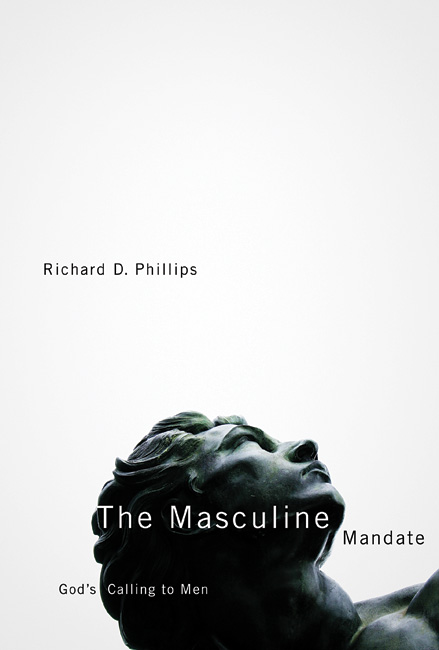 Host: I was intrigued by how you unpacked the mandate given to Adam to dress and keep the garden and how they work out in the physical realm of work and whatever labor you’re doing and in regard to your wife and children. It reminded me of the way Murray goes back in Principles of Conduct and roots everything in the creation ordinance. I had never heard that developed as much. Were these things you were reading, or was it just from your own study of Scripture that you were thinking about what was the principal work–what made a man a man, out of Genesis?
Richard Phillips: Well, you know, I mean, for the sake of the people who haven’t read the unpublished book, in Genesis 2:15, God says he placed Adam in the garden, and charged him to work it and keep it, and this book is an exposition of Genesis 2:15, which I’m describing as the masculine mandate. God put him in the garden to work it and keep it.
You know, what got me going on this was the book Wild at Heart. Because the first time I was asked to speak on this stuff, I got a copy of Wild at Heart, because I knew it was a massive best-seller, and I was absolutely mortified to read the first couple of chapters. He actually makes the statement that man was made out of the garden, and so he is undomesticated, and a male’s life is a life long quest to get in touch with your masculine side. Can you imagine Ronald Reagan making a statement like that?
No real men talk that way! “I’m on a quest for my masculinity.” That what life is, because Genesis 2:15 says–this is what he actually says–it’s a classic example of Bizarro hermeneutics–dominating today: God placed him in the garden, therefore he belongs out of the garden! And the way to get in touch with your masculine self is to get out of the place where God put you, and, as I put it in the book–I think you gotta think in these terms–you know, God placed Adam in the created, covenantal world with God-given relationships, duties and obligations. And Eldridge says, no no, you gotta go on a wilderness quest–ego trips, basically–self-quest. He actually goes so far as to say that Jesus’ forty days’ fast in the wilderness was Jesus seeking his masculine identity. I was just utterly horrified!
Well, I started reflecting on it, and I started thinking well he is right that this verse is paradigmatic. But it’s the exact opposite of what he’s teaching.
And I think, you know, two or three years ago, I did some men’s conferences, I just said, “Hey, let’s look at Genesis 2:15.” And I’m well aware that people are reading this book. I got my first copy of Wild at Heart, when an elder at my church (not this church) handed me a copy–how great the book was, and we need to buy the DVD curriculum of Wild at Heart to show all of our men.
Well, I read the book, and I go ballistic! But it occurs to me that he’s right that Genesis 2:15 is a very important statement. That’s what got me going in this direction. . .
. . . to be continued.
The Masculine Mandate, part 1
Episode #87 of Christ the Center, podcast by the Reformed Forum featured an interview with Dr. Richard Phillips regarding his new book The Masculine Mandate. Dr. Phillips says it’s primarily an exposition and application of Genesis 2:15, which reads, “The LORD God took the man and put him in the Garden of Eden to work it and keep it.” This verse, he says, is the foundational paradigm of the Scripture’s entire revelation of the male’s, or husband’s, role.
Since whenever I link to programs such as this, almost no one takes the time to go and listen, I’m transcribing the interview in a series of blog posts because I find this material to be especially needful for everyone. In this first post in the series, Dr. Phillips explains his reasons for writing the book.
Host: What did you see in men’s lives that needed to be addressed, which lead you to write this book? (Summary of the host’s actual wording)
Dr. Phillips: As is usually the case with books, there are several reasons why I wrote this book: one is, I was frustrated by the low quality of many evangelical books dealing with masculinity. Most especially, John Eldridge’s mega best-seller Wild at Heart, which is just unbiblical.
I was actually having dinner with Jerry Bridges, probably three or four years ago—and he lives out there in Colorado Springs—and we were lamenting this. I said, “Jerry, you ought to write a book on this.” And he didn’t have time, or whatever.
Meanwhile, I was asked by several conferences to speak on things like this. There was a group in Georgia two years ago who asked me to do a multi-day men’s conference.
Lig Duncan had me out to Jackson last year, to the Mid-South Men’s Rally. And so I was needing just for ministry requests, to put together biblical material. My own approach is always to exposit the Word, so if I’m asked to do a men’s conference, I’m going to exposit the Word. That got me dealing with these things.
And also, just as a pastor, I’m well aware, just as everybody is, today we’ve got a real masculinity problem in the culture and in the church. I mean, it is my view that, we talk about feminism, and all of those problems—look, we’ve got a far bigger problem with godly masculinity. In many of our churches we’ll have tlots more available, godly, marriageable women. Then we have . . . men in the church, but they’re not as mature so often. And I do believe that we have a great need for biblical instruction on masculinity.
Now, you start working on this stuff, and you start thinking about it, and you start becoming very impressed with the power of what the Bible says. As I say early on in the book, we know that when it comes to marriage and men in ministry and these sorts of things, that the New Testament directs us back to the early chapters of Genesis. If we’re going to say, “What does it mean to be a man? What is my calling as a man? What am I supposed to do to be a godly man? The answer is, go back and read Genesis 2. And what we’ll find is biblical teaching that is, in fact, a biblical paradigm.
What we read in Genesis 2 about God’s calling to Adam as the man, does in fact, have a paradigmatic influence that we will see pervading all of Scripture. And yet there’s very little teaching about the masculine mandate—that’s what I call Genesis 2:15. That there is a clear calling given to men, that will be seen playing out through the book of Proverbs, playing out through biblical examples of fatherhood, husband and Christian leadership. And it plays straight into the New Testament teaching. And I just came to believe that there is a need for some clear biblical teaching on this.
To be honest with you, it was a hard book to write, because most of my books will come out of my pulpit ministry. My working life is geared that way. I do a sermon on Sunday morning, I preach Sunday evening, I teach Wednesday night. I don’t have a lot of free time beyond that. So this book killed me. I mean, to write a book on the side—most of my books are biblical exposition flowing out of my pulpit ministry-but this one was a labor of love, because I just felt I had to get it done. Not that the world needs my book, but, I just felt an obligation to write this book.
It was not a book that I had time to do, but I just felt that there’s a great need for this, and I’m hopeful the Lord will bless it. You know, I ended up getting in about a year late, because you want to do it right.
But that’s why I wrote the book, just out of my own experiences, being asked to do work in it, and a profound sense that this material has to get out there.
The Outlined Book of Daniel
3. The book is generally divided into two nearly equal parts. The first of these (1-6) contains chiefly historical incidents, while the second (7-12) is entirely apocalyptic. This division is further supported by the fact that the details of the two sections are arranged in order of time, and that the commencement of the second section falls earlier than the close of the first, as if the writer himself wished to mark the division of suject. But on the other hand this division takes no account of the difference of language, nor of the change of person at the beginning of chapter 8. And though the first section is mainly historical, yet the vision of chapter 7 finds its true foundation and counterpart in chapter 2.
From these circumstances it seems better to divide the book (Auberlen, p. 36 ff.) into three parts. The first chapter forms an introduction. The next six chapters (2-7) give a general view of the progressive history of the powers of the world, and of the principles of the divine government as seen in events of the life of Daniel. The remainder of the book (8-12) traces in minuter detail the fortunes of the people of God, as typical of the fortunes of the Church in all ages.
The second section (2, 7) is distinguished by a remarkable symmetry. It opens (in chapter 2) with a view of the great kingdoms of the earth revealed to a heathen sovereign, to whom they appeared in their outward unity and splendor, and yet devoid of any true life (a metal colossus); it closes (in chapter 7) with a view of the same powers as seen by a prophet of God, to whom they were displayed in their distinct characters, as instinct with life, though of a lower nature, and displaying it with a terrible energy of action (thuria, four beasts). The image under which the manifestation of God’s kingdom is foreshown corresponds exactly with this twofold exhibition of the worldly powers. “A stone cut without hands,” “becoming a great mountain and filling the whole earth” (Dan. 2:34, 35)–a rock and not a metal–is contrasted with the finite proportions of a statue moulded by man’s art, as “the Son of man,” the representative of humanity, is the true Lord of that lower creation (Gen. 1:30) which symbolizes the spirit of mere earthly dominions (Dan. 7:13, 14).
The intermediate chapters (3-6) exhibit a similar correspondence, while setting forth the action of God among men. The deliverance of the friends of Daniel from the punishment to which they were condemned for refusing to perform an idolatrous act at the command of Nebuchadnezzar (ch. 3), answers to the deliverance of Daniel from that to which he was exposed by continuing to serve his God in spite of the edict of Darius (ch. 6); and in the same way the degradation, the repentance, and the restoration of Nebuchadnezzar (ch. 4), forms a striking contrast to the sacrilegious pride and death of Belshazzar (ch. 5:23-31).
The arrangement of the last section (8-12) is not equally distinct, though it offers traces of a similar disposition. The description of the progress of the Grecian power in ch. 8 is further developed in the last vision (10-12), while the last chapter appears to carry on the revelation to the first coming of Messiah in answer to the prayer of Daniel.
In summary, in this portion of the entry on the Book of Daniel from Smith’s Dictionary of the Bible, Bishop Westcott has suggested two ways to outline the material in the Book of Daniel. The first, and simpler, outline is something like as follows:
1. Historical Narratives of Daniel (1-6)
2. Apocalyptic Visions of Daniel (7-12)
In terms of chronology, according to Westcott, this two point outline works (see first paragraph above), but in terms of language and author, a more sophisticated outline seems in order. In this effort, Westcott follows the lead of Dr. Karl August Auberlen (I’ve linked to an online text of Auberlen’s book which seems to be the very one Westcott cites above) in dividing the book into a three point outline with several subpoints as follows:
1. Introduction (1:1-21)
2. Progressive History of World Powers and Principles of Divine Government (2-7)
A. Great Kingdoms of the Earth Revealed to a Heathen Sovereign (2)
B. Daniel’s Friends Delivered from Fiery Furnace (3)
C. Degredation, Repentance and Restoration of Nebuchadnezzar (4)
D. Handwriting on the Wall for Belshazzar (5)
E. Daniel Delivered from Lion’s Den (6)
3. Fortunes of the People of God, as Typical of the Fortunes of the Church in All Ages (8-12)
A. ( See paragraph 5 above for topical breakdown)
Also, don’t miss Pastor Kyle Oliphint’s exposition of Daniel Chapter 2 entitled, “A Bad Dream for a King, and Wisdom Sought from the King“
Tullian’s “Unfashionable” Book Tour
 The new pastor of Coral Ridge Presbyterian Church, Rev. Tullian Tchividjian (last name rhymes with “religion”), is making the rounds promoting his book, Unfashionable. Last week, he appeared on James Robison’s television talk show along with his wife, Kim.
This show is filmed not five miles from my house, but I missed when they were in town for the shooting several weeks ago, otherwise, you probably would have been able to spot my wife and me in the audience. Guess I need to put my name back on the Life Today email list so I’m prepared when people I’ll actually want to see are in town. It doesn’t happen often, but it does happen.
The episode was broadcast last week, but you can view it online here, and read about it at Tchividjian’s own blog here. Also, here’s the search results for “unfashionable” at his blog which lists the posts that contain more about the book.
It turns out that this Unfashionable author’s interview with the White Horse Inn was this Sunday morning as well. You can listen to this more in-depth interview here.
You can read about the book at the Multnomah Books website here.
On the Robison show, Tchividjian cites an anecdote from the life of his legendary grandfather, Billy Graham, who back in the 1950’s was approached by a Hollywood celebrity who gave him the kind of advice about which his grandson now writes. The celebrity told Graham: “Don’t ever try to do Hollywood, because Hollywood will always do it better than you. You give this world the one thing Hollywood can’t–the timeless truth of the Gospel.” That’s similar to one of my mottoes: Leave the entertainment to the entertainers, and leave the ministry to the ministers. The church and the world will both be the better for it.
The Multilingual Book of Daniel
 2. The language of the book, no less than its general form, belongs to an era of transition. Like the book of Ezra, Daniel is composed partly in the vernacular Aramaic (Chaldee), and partly in the sacred Hebrew. The introduction (1-2:4a) is written in Hebrew. On the occasion of the “Syriac” answer of the Chaldaeans, the language changes to Aramaic, and this is retained till the close of the seventh chapter (2:4b–7:28).
The personal introduction of Daniel as the writer of the text (8:1) is marked by the resumption of the Hebrew, which continues to the close of the book (8-12). The character of the Hebrew bears the closest affinity to that of Ezekiel and Habakkuk, or in other words to those prophets who lived nearest to the assumed age of Daniel; but it is less marked by peculiar forms and corruptions than that of Ezekiel.
The Aramaic, like that of Ezra, is also of an earlier form (cf. Maurer, Comm. in Dan. p. 87) than exists in any other Chaldaic document, but as the Targums–the next most ancient specimens of the language–were not committed to writing till about the Christian era, this fact cannot be insisted on as a proof of remote antiquity. It is, however, worthy of notice that J. D. Michaelis affirmed, on purely linguistic grounds, that the book was no late compilation though he questions the authenticity of some part of it (c. 3-7, cf. Keil, Lehr. d. Einl. §135, n. 4).
In addition to these two great elements–Aramaic and Hebrew–the book of Daniel contains traces of other languages which indicate the peculiar position of the writer. The use of Greek technical terms (cf. § 10) marks a period when commerce had already united Persia and Greece; and the occurrence of peculiar words which admit of an explanation by reference to Aryan and not to Semitic roots (Delitzsch, p. 274) is almost inexplicable on the supposition that the prophecies are a Palestinian forgery of the Maccabaean age.
Pastor Kyle Oliphint’s second sermon in his exposition of Daniel was preached last Sunday. The sermon title is “Life in Exile” based on Daniel 1:1-21. You can listen to it here. Here’s an excerpt:
“Daniel knew his God. And Daniel knew that his God was a God of grace. In the midst of circumstances that may beto the common observer look like God had abandoned him altogether. But Daniel knew that God had promised mercy and grace to a thousand generations. He had giant faith, even while feeling the discipline from his heavenly Father. Daniel knew he was loved; Daniel knew he was being cared for; Daniel knew that God was at work, even in the midst of not being able to point to evidence for it.
You remember when I said a minute ago that God is intricately and intimately involved in every aspect of our lives. I say that because I believe that’s what the Bible teaches. Now I wonder if we together know what that means. It means that those of us in this room, like me, who do not have the giant faith of Daniel–those of us in this room who can make a list of where and how we have lacked faith–and how that list, like mine, would be miles and miles long–those of us who fit in this category, have a God who is a part of your life, and determined through your life to bringing himself glory and to doing you good, even in the midst of your weak faith.”
Who’s Afraid of the Big, Bad “Beast”?
 Looking back on my years as an Independent Baptist who kept his eye on TBN, and his ear on Christian radio, I must admit that I had always been susceptible to just about every end times related conspiracy theory that came my way. Believe me, if you watch TBN, at least back in the eighties, you learned about a lot of end times related conspiracy theories. When it comes to Independent Baptist church life, however, preaching on the end times can be a mixed bag: some will major on it, others will minor on it and still others may avoid it almost completely, claiming they find no practical application to be had in the preaching of prophecy.
After I discovered Peter Ruckman, whom I affectionately refer to as “The King of the King James Onlyists,” I gained, not only a rich source of bad information regarding biblical textual criticism, but also a rich source of bad information regarding end times related conspiracy theories. Eventually, I discovered that prophecy preacher, Texe Marrs, whose books I sold as a teenager in the Christian bookstore at which I worked as a high school student, was a fellow “Ruckmanite.” Now, this man is a conspiracy theorist par excellence! Like Will Rogers once said about men, Texe Marrs never met a conspiracy theory he didn’t like. You can enjoy this man’s ravings at www.texemarrs.com.
One of the most outstanding conspiracy theories that I recalled hearing about frequently during those years, was the claim that the burgeoning European Union had developed a super-computer in Brussels, Belgium which had the capability of tracking and storing not only the vitals statistics of everyone on the planet, but also their shopping habits. Rumor had it that the “Revived Roman Empire” that was the European Union had further plans to one day see to it that everyone was marked with some sort of electronic device on their forehead or the back of their hand, that featured a number by which the entire population of the world could be catalogued and tracked by this EU super-computer that just happened to be nick-named “The Beast.” This, we were assured, would be the way Revelation’s prophecies regarding the mark of the Beast would be fulfilled in the Great Tribulation period. Oh, the dread that overtook us all as we periodically heard the news of further technological advancements that brought us step by step closer to the eventual unveiling of the New World Order under the seductive, yet tyrannical rule of the Antichrist.
I don’t have the words to describe the paranoia that can develop in one who pays as close attention to such sensationalistic claims as I once paid to end times conspiracy theories. I know what it is to look for and find a demon behind every bush, and under every rock. Such a lifestyle is truly paralyzing. I recall as a Bible College student fearing to so much as throw a paper route just to earn money to live on and with which to put myself through school. I could not, in good conscience, be a party to misinforming my neighbors with the propaganda published by the liberal media who served as the useful idiots of the behind the scenes architects of the New World Order. I guarantee you, that if I still had today the same mindset I had in my early twenties, I would never have sought employment by the federal government in order to print U. S. currency as I now do. Are you kidding? U.S. currency is just riddled with New World Order and masonic symbols! Just what do you think “Novus Ordo Seclorum” means, anyway? New World Order! It’s printed right there on your money! As Randy Newman sings in the theme song for the TV show, Monk, “if you paid attention, you’d be worried, too!”
At long last, freedom from such bondage came to me in the form of…yes, you guessed it! Reformed theology! Specifically, Reformed eschatology (the study of last things, or the end times). At last, I found the courage to divest myself of any and all fear from the countless rumors that swirl about regarding all the things going on behind the scenes about which, “they don’t want you to know!” Man, Reformed air is so refreshing! At last, I can breathe easy.
Last night, I was reminded by a friend of the Belgium-based super-computer called “The Beast.” My friend hears that it can track upwards of 15 billion people, not that the population of the earth is expected to reach that number before the Rapture! But that just goes to show you, folks, how close we are to the Tribulation period! If such rumors are to be believed. When my friend mentioned these things to me, as I politely nodded and grinned, I thought to myself, “I need to check Snopes about ‘The Beast.'” So, check I did. I didn’t find anything about it at www.Snopes.com–it may be there, but I didn’t find it. But my search did lead me to a similar urban legend website called www.TruthOrFiction.com, which did contain an entry which–wonder of wonders!–pronounced “‘The Beast,’ a supercomputer in Belgium, is Being Used To Track Every Human Being On Earth–Fiction!” Whew! What a relief! But the details they provide regarding the origin of the urban legend simply blew my mind. Here’s how the entry reads:
-
Summary of eRumor
A three-story computer in Brussels, Belgium called “The Beast,” is described as being the brain-child of the European Common Market. It is said to be “self programming” and is intended to track the buying and selling activities of every person on earth. Additionally, the system is alleged to depend on invisible tattoos on the forehead or back of the hand of each person for identity purposes. Ominously, the tattoo will be of a unique, personalized number composed of three entries of three digits each.
- The Truth
It’s easy to see how this story would grab the attention of Christians. It’s almost as though it were tailor-made to fit with the book of Revelation. And… it was.
Unlike most urban legends, we have a clear trail that leads to where the story came from. There are various printed versions of the story that date back to 1973, but the most widely circulated early account appeared in Christian Life magazine in August 1976.
Three months after publishing the story, Christian Life received a letter from Christian author Joe Musser. In it, he explained that the Beast Computer of Belgium did not exist in reality, but in fantasy. Musser said that he created the scenario for a novel he wrote, titled Beyond a Pale Horse (actually, it’s Behold, A Pale Horse–jdc), and for a screenplay for the David Wilkerson film, The Rapture. In the letter, Musser said that for three years he had seen the story he had created being passed along as fact.
The possibility for confusing fiction with fact was there from the outset. As a part of the promotion for the David Wilkerson film, some mock newspapers had been printed which had convincing-looking news stories about events that could be associated with the rapture, including the Beast Computer of Belgium. Unless one read the small print next to the copyright notice, there was nothing to indicate that it was fiction.
As with other urban legends, some thoughtful evaluation of the facts would cast doubt on the story. For example, anybody who is savvy enough about computers would know that it’s not going to take a computer occupying three stories of a major building to catalog all the people on the earth. Today’s computers can handle the task in a fraction of that space – assuming there was some way to know who all the people were.
Also, some versions of the story stated that the computer was self-programming, suggesting that perhaps it had a life of its own outside of the humans who programmed it. Artificial intelligence is a fascinating subject, and computers are getting smarter every day, but no computer expert that I know of is worried about whether a database program could become the Antichrist. Additionally, even if a decision were made to track all humans, it is not clear that the European Common Market would be the entity to initiate or control it. (Here’s the source)
My mind was officially blown. I never dreamed that I would learn, not only how it is that Belgian “Beast” Super Computer was a mere urban legend, but the very name of the man who dreamed up the idea in the first place! Let alone my astonishment that it was a fictitious scenario developed for a Christian novel on the end of the world! My adrenaline was flowing, and I couldn’t stop running around telling everyone I thought might have heard about this conspiracy theory, because I had to personally make sure they were utterly divested of any and all anxiety over such a prospect. Was I ever giddy! I didn’t know what to do with myself! But telling a few of my co-workers, both believing and unbelieving, I had to help make sure the world had more access to this information. I must make sure these facts are featured on Wikipedia! The world’s free online encyclopedia! Under the heading of “The Beast (Bible)” on Wikipedia, you will find my first ever contribution to this global pooling of knowledge. In the article, under the sub-topic of “Alternative Views” I found this single sentence referencing “The Beast” supercomputer: “Some identify the Beast with a Super Computer in Brussels, Belgium.” To this, I added the truly “alternative view”: “However, author Joe Musser, attributes the origin of this urban legend to his 1970 novel, Behold, a Pale Horse and the movie The Rapture which is based on his book. (Read the article here)
Finally, a little more surfing of the web produced a more in-depth discussion of this story. Silicon.com, a website featuring writing on all things computer related, interviewed Joe Musser, and the resulting article features what he had to say. I highly recommend that you read this article here.
The Apocalyptic Book of Daniel
The following is from Smith’s Dictionary of the Bible. I have supplied links to Scripture references, and highlighted key words, phrases and ideas to help catch the various points made by the scholar who penned this particular entry, Rev. B. F. Westcott. I’m posting on this, first, because I’m interested in learning more about the genre of apocalyptic literature, and this excerpt does a good job of presenting a few basics; second, because I’ll be following an expository series of sermons on Daniel by Kyle Oliphint (for you Westminster Seminary fans, yes, he’s K. Scott Oliphint’s brother–can’t you see the resemblance?), and third because the four-volume set of Smith’s Dictionary of the Bible which I had the privilege of discovering at a local antique mall several years ago is apparently a facsimile edition of the original dictionary set from which all modern editions of Smith’s Bible Dictionary have been condensed. It goes into detail I’ve rarely found in more recent editions. It’s a fascinating read in and of itself. Whichever of these three reasons may compel you to join me as I learn about the apocalypse of Daniel matter not to me, but you are certainly invited all the same. I don’t know how much I’ll be posting, but I may wind up simply transcribing the present entry in a series of several posts for your further study. You’ll be able to listen along to Kyle’s expositions every week if you like at the Grace Community Presbyterian Church website’s Online Sermons page, or you can subscribe to the podcast on iTunes. The first sermon is entitled “God and Men at Work” based on verses one and two of Daniel 1.
DANIEL, THE BOOK OF, is the earliest example of apocalyptic literature, and in a great degree the model, according to which all later apocalypses were constructed. In this aspect it stands at the head of a series of writings in which the deepest thoughts of the Jewish people found expression after the close of the prophetic era. The book of Enoch, the Jewish Sibyllines, and the fourth book of Ezra [2 Esdras], carry out with varied success and in different directions, the great outlines of universal history which it (Daniel) contains; and the “Revelation” of Daniel received at last its just completion in the Revelation of St. John. Without an inspired type it is difficult to conceive how the later writings could have been framed; and whatever judgment be formed as to the composition of the book, there can be no doubt that it exercised a greater influence upon the early Christian Church than any other writing of the Old Testament, while in the Gospels it is specially distinguished by the emphatic quotation of the Lord (Matt. 24:15).
- In studying the book of Daniel it is of the utmost importance to recognize its apocalyptic character. It is at once an end and a beginning, the last form of prophecy and the first “philosophy of history.” The nation is widened into the world: the restored kingdom of Judah into a universal kingdom of God. To the old prophets Daniel stands, in some sense, as a commentator (Dan. 9:2-19): to succeeding generations, as the herald of immediate deliverance. The form, the style, and the point of sight of prophecy, are relinquished upon the verge of a new period in the existence of God’s people, and fresh instruction is given to them suited to their new fortunes. The change is not abrupt and absolute, but yet it is distinctly felt. The eye and not the ear is the organ of the Seer: visions and not words are revealed to him. His utterance is clothed in a complete and artificial shape, illustrated by symbolic imagery and pointed by a specific purpose. The divine counsels are made known to him by the ministry of angels (7:16; 8:16; 9:21), and not by “the Word of the Lord.” The seer takes his stand in the future rather than in the present, while the prophet seized on the elements of good and evil which he saw working around him and traced them to their final issue. The one (the seer) looked forward from the present to the great “age to come”; the other (the prophet) looked backward from “the last days” to the trials in which he is still placed. In prophecy the form and the essence, the human and divine were inseparably interwoven; in revelation the two elements can be contemplated apart, each in its greatest vigor,–the most consummate art, and the most striking predictions. The Babylonian exile supplied the outward training and the inward necessity for this last form of divine teaching; and the prophetic visions of Ezekiel form the connecting link between the characteristic types of revelation and prophecy.
White Horse Inn Website Redesign
 If you haven’t checked out the newly redesigned website of the White Horse Inn radio show, featuring a panel of two presbyterian-type Reformed minister/scholars (Michael Horton and Kim Riddlebarger, a Calvinistic Baptist pastor (Rev. Ken Jones) and a Lutheran seminary professor (“Dad” Rod Rosenblat), talking about the doctrines of the Reformation and how they apply to current issues in American Evangelicalism, you really ought to check it out. I don’t know how many new resources have been added to the site, but the new format really makes them all a lot more accessible in my opinion. Here’s the outline of tabs, with several links on many of them, that will be at your disposal:
- Home
- White Horse Inn—White Horse Inn, Broadcast Archives, Upcoming Topics, Radio Stations
- Modern Reformation
- First Time Visitors—First Time Visitors, Guest Book, Newsletter
- Support Us
- About Us—Contact Us, Testimonials, Share WHI
- Resources—Resources, News, Events, Free Articles
- Blog
- F.A.Q.
If you’ve never listened to the show, and fear that a theological talk show may go over your head, I ask you to give it a try, and see if the chemistry between these co-hosts doesn’t hook you and keep you coming back. Although the topics are serious theological issues, the way the hosts interact is often light-hearted and entertaining. I think you’ll find it not only a fascinating show, but also an entertaining one.
The image included on this post is a link to the website, and you’ll notice that it may also be found in my sidebar. There it shall remain as a reminder to you to not let a week pass that you do not listen to an episode of the White Horse Inn. A new episode is broadcast every Sunday.
The Agony of the Deceit of the Word of Faith Movement
Just found this great video presentation of Steve Camp’s song “The Agony of Deceit” from his album “Consider the Cost.” Camp’s song applies 2 Peter 2 to today’s Word of Faith movement, and draws it’s title from the book, The Agony of Deceit, edited by Dr. Michael Horton of The White Horse Inn radio show and Modern Reformation Magazine. If you don’t know what the Word of Faith movement is, they’re the guys preaching the health and wealth, name-it-and-claim-it gospel that tends to make Christians more interested in what’s on the Master’s table rather than the Master himself (get a basic intro here). I’ve also included the great testimony by the Pentecostal minister who posted this video to his YouTube page. But best of all is the passage of Scripture on which the song is largely based. It’s simply astounding how well prosperity preachers fulfill the Holy Spirit’s revealed and revealing description of false teachers. This post concludes with Peter’s words inspired by the Holy Spirit.
While feeling called to study to be a missionary at Baptist Bible College back in the early 90’s, my mind was still somewhat confused about what to do with the claims of the Word of Faith and charismatic movements. It wasn’t until 1994, when I discovered a voice on my AM radio that was actually speaking critically of Kenneth Copeland and the others, and heard the speaker mention the release of his new book, Christianity in Crisis, that I was able to see clearly how in error this movement is, and to finally break free from the false notion that God may actually be using this movement. The radio show was The Bible Answer Man, and the host/author was Hank Hanegraaff.
from aflame4God:
“You MUST hear this song! A powerful song and teaching that gives you a serious warning concerning false teachers and their ungodly dangerous doctrines. You should listen to holy men of God who preach the truth from a sincere heart. THIS SONG IS FROM THE CD “CONSIDER THE COST” BY STEVE CAMP.I CONSIDER IT ONE OF HIS BEST. The following book is a very good book to read on the subject it is called “The Agony of Deceit” by Michael Horton. The song is based on this book and 2 Peter 2. You can order this book on Amazon.com or ebay.
If you are a serious Christian and want to know the truth about this Movement consider buying these books.
“You can find these books on amazon.com
1. “A Different Gospel” by D.R. McConnell
2. “The New Charismatics” by Michael Moriarty
3. “Christianity in Crisis” by Hank Hanegraaff
4. “The Seduction of Christianity” by Dave Hunt
5.” The Word-Faith Controversy” by Robert Bowman
6. “The Born Again Jesus of the Word-Faith Teaching” by Judith Matta
7. “The Strange World of Benny Hinn”
8. The Disease of the Wealth and Health Gospel” Gorden Fee (A renown godly Pentecostal Bible scholar).
“If fact there is no church historian or Bible Scholar that would agree with these false teachings. I know this movement well. I graduated from Rhema Bible Training Center in 1979 and spent 12 long years as a part of this movement. I preached in many WOF Churches. I was a devout reader of E.W. Kenyon. I read one of his books over 40 times! I met and heard many of the key figures of this movement in the ’70s and 80s. So I’m not a novice on the subject. God by His grace set me free from these false doctrines in 1988. At the time I was a pastor of a growing church. I recanted before my congregation. The Bible became like a new book to me, so precious, pure and powerful. Since then I’ve been on the narrow road that leads to life. I now preach the Gospel as according to Jesus and the Apostles as inspired by the Holy Spirit. Finally, let it be said that not all pentecostals agree with the Word of Faith Movement. God bless you. . . “
False Prophets and Teachers–2 Peter 2 ESV
2:1 But false prophets also arose among the people, just as there will be false teachers among you, who will secretly bring in destructive heresies, even denying the Master who bought them, bringing upon themselves swift destruction. 2 And many will follow their sensuality, and because of them the way of truth will be blasphemed. 3 And in their greed they will exploit you with false words. Their condemnation from long ago is not idle, and their destruction is not asleep.
4 For if God did not spare angels when they sinned, but cast them into hell [1] and committed them to chains [2] of gloomy darkness to be kept until the judgment; 5 if he did not spare the ancient world, but preserved Noah, a herald of righteousness, with seven others, when he brought a flood upon the world of the ungodly; 6 if by turning the cities of Sodom and Gomorrah to ashes he condemned them to extinction, making them an example of what is going to happen to the ungodly; [3] 7 and if he rescued righteous Lot, greatly distressed by the sensual conduct of the wicked 8 (for as that righteous man lived among them day after day, he was tormenting his righteous soul over their lawless deeds that he saw and heard); 9 then the Lord knows how to rescue the godly from trials, [4] and to keep the unrighteous under punishment until the day of judgment, 10 and especially those who indulge in the lust of defiling passion and despise authority.
Bold and willful, they do not tremble as they blaspheme the glorious ones, 11 whereas angels, though greater in might and power, do not pronounce a blasphemous judgment against them before the Lord. 12 But these, like irrational animals, creatures of instinct, born to be caught and destroyed, blaspheming about matters of which they are ignorant, will also be destroyed in their destruction, 13 suffering wrong as the wage for their wrongdoing. They count it pleasure to revel in the daytime. They are blots and blemishes, reveling in their deceptions, [5] while they feast with you. 14 They have eyes full of adultery, insatiable for sin. They entice unsteady souls. They have hearts trained in greed. Accursed children! 15 Forsaking the right way, they have gone astray. They have followed the way of Balaam, the son of Beor, who loved gain from wrongdoing, 16 but was rebuked for his own transgression; a speechless donkey spoke with human voice and restrained the prophet’s madness.
17 These are waterless springs and mists driven by a storm. For them the gloom of utter darkness has been reserved. 18 For, speaking loud boasts of folly, they entice by sensual passions of the flesh those who are barely escaping from those who live in error. 19 They promise them freedom, but they themselves are slaves [6] of corruption. For whatever overcomes a person, to that he is enslaved. 20 For if, after they have escaped the defilements of the world through the knowledge of our Lord and Savior Jesus Christ, they are again entangled in them and overcome, the last state has become worse for them than the first. 21 For it would have been better for them never to have known the way of righteousness than after knowing it to turn back from the holy commandment delivered to them. 22 What the true proverb says has happened to them: “The dog returns to its own vomit, and the sow, after washing herself, returns to wallow in the mire.”
Derek Thomas on the Regulative Principle of Worship
 Put simply, it’s about worshiping God according to Scripture.
Don’t miss Christ the Center, episode 80, “The Regulative Principle of Worship.”
The Reverend Derek Thomas, Minister of Teaching at First Presbyterian Church, Jackson, Mississippi, first explains the threefold aspects of worship– form, element, and circumstance–then demonstrates that the Reformed emphasis on the Regulative Principle of Worship (RPW) is not merely an invention of the Puritans, as J.I. Packer and others maintain, but is the application of the Reformation ideal of Sola Scriptura. In other words, the final authority of Scripture in the faith and practice of the church is the foundation on which the RPW is built. Rev. Thomas is also very helpful on many debatable issues like the frequency and symbolisms of the Lord’s Supper and the appropriateness of the inclusion of original hymnody and musical instruments in New Covenant worship. Finally, he makes a compelling and edifying case for Sunday evening worship. Would that more churches returned to such a practice in the interests of keeping holy the Lord’s Day.
Listen and learn a little more about what it means to worship God according to Scripture by Reading the Word, Praying the Word, Singing the Word and Hearing the Word Preached.
John Calvin and Michael Servetus
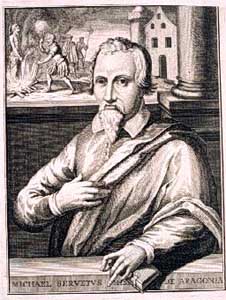 The following is part 7, concluding an excerpt from Presbyterians: Their History and Beliefs by Walter Lingle (John Knox Press, 1950). Click here to read part 1, part 2, part 3, part 4 ,part 5 and part 6.
Calvin and Servetus. It is sometimes said that John Calvin burned Michael Servetus at the stake. Servetus was burned at the stake just outside Geneva on October 27, 1553. John Calvin had some connection with the affair, and the part he played is not excusable in the light of the twentieth century, but it is not accurate to say that Calvin did the burning. Let us look at the facts.
Michael Servetus was a Spaniard with a brilliant but erractic mind. He renounced Roman Catholicism, but did not embrace Protestantism. He was a prolific writer and wrote vehemently against some of the most chedrished doctrines of Christianity. Both Catholics and Protestants considered his writings not only heretical but horribly blasphemous.
In 1553 Servetus was arrested by the Roman Catholic authorities in Vienne, France, and sentenced to be burned. While awaiting execution he escaped, and went direct to Geneva. With all the world before him, why did he go to Geneva when he had been warned to stay away? He knew that Calvin had many bitter enemies, and probably knew that at that particular moment the majority of the City Council were opposed to Calvin. The City Council had banished him once, and might be induced to do it again. Servetus probably went to Geneva to ally himself with the enemies of Calvin and thus help to overthrow Calvin and his work. When Calvin heard of the presence of Servetus in Geneva he reported the matter to the City Council. Bear in mind that Calvin was not a member of the City Council and that the majority of the Council were opposed to him. The Council arrested Servetus and put him on trial for heresy and blasphemy. John Calvin appeard as a witness against him.
After a long trial the City Council found Servetus guilty of heresy and blasphemy, and sentenced him to be burned. Accoring to the Old Testament, blasphemy was punishable with death. John Calvin urged the Council not to burn Servetus, but to take a more humane method of executing him. The Council refused. The whole story is a sad one, and Calvin does not appear at his best in it, but we should judge him by the light of the century in which he lived. The large majority of both Protestants and Catholics in that century approved of the death penalty for heresy and blasphemy.
Notwithstanding this blot and other blots on the name of Calvin which might be mentioned. Ernest Renan, the French skeptic and critic, had this to say aobut Calvin: “He succeeded more than all, in an age and in a country which called for reaction towards Christianity, simply because he was the most Christian man of his century.”
The Closing Years. The trial of Servetus was in reality a contest between Calvin and his enemies. Calvin won. The backbone of the opposition was broken. The last ten years were the most peaceful and in many respects the most fruitful years of his life.
John Calvin died on May 27, 1564, the year in which Willam Shakespeare was born. A noted scoffer intimates, in language which is none too reverent, that it was a blessed exchange for the world. But many informed and thoughtful people, with a full appreciation of Shakespeare, do not agree with the scoffer. Here is what Philip Schaff, the distinguised church historian, says: “Calvin’s moral power extended over all the Reformed Churches, and over several nationalities–Swiss, French, German, Polish, Bohemian, Hungarian, Butch, English, Scottish, and American. His religious influence upon the Anglo-Saxon race of both continents is greater than that of any native Englishman, and continues to this day.”


 The Misadventures of Captain Headknowledge
The Masculine Mandate, part 3
In this post, Richard Phillips gets into the details of his exposition and application of the “masculine mandate” in Genesis 2:15.
Richard Phillips: A couple of years ago, I was speaking at a men’s conference. So I’m sitting at a barber shop, and I’m reading ESPN Magazine. They have an article about Brian Deacon, this hooligan, X-game, trick-bike jumper. He’s like the Michael Jordan of that quasi-sport. He has a near-death crash. He got his girlfriend pregnant, and she’s off living with her parents. Meanwhile, he has this nationally televised crash, and he loses half his blood, and he goes to his girlfriend’s house to be medically rehabilitated. Meanwhile, she’s been converted to Christ at her parents’ church. He starts going to the parents’ church, and he gets converted. He heals up, and he comes back to the Metal Militia and starts leading a Bible study, and, one by one, leads most of these guys … he leads them all, one by one, to Christ.
Then I read another interview, where the typical thing’s happening: some guys saying, you know, “Dude, you’ve change! What happened to you? You’re Brian Deacon!” And Deacon says, “You know what? I’ve realized that I’ve got to become a man.” Now, the last thing this guy needs to be told is that being a man is going off on ego trips (see parts 1 & 2). You know, what he needs to be told is what his duty is as a husband and father biblically and what biblical love is. And biblically, what it means to be a covenantally faithful man. And I’m reading all this stuff, and I’m thinking, “I gotta write a book on this.”
Host: So let’s talk about that. The mandate involves two aspects, working and keeping; that’s what man was placed in the garden to do. Could you help us to understand what you mean by “work”? What is man’s specific duty in working, and what is he supposed to do?
Richard Phillips: Yeah, thanks. The two in the Hebrew, the two verbs are abad and shamar. Very simple, basic Hebrew words appear hundreds of times in the Old Testament. They’re kind of, you know, building block common verbs.
Abad, in a construction context, means “to build.” In a Temple context, it’s used of the priests serving the Temple. And in an agricultural setting, such as the garden, it’s used as farming. You know, cultivating, causing things to grow. And, what we see is, the man is given the mandate by God–and this is all in the agricultural meaning–what God calls a man to do. The first thing is, that he is to engage in labor that is to have the result of causing good things to grow. Now that alone is paradigm shifting.
Now one thing that strikes me is that in American culture, we don’t think of the man as the nurturer. Biblically he is. I’m not saying women aren’t nurturers. But I am saying that it is the role of a man in a relationship to grow and cultivate and engage in activity and ministry and labor that will cause others to grow. It may be to cause a business to grow. In marriage, it means your job is to, your wife’s heart is the garden in which you’re to have a spade and you’re to minister in that garden so that she grows spiritually.
I mean, you know, as a pastor, how often do I have someone come into my office and say, “Help, pastor. I’ve got a lot of problems in my relationship with my mother.” The answer is, virtually never. It may happen once or twice, you know. But how often do I have someone come and say, “Oh, my relationship with my dad…” All the time. Why? Because the father is the one through whose ministry we gain so much of our identity and who we are, and the cultivation of character and faith and all those things result from the man’s role.
And so, it’s enormously helpful for Brian Deacon to be told, “Hey, Brian, if you want to be a man now, what you are to do is, like Adam, you’re put by God to work the garden. To engage in sacrifical ministry that would cause us to grow. You’re to do that in all your relationships. And so the book works that out. First in principle, that in various relationships–marriage, fatherhood, church, friendship, those kinds of things.
The other verb is shamar. Another very common word. It means “to watch over and protect.” In Psalm 121, “the LORD will keep you.” The LORD watches over you, he neither slumbers nor sleeps. He will keep your life. That’s shamar. And so, Adam was placed by God into his covenantal world of relationships and duties, to cause the garden to grow and to keep the garden safe. And likewise, godly men are to engage in a life of labor, the effect of which is that those under our care are to be kept safe, and their growth will be nurtured by our ministry.
That’s it. Isn’t that beautifully simple?
Host: It is. It’s profound as well….
Richard Phillips: Profoundly simple, but it requires the redeeming work of Jesus Christ in my life fully expressing itself for me to do it. It’s anything but easy. But to me that is so helpfully clear: I’m a husband–what am I to do? My wife is to feel safe in our relationship, and I’m to make her–I’m to make her safe, to promote her safety, and I am to engage in ministry to her so that she grows.
Now you read Ephesians 5:22 and following and 1 Peter 3:1-6 and that is a good summary of what the apostles are teaching. So it’s a profoundly simple, but powerful paradigm.
Listen to Christ the Center episode #87 on The Masculine Mandate today!
Share this: