A Question for Presuppositionalists
 For those who may not be familiar with what “presuppositionalism” is, it can be described simply as the Reformed approach to apologetics (defense of the Christian faith). The New Dictionary of Theology explains: “The presuppositionalist endeavors to convince the unregenerate first by demonstrating that, on unregenerate presuppositions of chance occurrence in an impersonal universe, one cannot account for any sort of order and rationality. Next, he tries to show that life and reality make sense only on the basis of Christian presuppositions.” (see this link for citation)
I have not studied presuppositional apologetics personally to any extent whatsoever, yet. However, based on short definitions like the ones above, it occurred to me once upon a time, that since Edward F. Hills, author of The King James Version Defended is a graduate, not only of Yale, but also of Westminster Theological Seminary, and that much of Hills’ defense of the Textus Receptus (the popular name of the Greek text that underlies the King James Version New Testament) is written from a characteristically Reformed standpoint, that when he further makes his defense from what he calls “The Logic of Faith,” that this must be his way of applying presuppositional apologetics to the defense of the superiority of the Greek Text underlying the King James Version, as well as that translation itself.
My question for presuppositionalists who’ve read The King James Version Defended, therefore, is: Am I right? Was Hills a presuppositionalist, and is his so-called “Logic of Faith” a fair representation of the presuppositionalist apologetic, and is belief in the inherent superiority of the Textus Receptus therefore the consistently Reformed answer to the question, “Which New Testament text is closest to the original manuscripts?”
My personal short answer is, “I hope not.” I don’t really think the conclusion necessarily follows from the premise. I’m sure most presuppositionalists agree with me on this, and could probably give a better explanation as to why, and I’d like to see what you’d have to say on this topic. I’d also be interested in any King James Onlyist presuppositionalists out there (or perhaps more accurately, Textus Receptus Onlyist) who would answer yes to the question as stated in the previous paragraph.
Independent Baptist defender of the King James Version, Dr. David Cloud, has posted “The Testimony of Dr. Edward F. Hills,” in which Hills explains his journey to the position he defends. He writes that he was puzzled by Dr. B.B. Warfield, who was simultaneously perhaps the premier champion of the Westminster Confession of Faith, and an avid proponent of what Hills considered the textual criticism of theological liberalism. Hills explains that Warfield must have fallen prey to the false dichotomy between faith and reason, which he says Cornelius van Til taught him was begun by the medieval scholastic theologians. In this testimony, Hills does not state explicitly that he applied van Til’s presuppositional apologetic to this question, but what he does state explicitly does seem to say, at least implicitly, in my opinion, that this is just what he did.
What say you, Reformed presuppositionalists? Pro KJV/TR onlyists, or pro-modern textual criticism/modern versionists? I’m ready to learn.
The Rationalism of the “Biblicist”
 The April 25, 2010 episode of The Heidelcast, a weekly podcast by Dr. R. Scott Clark, Professor of Church History and Historical Theology at Westminster Seminary California, and writer of the Heidelblog, contains a discussion between Dr. Clark and Martin Downes, author of Risking the Truth, about how “biblicism” is fundamentally rationalistic, and so undermines the sole authority of Scripture, which it intends to uphold. What follows is a transcript of this short segment of their interview.
Clark: What happens when a fellow comes with his Bible open, as Faustus Socinus did (an anti-Trinitarian heretic)? He had his Bible open, and his uncle Laelius Socinus, managed to convince Heinrich Bullinger that he was basically orthodox. And so, both of these fellows said, “Listen, we believe the Bible, but we just don’t think that you’re getting it right. We’re more biblical than you. In fact, we want to get rid of all of this systematic theology and these confessions, and we just wanna follow the Bible.” What’s wrong with that approach, which scholars have called “Biblicism”?
Downes: The real problem is that, although it claims to be, upholding Sola Scriptura and the sole authority of Scripture, actually what’s really going on beneath that claim is a subtle form of rationalism.
Something that Jehovah’s Witnesses are always saying to people is, “Did you know the word “Trinity” isn’t in the Bible?” As if to say, “Ah, crums! It’s not there. Well, perhaps the idea isn’t really there.” Perhaps somebody invented that and imposed it upon the text.
I think what we find is that Biblicism demands that truth be stated in a certain way, and will not accept that we believe things, because of the express statements of Scripture, but also what “by good and necessary consequence may be deduced from Scripture” (Westminster Confession of Faith, chapter 1, section VI).
But it is very subtle, and I think that’s why it does take more people in. It’s an appeal to a standard of authority that we want to hold to whole-heartedly, but actually beneath that appeal, I think is a form of rationalism.
Clark: Doesn’t it also put the autonomous, individual Bible interpreter in charge of Scripture? And this is something of which Protestants are often accused, but it’s not really true. If someone pays attention to the history of Protestant theology, and the history of the Reformation, one would know right away that there was a huge difference between the Anabaptists, who were radicals and individualists and the Socinians, who were radicals and individualists…between them, and, the confessional Protestant Reformers, who actually worked within a churchly (ecclesiastical) context.
Downes: I remember once after an evening service, I chatted to a man at the door, and . . . I happened to mention what we are discussing—this particular issue—He said, “I’m not interested. That’s just a man made document.” But he wanted me to be interested in what he was saying, and his insights into the Scriptures.
So I said to him, “Look, why would I want to put aside a document that has churchly sanction, that represents the reflection from Scripture, and the thinking, not of an individual, but actually of the whole body of divines. And so, really what his claim was, “I’m not interested in what they think. I’m just interested in what I think. I just want you to believe what I’m saying. I struggle to find humility in that approach.
Clark: Not only is it arrogant, it’s essentially an Enlightenment-inspired, modernist approach to truth and error. At the end of the day, it’s not really God’s Word as understood and confessed by a body of believers, which is norming things, I’m norming things by my, private personal interpretation of Scripture. And so, at the end of the day, I, really, am the measure. I say I’m following the Bible, but I know better what the Bible says than anyone. And, unfortunately, I think, and maybe you’ll agree or not, I don’t know, that there’s a pretty radical misunderstanding of Sola Scriptura. What’s the real difference between Sola Scriptura as understood originally, and Biblicism?
Downes: I think it goes back to what you were saying about individualism. That it’s not seeing Christian belief in the context of the church, and the church is the pillar and ground of the truth, and maybe some of that is a fear of the Catholic element, with a large C and an R before it—maybe some of the squeamishness has to do with that—but I think fundamentally it is that individualistic mindset that it’s just me and my Bible. Well, it’s a big book. What does it teach? We ought to, if we are wise, consider very carefully two thousand years of Christian belief, in terms of the great creeds and the Reformed confessions.
My “Perfect Church” (With Apologies to My Current Church)

Redeemer Pres Exterior
I know the old saying, “If you find the perfect church, it’ll stop being perfect because you’re there,” or something like that. Well, I’ve been around the block a few too many times to think that there is such a thing as a church full of perfectly consistent Christians who always forgive each other, are loving, generous and caring, while at the same time utterly devoted to offering the purest, most biblically ordered and sincere worship of God. I may be a bit naive about some things, but when it comes to church, I’m . . . well, not so naive. But that doesn’t keep me from getting enthusiastic about church from time to time.
Perhaps a little closer to what I have in mind is the way people talk about “your own hell.” You know, some conceptualize hell by making it an infinite and eternal punishment of enduring whatever any given individual finds the most unpleasant or distasteful. Like hell for some people is lying on a bed of nails for eternity, for others it’s having to watch Family Matters reruns (I never did like that show), and still others may dread an eternity of reading poorly written blog posts, or something. But you get the idea. This is more analogous to what I have in mind when I say that this past Sunday, I visited what I consider to be “my perfect church.” It had just about everything I could ever ask for in a church (with very few exceptions).
In the world of debating the Reformed notion of the “Regulative Principle of Worship,” the matters that come under discussion are usually categorized in two ways: elements of worship (mandatory things the Bible requires:preaching, prayer, sacraments, etc.), and circumstances of worship (optional things utilized for practical reasons: choice of musical instruments, sound systems, carpet color, etc.). I think I’ll try to categorize the elements and circumstances of my own personal concept of the perfect church, which I discovered in Overland Park, Kansas at Redeemer Presbyterian Church.

Redeemer's Sanctuary (Not "Auditorium" or "Worship Center")
- Preaching that explicitly centers all exposition and application on the good news of Christ’s life, death and resurrection, with a minimum of autobiography, corny jokes, illustrations and sundry other rabbit trails.
- Weekly communion
- Long-winded prayers full of Scripture
- The predominance of classical, historic hymnody (I can tolerate a dose of contemporary music, as long as it’s done tastefully)
Circumstances (Icing on the Cake!)–
- Big, beautiful church architecture and a really cool pulpit (not a glorified music stand)
- Pipe organ accompaniment of at least the primary psalms and hymns sung by the congregation (okay, there were no pipes–just giant speakers, but the organ had the sound!)
- A book table full of Reformed literature
- A pastor who runs a Reformed blog
- Members who demonstrably care about me
Anyway, that gives you a pretty good idea of what gets me all giddy and makes me start speaking in terms of “the perfect church.” These were all to greater and lesser degrees present at Redeemer Presbyterian. I was even impressed by the hospitality of the couple in the pew in front of us with whom we “passed the peace” (my first time for that practice, but I’d heard of it from an Episcopal friend before). When they learned that we were from out of town to visit our daughter who attends UMKC, they gave us their name, phone number and address with an invitation to crash with them whenever we return to Kansas City.
Then there was the pastor and the preaching. First of all, when I was searching online for a church to visit last Sunday morning, I noticed on Redeemer’s webpage that their pastor is the man who runs the blog called “Reepicheep,” which I’d seen a few times before in the blogrolls of other blogs, but had yet to begin regularly following. Well that’s changed. When I shook his hand at the door on my way out, I told him I’d add him to my blogroll (see sidebar). As for the preaching, a thorough exposition and application of Philippians 2:9-11 on God’s and man’s response to the supreme humility of Christ sealed the deal (listen here). It was obvious by it’s predominance that the gospel is a priority for the preaching ministry of this church. If I lived in Kansas (or Kansas City, this would be the church for me). But I don’t, so it isn’t. But this is the heart of what I consider to be my “perfect” church.
P.S.–I would’ve taken more pictures like the tourist I was, but I was embarrassing my wife. 🙂
Jack Chick Earns the Respect of the Underground Comics Industry

Rare photo of the reclusive and elusive Jack Chick
I should probably save this for another time when I’ve got more time to write all that I have to say about Jack Chick and his world famous “Chick tracts,” (see his site, Chick Publications) but I can’t wait to at least show you the trailer for a documentary about Jack Chick and his comic books and comic book-style tracts. As it relates to me, Jack Chick is one of the instrumental causes of my dropping out of Bible College. I didn’t do my homework because I was too busy devouring his comics purchased from a nearby Christian bookstore.
Anyway, the following trailer features mostly the ways Chick’s views are poked fun of in the film, but if you ever get a chance to watch the documentary itself, as I did on the Documentary Channel a few days ago, you would see how much the filmmakers and even some of the non-Christian interviewees have for his comics as works of art. They say his work is even featured in galleries across the country and I think they said it even has a presence at comic book conventions and other such forums in which such material is auctioned. Jack Chick is collectible. All you fundies out there better hold onto at least a few copies of his tracts in case you need to cash them in once the economy completely collapses!
The picture to the right was found on the site of Catholic lay apologist Jimmy Akin’s website. He found it on the church website of an Independent Fundamental Baptist church whose pastor (right) has a testimony similar to that of the “Bad Bob” featured in the Chick tract of the same name held by the author (aka, Jack Chick himself, left). If you want to read about this picture and the hand-drawn portrait of Jack Chick at the Catholic apologist’s website, click here, here, and here. They make for fascinating reading, and serve as a little background info to some things I may share in a future post when I’ve got more time.
Below is the trailer to God’s Cartoonist: The Comic Crusade of Jack T. Chick.
Oh yeah, there are a few bios you will want to read on Jack Chick and his associates at Wikipedia in conjunction with this video:
Classic Video Of Dr. Michael Horton on The Agony of Deceit
The following line-up of videos features a series of classic interviews with a very young Dr. Michael Scott Horton promoting a now out-of-print book he edited on the Word of Faith movement (the so-called “prosperity preachers” or “faith healers”) called The Agony of Deceit. Please take the time to listen to the things Dr. Horton has to say in describing the content of his research and that of several other sound and prominent scholars, ministers and otherwise expert witnesses regarding the spiritual devastation that the blasphemous heresies of the Word of Faith movement has brought to unsuspecting souls around the world.
Another important work that the host promotes is A Different Gospel: Biblical and Historical Insights into the Word of Faith Movement, by former ORU adjunct professor D.R. McConnell, which identifies Kenneth “Dad” Hagin (so-called “Father of the Faith Movement”) as nothing more than the plagiarizing popularizer of the teaching of New Thought practitioner E.W. Kenyon (this article summarizes McConnell’s case).
These interviews were filmed perhaps around 1992. You can sense the excitment the host of this apparently low-budget Austin, Texas-based Christian cable program experienced to have the opportunity to host Dr. Horton as he relates to viewers like you and me “the agony of deceit.” I know this is old news, but so few believers have had the opportunity to give a hearing to material such as this exposing the depth of the heresy involved in the otherwise cartoonish movement that enters everyone’s homes through television, my desire is to do my small and feeble part in continuing to promote the truth, considering how disproportionately well-known are the propagandists of the positive-confession/prosperity gospel. How true it is that a lie is halfway around the world before the truth has got its boots on.
The Agony of the Health and Wealth Gospel, Part 1: Historical Roots of this False Religion
Part 2: Touch Not The Lord’s Anointed Gods
Part 3: Miracles For Money
Part 4: The Cult of the Tele-Evangelists
Part 5: Negative Positive Confession
Fundamentally Reformed Radio
 Bob Hayton, of the Fundamentally Reformed blog, which is featured in my blogroll, was interviewed yesterday on the Iron Sharpens Iron radio show regarding the theme of his blog, “Reforming Fundamentalism through Reformed theology.” Bod discusses the issues he has with the Independent, Fundamental Baptist movement in general, his experiences within it and as he and his brother were leaving it, and explains the key ingredient that makes Reformed theology such a draw: the gospel of Jesus Christ, not only preached to unbelievers for their justification, but also applied on a consistent basis to believers for their sanctification. The life, death and resurrection of the Lord Jesus Christ is the one thing that will free a believer, not only from the guilt of sin, not only the ongoing power of sin, as the believer is built up in the message of God’s grace in Jesus Christ, but also from the need for legalistic standards and divisive forms of “separatism.”
Also, ten minutes from the end of the show, you’ll be treated to my call-in question, and Bob’s insightful answer. Click on the link below to listen. Don’t be deterred by the Spanish language programming at the beginning of the podcast–Iron Sharpens Iron will begin directly…
\20100308–“Reforming Fundamentalism Through Reformed Theology\”
A Question of Chicken and Egg from John’s First Epistle
First John 5:1 reads “Everyone who believes that Jesus is the Christ has been born of God, and everyone who loves the Father loves whoever has been born of him.” Most contemporary fundamentalist and evangelical Christians miss the implication of the apostle John’s wording “has been born of God” as it relates to those who believe. Does this text imply that those who believe were first born of God? Does it therefore imply that regeneration precedes faith? Or must we deny this implication based on our preconceived notion that regeneration is not possible until after we make the right decision to choose to believe?
Reformed Baptist apologist, Dr. James White, has posted a short video explaining this passage in the light of the apostle John’s repeated use of the language “everyone who _____ has been born of God.” He explains that all agree that in the case of two other texts from the same epistle, 1 John 2:29 and 4:7, the apostle’s clear implication is that the action of the believer is the result, and therefore logically follows, the fact of his having been born of God. In these two passages, the actions are “practicing righteousness” (2:29), and “loving” (4:7). In other words, it’s easy to accept the idea that “everyone who practices righteousness has been born of God” at face value, and it is easy to agree that everyone who loves God and his neighbor is one who has been born of God. No one’s tradition teaches the contrary. However, when it comes to the exact same grammatical structure in the first verse of chapter five, we are told by many that we must not make the same inference that being born of God is the prerequisite of saving faith. Dr. White attempts to make the case that this is no more than reading one’s tradition into the text, rather than basing one’s interpretation of the verse on what the text demonstrably means. I agree with him. Watch the following video, and see if you, too, can agree with the apostle John that “everyone who believes that Jesus is the Christ has been born of God.”
The “Vile Pollution” of the Worship of God
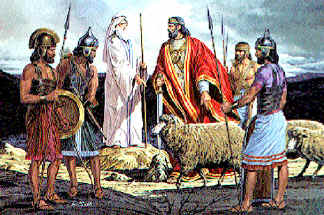
"What then is this bleating of the sheep in my ears...?" 1 Samuel 15:14
Need I point out that the following does not only apply to the sixteenth century Roman Catholic Church?
“Having observed that the Word of God is the test which discriminates between his true worship and that which is false and vitiated, we thence readily infer that the whole form of divine worship in general use in the present day is nothing but mere corruption. For men pay no regard to what God has commanded, or to what he approves, in order that they may serve him in a becoming manner, but assume to themselves a licence of devising modes of worship, and afterwards obtruding them upon him as a substitute for obedience. If in what I say I seem to exaggerate, let an examination be made of all the acts by which the generality suppose that they worship God. I dare scarcely except a tenth part as not the random offspring of their own brain. What more would we? God rejects, condemns, abominates all fictitious worship, and employs his Word as a bridle to keep us in unqualified obedience. When shaking off this yoke, we wander after our own fictions, and offer to him a worship, the work of human rashness, how much soever it may delight ourselves, in his sight it is vain trifling, nay, vileness and pollution. The advocates of human traditions paint them in fair and gaudy colours; and Paul certainly admits that they carry with them a show of wisdom (Colossians 2:23); but as God values obedience more than all sacrifices (1 Samuel 15:22), it ought to be sufficient for the rejection of any mode of worship, that it is not sanctioned by the command of God.” (emphasis added)
John Calvin, in his tract, “The Necessity of Reforming the Church” (cited from page 132 of Selected Works of John Calvin: Tracts and Letters, edited by Henry Beveridge and Jules Bonnet; Volume 1: Tracts, Part 1)
The Risk of Setting “Heart” Ahead of “Head”
 The following is a third generation post. I have nothing to add, but wish I had the credentials to actually write about such topics on my own without directing you elsewhere. But truth and quality sometimes dictate that I not attempt to take matters into my own hands.
The topic at hand is one that is utterly compatible with the theme of my blog: the sometimes false dichotomy between the head and the heart in matters related to Christian faith and life, and the havoc such dichotomies can wreak on the life of the church itself. Believe it or not, even in spiritual matters, some things are better left to the professionals.
Sean Michael Lucas, Presbyterian pastor in Hattiesberg, Mississippi, and former Church History professor at Covenant Theological Seminary in St. Louis, Missouri, has commented on an article written for the Nine Marks Ministries website, by Greg Wills, another Church History professor at Southern Baptist Theological Seminary in Louisville, Kentucky. Hence the three generations. The topic is how our current generation of the American evangelical church is in danger of degenerating into a new liberalism.
Wills gives us the narrative and diagnosis, and Lucas shows us how Wills’ proposals exemplify the risks of pitting the heart against the head. Some of it can be admittedly heady reading (especially regarding some of Lucas’ appeals to philosophy), but, as you read keep in mind that Merriam-Webster has a helpful website, as well as Wikipedia. These are usually all I ever need to keep up with what the experts with all the complicated terminology are trying to tell me, and I recommend their services to you. You will not regret the effort. But don’t worry, the gist is plain as day, even if you don’t want to tangle with the details.
I suppose it would be best to send you first to Lucas’ blog, to allow him to introduce you to the topic the same way I was. His post is called, “A New Liberalism?” and it links you to Wills’ article, “What Lessons Can We Learn From the History of Liberalism?”
Read and heed!
Hear Horton on Harried Haiti
In times like these, Biblical Christianity doesn’t only have to answer the biblical inquiry, “Why do bad things happen to good (bad or indifferent) people?” but also have to be able to explain why American Evangelicals with TV cameras persist in adding insult to injury to the suffering as they explain why God is judging them. Talk about taking religious liberty for granted…
Dr. Horton corrects Pat Robertson’s insensitive remarks about the Haitians’ alleged historic “pact with the devil” with the words of Jesus in his post, “Judgment, Fate or Providence in Haiti?” It’s a must read and it’s a must “Share.” If you’ve got an account on a social networking site, click the Share This link below Horton’s post and give the truth a fighting chance of catching up with the lie that’s doubtless bewitching and bemusing innocent bystanders around the world.
Will “Something Good Happen To” the Word of Faith Movement?

Oral Roberts, 1918-2009
So, the news announces that yesterday the pioneering faith-healer and televangelist and prosperity-gospel preacher, Oral Roberts, dies at the age of 91. I’m still kicking myself that as soon as I read Al Mohler’s interesting blogpost on Roberts yesterday, I should have set my DVR to record TBN’s Praise the Lord program, to catch whatever eulogizing and retrospectives were going on during the day of the announcement of his death. In my childhood, my father watched Oral Roberts and Jimmy Swaggart (and Garner Ted Armstrong) rather than go to church and risk exposure to hypocrites at church (I suppose heretics on TV are less risky than the immature orthodox). Yet, being raised to respect Christ (which he tries to do in his own little ways), he does read his Bible and keep an eye on some Christian television.
Anyway, here’s hoping that with the passing of a pioneer like Oral Roberts (here’s his Wiki entry, if you’re interested), that something good will happen to the movement as a whole with a younger generation at the helm. I know that apart from the gracious intervention of God, this is a pipe dream, but, hey, look how the Worldwide Church of God turned out. There is precedent! But as the apostle James writes, “you do not have because you do not ask” (James 4:2).
For those who’d like to learn a little about the origin and teachings of the Word of Faith movement, you should read A Different Gospel, Christianity in Crisis: 21st Century, and these Wikipedia articles: “Word of Faith,” and “New Thought.”
Better Than Thanksgiving Day Football (If You’re Me, That Is…)!

Dr. James R. White's Reformed Twin
As many of you know, and a few others may be disappointed to learn, I’m a life-long Independent Baptist (though currently a member of a Southern Baptist church, by God’s wise and inscrutable providence) who has adopted Presbyterian views. That includes the Presbyterian view of infant baptism. Ever since having adopted this view, in the interests of “givning God a chance” to “make my life easier,” I’ve from time to time done a little more reading on the case for believer’s baptism (aka, credobaptism) as opposed to the Reformed doctrine of infant baptism (aka, paedobaptism). I’ve done so with an open mind, knowing that I’m not the most brilliant theologian in the world, being, after all, an IFB Bible college drop-out. I may just want to believe in paedobaptism, because there’s so much I disagree with (and/or dislike) about the Baptist tradition, so if I’m going to expect my wife and kids to adopt the Reformed view of paedobaptism (which they’ve yet to do, again in God’s wise and inscrutable and gracious wisdom), I’d better be right. So far, every time I’ve entered into this debate with an open mind, I find myself

Dr. R. Scott Clark's Baptist Twin
becoming more and more thoroughly convinced that the Reformed view of paedobaptism is the more biblically consistent view. But, I keep reminding myself, I’ve yet to listen to one of my favorite Reformed Baptists, Dr. James White, debate the subject. Dr. White is one of the more relentless, aggressive and capable apologists and debaters I’ve ever seen. If anyone could dissuade me from the case for paedobaptism, it would likely be him.
It looks like I may soon get my chance.
I just finished reading Dr. James White’s post, entitled “R. Scott Clark and ‘Reformed,'” and Dr. Clark’s response, “Post-Thanksgiving Cartoons: Reply to James White.” White attempted to demonstrate the fallacy of Clark’s refusal to accept Baptists under the umbrella “Reformed” on the basis of his contention that paedobaptism is essential to being Reformed. Naturally, White believes for obvious reasons that he’s more thoroughly Reformed than his Presbyterian and Continental Reformed brethren. Clark believes Baptists may have an affinity for “the five heads of doctrine of the Synod of Dort” (popularly known as the five points of Calvinism), but denies they’re Reformed. For the record, having heard Dr. Clark’s teaching and gotten a glimpse of his personality from interviews and his Facebook page (for example, his status update at one point yesterday read, “I’m not passive-aggressive, I’m just aggressive”), leads me to believe that Dr. R. Scott Clark may just be Dr. James R. White’s Reformed twin (I’ve always contended that my friend, Gage Browning, is White’s Presbyterian twin–there is a difference). It’s all about personality and hairdo. I guess that would make Gage Dr. Clark’s Presbyterian twin, too–but I digress.
Anyway, having read both of these esteemed theologians’ posts, I just wanted to put out there that my appetite is officially whetted for a new debate on credobaptism versus paedobaptism between Drs. James R. White and R. Scott Clark. Who’s with me?
When “Whosoever” Misseth the Point

Some of us think the chorus in "Whosoever Meaneth Me" sounds like the theme to Hogan's Heroes. Visit http://free-loops.com/download-free-loop-3481.html to listen and compare to the hymn's midi below!
For God so loved the world, that he gave his only begotten Son, that whosoever believeth in him, should not perish, but have everlasting life. (John 3:16 KJV)
For God so loved the world, that he gave his only Son, that whoever believes in him should not perish, but have eternal life (ESV)
For God loved the world in this way: He gave his one and only Son, so that everyone who believes in him will not perish but have eternal life. (HCSB)
The first citation of John 3:16 is from the King James Version, which contains—and established—the traditional wording of this verse, no less in the case of the highlighted phrase in question, “whosoever believeth.” The second updates, but carries this traditional translation forward, while the third, from the Holman Christian Standard Bible (HCSB), seems to have come a little closer to the literal meaning of the verse.
This can be seen by examining the original Greek, from which all three versions are translated: pas o pisteuo. Pas means “all,” “any,” “each,” “everyone,” “all things,” etc., in individual contexts like this one, but it is usually found in collective contexts, where it means “some of all sorts.” This is the word that is translated “whosoever” in the King James Version, “whoever” in many modern translations like the ESV, and “everyone” in the HCSB. The NET Bible has some helpful notes in this regard, which may be accessed here.
In the great debate between Calvinists and Arminians about the extent of Christ’s atonement, the latter camp has, in an effort to emphasize the fact that Jesus died for everyone without distinction, turned the KJV’s “whosoever” into three words: “For God so loved the world, that he gave his only begotten Son, that Who … So … Ever (!). With often little regard for the context of this verse, Arminians will focus on this one little three letter Greek word, and seemingly make it the point of the passage, which it is not.
Pas is not the only word in this phrase. “Everyone” in this context does not stand alone. It is modified by the action taken by each member in the group of people so identified. The action they take is pisteuo: “believing.” So, the first thing we must clarify is that this verse is not intended to state or imply the number of people for whom Christ died; it merely expresses the purpose behind the Father’s giving of the Son to the world: to grant eternal life to pas (everyone) o (who, or that) pisteuo (believes).
On the Nov. 17 episode of The Dividing Line, Dr. James White explained why “whosoever,” “whoever,” and “everyone” are used to translate pas. He said that when pas is used with a singular participle (in this case, “believes”), what is being communicated is a group that is defined by the action in that participle. Since the emphasis of the verse is on the mutual activity of the group, rather than the indistinct universality of the group itself, perhaps it may help direct our attention to “believes” if translators rendered pas o pisteuo as “all those who believe,” or just “those who believe.” But I’m no scholar.
Therefore, pas o piteuo makes neither of the following Arminian emphases:
- It does not mean that God sent Jesus to propitiate the Father in his death for everyone indiscriminately;
- It does not mean that everyone indiscriminately has the inherent moral ability to believe.
What this phrase does mean, though, is that God loved the world by sending his only Son in order to grant eternal life to those, and only those, who actually come to faith. If God sent his only Son to die for everyone indiscriminately, then everyone indiscriminately would come to faith, for he would have, with the atonement, granted faith to everyone indiscriminately. If everyone indiscriminately had the inherent moral ability to obey the command to believe, then God’s Word would be untrue (Romans 8:7; Ephesians 2:8,9).
Let us not read things into the Word of God which are not there. John 3:16 is not a proof text for general redemption (the doctrine that Christ died for everyone indiscriminately), nor a view of human sinfulness that leaves room for some amount of inherent righteousness that enables the self-determining sinner (which creature does not exist) the ability “of his own free will” to “decide to follow Jesus” without the prior work of the Holy Spirit’s effectual calling (Romans 8:30).
Are you one of those who’ve come to believe in the one and only Son of God? Then you have received the Father’s saving love in the gift of his Son who became incarnate for you, obeyed God’s Law perfectly for you, died suffering the consequences of your sin, and rose on the third day that you also might be raised up to eternal life spiritually now (regeneration), and physically upon his return (resurrection). I urge you to do what you can to reciprocate his love by Spirit-empowered love for him and your neighbor. We love because he first loved us.
“Whosoever Meaneth Me?” (audio) “Whosoever” means all those, and only those, who believe.
Reformation Day is Coming
A few years ago, I was invited to speak on Martin Luther at church. The following link is a Power Point presentation I made for the event. In the sidebar you can find the audio if you’d like to listen and follow along. Just right click on the slideshow link to open it in another tab or window so you can keep this window open to hear the audio, too. I’d make a bigger deal about it, but this being Calvin’s 500th anniversary year, I’m actually a little done with Reformer retrospectives. But I hope you enjoy mine!
If you prefer, however, you can view the slides and read the text here, and here.
Or just click on Luthermania in the category cloud in the sidebar and browse all my Luther posts and read whichever you prefer.
Happy Reformation Day!


 The Misadventures of Captain Headknowledge
Because the American Church is Losing Its Mind…
According to Jesus, the words of Scripture simply are identical with the word of God. The apostle Paul said that, “the Scriptures are breathed out by God,” and Peter said that, “no prophecy ever came from human initiative, but men spoke from God.” For its first sixteen centuries the Christian church enjoyed unanimous consensus concerning the nature of Scripture. This view came to be known as “verbal-plenary inspiration.” This means that the Bible is breathed out by God not only in its intended meaning but in its very words. In spite of all the other differences the Protestant Reformers and Rome agreed on this essential point. But this consensus was challenged by radical Protestant movements. The Protestant Reformers themselves faced the challenge of the radical Anabaptists who valued a supposedly “inner word” in their hearts, a direct immediate, and private revelation over the external word conveyed through Scripture and preaching. The Reformers called this “enthusiasm” meaning literally, “God withinism.” Like Adam after the fall our natural tendency is to want to bring ultimate authority inside our own hearts and minds under our control, instead of hearing an external word of command and promise from our covenant Lord.
By the time of the Enlightenment a full assault on the reliability, authority, and inspiration of Scripture penetrated theological academies and churches. Sometimes it came in the form of denials of any need for special revelation since general revelation and reason were thought to be sufficient. But in the Romantic era, through liberal theologians like Friedrich Schleiermacher, challenges came in the form of making anything and everything a medium of inspired utterance. Every impulse from the inner voice of the pious soul could be regarded as inspired. In Protestant Liberalism, then, we meet the convergence of radical Protestant enthusiasm and rationalistic criticism of God’s miraculous intervention. As a result the Bible came increasingly not as a written treasure of God’s communication to us, but as a record of our attempts to express in words that universal religious experience that is common to everyone. In this perspective inspiration doesn’t come to us from outside of ourselves as a characteristic of the Biblical texts, but from within individuals and communities and their spiritual experience.
Historically Evangelicals were known for defending a high view of Scripture against these challenges. The giants of old Princeton: Charles Hodge, A.A. Hodge, B.B. Warfield, helped to shape a new generation of conservative Protestants as mainline Protestantism became racked with debates over inspiration. Led by Carl Henry, John Stott, F.F. Bruce, and many other theologians and Biblical scholars, Evangelicalism provided a sustained defense of Scripture with two generations of fruitful successors. But today the old arguments against the classic Christian view of Scripture are being retro-fitted with new lingo and updated arguments. Even within Evangelical circles there is a growing tendency to treat the Bible more as a record of the evolving religious experience of the community rather than as a revelation from heaven through human agents. In this program we will unpack the meaning of Biblical inspiration and take a look at some of the challenges that we face today.
Share this: