Memoir of the Rev. John Brown, part 1
Brown’s Self-Interpreting Bible (1859) contains an extensive biography of the editor. It’s a great story, but it’s going to take quite a while to get the entire thing transcribed and posted. In the meantime, I’ll be mixing it up a little with other features from my new favorite study Bible. The author of this biography is not credited. But you can download Robert Mackenzie’s 1918 biography, John Brown of Haddington, in a 178 page PDF file from Still Waters Revival Books for 99 cents at this link.
The REV. JOHN BROWN was born in the year 1722, at Carpow, a small village in the parish of Abernethy, and county of Perth. His parents ranked in that class of society who earn their bread by the sweat of their brow. His father could boast of no rent-rolls, nor had he any title of honour, save that of an honest man and an industrious mechanic, who, during the greater part of his life, laboured in the profession of an operative weaver. Though destitute of all the advantages arising from a regular education, he was nevertheless a man of considerable intelligence, moral worth, and Christian sincerity. He made conscience of keeping up the worship of God in his family, and set a Christian example before them, though living in a neighbourhood remarkably careless of these things. His external circumstances were so narrow, that it was little he could afford to promote the intellectual improvement of his son; so that the subject of this momoir found his situation in this respect but little superior to that of his father. He was sent to school; but the time allowed him to acquire the elements of reading, writing, and arithmetic, was so very short, that nothing but an excellent genius, and the most intense application, could have enabled him to attain the ordinary education of the lowest orders in the country. This, however, with one solitary month which he bestowed on the Latin, and that without the consent of his parents, appears to have been all the regular education he ever received, till we find him studying philosophy and divinity under the superintendence of the Rev. Ebenezer Erskine and James Fisher. It does not appear that his father ever intended him for the church, or even contemplated the possibility of his accomplishing such a design; though the strong propensity of his mind to learning, and particularly to that species of learning the nearest allied to divinity, seems to have suggested to his mother the possibility, that the day might come when his literary predilection might find room for its gratification in the service of the church; and often and again has she pictured to herself that happy day, when her darling child should emerge from his obscurity, clothed in the emblems of the most honourable employment—an ambassador of the Prince of Peace. In the mean time, his personal piety, the most important of all the prerequisite qualifications for an office so sacred, afforded her the lively hope that his labours, should her ardent wishes be ever realized would not be in vain in the Lord. In a short narrative of his experiences written by himself, Brown acknowledges the delight which he had while at school, in committing to memory the Catechisms of Vincent, Flaw, and the Westminster Assembly; and the profit he afterwards derived while yet a boy, from the perusal of the Bible, Rutherford’s Letters, and Gouge’s Directions how to Walk with God, His God was preparing him inconsciously for the service of Christ. He had separated him from the womb, and was even now calling him by his grace, (Gal. i. 15.) that he might reveal his Son in him, and send him to preach. In the same memoir he records the solemn impressions made on his young mind, by witnessing the dispensation of the Sacrament, and listening to the addresses delivered during the service; and, from his experience of profit argues against the impropriety of excluding children from witnessing a service so calculated to engage the affections. This exclusion appears to have been practiced in the Church of Scotland at the commencement of last century; and was perhaps a remnant of Episcopal feeling, remaining after the restoration of Presbytery. “About the eighth year of my age,” says he, “I happened, in a crowd, to push into the church at Abernethy, on a sacrament Sabbath. Then it was common for all but intended communicants to be excluded. Before I was excluded I heard one or two tables served by the minister, who spake much to the commendation of Christ, which in a sweet and delightful manner so captivated my young affections, as has since made me think that children should never be kept out of the church on such occasions.”
“Bunyan, Brown and Boston”

John Brown's Self-Interpreting Bible (1859)
“For now I’m grown sae cursed douce
I pray and ponder butt the house;
My shins, my lane, I there sit roastin’,
Perusing Bunyan, Brown, an’ Boston,”
These lines are from a Robert Burns poem of 1789 entitled, “Epistle To James Tennant of Glenconner.” (The rest of his poetry is linked to from this page) The final line of this excerpt features the names of three figures from church history: John Bunyan, John Brown, and Thomas Boston. This poem references these writers in passing, highlighting what household names these three were in the eighteenth century.
Many of us are already familiar with the first, John Bunyan, seventeenth century Baptist preacher, who penned Pilgrim’s Progress during a twelve year sabbatical in jail. The third figure, Thomas Boston, may be less familiar nowadays, but he still has currency among readers within the Reformed tradition. He’s the author of The Fourfold State of Man. But the least familiar of these to modern Americans (perhaps even most Presbyterian and Reformed Americans) is the second figure, the Reverend John Brown of Haddington. The volume that elevated John Brown to household name status was his then-widely read Self-Interpreting Bible. Originally published in 1778, it went through at least 26 known editions.
 I recently came into possession of the 1859 edition. It’s in very good shape, and I hope I’m able to preserve that condition as I regulary mine it’s pages for it’s amazing lithographs and it’s even more amazing Reformed study notes, devotional applications and indices. I found it at a local antique store, and purchased it for my wife (and, of course, myself) as a gift for a significant milestone birthday that shall remain confidential. This is an appropriate gift for her because we share a love of old books and lithographs. The extensive study notes are more of interest to me, but she enjoys listening to them as I read them aloud to her on occasion.
So far, I’ve found little online about the book, but there was one very informative article that will make many of you desire along with me that this Reformed study Bible would find a publisher that would reintroduce it to the modern world during this period of renewed interest in Reformed theology. Since I’m not a publisher, and since this book is so old it’s bound to not be under any copyright restrictions, I’ll begin posting freely from it from now on for who knows how long. There’s so much wonderful material in here that I want to share with you, so subscribe to this blog either by email or RSS feed, and keep up with every entry. I know I’m not the most regular blogger, but now that I’ve got an antiquarian Bible full of stuff you’ve likely never read, I’ll be doing so more regularly.
The article “John Brown’s Bibles” may be read at this link; John Brown of Haddington’s Wikipedia entry may be read here, but I’ll be posting even more detailed biographical information about him in the days and weeks to come from the pages of his claim to fame. Banner of Truth Trust sells Life of John Brown with Select Writings.
If you browse through online Reformed booksellers, you will encounter a later theologian named John Brown who wrote many exegetical commentaries. I ordered his commentary on Galatians recently thinking it was the Brown of Haddington, only to be disappointed upon its arrival. But that’s alright, it looks like it’ll be a useful help itself. You can read an interesting article about the later John Brown here.
Understanding KJV-Onlyism
 Understanding Our Times with Kevin Thompson has invited Bob Hayton of the blogs Fundamentally Reformed, KJV-Only Debate, and RE:Fundamentals to guest host the show tomorrow night at 5pm central time. It will be a call-in discussion hosted by Bob and his compatriot in Debating KJV-Onlyism, Damien Garofalo. Bob has been interviewed before about Fundamentalism and his journey to Calvinism on Understanding Our Times as well as Iron Sharpens Iron (a traditional radio show out of Long Island, NY–listen here).
Here’s Bob’s announcement if you desire more information.
Natural Law and the Current Fight for Civil Rights
Natural law is said to have been historically the basis on which previous generations stood in order to expand civil rights to previously disenfranchised groups like women and African Americans, among others. Provoked by the recent overturning of “The California Marriage Protection Act” (the famous “Prop 8”–see page 49 of this link), Church historian, Dr. R. Scott Clark, argues that the current fight to win civil rights for unrepentant sodomites, euphamistically psychologized today as homosexuality, and the right of this group to enter into legally sanctioned relationships that bear all the benefits–along with the title of “marriage”–stands on arguments contrary to the dictates of natural law. I highly recommend that you read the straight talk in Dr. Clark’s Heidelblog post, “Sexual Liberation, Natural Law, and the Modern Resistance to Fixed Moral Norms.”
President Reagan’s “Evil Empire” Speech
This week, I’m on vacation in California. Today, I’m about to visit the Ronald Reagan Presidential Library in Simi Valley. Here’s their website; here’s their YouTube page; and here’s Reagan’s famous “Evil Empire” Speech…
R.C. Sproul’s “Throwback Theology” Is Cool Again
The Orlando Sentinel featured the resurging influence of Dr. R. C. Sproul in this era of what Time Magazine called “The New Calvinism.” The “emerging” generation of twenty- and thirty-somethings don’t have to settle for Christianity compromised by postmodern philosophy and innovation…” A generation raised in the come-as-you-are philosophy of religion is returning to the Sunday-best religion of its grandparents.”
Read the Orlando Sentinel’s article entitled “Sanford evangelist Sproul influences a younger generation of conservatives.” Don’t miss the video they included featuring Sproul discussing the theological and practical reasons for worshiping in a gothic church building.
R. C. Sproul’s Ligonier Ministries website may be found here…
Saint Andrews Chapel in Sanford, Floriday may be found here.
WHI on the Effects of eDistraction
This week’s episode of the White Horse Inn radio show featured an interview with Grove City College Media Ecology professor T. David Gordon. Gordon is the author of two books that are of special interest to this blogger and will be hopefully to his readers also. The books are Why Johnny Can’t Preach (2009) and Why Johnny Can’t Sing Hymns (2010).
Why Johnny Can’t Preach is “an analysis of shifts in dominant media forms and their effects on the sensibilities of the culture as a whole. Many of those shifts have profound, and unfortunate, effects on preaching.” About Gordon’s newer book, Why Johnny Can’t Sing Hymns, the publisher’s website has this to say:
Changes in music have affected the way we think, the way we worship—even the way we are able to worship. We are steeped in a culture of pop music that makes other genres seem strangely foreign and unhelpful. Worship has become a conflict area, rather than a source of unity.
T. David Gordon looks at these changes in worship and not only examines the problems, but also provides solutions. They are solutions of great importance to us all—because how we sing affects how we live. Dr. Gordon not only shows the problems, he also provides solutions – it’s important, because how we sing affects how we live.
The White Horse Inn blog has also posted additional resources on the current phenomenon of media distraction and its effect on our minds, as Christians or otherwise, let alone culture at large (see blogpost here).
Get A Copy While You Still Can!
Apparent Danger author, David Stokes, has posted that his great new book about J. Frank Norris is now being picked up by Random House Publishers to be released next year, possibly under a different title. Now it’s time for him to move some merchandise. These original editions may just be collectibles some day. They certainly are for some of us here in Fort Worth, Texas. Read all about it over at his blog.
The Caffeinated Captain!

I know it’s been a few weeks, but I just had to share one of the two coffee mugs my wife got me for Father’s Day. Does she love me, or what?
“You Either Love Him Or You Hate Him”. . .
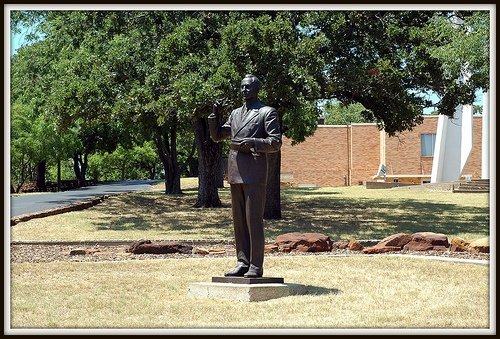
Statue of J. Frank Norris on the campus of Arlington Baptist College
. . . this is the kind of sentiment that a character like J. Frank Norris draws. For those whose lives were changed for the better, it seems the man can do no wrong, and watch out if you try to accurately paint a picture of such a saint–the way the Bible portrays it’s saints–warts and all. With Norris, most of those folks have gone on to their reward, as has their hero. But there of course remains a faithful remnant.
The segment of the fundamentalist independent Baptist movement that Norris spearheaded remains more or less the home of the majority of Norris’ faithful followers, but there are exceptions. There remain a few who are and have always been, members of First Baptist Church of Fort Worth, who, in the light of the publication of David Stokes’ work of narrative non-fiction on the life and ministry of J. Frank Norris and especially his murder trial, Apparent Danger, are unhappy that Norris’ warts are portrayed as prominently as they are. Back in June, one such member wrote on “J. Frank Norris’ lasting influence.” To Melissa Easter, Norris has had a lasting influence on several generations of her family. Without challenging Stokes’ facts or his documentation thereof, Easter was compelled to remind her Fort Worth neighbors there was lasting spiritual fruit that was borne through the ministry of J. Frank Norris, her family among them. Concluding her defense, Easter writes:
I do not know everything. But what I do know and what I believe is that J. Frank Norris had a good heart and a passion for God. Otherwise my great-grandparents would not have named my grandfather after him. Otherwise my family would not have attended that church after moving from Oklahoma. Otherwise my grandfather would not have asked J. Frank Norris to officiate his marriage to my grandmother.
It is unfortunate that Norris was involved in such an incident as that of July 1926, but that event should not overshadow the fact that he helped lead many people to the saving knowledge of Jesus Christ. I’m sure he asked the Lord for forgiveness, and, in my opinion, judgment was God’s alone to make.
Why is it that after so many years someone has seen fit to stir the pot once again? It is a futile matter; it brings up hurt to those who view J. Frank Norris in a positive light and potentially turns others away from the church.
Perhaps then we should all spend more time trying to bring people to the kingdom of heaven rather than shine light on an 84-year-old blemish.
Can you write a book that tells the whole truth about a man while there are still people alive who don’t want the whole truth to get out and complicate their fond memories? Not without criticism. But I believe it’s safe to say that David Stokes was aware of this fact and was thoroughly prepared to deal with it. Evangelism notwithstanding.
Jesus Storybook Bible as a bible study material (via Mission NPIC)
The next time you’re in a Christian bookstore, see if you can find this book on their shelves. If so, look through it and you’ll see why this story makes perfect sense. I recall seeing a blogpost back when this book was first published that quoted the author’s pastor, Tim Keller, as saying that every pastor should read this book, because it would improve their preaching. It really is true!

via Mission NPIC
Meet the Godfather of Fundamentalism, J. Frank Norris
Fairfax, Virginia Baptist Bible Fellowship local church pastor David Stokes grew up as a member of Detroit’s Temple Baptist Church, not twenty years after J. Frank Norris pastored that church at the same time that he pastored First Baptist Church in Fort Worth, Texas. In his day, Norris was known as the “Texas Tornado,” and the “Pistol-Packing Parson.” The memory of J. Frank Norris casts a long shadow for those whose lives were touched by his sensationalistic and controversial ministry. It must be as true for those like Stokes who grew up in the decades following Norris’ death, as it is for us down here in Fort Worth, who boast of relatives with stories of personal connections to the famous fundamentalist firebrand. For example, my own mother grew up playing with Norris’ grandson, George. He was my mother’s best friend’s boyfriend. My great-grandmother hosted the visiting preacher at her house, where lively discussions are said to have ensued between Norris and my great-great grandmother, charming them with the admission that “the only person who could ever change his mind was Mrs. Freeman.” Not only that, J. Frank Norris even performed the wedding ceremony for my first wife’s grandparents. For better or worse, J. Frank Norris is one of the more colorful cast members in the dramatic history of Fort Worth, Texas. Featuring his battle with the Southern Baptist Convention over Baylor University’s teaching evolution and his own personal war against corruption in local politics as well as the Prohibition-era liquor trade itself, I’ve always said, even as a one-time devoted follower, that the life story of J. Frank Norris would make a great gangster movie!
It looks like the novel on which that movie could be based has just been written by David Stokes. The book is called Apparent Danger: The Pastor of America’s First Megachurch and the Texas Murder Trial of the Decade in the 1920’s. Just a couple of weeks ago, Stokes held a book signing at Barnes and Noble just a few blocks away from the site of FBCFW during Norris’ ministry. On his Facebook page, Stokes reports that about a hundred people turned out for a book and an autograph, and even an unnamed “very nice” 91 year-old former associate of Norris protested his book by passing out a pamphlet with the title “The Real J. Frank Norris.”
My only regret is that I first heard about the book the day after the signing. But now I have my copy, and I’m currently reading it aloud to my wife so that we might enjoy it together. Enjoying it, we are. I let Bob Hayton of the blog Fundamentally Reformed know about it, and he said he plans to review the book on his blog after he reads it, to which I will dutifully link you when it’s posted. But in the meantime, allow me to whet your appetite for the book with the following trailer. If you’ve never heard of him, or if you’ve always known about him–love him or hate him, you’ll be both shocked and in awe of the story of J. Frank Norris and the trial that failed to sentence Norris to “Sparky,” the state of Texas’ newly acquired electric chair for the death of D.E. Chipps.
Should 1 John 5:7 Be In The Bible?
Interested in learning more? Select from this list of articles relevant to 1 John 5:7 at Bible.org.
A Question for Presuppositionalists
 For those who may not be familiar with what “presuppositionalism” is, it can be described simply as the Reformed approach to apologetics (defense of the Christian faith). The New Dictionary of Theology explains: “The presuppositionalist endeavors to convince the unregenerate first by demonstrating that, on unregenerate presuppositions of chance occurrence in an impersonal universe, one cannot account for any sort of order and rationality. Next, he tries to show that life and reality make sense only on the basis of Christian presuppositions.” (see this link for citation)
I have not studied presuppositional apologetics personally to any extent whatsoever, yet. However, based on short definitions like the ones above, it occurred to me once upon a time, that since Edward F. Hills, author of The King James Version Defended is a graduate, not only of Yale, but also of Westminster Theological Seminary, and that much of Hills’ defense of the Textus Receptus (the popular name of the Greek text that underlies the King James Version New Testament) is written from a characteristically Reformed standpoint, that when he further makes his defense from what he calls “The Logic of Faith,” that this must be his way of applying presuppositional apologetics to the defense of the superiority of the Greek Text underlying the King James Version, as well as that translation itself.
My question for presuppositionalists who’ve read The King James Version Defended, therefore, is: Am I right? Was Hills a presuppositionalist, and is his so-called “Logic of Faith” a fair representation of the presuppositionalist apologetic, and is belief in the inherent superiority of the Textus Receptus therefore the consistently Reformed answer to the question, “Which New Testament text is closest to the original manuscripts?”
My personal short answer is, “I hope not.” I don’t really think the conclusion necessarily follows from the premise. I’m sure most presuppositionalists agree with me on this, and could probably give a better explanation as to why, and I’d like to see what you’d have to say on this topic. I’d also be interested in any King James Onlyist presuppositionalists out there (or perhaps more accurately, Textus Receptus Onlyist) who would answer yes to the question as stated in the previous paragraph.
Independent Baptist defender of the King James Version, Dr. David Cloud, has posted “The Testimony of Dr. Edward F. Hills,” in which Hills explains his journey to the position he defends. He writes that he was puzzled by Dr. B.B. Warfield, who was simultaneously perhaps the premier champion of the Westminster Confession of Faith, and an avid proponent of what Hills considered the textual criticism of theological liberalism. Hills explains that Warfield must have fallen prey to the false dichotomy between faith and reason, which he says Cornelius van Til taught him was begun by the medieval scholastic theologians. In this testimony, Hills does not state explicitly that he applied van Til’s presuppositional apologetic to this question, but what he does state explicitly does seem to say, at least implicitly, in my opinion, that this is just what he did.
What say you, Reformed presuppositionalists? Pro KJV/TR onlyists, or pro-modern textual criticism/modern versionists? I’m ready to learn.


 The Misadventures of Captain Headknowledge
Rev. John Brown’s Original Preface
Title Page to Brown's Self-Interpreting Bible
The following is the original preface to Rev. John Brown’s Self-Interpreting Bible, in which he explains the various features he’s included, and shows how they will aid the reader in understanding and profiting spiritually from the Word of God. I’ve highlighted the features as they occur throughout. The rest is original to the editor.
My intention in the coming posts will be to demonstrate to varying degrees, each of these features, along with pictures of the numerous beautiful lithographs that are found along the way.
PREFACE TO THE ORIGINAL EDITION
Not to depreciate the valuable commentaries of Pool, Patrick, Clarke, Henry, Burkitt, Gill, and Doddridge, &c., but to exhibit their principal substance with all possible advantage, in a manner that might best comport with the ability and leisure of the poorer and labouring part of mankind; and especially to render the oracles of God their own interpreter, and enable every serious reader to judge for himself what doctrines ought to be believed, and what duties practiced by the Christian, are the avowed aims of this publication.
In the copious INTRODUCTION, the principal proofs of the Divine Authority of the Old and New Testaments, and the rules necessary to promote the profitable perusal of the oracles of God therein contained, are largely exhibited. The connected scheme of the Hebrew Laws, and their evangelical signification,–and of the fate of nations, narrated or predicted in Scripture, as subservient to the glorious work of our redemption,–together with the large Chronological Index,–form a summary of the most celebrated labours of the learned world on these diversified subjects. An accurate attention thereto will, through the blessing of God, greatly assist in searching the Scriptures with success.
The contents of the sacred books, and their respective chapters, are an accurate, full and explicatory representation of their subject. Properly attending to these, the reader must discern of whom, or of what, the Holy Ghost there speaks, and understand the passage accordingly. He may easily fix in his mind a general, but distinct view of the whole system of inspiration; and thus be capable, with the utmost readiness, to find out or compare whatever passages of Scripture he may desire.
The EXPLANATORY NOTES are chiefly confined to the figurative, the prophetic, and the practical parts. Here the obscurity of Scripture, or the importance of faith and holiness, chiefly required them.
In our Saviour’s delightful discourses, and the epistles of his inspired Messengers, our holy religion is most fully delineated; and there the explication is peculiarly extensive, and attempts to exhibit the substance of many learned and expensive commentaries, in a manner which, attending to the beautiful connexion, clearly unfolds the scope and meaning of the Spirit of God.
A particular and lively application of divine truth to the heart, and an unspotted holiness of conversation, being the immediate end of God’s revelations to men, the contents of each chapter, which are often in an explicatory manner, are in the Reflections practically summed up, and directed home to the reader himself, for enlightening his understanding, awakening his conscience, warming his heart, and for directing and animating his practice.
An exact knowledge of the seasons in which the oracles of God were delivered, or the events mentioned in them took place, being of no small importance for obtaining a distinct perception of their meaning, the dates before and after our Saviour’s incarnation have been adjusted from the best chronologers, and marked in the margin.
Lithograph of the Reverend John Brown of Haddington
But, as every Protestant must allow the Scripture itself to be its own best interpreter—as God, to oblige men to a diligent search of his word, comparing spiritual things with spiritual, has seldom fully unfolded any of his more important truths in one particular passage—the uncommon collection of Parallel Scriptures, such as is not to be found anywhere else that I know of, has formed the most laborious, and will, to the diligent peruser, be found by far the most valuable part of the work. Some of these are similar in phrase, others in meaning, and, in fine, others in their scope and design. In these, and others which may be added, we have a delightful view of the harmony of the Scripture, and multiplied proofs of every article of our Christian faith; we have a real Concordance, which may abundantly furnish preachers and others with their desired quotations; we have, in little room, a large Commentary, infinitely more certain than any dictates of men; and of which the very words are, as nails and as goads, pointed and fastened by the great Master of assemblies. In a truly diligent comparison of them, many texts all at once explain, and are explained by each other. Nor, unless at first, will the careful reader find much trouble in comparing the texts: but the mere view of the marginal quotations will direct his memory to that part of them which corresponds with the sentence to which they are annexed for explication. And, for his encouragement, I can only say, that my labour, in collecting the parallel texts in this work, has afforded me much more pleasant insight into the oracles of God than all the numerous commentaries which I ever perused.
Thus we may listen to, and converse with God, and lay our consciences open to the inspired arrows of our all-conquering Redeemer;–we find his words, and eat them, to the joy and health of our soul; we hide them in our heart, that we may not sin against him; we become mighty in the Scriptures, and expert in handling this sword of the Spirit, in opposition to every enemy of our soul: in fine, we are made wise unto salvation; are reproved, corrected, and instructed in righteousness, and perfectly furnished for every good work. May the Lord himself prosper it for these ends!
J. BROWN
Share this: