Classic Video Of Dr. Michael Horton on The Agony of Deceit
The following line-up of videos features a series of classic interviews with a very young Dr. Michael Scott Horton promoting a now out-of-print book he edited on the Word of Faith movement (the so-called “prosperity preachers” or “faith healers”) called The Agony of Deceit. Please take the time to listen to the things Dr. Horton has to say in describing the content of his research and that of several other sound and prominent scholars, ministers and otherwise expert witnesses regarding the spiritual devastation that the blasphemous heresies of the Word of Faith movement has brought to unsuspecting souls around the world.
Another important work that the host promotes is A Different Gospel: Biblical and Historical Insights into the Word of Faith Movement, by former ORU adjunct professor D.R. McConnell, which identifies Kenneth “Dad” Hagin (so-called “Father of the Faith Movement”) as nothing more than the plagiarizing popularizer of the teaching of New Thought practitioner E.W. Kenyon (this article summarizes McConnell’s case).
These interviews were filmed perhaps around 1992. You can sense the excitment the host of this apparently low-budget Austin, Texas-based Christian cable program experienced to have the opportunity to host Dr. Horton as he relates to viewers like you and me “the agony of deceit.” I know this is old news, but so few believers have had the opportunity to give a hearing to material such as this exposing the depth of the heresy involved in the otherwise cartoonish movement that enters everyone’s homes through television, my desire is to do my small and feeble part in continuing to promote the truth, considering how disproportionately well-known are the propagandists of the positive-confession/prosperity gospel. How true it is that a lie is halfway around the world before the truth has got its boots on.
The Agony of the Health and Wealth Gospel, Part 1: Historical Roots of this False Religion
Part 2: Touch Not The Lord’s Anointed Gods
Part 3: Miracles For Money
Part 4: The Cult of the Tele-Evangelists
Part 5: Negative Positive Confession
“For All The Saints”
And I heard a voice from heaven saying, “Write this: Blessed are the dead who die in the Lord from now on.” “Blessed indeed,” says the Spirit, “that they may rest from their labors, for their deeds follow them” (Revelation 14:13)
Since January 10th, at my local non-Reformed Southern Baptist church, I’ve been teaching on Sunday evenings a class summarizing church history from the days of the apostles through the Reformation. To assist my presentation, I selected a PowerPoint presentation by Rose Publishing called “Christian History Made Easy,” by Dr. Timothy Paul Jones (see also Dr. Jones’ own site) of the Calvinistic Southern Baptist Theological Seminary.
My preparation for this survey of church history has enhanced my understanding of, and appreciation for first and second century life in the pagan Roman Empire. Although the Pax Romana largely enabled most to live in relative peace as long as they pluralistically accepted and paid homage to the Roman pantheon, such an existence forced the Christian church to practice its faith underground. The moral implications of following Christ also made Christians a nuisance to Roman society because of their biblically-based respect for women, children and even slaves. Although persecution was not an everyday occurence for Christians in pagan Rome, there were occaisional periods during which persecution would break out. This is the source of the infamous act of throwing Christians to the lions in the Coliseum, where many Christian martyrs were made.
This morning, one of my Facebook friends, Henry Christoph, Jr. directed my attention to a Lutheran YouTube page which apparently commits many classic hymns to video paired with either still art or live action selections to illustrate the spiritual truths featured in each hymn. One such video dovetailes nicely with my current focus on ancient church history. Below, you can view the video of the hymn “For All the Saints,” a processional hymn featured in Anglican and Lutheran observance of All Saints Day and other similar occaisions on the church calendar.
Part of the scriptural basis of this hymn is the text I featured at the beginning of this post. This text, as applied in “For All The Saints” highlights one of the practical applications of the otherwise mysterious book of Revelation: a message of comfort and hope for Christians who are suffering persecution even in the present day. Many dispensational premillennialists view these as applying only to future martyrs, and so at times shy away from preaching from the book of Revelation because their eschatology causes them to miss how the book of Revelation applies to Christians today. Christian martyrdom is a daily fact of life for more believers around the world today than at any time in church history. Is there no valid word from the Lord in the book of Revelation to strengthen the faith and resolve of these suffering believers?
I’ll provide the text of the hymn first, and below you will find the YouTube video. May the Lord grant to each of us the courage to so let our lights shine as it so effectively did in the earliest centuries of church history, and may he continue to be praised for the gift of religious liberty in his common grace. Let us not take it for granted, nor allow it to enable us to forego the taking up of our crosses.
William Walsham How, 1864, 1875
SINE NOMINE 10.10.10.al.
Ralph Vaughn Williams, 1906
For all the saints who from their labors rest,
Who thee by faith before the world confessed,
Thy name, O Jesus, be forever blest.
Alleluia! Alleluia!
Thou was their rock, their fortress and their might;
Thou, Lord, their Captain in the well-fought fight;
Thou, in the darkness drear, their one true light.
Alleluia! Alleluia!
O may thy soldiers faithful, true and bold,
Fight as the saints who nobly fought of old,
And win with them the victor’s crown of gold.
Alleluia! Alleluia!
The golden evening brightens in the west;
Soon, soon to faithful warriors comes their rest;
Sweet is the calm of paradise the blest.
Alleluia! Alleluia!
But lo! There breaks a yet more glorious day;
The saints triumphant rise in bright array;
The King of glory passes on his way.
Alleluia! Alleluia!
From earth’s wide bounds, from ocean’s farthest coast,
Through gates of pearl streams in the countless host,
Singing to Father, Son and Holy Ghost.
Alleluia! Alleluia!
The Agony of the Deceit of the Word of Faith Movement
Just found this great video presentation of Steve Camp’s song “The Agony of Deceit” from his album “Consider the Cost.” Camp’s song applies 2 Peter 2 to today’s Word of Faith movement, and draws it’s title from the book, The Agony of Deceit, edited by Dr. Michael Horton of The White Horse Inn radio show and Modern Reformation Magazine. If you don’t know what the Word of Faith movement is, they’re the guys preaching the health and wealth, name-it-and-claim-it gospel that tends to make Christians more interested in what’s on the Master’s table rather than the Master himself (get a basic intro here). I’ve also included the great testimony by the Pentecostal minister who posted this video to his YouTube page. But best of all is the passage of Scripture on which the song is largely based. It’s simply astounding how well prosperity preachers fulfill the Holy Spirit’s revealed and revealing description of false teachers. This post concludes with Peter’s words inspired by the Holy Spirit.
While feeling called to study to be a missionary at Baptist Bible College back in the early 90’s, my mind was still somewhat confused about what to do with the claims of the Word of Faith and charismatic movements. It wasn’t until 1994, when I discovered a voice on my AM radio that was actually speaking critically of Kenneth Copeland and the others, and heard the speaker mention the release of his new book, Christianity in Crisis, that I was able to see clearly how in error this movement is, and to finally break free from the false notion that God may actually be using this movement. The radio show was The Bible Answer Man, and the host/author was Hank Hanegraaff.
from aflame4God:
“You MUST hear this song! A powerful song and teaching that gives you a serious warning concerning false teachers and their ungodly dangerous doctrines. You should listen to holy men of God who preach the truth from a sincere heart. THIS SONG IS FROM THE CD “CONSIDER THE COST” BY STEVE CAMP.I CONSIDER IT ONE OF HIS BEST. The following book is a very good book to read on the subject it is called “The Agony of Deceit” by Michael Horton. The song is based on this book and 2 Peter 2. You can order this book on Amazon.com or ebay.
If you are a serious Christian and want to know the truth about this Movement consider buying these books.
“You can find these books on amazon.com
1. “A Different Gospel” by D.R. McConnell
2. “The New Charismatics” by Michael Moriarty
3. “Christianity in Crisis” by Hank Hanegraaff
4. “The Seduction of Christianity” by Dave Hunt
5.” The Word-Faith Controversy” by Robert Bowman
6. “The Born Again Jesus of the Word-Faith Teaching” by Judith Matta
7. “The Strange World of Benny Hinn”
8. The Disease of the Wealth and Health Gospel” Gorden Fee (A renown godly Pentecostal Bible scholar).
“If fact there is no church historian or Bible Scholar that would agree with these false teachings. I know this movement well. I graduated from Rhema Bible Training Center in 1979 and spent 12 long years as a part of this movement. I preached in many WOF Churches. I was a devout reader of E.W. Kenyon. I read one of his books over 40 times! I met and heard many of the key figures of this movement in the ’70s and 80s. So I’m not a novice on the subject. God by His grace set me free from these false doctrines in 1988. At the time I was a pastor of a growing church. I recanted before my congregation. The Bible became like a new book to me, so precious, pure and powerful. Since then I’ve been on the narrow road that leads to life. I now preach the Gospel as according to Jesus and the Apostles as inspired by the Holy Spirit. Finally, let it be said that not all pentecostals agree with the Word of Faith Movement. God bless you. . . “
False Prophets and Teachers–2 Peter 2 ESV
2:1 But false prophets also arose among the people, just as there will be false teachers among you, who will secretly bring in destructive heresies, even denying the Master who bought them, bringing upon themselves swift destruction. 2 And many will follow their sensuality, and because of them the way of truth will be blasphemed. 3 And in their greed they will exploit you with false words. Their condemnation from long ago is not idle, and their destruction is not asleep.
4 For if God did not spare angels when they sinned, but cast them into hell [1] and committed them to chains [2] of gloomy darkness to be kept until the judgment; 5 if he did not spare the ancient world, but preserved Noah, a herald of righteousness, with seven others, when he brought a flood upon the world of the ungodly; 6 if by turning the cities of Sodom and Gomorrah to ashes he condemned them to extinction, making them an example of what is going to happen to the ungodly; [3] 7 and if he rescued righteous Lot, greatly distressed by the sensual conduct of the wicked 8 (for as that righteous man lived among them day after day, he was tormenting his righteous soul over their lawless deeds that he saw and heard); 9 then the Lord knows how to rescue the godly from trials, [4] and to keep the unrighteous under punishment until the day of judgment, 10 and especially those who indulge in the lust of defiling passion and despise authority.
Bold and willful, they do not tremble as they blaspheme the glorious ones, 11 whereas angels, though greater in might and power, do not pronounce a blasphemous judgment against them before the Lord. 12 But these, like irrational animals, creatures of instinct, born to be caught and destroyed, blaspheming about matters of which they are ignorant, will also be destroyed in their destruction, 13 suffering wrong as the wage for their wrongdoing. They count it pleasure to revel in the daytime. They are blots and blemishes, reveling in their deceptions, [5] while they feast with you. 14 They have eyes full of adultery, insatiable for sin. They entice unsteady souls. They have hearts trained in greed. Accursed children! 15 Forsaking the right way, they have gone astray. They have followed the way of Balaam, the son of Beor, who loved gain from wrongdoing, 16 but was rebuked for his own transgression; a speechless donkey spoke with human voice and restrained the prophet’s madness.
17 These are waterless springs and mists driven by a storm. For them the gloom of utter darkness has been reserved. 18 For, speaking loud boasts of folly, they entice by sensual passions of the flesh those who are barely escaping from those who live in error. 19 They promise them freedom, but they themselves are slaves [6] of corruption. For whatever overcomes a person, to that he is enslaved. 20 For if, after they have escaped the defilements of the world through the knowledge of our Lord and Savior Jesus Christ, they are again entangled in them and overcome, the last state has become worse for them than the first. 21 For it would have been better for them never to have known the way of righteousness than after knowing it to turn back from the holy commandment delivered to them. 22 What the true proverb says has happened to them: “The dog returns to its own vomit, and the sow, after washing herself, returns to wallow in the mire.”
“We Put the NO in Innovation”
This commercial is great! It bears a striking resemblance to a biblical attitude about worship. God has prescribed how we are to worship him, and innovation is not what he had in mind. Ask Nadab and Abihu. You can read about the consequences of their “innovation” below. But first, watch the illustrative video.
Leviticus 10:1-3 Now Nadab and Abihu, the sons of Aaron, each took his censer and put fire in it and laid incense on it and offered unauthorized fire before the Lord, which he had not commanded them. And fire came out from before the Lord and consumed them, and they died before the Lord. Then Moses said to Aaron, “This is what the Lord has said, ‘Among those who are near me I will be sanctified, and before all the people I will be glorified.’” And Aaron held his peace.
If you don’t know what I’m talking about, you can get caught up by reading up on what the Reformed call “The Regulative Principle of Worship.”
Mission Accomplished
Now, this is what I call music…!
In case you can’t keep up, here’s the lyrics. Read along, then consult your Bible and read and pray and think!
Verse 1
Here’s a controversial subject that tends to divide
For years it’s had Christians lining up on both sides
By God’s grace, I’ll address this without pride
The question concerns those for whom Christ died
Was He trying to save everybody worldwide?
Was He trying to make the entire world His Bride?
Does man’s unbelief keep the Savior’s hands tied?
Biblically, each of these must be denied
It’s true, Jesus gave up His life for His Bride
But His Bride is the elect, to whom His death is applied
If on judgment day, you see that you can’t hide
And because of your sin, God’s wrath on you abides
And hell is the place you eternally reside
That means your wrath from God hasn’t been satisfied
But we believe His mission was accomplished when He died
But how the cross relates to those in hell?
Well, they be saying:
Lord knows He tried (8x)
Verse 2
Father, Son and Spirit: three and yet one
Working as a unit to get things done
Our salvation began in eternity past
God certainly has to bring all His purpose to pass
A triune, eternal bond no one could ever sever
When it comes to the church, peep how they work together
The Father foreknew first, the Son came to earth
To die- the Holy Spirit gives the new birth
The Father elects them, the Son pays their debt and protects them
The Spirit is the One who resurrects them
The Father chooses them, the Son gets bruised for them
The Spirit renews them and produces fruit in them
Everybody’s not elect, the Father decides
And it’s only the elect in whom the Spirit resides
The Father and the Spirit- completely unified
But when it comes to Christ and those in hell?
Well, they be saying:
Lord knows He tried (8x)
Verse 3
My third and final verse- here’s the situation
Just a couple more things for your consideration
If saving everybody was why Christ came in history
With so many in hell, we’d have to say He failed miserably
So many think He only came to make it possible
Let’s follow this solution to a conclusion that’s logical
What about those who were already in the grave?
The Old Testament wicked- condemned as depraved
Did He die for them? C’mon, behave
But worst of all, you’re saying the cross by itself doesn’t save
That we must do something to give the cross its power
That means, at the end of the day, the glory’s ours
That man-centered thinking is not recommended
The cross will save all for whom it was intended
Because for the elect, God’s wrath was satisfied
But still, when it comes to those in hell
Well, they be saying:
Lord knows He tried (8x)
Thank you, Shai Linne, whoever you are.
If it’s good enough for Moses . . .
Just kidding. This video was linked to on the Facebook King James Bible fan page, and I’m a big fan of Chuck’s (we even share a birthday–Oct. 4!), so I just wanted to post this. Most of what he says are the right reasons to love the Authorized King James Version. There are, unfortunately, a lot of wrong reasons to love it going around. Listen to Moses . . .
Persecution and Slander: Both Inexcusable
One of the most effective ploys to scare Arminians and moderate Calvinists away from Calvinism is to paint John Calvin as some evil, persecuting tyrant who reigned over a theocracy of his own making in Geneva, Switzerland–twisting the facts, and omitting many other facts relevant to the unfortunate episode that was the burning of anti-trinitarian heretic, Miguel Servetus. In the following video, Reformed apologist James White sets the historical record straight by simply listing related facts that Calvin’s critics never get around to presenting which sheds a whole new light on the incident.
Yes, Calvin was a man of his times, and the part he played in the execution of Servetus is not to be excused, however, Calvin’s 21st century critics are also men of their time, and it’s equally inexcusable to slander dead Reformers (or anyone else, for that matter).
YouTube Fundy vs. Calvinism
Steven L. Anderson, pastor of Faithful Word Baptist Church in Pheonix, AZ, has a very full YouTube page of videos featuring his preaching and teaching ministry. Some of the arguments made in some of the videos, it must be said, range from the average, to the illogical, to the hilariously absurd. StuffFundiesLike featured one of the more amusing ones (view it here), but Fundamentally Reformed once posted on one I’ve yet to see topped (view it here)! Compared to these two, the one I’m posting and commenting on today is rather ho-hum.
In this video, Pastor Anderson presents a few arguments from John 6 and John 15 against the doctrines of God’s foreordination of all things (Ephesians 1:11), predestination to salvation (Ephesians 1:5; Romans 9:23) and reprobation to condemnation (2 Peter 2; Romans 9:22).
Watch the video and interact with his arguments. I’m going to be out of town over the weekend and probably have little access to the internet. If you’re not familiar with the doctrines of Calvinism regarding the sovereignty of God over all things, even the salvation of sinners, feel free to ask questions. They’ll be welcomed and answered with gentleness and respect when I return, unless one of my Calvinist commenters is pleased to interact with you over the weekend (you know who you are–this is your cue!).
Here are the passages Pastor Anderson dealt with. View them for yourself and prayerfully examine their contexts and see the sovereign hand of a God who is not merely a one-dimensional “God of love” who is passive in the face of your sovereign self-determination, but “is love” and just at the same time.
“You did not choose me, but I chose you and appointed you that you should go and bear fruit and that your fruit should abide, so that whatever you ask the Father in my name, he may give it to you” (John 15:16)
“Jesus answered them, “Did I not choose you, the Twelve? And yet one of you is a devil.” He spoke of Judas the son of Simon Iscariot, for he, one of the Twelve, was going to betray him” (John 6:70-71; cf. Acts 1:16–indicating what Judas was actually chosen for).
Why Saint Patrick was NOT a Baptist, part 1
To most people, this is almost a pointless distinction to make. “Everyone knows that Saint Patrick was a Roman Catholic priest, right?” Not so.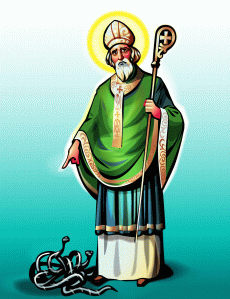 There are some wishful thinkers out there in the realm of Baptist fundamentalism who attempt to annex this 4th to 5th century missionary to Ireland into their pantheon of ancient prototypical “Baptists.” Granted, this is a minority view among Baptists, however, it is the view with which I was raised. This view of Baptist history is called by scholars “Baptist Successionism,” but among its adherents it’s usually known as “Landmarkism.”
As you know St. Patrick’s Day has come and gone two days ago. March 17th is officially recognized by Roman Catholics as the feast day of St. Patrick, commemorating the date of his death. Like most years, about a day before this holiday arrives, I think to myself, I ought to do a little homework to combat this notion that St. Patrick is a Baptist, but I usually run out of time before I can make any headway. So I drop it until about March 16th of the following year. Well, this year, I happened to read a St. Patrick’s Day devotional post by Bob Hayton at Fundamentally Reformed. I commented that I’d intended to post a view contrary to the successionist view of St. Patrick, and missed my “deadline,” but Bob encouraged me to go ahead and do it anyway, so here goes. Looks like this might turn into a series.
I’m by no means a historical scholar, just a Christian who cares to learn the truth about Baptist history, having been burned by so much bad history in the name of promoting the Baptist tradition. A few years ago, I read a book review in the Founders Journal of a book called Baptist Successionism: A Crucial Question in Baptist History, by Dr. James Edward McGoldrick, a professor of church history at Greenville Presbyterian Theological Seminary. I was encouraged by the review, ordered the book, and found that it does a very good job of examining the claims of Baptist Successionism in the light of academic  historical scholarship. Chapter 4 of this book, “St. Patrick: A Baptist?” will serve as the basis of this series.
The only concession one can make about the beliefs and practices of Saint Patrick is the undocumented and therefore uncertain nature of them. This is where Baptist successionists find the wiggle room to make the claims that they make. McGoldrick writes on page 24:
All who have undertaken serious research on the life and thought of Saint Patrick have discovered early that the materials available for the reconstruction of his career are few, and some that have been employed are of dubious reliability. Scholars, both within and without the Roman Catholic Church, have recognized this problem, and, consequently, they have had to admit that their findings are tentative. Only two brief, nontheological writings of Patrick are extant, so interpreters are not in a position to make dogmatic judgments about his doctrinal position. Collateral evidence from the period of Patrick’s life is very scant and does not enlarge our knowledge of his beliefs very much. Moreover, legends abound about practically every phase of Patrick’s life, and separating fact from fiction may, at points, be impossible. The saint’s own works, The Confession and the Letter to Coroticus, are the only unimpeachable sources of information about his views. These, and Muirchu’s monograph on Patrick composed in the seventh century, provide little more than a biographical sketch [see St. Patrick: His Writings and Muirchu’s Life, ed. and tr. A. B. E. Hood (Totowa, NJ: Rowman & Littlefield, 1978)].
So a little biographical material is all we can trust. His theological views, his views on the sacraments (ordinances, for my Baptist readers), his views on church government and ministry, if they are to be known at all, will have to be read carefully between the lines within the context of Patrick’s day and age. By the time this series is finished, I think Dr. McGoldrick will have helped us realize that the Baptist Successionist view is little more than wishful thinking.
Part two will examine Saint Patrick’s probable, or possible, views on revelation, and compare it with the Protestant, Reformed, Evangelical and Baptist view historically known as Sola Scriptura.
update: Dr. Russel Moore at his “Moore to the Point” blog directs us to a more constructive way to benefit from the legacy of St. Patrick (read blog here). He recommends Dr. Philip Freeman’s biography, St. Patrick of Ireland. You can also view a short television interview with Dr. Freeman about St. Patrick (view segment here).
Traveling Light
A friend at work wanted me to read an article from Newsweek magazine today. As I was leaving and he was starting his shift he handed it off to me. It’s about how many of the upcoming generation are adopting a popular new label that doesn’t carry the baggage of the traditional ones. This time, even “Christian” is out. The article is called, “A Christian By Any Other Name.” Suffice it to say, here’s yet another way to minor on the doctrines of the faith and major on outward behavior while claiming you’re not majoring on outward behavior.
This is what Horton and the Modern Reformation gang call “Deeds Not Creeds,” co-opting the phrase from Rick Warren’s desire for a “Reformation of Deeds, Not Creeds.” The fact is that the Scriptural order is that the deeds should flow from the creeds (or doctrines), rather than being focused on at the expense of doctrine (read, “Creeds and Deeds: How Doctrine Leads to Doxological Living“). Reflecting this biblical emphasis, the Heidelberg Catechism organizes its questions and answers in a three part format, which in generations past were titled “The First Part – Of The Misery Of Man”; “The Second Part – Of Man’s Deliverance”; and “The Third Part – Of Thankfulness.” A simplified read of this goes, “Guilt, Grace, Gratitude.” You can access the Heidelberg Catechism from my sidebar by clicking on the “Creeds, Confessions and Catechisms” page. Changing your label won’t help a thing–one day, it’ll accumulate the same baggage all previous labels have. Resistance is futile, you will be assimilated.
Those adopting the new label “follower of Jesus”, like so many other such efforts, will eventually (or sooner) lead to people claiming “unity” with religious people of various false religions at the expense of doctrine (that’s what the parents and grandparents of these original “followers” used to call “ecumenism.” They may not intend to (see this defense of Warren’s focus), but it’s inevitable. Miss the lessons of history, and you’re doomed to repeat it’s mistakes. Folks like this, who are so determined to leave the past behind and strike out on the “road less travelled” will be surprised how many have already gone before them, following, not Jesus, but some blind guide, who will eventually lead them into the “ditch,” as Jesus warned.
Indeed, theological liberalism by any other name stinks just as badly.
“The Bible Kind of Salvation”
Founders Ministries posted a video of a sermon by the late, great Southern Baptist pastor, Dr. W. A. Criswell entitled, “The Bible Kind of Salvation.” In his opening remarks, Dr. Criswell explains clearly that this is a sermon on the election and choosing of God. The fact that Founders Ministries is promoting this sermon says something about on which side of this great debate Dr. Criswell comes down (Who was Dr. Criswell?). Southern Baptists who are reading this blog are urged to consider the remarks that one of your great leaders of the recent past proclaimed as the truth of the matter on what the Bible teaches about the doctrine of election and the so-called “sovereign grace” of God.
In the “about us” page of Founders Ministries, it reads as follows:
Founders Ministries is a ministry of teaching and encouragement promoting both doctrine and devotion expressed in the Doctrines of Grace (what are the doctrines of grace? click here) and their experiential application to the local church, particularly in the areas of worship and witness. Founders Ministries takes as its theological framework the first recognized confession of faith that Southern Baptists produced, The Abstract of Principles. We desire to encourage the return to and promulgation of the biblical gospel that our Southern Baptist forefathers held dear.
As a deacon in a Southern Baptist church, I’m personally convinced that everything that’s right about the Baptist tradition it learned from

Deacon Council, Shady Grove Baptist Church, N. Richland Hills, Texas
Reformed theology, and everything that’s wrong with it was adapted either intentionally or unintentionally from Anabaptism. I further believe that a return to a more consistent application of Reformed theology (aka, the doctrines of grace or Calvinism) is the key that will solve many of the issues that trouble Southern Baptists churches today.
The following is part one of a four part series. If you need help finding parts 2-4, click here.
Sneak Peek at ESV Study Bible
If you haven’t yet bought a copy of the ESV Study Bible, Crossway Publishers is allowing access to the online edition during the month of March only. This free access will end on the 31st. Go take a look at the wealth of helpful material you are currently going without. The “ESV Study Bible Blog” tells the rest of the story here.
The following video is part of the thirteen minutes of promotional video I told you about in the previous post about Tullian Tchividjian (his blog), the one negotiating a merger between his church New City Church and Coral Ridge Presbyterian Church.
By the way, if you’d like to enter a drawing to win a Calfskin leather bound edition of the ESV Study Bible, like I have, visit this post at A Boomer in the Pew.
Bach’s Bible
As a bibliophile, I can only wish (short of praying) to be this lucky:
And, of course, for you inquiring minds, here’s Bach’s Wikipedia entry.
James White on Faithful Scholarship
Here’s the video of Dr. White’s call for “believing Biblical Studies.” In case you had any trouble following my transcription of his monologue in the previous post, now you can watch it and hear it as well. Using as many senses as possible will always help your comprehension. If there were some way we could touch, taste and smell it, I’d post that, too, but for now the technology remains limited. Of course, if you really want to touch your monitor screen be my guest, just don’t press too hard if you’ve got one of those gel screen type set ups.
Also worthy of note is how Dr. White is sporting the sharp “Sola Conference” shirt that he mentioned in the previous video of him I posted. Like the Bible says, “You have not because you ask not.” If you like to see more videos by Dr. James White, Reformed Baptist apologist extraordinaire, you can view his YouTube page here.


 The Misadventures of Captain Headknowledge
A Question of Chicken and Egg from John’s First Epistle
First John 5:1 reads “Everyone who believes that Jesus is the Christ has been born of God, and everyone who loves the Father loves whoever has been born of him.” Most contemporary fundamentalist and evangelical Christians miss the implication of the apostle John’s wording “has been born of God” as it relates to those who believe. Does this text imply that those who believe were first born of God? Does it therefore imply that regeneration precedes faith? Or must we deny this implication based on our preconceived notion that regeneration is not possible until after we make the right decision to choose to believe?
Reformed Baptist apologist, Dr. James White, has posted a short video explaining this passage in the light of the apostle John’s repeated use of the language “everyone who _____ has been born of God.” He explains that all agree that in the case of two other texts from the same epistle, 1 John 2:29 and 4:7, the apostle’s clear implication is that the action of the believer is the result, and therefore logically follows, the fact of his having been born of God. In these two passages, the actions are “practicing righteousness” (2:29), and “loving” (4:7). In other words, it’s easy to accept the idea that “everyone who practices righteousness has been born of God” at face value, and it is easy to agree that everyone who loves God and his neighbor is one who has been born of God. No one’s tradition teaches the contrary. However, when it comes to the exact same grammatical structure in the first verse of chapter five, we are told by many that we must not make the same inference that being born of God is the prerequisite of saving faith. Dr. White attempts to make the case that this is no more than reading one’s tradition into the text, rather than basing one’s interpretation of the verse on what the text demonstrably means. I agree with him. Watch the following video, and see if you, too, can agree with the apostle John that “everyone who believes that Jesus is the Christ has been born of God.”
Share this: