Theological and Doxological Meditation #14
 Sin Defined
Q. What is sin?
A. Sin is any want of conformity unto,
or transgression of,
the law of God (1 John 3:4).
God, Be Merciful to Me
Music by Richard Redhead, 1853
#486, Trinity Hymnal (© 1990)
God, be merciful to me,
on thy grace I rest my plea;
plenteous in compassion thou,
blot out my transgressions now;
wash me, make me pure within,
cleanse, O cleanse me from my sin.
My transgressions I confess,
grief and guilt my soul oppress;
I have sinned against thy grace
and provoked thee to thy face;
I confess thy judgment just,
speechless, I thy mercy trust.
I am evil, born in sin;
thou desirest truth within.
Thou alone my Savior art,
teach thy wisdom to my heart;
make me pure, thy grace bestow,
wash me whiter than the snow.
Broken, humbled to the dust
by thy wrath and judgment just,
let my contrite heart rejoice
and in gladness hear thy voice;
from my sins O hide thy face,
blot them out in boundless grace.
Gracious God, my heart renew,
make my spirit right and true;
cast me not away from thee,
let thy Spirit dwell in me;
thy salvation’s joy impart,
steadfast make my willing heart.
Sinners then shall learn from me
and return, O God, to thee;
Savior, all my guilt remove,
and my tongue shall sing thy love;
touch my silent lips, O Lord,
and my mouth shall praise accord.
Theological and Doxological Meditation #13
The Fall
 Q. Did our first parents continue in the estate wherein they were created?
A. Our first parents, being left to the freedom of their own will, fell from the estate wherein they were created, by sinning against God (Genesis 3:6-8; Ecclesiastes 7:29).
With Tears of Anguish I Lament
Samuel Stennett (1727-1795)
With tears of anguish I lament
here at thy feet, my God
my passion, pride and discontent
and vile ingratitude
Sure there was ne’er a heart so base
so false as mine has been
so faithless to its promises
so prone to ev’ry sin
My reason tells me thy commands
are holy, just and true
tells me whate’er my God demands
is his most righteous due
Reason I hear, her counsels weigh
and all here words approve
but still I find it hard t’obey
and harder yet to love
How long, dear Savior, shall I feel
these strugglings in my breast?
When wilt thou bow my stubborn will,
and give my conscience rest?
Break, sov’reign grace, O break the charm
and set the captive free
reveal, Almighty god, thine arm
and haste to rescue me.
Theological and Doxological Meditation #12
 Providence Toward Man
Q. What special act of providence did God exercise toward man in the estate wherein he was created?
A. When God had created man,
he entered into a covenant of life with him,
upon condition of perfect obedience (Galatians 3:12);
forbidding him to eat
of the tree of the knowledge of good and evil,
upon pain of death (Genesis 2:17).
My Dear Redeemer and My Lord
#238, Trinity Hymnal
Isaac Watts
My dear Redeemer and my Lord,
I read my duty in your Word;
but in your life the law appears
drawn out in living characters.
Such was your truth, and such your zeal,
such def’rence to your Father’s will,
such love, and meekness so divine,
I would transcribe and make them mine.
Cold mountains and the midnight air
witnessed the fervor of your prayer;
the desert your temptations knew,
your conflict and your vict’ry too.
Be now my pattern; make me bear
more of your gracious image here:
then God the Judge shall own my name
amongst the foll’wers of the Lamb.
Easter Theology
 Resurrection and Justification
How is the resurrection of Christ linked to the idea of justification in the New Testament? To answer this question, we must first explore the use and meaning of the term justification in the New Testament. Confusion about this has provoked some of the fiercest controversies in the history of the church. The Protestant Reformation itself was fought over the issue of justification. In all its complications, the unreconciled and unreconcilable difference in the debate came down to the question of whether our justification before God is grounded in the infusion of Christ’s righteousness into us, by which we become inherently righteous, or in the imputation, or reckoning, of Christ’s righteousness to us while we are still sinners. The difference between these views makes all the difference in our understanding of the Gospel and how we are saved.
Losing Something in the Translation
One of the problems that led to confusion was the meaning of the word justification. Our English word justification is derived from the Latin justificare. The literal meaning of the Latin is “to make righteous.” The Latin fathers of church history worked with the Latin text instead of the Greek text and were clearly influenced by it. By contrast, the Greek word for justification, dikaiosune, carries the meaning of “to count, reckon, or declare righteous.” The verb “to justify” and its noun form, “justification,” have shades of meaning in Greek. One of the meanings of the verb is “to vindicate” or “to demonstrate.”
The Justification of Jesus
The Resurrection involves justification in both senses of the Greek term. First, the Resurrection justifies Christ himself. Of course, he is not justified in the sense of having his sins remitted, because he had no sins, or in the sense of being “made righteous.” Rather, the Resurrection serves as the vindication or demonstration of the truth of his claims about himself.
In his encounter with the philosophers at Athens, Paul declared: “Truly, these times of ignorance God overlooked, but now commands all men everywhere to repent, because he has appointed a day on which he will judge the world in righteousness by the Man whom he has ordained. He has given assurance of this to all by raising him from the dead” (Acts 17:30-31).
Here Paul points to the Resurrection as an act by which the Father universally vindicates the authenticity of his Son. In this sense, Christ is justified before the whole world by his resurrection.
The Justification of Sinners
However, the New Testament also links Christ’s resurrection to our justification. Paul writes, “It shall be imputed to us who believe in him who raised up Jesus our Lord from the dead, who was delivered up because of our offenses, and was raised because of our justification” (Romans 4:24-25).
It is clear that in his atoning death Christ suffered on our behalf, or for us. Likewise, his resurrection is seen not only as a vindication of or surety of himself, but as a surety of our justification. Here justification does not refer to our vindication, but to the evidence that the atonement he made was accepted by the Father. By vindicating Christ in his resurrection, the Father declared his acceptance of Jesus’ work on our behalf. Our justification in this theological sense rests on the imputed righteousness of Christ, so the reality of that transaction is linked to Christ’s resurrection. Had Christ not been raised, we would have a mediator whose redeeming work in our behalf was not acceptable to God.
However, Christ is risen indeed!
Romans 4:25 bugged me for years and I used to ask everyone I knew whom I thought might know something, and the only answer I ever got was, “Because God’s Word says so.”
Thanks to Ligonier Ministries for this short article detailing the relationship between Christ’s resurrection and our justification. Be sure and click on the link above in the title, “Easter Theology” and patronize their ministry. You’ll be amazed how much you’ll learn about God, do so on your knees and allow the theology to become doxology (praise)! 
Theological and Doxological Meditation #11

On Providence
Q. What are God’s works of providence?
A. God’s works of providence are,
his most holy (Psalm 145:17),
wise (Isaiah 28:29),
and powerful preserving (Hebrews 1:3),
and governing all his creatures
and all their actions (Psalm 103:19; Matthew 10:29).
God Moves in a Mysterious Way (click title to play)
William Cowper (pronounced “Cooper”),
#128, Trinity Hymnal (© 1990)
God moves in a mysterious way
his wonders to perform;
he plants his footsteps in the sea,
and rides upon the storm.
Deep in unfathomable mines
of never-failing skill
he treasures up his bright designs,
and works his sovereign will.
Ye fearful saints, fresh courage take
the clouds ye so much dread
are big with mercy, and shall break
in blessings on your head.
Judge not the Lord by feeble sense,
but trust him for his grace;
behind a frowning providence
he hides a smiling face.
His purposes will ripen fast,
unfolding ev’ry hour;
the bud may have a bitter taste,
but sweet will be the flower.
Blind unbelief is sure to err,
and scan his work in vain;
God is his own interpreter,
and he will make it plain.
Theological and Doxological Meditation #10
The Creation of Man
Q. How did God create man?
A. God created man male and female,
after his own image (Genesis 1:27),
in knowledge, righteousness, and holiness
(Colossian 3:10; Ephesians 4:24),
with dominion over the creatures (Genesis 1:28).
Hallelujah, Praise Jehovah! (click title to play)
#110, Trinity Hymnal (© 1990)
William J. Kirkpatrick
Hallelujah, praise Jehovah,
from the heavens praise his name;
praise Jehovah in the highest,
all his angels, praise proclaim.
All his hosts, together praise him,
sun and moon and stars on high;
praise him, O you heav’ns of heavens,
and you floods above the sky.
Let them praises give Jehovah,
for his name alone is high,
and his glory is exalted,
and his glory is elalted,
and his glory is exalted
far above the earth and sky.
Let them praises give Jehovah,
they were made at his command;
them forever he established,
his decree shall ever stand.
From the earth, O praise Jehovah,
all you seas, you monsters all,
fire and hail and snow and vapors,
stormy winds that hear his call.
Let them praises give Jehovah,
for his name alone is high,
and his glory is exalted,
and his glory is exalted,
and his glory is exalted
far above the earth and sky.
All you fruitful trees and cedars,
all you hills and mountains high,
creeping things and beasts and cattle,
birds that in the heavens fly,
kings of earth, and all you people,
princes great, earth’s judges all;
praise his name, young men and maidens,
aged men, and children small.
Let them praises give Jehovah,
for his name alone is high,
and his glory is exalted,
and his glory is exalted,
and his glory is exalted
far above the earth and sky.
Theological and Doxological Meditation #9
On Creation
Q. What is the work of creation?
A. The work of creation is,
God’s making all things of nothing (Genesis 1:1),
by the word of his power (Hebrews 11:3),
in the space of six days,
and all very good (Genesis 1:31).
All Things Bright and Beautiful
#120, Trinity Hymnal (© 1990)
Cecil F. Alexander, 1848
All things bright and beautiful,
all creatures great and small,
all things wise and wonderful,
the Lord God made them all.
Each little flow’r that opens,
each little bird that sings,
he made their glowing colors,
he made their tiny wings.
The purple-headed mountain,
the river running by,
the sunset, and the morning
that brightens up the sky.
The cold wind in the winter,
the pleasant summer sun,
the ripe fruits in the garden,
he made them, every one.
The tall trees in the greenwood,
the meadows where we play,
the flowers by the water
we gather every day.
He gave us eyes to see them,
and lips that we might tell
how great is God Almighty,
who has made all things well.
All things bright and beautiful,
all creatures great and small,
all things wise and wonderful,
the Lord God made them all.
Theological and Doxological Meditation #8
Decretal Modes
Q. How doth God execute his decrees?
A. God executeth his decrees
in the works of creation and providence.
Let All Things Now Living (click title to play)
#125, The Trinity Hymnal (© 1990)
Let all things now living
a song of thanks giving
to God the Creator
triumphantly raise,
who fashioned and made us,
protected and stayed us,
who guides us and leads to
the end of our days.
His banners are o’er us,
his light goes before us,
a pillar of fire
shining forth in the night,
’til shadows have vanished
and darkness is banished,
as forward we travel
from light into light.
His law he enforces:
the stars in their courses,
the sun in its orbit,
obediently shine;
the hills and the mountains,
the rivers and fountains,
the deeps of the ocean
proclaim him divine.
We too should be voicing
our love and rejoicing,
with glad adoration
a song let us raise,
’til all things now living
unite in thanksgiving
to God in the highest,
hosanna and praise!
Theological and Doxological Meditation #7
The Decrees of God
Q. What are the decrees of God?
A. The decrees of God are his eternal purpose, according to the counsel of his will, whereby, for his own glory, he hath fore-ordained whatsoever comes to pass (Ephesians 1:11).
Whate’er My God Ordains Is Right (click title to play)
#108, Trinity Hymnal (© 1990)
Samuel Rodigast, 1675
Whate’er my God ordains is right:
his holy will abideth;
I will be still whate’er he doth,
and follow where he guideth.
He is my God; though dark my road,
he holds me that I shall not fall:
wherefore to him I leave it all.
Whate’er my God ordains is right:
he never will deceive me;
he leads me by the proper path;
I know he will not leave me.
I take, content, what he hath sent;
his hand can turn my griefs away,
and patiently I wait his day.
Whate’er my God ordains is right:
though now this cup, in drinking,
may bitter seem to my faint heart,
I take it, all unshrinking.
My God is true; each morn anew
sweet comfort yet shall fill my heart,
and pain and sorrow shall depart.
Whate’er my God ordains is right:
here shall my stand be taken;
though sorrow, or death be mine,
yet am I not forsaken.
My Father’s care is round me there;
he holds me that I shall not fall:
and so to him I leave it all.
Theological and Doxological Meditation #6
The Persons of God
Q. How many persons are there in the Godhead?
A.There are three persons in the Godhead,
the Father, the Son, and the Holy Ghost
(Matthew 28:19);
and these three are one God,
the same in substance,
equal in power and glory (1 John 5:7 KJV)
O God, We Praise Thee (click title to play)
#105, Trinity Hymnal (© 1990)
Te Deum, 4th Century
Translated in Tate and Brady’s Supplement to the New Version, 1708
Scottish Psalter, 1615
DUNDEE C.M.
O God, we praise thee; and confess
that thou the only Lord
and everlasting Father art,
by all the earth adored.
To thee all angels cry aloud;
to thee the pow’rs on high,
both cherubim and seraphim,
continually do cry.
O holy, holy, holy Lord,
whom heav’nly hosts obey,
the world is with the glory filled
of thy majestic ray.
Th’apostles’ glorious company
and prophets crowned with light,
with all he martyrs’ noble host ,
thy constant praise recite.
The holy church throughout the world,
O Lord, confesses thee,
that thou Eternal Father art,
of boundless majesty;
Thine honored, true and only Son;
and Holy Ghost, the Spring
of never-ceasing joy: O Christ,
of glory thou art King.
The Law of Love
1 John 4:13-19 ESV
By this we know that we abide in him and he in us, because he has given us of his Spirit. And we have seen and testify that the Father has sent his Son to be the Savior of the world. Whoever confesses that Jesus is the Son of God, God abides in him, and he in God. So we have come to know and to believe the love that God has for us. God is love, and whoever abides in love abides in God, and God abides in him. By this is love perfected with us, so that we may have confidence for the day of judgment, because as he is so also are we in this world. There is no fear in love, but perfect love casts out fear. For fear has to do with punishment, and whoever fears has not been perfected in love. We love because he first loved us. If anyone says, “I love God,” and hates his brother, he is a liar; for he who does not love his brother whom he has seen cannot love God whom he has not seen. And this commandment we have from him: whoever loves God must also love his brother.
“Things that go together should never be separated”
It’s amazing how easy it is for us to separate Biblical teachings which ought to remain unified. In a sermon preached a few years ago, Dr. Jeffrey Bingham of Dallas Theological Seminary sought to show the unified relationship between truth and love in 2 John.
His introduction was very humorous. He talked about the fact that in life there are many things that (not exact quotes) “go together, and should never be separated.” First example, poverty and home ownership: “Once I became a home owner, companies I’d never even heard of began asking for my money; therefore, poverty and home ownership always go together.”
Dr. Bingham’s second illustrative example featured (this is a more exact quote): “Chocolate chip cookies and milk. It is wickedness of the deepest darkness (!) to have a chocolate chip cookie without a cold glass . . . of milk.” Then he went on to show the necessary unity and unbreakable link that must remain between the Biblical notions of “Truth and Love.” But that’s another story. The point of this posting is that in this passage from John’s first letter, loving God and loving others are inseparable. Love for others gives credence to our claim to love God.
But I wanted to highlight this concept from 1 John 4 because John wrote that “we love (others, in this context) because [God] first loved us.”
The Logical Order of Biblical Indicatives and Biblical Imperatives
Now, to switch gears, notice the logical order: first, God loved us; second, we love others (as evidence that we love God). The logical order is vital. This is what I called “Indicative” and “Imperative” in a past posting a couple of weeks ago. It is imperative to keep in mind that in biblical Christianity, the “indicative” always precedes the “imperative.” In other words, in biblical Christianity, the reason we work is because of what God did for us. If we have a concept of a God who loves us because of our work (placing “imperative” logically before “indicative”), then we are legalists. The book of Galatians is one of Paul’s great treatises written to distinquish biblical Christianity from legalism (Galatians 3:3). We don’t get God to do for us by doing for him, we do for him because he did for us; that’s why John wrote, “We love (God and others) because he first loved us.” This is the point John makes and this is the point of my concern that all application (the imperatives, or precepts or commands, of Scripture) should be made in preaching on the basis of the Gospel preached (The Indicative of indicatives), and not only preached as an evangelistic appeal directed toward unbelievers, but preached also to the believers as the foundation, reason and source of the particular application of each and every “practical and relevant” sermon. If application is preached as separate from the gospel, you have legalism. It’s not good enough to assume the listeners understand the foundation, it must be presented as a unified, package deal.
It is “wickedness of the deepest darkness” to preach application without explicitly basing it on the gospel.
Imperative comes from Indicative; application comes from gospel; “do” comes from “be.” Kind of like that old saying, “we sin because we are sinners.” Likewise, we walk in righteousness because we are righteous, not “we become righteous by walking in righteousness.” How did we become righteous? Righteousness was given to us by God as a free gift of his grace (Romans 1:17; 3:24).
Third Gear
John Wesley made his mark on Chrisitian theology by emphasizing that Christians ought, to weave in my own language, to perform the imperatives of Scripture, based either on the motive of fear of punishment or hope of reward. This is one of the distinctives of the Wesleyan form of Arminianism (God does his part, man does his part). In Wesley’s scheme, what do we have? Man working in order to get God to reward him and in order to keep God from punishing him. What did we call that in the earlier paragraph? Legalism! Imperative preceding Indicative. Earning salvation by my own works. What is the alternative?
Wesley was lifelong friends with fellow revivalist, George Whitefield. Now Whitefield was a Calvinist. The two agreed that while out publicly preaching they would not debate Calvinism vs. Arminianism. Naturally, they failed to maintain this bond, poor John just couldn’t help himself, but that’s beside the point. The point is, Calvinist theology (the system of doctrine the great Baptist preacher, Charles Spurgeon called, “another name for the gospel” or “biblical theology”), in other words, the teaching of Scripture is that the proper motive for obedience is gratitude. A few scriptural phrases: “faith without works is dead” “faith works by love” “if you love me, you will keep my commandments.” See? Imperative follows Indicative. We love (keep his commandments) because he first loved us. That’s why Paul wrote that grace and faith establish the Law rather than eliminate it (Romans 3:31).
And now, the real point
The reason I’m belaboring all of this is because it’s the theology that lies behind a song I wrote. I wanted to write a song about the Ten Commandments, but as I thought about it, it became my theology of Christian obedience to the Ten Commandments. “We Love God Because He First Loved Us.”
The Love Song © 2004, John Douglas Chitty
We love God because he first loved usby sending us his Son.
Jesus kept the Lord our God’s commands, by him the work was done.
Every day we break God’s Law in thought, word or in deed.
Jesus died and rose again for the forgiveness we need.
How do we give thanks to him? What did the Savior say?
Jesus said, “If you love me, my commandments you’ll obey.”
We love God because he first loved us, and our love is of this kind:
Jesus said, “You shall love the Lord your God with all your heart . . .
and with all your soul . . .
and with all your mind.”
You shall have no other gods before me.
You shall not bow down or serve carved images.
You shall not take the name of the Lord your God in vain.
Sanctify the Sabbath day and so rest in the Lord;
in six days God made the world, and rested on one more.
That’s not all the Savior said would praise the Lord above.
Jesus said, “Your neighbor, too, needs you to show your love.”
Give honor to your father, and at your mother’s knee.
And you shall not murder, nor commit adultery.
You shall not take away your neighbor’s belongings.
Neither lie about him, nor desire to have his things.
We love God because he first loved us by sending us his Son.
Jesus kept the Lord our God’s commands, by him the work was done.
Every day we break God’s Law in thought, word or in deed.
Jesus died and rose again for the forgiveness we need.
How do we give thanks to him? What did the Savior say?
Jesus said, “If you love me, my commandments you’ll obey.”
The Right Story
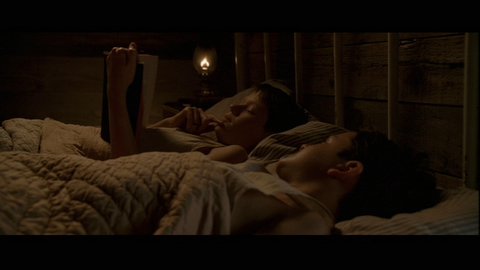 “You can’t help nobody if you can’t tell ’em the right story.” Jack Cash, brother of Johnny Cash, as portrayed in Walk the Line (PG 13)
Every story is about fall and redemption in one way or another. There would be no plot if there were no problem to solve or conflict to resolve. The story of the entir human race is that of its fall and redemption. Your stroy is about your fall and your redemption. The mission of the church is to tell this story; to introduce the characters to the plot: they’ve fallen and they can’t get themselves up on their own, their problem is so bad, they can’t solve it themselves, they need Another to solve it for them, the conflict that has entered their life has killed them, and they need Another to return them to life.
Stories are often considered mere entertainment. And to be sure, the church in this Laodecian (Rev. 2) generation have caught on to the idea that entertainment will help them tell the Story. Even if at times they’re telling the right story, that of the fall of man into sin and the sinless Christ crucified and risen for sinners, they’ve wrapped it up in so much entertainment that many are in danger of overlooking the Gift because they’re so fascinated by the wrapping paper. If sinners are distracted from the Story by trappings geared toward appealing to their interests, or meeting their felt needs, the church can’t help them. At other times, the church forgets to get around to the Story at all because they’re so aware of all the other stories in the Bible. “Christians don’t need to hear the Story this week, they’ve already heard and believed and received it, now they need to hear what they need to do,” and thus the Story is placed on the shelf in the interest of relevance or practicality. But no matter how much they mean to help, they “can’t help nobody if [they ain’t tellin’ ’em] the right story.”
The church seeks to tell a story, but all too often it’s not the Story they were commissioned to tell (Matthew 28:19-20). Many times they tell their own story. A story about how they’ve picked themselve up by their own bootstraps, a story about what a great example they are. When this is the story they tell, the Holy Spirit won’t bring sinners to life, nor will he empower believers to serve. All applications and all examples, and all pastoral autobiography are not to stand alone. They are to be built on the firm foundation of the Story, explicitly told each week.
We’ve fallen into sin so there’s nothing we can do to redeem ourselves:
the sinless Christ was crucified because we are sinners who deserve to die;
Christ rose from the dead on the third day because God has accepted Christ’s death in the place of sinners who come to believe and repent of their sins;
saved sinners are called to be holy and to serve others, which brings them into conflict with the sin thay yet remains in their natures and they aren’t always able to be holy and serve others (Romans 7). . .
. . . that’s why the Story must remain on center stage: The Gospel is for Christians, too!
They must be reminded that even though they’ve been saved they still need to hear the Gospel addressed to them (1 John 1:9) to cleanse them so they can progress on the journey to glorification by way of sanctification (Proverbs 4:18).
When the preacher neglects to tell the church the right Story, he can’t help the church grow in grace.
Theological and Doxological Meditation #5
The Uniqueness of God
Q. Are there more Gods than one?
A. There is but one only (Deuteronomy 6:4),the living and true God (Jeremiah 10:10).
My God, How Wonderful Thou Art (right click title to play in a new tab)
#35 Trinity Hymnal (© 1990)
Frederick W. Faber, 1848; alt. 1961, 1990
My God, how wonderful thou art,
thy majesty how bright!
How beautiful thy mercy seat,
in depths of burning light!
Wondrous are thine eternal years,
O everlasting Lord,
by holy angels day and night
unceasingly adored!
O how I fear thee, living God,
with deepest, tend’rest fears,
and worship thee with trembling hope,
and penitential tears.
Yet I may love thee too, O Lord,
almighty as thou art;
for thou hast stooped to ask of me
the love of my poor heart.
No earthly father loves like thee,
no mother half so mild
bears and forbears, as thou hast done
with me, thy sinful child.
How wonderful, how beautiful,
the sight of thee will be,
thine endless wisdom, boundless pow’r,
and awesome purity!
The Main Thing . . . What Else? The Gospel
“For I delivered to you as of first importance what I also received: that Christ died for our sins in accordance with the Scriptures, 4 that he was buried, that he was raised on the third day in accordance with the Scriptures . . . ” 1 Corinthians 15:3-4
How easily Christians are diverted from a focus on the Gospel of Christ in favor of their favorite theological hobby-horse! I’ve had a few. I remember back when all I could find the motivation to read were book, tracts, booklets, articles on the superiority (and even divine inspiration) of the 1611 Authorized King James Version of the Bible (I even wrote a song about it!), many people with whom I’d discuss the issues would ask me, why is it that I hear you talk more about King James than Jesus? This is a question that is appropriate for all theology geeks like myself who allow the subject in which they’re most interested to move to the center of their minds and hearts while the cross of Christ and the power of his resurrection slip to the back burner. Even now that I’m a Calvinist, I try to keep in mind the place from where I came and recall how annoying are those theological bulldogs who viciously and unrelentingly know how to turn every conversation from the topic at hand to an argument over the sovereignty of God, election, reprobation, and predestination. Although, after becoming acclamated to the truth (I don’t mean those Calvinistic bulldogs were wrong, just annoying), I was discussing with one of my friends about this very topic, how that every Christian tradition has its favorite theological emphases that are distinctive of that particular tradition. My friend replied, “That’s what verifies the truth of Calvinism to me: all they care about is making sure the gospel is accurately preached; hence the concern for the sovereignty of God in salvation.”
In other words, it’s all about the Gospel. The Gospel is the center. The Gospel is the foundation. The Gospel is the source of the power. The Gospel is the agent of life in Christ. The Gospel is the basis of all practical application. The Gospel is the fulfillment of all prophecy. The Gospel is the Main Thing. Paul was right, “…that Christ died for our sins in accordance with the Scriptures, that he was buried, that he was raised again the third day in accordance with the Scriptures [is of first importance].”
That’s why I would like to recommend that you go to the website for Sovereign Grace ministries right now and discover a wonderful book that reminds us how to keep the Gospel the main thing. It’s called Living the Cross Centered Life by C. J. Mahaney. The title of this post is a link to the webpage advertising this book. I found an earlier edition of this book a couple of years ago. It’s a tiny book. But, boy, was it packed with mind-altering material. What kind of material was it? Simply a reminder that the source of power for living a Christian life is to stay focused on the Gospel all the time. Read about it, talk to yourself and others about it, sing about it, examine your behavior in the light of it, you name it.
Speaking of writing songs about favorite theological hobby-horses, here’s one I wrote about that which is of first importance. I call it The Corinthian Creed. It’s simply a summary of 1 Corinthians 15. This chapter is a proclamation of Christ’s resurrection, an apologetic defense of resurrection in general and even a sermon on the believer’s hope and motivation to persevere inspired by the resurrection. Hope it helps you grasp the truths of this vital New Testament chapter as writing it has done for me.
The Corinthian Creed
© 2005, John Douglas Chitty
We believe that Chirst died for our sins
according to the Scriptures;
That he was buried, that he was raised on the third day
according to the Scriptures.
Then he was seen by Peter,
then by all the Twelve;
after that he was seen by more than
five hundred brothers at once as well.
Then he was seen by James,
then by all the Apostles;
and last of all, he was seen by Paul,
as by one born out of due time.
chorus
We believe this is of first importance:
Christ died for our sins,
According to the Scriptures,
the third day, he rose again.
We believe in resurrection
because if the dead don’t rise,
our faith is vain,
we’re still in sin,
and lost is he who dies.
But Christ in fact is risen,
the firstfruits of the dead.
For as all die in Adam,
so all live in Christ, their Head.
Christ our King rose first,
so, when he comes, shall we,
for he must reign and conquer
till his last foe, Death’s, defeat!
repeat chorus
Why, then, do we suffer,
if the dead in Christ won’t rise?
If so, let us eat and drink,
for tomorrow we will die.
Do not be deceived,
wake up and do what’s right.
Do not go on sinning
like the ones who lack God’s light.
But someone will ask,
“What kind of bodies will arise?”
You fool! No seed, when planted, will grow
unless first it dies!
repeat chorus
We believe there is a natural body,
and one of the Spirit.
The natural body perishes,
sin’s curse is buried with it.
As Christ raised the third day,
at last in all his glory,
so will those who follow him
and trust the Gospel story.
Adam of the earth,
Jesus Christ of heaven.
As we’ve borne Adam’s image,
We will bear Christ’s image, even!
repeat chorus
We believe when Christ our King returns
all sleeping saints to waken,
we may not all sleep,
but all will gain a transformation.
So will come to pass
the saying that is written:
“Death is swallowed up in victory,” sin is finally smitten.
But thanks be to God,
through Christ, our Victory!
Be strengthened in his service,
knowing death won’t end the story!
We believe this is of first importance:
Christ died for our sins.
According to the Scriptures,
the third day he rose again!
Theological and Doxological Meditation #4
The Nature of God
Q. What is God?
A. God is a Spirit (John 4:24), infinite (Job 11:7), eternal (Psalm 90:2), and unchangeable (James 1:17), in his being (Exodus 3:14), wisdom (Psalm 147:5), power (Revelation 4:8), holiness (Revelation 15:4), justice, goodness and truth (Exodus 34:6-7).
Holy, Holy, Holy! (right click title to play in a new tab)
#100, Trinity Hymnal (© 1990)
Reginald Heber, 1783-1826
Holy, holy, holy! Lord God Almighty!
Early in the morning our song shall rise to thee.
Holy, holy, holy! Merciful and mighty!
God in three Persons, blessed Trinity!
Holy, holy, holy! All the saints adore thee,
casting down their golden crowns around the glassy sea;
cherubim and seraphim falling down before thee,
who wert, and art, and evermore shalt be.
Holy, holy, holy! Though the darkness hide thee,
though the eye of sinful man thy glory may not see,
only thou art holy; there is none beside thee
perfect in pow’r, in love, and purity.
Holy, holy, holy! Lord God Almighty!
All thy works shall praise thy name in earth and sky and sea.
Holy, holy, holy! Merciful and mighty!
God in three Persons, blessed Trinity!


 The Misadventures of Captain Headknowledge