The Masculine Media Considered

Hope you’ve all had a merry Christmas, and I hope you all have a happy new year. During my Christmas vacation between these holidays, I’m currently reading (finally!) T. David Gordon’s Why Johnny Can’t Preach: The Media Have Shaped the Messengers. It’s an awesome little volume (maybe too little, but I suppose it packs enough of a wallop that were it longer it might border on the uncharitable or abusive–something the author was concerned about, and which delayed his writing of it). I’m a slow reader, so I haven’t finished it yet. I just finished chapter two, “Why Johnny Can’t Preach, Part 1: Johnny Can’t Read (Texts),” and one passage in this chapter led me to consider something about the scriptural mandate that men (specifically, males) are God’s appointed medium in preaching. Concluding chapter two, Gordon writes:
In a sense, then, the few conversations there have been about preaching and preachers in the last generation have been relatively pointless. Whether a sermon is preached by a man or a woman is comparatively unimportant; whether it encourages a liberal or conservative sociopolitical agenda is comparatively inconsequential; whether its “how-to” advice or pop psychology is helpful or not makes little difference. What would make a difference would be Christian proclamation that is consequential, that is concerned less with current events than with the history-encompassing events of creation, fall, and redemption. What would make a difference would be Christian proclamation that did not panic every time a court rendered a decision on some pet geopolitical concern, but called our attention instead to the certain judgment of God, with whom we have to do. What would make a difference would be Christian proclamation that was less concerned with “how-to” and more concerned with “why-to,” why humans are fearfully and wonderfully made in the image of God. What might make a difference would be Christian proclamation that was less concerned with the latest news from the Beltway, and more concerned with the stunning and perennial good news that God in Christ is reconciling sinners to himself. But any one of these preferred alternatives requires a sensiblilty for the significant; a capacity to distinguish the weighty from the light, and the consequential from the trivial (pp. 59-60; emphasis mine).
Perhaps I didn’t need to transcribe the entire paragraph, but it’s all such sorely-needed information, I decided not to resist the temptation. The main point of the paragraph is beside the point of this post. Like a poorly expounded text of Scripture, I’m going to launch off onto a question raised by only one minor aspect of the paragraph mentioned only in passing, and as only one item in a long list of other items. My question is raised by the highlighted reference at the beginning of the paragraph to the comparative unimportance of whether a sermon is preached by a man or a woman.
I, and most of my readers, are well aware that Scripture certainly does prescribe that in corporate Christian worship, a male is the appropriate kind of person ordained by God to preach. Gordon’s point is not to deny this divine prescription, but to argue that the content of the sermon is much more important than the sex of the preacher, as important as that is. This point, made this way by Gordon, moved me to consider the reason behind God’s stated reason (a dangerous exercise, I’m sure) for the command that women are to neither teach nor usurp authority from the man (1 Timothy 2:12). Verse thirteen of 1 Timothy 2 appeals to the fall of Adam and Eve, and hence ultimately to the roles of husbands and wives and their typifying of the hierarchy of roles between Christ and his Bride, the Church (cf. Ephesians 5:22-33).
Perhaps my question is simply an unnecessary reduction of the husband/wife hierarchy, but, is it simply that males are God’s ordained medium for preaching because of the authority which males inherently and by Scriptural injunction represent? R. C. Sproul in his series on Recovering the Beauty of the Arts explains the basic principle that “all forms are art forms, and all art forms communicate something.” Sproul makes this his fundamental point in arguing for the benefit of many of the traditional forms that have come down to us from previous generations in the context of corporate worship–for example, pulpits and other aspects of traditional church architecture. Thinking in terms of the communicative nature of forms, am I getting off track to ponder whether it is basically the authority a man conveys by virtue of his sex in the act of preaching that God has in mind when he prescribes specifically men to serve in the office of elder/pastor/preacher?
I assume that many who are conditioned by modern egalitarian sensibilities regarding the inherent nature of males versus that of females would challenge this whole line of reasoning. But consider another medium and its use of male and female images: television commercials. I’m convinced that it is safe to say that the vast majority of commercials advertizing, say, board games, portray the female winning a game played against a male. This image is just one of many ways the classic motif of David vs. Goliath plays out in probably all art, literature, television and movies. The “little guy” wins out over “the big guy.” I submit that the drama inherent in this simple motif is there because, among other reasons, males inherently represent authority or superordinate roles, whereas females inherently represent subordinate roles.
Although matriarchal cultures do exist, they are the exception, rather than the rule, and I think if the anthropologist were to examine such cultures to their foundations, he would find a point in their histories at which the matriarch replaced the patriarch as the head of those cultures. This is the case of at least one native American tribe in the Southwest. My family toured a village populated by this tribe (whose name eludes me), and the tour guide explained that this tribe was matriarchal, and that it wasn’t always so, but became so due to a lack of provision on the part of the males in that tribe. This also reminds me of the origin of the Full Gospel denomination, but that is a subject better taken up by Robert Godfrey of Westminster Seminary California.
Perhaps it’s going “beyond what is written” to ponder such things, but considering the reasons stated above, I hope you understand where I’m coming from.
Christianity and Liberalism Revisited
Here’s a conference I wish I could attend. Believe it or not, I first discovered J. Gresham Machen’s book Christianity and Liberalism in a catalog for Peter Ruckman’s bookstore in the mid-nineties (see also here and here), but I only read it about two years ago. Growing up I was conscious of my fundamentalist pastor talking about “modernism,” but only had a very vague notion of what that might be. So vague, in fact, I couldn’t then, nor could I now define with any certainty just how much I understood about it then.
It is so important that Christians understand that the most basic and foundational thing about Christianity is not how you live, it is what you believe. This is not a denial of the importance of how you live, just a denial that it is what makes you a Christian. Actually, how you live is the product or fruit of what you believe. If you live the cleanest life in the most loving and charitable way, yet deny the deity of Christ, the trinitarian nature of God, or the virgin birth of Christ, etc., then you are not a Christian. This is what liberalism is, although it is so much more at the same time. It exalts the necessity of works over the necessity of orthodox doctrine. That’s why Machen said liberalism is not another form of Christianity, it is an entirely different religion.
Balm for Believing Victims of Christianity
The following is a sermon by Lutheran (Missouri Synod) Seminary professor, Dr. Rod Rosenbladt, who is also co-host of The White Horse Inn radio show. The title of the sermon is “The Gospel for Those Broken by the Church.” He addresses two kinds of believers who have given up on going to church: the “sad,” who feel they couldn’t measure up, so they quit trying; and the “mad,” who’ve been “used up and spit out” by the church, or who have been justly scandalized by Christianity’s many historic misdeeds. Dr. Rosenbladt’s premise is that the good news of Christ’s cross and blood shed for sinners will save not only the pagan unbeliever, but also the wounded believer who, for whatever reason, has given up on Christianity.
In some ways, Dr. Rosenbladt’s presentation may come off a bit academic, but if you hang with him, you’ll find that the heart of the message is clear as a bell. If you’ve got friends or relatives who are mad or sad at the church, please forward this post to them.
Did Jesus Even Exist?
There’s a growing trend in the realm of skepticism to claim that there is no historical proof that Jesus ever existed in the first place. They believe the contents of the canonical Gospel narratives to have developed during the century following whatever may have actually happened in the first century that caused a group of men to scatter across the Roman Empire and start claiming that the Jewish Messiah had arrived, bringing the kind of Kingdom no one expected–one that would encompass all nations. Technically, the eyewitness accounts that initially testified of his life, ministry, death, resurrection and ascension are sufficient. But usually, only Christian believers and honest historians accept the four Gospels as historically reliable. Others demand supplementary evidence. There’s plenty. Until the late twentieth century, the evidence that currently stands satisfied the demands of historical scholarship. Now, some radical skeptics have imposed a double standard on Jesus and raised the bar, just so they can feel their arguments have more merit. When one’s argument is weak, sometimes the only way it can survive is by putting down the other side.
Anyway, I found an awesome series of YouTube videos presenting some of the major extra-biblical historical references that have provided the evidence for the existence of Jesus of Nazareth. It also defends these citations against common “skeptical interjections.” I think the man who made these did a terrific job. These videos were apparently produced by the folks who run a website called “The Divine Evidence.” I know little about them other than the good job they did in this video presentation, but you can read their “About Us” on the homepage for more info.
On with the show…
Gospel-Driven: From Doctrine to Discipleship

Dr. Michael Horton and me
New St. Peter’s Presbyterian Church in Dallas hosts an annual Reformation Conference the weekend before Reformation Sunday. This year saw their fourth such conference, “Gospel-Driven: From Doctrine to Discipleship,” featuring the teaching of Dr. Michael Scott Horton, Associate Pastor of Christ United Reformed Church of Santee, CA (see Dr. Horton’s Adult Bible Class page), J. Gresham Machen Professor of Systematic Theology and Apologetics at Westminster Seminary California, host of the White Horse Inn radio show (and podcast), Editor-In-Chief of Modern Reformation Magazine, and author of an ever-growing number of books, three of which were the subject of this year’s conference (see his Wikipedia entry for more info).
Two of the three books have already been published, but the third, on which Dr. Horton spoke, is to be published in the coming months. These books are (in order), Christless Christianity, The Gospel-Driven Life, and I think the title of book three will be The Gospel Commission. The first volume addresses the heart of the problem with all of contemporary evangelical, even Reformed, Christianity–an exchange of preaching the gospel of the Lord Jesus Christ for the preaching of self-salvation by self-improvement in a variety of manifestations–preaching “good advice” at the expense of preaching the good news. The Gospel-Driven Life addresses why preaching the gospel (along with regularly receiving the Lord’s Supper) is essential for Christian growth and sanctification, not just evangelism. Finally, The Gospel Commission (if that is it’s actual title) will go into how the church is to obey the imperative Great Commission out of a conscious response to the gospel indicative of the complete authority over heaven and earth given to the Lord Jesus Christ by his Father (Matthew 28:18).
This was an exciting opportunity for me to meet the man who first introduced me to Reformed theology. Back in 1991 Dr. Horton published his first book, Mission Accomplished (later revised and republished as Putting Amazing Back Into Grace). In the providence of God, Dr. Horton was invited to promote the book on a morning talk show on, of all places, the Trinity Broadcasting Network! During this interview, Dr. Horton had the unique opportunity to introduce Calvinism to the constituents of the Word of Faith heresy of Kenneths Hagin and Copeland, Benny Hinn, Oral Roberts, and more recently Joyce Meyer, John Hagee and Joel Osteen, myself among them. I recall mostly his emphasis on how the doctrine of election and predestination, far from squashing evangelism, actually motivates it. I found my introduction to Reformed theology and its benefits fascinating and exciting. At the time Dr. Horton was leading a ministry called Christians United for Reformation (CURE). I subscribed to CURE’s newsletter for a short time–I found it equally fascinating and really cool, but I also found it to be waaay over my head. So I got on with my life, marrying my first wife, moving off to Missouri to study to be an Independent Baptist missionary (which plan would change), living life between my initial and later providential and interesting encounters with Reformed theology.
I brought my copy of Mission Accomplished with me to the conference to get it autographed by Dr. Horton, along with the copy of The Gospel-Driven Life which I purchased at the conference. It was my joy to be able to personally thank him for his introducing me to Reformed theology, and when I mentioned that I saw him on TBN, he grimaced with shame as if a deep, dark secret had been exposed, and we all enjoyed a laugh at the stark irony of his television debut. Then as he opened my book and began writing on the first page, he informed me that the host of that talk show was fired not long after that episode. He assured me that the fact that he had been a guest on the show “was not unrelated” to his firing–WOW! But it makes perfect sense, considering that it would not be long before Dr. Horton would edit an expose of the Word of Faith movement, The Agony of Deceit. But just think, that TBN host’s firing may have just been one of the best things to ever happen to him. I consider it a noble sacrifice for the cause on his part. I just wish I could remember that host’s name so I could search for videos of his interviews on YouTube in the hopes of finding his interview of Michael Horton. Now that would be a blast!
If you’ve never listened to the White Horse Inn, then you are not aware of just what a heady, yet eminently edifying and motivating speaker Dr. Horton is. The way he helped us understand the covenantal nature of God’s relationship to Old Testament Israel and the New Testament Church simply boggles the mind with how it brings together so many aspects of the biblical revelation of redemption and also highlights the importance of the doctrine of justification by grace alone (sola gratia) that is received by faith alone (sola fide). He even mentioned how Pope Benedict XVI has admitted that the Bible’s use of the form and content of ancient Near Eastern Suzerainty/Vassal treaties in his covenantal dealings with his people makes it understandable that the Reformers taught what they did about justification. Horton observed that when the Pope sounds more like the Reformers than contemporary Evangelical theologians, you know you are living in a Salvador Dali painting!
You can download the audio of the messages below (PS–I hear there’s a video in the works, but haven’t heard if and when it’ll be released):
- Christless Christianity: The Problem
- Gospel-Driven Life: The Solution
- Gospel Commission: The Application
- Questions and Answers with Dr. Horton
- The Missionary Servant: The Sermon
God’s Law Reveals Your Misery
3. How do you come to know your misery?
A. The law of God tells me.1
1. Romans 3:20 “For by works of the law no human being will be justified in his sight, since through the law comes knowledge of sin.”
Romans 7:7-25 “What then shall we say? That the law is sin? By no means! Yet if it had not been for the law, I would not have known sin. For I would not have known what it is to covet if the law had not said, ‘You shall not covet.’ But sin, seizing an opportunity through the commandment, produced in me all kinds of covetousness. For apart from the law, sin lies dead. I was once alive apart from the law, but when the commandment came, sin came alive and I died. The very commandment that promised life proved to be death to me. For sin, seizing an opportunity through the commandment, deceived me and through it killed me. So the law is holy, and the commandment is holy and righteous and good.
“Did that which is good, then, bring death to me? By no means! It was sin, producing death in me through what is good, in order that sin might be shown to be sin, and through the commandment might become sinful beyond measure. For we know that the law is spiritual, but I am of the flesh, sold under sin. For I do not understand my own actions. For I do not do what I want, but I do the very thing I hate. Now if I do what I do not want, I agree with the law, that it is good. So now it is no longer I who do it, but sin that dwells within me. For I know that nothing good dwells in me, that is, in my flesh. For I have the desire to do what is right, but not the ability to carry it out. For I do not do the good I want, but the evil I do not want is what I keep on doing. Now if I do what I do not want, it is no longer I who do it, but sin that dwells within me. So I find it to be a law that when I want to do right, evil lies close at hand. For I delight in the law of God, in my inner being, but I see in my members another law waging war against the law of my mind and making me captive to the law of sin that dwells in my members. Wretched man that I am! Who will deliver me from this body of death? Thanks be to God through Jesus Christ our Lord! So then, I myself serve the law of God with my mind, but with my flesh I serve the law of sin.”
4. What does God’s law require of us?
A. Christ teaches us this in summary in Matthew 22: Love the Lord your God with all your heart and with all your soul and with all your mind [and with all your strength—KJV].1 This is the first and greatest commandment. And the second is like it: Love your neighbor as yourself.2 All “the Law and the Prophets” (the Old Testament) hang on these two commandments.
1. Deuteronomy 6:5 “You shall love the LORD your God with all your heart and with all your soul and with all your might.”
2. Leviticus 19:18 “You shall not take vengeance or bear a grudge against the sons of your own people, but you shall love your neighbor as yourself: I am the LORD.”
5. Can you live up to all this perfectly?
A. No.1 I have a natural tendency to hate God and my neighbor.2
1. Romans 3:9-20,23 “What then? Are we Jews any better off? No, not at all. For we have already charged that all, both Jews and Greeks, are under sin, as it is written: ‘None is righteous, no, not one;no one understands;no one seeks for God.All have turned aside; together they have become worthless;no one does good, not even one.’Their throat is an open grave;they use their tongues to deceive.’‘The venom of asps is under their lips.’‘Their mouth is full of curses and bitterness.’ ‘Their feet are swift to shed blood;in their paths are ruin and misery, and the way of peace they have not known.’‘There is no fear of God before their eyes.’ Now we know that whatever the law says it speaks to those who are under the law, so that every mouth may be stopped, and the whole world may be held accountable to God. For by works of the law no human being will be justified in his sight, since through the law comes knowledge of sin.”
“for all have sinned and fall short of the glory of God”
1 John 1:8,10 “If we say we have no sin, we deceive ourselves, and the truth is not in us.” “If we say we have not sinned, we make him a liar, and his word is not in us.”
2. Genesis 6:5 “The LORD saw that the wickedness of man was great in the earth, and that every intention of the thoughts of his heart was only evil continually.”
Jeremiah 17:9 “The heart is deceitful above all things, and desperately sick; who can understand it?”
Romans 7:23-24 “but I see in my members another law waging war against the law of my mind and making me captive to the law of sin that dwells in my members. Wretched man that I am! Who will deliver me from this body of death?”
Romans 8:7 “For the mind that is set on the flesh is hostile to God, for it does not submit to God’s law; indeed, it cannot.”
Ephesians 2:1-3 “And you were dead in the trespasses and sins in which you once walked, following the course of this world, following the prince of the power of the air, the spirit that is now at work in the sons of disobedience— among whom we all once lived in the passions of our flesh, carrying out the desires of the body and the mind, and were by nature children of wrath, like the rest of mankind.”
Titus 3:3 “For we ourselves were once foolish, disobedient, led astray, slaves to various passions and pleasures, passing our days in malice and envy, hated by others and hating one another.”
“Extent”
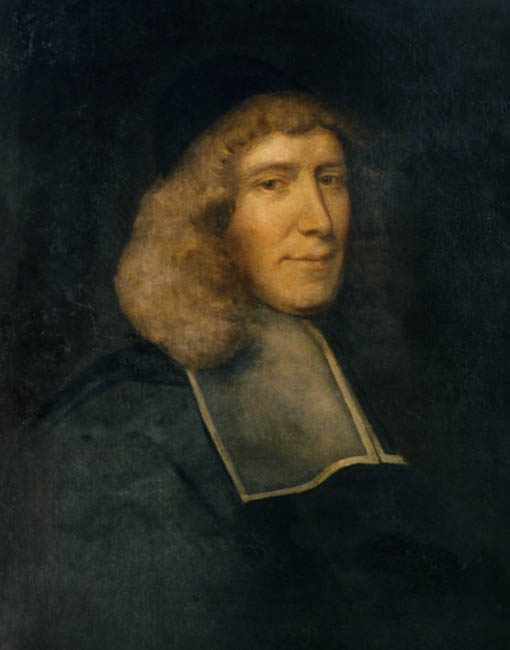
John Owen (1616-1683), thanks to ReformationArt.com
Time for our first break from Brown’s Self-Interpreting Bible. How about if we dabble in the doctrine of particular redemption?
I ran across, once again, the famous quote by Puritan theologian par excellence, John Owen (1616-1683), from his book, The Death of Death in the Death of Christ. Among statements in defense of the Reformed doctrine of particular redemption, this one is literally viral in the Reformed blogosphere. This quote is Owen’s logical critique of general redemption, and is worth thinking through and searching the Scriptures about if you’ve never taken the time.
Anyway, here’s a breakdown of his complex argument from Reformed.org:
The Father imposed His wrath due unto, and the Son underwent punishment for, either:
- All the sins of all men.
- All the sins of some men, or
- Some of the sins of all men.
In which case it may be said:
- That if the last be true, all men have some sins to answer for, and so, none are saved.
- That if the second be true, then Christ, in their stead suffered for all the sins of all the elect in the whole world, and this is the truth.
- But if the first be the case, why are not all men free from the punishment due unto their sins?
You answer, “Because of unbelief.”
I ask, Is this unbelief a sin, or is it not? If it be, then Christ suffered the punishment due unto it, or He did not. If He did, why must that hinder them more than their other sins for which He died? If He did not, He did not die for all their sins!”
I’ve looked at this many times and have until now always had trouble keeping the whole train of thought on the rails in my head, if you know what I mean. Finally, the other day, I decided I’m going to have to do with this what I do with Scripture verses and catechism questions that I want to memorize–put it to music!
The following is the result. It’s roughly based on the tune to the children’s song “I’m in the Lord’s Army,” although there are some divergences. Do what you will with it. So, without further ado, I give you . . .
Extent
by John D. Chitty
Did Christ die for
all sins of all men
or all sins of some men
or some sins of all men?
If Christ died for
some sins of all men,
then all die
for those he did not.
But if Christ died for
all sins of some men,
that’s what we believe,
all th’elect of all the nations!
But if Christ died for
all sins of all men,
why are not
all men saved?
You will answer
“Because of unbelief”–
Is unbelief a sin or not?
If not, why then,
for it give account?
Either for it
Christ was punished, or not!
If he was, then,
why does unbelief
prevent salvation
more than other sins he died for?
But if he did not
die for unbelief,
then for all sins of all men
Christ did not die!
So Christ died for
all sins of some men,
those the Father
gave to His Son!
I’m from Geneva, and I’m here to help!
WHI on the Effects of eDistraction
This week’s episode of the White Horse Inn radio show featured an interview with Grove City College Media Ecology professor T. David Gordon. Gordon is the author of two books that are of special interest to this blogger and will be hopefully to his readers also. The books are Why Johnny Can’t Preach (2009) and Why Johnny Can’t Sing Hymns (2010).
Why Johnny Can’t Preach is “an analysis of shifts in dominant media forms and their effects on the sensibilities of the culture as a whole. Many of those shifts have profound, and unfortunate, effects on preaching.” About Gordon’s newer book, Why Johnny Can’t Sing Hymns, the publisher’s website has this to say:
Changes in music have affected the way we think, the way we worship—even the way we are able to worship. We are steeped in a culture of pop music that makes other genres seem strangely foreign and unhelpful. Worship has become a conflict area, rather than a source of unity.
T. David Gordon looks at these changes in worship and not only examines the problems, but also provides solutions. They are solutions of great importance to us all—because how we sing affects how we live. Dr. Gordon not only shows the problems, he also provides solutions – it’s important, because how we sing affects how we live.
The White Horse Inn blog has also posted additional resources on the current phenomenon of media distraction and its effect on our minds, as Christians or otherwise, let alone culture at large (see blogpost here).
A Question for Presuppositionalists
 For those who may not be familiar with what “presuppositionalism” is, it can be described simply as the Reformed approach to apologetics (defense of the Christian faith). The New Dictionary of Theology explains: “The presuppositionalist endeavors to convince the unregenerate first by demonstrating that, on unregenerate presuppositions of chance occurrence in an impersonal universe, one cannot account for any sort of order and rationality. Next, he tries to show that life and reality make sense only on the basis of Christian presuppositions.” (see this link for citation)
I have not studied presuppositional apologetics personally to any extent whatsoever, yet. However, based on short definitions like the ones above, it occurred to me once upon a time, that since Edward F. Hills, author of The King James Version Defended is a graduate, not only of Yale, but also of Westminster Theological Seminary, and that much of Hills’ defense of the Textus Receptus (the popular name of the Greek text that underlies the King James Version New Testament) is written from a characteristically Reformed standpoint, that when he further makes his defense from what he calls “The Logic of Faith,” that this must be his way of applying presuppositional apologetics to the defense of the superiority of the Greek Text underlying the King James Version, as well as that translation itself.
My question for presuppositionalists who’ve read The King James Version Defended, therefore, is: Am I right? Was Hills a presuppositionalist, and is his so-called “Logic of Faith” a fair representation of the presuppositionalist apologetic, and is belief in the inherent superiority of the Textus Receptus therefore the consistently Reformed answer to the question, “Which New Testament text is closest to the original manuscripts?”
My personal short answer is, “I hope not.” I don’t really think the conclusion necessarily follows from the premise. I’m sure most presuppositionalists agree with me on this, and could probably give a better explanation as to why, and I’d like to see what you’d have to say on this topic. I’d also be interested in any King James Onlyist presuppositionalists out there (or perhaps more accurately, Textus Receptus Onlyist) who would answer yes to the question as stated in the previous paragraph.
Independent Baptist defender of the King James Version, Dr. David Cloud, has posted “The Testimony of Dr. Edward F. Hills,” in which Hills explains his journey to the position he defends. He writes that he was puzzled by Dr. B.B. Warfield, who was simultaneously perhaps the premier champion of the Westminster Confession of Faith, and an avid proponent of what Hills considered the textual criticism of theological liberalism. Hills explains that Warfield must have fallen prey to the false dichotomy between faith and reason, which he says Cornelius van Til taught him was begun by the medieval scholastic theologians. In this testimony, Hills does not state explicitly that he applied van Til’s presuppositional apologetic to this question, but what he does state explicitly does seem to say, at least implicitly, in my opinion, that this is just what he did.
What say you, Reformed presuppositionalists? Pro KJV/TR onlyists, or pro-modern textual criticism/modern versionists? I’m ready to learn.
My “Perfect Church” (With Apologies to My Current Church)

Redeemer Pres Exterior
I know the old saying, “If you find the perfect church, it’ll stop being perfect because you’re there,” or something like that. Well, I’ve been around the block a few too many times to think that there is such a thing as a church full of perfectly consistent Christians who always forgive each other, are loving, generous and caring, while at the same time utterly devoted to offering the purest, most biblically ordered and sincere worship of God. I may be a bit naive about some things, but when it comes to church, I’m . . . well, not so naive. But that doesn’t keep me from getting enthusiastic about church from time to time.
Perhaps a little closer to what I have in mind is the way people talk about “your own hell.” You know, some conceptualize hell by making it an infinite and eternal punishment of enduring whatever any given individual finds the most unpleasant or distasteful. Like hell for some people is lying on a bed of nails for eternity, for others it’s having to watch Family Matters reruns (I never did like that show), and still others may dread an eternity of reading poorly written blog posts, or something. But you get the idea. This is more analogous to what I have in mind when I say that this past Sunday, I visited what I consider to be “my perfect church.” It had just about everything I could ever ask for in a church (with very few exceptions).
In the world of debating the Reformed notion of the “Regulative Principle of Worship,” the matters that come under discussion are usually categorized in two ways: elements of worship (mandatory things the Bible requires:preaching, prayer, sacraments, etc.), and circumstances of worship (optional things utilized for practical reasons: choice of musical instruments, sound systems, carpet color, etc.). I think I’ll try to categorize the elements and circumstances of my own personal concept of the perfect church, which I discovered in Overland Park, Kansas at Redeemer Presbyterian Church.
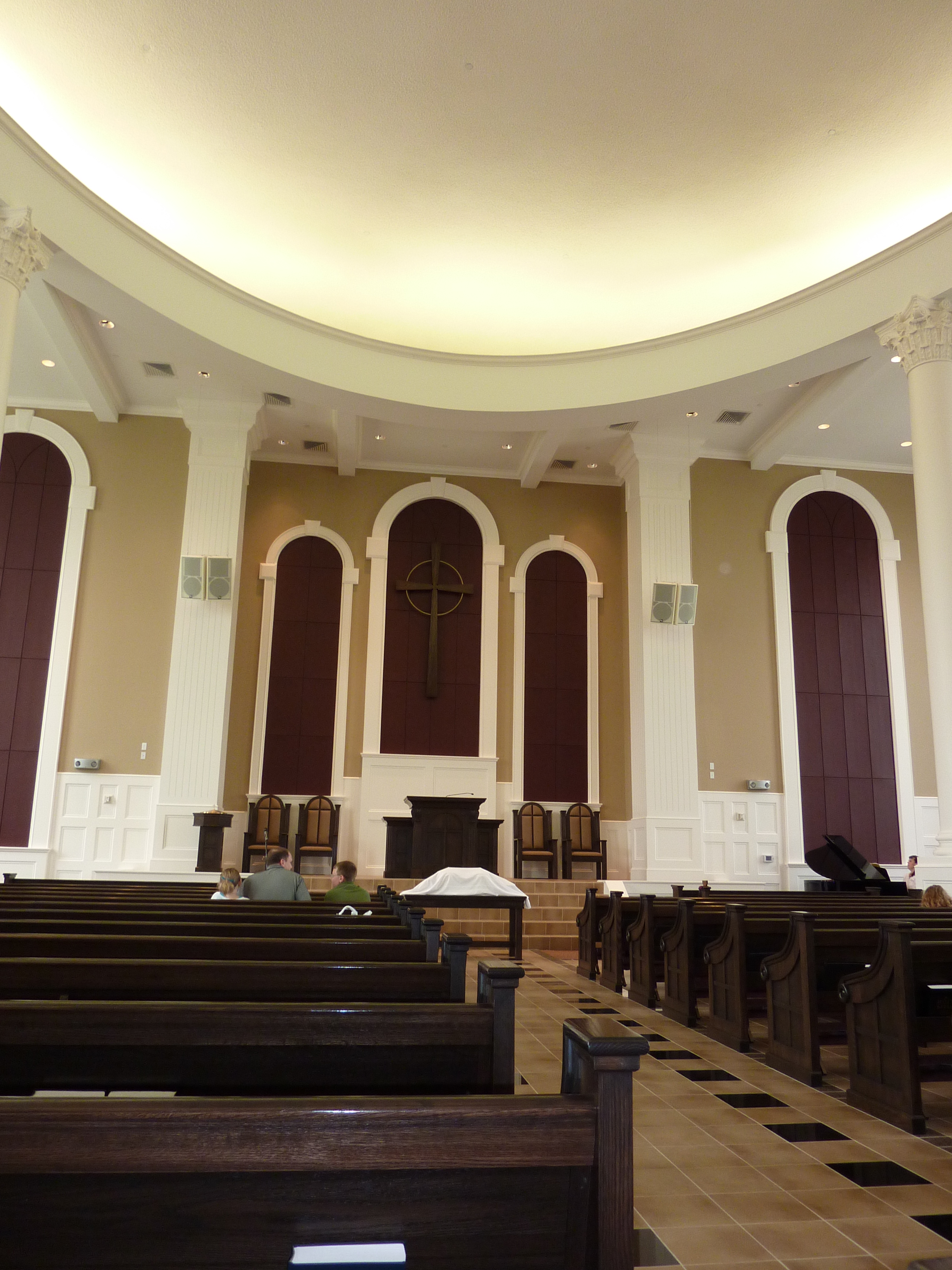
Redeemer's Sanctuary (Not "Auditorium" or "Worship Center")
- Preaching that explicitly centers all exposition and application on the good news of Christ’s life, death and resurrection, with a minimum of autobiography, corny jokes, illustrations and sundry other rabbit trails.
- Weekly communion
- Long-winded prayers full of Scripture
- The predominance of classical, historic hymnody (I can tolerate a dose of contemporary music, as long as it’s done tastefully)
Circumstances (Icing on the Cake!)–
- Big, beautiful church architecture and a really cool pulpit (not a glorified music stand)
- Pipe organ accompaniment of at least the primary psalms and hymns sung by the congregation (okay, there were no pipes–just giant speakers, but the organ had the sound!)
- A book table full of Reformed literature
- A pastor who runs a Reformed blog
- Members who demonstrably care about me
Anyway, that gives you a pretty good idea of what gets me all giddy and makes me start speaking in terms of “the perfect church.” These were all to greater and lesser degrees present at Redeemer Presbyterian. I was even impressed by the hospitality of the couple in the pew in front of us with whom we “passed the peace” (my first time for that practice, but I’d heard of it from an Episcopal friend before). When they learned that we were from out of town to visit our daughter who attends UMKC, they gave us their name, phone number and address with an invitation to crash with them whenever we return to Kansas City.
Then there was the pastor and the preaching. First of all, when I was searching online for a church to visit last Sunday morning, I noticed on Redeemer’s webpage that their pastor is the man who runs the blog called “Reepicheep,” which I’d seen a few times before in the blogrolls of other blogs, but had yet to begin regularly following. Well that’s changed. When I shook his hand at the door on my way out, I told him I’d add him to my blogroll (see sidebar). As for the preaching, a thorough exposition and application of Philippians 2:9-11 on God’s and man’s response to the supreme humility of Christ sealed the deal (listen here). It was obvious by it’s predominance that the gospel is a priority for the preaching ministry of this church. If I lived in Kansas (or Kansas City, this would be the church for me). But I don’t, so it isn’t. But this is the heart of what I consider to be my “perfect” church.
P.S.–I would’ve taken more pictures like the tourist I was, but I was embarrassing my wife. 🙂
Classic Video Of Dr. Michael Horton on The Agony of Deceit
The following line-up of videos features a series of classic interviews with a very young Dr. Michael Scott Horton promoting a now out-of-print book he edited on the Word of Faith movement (the so-called “prosperity preachers” or “faith healers”) called The Agony of Deceit. Please take the time to listen to the things Dr. Horton has to say in describing the content of his research and that of several other sound and prominent scholars, ministers and otherwise expert witnesses regarding the spiritual devastation that the blasphemous heresies of the Word of Faith movement has brought to unsuspecting souls around the world.
Another important work that the host promotes is A Different Gospel: Biblical and Historical Insights into the Word of Faith Movement, by former ORU adjunct professor D.R. McConnell, which identifies Kenneth “Dad” Hagin (so-called “Father of the Faith Movement”) as nothing more than the plagiarizing popularizer of the teaching of New Thought practitioner E.W. Kenyon (this article summarizes McConnell’s case).
These interviews were filmed perhaps around 1992. You can sense the excitment the host of this apparently low-budget Austin, Texas-based Christian cable program experienced to have the opportunity to host Dr. Horton as he relates to viewers like you and me “the agony of deceit.” I know this is old news, but so few believers have had the opportunity to give a hearing to material such as this exposing the depth of the heresy involved in the otherwise cartoonish movement that enters everyone’s homes through television, my desire is to do my small and feeble part in continuing to promote the truth, considering how disproportionately well-known are the propagandists of the positive-confession/prosperity gospel. How true it is that a lie is halfway around the world before the truth has got its boots on.
The Agony of the Health and Wealth Gospel, Part 1: Historical Roots of this False Religion
Part 2: Touch Not The Lord’s Anointed Gods
Part 3: Miracles For Money
Part 4: The Cult of the Tele-Evangelists
Part 5: Negative Positive Confession
“For All The Saints”
And I heard a voice from heaven saying, “Write this: Blessed are the dead who die in the Lord from now on.” “Blessed indeed,” says the Spirit, “that they may rest from their labors, for their deeds follow them” (Revelation 14:13)
Since January 10th, at my local non-Reformed Southern Baptist church, I’ve been teaching on Sunday evenings a class summarizing church history from the days of the apostles through the Reformation. To assist my presentation, I selected a PowerPoint presentation by Rose Publishing called “Christian History Made Easy,” by Dr. Timothy Paul Jones (see also Dr. Jones’ own site) of the Calvinistic Southern Baptist Theological Seminary.
My preparation for this survey of church history has enhanced my understanding of, and appreciation for first and second century life in the pagan Roman Empire. Although the Pax Romana largely enabled most to live in relative peace as long as they pluralistically accepted and paid homage to the Roman pantheon, such an existence forced the Christian church to practice its faith underground. The moral implications of following Christ also made Christians a nuisance to Roman society because of their biblically-based respect for women, children and even slaves. Although persecution was not an everyday occurence for Christians in pagan Rome, there were occaisional periods during which persecution would break out. This is the source of the infamous act of throwing Christians to the lions in the Coliseum, where many Christian martyrs were made.
This morning, one of my Facebook friends, Henry Christoph, Jr. directed my attention to a Lutheran YouTube page which apparently commits many classic hymns to video paired with either still art or live action selections to illustrate the spiritual truths featured in each hymn. One such video dovetailes nicely with my current focus on ancient church history. Below, you can view the video of the hymn “For All the Saints,” a processional hymn featured in Anglican and Lutheran observance of All Saints Day and other similar occaisions on the church calendar.
Part of the scriptural basis of this hymn is the text I featured at the beginning of this post. This text, as applied in “For All The Saints” highlights one of the practical applications of the otherwise mysterious book of Revelation: a message of comfort and hope for Christians who are suffering persecution even in the present day. Many dispensational premillennialists view these as applying only to future martyrs, and so at times shy away from preaching from the book of Revelation because their eschatology causes them to miss how the book of Revelation applies to Christians today. Christian martyrdom is a daily fact of life for more believers around the world today than at any time in church history. Is there no valid word from the Lord in the book of Revelation to strengthen the faith and resolve of these suffering believers?
I’ll provide the text of the hymn first, and below you will find the YouTube video. May the Lord grant to each of us the courage to so let our lights shine as it so effectively did in the earliest centuries of church history, and may he continue to be praised for the gift of religious liberty in his common grace. Let us not take it for granted, nor allow it to enable us to forego the taking up of our crosses.
William Walsham How, 1864, 1875
SINE NOMINE 10.10.10.al.
Ralph Vaughn Williams, 1906
For all the saints who from their labors rest,
Who thee by faith before the world confessed,
Thy name, O Jesus, be forever blest.
Alleluia! Alleluia!
Thou was their rock, their fortress and their might;
Thou, Lord, their Captain in the well-fought fight;
Thou, in the darkness drear, their one true light.
Alleluia! Alleluia!
O may thy soldiers faithful, true and bold,
Fight as the saints who nobly fought of old,
And win with them the victor’s crown of gold.
Alleluia! Alleluia!
The golden evening brightens in the west;
Soon, soon to faithful warriors comes their rest;
Sweet is the calm of paradise the blest.
Alleluia! Alleluia!
But lo! There breaks a yet more glorious day;
The saints triumphant rise in bright array;
The King of glory passes on his way.
Alleluia! Alleluia!
From earth’s wide bounds, from ocean’s farthest coast,
Through gates of pearl streams in the countless host,
Singing to Father, Son and Holy Ghost.
Alleluia! Alleluia!
Fundamentally Reformed Radio
 Bob Hayton, of the Fundamentally Reformed blog, which is featured in my blogroll, was interviewed yesterday on the Iron Sharpens Iron radio show regarding the theme of his blog, “Reforming Fundamentalism through Reformed theology.” Bod discusses the issues he has with the Independent, Fundamental Baptist movement in general, his experiences within it and as he and his brother were leaving it, and explains the key ingredient that makes Reformed theology such a draw: the gospel of Jesus Christ, not only preached to unbelievers for their justification, but also applied on a consistent basis to believers for their sanctification. The life, death and resurrection of the Lord Jesus Christ is the one thing that will free a believer, not only from the guilt of sin, not only the ongoing power of sin, as the believer is built up in the message of God’s grace in Jesus Christ, but also from the need for legalistic standards and divisive forms of “separatism.”
Also, ten minutes from the end of the show, you’ll be treated to my call-in question, and Bob’s insightful answer. Click on the link below to listen. Don’t be deterred by the Spanish language programming at the beginning of the podcast–Iron Sharpens Iron will begin directly…
\20100308–“Reforming Fundamentalism Through Reformed Theology\”
The “Vile Pollution” of the Worship of God
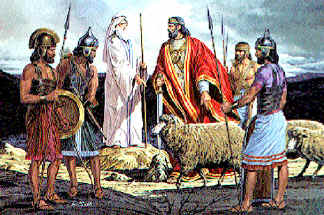
"What then is this bleating of the sheep in my ears...?" 1 Samuel 15:14
Need I point out that the following does not only apply to the sixteenth century Roman Catholic Church?
“Having observed that the Word of God is the test which discriminates between his true worship and that which is false and vitiated, we thence readily infer that the whole form of divine worship in general use in the present day is nothing but mere corruption. For men pay no regard to what God has commanded, or to what he approves, in order that they may serve him in a becoming manner, but assume to themselves a licence of devising modes of worship, and afterwards obtruding them upon him as a substitute for obedience. If in what I say I seem to exaggerate, let an examination be made of all the acts by which the generality suppose that they worship God. I dare scarcely except a tenth part as not the random offspring of their own brain. What more would we? God rejects, condemns, abominates all fictitious worship, and employs his Word as a bridle to keep us in unqualified obedience. When shaking off this yoke, we wander after our own fictions, and offer to him a worship, the work of human rashness, how much soever it may delight ourselves, in his sight it is vain trifling, nay, vileness and pollution. The advocates of human traditions paint them in fair and gaudy colours; and Paul certainly admits that they carry with them a show of wisdom (Colossians 2:23); but as God values obedience more than all sacrifices (1 Samuel 15:22), it ought to be sufficient for the rejection of any mode of worship, that it is not sanctioned by the command of God.” (emphasis added)
John Calvin, in his tract, “The Necessity of Reforming the Church” (cited from page 132 of Selected Works of John Calvin: Tracts and Letters, edited by Henry Beveridge and Jules Bonnet; Volume 1: Tracts, Part 1)


 The Misadventures of Captain Headknowledge
Heresy in Defense of the Fundamentals
Council of Chalcedon, AD 451
“Since therefore the children share in flesh and blood, he himself likewise partook of the same things, that through death he might destroy the one who has the power of death, that is, the devil, and deliver all those who through fear of death were subject to lifelong slavery” (Hebrews 2:14-15 ESV).
Recently, I heard an Independent Fundamental Baptist preacher comment that he believes in salvation “by the blood of Christ, not his death.” One who heard this comment with me registered his shock at the statement. Having discussed this issue with this particular preacher in the past, I knew what he meant by it, and was able to fill in my companion. The following bullet points are a summary of the things I shared with him.
Suffice it to say that there is a segment of Independent Baptist Fundamentalism that so wants to defend the “literal” interpretation of Scripture that it will often deny simple figures of speech in Scripture to the extent that it begins to distort the very fundamentals it intends to defend. One such fundamental of the faith that has suffered such distortion is that of the hypostatic union of Christ’s human and divine natures, of which the historic conciliar statement produced by the Council of Chalcedon (AD 451) expresses the Biblical doctrine quite thoroughly and has served the church well in defining the orthodox position. Although an appeal to the so-called “Definition of Chalcedon” as an expression of Scriptural teaching on the matter falls on deaf fundamentalist ears, it does not change the fact that, historically speaking, for the Protestant as well as the Roman Catholic, to dissent from this Ecumenical Council on the hypostatic union is to be led by blind guides into the ditch of formal heresy. Sad to say, this is the fate of the kind of irresponsible Biblicism that often goes on in the Fundamentalist movement.
I’ve posted on this topic before here and here. The names I’ve used for this fundamentalist heresy are “Divine Blood” and “Celestial Flesh.” These titles describe the ways in which fundamentalists blur the distinction between Christ’s human and divine natures to a possibly heretical extent. This explains the use of these terms in the following bullet points:
I found an excellent, but lengthy, treatment of this doctrine by an Irish Reformed minister. If you’ve ever heard of this doctrine before, and are the least bit concerned about it, please invest the time in reading “Fundamentalists and the ‘Incorruptible’ Blood of Christ” by Martyn McGeown of Covenant Protestant Reformed Church in Ballymena, North Ireland. Although it’s by an Irish writer, much of his essay interacts with American fundamentalist contributions to the controversy as well.
Share this: