A Question for Presuppositionalists
 For those who may not be familiar with what “presuppositionalism” is, it can be described simply as the Reformed approach to apologetics (defense of the Christian faith). The New Dictionary of Theology explains: “The presuppositionalist endeavors to convince the unregenerate first by demonstrating that, on unregenerate presuppositions of chance occurrence in an impersonal universe, one cannot account for any sort of order and rationality. Next, he tries to show that life and reality make sense only on the basis of Christian presuppositions.” (see this link for citation)
I have not studied presuppositional apologetics personally to any extent whatsoever, yet. However, based on short definitions like the ones above, it occurred to me once upon a time, that since Edward F. Hills, author of The King James Version Defended is a graduate, not only of Yale, but also of Westminster Theological Seminary, and that much of Hills’ defense of the Textus Receptus (the popular name of the Greek text that underlies the King James Version New Testament) is written from a characteristically Reformed standpoint, that when he further makes his defense from what he calls “The Logic of Faith,” that this must be his way of applying presuppositional apologetics to the defense of the superiority of the Greek Text underlying the King James Version, as well as that translation itself.
My question for presuppositionalists who’ve read The King James Version Defended, therefore, is: Am I right? Was Hills a presuppositionalist, and is his so-called “Logic of Faith” a fair representation of the presuppositionalist apologetic, and is belief in the inherent superiority of the Textus Receptus therefore the consistently Reformed answer to the question, “Which New Testament text is closest to the original manuscripts?”
My personal short answer is, “I hope not.” I don’t really think the conclusion necessarily follows from the premise. I’m sure most presuppositionalists agree with me on this, and could probably give a better explanation as to why, and I’d like to see what you’d have to say on this topic. I’d also be interested in any King James Onlyist presuppositionalists out there (or perhaps more accurately, Textus Receptus Onlyist) who would answer yes to the question as stated in the previous paragraph.
Independent Baptist defender of the King James Version, Dr. David Cloud, has posted “The Testimony of Dr. Edward F. Hills,” in which Hills explains his journey to the position he defends. He writes that he was puzzled by Dr. B.B. Warfield, who was simultaneously perhaps the premier champion of the Westminster Confession of Faith, and an avid proponent of what Hills considered the textual criticism of theological liberalism. Hills explains that Warfield must have fallen prey to the false dichotomy between faith and reason, which he says Cornelius van Til taught him was begun by the medieval scholastic theologians. In this testimony, Hills does not state explicitly that he applied van Til’s presuppositional apologetic to this question, but what he does state explicitly does seem to say, at least implicitly, in my opinion, that this is just what he did.
What say you, Reformed presuppositionalists? Pro KJV/TR onlyists, or pro-modern textual criticism/modern versionists? I’m ready to learn.
Jack Chick Earns the Respect of the Underground Comics Industry

Rare photo of the reclusive and elusive Jack Chick
I should probably save this for another time when I’ve got more time to write all that I have to say about Jack Chick and his world famous “Chick tracts,” (see his site, Chick Publications) but I can’t wait to at least show you the trailer for a documentary about Jack Chick and his comic books and comic book-style tracts. As it relates to me, Jack Chick is one of the instrumental causes of my dropping out of Bible College. I didn’t do my homework because I was too busy devouring his comics purchased from a nearby Christian bookstore.
Anyway, the following trailer features mostly the ways Chick’s views are poked fun of in the film, but if you ever get a chance to watch the documentary itself, as I did on the Documentary Channel a few days ago, you would see how much the filmmakers and even some of the non-Christian interviewees have for his comics as works of art. They say his work is even featured in galleries across the country and I think they said it even has a presence at comic book conventions and other such forums in which such material is auctioned. Jack Chick is collectible. All you fundies out there better hold onto at least a few copies of his tracts in case you need to cash them in once the economy completely collapses!
The picture to the right was found on the site of Catholic lay apologist Jimmy Akin’s website. He found it on the church website of an Independent Fundamental Baptist church whose pastor (right) has a testimony similar to that of the “Bad Bob” featured in the Chick tract of the same name held by the author (aka, Jack Chick himself, left). If you want to read about this picture and the hand-drawn portrait of Jack Chick at the Catholic apologist’s website, click here, here, and here. They make for fascinating reading, and serve as a little background info to some things I may share in a future post when I’ve got more time.
Below is the trailer to God’s Cartoonist: The Comic Crusade of Jack T. Chick.
Oh yeah, there are a few bios you will want to read on Jack Chick and his associates at Wikipedia in conjunction with this video:
Discovery of Biblical Manuscripts Goes On
 The Yahoo! News site is featuring an article on the recent reunion of two portions of an ancient Hebrew scroll containing “The Song of the Sea,” otherwise known as Exodus 15:9-10. You can read all about it here. If you’re curious about what sorts of New Testament manuscript discoveries are ongoing, read this post and/or check out the website for the Center for the Study of New Testament Manuscripts.
Commemorative Coins From the Ancient Egyptian Mint?

Just some of lots and lots of ancient artifacts in the Egyptian Museum, Cairo
Dr. Kim Riddlebarger recently posted a link to a story in The Jerusalem Post about a coin found in the Egyptian Museum in Cairo that bears the image and name of the Old Testament Joseph (Kim’s post). Such a find seems to sound like one of the more sensational on its face, but considering the fact that the claim comes from a Muslim archaeologist, reported in a Cairo newspaper, passed on by the Middle East Media Research Institute, carried by The Jerusalem Post lends at least an initial note of credibility. I’m sure lots of peer reviewing is afoot among Dr. Sa’id Muhammed Thabet’s colleagues, and who knows if any more will ever be heard about it, but, as Dr. Riddlebarger said, if it’s legitimate, it’s yet another piece of evidence that the Jews were where the Bible says they were when the Bible says they were. But you can also bet that if it is legitimate, you won’t be seeing any rush by the media to produce best-selling books and prime-time TV specials about it. For that reason, stay tuned to the Reformed blogosphere.
Be that as it may, I did a little more digging and found the MEMRI report that contains excerpts from the Cairo newspaper article about Dr. Thabet’s find. Thought a few of my readers would find this interesting reading. Here’s the link to the report entitled, “Leading Egyptian Daily ‘Al-Ahram’ Reports: Coins From Era of Biblical Joseph Found in Egypt.”
The report indicates that the coins turned up at the Egyptian Museum in Cairo, which is the primary resting place of so many of the most amazing arifacts of ancient Egypt, including those of King Tut. My wife and I visited this museum on our Holy Land Tour back in 2007 (see the category link in the sidebar for a few posts related to our trip, as well as some pictures on my Flikr page which is also linked to in the sidebar). One thing that struck us about the museum was that so many of the artifacts, especially statues and other large items were just out in the main thoroughfare where anyone and everyone could place their grimy hands all over them! I guess they figure if they’ve lasted this long, a few fingerprints aren’t going to hurt them the way they might harm other items from more recent times (they don’t make ancient artifacts like they used to). But the other thing that struck us about the museum was that there was so much stuff in the museum, we find it to be no surprise that something like this would turn up having been previously overlooked. But, boy, wouldn’t it be great if these coins not only proved that ancient Egyptians used money and didn’t only barter, which is the main significance the archaeological world seems to invest it with, but also was considered by scholars of Biblical archaeology to be tangible evidence of the existence of the biblical Joseph, truly lending further evidence to the historical reliability of the Bible.
Twenty-first Century New Testament Textual Criticism
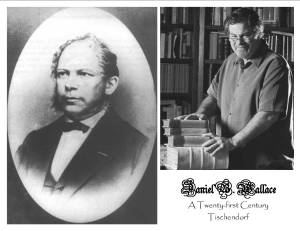
Constantin Von Tischendorf (r); Daniel B. Wallace (l)
Will the 21st century go down as another great age of discovery when it comes to our knowledge of the transmission of the text of the Greek New Testament? While many skeptical and liberal scholars like Bart Ehrman are busy using their expertise in the Biblical Studies to destroy faith in God’s revealed Word in the Scriptures, others, like Dr. Daniel B. Wallace of Dallas Theological Seminary, founder of The Center for the Study of New Testament Manuscripts, is using modern technology to “discover” ancient manuscripts which have until now been inaccessible due to their fragile condition. According to an interview of him on Friday’s edition of Christ the Center, in the past year, about 36 manuscripts have been discovered and are in line behind about 75 others to be catalogued at the place in Munster, Germany where the knowledge of such manuscripts are warehoused for use by scholars the world over.
No time to finish this post. But I want you to listen to the program. Here’s the link: http://reformedforum.org/ctc70/
The Truth About “Angels & Demons”
This weekend, the companion to The DaVinci Code, called Angels & Demons, hit the theaters. Just a few days before the movie came out, some scholars from Westminster Theological Seminary in Philadelphia, Pennsylvania, announced their website called “The Truth About Angels & Demons,” devoted to addressing the issues raised by Dan Brown’s book and the new movie based thereon. You may have noticed there has not been nearly the controversy swirling around this movie, but that doesn’t mean the story doesn’t distort the truths with which it deals. Hence the concern that, in this generation in which many people learn their history, science and theology from novels and movies, often accepting uncritically that which they read and watch, inaccuracies be corrected on a popular level.
In addition, Dr. Peter Lillback, one of the men behind the website, was interviewed on Issues, Etc., introducing the website and discussing some of the issues dealt with on the site. These issues range from the true identity of the historical secret society called the Illuminati to the conflict between science and religion, to the reason this film hasn’t been quite as controversial as the last. You can listen to this interview here.
Dr. Peter Lillback is a professor of historical theology at Westminster Theological Seminary, and is the author of The Binding of God, Lessons on Liberty: A Primer for Young Patriots, Wall of Misconception: Does the Separation of Church and State Mean the Separation of God and Government?, and George Washington’s Sacred Fire.
If it’s good enough for Moses . . .
Just kidding. This video was linked to on the Facebook King James Bible fan page, and I’m a big fan of Chuck’s (we even share a birthday–Oct. 4!), so I just wanted to post this. Most of what he says are the right reasons to love the Authorized King James Version. There are, unfortunately, a lot of wrong reasons to love it going around. Listen to Moses . . .
Equal in Creation and Redemption; Complementary in Role
 Yesterday on the Gender Blog for the Council on Biblical Manhood & Womanhood, Dr. Albert Mohler, president of Southern Baptist Theological Seminary responded to a USA Today op-ed column by Mary Zeiss Stange, professor of Women’s Studies and Religion at Skidmore College in Saratoga Springs, N.Y. The topic: of course, women’s role in church ministry. Considering her credentials, it’s easy to see that Stange is going to be an advocate of egalitarianism (look it up) between the sexes when it comes to church leadership. Dr. Mohler attempts to bring Stange’s, and the modern culture’s, basic worldview into focus, and he contrasts it with some basic comments regarding the biblical, complementarian (look it up), worldview of the roles of men and women in church life.
I realize that the world isn’t consciously fettered to the clear teaching of Scripture, and it should be no surprise that the world would attempt to budge the church from faithfulness thereto. The world does a very good job of it, across the board, when it has to try at all, and doesn’t find a church eager to join the world’s parade regardless of which direction it’s going. But I thought in the light of the present discussion on those other sites, I’d post Paul’s controversial restriction on women in church leadership from 1 Timothy 2. And I mean the whole, short chapter. As you read the chapter, notice first of all the redemptive basis of his restriction, then notice the Old Testament or creational basis of his restriction:
2:1 First of all, then, I urge that supplications, prayers, intercessions, and thanksgivings be made for all people, 2 for kings and all who are in high positions, that we may lead a peaceful and quiet life, godly and dignified in every way. 3 This is good, and it is pleasing in the sight of God our Savior, 4 who desires all people to be saved and to come to the knowledge of the truth. 5 For there is one God, and there is one mediator between God and men, the man Christ Jesus, 6 who gave himself as a ransom for all, which is the testimony given at the proper time. 7 For this I was appointed a preacher and an apostle (I am telling the truth, I am not lying), a teacher of the Gentiles in faith and truth.
8 I desire then that in every place the men should pray, lifting holy hands without anger or quarreling; 9 likewise also that women should adorn themselves in respectable apparel, with modesty and self-control, not with braided hair and gold or pearls or costly attire, 10 but with what is proper for women who profess godliness—with good works. 11 Let a woman learn quietly with all submissiveness. 12 I do not permit a woman to teach or to exercise authority over a man; rather, she is to remain quiet. 13 For Adam was formed first, then Eve; 14 and Adam was not deceived, but the woman was deceived and became a transgressor. 15 Yet she will be saved through childbearing—if they continue in faith and love and holiness, with self-control.
The redemptive basis of Paul’s restrictions on women in church leadership is found in verses five and six. Men and women share the same mediator. Elsewhere, in the context of roles in marriage, Peter instructs husbands to keep in mind that their wives are “heirs with [them] of the grace of life” (1 Peter 3:7). The same is true in this context. Christ died, not only for “kings, and all who are in high positions,” or just for Jews and men (meaning males), but he died for all kinds of people. He died for the powerful and the powerless; for the Jew and for the Gentile; and the Lord Jesus Christ is the sole mediator between God and humans of both sexes. It is instructive to note that the word “man” in verse five translates the same Greek word that is translated people in verses one and four. Christ didn’t just die for males, he died for males and females. It is first in the light of this fact, men’s and women’s equality in redemption, that Paul gives any instruction at all to anyone. For here is the source of life: the message of redemption in Christ. No other message will grant to men or women the grace to serve God according to his will. And any differentiation of roles between the sexes would certainly not last, if not for loving gratitude to the Lord for what he has done for men and women.
Secondly, notice Paul’s Old Testament, or creational, basis for his restriction on women in the church leadership role. This is found in verses thirteen and fourteen. Refer to the passage above for a refresher. Paul states two simple reasons. I might add that they are reasons that were “breathed-out,” or spoken, by God himself. Reason one: Women should not “teach” or “excercise authority over a man,” but are to “remain quiet” because of creational chronology. Adam was created first, and Eve was created second. The simple fact is that the biblical revelation of the creation of men and women included from the very beginning inherent complementarian roles. Moses clearly writes that the woman was created to be “a helper fit (or corresponding) to him” (Genesis 2:18). Paul does not elaborate on this chronology as an excuse to institute complementarian roles in the church, just states it as the reason.
The challenge of competent biblical interpretation is to avoid going beyond what Scripture teaches. Yes, this includes the implicit teaching as well as the explicit, but not all inferences drawn from the text are equally valid or necessary. One must tread with caution when it comes to that. When the interpreter is not cautious in drawing inferences, misinterpretation results, and this misinterpretation will contradict the totality of biblical revelation. So it is in this case. The reason people get offended so easily by this passage is that when they hear that men were created before women, they don’t hear a chronological list, they instinctively hear a qualitative list, for want of a better word (if you’ve got one, submit it in your comment). In other words, they hear something like, men were created first, and therefore they are better than women. This is what I call an invalid, and unnecessary inference drawn from the text. This is not what Paul is saying. It is important to not “go beyond what is written” (compare 1 Corinthians 4:6-7).
Paul’s second Old Testament basis is the fact that Eve became a transgressor by being deceived in the fall, and Paul clarifies that Adam was not deceived. Here again, it is important to reign in our instinctive inferences based on sexual rivalry. Many hear this passage as implying that women should not teach men in church, or serve in the pastoral office, because they are somehow by nature more prone to deception, and that, in order to preserve the truth of Scripture, women should be restricted from the teaching ministry of the church. This, again, is an invalid inference. If this passage does anything, it points out the greater responsibility Adam had in the fall, as compared with Eve. Put simply, the devil tricked Eve into eating the forbidden fruit; Adam ate it, as they say, “of his own free will.” So here again, Eve is subordinate in role (not in inherent worth) not only in her creation, but also in her fall from original righteousness, into original sin. Thus Paul’s second facet of the creational basis of complementarianism in roles in the church.
So Adam and Eve were created and fell with reference to superordinate and subordinate roles. So, where do we find the inherent equality in worth? Genesis 1:26 says, “Then God said, “Let us make man (generic for both sexes) in our image, after our likeness.” Both men and women reflect God in righteousness, knowledge and holiness (compare Ephesians 4:24; Colossians 3:10). Men and women were created equally righteous, but fell from this; they were equally rational–both have the capacity for reason which distinguishes them from the animal kingdom, and so reflect God. Men and women were also created equally “holy” or set apart by God to perform God-given roles. Although these roles differ, the fact that they are set apart for specific roles is equal.
So, in creation and redemption, men and women are equal. In role, men and women complement each other. When tempted to defer to the pressure of the world to conform to its egalitarian expectations, it’s important to recall that Paul quoted Old Testament Scripture as his sole reason for having men and women serve differing roles out of loving gratitude for the mediatorial life, death and resurrection of the Lord Jesus Christ. The roles were not culturally contrived, and therefore dated and obsolete. The roles were built in at creation and are expected in the light of the cross. Paul stood on God’s Word, and so should the 21st century Christian.
Faith vs. Reason

"Extra! Extra! Read all about it!"
Make sure you read the headlines from the Daily Evangel today, over in my sidebar to the right. Especially of interest is the Theological Word of the Day: Fideism.
Without giving anything away, I’d like to at least point out that this is what theological liberals like to appeal to in order to hold onto a facade of religion as they follow the secularistic trends in biblical studies which leads them to “re-mythologize” their theology, if you will.
The Devil is a Degenerate Creation of God
The following is from Institutes of the Christian Religion by John Calvin, published in its final form in 1559 (for more on Calvin and the Institutes, read this). In his summary of the origin of Satan, see if you can tell what’s conspicuous by its absence, and what Calvin writes that has some bearing on what 21st century Christians generally would expect to see here. This passage is from Book 1, chapter 14, section 16.
Yet, since the devil was created by God, let us remember that this malice, which we attribute to his nature, came not from his creation but from his perversion. For, whatever he has that is to be condemned he has derived from his revolt and fall. For this reason, Scripture warns us lest, believing that he has come forth in his present condition from God, we should ascribe to God himself what is utterly alien to him. For this reason, Christ declares that “when Satan lies, he speaks according to his own nature” and states the reason, because “he abode not in the truth” [John 8:44 p.]. Indeed, when Christ states that Satan “abode not in the truth,” he hints that he was once in it, and when he makes him “the father of lies,” he deprives him of imputing to God the fault which he brought upon himself.
But although these things are briefly and not very clearly stated, they are more than enough to clear God’s majesty of all slander. And what concern is it to us to know anything more about devils or to know it for another purpose? Some persons grumble that Scripture does not in numerous passages set forth systematically and clearly that fall of the devils, its cause, manner, time, and charater. But because this has nothing to do with us, it was better not to say anything, or at least to touch upon it lightly, because it did not befit the Holy Spirit to feed our curiosity with empty histories to no effect. And we see that the Lord’s purpose was to teach nothing in his sacred oracles except what we should learn to our edification. Therefore, lest we ourselves linger over superfluous matters, let us be content with this brief summary of the nature of devils: they were when first created angels of God, but by degeneration they ruined themselves, and became the instruments of ruin for others. Because this is profitable to know, it is plainly taught in Peter and Jude. God did not spare those angels who sinned [2 Peter 2:4] and kept not their original nature, but left their abode [Jude 6]. And Paul, in speaking of the “elect angels” [1 Timothy 5:21], is no doubt tacitly contrasting them with the reprobate angels.
Give up? Calvin didn’t identify the pre-fallen Satan as bearing the name Lucifer, based on Isaiah 14:12! That would be because the word Lucifer is used to translate the Hebrew word for “morning star” or “day star” in the King James Version. This was carried over from the Latin Vulgate by the King James translators. “Lucifer” was historically a name for the planet Venus, which happens to be the morning star. Besides, the passage in Isaiah is a prophecy of judgment against the King of Babylon. It’s use in reference to the chief fallen angel is allegorical at best and simply out of context at worst. Before he fell, the Lord and his angels up in heaven did not call him Lucifer as if it were his name. This was popularized in Dante’s Inferno, and Milton’s Paradise Lost. See this Wikipedia article on Lucifer, and this one on Venus for more information.
Furthermore, our eagerness to derive a portrayal of the fall of Satan in Isaiah’s passage is just the kind of “lingering over superfluous matters” that “feed our curiosity with empty histories to no effect.” Calvin writes that things like this have “nothing to do with us” and that “the Lord’s purpose was to teach nothing in his sacred oracles except what we should learn to our edification.” Justin Taylor’s post at “Blogging the Institutes” summarizes Calvin’s remarks well (read Justin’s post here).
Therefore, class, your homework assignment is to memorize what the Bible explicitly (and actually), albeit sketchily, teaches about the fall of Satan and his angels–Jude 6. “And the angels who did not stay within their own position of authority, but left their proper dwelling, he has kept in eternal chains under gloomy darkness until the judgment of the great day—”
Class dismissed.
Sneak Peek at ESV Study Bible
If you haven’t yet bought a copy of the ESV Study Bible, Crossway Publishers is allowing access to the online edition during the month of March only. This free access will end on the 31st. Go take a look at the wealth of helpful material you are currently going without. The “ESV Study Bible Blog” tells the rest of the story here.
The following video is part of the thirteen minutes of promotional video I told you about in the previous post about Tullian Tchividjian (his blog), the one negotiating a merger between his church New City Church and Coral Ridge Presbyterian Church.
By the way, if you’d like to enter a drawing to win a Calfskin leather bound edition of the ESV Study Bible, like I have, visit this post at A Boomer in the Pew.
James White on Faithful Scholarship
Here’s the video of Dr. White’s call for “believing Biblical Studies.” In case you had any trouble following my transcription of his monologue in the previous post, now you can watch it and hear it as well. Using as many senses as possible will always help your comprehension. If there were some way we could touch, taste and smell it, I’d post that, too, but for now the technology remains limited. Of course, if you really want to touch your monitor screen be my guest, just don’t press too hard if you’ve got one of those gel screen type set ups.
Also worthy of note is how Dr. White is sporting the sharp “Sola Conference” shirt that he mentioned in the previous video of him I posted. Like the Bible says, “You have not because you ask not.” If you like to see more videos by Dr. James White, Reformed Baptist apologist extraordinaire, you can view his YouTube page here.
A Call to Believing Biblical Studies
On the Tuesday, February 17th edition of Dr. James White’s The Dividing Line webcast (here’s the link), he read a scathing review (read it here) of evangelical scholar Dr. J. Harold Greenlee’s, book, The Text of the New Testament, by Dr. J. K. Elliott of the University of Leeds, U. K. Dr. White takes this opportunity to demonstrate how that so often, secular scholars of Biblical Studies do not engage their evangelical counterparts with dispassionate scholarly restraint, simply answering their scholarship with superior argumentation, but rather tend to resort to ridicule and derision. This review prompted a veritable eruption from Dr. White, who, in the wake of his debate with agnostic Religious Studies professor, Dr. Bart Ehrman (his website) had already been considering this phenomenon, and apparently just needed to get it off his chest. Dr. White winds up calling on enthusiastic young Reformed scholars to consider entering the field of Biblical Studies, learning all the truthful facts that the secularist academics have to teach, but, as Dr. White said, “combining it with faith.”
This is exactly the kind of call I wish to see get out, so in the interest of doing so, I have transcribed Dr. White’s monologue below. My request to you is, if you know a Christian young man who may fit this profile, pass this message on to him, and I will be in your debt.
“I was really bothered . . . I read this review. And those of you who have the RSS Feed to the Evangelical Textual Criticism blog may have read it as well. This is a review by J. K. Elliott, of the University of Leeds in the U. K. of J. Harold Greenlee’s Text of the New Testament: From Manuscript to Modern Edition. Now, I do not have this edition of Greenlee–it’s on it’s way, it’ll probably arrive today–but this is an update of the books I do have, and that was his original work on textual criticism, which then became updated I think in the eighties or nineties, to Scribes, Scrolls and Scripture, and now has a new name with Hendricksen’s publishers.
“There are things that are said by Elliott in this–I want to check them out and make sure they’re accurate–I don’t have any reason to question that they are. For example, he goes after Greenlee for a bad Scripture Index. I understand how that happens, especially if you’re updating an older book. I can understand how Scripture Index issues can arise, to be perfectly honest with you. And some of the other statements he makes here, I would take some issue with Greenlee on, but I want you to listen to the voice of modern scholarship.
“This bothers me. . . and I hope it will bother you as much, because it really has prompted me to do a lot of thinking about how to avoid the irrationality of those who are scared of scholarship. . . And who are afraid of tackling truth. Dan Wallace has a good point: he talks about people who are more desirous of having certainty than of having the truth. And I’ve met many people who are very certain of untruths. So I don’t want to go there. But, at the same time, I don’t want to be J. K. Elliott. Listen to what he says. I’m just reading two paragraphs. This is from his review–this is from SBL. The Society of Biblical Literature. This is the RBL of January of 2009, so this is brand new. . . .
“One of his ways to answer readers’ concerns is to offer palliative platitudes. Among such pacifying remarks are “The great majority of textual variants involve little or no difference in meaning” (83), and “The vast majority of the most theologically significant passages of the New Testament have no significant textual variations” (117), a blatantly unsustainable assertion that tests the gullibility of the readership. Also to be endured are his quoting Bengel’s pabulum that “the variations between the manuscripts did not shake any article of evangelical doctrine” (76) and his repeating Sir Frederic Kenyon’s words “we have in our hands, in substantial integrity, the veritable Word of God” (120), despite his not drawing attention to the unsettling get-out phrase “in substantial [i.e., not complete] integrity.” The fact that the majority of the text is secure may well be true, but what disturbs conservative readers is not the total percentage of variants that are insignificant as regards matters theological but that minority of readings that are indeed theologically important. More on these below.
“Another means used to placate the fundamentalists is to appeal to divine protection of the text. Surprisingly, in a book by a respected academic, is his appeal on more than one occasion to the Holy Spirit (although why the index has a reference to the Holy Spirit on 46–47 eludes this reviewer). On page 37 we do find: “we believe that the Holy Spirit guided the authors of the New Testament books so that their message would be protected from error” and “We likewise believe that the Holy Spirit operated providentially in the copying and preservation of the MSS through the centuries.” Oh! That is not the sort of presupposition one would find in works of textual criticism of the Greek or Latin classics or of other ancient literature. Nor is it warranted here. In any case, such a view is a hostage to fortune—the vast quantity of textual variants is hardly suggestive of providential preservation. It were better had Greenlee avoided such peculiar obiter dicta. Even Greenlee himself tells us in a prelude to a description of scribal habits that “we should not think that it was only by supernatural preservation that the New Testament was kept from being lost or hopelessly confused during those centuries” (37) Perversely, Greenlee allows (103) that Mark’s original ending has been lost. Mainly, though, Greenlee is concerned to show how the frail human agency of scribal copying resulted in accidental and deliberate change (and even he points to places such as 1 Thess 2:7 and 1 Cor 13:3 [!] where he is not certain which reading came from the “inspired” biblical author).”
“Now–ahem–listening to this was like chewing on aluminum foil for me. Here is someone who is, indeed, speaking the presuppositions of the modern Academy, represented by Bart Ehrman. It is not an argument to mock a position. It would be better to provide a meaningful interaction. But we do need to understand that this is the language of the modern Academy. Now I’ve never figured out why people who don’t believe in the inspiration of the Bible would spend their time studying the Bible, but there are a lot of people who do.
“Just a couple of things. He identifies as ‘pacifying remarks’, the statement, ‘the vast majority of textual variants involve little or no difference in meaning.’ I don’t know how many times I’ve heard Bart Ehrman say that. That is not even a disputable assertion. Given that the largest textual variant in the New Testament–and I don’t mean largest as in number of verses–but the most number of times this textual variant comes up–has to do with the “movable NU (watch this how to video on the movable NU).” The movable NU does not impact meaning. So, that’s a fact. How is that a pacifying thing? Or are we just not supposed to mention that? Does J. K. Elliot so live in the realm of variation that he can’t admit these facts?
Then the next quote: “The vast majority of the most theologically significant passages in the New Testament have no significant textual variation. Okay. I’ve got to agree with Elliott on that one. I wouldn’t say it that way. He says, “A blatantly unsustainable assertion that tests the gullibility of the readership.” I think Elliott is following Ehrman in his book review methodology, here, to be perfectly honest with you. But I wouldn’t say that. I think that there– any theologically significant is going to have either minor or major textual variation in it. Most of it is going to be minor . . . But the things that bug me– he identifies Bengel’s statement as “pabulum.”
If a conservative were writing about someone else–a liberal, they would be dismissed for this kind of clearly biased presentation. It’s amazing! But then, here’s what really hit me. . . .
“Another means used to ‘placate the fundamentalists.” That’s just bias. That’s bigotry. That’s prejudice. “To placate the fundamentalist” is to appear. . . face it folks, if you wanted to “placate the fundamentalists,” you’d be using the King James Version of the Bible, and you wouldn’t be writing the stuff that Greenlee’s writing in the first place! Trust me, I know!
“Another means used to placate the fundamentalist is to appeal to divine protection of the text.” See, it’s as if that can’t even be a possibility. It’s not even allowed on the table now. But how do you keep it off the table? You just mock the people who don’t believe it. You don’t argue against it. You don’t demonstrate any type of consistent worldview that would give you a reason for doing that. You just simply dismiss it. That’s how liberalism works, folks; it’s how it works in politics, that’s how it works in religion. That’s how it works in our seminaries. And this is what’s coming into the seminaries. This is the kind of attitude that’s producing the kind of literature that’s out there today.
“I think what we’ve got to realize is, we’ve got a bunch of unbelievers who have hijacked the “leading edge” of this discipline, and we need to start identifying that. What that also means is, those who are believers, who, by the work of the Spirit in their heart, have had the rebellion against God’s Word removed, and, I believe, a part of regeneration, a part of the change of the heart, is to cause a person to bow the knee before God’s Speech; before God’s Word.
“The men of old who have changed this world have been people who gave clear evidence of obedience to the Word of God. And those in whose lives the Spirit has moved in that way, I challenge you, I plead with you: if you’re a young man and you feel called to the ministry, you feel called to study, I challenge the young men of this generation–go into this field. Learn what these people have to say, yes, but don’t imitate their unbelief. Take the truth that they say, yes, but combine it with faith, and begin providing the kind of believing scholarship that goes beyond the circularity–I submit to you, secular humanism is no foundation for dealing with God’s universe–it will always result in the stunted viewpoints that we see in a Bart Ehrman. It can give us no reason for life, no reason to get up in the morning and do what is right. I call upon those young people, as you go into this field, don’t just dodge this, don’t dodge this area, dive into it in trust and faith that God’s Word is true, and let’s begin producing a kind of believing Biblical Studies. We have so much given the field over to the unbelievers, so they can say, “Look at all we write. We run SBL, and we do this and we do that.”
“There is such danger when the Christian Academy is so in love with the acceptance of the world that we are no longer willing to stand up and say, “I operate under the Lordship of Christ; you operate under the Lordship of your own mind. You are a rebel against Christ.” And that simply isn’t allowed in the Academy any longer. I hope there’s some listening right now, I know young Reformed men, they have a lot of zeal, they have a lot of desire. They desire to learn, they desire to study. I call you. Give consideration. Do you want to be a scholar? Do you want to teach? I’m not saying it’s going to be easy. You’re going to have to go against the flow. Anybody who believes in the Lordship of Christ, anyone who believes God is their Creator today has to go against the flow. But we need good, sound scholarship being produced out there. I’m not saying lower the level of scholarship, I’m saying go to a higher level of scholarship. Because I say to you, to do scholarship under the Lordship of Christ is the highest calling. To do scholarship under the lordship of Secular Humanism is not a high calling. We need to delve into this area and “give an answer for the hope that’s within us.”
Did the Bible Misquote Jesus?
Back in 2005, Dr. Bart D. Ehrman wrote Misquoting Jesus: The Story Behind Who Changed the Bible And Why, and it became a bestseller. Ehrman’s works are often appealed to by the skeptical in the media to undermine the traditional, orthodox view of Scripture. A Princeton grad, Ehrman studied under the leading light Bruce Metzger, with whom I’m familiar because when he was alive he so often appeared in programs produced by Evangelicals in defense of the reliability of the New Testament, although he himself ran in the circles of the theologically liberal. Ehrman was originally a student at Moody Bible Institute, but began to lose his faith in the preservation of Scripture, then the inspiration of Scripture, and now I think he has even become an agnostic.
Last week, Reformed Baptist elder and Christian apologist James White faced off with Dr. Ehrman in a debate on the claims of his book. You can read a little about the debate here, and you can purchase the debate for $15.00 on CD here, and for $6.00 on mp3 here. Sometimes you have to listen fast, but it’s well worth the effort. While Ehrman seems to hold his own pretty well, later, on White’s webcast, The Dividing Line (haven’t found the link to the program yet), he points out how much of Ehrman’s defense is based on the logical fallacy of appeal to authority, which authority, of course, would be Ehrman’s own credentials. You gotta check this out, and pass the info on to those who spend too much time listening uncritically to the History Channel and the Discovery Channel and other popular forms of skepticism in the media.
Does “Every Member Ministry” Contribute to “Christless Christianity”?
An “every member ministry.” The name should be self-explanatory. This is a staple of modern American Evangelical and Fundamentalist discipleship, and likely of the Reformed, as well. We probably all can hear the echoes of pastors past and present who’ve clearly proclaimed that they are not the only “ministers” in the local church. Every member, not just the pastor, is here to exercise his gifts for the building up of the body of Christ. Might this be a “fifth rail” of American Christianity that the believer in his right mind dare not touch, lest he be accused of attempting to take us back to Roman Catholicism with its clearly defined gap between the clergy and the laity? Don’t worry, my personal intention is not to state anything to the contrary of those who believe they are gifted to perform any of a myriad of tasks in the local church. Some of us are gifted to teach, though we’re not ordained pastor/teachers; some are gifted to serve the physical needs of the least of the congregation; some are gifted to aid in the musical operation of the local church; some are gifted to do any myriad of other things that are indded vital activities that ought to take place in the context of the local church, and by the members of the congregation, not just the ordained pastors, elders and deacons. I’m not out to overturn the apple cart of an “every member ministry” as it happens to currently be manifest in American churches. But I would like to address, or rather, cite Michael Horton’s remarks regarding, one passage of Scripture that is famously associated with the idea of an every member ministry, and in fact, serves as part of the Scriptural basis for such activity.
But first, let’s look at the passage: Ephesians 4:1-16, as it is translated in the King James Version. And let us pay special attention to where the punctuation falls in verse twelve, which I’ve highlighted.
1I therefore, the prisoner of the Lord, beseech you that ye walk worthy of the vocation wherewith ye are called, 2With all lowliness and meekness, with longsuffering, forbearing one another in love; 3Endeavouring to keep the unity of the Spirit in the bond of peace.
4There is one body, and one Spirit, even as ye are called in one hope of your calling; 5One Lord, one faith, one baptism, 6One God and Father of all, who is above all, and through all, and in you all. 7But unto every one of us is given grace according to the measure of the gift of Christ.
8Wherefore he saith, When he ascended up on high, he led captivity captive, and gave gifts unto men. 9(Now that he ascended, what is it but that he also descended first into the lower parts of the earth? 10He that descended is the same also that ascended up far above all heavens, that he might fill all things.)
11And he gave some, apostles; and some, prophets; and some, evangelists; and some, pastors and teachers; 12For the perfecting of the saints, for the work of the ministry, for the edifying of the body of Christ: 13Till we all come in the unity of the faith, and of the knowledge of the Son of God, unto a perfect man, unto the measure of the stature of the fulness of Christ: 14That we henceforth be no more children, tossed to and fro, and carried about with every wind of doctrine, by the sleight of men, and cunning craftiness, whereby they lie in wait to deceive; 15But speaking the truth in love, may grow up into him in all things, which is the head, even Christ: 16From whom the whole body fitly joined together and compacted by that which every joint supplieth, according to the effectual working in the measure of every part, maketh increase of the body unto the edifying of itself in love.
Now let us see what Michael Horton has said about this passage in his latest book, Christless Christianity, on pages 248-249, in the final chapter, “A Call to the Resistance.”
And now, as we are reminded in Ephesians 4:8-16, the ascended King moves his gifts of this subversive revolution down to us; we do not have to climb up to him. Here the apostle Paul teaches that the same one who descended to the uttermost depths for us and ascended “far above all the heavens, that he might fill all things” (v. 10), does not keep the treasures of his conquest to himself but liberally distributes them to his liberated captives below. The original Greek emphasizes, “The gifts that he himself gave . . . .” They originate with Christ, not with individual members or the body as a whole. The gifts he gives are apostles, prophets, evangelists, pastors, and teachers (v. 11). They are not given as a hierarchy of control, like “the rulers of the Gentiles” who “lord it over” their subjects instead of serving (Matt. 20:25; see vv. 25-28). Rather, Paul says they are given . . . (here he cites Ephesians 4:12-15, which we’ve just read above). More recent translations typically render the clasuse in verse 12, “to equip the saints for the work of ministry” (e.g., ESV, NRSV, RSV), which has been used as the chief proof-text for every member ministry. For various reasons, I am persuaded that the older translations (especially of verse 12) are more accurate and also capture better the logic of the argument.
This does not mean, of course, that the official ministry of the Word (now exercised by pastors and teachers) is the only gift or that ministers rank higher in the kingdom of Christ than everyone else. Rather, this gift of the ministry of the Word is given so that the whole body may be gifted: brought together in the unity of the faith and of the knowledge of the Son of God. Only then can each member receive the additional gifts that make them function together as one mature body with Christ as its living Head (Eph. 1:15-16). The gifts flow down from Christ; the Great Shepherd serves his flock through undershepherds who minister his gospel through preaching and sacrament. Of course in other places Paul expands the list of gifts that are exercised by the wider body (see Rom. 12:3-8; 1 Cor. 12). A church that is lacking in generosity, hospitality, and other gifts of mutual edification is unhealthy; a church that lacks the Word is not a church. Therefore we come to church first of all to receive these gifts, realizing more and more our communion with Christ and therefore with each other as his body. (emphasis mine)
I always wondered if there was something up with this difference in punctuation between the KJV and many, if not all, modern translations (I haven’t checked). I know just bringing up the matter will draw criticism as if I’m out to tell everyone in the church to stop doing stuff for Christ, and just sit and listen to the preacher. This is the great fear of those who zealously proclaim this passage as it is translated and punctuated in modern translations (even if they’re KJV onlyists!) Rather, the point I want to make is the same simple point I always make. For ministry to be Christ-centered, the cart must not go before the horse. The Law and Gospel preached and the sacraments properly administered is the horse, and this and only this, is what makes the cart of our fruitful service go. The Law and Gospel preached and the sacraments properly administered turns some goats into sheep, and then the same Law and Gospel preached also feeds the sheep and strengthens them to love one another, not only as a congregation, but also as sojourners and strangers among our unbelieving neighbors in the world. Profound in its simplicity; simple in its profundity!
The cart may be getting put before the horse sometimes when our focus on the “priesthood of the believer” somehow turns into the “ministryhood” of the believer, as Horton frequently says. Hear me clearly, brethren: don’t give up your Sunday School class, don’t drop out of the choir or praise band (or whatever your church calls it), don’t stop helping in all the little, unnoticed ways you do. Just don’t make your primary focus–don’t make these activities your main purpose for being there. If you do, you may be living a Christless Christianity, intending to earn God’s grace by your good works. Rather, first look to being served by Christ through the ordained ministry of Word (Law & Gospel! Not just Law and not just Gospel!) and sacrament as your source of grace and faith and strength . . .
13 until we all attain to the unity of the faith and of the knowledge of the Son of God, to mature manhood, to the measure of the stature of the fullness of Christ, 14 so that we may no longer be children, tossed to and fro by the waves and carried about by every wind of doctrine, by human cunning, by craftiness in deceitful schemes. 15 Rather, speaking the truth in love, we are to grow up in every way into him who is the head, into Christ, 16 from whom the whole body, joined and held together by every joint with which it is equipped, when each part is working properly, makes the body grow so that it builds itself up in love. (Ephesians 4:13-16, ESV).


 The Misadventures of Captain Headknowledge