C. S. Lewis on Higher Criticism, part 2

The following is the next few paragraphs from C. S. Lewis’ essay, “Fern Seed and Elephants,” in which he gives one educated sheep’s skeptical perception of modern liberal theology and higher textual criticism. You will find among Lewis’ comments that he evidences a lack of entire agreement with the doctrine of the inerrancy of Scripture, but overall, his critiques of the more extermely liberal theological and textual critical views remain helpful even for conservative Evangelical inerrantists.
For more information on the Evangelical doctrine of the inerrancy of Scripture, read the Chicago Statement on Biblical Inerrancy (this link takes you to my Creeds, etc. page on the statement, from which you may link elsewhere to read the document).
The Skepticism of One Educated Sheep
The undermining of the old orthodoxy has been mainly the work of divines engaged in New Testament criticism. The authority of experts in that discipline is the authority in deference to whom we are asked to give up a huge mass of beliefs shared in common by the early Church, the Fathers, the Middle Ages, the Reformers, and even the nineteenth century. I want to explain what it is that makes me skeptical about this authority. Ignorantly skeptical, as you will all too easily see. But the scepticism is the father of the ignorance. It is hard to persevere in a close study when you can work up no prima facie confidence in your teachers.
Lewis’ First Bleat: New Testament Critics Lack Literary Judgment
First then, whatever these men may be as Biblical critics, I distrust them as critics. They seem to me to lack literary judgement, to be imperceptive about the very quality of the texts they are reading. It sounds a strange charge to bring against men who have been steeped in those books all their lives. But that might be just the trouble. A man who has spent his youth and manhood in the minute study of New Testament texts and of other people’s studies of them, whose literary experience of those texts lacks any standard of comparison such as can only grow from a wide and deep and genial experience of literature in general, is, I should think, very likely to miss the obvious thing about them. If he tells me that something in a Gospel is legend or romance, I want to know how many legends and romances he has read, how well his palate is trained in detecting them by the flavour; not how many years he has spend on that Gospel. But I had better turn to examples.
“Reportage,” or a Genre Ahead of its Time
In what is already a very old commentary I read that the fourth Gospel is regarded by one school as a ‘spiritual romance’, ‘a poem not a history’, to be judged by the same canons as Nathan’s parable, the book of Jonah, Paradise Lost ‘or, more exactly, Pilgrim’s Progress‘. After a man has said that, why need one attend to anything else he says about any book in the world? Note that he regards Pilgrim’s Progress, a story which professes to be a dream and flaunts its allegorical nature by every single proper name it uses, as the closest parallel. Note that the whole epic panoply of Milton goes for nothing. But even if we leave our the grosser absurdities and keep to Jonah, the insensitiveness is crass – Jonah, a tale with as few even pretended historical attachments as Job, grotesque in incident and surely not without a distinct, though of course edifying, vein of typically Jewish humour. Then turn to John. Read the dialogues: that with the Samaritan woman at the well, or that which follows the healing of the man born blind. Look at its pictures: Jesus (if I may use the word) doodling with his finger in the dust; the unforgettable nv vuz (13:30). I have been reading poems, romances, vision-literature, legends, myths all my life. I know what they are like. I know that not one of them is like this. Of this text there are only two possible views. Either this is reportage – though it may no doubt contain errors – pretty close up to the facts; nearly as close as Boswell. Or else, some unknown writer in the second century, without known predecessors, or successors, suddenly anticipated the whole technique of modern, novelistic, realistic narrative. If it is untrue, it must be narrative of that kind. The reader who doesn’t see this has simply not learned to read. I would recommend him to read Auerbach.
“Reassimilating” the Parousia and the Passion
Here, from Bultmann’s Theology of the New Testament is another: ‘Observe in what unassimilated fashion the prediction of the parousia (Mark 8:38) follows upon the prediction of the passion (8:31). What can he mean? Unassimilated? Bultmann believes that predictions of the parousia are older than those of the passion. He therefore wants to believer – and no doubt does believe – that when they occur in the same passage some discrepancy or ‘unassimilation’ must be perceptible between them. But surly he foists this on the text with shocking lack of perception. Peter has confessed Jesus to be the Anointed One. That flash of glory is hardly over before the dark prophecy begins – that the Son of Man must suffer and die. Then this contrast is repeated. Peter, raised for a moment by his confession, makes his false step: the crushing rebuff ‘Get thee behind me’ follows. Then, across that momentary ruin which Peter (as so often) becomes, the voice of the Master, turning to the crowd, generalizes the moral. All his followers must take up the cross. This avoidance of suffering, this self-preservation, is not what life is really about. Then, more definitely still, the summons to martyrdom. You must stand to your tackling. If you disown Christ here and now, he will disown you later. Logically, emotionally, imaginatively, the sequence is perfect. Only a Bultmann could think otherwise.
The Personality of the Lord
Finally, from the same Bultmann: ‘the personality of Jesus has no importance for the kerygma either of Paul or John… Indeed, the tradition of the earliest Church did not even unconsciously preserve a picture of his personality. Every attempt to reconstruct one remains a play of subjective imagination.’
So there is no personality of our Lord presented in the New Testament. Through what strange process has this learned German gone in order to make himself blind to what all men except him see? What evidence have we that he would recognize a personality if it were there? For it is Bultmann contra mundum. If anything whatever is common to all believers, and even to many unbelievers, it is the sense that in the Gospels they have met a personality. There are characters whom we know to be historical but of whom we do not feel that we have any personal knowledge – knowledge by acquaintance; such are Alexander, Attila, or William of Orange. There are others who make no claim to historical reality but whom, none the less, we know as we know real people: Falstaff, Uncle Toby, Mr. Pickwick. But there are only three characters who, claiming the first sort of reality, also actually have the second. And surely everyone knows who they are: Plato’s Socrates, the Jesus of the Gospels, and Boswell’s Johnson. Our acquaintance with them shows itself in a dozen ways. When we look into the apocryphal gospels, we find ourselves constantly saying of this or that logion, ‘No. It’s a fine saying, but not his. That wasn’t how he talked’ – just as we do with all pseudo-Johnsoniana. We are not in the least perturbed by the contrasts within each character: the union in Socrates of silly and scabrous titters about Greek pederasty with the highest mystical fervor and the homeliest good sense; in Johnson, of profound gravity and melancholy with that love of fun and nonsense which Boswell never understood though Fanny Burney did; in Jesus of peasant shrewdness, intolerable severity, and irresistible tenderness. So strong is the flavour of the personality that, even while he says things which, on any other assumption than that of divine Incarnation in the fullest sense, would be appallingly arrogant, yet we – and many unbelievers too – accept him as his own valuation when he says ‘I am meek and lowly of heart’. Even those passages in the New Testament which superficially, and in intention, are most concerned with the divine, and least with the human nature, bring us fact to face with the personality. I am not sure that they don’t do this more than any others. ‘We beheld his glory, the glory as of the only begotten of the Father, full of graciousness and reality… which we have looked upon and our hands have handled. What is gained by trying to evade or dissipate this shattering immediacy of personal contact by talk about ‘that significance which the early Church found that it was impelled to attribute to the Master’? This hits us in the face. Not what they were impelled to do but what impelled them. I begin to fear that by personality Dr. Bultmann means what I should call impersonality: what you’d get in a Dictionary of National Biography article or an obituary or a Victorian Life and Letters of Yeshua Bar-Yosef in three volumes with photographs.
That then is my first bleat. These men ask me to believe they can read between the lines of the old texts; the evidence is their obvious inability to read (in any sense worth discussing) the lines themselves. They claim to see fern-seed and can’t see an elephant ten yards way in broad daylight.
C. S. Lewis on Higher Criticism, part 1

I’m looking forward to attending the upcoming debate between the evangelical Dr. Dan Wallace of the Center for the Study of New Testament Manuscripts and the agnostic Dr. Bart D. Ehrman of the University of North Carolina, Chapel Hill on the trustworthiness of the text of the New Testament at McFarlin Auditorium on the campus of Southern Methodist University in Dallas, Texas on Saturday, October 1, 2011. (debate website) This debate necessarily involves the issue of the undermining effect the discipline of higher textual criticism has had on orthodox theology in general, and the orthodox doctrine of the inspiration, infallibility, inerrancy and authority of the Holy Scriptures of the Old and New Testaments in particular.
Several decades ago, world famous Christian apologist, novelist and literary critic, Dr. C. S. Lewis, addressed a body of Anglican ministers and shared his concerns as an educated parishioner (or “sheep”) that modern higher criticism lacks credibility, and thus higher critics, in his view, lack literary judgment. The next several posts will include sections of this lengthy lecture/essay including my own helpful section titles. It is not the easiest read, due to many unfamiliar literary or other academic references, but there is much wisdom to be gained by the diligent reader, and it may help to motivate further diligence to know that it is generously sprinkled throughout with Lewis’ characteristic wit.
Originally entitled ‘Modern Theology and Biblical Criticism’, Lewis read this essay at Westcott House, Cambridge, on 11 May 1959. Published under that title in Christian Reflections (1981), it is now in Fern-seed and Elephants (1998). HT: Homepage for Orthodox Theology
Introduction: A Sheep to Shepherds
This paper arose out of a conversation I had with the Principal one night last term. A book of Alec Vidler’s happened to be lying on the table and I expressed my reaction to the sort of theology it contained. My reaction was a hasty and ignorant one, produced with the freedom that comes after dinner. One thing led to another and before we were done I was saying a good deal more than I had meant about the type of thought which, so far as I could gather, is no dominant in many theological colleges. He then said, ‘I wish you would come and say all this to my young men.’ He knew of course that I was extremely ignorant of the whole thing. But I think his idea was that you ought to know how a certain sort of theology strikes the outsider. Though I may have nothing but misunderstandings to lay before you, you ought to know that such misunderstandings exist. That sort of thing is easy to overlook inside one’s own circle. The minds you daily meet have been conditioned by the same studies and prevalent opinions as your own. That may mislead you. For of course as priests it is the outsiders you will have to cope with. You exist in the long run for no other purpose. The proper study of shepherds is sheep, not (save accidentally) other shepherds. And woe to you if you do not evangelize. I am not trying to teach my grandmother. I am a sheep, telling shepherds what only a sheep can tell them. And now I begin my bleating.
How the Uneducated Might Respond to Modern Theology
There are two sorts of outsiders: the uneducated, and those who are educated in some way but not in your own way. How you are to deal with the first class, if you hold views like Loisy’s or Schweitzer’s or Bultmann’s or Tillich’s or even Alec Vidler’s, I simply don’t know. I see – and I’m told that you see – that it would hardly do to tell them what you really believe. A theology which denies the historicity of nearly everything in the Gospels to which Christian life and affections and thought have been fastened for nearly two millennia – which either denies the miraculous altogether or, more strangely, after swallowing the camel of the Resurrection strains at such gnats as the feeding of the multitudes – if offered to the uneducated man can produce only one or other of two effects. It will make him a Roman Catholic or an atheist. What you offer him he will not recognize as Christianity. If he holds to what he calls Christianity he will leave a Church in which it is no longer taught and look for one where it is. If he agrees with your version he will no longer call himself a Christian and no longer come to church. In his crude, coarse way, he would respect you much more if you did the same. An experienced clergyman told me that the most liberal priests, faced with this problem, have recalled from its grave the late medieval conception of two truths: a picture-truth which can be preached to the people, and an esoteric truth for use among the clergy. I shouldn’t think you will enjoy this conception much once you have put it into practice. I’m sure if I had to produce picture-truths to a parishioner in great anguish or under fierce temptation, and produce them with that seriousness and fervor which his condition demanded, while knowing all the time that I didn’t exactly – only in some Pickwickian sense – believe them myself, I’d find my forehead getting red and damp and my collar getting tight. But that is your headache, not mine. You have, after all, a different sort of collar. I claim to belong to the second group of outsiders: educated, but not theologically educated. How one member of that group feels I must now try to tell you.
Should We “Pass Over” Easter?
“And when he had apprehended him, he put him in prison, and delivered him to four quaternions of soldiers to keep him; intending after Easter to bring him forth to the people” (Acts 12:4 KJV—emphasis mine).
Is Easter a valid translation of pascha in Acts 12:4? It is according to Nick Sayers in his video and companion two-part article, “Why We Should Not Passover Easter.” Sayers points to the presence of early forms of the word Easter in pre-KJV translations of the New Testament. He shows how from Tyndale’s use of ester and esterlambe (haven’t taken the time to check the spelling) and his coining of the English word “Passover” there is a transitional pattern in the intervening translations of the New Testament between Tyndale’s and King James’. Sayers’ ultimate point is that, if you look at Acts 12:4 in context, it would be clear that Herod had the Jewish Passover in mind, but that the KJV translators retained Easter as their translation of pascha because they believed Luke’s pointing out that the events in the passage took place during the days of unleavened bread that his use of the word pascha was also an allusion to the supposed apostolic practice of an annual commemoration of Christ’s resurrection, which in the seventeenth as well as the twenty-first centuries, is called Easter. Ironically, Sayers links to a Trinitarian Bible Society article on Easter in the KJV which states unequivocally that there was no apostolic annual commemoration of Christ’s resurrection, only the weekly Lord’s Day.
There is much I find compelling about the presentation in this video, yet I still have some lingering doubts. I do agree with modern version proponents that “Passover” is still the better translation of pascha in Acts 12:4, but given some of the information in Sayers’ video, coupled with the fact that the Venerable Bede is the uncorroborated source of the claim that the word Easter is derived from an ancient pagan goddess, I can see how it may have been that the KJV translators had some decent reasons for wanting to retain the use of the word Easter, if only once, in their version.
One thing that I appreciate most about the presentation in the video, is that it does a good job of demonstrating the flaws in Alexander Hislop’s claim that the word Easter comes from ancient Phoenician worship of Ishtar on phonetic grounds (“Easter sounds like Ishtar”). Another helpful expression of critical thinking skills is how Sayers points out early in his video that cultists are drawn to old wive’s tales like Hislop’s treatment of Easter in his widely read (among fundamentalists) book, The Two Babylons. A great take-away quote from Sayer is, “If you are a Bible believer, you believe the Bible; if you are superstitious, you will believe Hislop.” Amen!
I find myself hesitant to latch on to Sayers’ attempt to demonstrate that due to its etymology in the German word oster, Easter basically means “resurrection.” Until I see more authoritative evidence of this, I think it’s safest to say that this is just a little too good to be true, as much as I would like for it to be. If any of my readers have done some homework on this topic, and is able to correct or corroborate Sayers’ claims in his video and articles, please share your findings with me in the comments. My mind is open regarding these things, and I solicit your input.
I’m afraid, however, I’m drawn to this line of argumentation because I’m personally so eager to encourage those who think Easter really is an allusion to a pagan goddess to embrace the very real possibility that it actually springs from a Christian source of origin rather than pagan (see my post “Treating Easterphobia“). This just goes to show that I may not be quite as Reformed as I’d like to be. Help me, dear readers, and may you have an edifying Lord’s Day and a happy Easter.
Return of the ICBI!

At the 2011 Twin Lakes Fellowship, Dr. Ligon Duncan announced the re-constitution of the International Council on Biblical Inerrancy (ICBI). Chief among their concerns is first to introduce the emerging generation of evangelicals to the true doctrine of the inerrancy of Scripture. So much slander and misrepresentation of this doctrine has been made by those “emerging” and Emergent church leaders that a re-affirmation of what historic orthodoxy has always believed about inerrancy must be broadcast far and wide. The blogger at Green Baggins is in attendance at the Twin Lakes Fellowship and is the one who has alerted me to Duncan’s announcement. He writes,
Some highlights: “If God is a Spirit, then the only way we can know him is if he speaks to us. And if he does not speak truth to us, we have no way of knowing him truly.” [Duncan’s] advice to pastors on how to be of help to our younger brothers and sisters:
- Re-read the classics on the doctrine of inerrancy.
- Walk with seminarians and others through the arguments of the current critics of inerrancy.
- Don’t assume Young Evangelicals own this tradition. Instead, persuade them into it by boht your understanding of the arguments from the critics and the biblical defense against those arguments.
You can read the rest of his comments on Duncan’s announcement in his post, “Twin Lakes and Inerrancy.” You can link to and read the original Chicago Statement on Biblical Inerrancy from my Creeds, etc. page.
Did I mention that I’m excited about this?
Divine Inspiration Required by the Manner, Scope and Harmony of the Scriptures

Self-Interpreting Bible (1859 edition), Rev. John Brown of Haddington, original editor
The following continues a series of excerpts from “An Introduction to the Right Understanding of the Oracles of God,” by the Rev. John Brown of Haddington, as published in his Self-Intepreting Bible (1859 edition).
II. The MANNER in which these subjects are exhibited in the Scriptures is evidently divine; –wise, condescending, and yet majestic. The discoveries have been gradual, as men stood in need of them or were in a proper condition to receive them (Gen. 3,9,12,17 & c.; Heb. 1:1). The principal points; as of God’s new-covenant grant of himself to sinful men; his full satisfaction in and with Christ as our Mediator; and the law of the ten commandments; were declared from heaven with uncommon solemnity (Mat. 3:17; 17:5; Ex. 20:1-18, &c.). And, while these and other similar truths are announced in a style the most plain and simple, there appears therein something astonishingly sublime and majestic. While the dictates are authorized with a THUS SAITH THE LORD, the very style, particularly in Scripture songs, Job, Psalms, Lamentations, and Isaiah, and in our Saviour’s discourses, &c., is at once surprisingly suited to the dignity of the Author, the nature of the subject, and the condition of the persons addressed.
III. The manifest SCOPE of the Scriptures is to render sin loathsome and hated, and to promote holiness and virtue; to humble men, and reform them from their beloved lusts and sinful practices, and to exalt and glorify God to the highest. No good angel or man could dare to personate God in the manner of the Scriptures; nor could bad angels or men publish, and so warmly inculcate, what is so remarkably contrary to their own vicious inclinations and honour. It therefore remains that God alone must be the author and inditer of them.
IV. Notwithstanding the dictates of Scripture are so extremely contrary to the natural inclinations of mankind, and were published without any concert by various persons, of very different conditions, and in different ages and places, yet such is the marvellous HARMONY of all the parts, in their whole matter and scope, as irrefragably demonstrates that these penmen must all have been directed by the same Spirit of God. One part of our Bible is so connected with, and tends to the establishment of another, that we cannot reasonably receive any part without receiving the whole. In the New Testament we have the historical narrative of the fulfillment of the typical and verbal predictions of the Old. In both Testaments the subsequent books, or subsequent parts of a book, are connected with that which went before, as a narrative of the execution of a scheme begun, or of the fulfillment of a prophecy declared. If we receive the history, we must also receive the prediction. If we admit the prediction, we must believe the history. To a diligent searcher of the Scriptures, it cannot fail to occasion a most pleasant astonishment, to find everywhere the same facts supposed, related or prepared for; the same doctrines of a gracious redemption through Jesus Christ exhibited, or supposed to be true; the same rules or exemplifications of piety and virtue, and motives thereto; the same promises of mercy, or threatenings of just misery, to persons, societies, or nations, exhibited without a single contradiction. When there is an appearance of contradiction, it will be found that the different passages do not respect the same thing or person, in the same respect, and in the same circumstances of time, place, or manner; and so there is no contradiction at all.
Full Confidence Audio

I can't wait to load these messages on my iPod!
At last we are able to download the lectures delivered at the recent Full Confidence Conference at Grace Community Presbyterian Church in Ft. Worth, Texas. A link to the messages may be found on GCPC’s home page, or you can simply link to the messages from the list below.
Having heard the lectures in person myself, I must say that I was awed by Dr. Oliphint’s ability to make the point of his messages (both the one at the conference, and his Sunday morning sermon at Mid Cities OPC, which I will provide in a future post) very powerfully by presenting opposing viewpoints, effectively dismantling them, and then so unpacking the truth of God’s Word in such a way, that the hearer (at least, I was) has such a clear concept in his mind of the given topic that it is simply overwhelming, effectively prompting a spontaneous response of worship of the Lord.
Also, don’t miss Dr. Oliphint’s remarks about hell at the end of the Q&A session. It’ll prove a helpful defense of the orthodox doctrine of eternal conscious torment in hell in the light of the current controversy with Rob Bell.
Likewise, Dr. David Garner’s communication skills shone through in his messages. He is a genuine word smith.
I’m sure that you, too, will find much to admire and learn from each of the three conference speakers.
Session 1: The Context for Confidence (Dr. K. Scott Oliphint)
Session 2: the Gospel from Above (Dr. David Garner–not recorded due to technical difficulties)
Session 3: Who Says? (Dr. Timothy Witmer)
Session 4: Vital Inspiration in a Virtual World and Q&A Session (Dr. David Garner/All of the above)
Rev. John Brown on the Inabilities of Natural Reason

John Brown’s Self-Interpreting Bible (1859)
The recent unpleasantness regarding Rob Bell’s rejection of orthodox thinking and teaching is sparking a concerted effort among my fellow Reformed bloggers and other online ministries to raise awareness that evangelicalism has been in decline for many years, and it is only accelerating. Bible believing Christians need to get back to the basics of what it means to believe the Bible.
To that end, I will begin a new series of excerpts from my antiquarian Self-Interpreting Bible, by the Rev. John Brown of Haddington, Scotland. One of his numerous helps in highlighting the Bible’s self-attestation to it’s inspiration as well as its self-interpretation, is an essay entitled, “An Introduction to the Right Understanding of the Oracles of God.” Chapter one of this lengthy introduction is called, “Of the Divine Authority of the Scriptures of the Old and New Testament.”
In this chapter, Rev. Brown begins by demonstrating that there are some things which natural reason is unable to accomplish on its own. Such things are impossible to it without the aid of divine revelation. This fact is often something that even the most devout believer of the Bible forgets, and in such cases, the faith and practice of the church are undermined. Such is undoubtedly the case in the present controversy that has been sparked by natural reason in the form of Rob Bell’s postmodern liberalism.
No man, who is an unbiased free-thinker, can soberly hearken to the dictates of his natural reason, and seriously ponder the absurd and contradictory principles and practices which have been or are prevalent among mankind, without perceiving that the light, or even the law of nature, is altogether insufficient to direct us to true holiness, or lasting happiness, in our present lapsed condition.
It can give us no plain, distinct, convincing, pleasant, powerful, and lasting ideas of God. It cannot direct us in the right manner of worshipping him with due love, resignation, humility, self-denial, zeal, wisdom, sincerity, and fervent desire of the eternal enjoyment of him. It cannot show us our true happiness, which is suited to our highest powers, which may always be enjoyed without shame, suspicion, fear, or dread of loss or danger, and which will in every situation support and comfort us.
It can discover no true system of morality, perfect in its rules, means, and motives. It can discover no effectual incitements to virtue, drawn from the excellency and presence of God the law-giver, from the authority of his law, or from his discovering a proper regard to it in rewarding virtue and punishing vice. It cannot manifest in a striking manner the certainty, excellence, pleasure, and allurement of virtue in our heart, which will ripen us to that proper pitch of religion and virtue in our heart, which will ripen us for the full and immediate enjoyment of God. It cannot show us one perfect example of virtue, either among learned or unlearned heathens; nor give us any promise of God’s assisting us in the study of it.
It can discover no certainty that God will pardon our sins;
no proper atonement;
no actually pardoned sinner;
no happy soul, praising God for his pardoning mercy;
no spiritual worship, appointed by God for rebellious sinners;
no purpose, promise, perfection, or name of God, that his honour, or is intended in his patient bearing with sinners on earth;
nor does it afford any divine proclamation of pardon, nor even any incitement to us to forgive our injurers;
and, in fine, it cannot effectually sanctify our heart, nor produce that bent of will and affection, that inward peace with God, that sufficiency of light and strength from God, or that solid hope of eternal happiness, which is necessary to produce true holiness and virtue.
It cannot support us under heavy and bitter afflictions, by showing us God’s fatherly care of us, his promises to us, or his making all things to work together for our good; nor can it comfort us against death by certain views of his love to us, and providing everlasting life and happiness for us.
James White on the Bad News of Rob Bellion
The following video by Reformed Baptist apologist, Dr. James White of Alpha and Omega Ministries, applies some critical thinking skills, and with a small amount of research, shows how inaccurate and naive Rob Bell is to perpetuate the common skeptical theories about how many aspects of the gospel of Christ are based on pagan mystery religions. He makes several very helpful remarks that will fortify your defense of the reliability and historicity of the New Testament accounts of Christ. Dr. White posted this video here. You may also benefit greatly by any of his other 512 videos uploaded to his YouTube channel, DrOakley1689.
Pirate Christian Radio podcaster Chris Rosebrough treated this same Nooma video by Rob Bell back in July of 2009. His Fighting for the Faith podcast episode was called, “Deconstructing Rob Bell’s False Gospel.” Rosebrough goes into a lot more detail, but both provide fascinating presentations of the sloppy scholarship of the skeptics, and the fact that answers are out there which support the authenticity of the New Testament. Every Christian who interacts with unbelievers needs to prepare himself with these answers so that he might give a sound defense of the hope that is within him with gentleness and respect (1 Peter 3:15).
Full Confidence Conference Photo Gallery
The folks at the Full Confidence Conference didn’t know they had a representative from the shallow end of the Refomred blogosphere covering them until I stuck my camera in their faces. When the audio of the messages are made available, I’ll provide summaries and links, but for now, here are a few photos of some of the folks involved:
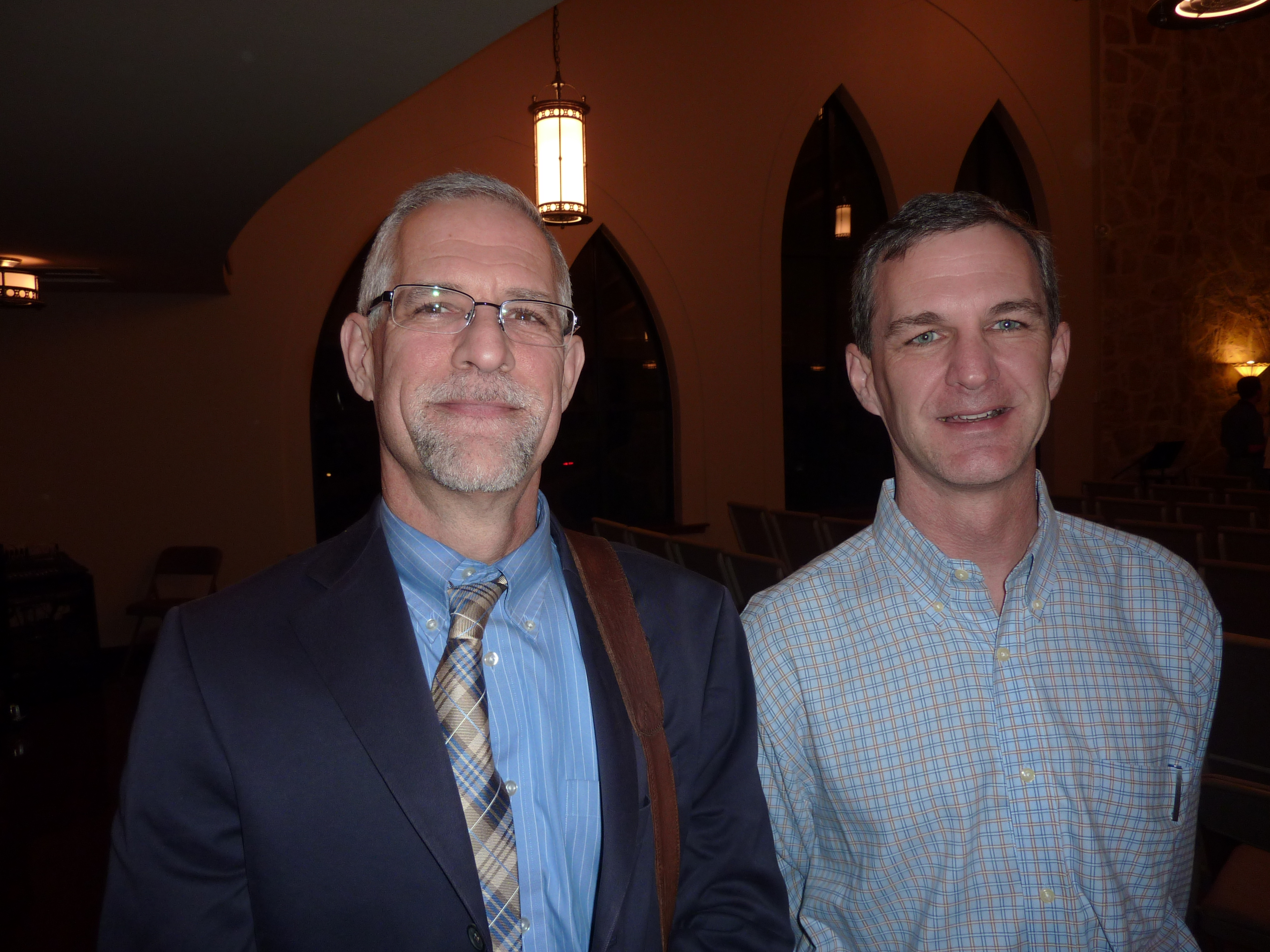
Dr. K. Scott Oliphint (left), with brother Pastor Kyle (right).
Here’s a blooper I just can’t resist sharing with you. Here are Pastor Kyle Oliphint and Dr. David Garner losing focus and starting to chat and look around just as I snap their picture…Hey Kyle! I’m over here! 🙂

Kyle (right) with Conference organizer, Dr. David Garner.
Next is a look at the “emerging” Westminster generation–Jonathan Brack with Dean of Admissions and son of Dr. K. Scott Oliphint, Jared Oliphint. I hope they enjoyed their little family reunion.

Jonathan Brack (left) with Jared Oliphint (right)
And finally, I took the opportunity to get a snapshot with one of my heroes of the faith, a man who successfully lead his family out of fundamentalism and into the Reformed faith intact, Dr. Thomas R. Browning (Hey, Bob Hayton! Here’s a real, live “Fundamentalist Reformer” for you!). He is the Assistant Pastor of Grace Community Presbyterian Church, and can be found teaching the adult Bible study in the sanctuary most Sunday mornings. In many ways, I am indirectly a product of his influence, in that he taught the guys who, after years of on-again, off-again considering of the doctrines of grace, lovingly latched onto my ankle (like the Calvinist bulldogs they are) and didn’t let up until I said “Uncle!” Every time I think of this guy, I recall the touching tribute once spoken by his son, Gage (a former co-worker): “My dad is my favorite preacher.” Learn more about Dr. Browning and his ministry of preaching and teaching here and here.

John Chitty (left) with Dr. Thomas R. Browning (right)
The Words of Life
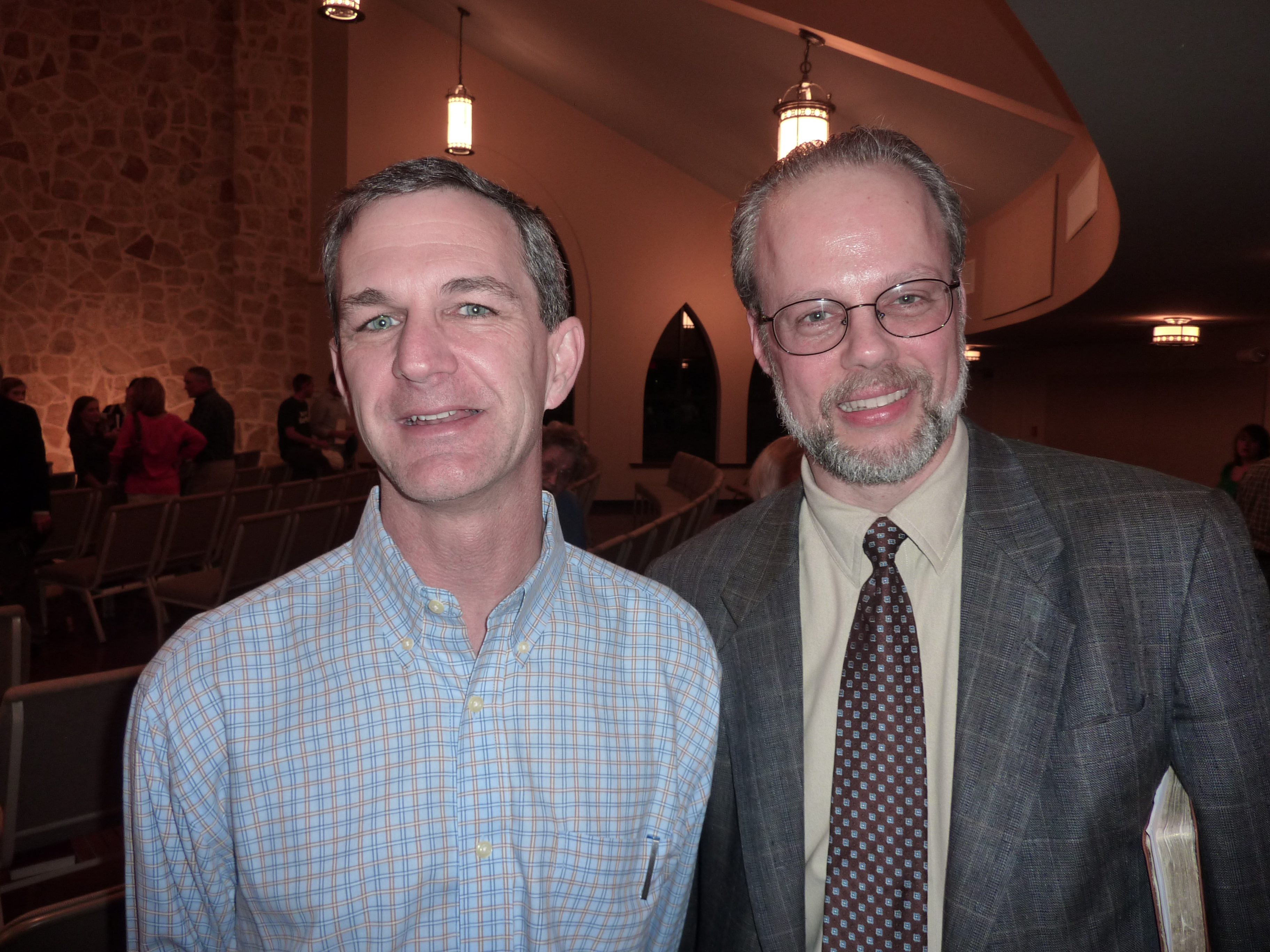
GCPC Pastor Kyle Oliphint (left) with Dr. David Garner (right)
Thought I’d tease you with a Luther quote given by Dr. David Garner in his message, “The Gospel From Above,” last night at the Full Confidence Conference at Grace Community Presbyterian Church in Ft. Worth, Texas. The highlighted portion is the portion to which Dr. Garner made reference, the rest shows a little context of what Luther was discussing:
“The neglect of Scripture, even by spiritual leaders, is one of the greatest evils in the world. Everything else, arts or literature, is pursued and practiced day and night, and there is no end of labor and effort; but Holy Scripture is neglected as though there were no need of it. Those who condescend to read it want to absorb everything at once. There has never been an art or a book on earth that everyone has so quickly mastered as the Holy Scriptures. But its words are not, as some think, mere literature (Lesewort); they are words of life (Lebewort), intended not for speculation and fancy but for life and action. By why complain? No one pays any attention to our lament. May Christ our Lord help us by His Spirit to love and honor His holy Word with all our heart. Amen.” (LW 14:46)
More to come next week…
Full Confidence Conference Coming to Fort Worth This Weekend!
Just to give you a heads up, this Friday night, February 18, 2011 (that’s tomorrow night from the time of this posting), my wife and I will be attending the Fort Worth wing of the Full Confidence Conference Tour put on by Westminster Theological Seminary in Philadelphia, Pennsylvania and hosted by Grace Community Presbyterian Church (PCA) with a small group of friends from my church. In the light of many assaults on the inspiration, inerrancy and authority of Scripture in both the broadly evangelical world, and even the Reformed tradition itself in a few cases, WTS has been traveling the country to reaffirm and build up the Body of Christ to have full confidence in the Word of God.
The Fort Worth, Texas conference is going to feature as speakers, Dr. K. Scott Oliphint (elder brother of GCPC’s pastor, Rev. Kyle Oliphint), Dr. Tim Witmer, Dr. David Garner and Dr. John Currie. You can read their bios at the Full Confidence link above. Pastor Kyle Oliphint has been preaching a series on having full confidence in the Word of God for the past three weeks. I’ve been following them and will share the links next week, but if you want to hear them now just find the link to GCPC’s podcast from their church website and listen for yourself. An exciting bonus for my church, Mid-Cities Orthodox Presbyterian Church, in Bedford, Texas, will have the honor of welcoming Dr. Scott Oliphint to preach in our morning service the Lord’s Day following the conference, Sunday, February 20. I’ll post a link to his sermon as it becomes available.
Here’s a video intro of the conference by one of our speakers:
From KJV Onlyism to Calvinism

Perhaps one day I’ll write something on how King James Onlyism opened my mind and heart to Reformed theology. It had a little to do with this book, The King James Version Defended, by Edward F. Hills.
In an attempt to bring the work of John William Burgon into the twentieth century, Hills, a Westminster Theological Seminary graduate (along with Yale, Harvard, Columbia Theological Seminary and the University of Chicago) made probably the most interesting case in favor of retaining the Textus Receptus as it has been translated in the KJV as the Protestant New Testament, applying the presuppositional apologetic of Cornelius Van Til who developed and taught it at Westminster Theological Seminary in order to arm confessional Reformed Presbyterians, among others, with a consistently Reformed, confessional and covenantal method for defending the faith.
I just got the 2006 edition of it in the mail today. It was updated in conjunction with the Encylcopedia Puritannica Project. Boy, I hope they didn’t screw it up! Hills deserves better than that! Here’s something I posted about this book in the past.
Bible Questions on the History of the Kings of Judah and Israel, No. 2
Don’t you just love quizzes that give away the answers to earlier questions in the later ones? Surely you can at least figure some of these out this way, if you aren’t going to sit down with your Bible and find all of the answers to the following questions from The Sunday at Home: A Family Magazine for Sabbath Reading (issue 1032, February 7, 1874).
- By whom was the second king of Israel selected? Name his father, tribe and birthplace.
- What was his occupation when chosen to be king? Mention any passages in the Psalms which refer to this. Have we any clue to his character as a shepherd?
- Describe his personal appearance.
- Where was he anointed? By whom? What change was seen in him from that time?
- What brought him first to court? How was he regarded by King Saul?
- What led him to give up his pastoral work for that of a soldier? How did he at this time show his simple trust in God?
- We have seen how David became the object of Saul’s envy. Did any of his own family show a similar feeling toward him?
- David had to be trained for the great work which God had for him to do, and he needed trial to strengthen his character. Can you find any texts which speak of the blessing of affliction, even in early life?
- For many years from this time, David was an exile and a fugitive. Find the references to the following places where he took shelter—Ramah, Nob, Gath, Adullam, the forest of Hareth, Keilah, the wilderness of Ziph, Engedi, the wilderness of Paran, Gath (a second time), Ziklag.
- How did he meanwhile provide for the safety of his parents? Can you find anything in the history of his ancestors which may select a possible reason for selecting that country?
- Mention some occasions on which he showed want of faith, and show how in each case he brought himself into difficulties.
- Which Psalms appear to refer to this part of David’s life?
Other “Head Knowledge Helpers” like this one are categorized under the heading “The Sunday at Home.”


 The Misadventures of Captain Headknowledge