A Question for Presuppositionalists
 For those who may not be familiar with what “presuppositionalism” is, it can be described simply as the Reformed approach to apologetics (defense of the Christian faith). The New Dictionary of Theology explains: “The presuppositionalist endeavors to convince the unregenerate first by demonstrating that, on unregenerate presuppositions of chance occurrence in an impersonal universe, one cannot account for any sort of order and rationality. Next, he tries to show that life and reality make sense only on the basis of Christian presuppositions.” (see this link for citation)
I have not studied presuppositional apologetics personally to any extent whatsoever, yet. However, based on short definitions like the ones above, it occurred to me once upon a time, that since Edward F. Hills, author of The King James Version Defended is a graduate, not only of Yale, but also of Westminster Theological Seminary, and that much of Hills’ defense of the Textus Receptus (the popular name of the Greek text that underlies the King James Version New Testament) is written from a characteristically Reformed standpoint, that when he further makes his defense from what he calls “The Logic of Faith,” that this must be his way of applying presuppositional apologetics to the defense of the superiority of the Greek Text underlying the King James Version, as well as that translation itself.
My question for presuppositionalists who’ve read The King James Version Defended, therefore, is: Am I right? Was Hills a presuppositionalist, and is his so-called “Logic of Faith” a fair representation of the presuppositionalist apologetic, and is belief in the inherent superiority of the Textus Receptus therefore the consistently Reformed answer to the question, “Which New Testament text is closest to the original manuscripts?”
My personal short answer is, “I hope not.” I don’t really think the conclusion necessarily follows from the premise. I’m sure most presuppositionalists agree with me on this, and could probably give a better explanation as to why, and I’d like to see what you’d have to say on this topic. I’d also be interested in any King James Onlyist presuppositionalists out there (or perhaps more accurately, Textus Receptus Onlyist) who would answer yes to the question as stated in the previous paragraph.
Independent Baptist defender of the King James Version, Dr. David Cloud, has posted “The Testimony of Dr. Edward F. Hills,” in which Hills explains his journey to the position he defends. He writes that he was puzzled by Dr. B.B. Warfield, who was simultaneously perhaps the premier champion of the Westminster Confession of Faith, and an avid proponent of what Hills considered the textual criticism of theological liberalism. Hills explains that Warfield must have fallen prey to the false dichotomy between faith and reason, which he says Cornelius van Til taught him was begun by the medieval scholastic theologians. In this testimony, Hills does not state explicitly that he applied van Til’s presuppositional apologetic to this question, but what he does state explicitly does seem to say, at least implicitly, in my opinion, that this is just what he did.
What say you, Reformed presuppositionalists? Pro KJV/TR onlyists, or pro-modern textual criticism/modern versionists? I’m ready to learn.
Jack Chick Earns the Respect of the Underground Comics Industry

Rare photo of the reclusive and elusive Jack Chick
I should probably save this for another time when I’ve got more time to write all that I have to say about Jack Chick and his world famous “Chick tracts,” (see his site, Chick Publications) but I can’t wait to at least show you the trailer for a documentary about Jack Chick and his comic books and comic book-style tracts. As it relates to me, Jack Chick is one of the instrumental causes of my dropping out of Bible College. I didn’t do my homework because I was too busy devouring his comics purchased from a nearby Christian bookstore.
Anyway, the following trailer features mostly the ways Chick’s views are poked fun of in the film, but if you ever get a chance to watch the documentary itself, as I did on the Documentary Channel a few days ago, you would see how much the filmmakers and even some of the non-Christian interviewees have for his comics as works of art. They say his work is even featured in galleries across the country and I think they said it even has a presence at comic book conventions and other such forums in which such material is auctioned. Jack Chick is collectible. All you fundies out there better hold onto at least a few copies of his tracts in case you need to cash them in once the economy completely collapses!
The picture to the right was found on the site of Catholic lay apologist Jimmy Akin’s website. He found it on the church website of an Independent Fundamental Baptist church whose pastor (right) has a testimony similar to that of the “Bad Bob” featured in the Chick tract of the same name held by the author (aka, Jack Chick himself, left). If you want to read about this picture and the hand-drawn portrait of Jack Chick at the Catholic apologist’s website, click here, here, and here. They make for fascinating reading, and serve as a little background info to some things I may share in a future post when I’ve got more time.
Below is the trailer to God’s Cartoonist: The Comic Crusade of Jack T. Chick.
Oh yeah, there are a few bios you will want to read on Jack Chick and his associates at Wikipedia in conjunction with this video:
Twenty-first Century New Testament Textual Criticism
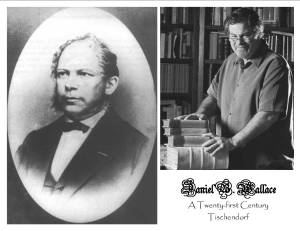
Constantin Von Tischendorf (r); Daniel B. Wallace (l)
Will the 21st century go down as another great age of discovery when it comes to our knowledge of the transmission of the text of the Greek New Testament? While many skeptical and liberal scholars like Bart Ehrman are busy using their expertise in the Biblical Studies to destroy faith in God’s revealed Word in the Scriptures, others, like Dr. Daniel B. Wallace of Dallas Theological Seminary, founder of The Center for the Study of New Testament Manuscripts, is using modern technology to “discover” ancient manuscripts which have until now been inaccessible due to their fragile condition. According to an interview of him on Friday’s edition of Christ the Center, in the past year, about 36 manuscripts have been discovered and are in line behind about 75 others to be catalogued at the place in Munster, Germany where the knowledge of such manuscripts are warehoused for use by scholars the world over.
No time to finish this post. But I want you to listen to the program. Here’s the link: http://reformedforum.org/ctc70/
If it’s good enough for Moses . . .
Just kidding. This video was linked to on the Facebook King James Bible fan page, and I’m a big fan of Chuck’s (we even share a birthday–Oct. 4!), so I just wanted to post this. Most of what he says are the right reasons to love the Authorized King James Version. There are, unfortunately, a lot of wrong reasons to love it going around. Listen to Moses . . .
The Devil is a Degenerate Creation of God
The following is from Institutes of the Christian Religion by John Calvin, published in its final form in 1559 (for more on Calvin and the Institutes, read this). In his summary of the origin of Satan, see if you can tell what’s conspicuous by its absence, and what Calvin writes that has some bearing on what 21st century Christians generally would expect to see here. This passage is from Book 1, chapter 14, section 16.
Yet, since the devil was created by God, let us remember that this malice, which we attribute to his nature, came not from his creation but from his perversion. For, whatever he has that is to be condemned he has derived from his revolt and fall. For this reason, Scripture warns us lest, believing that he has come forth in his present condition from God, we should ascribe to God himself what is utterly alien to him. For this reason, Christ declares that “when Satan lies, he speaks according to his own nature” and states the reason, because “he abode not in the truth” [John 8:44 p.]. Indeed, when Christ states that Satan “abode not in the truth,” he hints that he was once in it, and when he makes him “the father of lies,” he deprives him of imputing to God the fault which he brought upon himself.
But although these things are briefly and not very clearly stated, they are more than enough to clear God’s majesty of all slander. And what concern is it to us to know anything more about devils or to know it for another purpose? Some persons grumble that Scripture does not in numerous passages set forth systematically and clearly that fall of the devils, its cause, manner, time, and charater. But because this has nothing to do with us, it was better not to say anything, or at least to touch upon it lightly, because it did not befit the Holy Spirit to feed our curiosity with empty histories to no effect. And we see that the Lord’s purpose was to teach nothing in his sacred oracles except what we should learn to our edification. Therefore, lest we ourselves linger over superfluous matters, let us be content with this brief summary of the nature of devils: they were when first created angels of God, but by degeneration they ruined themselves, and became the instruments of ruin for others. Because this is profitable to know, it is plainly taught in Peter and Jude. God did not spare those angels who sinned [2 Peter 2:4] and kept not their original nature, but left their abode [Jude 6]. And Paul, in speaking of the “elect angels” [1 Timothy 5:21], is no doubt tacitly contrasting them with the reprobate angels.
Give up? Calvin didn’t identify the pre-fallen Satan as bearing the name Lucifer, based on Isaiah 14:12! That would be because the word Lucifer is used to translate the Hebrew word for “morning star” or “day star” in the King James Version. This was carried over from the Latin Vulgate by the King James translators. “Lucifer” was historically a name for the planet Venus, which happens to be the morning star. Besides, the passage in Isaiah is a prophecy of judgment against the King of Babylon. It’s use in reference to the chief fallen angel is allegorical at best and simply out of context at worst. Before he fell, the Lord and his angels up in heaven did not call him Lucifer as if it were his name. This was popularized in Dante’s Inferno, and Milton’s Paradise Lost. See this Wikipedia article on Lucifer, and this one on Venus for more information.
Furthermore, our eagerness to derive a portrayal of the fall of Satan in Isaiah’s passage is just the kind of “lingering over superfluous matters” that “feed our curiosity with empty histories to no effect.” Calvin writes that things like this have “nothing to do with us” and that “the Lord’s purpose was to teach nothing in his sacred oracles except what we should learn to our edification.” Justin Taylor’s post at “Blogging the Institutes” summarizes Calvin’s remarks well (read Justin’s post here).
Therefore, class, your homework assignment is to memorize what the Bible explicitly (and actually), albeit sketchily, teaches about the fall of Satan and his angels–Jude 6. “And the angels who did not stay within their own position of authority, but left their proper dwelling, he has kept in eternal chains under gloomy darkness until the judgment of the great day—”
Class dismissed.
Does “Every Member Ministry” Contribute to “Christless Christianity”?
An “every member ministry.” The name should be self-explanatory. This is a staple of modern American Evangelical and Fundamentalist discipleship, and likely of the Reformed, as well. We probably all can hear the echoes of pastors past and present who’ve clearly proclaimed that they are not the only “ministers” in the local church. Every member, not just the pastor, is here to exercise his gifts for the building up of the body of Christ. Might this be a “fifth rail” of American Christianity that the believer in his right mind dare not touch, lest he be accused of attempting to take us back to Roman Catholicism with its clearly defined gap between the clergy and the laity? Don’t worry, my personal intention is not to state anything to the contrary of those who believe they are gifted to perform any of a myriad of tasks in the local church. Some of us are gifted to teach, though we’re not ordained pastor/teachers; some are gifted to serve the physical needs of the least of the congregation; some are gifted to aid in the musical operation of the local church; some are gifted to do any myriad of other things that are indded vital activities that ought to take place in the context of the local church, and by the members of the congregation, not just the ordained pastors, elders and deacons. I’m not out to overturn the apple cart of an “every member ministry” as it happens to currently be manifest in American churches. But I would like to address, or rather, cite Michael Horton’s remarks regarding, one passage of Scripture that is famously associated with the idea of an every member ministry, and in fact, serves as part of the Scriptural basis for such activity.
But first, let’s look at the passage: Ephesians 4:1-16, as it is translated in the King James Version. And let us pay special attention to where the punctuation falls in verse twelve, which I’ve highlighted.
1I therefore, the prisoner of the Lord, beseech you that ye walk worthy of the vocation wherewith ye are called, 2With all lowliness and meekness, with longsuffering, forbearing one another in love; 3Endeavouring to keep the unity of the Spirit in the bond of peace.
4There is one body, and one Spirit, even as ye are called in one hope of your calling; 5One Lord, one faith, one baptism, 6One God and Father of all, who is above all, and through all, and in you all. 7But unto every one of us is given grace according to the measure of the gift of Christ.
8Wherefore he saith, When he ascended up on high, he led captivity captive, and gave gifts unto men. 9(Now that he ascended, what is it but that he also descended first into the lower parts of the earth? 10He that descended is the same also that ascended up far above all heavens, that he might fill all things.)
11And he gave some, apostles; and some, prophets; and some, evangelists; and some, pastors and teachers; 12For the perfecting of the saints, for the work of the ministry, for the edifying of the body of Christ: 13Till we all come in the unity of the faith, and of the knowledge of the Son of God, unto a perfect man, unto the measure of the stature of the fulness of Christ: 14That we henceforth be no more children, tossed to and fro, and carried about with every wind of doctrine, by the sleight of men, and cunning craftiness, whereby they lie in wait to deceive; 15But speaking the truth in love, may grow up into him in all things, which is the head, even Christ: 16From whom the whole body fitly joined together and compacted by that which every joint supplieth, according to the effectual working in the measure of every part, maketh increase of the body unto the edifying of itself in love.
Now let us see what Michael Horton has said about this passage in his latest book, Christless Christianity, on pages 248-249, in the final chapter, “A Call to the Resistance.”
And now, as we are reminded in Ephesians 4:8-16, the ascended King moves his gifts of this subversive revolution down to us; we do not have to climb up to him. Here the apostle Paul teaches that the same one who descended to the uttermost depths for us and ascended “far above all the heavens, that he might fill all things” (v. 10), does not keep the treasures of his conquest to himself but liberally distributes them to his liberated captives below. The original Greek emphasizes, “The gifts that he himself gave . . . .” They originate with Christ, not with individual members or the body as a whole. The gifts he gives are apostles, prophets, evangelists, pastors, and teachers (v. 11). They are not given as a hierarchy of control, like “the rulers of the Gentiles” who “lord it over” their subjects instead of serving (Matt. 20:25; see vv. 25-28). Rather, Paul says they are given . . . (here he cites Ephesians 4:12-15, which we’ve just read above). More recent translations typically render the clasuse in verse 12, “to equip the saints for the work of ministry” (e.g., ESV, NRSV, RSV), which has been used as the chief proof-text for every member ministry. For various reasons, I am persuaded that the older translations (especially of verse 12) are more accurate and also capture better the logic of the argument.
This does not mean, of course, that the official ministry of the Word (now exercised by pastors and teachers) is the only gift or that ministers rank higher in the kingdom of Christ than everyone else. Rather, this gift of the ministry of the Word is given so that the whole body may be gifted: brought together in the unity of the faith and of the knowledge of the Son of God. Only then can each member receive the additional gifts that make them function together as one mature body with Christ as its living Head (Eph. 1:15-16). The gifts flow down from Christ; the Great Shepherd serves his flock through undershepherds who minister his gospel through preaching and sacrament. Of course in other places Paul expands the list of gifts that are exercised by the wider body (see Rom. 12:3-8; 1 Cor. 12). A church that is lacking in generosity, hospitality, and other gifts of mutual edification is unhealthy; a church that lacks the Word is not a church. Therefore we come to church first of all to receive these gifts, realizing more and more our communion with Christ and therefore with each other as his body. (emphasis mine)
I always wondered if there was something up with this difference in punctuation between the KJV and many, if not all, modern translations (I haven’t checked). I know just bringing up the matter will draw criticism as if I’m out to tell everyone in the church to stop doing stuff for Christ, and just sit and listen to the preacher. This is the great fear of those who zealously proclaim this passage as it is translated and punctuated in modern translations (even if they’re KJV onlyists!) Rather, the point I want to make is the same simple point I always make. For ministry to be Christ-centered, the cart must not go before the horse. The Law and Gospel preached and the sacraments properly administered is the horse, and this and only this, is what makes the cart of our fruitful service go. The Law and Gospel preached and the sacraments properly administered turns some goats into sheep, and then the same Law and Gospel preached also feeds the sheep and strengthens them to love one another, not only as a congregation, but also as sojourners and strangers among our unbelieving neighbors in the world. Profound in its simplicity; simple in its profundity!
The cart may be getting put before the horse sometimes when our focus on the “priesthood of the believer” somehow turns into the “ministryhood” of the believer, as Horton frequently says. Hear me clearly, brethren: don’t give up your Sunday School class, don’t drop out of the choir or praise band (or whatever your church calls it), don’t stop helping in all the little, unnoticed ways you do. Just don’t make your primary focus–don’t make these activities your main purpose for being there. If you do, you may be living a Christless Christianity, intending to earn God’s grace by your good works. Rather, first look to being served by Christ through the ordained ministry of Word (Law & Gospel! Not just Law and not just Gospel!) and sacrament as your source of grace and faith and strength . . .
13 until we all attain to the unity of the faith and of the knowledge of the Son of God, to mature manhood, to the measure of the stature of the fullness of Christ, 14 so that we may no longer be children, tossed to and fro by the waves and carried about by every wind of doctrine, by human cunning, by craftiness in deceitful schemes. 15 Rather, speaking the truth in love, we are to grow up in every way into him who is the head, into Christ, 16 from whom the whole body, joined and held together by every joint with which it is equipped, when each part is working properly, makes the body grow so that it builds itself up in love. (Ephesians 4:13-16, ESV).
Order of Events in the Transmission of the New Testament Text
 The following is a synopsis of the things I learned after reading The Origin of the Bible, edited by Phillip Comfort, with chapters contributed by scholars such as F. F. Bruce, Carl F. H. Henry, J. I. Packer and Leland Ryken among others. I highly recommend this book for those who would like to learn the facts regarding New Testament textual criticism. Having come out of an Independent Baptist, King-James Only perspective, this topic is dear to me, although I am not an expert. What follows is my synopsis only, with links to names or concepts that may warrant further study.
If you are knowledgable of the facts below, are not King-James Onlyist, and detect any inaccuracy, feel free to speak up and correct what I’ve written. Of course, if you are King James Onlyist, feel free to engage me in dialogue about it. Again, I’m no scholar, I just wanted to put this info down to help solidify in my mind that which I read in the book. But I posted it because I wanted it to benefit anyone it can. I admit the information listed below is kind of condensed, which may make it a little difficult to comprehend. Feel free to also ask me to clarify what I’ve written, if necessary.
-
Original Autographs
- Early faithful copies
- “Western” or “Popular” Text copies (independent copies all seeking to “improve” the text by either harmonizing events or parallel passages, smoothing out awkward language, emphasizing doctrinal aspects)
- “Alexandrian” or “Polished” Text, begins taking shape through a long process of classifying manuscripts and applying textual critical methods to recover the original readings, developing a superior type of text, although some original readings are “polished” (and thus corrupted) and are instead preserved by the Western or Byzantine Texts.
- Concurrent with the ongoing efforts of Alexandrian scholarship, Lucian of Antioch, Syria, (head of the theological school in that city) edits a recension (revision) of the Western Text, conflating (combining) variant readings and smoothing out awkward language. Subsequently, Roman emperor Diocletian persecutes the Church and confiscates Bibles. After Constantine legislates tolerance for Christianity, copies of Lucian’s recension of the Western Text of the New Testament are distributed among the Eastern churches by bishops trained at Lucian’s theological school. This becomes the dominant type of text during the Byzantine era, and is classified as the Byzantine Text. This also becomes the text of Protestant Christianity after the fall of Byzantine civilization and the westward migration of eastern Greek manuscripts, including Byzantine New Testament manuscripts. Hence the formation of the Textus Receptus.
- Usage of the Greek language falls out of use in the Mediterranean region and so the demand for copies of the Alexandrian Text of the New Testament is diminished until the type of text is largely lost to Christendom, although traces of it are retained in the Latin Vulgate and other versions. About 1481 Codex Vaticanus is discovered and placed in the Vatican’s library, but it is not until the 19th century before the bulk of Alexandrian manuscripts is discovered and begins to influence the work of textual critics.
- The two strands meet when in 1881, the Authorized Version (based on the Textus Receptus) is revised utilizing Alexandrian scholarship to create the English Revised Version, which revolutionizes the work of English Bible translation, culminating in the Nestle/Aland/UBS critical editions of the Greek New Testament which brings the New Testament to as close proximity to the original wording of the New Testament as has yet been achieved.
The Delusion of Extreme KJV Onlyism

In this simple paragraph from the Massachusetts General School Law of 1647, aka “The Old Deluder Satan Law”
Yt being one cheife piect of ye ould deluder, Satan, to keepe men from the knowledge of ye Scriptures, as in formr times by keeping ym in an unknowne tongue, so in these lattr times by pswading from ye use of tongues, yt so at least ye true sense & meaning of ye originall might be clouded by false glosses of saint seeming deceivers, yt learning may not be buried in ye grave of or fathrs in ye church & comonwealth, the Lord assisting or endeavors,—
lt is therefore ordred yt evry towneship in this jurisdiction, aftr ye Lord hath increased ym to ye number of 50 householdrs, shall then forthwth appoint one wthin their towne to teach all such children as shall resort to him to write & reade, whose wages whall be paid eithr by ye parents or mastrs of such children, or by ye inhabitants in genrall, by way of supply, as ye maior pt of those yt ordr ye prudentials of ye towne shall appoint; pvided, those yt send their children be not oppressed by paying much more ytn they can have tm taught for in othr townes; & it is furthr ordered, yt where any towne shall increase to ye numbr of 100 families or househouldrs, they shall set up a gramer schoole, ye mr thereof being able to instruct youth so farr as they may be fited for ye university, pvided, yt if any towne neglect ye pformance hereof above one yeare, yt every such towne shall pay 5 Ito ye next schoole till they shall pforme this order.
Now, let me revise the above highlighted clause in order to make it easier to read.
“. . . so in these latter times by persuading from the use of tongues, that so at least the true sense and meaning of the original [Old Testament Hebrew & New Testament Greek, that is] might be clouded by false glosses of saint-seeming deceivers . . . ”
What is the moral of this story? If you simply prefer the use of the King James Version of the Holy Scriptures for your own personal study and devotional reading, or even if you believe after a considerate examination of the issues of textual criticism, that it is best to retain the Byzantine readings of the New Testament, and therefore ought to not revise the King James Version with a modern, eclectic, critical Greek text, this post does not criticize your view (even though I certainly disagree with your view). But if you believe that the King James Version of the Bible was given by the special inspiration of God, and that it’s English text is superior to the lost original Hebrew and Greek manuscripts for the simple reason that we can hold the KJV in our hands, while we cannot hold the original manuscripts in our hands, and that therefore, we need not bother burdening our congregations with recourse to the original languages to properly interpret the words of the KJV, the Massachusetts General School Law of 1647 identifies those who would undermine the need to understand the Word of God in the original languages as “saint-seeming deceivers” whose efforts would in effect, bury learning in the graves of our fathers in the church. If only you would see the error of your ways, and stop deceiving unlearned believers under your care that it’s dangerous to “correct the King James” with anything, even the sense of the original Hebrew and Greek languages.
Hanegraaff’s Handy Headknowledge Helpers

Introduction
Resurrection of Antichrist
Racial Discrimination
Real Estate
Exegetical Eschatology (e2): Method vs. Model
Literal Principle
Illumination Principle
Grammatical Principle
Historical Principle
Typology Principle
Scriptural Synergy
Literal Principle: Reading the Bible as Literature
Form
Figurative Language
Fantasy Imagery
Illumination Principle: Faithful Illumination vs. Fertile Imagination
Two Distinct People
Two Distinct Plans
Two Distinct Phases
Grammatical Principle: “It depends on the meaning of the word is”
This Generation
The Pronoun You
The Adverb Soon
Historical Principle: Historical Realities vs. Historical Revisionism
Location
Essence
Genre
Author
Context
Years
Typology Principle: The Golden Key
The Holy Land
The Holy City
The Holy Temple
Scriptural Synergy: The Code Breaker
Supreme Rule
Substance or Shadow
Sacrificing Traditions
Riplinger, the author of such enduring KJV-Only classics as New Age Bible Versions and In Awe of Thy Word: Understanding the King James Bible/Its Mystery & History Letter By Letter, making a case for the greater mnemonic benefit derived from translating in the inspired King’s English, generally attempts to emulate the KJV’s memorability by resorting not only to alliteration, but also to clever turns of phrase and at times resorts to rhymes (sorry, just couldn’t help myself). Here’s a sample from New Age Bible Versions . . .
 Now compare this with the way Hanegraaff almost alliterates an entire paragraph on page 53 of The Apocalypse Code:
“As God had promised Abraham real estate, he had also promised him a royal seed. Joshua led the children of Israel into the regions of Palestine; Jesus will one day lead his children into the restoration of Paradise. There they will forever experience rest. From Adam’s rebellion to Abraham’s Royal Seed, the Scriptures chronicle God’s one unfolding plan for the redemption of humanity. Far from a postponement in God’s plans because the Jews crucified Jesus, Scripture reveals the fulfillment of God’s plans in the crucifixion. For only through faith in Christ’s death and his subsequent resurrection can God’s one covenant community find rest from their wanderings (Hebrews 4:1-11). In Christ—“the last Adam” (1 Corinthians 15:45)—God’s promises find ultimate fulfillment. As Paul so elegantly put it, “If you belong to Christ, then you are Abraham’s seed, and heirs according to the promise” (Galatians 3:29). [emphasis mine]
Now, I agree that it is indeed helpful to receive a memorable outline, and alliteration can help the reader associate parallel concepts. For this I do not fault Hanegraaff. It was simply the rate of such devices, especially in chapter three (so far) that got me giggling about his how his writing was reminiscent of Riplinger (there I go again!).
The Apocalypse Code, overall, is a very good book, but it seems to desperately try to tick off Dispensationalists, especially by associating Dispensationalism, Darby’s quaint nineteenth century theory from the British isles, with evolution, Darwin’s quaint nineteenth century theory from the British isles which lead to the fallacious science of eugenics and culminated in the twentieth century holocaust. Hanegraaff likewise charges that Dispensationalism may create its own self-fulfillment of their literal interpretation of the Battle of Armageddon, resulting in a future holocaust of the Jews they so mean to bless (Gen. 12:3). While the two seem to parallel effectively, Hanegraaff may deserve whatever charges of sensationalism he may receive.
Buy the book and read it. It will aid in communicating the heterodoxy of Dispensationalism to its victims, and will help lead many of them toward more orthodox eschatology. And enjoy the entertainment value eminently evidenced in Hank’s exposition of “exegetical eschatology.”
From Rasict Ruckmanism to Reformed Theology
The KJV Code Revisited

What precedent is there in Scripture, history or the disciplines of textual criticism or translation theory/practice for demanding a static translated text? There is none. There are anecdotal cases to which KJV onlyists could appeal, like the superstitious exaltation of the Septuagint, but these are erroneous and would prove utterly ineffective to persuade the bulk of orthodox scholarship to adapt everything to this invalid line of reasoning. Besides, radical KJV onlyists deny the validity of the Septuagint, and wouldn’t want to go there. This leaves them all alone with their novel theory.
Fundamentalists Contra Mundum!

 That’s when it hit me! Fundamentalists contra mundum! Fundamentalists who seem to be against everything that’s going on in the broader Christian world except what’s going on within the four walls of their own churches, and the small group of churches with whom they are willing to extend genuine fellowship are like a photographic negative of the man for whom this Latin nickname was coined. There for a minute I considered telling my friend the story of Athanasius, who famously stood “against the world” (contra mundum) to defend the orthodox view of the Trinity and the deity of Christ during the Council of Nicea, but he had plenty of other things on his mind so before I had another chance to speak, the thought had escaped me. But now it’s back, and I thought it was a cute enough little association that serves to underscore the hyper-separatism of fundamentalism, that I just had to share it with you.
The KJV Code

Actually, for Riplinger to focus in on every word and letter of the KJV as divinely placed by God and therefore, never to be changed, is nothing new. In this book, Riplinger goes into painstaking detail how to construct a definition of the words in the King James Version by its context. Contending that modern dictionaries mislead modern readers as to the definitions of archaic King James words sometimes, she suggests, instead of getting a version translated in more modern English, the faithful King James Onlyist should get older dictionaries!
Like an environmentalist worrying about the delicate balance of the ecology, the King James Onlyist dares not to disturb the inspired wording of the King James Version, lest eternal verities which can only be mined from its decaying pages are lost forever, as if the gates of hell would prevail against the church if twenty-first century Christians read the Word of God translated for them in the language of twenty-first century Christians, using twenty-first century biblical textual scholarship.
Pray for those in your circle of influence who are involved with such paranoid isolationism that the Lord may reveal to them the weakness of the case built by King James Only propagandists like Gail Riplinger, Peter Ruckman, Bill Grady and others of their extreme persuasion.
Riplinger’s Mythology Regarding Wycliffe and the Latin Vulgate

The myth that Wycliffe had no access to the original languages is discounted by Wycliffe himself who said that he had access to Hebrew Old Testament manuscripts which were in “complete agreement” with the Old Latin text he followed. He adds, “[T]he Jews were dispersed among the nations, taking with them their Hebrew manuscripts. Now this happened . . . that we (Christians, not Wycliffe and his fellow editors, specifically–CHK) might have recourse to their manuscripts as witnesses to the fact that there is no difference in the sense found in our Latin books and those Hebrew ones” (Truth, p. 157). He also makes reference to manuscripts being “corrected according to the Greek exemplar.” Once Jerome’s text was corrected, there was “complete agreement of his translation [Wycliffe’s] with the Hebrew and Greek manuscripts” (Truth, pp. 143,157 et al.).
Part Two: The Authority of Scripture
Part Three: The Divine Origin of Scripture
Part Four: Scripture as the Law of Christendom


 The Misadventures of Captain Headknowledge
Should 1 John 5:7 Be In The Bible?
Interested in learning more? Select from this list of articles relevant to 1 John 5:7 at Bible.org.
Share this: