Reforming Saint Nicholas Day
Saint Nicholas privately giving to save poor girls from slavery.
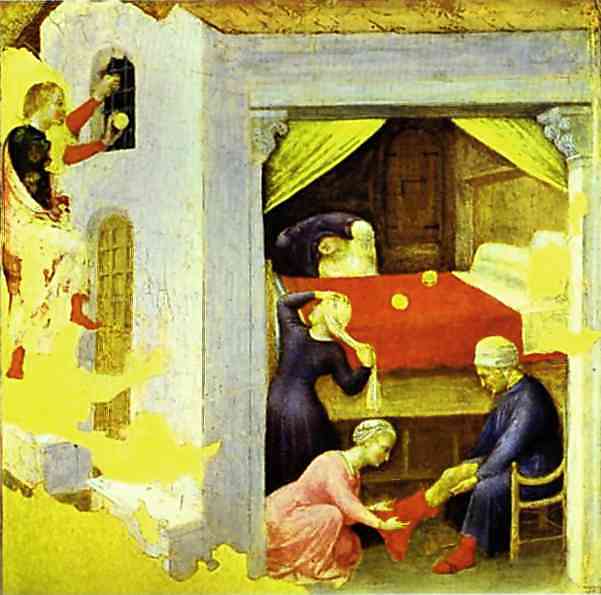
As much as I love the Reformed tradition, some of its more extreme instincts, in my humble opinion, lead it to throw out the baby of the communion of the saints with the bath water of Roman Catholic superstition. One case in point is the memory and example of the saints of the past. Not wanting to retain a Romanist veneration of the saints, we neglect the important and edifying discipline of gleaning from the history of the church the graces of the saints conveyed to us in the annals of church history. This may lead us to keep an eye on the historic church calendar, but we do not have to allow the entire worship of Christ to be distorted by this. There are ways to corporately remember the faith and works of the saints without violating the regulative principle of worship. What it takes is a little ingenuity on the part of Reformed congregations—their members under the informed supervision of their sessions.
The Westminster Confession of Faith, chapter 26, “Of the Communion of Saints,” presents the biblical principles that go along with the communion of believers with Christ by the Spirit through faith, and with each other in love.
All saints, that are united to Jesus Christ their Head, by the Spirit, and by faith, have fellowship with him in his graces, sufferings, death, resurrection, and glory (1 John 1:3; Eph. 3:16-18; John 1:16; Eph. 2:5-6; Phil. 3:10; Rom. 6:5-6; 8:17; 2 Tim. 2:12): and, being united to one another in love, they have communion in each other’s gifts and graces (Eph. 4:15-16; 1 Cor. 3:21-23; 12:7,12; Col. 2:19), and are obliged to the performance of such duties, public and private, as do conduce to their mutual good, both in the inward and outward man (1 Thess. 5:11,14; Rom. 1:11-12,14; 1 John 3:16-18; Gal. 6:10). [WCF 26.1, as adopted by the Orthodox Presbyterian Church]
With regard to this section of the confession, there are gifts and graces to be communicated by one believer to others. This does primarily intend to apply to all living believers who are physically present among the saints in their generation of the church militant. But just as our confession transmits to us the corporate Reformed understanding of biblical faith, piety and practice, so can church history communicate to us the benefit of the gifts and graces of great Christians of the past who are now numbered among the church triumphant in heaven, with whom we are lifted in the Spirit on a weekly basis to join them in worship of Christ.
In one sense, this takes place all the time in one Reformed church or another as pastors illustrate the teachings of Scripture with examples of the works and experiences of saints of the past. By so appropriating their examples in the exposition and application of the Scriptures to us, I submit that we are benefiting from the gifts and graces of these historic saints, and so are experiencing the communion of saints even with them, if only in a sense. If the teaching ministries of Calvin, Luther, Spurgeon, Warfield, Machen, etc., continue to build up and instruct the church, why not the lives and works of those who published nothing, as their lives are recorded in church history?
One of the Scripture proofs in the section of the confession above is Romans 1:11-12,14. In this passage, the apostle Paul expresses his desire to commune with the saints at Rome.
For I long to see you, that I may impart to you some spiritual gift to strengthen you—that is, that we may be mutually encouraged by each other’s faith, both yours and mine. I do not want you to be unaware, brothers, that I have often intended to come to you (but thus far have been prevented), in order that I may reap some harvest among you as well as among the rest of the Gentiles. I am under obligation both to Greeks and to barbarians, both to the wise and to the foolish. So I am eager to preach the gospel to you also who are in Rome.
If Paul desired to impart a spiritual gift to the Romans in person, for his strengthening with the Romans in their mutual faith in the Person and Work of Christ, he certainly did impart such not only to them, but also to all Christians who would follow to this present day, twenty centuries later in his writing the most comprehensive exposition of the gospel of Christ in his letter to the Romans.
Paul’s grace was the grace of apostleship. Other ministers of the gospel have spiritual gifts to impart which are outworkings of this Pauline gospel. In the case of Nicholas, the grace of generosity to the poor among his parishoners has been communicated to us today through sixteen centuries of church tradition. If we may demythologize the traditions of St. Nicholas’ “wonder-working” intercessions, among other fanciful traditions, what we find remains is the kernel of a godly example of generosity on a par with that first lived by Christ in his state of humiliation. As Paul wrote, “For you know the grace of our Lord Jesus Christ, that though he was rich, yet for your sake he became poor, so that you by his poverty might become rich. (2 Corinthians 8:9, ESV). Saint Nicholas was rich, and he used his wealth to relieve the poverty of those in his ministerial care. Truly, Saint Nicholas excelled in the grace of giving, taught in 2 Corinthians 8 and 9. His example can help us learn how to live out the teaching of this passage.
It seems to me that due to the Reformed tradition’s utter rejection of corporate recognition of such great saints from church history, depriving ourselves and our congregations of their gifts and graces, are we not also neglecting a sense of communion with those professing Christians, whether Protestant or Catholic, who do recognize these days? We may be appropriately divided from Roman Catholics and Orthodox Christians over essentials like justification by faith alone, or other Protestants over important doctrines like the sovereignty of God in the gospel, ecclesiology and the sacraments, but we can at the very least affirm the validity of, rather than despise, their edifying themselves with the gifts and graces of the saints of the past. We could furthermore, I propose, go a step further by not only affirming them in their commemoration, but perhaps exemplify a “more perfect way” of doing so in the context of Reformed theology, piety and practice.
Many Reformed churches are happy to commemorate Reformation Day on a yearly basis. We promote our commonly held Protestant distinctives, displaying our unity with Lutheran, Anglican, Methodist and Baptist Protestants. We also take it a step further and do it in a Reformed way. If we can do it with the memory of the works of Saint Martin Luther, why can we not do it with others like Saint Nicholas? Today is Saint Nicholas Day. December 6 is the anniversary of his death. It is on this day that Orthodox, Catholic, Anglican and Lutheran churches commemorate his life and ministry in their various ways. Yet the Reformed ignore it, although many of them have borrowed from the Anglicans at Christmas and found a way to bring into greater conformity to the Refomred confessions the Anglican Service of Lessons and Carols.
I say we should find a way to bring into greater conformity to our confessions the commemoration of the life and ministry of Saint Nicholas (read all about him here) and so reform in a more winsome and attractive way, the commercialized specter of Santa Claus, rather than merely turning up our noses to it and saying “Bah! Humbug.” Saint Nicholas is the world’s favorite saint. Sure, they’ve refashioned him in their own image, but we shouldn’t just leave him to them. Let us keep alive the true Saint Nicholas, who currently enriches our Christmas seasons with his emphasis on sacrificial generosity to the poor, and perhaps, through such edifying efforts build bridges over which some of the elect may find their way into the communion of saints through faith in Christ by the power of the Spirit and love for one another, and we can learn from Saint Nicholas how to better minister to the needy among us, as well as in the world, without feeling like we’re capitulating to some liberal “social gospel” or postmodern version of progressive “social justice.” Let us reform Saint Nicholas day and perhaps in his providence the Lord will use us to reform the way Christian charity is done in a more perfect way.
Happy Saint Nicholas Day!
Strange Fire Conference Kindles Controversy
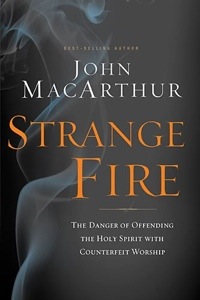
For the past week or so, evangelical sites have been critiquing John MacArthur’s Strange Fire conference, which condemns “the Charismatic Movement” as a tradition that performs false worship practices. Featuring, in addition to himself, messages by Joni Eareckson Tada and R. C. Sproul, along with a number of lesser known associates of MacArthur, this conference anticipates the November 12 release of a book by the same title (pre-order the hardback here). One of MacArthur’s stated purposes was to “start a conversation” about the errors, extremes and dangers of the movement as a whole; judging from the reaction, I’d say he started something more akin to a cyber-riot.
But MacArthur probably isn’t surprised. He’s been the provocateur of tremendous controversy before, over the relationship between the Lordship of Christ and the freeness of God’s grace in salvation, back in the 1980’s, centering around his book, The Gospel According to Jesus. In both cases, I think it is fair to say that the intensity of the reaction is partly due to ways in which MacArthur’s message misses the mark, and opens himself up, as one Cessationist reviewer put it, to easy refutation due to his failure to draw careful distinctions between the various movements–in this case, within the Pentecostal tradition and the Charismatic Renewal, Word of Faith Movement, the Brownsville Revival, New Apostolic Reformation, and any number of other varieties which feature distinctive forms of the so-called “charismata,” or purportedly supernatural manifestations of the power of the Holy Spirit.
In addition to his denial of the legitimacy of the focus on the miraculous in this multi-faceted tradition, the Strange Fire Conference also intends to focus on ways in which the movement in general promotes false forms of worship, as the conference name implies, being an allusion to the account of the deaths of Aaron’s sons, Nadab and Abihu, in Leviticus 10:1-3 upon their offering of “unauthorized” (ESV), or “strange” (KJV), fire in their censers, in direct violation of God’s explicit and detailed prescription for Israelite worship.
1 Now Nadab and Abihu, the sons of Aaron, each took his censer and put fire in it and laid incense on it and offered unauthorized fire before the LORD, which he had not commanded them.
2 And fire came out from before the LORD and consumed them, and they died before the LORD.
3 Then Moses said to Aaron, “This is what the LORD has said: ‘Among those who are near me I will be sanctified, and before all the people I will be glorified.'” And Aaron held his peace.
Fair or not, MacArthur and his fellow conference speakers would all advocate worship derived solely from the clear teaching of Scripture, a distinctive of Reformed theology known as the Regulative Principle of Worship. Undoubtedly, MacArthur, et al desire to see them come into closer conformity to Scriptural modes of worship, in essence calling the movement as a whole to Reformation as the Calvinistic Reformed tradition understands it.
Now it is possible for us not only to read, watch and hear what critics of the Strange Fire Conference have to say, we can all, friend or foe, see for ourselves how the messages of the conference were presented. Audio files of the have now been released, and are available for free download, with video and transcripts of each session forth-coming. Judge for yourself whether MacArthur’s charges against so-called Continuationism (the view that New Testament sign gifts are ongoing today) and his distinctive case for Cessationism (the view that these came to an end with the close of both the Apostolic era and the canon of Scripture–with which I agree) are legitimate, and where he misses the mark.
Visit Grace To You’s blog post, “John MacArthur on Making an Informed Response to Strange Fire” to watch a short introductory video and to download the audio files for each session of the conference which has set the evangelical blogosphere ablaze, in my view, both rightly and wrongly.
Sermon Notes: Crossing the Jordan, Part 1

The following are notes from the sermon I heard yesterday, October 13, 2013 at Mid Cities Presbyterian Church. The sermon is called “Crossing the Jordan, Part 1,” and is based on Joshua 3:1-5. Rev. Joseph L. Troutman preached the sermon. Some of the material below is original to me, however.
1Then Joshua rose early in the morning and they set out from Shittim. And they came to the Jordan, he and all the people of Israel, and lodged there before they passed over. 2 At the end of three days the officers went through the camp 3 and commanded the people, “As soon as you see the ark of the covenant of the Lord your God being carried by the Levitical priests, then you shall set out from your place and follow it. 4 Yet there shall be a distance between you and it, about 2,000 cubits in length. Do not come near it, in order that you may know the way you shall go, for you have not passed this way before.” 5 Then Joshua said to the people,“Consecrate yourselves, for tomorrow the Lord will do wonders among you.”
The big idea of this sermon is that the gap between God and Man is caused by our sin, and is bridged only by Christ, who is God with us.
1. Follow Me (verses 1-3) they set out from Shittim. And they came to the Jordan The distance between Shittim and the Jordan River is about 12 miles. The trip took about a day.
and all the people of Israel, and lodged there before they passed over. Day 1:Their arrival, there for partial day; Day 2: “Lodged” all day; Day 3: There a partial day before crossing the river. Similar to the timing of Christ in the tomb–he wasn’t in the tomb for precisely 72 hours, but part of the first day, all of the second, and rose before sunup on day three.
Condition of the Jordan River, see verse 15: (now the Jordan overflows all its banks throughout the time of harvest) It was springtime, and the river was turbulent.
“As soon as you see the ark of the covenant of the Lord your God being carried by the Levitical priests, then you shall set out from your place and follow it. Yet there shall be a distance between you and it, about 2,000 cubits in length. Do not come near it, in order that you may know the way you shall go, for you have not passed this way before.”
The ark of the covenant symbolized God’s presence. It was holy because God is holy. In the Bible, all visible signs of spiritual truths are so closely associated with the spiritual truth that it is identified as if it were the spiritual truth. In the Hebrew text of Joshua 3:17, the ark is not only called the ark of the covenant, but the covenant itself. This is why some mistake baptism as the thing that actually saves, and that the bread and wine of the Lord’s Supper are actually transformed into the literal body and blood of Christ. The sign is called by the name of the reality, but the sign only points to the reality; the sign is not the reality. That’s why, in chapter 27, section 2 of the Westminster Confession of Faith, it reads:
There is, in every sacrament, a spiritual relation, or sacramental union, between the sign and the thing signified: whence it comes to pass, that the names and effects of the one are attributed to the other.
In a sense, the ark was treated by the Israelites the way the sacraments of baptism and the Lord’s Supper are treated by Bible-believing Christians today.
2. A Safe Distance (verse 4)
Yet there shall be a distance between you and it, about 2,000 cubits in length. Do not come near it,
Two thousand cubits is about three thousand feet–over half a mile. This distance which the Israelites were to keep between themselves and the ark of the covenant symbolizes the distance between the holy God and sinful humanity. Although God was with his people, their sins still separate them from him; however, the Levites were graciously allowed to carry the ark, and thus the priesthood does its job of mediating between the holy God and sinners. They represent the people to God, and thus he is near his people while keeping a safe distance for the good of his people. This nearness of God with Man, while at the same time being separate from them is ultimately bridged in the person of Jesus, our Great High Priest.
3. Consecration (verse 5)
Then Joshua said to the people, “Consecrate yourselves, for tomorrow the Lord will do wonders among you.”
The people must set themselves apart from unclean things, as well as from common things. God is holy, so they must be holy. God is clean and he is uncommon, therefore, so should the Israelites make this spiritual fact ceremonially visible in the same way the ark makes the presence of the Lord ceremonially visible. They were to wash their clothes and abstain from sex, as in Exodus chapter 19, which gives a good description of the way the people must consecrate themselves and keep a safe distance from Mount Sinai, and the severity of the consequences if they do not.
the Lord said to Moses, “Go to the people and consecrate them today and tomorrow, and let them wash their garments and be ready for the third day. For on the third day the Lord will come down on Mount Sinai in the sight of all the people. And you shall set limits for the people all around, saying, ‘Take care not to go up into the mountain or touch the edge of it.Whoever touches the mountain shall be put to death. No hand shall touch him, but he shall be stoned or shot; whether beast or man, he shall not live.’ When the trumpet sounds a long blast, they shall come up to the mountain.” So Moses went down from the mountain to the people and consecrated the people; and they washed their garments. And he said to the people, “Be ready for the third day; do not go near a woman.”
Similarly, Christians should see themselves as called out from the unclean and the common, to be God’s chosen possession.
But you are a chosen race, a royal priesthood, a holy nation, a people for his own possession, that you may proclaim the excellencies of him who called you out of darkness into his marvelous light (1 Peter 2:9).
“…for tomorrow the Lord will do wonders among you.” Miracles are a sign of God’s power announcing that the observer is in the presence of God. Christ himself so far surpasses Old Testament miracles that if we are unaffected by the fact of his incarnation, righteousness, substitution for us on the cross, his resurrection and ascension to be enthroned on the right hand of God the Father, this speaks ill of our spiritual condition. Jesus, the God-Man bridges the gap between the holy God and sinful humanity, and consecrates those who repent and believe that they might draw near to God to serve and worship him.
An Ordinary Reformation

Westminster Confession of Faith 1.7. All things in Scripture are not alike plain in themselves, nor alike clear unto all: yet those things which are necessary to be known, believed, and observed for salvation, are so clearly propounded, and opened in some place of Scripture or other, that not only the learned, but the unlearned, in a due use of the ordinary means, may attain unto a sufficient understanding of them.
Westminster Confession of Faith 5.3. God, in his ordinary providence, maketh use of means, yet is free to work without, above, and against them, at his pleasure.
Westminster Confession of Faith 18.3. This infallible assurance doth not so belong to the essence of faith, but that a true believer may wait long, and conflict with many difficulties before he be partaker of it: yet, being enabled by the Spirit to know the things which are freely given him of God, he may, without extraordinary revelation, in the right use of ordinary means, attain thereunto. And therefore it is the duty of everyone to give all diligence to make his calling and election sure, that thereby his heart may be enlarged in peace and joy in the Holy Ghost, in love and thankfulness to God, and in strength and cheerfulness in the duties of obedience, the proper fruits of this assurance; so far is it from inclining men to looseness.
If everything in the Christian life is “dynamic,” “epic,” “impactful,” “powerful,” and “extraordinary,” then the extraordinary becomes the expected norm, rather than the exception. It’s easy to see that with such high spiritual expectations, disillusionment is sure to follow. For this reason, I’d like to direct you to a series of episodes of the White Horse Inn called “Ordinary.” Along with concepts like “sovereignty,” and “predestination,” one of the unsung distinctive doctrines of Reformed theology is the way that God ordinarily works through ordinary means in our lives by His Word and sacraments. He reveals himself and his work of redemption to us in the Scriptures, grants to his chosen regeneration, faith, justification, repentance, sanctification, communion with him in grace and assurance. That he ordinarily does so through the “ordinary means of grace” (the Word read and preached, the sacraments and prayer), means that, indeed, in extraordinary circumstances, he is free to work by extraordinary means. The extraordinary nature of these means should be our first hint that this will not be what Christians should expect every Sunday during their so-called “worship experience.” Take some time to listen and be reformed to a liberatingly ordinary Christian spirituality.
Gender Roles, part 2–Patriarchalism
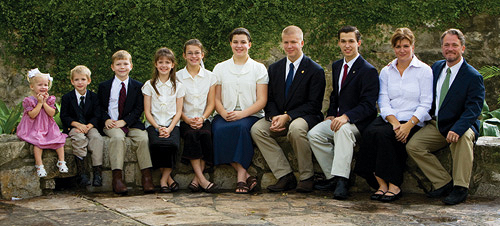
Vision Forum founder Doug Phillips and family
I’ve been aware of Vision Forum (VF) ever since I began searching the internet for Reformed websites back in the late 1990’s into the early years of the first decade of the twenty-first century. What I saw in Vision Forum was a site promoting traditional, conservative Americana of all kinds. Cool reprints of things like Of Plymouth Plantation and the writings of John Quincy Adams, the sixth American President who dabbled with Calvinism in his early adulthood, but would ironically return to the Unitarianism of his father and the intellectual elite of his day. Fun stuff, if you are into strident third party ultra-conservatism (for the record, VF founder Doug Phillips is son of Nixon-era figure and third party founder, Howard Phillips, whom I was providentially prevented from voting for in the 1992 election, but that’s another post!).
But then I found Phil Johnson’s Hall of Church History and any fledgling interest in Vision Forum fell by the wayside. My initial introduction to Vision Forum and its association with homeschooling and conservative politics raised no red flags. To me, it was what it was.
It was not until more recent years that I grew in my familiarity with the details of Vision Forum’s vision for families by their promotion of concepts like patriarchalism among others like the so-called family-integrated church (FIC), quiverfull and multi-generational faithfulness movements. Classified under these headings we find the dark side of the homeschooling movement. At the time of this writing, I have nothing against homeschooling, per se, but these movements which find their origin within the homeschool movement leave much to be desired, in my humble opinion. For more information on the latter movements, see here, here, and here.
Please recall that in the last post, I summarized my understanding of egalitarianism as practiced among “mainline” liberal Protestant denominations and an increasing number of Evangelical denominations and movements, and noted that there have been two major responses to this movement: namely, patriarchalism and complementarianism. The former is an extreme response, the latter is more moderate, unless you’re an egalitarian.
Complementarianism agrees with patriarchalism that:
(1) Eve was created to serve as “an help meet”(KJV) for Adam, or a “helper suitable” (NASB) for him, and that this is a creation ordinance binding on all human marital relationships; that a relationship of loving leadership by example and sacrificial protection on the part of the husband, and of respectful and voluntary submission on the part of the wife typifies the relationship between Christ and the church for which he died (Ephesians 5:22-33),
(2) and that consistent with this state of affairs, the New Testament explicitly limits offices of ordained church leadership to men (1 Timothy 3:1-7, notice candidates for church office are assumed to be male, and evidence to the contrary is lacking elsewhere in the New Testament).
Nevertheless, complementarianism disagrees with patriarchalism that wives, or women in general, should therefore necessarily refrain from seeking work or leadership roles in civic or commercial society outside the home. In short, complementarianism respects a greater degree of liberty for women than does its more extremist counterpart, patriarchalism.
In what ways does patriarchalism restrict the Christian liberty of women in the name of following the teaching of Scripture? To answer this question, let us consult a Vision Forum Ministries-published semi-creedal statement, “The Tenets of Biblical Patriarchy” drafted by Phil Lancaster, in consultation with Doug Phillips and R.C. Sproul, Jr. This statement lists 26 points under the following headings:
(1) God as Masculine (point 1)
(2) The Image of God and Gender Roles (points 2-4)
(3) The Authority of Fathers (points 5-7)
(4) Family, Church and State (points 8-11)
(5) Men & Women: Spheres of Dominion (points 12-14)
(6) Procreation (point 15)
(7) Education and Training of Children (points 16-21)
(8) A Father and His Older Children (points 22, 23)
(9) The Sufficiency and Application of Scripture (points 24-26)
Let’s look at point 11, under the heading of “Family, Church and State”:
11. Male leadership in the home carries over into the church: only men are permitted to hold the ruling office in the church. A God-honoring society will likewise prefer male leadership in civil and other spheres as an application of and support for God’s order in the formative institutions of family and church.(1 Tim. 3:5) (emphasis mine)
By this statement, patriarchalists cannot state that the Bible teaches that women shouldn’t work outside the home (among other things, like vote, for instance!), but appeals to the biblical mandates of male leadership in the home and the church and asserts that a society can only honor God if it “prefers” male leadership in societal spheres. By implication, this means that a society actively dishonors God if it allows women to vote, work outside the home and lead in other societal venues. They do allow for exceptions in the case of single women—“unmarried women may have more flexibility” (point 14), but I submit that in patriarchal circles, this exceptional circumstance will likely be discouraged, if not frowned upon. They only concede the possibility that single women may have more flexibility, which means, when in doubt, see point 11.
While we’re on this point, let us consider the Tenets’ reference to “a God-honoring society.” Did I mention that Vision Forum is postmillennial (not necessarily a problem) and theonomist (a big problem!)? Political liberals commonly refer to theonomy as “Dominionism,” which is a movement among interdenominational charismatic churches. The fact is, dominionism is based on theonomy, aka Christian Reconstructionism. Vision Forum’s vision for patriarchalism is a means to the end of taking dominion over the nations of the world and subjecting them all to the Law of God, and it is in this way that they believe Christ’s Millennial Kingdom will be established in the earth. These facts are implicit in their notion of a “God-honoring society.” In the radical patriarchalist’s perfect world, therefore, all women will be restricted to the domestic vocation of housewife, barring the undesirable exception of singleness. But in a future glorious Kingdom of Christ, would not He be willing to provide a husband to provide for and protect every woman? In the meantime we have to make due with conceding the possibility that single women may have the flexibility to work outside the home, and perhaps even vote.
Then there is the matter of “A Father and His Older Children,” points 22 and 23. Notice the extra restriction on adult daughters as compared to adult sons.
22. Both sons and daughters are under the command of their fathers as long as they are under his roof or otherwise the recipients of his provision and protection. Fathers release sons from their jurisdiction to undertake a vocation, prepare a home, and take a wife. Until she is given in marriage, a daughter continues under her father’s authority and protection. Even after leaving their father’s house, children should honor their parents by seeking their counsel and blessing throughout their lives. (Gen. 28:1-2; Num. 30:3ff.; Deut. 22:21; Gal. 4:1,2; Eph. 6:2-3) (emphasis mine)
23. Fathers should oversee the process of a son or daughter seeking a spouse. While a father may find a wife for his son, sons are free to take initiative to seek and “take a wife.” A wise son will desire his parents’ involvement, counsel, and blessing in that process. Since daughters are “given in marriage” by their fathers, an obedient daughter will desire her father to guide the process of finding a husband, although the final approval of a husband belongs to her. Upon a Marriage taking place, a new household with new jurisdiction is established, separate from that of the father. (Gen. 24:1ff.; 25:20; 28:2; Ex. 2:21; Josh. 15:17; Jdg. 12:9; 1 Sam. 18:27; Jer. 29:6; 1 Cor. 7:38; Gen. 24:58)
The implication is that an adult daughter of a Christian patriarch ought not move out of her father’s home until she has been “given” by him in marriage. There is a dangerous wooden-literalism in patriarchalist biblical hermeneutics which leads to imposing this aspect of Ancient Near Eastern culture on twenty-first century Christians. Here is one of the other problems with patriarchalism as a response to egalitarianism: it looks back fondly on the way things were done in the past and makes some of the customs of that era moral absolutes for the present.
Another era which patriarchalists mine for unbiblical moral absolutes is the ante-bellum American South. This era is considered by Phillips, and other patriarchalist leaders as the greatest form of Christian culture ever experienced on earth, and patterns much of its ideals accordingly. Arch patriarchalist Doug Phillips is a huge fan of southern Presbyterian theologian R.L. Dabney, who was in many ways a fine Reformed theologian, with the exception that he was a bitter opponent of emancipation for slaves, and is a poster-child for the use of the Bible in support of the institution of chattel slavery. You can read more about the inherent racism and sexism of patriarchalism in a blog post entitled “Patriarchy, Christian Reconstruction and White Supremacy” at the blog Diary of an Autodidact. The fact that Southern idealism is a strong influence on this movement is further evidence of the extra- and unbiblical nature of the patriarchalist movement as directed and informed by Vision Forum.
For these and other reasons, it would be unwise for an Evangelical Christian to resist the cultural pressures of liberal egalitarianism by subjecting one’s self and one’s family to the so-called “Tenets of Biblical Patriarchy.” In the gracious providence of God, complementarianism is the name of the more biblical approach to the roles of husbands and wives in the family, the church and society. Keeping in mind what we’ve discussed about it above in contrast with patriarchalism, we’ll look at complementarianism in more detail in the next post.
Gender Roles, part 1–Egalitarianism

As the father of a young lady who is growing in her understanding of Reformed theology, I have had to wrestle with the relative merits of “patriarchalism” versus “complementarianism.” What are the definitions of these fifty cent words, you ask? How glad I am that you asked!
Allow me to preface these definitions with yet another term—egalitarianism–and the environment in which these three terms have become points around which various parties rally. With the advent of feminism in the late nineteenth and twentieth centuries, efforts to free women from all forms of tyranny, real or perceived, in society, the home and the church have sparked a two-pronged response. Feminism promotes the ideal of egalitarianism, which asserts the absolute equality of men and women in every way, so that the institution of marriage is often disparaged, women are encouraged to work outside the home and pressured to refrain from the honorable vocation of domestic engineering (that is, being a housewife), and to answer an unbiblical call to pastoral ministry in the Christian church. This movement became part and parcel of the ideals of liberal Protestant theology and practice throughout the twentieth century. Toward the end of that century, however, the movement began making inroads into otherwise conservative Evangelical churches.
Throughout the history of the development of Christian theology, orthodoxy was commonly believed among the whole church, and remained generally agreed upon and largely unwritten, since there was little to no disagreement about the orthodox interpretation of Scripture. This is why we see in church history how that it is the aggressive assertion of heresy which forces the orthodox to go back to the drawing board and more carefully work out and put into writing the correct understanding of the Bible. In theology as well as commerce, competition forces one to work harder to increase the quality of their philosophical principles, goods and services.
How, in this environment, are Christian families to insulate their children from the erroneous claims of modern feminist egalitarianism? In the next post, we’ll deal with conservative Evangelical responses to egalitarianism which have resulted in the spectrum with which we must deal today.
ACE and WHI Remember Dr. C. Everett Koop (1916-2013)
Yesterday I tweeted a request to Reformed bloggers in the know to post on the Reformed side of American medical icon, the late Dr. C. Everett Koop, who died Monday at the age of 96. Dr. Koop’s medical and public service bonafides are a matter of public record. One quick and easy summary may of course be accessed, where else? Wikipedia! Here also is a press release from HHS Secretary, Kathleen Sabelius, detailing his legacy from the point of view of the federal government. But in addition to his service to the City of Man, Dr. C. Everett Koop was an accomplished lay leader in the City of God, serving as a Presbyterian church elder, and until the day of his death, a board member of the Alliance of Confessing Evangelicals (ACE), the para-church organization which was so instrumental in introducing me to and cultivating in me the Reformed faith and theology.
Incidentally, tomorrow afternoon, my pastor and I depart for ACE’s Texas Hill Country Bible Conference in Boerne, Texas. It’ll be interesting to see what kind of tribute they put together for him there. For now, though, the ACE website offers a “Koop Classic”: Life, Bioethics and Christianity (2010, ACE).
But in answer to my (“all about me”–apologies to Dr. D.G. Hart 😉 request, two of my favorite Reformed bloggers has indeed posted remembrances of Dr. C. Everett Koop: Drs. Michael Horton and Kim Riddlebarger. You may read Dr. Horton’s at the White Horse Inn blog, and Dr. Riddlebarger’s post at the Riddleblog. Horton gives a nice summary of meeting Dr. Koop and his service to his church, Tenth Presbyterian Church in Philadelphia, PA and the Alliance of Confessing Evangelicals, featuring the audio of a 2001 interview and a link to Dr. Koop’s contribution (“Faith-Healing and the Sovereignty of God”) to Horton’s out of print 1990 expose of televangelism, The Agony of Deceit–download it as soon as possible! Riddlebarger adds an amusing anecdote of Dr. Koop’s sobering reaction to his sense of humor. Both posts are great reads.
Be sure to peruse the other links I tweeted yesterday regarding the late Dr. C. Everett Koop from Christianity Today and Banner of Truth magazines and the Gospel Coalition blog featuring both compliment and criticism. Finally, in search of an image of Dr. Koop inside the building of Tenth Pres, I ran across a video of his 2010 marriage to Cora Hogue (pray comfort for her in her loss), officiated by former pastor, Phil Ryken, who is now the President of Wheaton College, whose sermons are still featured on ACE’s broadcast, Every Last Word. For those who are interested in viewing this heartwarming moment, the service begins about 30 minutes into the video, after the beautiful music of Westminster Brass.
Koop-Hogue Wedding Ceremony from Tenth Presbyterian Church on Vimeo.
The Hermeneutics of Insider Syncretism
On this week’s episode of the Christ the Center podcast (#263, “Insider Movements“), Dr. David Garner is interviewed about his recent article in Themelios, “High Stakes: Insider Movement Hermeneutics and the Gospel,” analyzing the hermeneutics underlying the Insider Movement, a sociological and anthropological approach to contextualizing evangelism without calling on people whose identities are tied to other world religions like Judaism, Islam and Hinduism to disassociate themselves from those religious, cultural and family ties, but to work inside them and transform their approach to those religions in light of the teachings of Jesus. While it is noble to attempt to find a way to minimize the risk of loss or danger a Jew, Muslim or Hindu (for example) may face upon becoming a Christian, it is unfaithful to the Jesus they claim to follow if they would settle for living to distort their new-found faith with the teachings and practices of the religion with which they have previously been associated. Living to syncretize Christianity with non-Christian world religions is not a faith worth living for or dying for.
This movement is clearly in contradiction with the teachings of Jesus to those who would follow him. Jesus carried his cross and died on it for those who believe, and he calls on believers to take up their cross, follow him, and be willing to live publicly for him and, if need be, accept rejection by leaders of other religions, communities and families, even if such rejection includes dying for him.
“Do not think that I have come to bring peace to the earth. I have not come to bring peace, but a sword. For I have come to set a man against his father, and a daughter against her mother, and a daughter-in-law against her mother-in-law. And a person’s enemies will be those of his own household. Whoever loves father or mother more than me is not worthy of me, and whoever loves son or daughter more than me is not worthy of me. And whoever does not take his cross and follow me is not worthy of me. Whoever finds his life will lose it, and whoever loses his life for my sake will find it (Matthew 10:34-39 ESV).
I know it’s easy for me to say, and to criticize those who would find a way around it, but I too have a cross of self-denial to carry if I am to follow Jesus. I must kill my own sin (a struggle which involves suffering and risk of social rejection on my part), and publicly acknowledge Jesus as my Lord and Savior and associate myself formally with his people, the Church (Hebrews 10:25), serving him with my time, talent and treasure–loving, forgiving and giving to my brothers until it hurts. Should the time come that the culture or community in which I live demands that I deny my Lord Jesus Christ, I am called upon to defy such a demand and willingly suffer the consequences in reliance upon the grace and goodness of God, knowing that if such is happening to me, it is no more than what he sacrificed for me.
One of the interesting things about this movement which Dr. Garner points out in the article and the interview is that the intellectual source of such innovation in world missions comes from the same root as the church growth movement–Donald McGavran (d. 1990) and his School of Intercultural Studies at Fuller Theological Seminary (formerly the famous School of World Mission).
Donald Anderson McGavran (December 15, 1897–1990) was a missiologist who was the founding Dean (1965) and Professor of Mission, Church Growth, and South Asian Studies at the School of World Mission at Fuller Theological Seminary in Pasadena, California. A child of missionaries in India and later amissionary himself (1923–1961), McGavran spent most of his life trying to identify and overcome barriers to effective evangelism or Christian conversion.
McGavran identified differences of caste and economic social position as major barriers to the spread of Christianity. His work substantially changed the methods by which missionaries identify and prioritize groups of persons for missionary work and stimulated the Church Growth Movement. McGavran developed his church growth principles after rejecting the popular view that mission was ‘philanthropy, education, medicine, famine relief, evangelism, and world friendship’ and become convinced that good deeds – while necessary – ‘must never replace the essential task of mission, discipling the peoples of the earth’. [HT: Wikipedia]
While McGavran’s efforts in his time were more theologically conservative and a reaction against liberal missionary trends, a student of his named C. Peter Wagner built on McGavran’s principles and create the church growth movement which has brought us such phenomena as seeker-sensitive worship and the modern megachurch. Incidentally, he is also the one who coined the phrase New Apostolic Reformation for the worldwide sweep of Charismatic and Word of Faith theology with a special emphasis on the restoration of the apostolic office, which movement in America has recently frightened the political Left because so many who would fall under this umbrella have modified the theonomist views of R. J. Rushdoony (for more on that, see this) and declared that they would “take dominion” over every sphere of influence in America.
Syncretism in the name of saving one’s life is no way to spread Christianity. A new generation around the world must hear the age-old truism: “The blood of the martyrs is the seed of the church” [paraphrasing Tertullian, Apology chapter 50].
Hearing Frame’s Side of the Story

Dr. John Frame, Professor of Theology and Philosophy at RTS, Orlando
As one who was first introduced to Reformed theology by Dr. Michael Horton in a televised interview promoting his first book, I have a great affection and appreciation for the work of those who are, in Reformed circles, associated with what Dr. John Frame (RTS, Orlando) calls “The Escondido Theology.” Frame and others seem to think that for Reformed folks to interact with Lutheran theology on the things with which they agree is some sort of compromise of the integrity of Reformed theology. As a layman who hasn’t read it all on this controversy, that’s the impression I get. Frame’s book is promoted as a discussion primarily of the Two Kingdom approach to Christ and culture, but I’ve just learned that there is more to Dr. Frame and the Escondido Theology that this one issue.
In terms of coming to a greater understanding of the broader controversy myself, I was pleased to find that Scott Oakland interviewed Dr. Frame on a recent episode of ReformedCast. Agree or disagree, it is important to understand Frame’s point of view on the matter. Looking back to the days in which he helped found Westminster Seminary California, Dr. Frame portrays himself as not fitting in with any of the “parties” that formed among the faculty there. I also found it helpful to hear him express his concerns with how closely many among the faculty wanted to stick to the Reformed confessions, while he, in my opinion, thought the Reformed principle of sola scriptura was better honored by not “turning biblical and systematic theology into historical theology” (or something like that–it’s been a few days since I heard the interview). This helped me understand why Dr. Frame was willing to be a little more “progressive” in his approach to worship, and became a veritable whipping boy among many in the so-called “worship wars” (see, for example, how Frame’s writing is treated in Hart and Muether’s With Reverence and Awe: Returning to the Basics of Reformed Worship.) While I do not doubt Dr. Frame’s commitment to the Reformed interpretation of Scripture, it does seem to me that he has a more moderate approach. Neither side of this Escondido debate deny that the Reformed Confessions are subject to the authority of Scripture, but I perceive that in some ways Dr. Frame seems so much more openly self-conscious of highlighting the authority of Scripture over the Confessions that he runs the risk of coming off more broadly evangelical than Reformed on the issue of worship. I could be wrong, but this is my initial impression.
Many of you have read more Frame than I have, and have a more informed opinion of his approach to Reformed theology. Feel free to enlighten and correct my impressions in the comments. I simply wanted to share my thoughts on the interview as I recommend it to you. If any of you have wondered about the back and forth that sometimes takes place online about the so-called “Escondido Theology,” this interview is an important resource for gaining some insight into both sides of the debate.
Thankful for the Committee on Christian Education
I just finished watching the latest video uploaded to the Reformed Audio YouTube page, Rev. John Galbraith, Address at GA on 75th Anniversary of the Orthodox Presbyterian Church. The Rev. Galbraith, age 98 at the time of the delivery of this address back in June of 2011, was in attendance and stood to vote for the founding of the Orthodox Presbyterian Church on June 11, 1936. The extent of his service to the church is outlined in the introductory material under the video on the YouTube page as follows:
Rev. John P. Galbraith, founding member of the Orthodox Presbyterian Church in 1936 and retired minister, addresses the General Assembly of the OPC’s Committee on Christian Education on the 75th Anniversary of the OPC on June 11, 2011. Rev. Galbraith graduated from Westiminster Theological Seminary in 1937 (where he studied under J. Gresham Machen until his untimely death) and was ordained to the gospel ministry that same year. During his 75 years as a minister in Christ’s church, Rev. Galbraith served as the pastor of three OPC churches, clerk of the OPC General Assembly for six years (1940, 1984-88), General Secretary of the Committee for Foreign Missions for thirty years, General Secretary of the Committee for Home Missions, and on numerous other denominational committees. In this address, at the age of 98 years old, he reflects on the mission of the OPC and God’s goodness to the church for 75 years, as well as challenges the church faces. Introduction by Rev. Danny Olinger. For more of Rev. John Galbraith, please visit www.reformedaudio.org/Galbraith
In his address, Rev. Galbraith comments that J. Gresham Machen’s “two pillars” of the church are that 1)The Bible is the Word of God, and 2) It Must Be Obeyed! Built upon these pillars, the young denomination would organize the Committees on Home and Foreign Missions in order to “speak to those who are without,” and underscores how that it is the mission of the Committee on Christian Education to “speak to those who are within”–to teach the teachers. He goes on to urge the OPC to watch out for the inclusivism which ultimately destroyed the PCUSA, and commends toward that end a firm committment to the Westminster Standards as our corporate confession of our ultimate guide, the Bible. Finally, upon his conclusion and stirring recommendation, those in attendance rise to sing “All Hail the Power of Jesus Name.”
You will be challenged and encouraged to renew your faith in and obedience to the Bible in this address.
Memoir of the Rev. John Brown, part 10

Celebrated Author
But Mr. Brown was not only distinguished as a minister of the gospel, and a teacher of divinity, he is celebrated also as an author. A strong desire to contribute towards the moral and religious improvement of mankind, and that he might, in some measure, be useful to the church of Christ, when he rested from his labours, weighed down every consideration of either profit or applause connected with his writings; indeed the pecuniary reward of all his labours, in this way, was but a matter of small account, never exceeding forty pounds. It was reserved, however, for his booksellers to reap a much more bountiful harvest; several of his works having already appeared in upwards of thirty, and some even in forty editions.
His first attempt as an author was his large work on the Catechism, which appeared in the year 1758; the next was a lesser work, also on the Catechism; and the rest of his works succeeded one another as circumstances seemed to render them necessary. (A modern edition is available from Reformation Heritage Books) That the doctrines he taught might appear with all the solidity and perspicuity in his power, he was at the extraordinary pains of writing his manuscripts thrice, and occasionally four times over, before they went to press; and frequently, after all this trouble in correcting, adding, and retrenching them, to request some one of his brethren to examine, and give his candid opinion concerning them.
But on none of his works has he bestowed so much labour as on his Dictionary of the Bible; a book of such diversified information, extensive research, and generally acknowledged utility, that it is doubtful if any work, of equal size, has hitherto appeared better calculated for assisting in the study of the Holy Scriptures, although now from the increased amount of information on scientific, historical, and other subjects, it necessarily is imperfect as compared with what he doubtless would have made it, had he possessed the opportunities of our day.
Memoir of the Rev. John Brown, part 9

Lithograph of the Reverend John Brown of Haddington
Professor of Divinity
On the death of the Rev. J. Swanston of Kinross (1768), the professor of divinity for the Burgher branch of the Secession, Mr. Brown was elected to fill the vacant office; nor were they at all disappointed in their choice. The ability and attention with which he fulfilled the various duties of that important charge, met with universal approbation. He found it was absolutely necessary to support the dignity of a teacher amongst his students, but could not help discovering, at the same time, the affection and anxious solicitude of a father for his children, which, on their parts, was rewarded with confidence, love, and obedience.
He treated them with the greatest impartiality; or, if piety, talents, application, or exemplary conduct, in any case inclined him to a preference, he was careful that it should never be observed. To promote their best interests, he was unwearied in his labours of love. That he might satisfy himself that the young men were improving their time, he used to visit them at their lodgings early in the morning, to see that they were properly engaged.
The ordinary course of attendance on the divinity lectures was five sessions, of two months each. In his View of Natural and Revealed Religion, and the Cases of Conscience subjoined to his Practical Piety, we have a connected view of the substance of all these lectures. His General History of the Church, as well as that of the British Churches, were originally intended for the use of his students. He ever considered personal piety the most essential qualification for successfully discharging the various and important duties of the ministerial office; and accordingly pressed on his students the pre-eminent interest they themselves had in the doctrines they were to preach to others; assuring them, that divinity was to be studied in a very different way from that of a system of philosophy; and that, without heart-religion, they must necessarily continue unprofitable students of theology.
He urged, moreover, by all means to make themselves thoroughly acquainted with the oracles of God in the original languages; and, next to these, with the writings of Turretine, Owen, Boston, Fisher’s Marrow of Modern Divinity, the Erskines, and Hervey’s Theron and Aspasio, with his Defence against Wesley. The serious and solemn manner in which, on particular occasions, he was in the habit of addressing his students, but especially on parting at the end of the sessions, seldom failed in melting both the speaker and hearer into tears and of leaving the best impressions on their young minds; and the many able and acceptable ministers, in Great Britain and Ireland, who had been trained up under his tuition, afford the most convincing proof of his success in this department of his manifold labours.
Memoir of the Rev. John Brown, part 8

John Brown’s Self-Interpreting Bible (1859)
Presbyterian Polymath
The pastor of a large congregation has but little time to spare from the duties of his office, compared with one engaged with a less numerous charge. In this respect Mr. Brown found himself in his proper element at Haddington. There, without trenching on the duties of his office, he could devote a very considerable portion of his time to study; and this privilege he improved to the best advantage.
In the summer months his constant rule was to rise between four and five, and during the winter by six. From these early hours, till eight in the evening, excepting the time allotted to bodily refreshment, family worship, or when called away on the duties of office, he continued to prosecute his studies with unremitting application. To a mind so ardent in the acquisition of knowledge, with a judgment so clear, a retentive memory, and exertions so intense, it was by no means surprising that he became greatly superior to most men engaged in discharging the same sacred duties.
In acquiring the knowledge of languages, ancient or modern, he possessed a facility altogether his own. Without an instructor, unless for one month to start him in the Latin, as formerly mentioned, he soon got so far acquainted with that language as to relish its beauties; and, left to his own resources, though frequently but indifferently provided with the proper books, he soon became critically acquainted with the Greek, and especially the Hebrew. Of the living languages, he could read and translate the Arabic, Syriac, Persic, and Ethiopic, the French, Spanish, Italian, Dutch, and German.
With him natural history, civil law, natural and moral philosophy, were particular objects of research; but divinity, and the history of human affairs, sacred or civil, were his favourite studies; and his success in these departments of knowledge are visible in his various works.Among the writers on divinity with whom he was versant, we find that Turretine, Pietet, Mastrecht, and Owen, with Boston, Erskine, and Hervey, were the chief; which shows that he accounted sound divinity and accurate sentiment a far better recommendation of his author, than the flowing fancy, the brilliant style, or the harmonious period.
Though stimulated by a sense of duty, and strongly excited by inclination, to the study of divinity, such was his anxiety to become a universal scholar, that he made himself acquainted with the whole round of the sciences. In his reading, especially important works, he was in the habit of compendizing his author as he went along. In this way he abridged the whole of Blackstone’s Commentaries, the ancient Universal History, and a number of other important works. This, however, is a method concerning which the learned hold different opinions. To lay aside the book, and abridge entirely from memory, and that in the writer’s own language, without regarding the style of the author, will make the substance of the work more his own; which, with other reasons that might be named, seems to render it the more eligible method.
Christian Knowledge | East of Eden

Jonathan Edwards Tee by ReformationShirts.com (click image to see more)
The following episode of the Reformed Forum’s new podcast, East of Eden, was tailor-made for the readers of this blog! East of Eden is a podcast devoted to discussing all things Jonathan Edwards. Not the recent politician with good hair and a bad reputation, but the eighteenth century preacher of the First Great Awakening who became known as the theologian of revival. In this week’s episode, the co-hosts interview a guest to be named below as they discuss Edwards’ sermon on “The Importance and Advantage of a Thorough Knowledge of Divine Truth.” One comment made by Nick Batzig sums up nicely both the sermon and the theme of this blog: “You can have truth in the mind without godliness in the heart, but you can’t have godliness in the heart without truth in the mind.”
Later, I will update this post with a transcript of the context of the preceding quote. In the meantime, listen to the entire episode, “Christian Knowledge,” to be challenged to inform your godliness with a thorough understanding of the truth which accords with godliness (Titus 1:1).


 The Misadventures of Captain Headknowledge
Westminster Releases Tome on Doctrine of Scripture
Pleasing to the eye, desirable to make one wise 😉 Get one for yourself, and one for your church library!
Edited by Richard Gaffin and Peter Lillback of Westminster Theological Seminary, Philadelphia, PA. Click image to view at wtsbooks.com.
Share this: