From “Freedom” to Bondage?

Thomas Chalmers by ReformationArt.com
Considering the recent controversy over ordaining an openly gay minister to a congregation in the Free Church of Scotland (see Iain Campbell’s post at Ref21), I found it interesting that it was on this day, May 18, 1843, that Thomas Chalmers led four hundred ministers out of the established church of Scotland in reaction to its trend toward “liberal formalism” to found the Free Church of Scotland. How ironic that liberalism is now catching up with them.
It was at the end of his life, when his reputation was well established, his contribution to the life of Scotland, England and Ireland fully recognized, and his fame spread around the world that the greatest test came to Thomas Chalmers (1780-1847). During the course of his long and storied career the great Scottish Reformer had served as the pastor of three congregations, taught in three colleges, published more than thirty-five best-selling books, and helped to establish more than a hundred charitable relief and missions organizations. He practically reinvented the Scottish parish system as well as the national social welfare structure. He counted such luminaries as the Duke of Wellington, Sir Walter Scott, King William IV, Thomas Carlyle, William Wilberforce, and Robert Peel as his friends and confidants. Indeed, he was among the most influential and highly regarded men of his day. Even so, he did not hesitate to involve himself in–and ultimately lead–a movement that was to set him in apparent disregard of the authority of the highest civil court in the land.
With the disappearance of Catholic authority in Scotland, Reformers worked hard to replace it with a faithful national church. Their struggle for spiritual independence had been a long and costly one under the leadership of John Knox and Andrew Melville among others. At long last, in 1690, their Reformed Church was legally recognized by the Crown as the established Church of Scotland. The danger of such an establishment was that the state might attempt to manipulate the internal affairs of the church.
That danger was realized when Parliament imposed conformity with the standards of English patronage upon the Scottish church. In reality, patronage was hardly different from the medieval practice of lay investiture–it gave landowners the right to appoint to a parish a minister who might or might not be biblically qualified for the post or acceptable to the elders of the congregation. The patronage conflict came to a head in 1838 when several ministers were forced on congregations opposed to their settlement. Many, including Chalmers, believed that the integrity of the gospel was at stake.
At about the same time, it was decided by Parliament that the church did not have the power to organize new parishes or to give the ministers there the status of clergy of the church. It had no authority to receive again clergy who had left it. And perhaps worst of all, a creeping liberal formalism was slowly smothering the evangelical zeal of the whole land–in large part due to the assumption of pastoral duties by men altoghether unfit for such a solemn vocation.
After a ten-year struggle to regain the soul of the church, the evangelical wing, led by Chalmers, laid a protest on the table of the assembly, and some four hundred ministers left the established Church of Scotland on this day in 1843, to form the Free Church. When the new church was constituted that grave morning, Thomas Chalmers was, of course, called to be its moderator. He was the man whose reputation in the Christian world was the highest; he was also the man whose influence had been greatest in directing the events that led to what would eventually be called the “Disruption.” (George Grant& Gregory Wilbur; The Christian Almanac: A Book of Days Celebrating History’s Most Significant People & Events, page 296; Cumberland House, Nashville, Tennessee–buy it real cheap from Christianbook.com or Amazon.com)
Mission Accomplished
Now, this is what I call music…!
In case you can’t keep up, here’s the lyrics. Read along, then consult your Bible and read and pray and think!
Verse 1
Here’s a controversial subject that tends to divide
For years it’s had Christians lining up on both sides
By God’s grace, I’ll address this without pride
The question concerns those for whom Christ died
Was He trying to save everybody worldwide?
Was He trying to make the entire world His Bride?
Does man’s unbelief keep the Savior’s hands tied?
Biblically, each of these must be denied
It’s true, Jesus gave up His life for His Bride
But His Bride is the elect, to whom His death is applied
If on judgment day, you see that you can’t hide
And because of your sin, God’s wrath on you abides
And hell is the place you eternally reside
That means your wrath from God hasn’t been satisfied
But we believe His mission was accomplished when He died
But how the cross relates to those in hell?
Well, they be saying:
Lord knows He tried (8x)
Verse 2
Father, Son and Spirit: three and yet one
Working as a unit to get things done
Our salvation began in eternity past
God certainly has to bring all His purpose to pass
A triune, eternal bond no one could ever sever
When it comes to the church, peep how they work together
The Father foreknew first, the Son came to earth
To die- the Holy Spirit gives the new birth
The Father elects them, the Son pays their debt and protects them
The Spirit is the One who resurrects them
The Father chooses them, the Son gets bruised for them
The Spirit renews them and produces fruit in them
Everybody’s not elect, the Father decides
And it’s only the elect in whom the Spirit resides
The Father and the Spirit- completely unified
But when it comes to Christ and those in hell?
Well, they be saying:
Lord knows He tried (8x)
Verse 3
My third and final verse- here’s the situation
Just a couple more things for your consideration
If saving everybody was why Christ came in history
With so many in hell, we’d have to say He failed miserably
So many think He only came to make it possible
Let’s follow this solution to a conclusion that’s logical
What about those who were already in the grave?
The Old Testament wicked- condemned as depraved
Did He die for them? C’mon, behave
But worst of all, you’re saying the cross by itself doesn’t save
That we must do something to give the cross its power
That means, at the end of the day, the glory’s ours
That man-centered thinking is not recommended
The cross will save all for whom it was intended
Because for the elect, God’s wrath was satisfied
But still, when it comes to those in hell
Well, they be saying:
Lord knows He tried (8x)
Thank you, Shai Linne, whoever you are.
Jesus Christ: Sinless Man/Eternal God
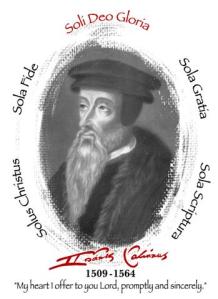
Get this on a t-shirt from reformationshirts.com!
Here’s a follow-up on my series of posts on “Compromising the Full Humanity of Christ” which dealt with the “heavenly flesh of Christ” heresy. In my reading through Calvin’s Institutes in commemoration of his quincentenary, I recently got to a passage in which he deals with this very issue, which he indicates that it predates Anabaptism, tying it to Manichaeism. Let’s read Calvin himself on this . . .
Indeed, the genuineness of his human nature was impugned long ago by both the Manichees and the Marcionites. The Marcionites fancied Christ’s body a mere appearance, while the Manichees dreamed that he was endowed with heavenly flesh. But many strong testimonies of Scripture stand against both (Book 2, chapter 13, section 1)…Marcion imagines that Christ put on a phantasm instead of a body because Paul elsewhere says that Christ was “made in the likeness of man . . . . being found in fashion as a man” (Phil. 2:7-8)…Mani forged him a body of air, because Christ is called “the Second Adam of heaven, heavenly” (1 Cor. 15:47) (Book 2, chapter 13, section 2).
You can read summaries of both of these sections at “Blogging the Institutes” from Reformation21.org, just follow the links in the two parenthetical references in the excerpt above.
Finally, in section 4, Calvin concludes his defense of the biblically orthodox view of Christ’s full humanity (which accords with the Definition of Chalcedon), explaining how it is that Christ’s human nature could be identical to our human nature without original sin–for Calvin, it’s simple, the Holy Spirit sanctified his human nature:
The absurdities with which they wish to weigh us down are stuffed with childish calumnies. They consider it shameful and dishonorable to Christ if he were to derive his origin from men, for he could not be exempted from the common rule, which includes under sin all of Adam’s offspring without exception. But the comparison that we read in Paul readily disposes of this difficulty: “As sin came in . . . through one man, and death through sin . . . so through the righteousness of one man grace abounded” (Rom. 5:12, 18). Another comparison of Paul’s agrees with this: “The first Adam was of the earth, and earthly and natural man, the Second of the heaven, heavenly” (1 Cor. 15:47). The apostle teaches the same thing in another passage, that Christ was sent “in the likeness of sinful flesh” to satisfy the law (Rom. 8:3-4). Thus, so skillfully does he distinguish Christ from the common lot that he is true man but without fault and corruption. But they babble childishly: if Christ is free from all spot, and through the secret working of the Spirit was begotten of the seed of Mary, then woman’s seed is not unclean, but only man’s (you can hear that from many independent Baptist fundamentalists in the 21st century–I heard it all my life.) For we make Christ free of all stain not just because he was begotten of his mother without copulation with man, but because he was sanctified by the Spirit that the generation might be pure and undefiled as would have been true before Adam’s fall. And this remains for us an established fact: whenever Scripture calls our attention to the purity of Christ, it is to be understood of his true human nature, for it would have been superfluous to say that God is pure. Also, the sanctification of which John, ch. 17, speaks would have no place in divine nature (John 17:19). Nor do we imagine that Adam’s seed is twofold, even though no infection came to Christ. For the generation of man is not unclean and vicious of itself, but is so as an accidental quality arising from the Fall. No wonder, then, that Christ, through whom integrity was to be restored, was exempted from common corruption! They thrust upon us as something absurd the fact that if the Word of God became flesh, then he was confined within the narrow prison of an earthly body. This is mere impudence! For even if the Word in his immeasurable essence united with the nature of man into one person, we do not imagine that he was confined therein. Here is something marvelous: the Son of God descended from heaven in such a way that, without leaving heaven, he willed to be borne in the virgin’s womb, to go about the earth, and to hang upon the cross; yet he continuously filled the world even as he had done from the beginning!
That Christ’s human nature is equally sinless and at the same time the product of Mary’s reproductive system is easily seen in Scripture. The Spirit illumined this to my understanding by a simple reading of Luke 1:35 once I came to realize the modern fundamentalist heavenly flesh view with which I was raised had to be wrong:
And the angel answered her, “The Holy Spirit will come upon you, and the power of the Most High will overshadow you; therefore the child to be born will be called holy—the Son of God.”
See the word “therefore” in this verse? The former activity is the reason for the latter condition; the Holy Spirit’s overshadowing Mary in Jesus’ conception is the reason for his holiness. It’s as simple as that! Long ago, I got a grasp of the fact that names in Scripture usually reflect something of the nature or behavior of the people who bear them. In this case, the Spirit’s name is “Holy Spirit.” In short, he’s the Spirit who makes people holy. The human nature of Jesus was holy because of his conception via the Holy Spirit. And believers today are being sanctified (being made holy) by the Holy Spirit through the ordinary means of the preaching of Law and Gospel, signified and sealed to them in the sacraments of baptism and the Lord’s Supper.
Persecution and Slander: Both Inexcusable
One of the most effective ploys to scare Arminians and moderate Calvinists away from Calvinism is to paint John Calvin as some evil, persecuting tyrant who reigned over a theocracy of his own making in Geneva, Switzerland–twisting the facts, and omitting many other facts relevant to the unfortunate episode that was the burning of anti-trinitarian heretic, Miguel Servetus. In the following video, Reformed apologist James White sets the historical record straight by simply listing related facts that Calvin’s critics never get around to presenting which sheds a whole new light on the incident.
Yes, Calvin was a man of his times, and the part he played in the execution of Servetus is not to be excused, however, Calvin’s 21st century critics are also men of their time, and it’s equally inexcusable to slander dead Reformers (or anyone else, for that matter).
YouTube Fundy vs. Calvinism
Steven L. Anderson, pastor of Faithful Word Baptist Church in Pheonix, AZ, has a very full YouTube page of videos featuring his preaching and teaching ministry. Some of the arguments made in some of the videos, it must be said, range from the average, to the illogical, to the hilariously absurd. StuffFundiesLike featured one of the more amusing ones (view it here), but Fundamentally Reformed once posted on one I’ve yet to see topped (view it here)! Compared to these two, the one I’m posting and commenting on today is rather ho-hum.
In this video, Pastor Anderson presents a few arguments from John 6 and John 15 against the doctrines of God’s foreordination of all things (Ephesians 1:11), predestination to salvation (Ephesians 1:5; Romans 9:23) and reprobation to condemnation (2 Peter 2; Romans 9:22).
Watch the video and interact with his arguments. I’m going to be out of town over the weekend and probably have little access to the internet. If you’re not familiar with the doctrines of Calvinism regarding the sovereignty of God over all things, even the salvation of sinners, feel free to ask questions. They’ll be welcomed and answered with gentleness and respect when I return, unless one of my Calvinist commenters is pleased to interact with you over the weekend (you know who you are–this is your cue!).
Here are the passages Pastor Anderson dealt with. View them for yourself and prayerfully examine their contexts and see the sovereign hand of a God who is not merely a one-dimensional “God of love” who is passive in the face of your sovereign self-determination, but “is love” and just at the same time.
“You did not choose me, but I chose you and appointed you that you should go and bear fruit and that your fruit should abide, so that whatever you ask the Father in my name, he may give it to you” (John 15:16)
“Jesus answered them, “Did I not choose you, the Twelve? And yet one of you is a devil.” He spoke of Judas the son of Simon Iscariot, for he, one of the Twelve, was going to betray him” (John 6:70-71; cf. Acts 1:16–indicating what Judas was actually chosen for).
Love or Apostasy?

"Extra! Extra! Read all about it!"
Today’s headlines from the Daily Evangel, in the Evangelical News & Views section, includes Christianity Today’s interview with Rick Warren in which he clarifies some of the comments he made during his interview with Larry King on CNN Monday night (click on “Q & A: Rick Warren” in the sidebar). In my last post, I introduced the topic with the statement that “a couple of pastor Warren’s comments troubled me,” then I only blogged on one of them. The second thing was his announcement, as an example of what he calls “interfaith projects” (which he finds far superior to “interfaith dialogue”), that he would attend a Jewish Passover seder hosted by a rabbi friend of his, Elie Spitz. Spitz’s congregation is hosting a “community seder” (see this advertisement).
Larry King had sought a comment from Warren about President Obama’s recent comments regarding Islam in Turkey. Here’s the exchange:
KING: Obama has traveled to Turkey, first president to visit a Muslim country. He had this to say about the United States and Islam in a speech to Turkish parliament. Watch. I’d like you to comment.
(BEGIN VIDEO CLIP)
OBAMA: The United States is not and will never be at war with Islam. In fact, our partnership with the Muslim world is critical, not just in rolling back the violent ideologies that people of all faiths reject, but also to strengthen opportunity for all people.
(END VIDEO CLIP)
KING: What do you think of that?
WARREN: You know, I think that’s the exact right tone, Larry. There are 600,000 Buddhists in the world. There are 800,000 Hindus in the world. There are a billion Muslims in the world. There are 2.3 billion Christians in the world. You have to get along together. That’s why I speak with Jewish groups. I speak to Muslim groups.
We’re all human beings. We have to work on issues we don’t always agree on. I’m not really into what I call inter-faith dialogue. I think that’s a lot of wasted time. I’m interested in what I call inter-faith projects. In other words, I’m not going to convince a lot of people who have other beliefs to change their beliefs and vice versa. But we can work together on issues like poverty, disease, illiteracy and things that — problems common to all humanity.
This week, for instance, tomorrow night, I’m going to a Seder dinner with my dear friend Elie Spitz (ph), who is a local rabbi. We’ll celebrate Passover together. And then later in the work [week? jdc], I’ll do Easter, which is — they’re both all about redemption. My next door neighbor is Muslim. I traveled with him to the Middle East. We’re dear, dear friends. And there’s no reason — what people don’t seem to understand is that you don’t have to agree with everybody in order to love them.
In the CT interview, Warren elaborates on these remarks:
People see me out there — I speak to Muslim groups and Jewish groups, I’m actually having a Passover Seder tomorrow night. People never need to doubt why I do what I do, even when associating with people gets me in all kinds of hot water. Jesus got into hot water for the people he associated with. Fundamentalist groups say Warren hangs out with Jews and Muslims and gays and on and on. The point is, I’m not allowed to not love anybody.
With these words, Warren blurs the lines between loving people regardless of religion or lack thereof, which is of course appropriate, and worshiping with them. It’s not hard to distinguish between the two, yet Warren seems to see no distinction. The apostle Paul wrote in Romans 13:10, “Love does no wrong to a neighbor; therefore love is the fulfilling of the law.” However, in the book of Hebrews, the author of that letter warns Christians against engaging in the worship of unbelieving Jews (Hebrews 5:11-6:8). To do so, according to the author of Hebrews, is tantamount to apostasy. The elements of the Passover seder, like the Old Testament temple worship, are a “copy” and “shadow of the heavenly things” (Hebrews 8:5).
I submit that it is not unloving to refrain from worshiping with those who reject the gospel, while still living a life that does no harm to them. At the same time, I find that this announcement of participating in the copies and shadows of things fulfilled by the Lord Jesus Christ, in the context and company of those who deny his fulfillment of them, is just the logical conclusion of the kind of fuzzy thinking Warren engages in when he calls Roman Catholics and others who distort the gospel, “brothers and sisters in God’s family” (see my previous post).
 Dearly beloved, this type of activity on the part of Protestant (yes, I said “Protestant”) leaders is indicative of the spiritual decline in Christianity that I believe is linked to the kind of sociological decline reported on by Newsweek magazine. What American Christianity needs is a revival and a Reformation. It needs to regain the courage to be Protestant. I would ask you to consider the words of the Cambridge Declaration, a recent statement and call to reformation and revival prepared by the Alliance of Confessing Evangelicals. This statement is found on my “Creeds, Confessions, Catechisms and Statements” page, but here’s the link for your convenience.
The introduction to the Cambridge Declaration describes well the state of affairs and the need of the hour. Please consider them seriously:
Evangelical churches today are increasingly dominated by the spirit of this age rather than by the Spirit of Christ. As evangelicals, we call ourselves to repent of this sin and to recover the historic Christian faith.
In the course of history words change. In our day this has happened to the word “evangelical.” In the past it served as a bond of unity between Christians from a wide diversity of church traditions. Historic evangelicalism was confessional. It embraced the essential truths of Christianity as those were defined by the great ecumenical councils of the church. In addition, evangelicals also shared a common heritage in the “solas” of the sixteenth century Protestant Reformation.
Today the light of the Reformation has been significantly dimmed. The consequence is that the word “evangelical” has become so inclusive as to have lost its meaning. We face the peril of losing the unity it has taken centuries to achieve. Because of this crisis and because of our love of Christ, his gospel and his church, we endeavor to assert anew our commitment to the central truths of the Reformation and of historic evangelicalism. These truths we affirm not because of their role in our traditions, but because we believe that they are central to the Bible.
Puritan Theology
The progress (or perhaps, regress) of my theological views from independent Baptist fundamentalism to confessional Reformed theology results from my desire to get to the true roots of the Baptist tradition. Sort of a “back to the basics” quest. Essential in the post-Reformation development of Reformed theology, and even the development of the original Baptist movement, is Puritan theology. As Baptist historian, Leon McBeth, writes at the Baptist History and Heritage Society website, “Our best historical evidence says that Baptists came into existence in England in the early seventeenth century. They apparently emerged out of the Puritan-Separatist movement in the Church of England.” Several notable Puritans, like the great John Owen, renounced their paedobaptistic distinctives in favor of the emerging Baptistic alternatives, which I still contend are due to Anabaptistic, rather than Reformed, influence. But I digress (for more on the ongoing debate about an Anabaptist/Baptist connection, read this article from the Baptist Standard).
One of the Reformed podcasts I follow weekly, “Christ the Center,” by the Reformed Forum, features an interview of Rev. James O’Brien, pastor of Reedy River PCA on the Christ-centered, and piety-enriching benefits of reading the Puritans (listen to the episode here). Puritan literature is available, not only from Banner of Truth Trust, and other Reformed publishers who reprint their works, but a world of Puritan literature is also available at Archive.org, and Google Books. But to get an easy start, you or some Christian you know probably has a copy of Matthew Henry’s commentary. Pull it off the shelf and peruse it. I bet you won’t regret it.
“The Bible Kind of Salvation”
Founders Ministries posted a video of a sermon by the late, great Southern Baptist pastor, Dr. W. A. Criswell entitled, “The Bible Kind of Salvation.” In his opening remarks, Dr. Criswell explains clearly that this is a sermon on the election and choosing of God. The fact that Founders Ministries is promoting this sermon says something about on which side of this great debate Dr. Criswell comes down (Who was Dr. Criswell?). Southern Baptists who are reading this blog are urged to consider the remarks that one of your great leaders of the recent past proclaimed as the truth of the matter on what the Bible teaches about the doctrine of election and the so-called “sovereign grace” of God.
In the “about us” page of Founders Ministries, it reads as follows:
Founders Ministries is a ministry of teaching and encouragement promoting both doctrine and devotion expressed in the Doctrines of Grace (what are the doctrines of grace? click here) and their experiential application to the local church, particularly in the areas of worship and witness. Founders Ministries takes as its theological framework the first recognized confession of faith that Southern Baptists produced, The Abstract of Principles. We desire to encourage the return to and promulgation of the biblical gospel that our Southern Baptist forefathers held dear.
As a deacon in a Southern Baptist church, I’m personally convinced that everything that’s right about the Baptist tradition it learned from

Deacon Council, Shady Grove Baptist Church, N. Richland Hills, Texas
Reformed theology, and everything that’s wrong with it was adapted either intentionally or unintentionally from Anabaptism. I further believe that a return to a more consistent application of Reformed theology (aka, the doctrines of grace or Calvinism) is the key that will solve many of the issues that trouble Southern Baptists churches today.
The following is part one of a four part series. If you need help finding parts 2-4, click here.
Christ-Centered Counseling
Along with a local PCA Church, Grace Community Presbyterian in Fort Worth, Texas, I am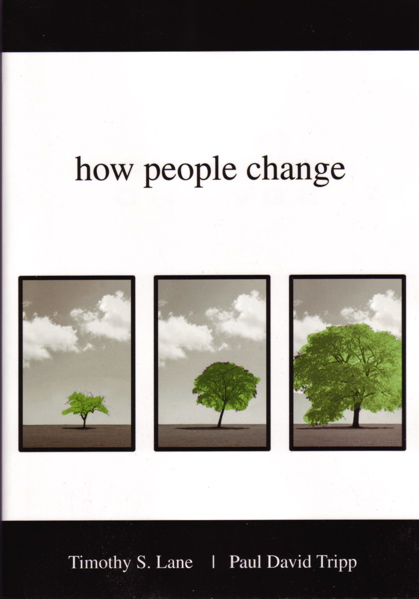 reading through several books this year. For the months of March and April, I’m reading through How People Change by biblical counselors Dr. Timothy Lane, executive director and faculty member of the Christian Counseling and Educational Foundation (CCEF), and Dr. Paul David Tripp, president of Paul Tripp Ministries, pastor, and adjunct professor at Westminster Theological Seminary as well as adjunct faculty member of CCEF. The slogan across the top of the CCEF website (www.ccef.org) is “Restoring Christ to Counseling and Counseling to the Church.” We’re off to a good start.
As you may have guessed, I’m not the sort who naturally gravitates toward such “practical” material. But that’s my own problem. This volume, however, proves promising. I’ve only gotten through chapter one, so far, and it appears to have already gotten my number. The title of chapter one is “the gospel gap” (all titles are in lower case in this book), which the authors summarize in this way:
The good news of the gospel of Jesus Christ is a “then-now-then” gospel…First, there is the “then” of the past. When I embrace Christ by faith, my sins are completely forgiven, and I stand before God as righteous. There is also the “then” of the future, the promise of eternity with the Lord, free of sin and struggle. The church has done fairly well explaining these two “thens” of the gospel, but it has tended to understate or misunderstand the “now” benefits of the work of Christ. What difference does the gospel make in the here and now? How does it help me as a father, a husband, a worker, and a member of the body of Christ? How does it help me respond to difficulty and make decisions? How does it give me meaning, purpose and identity? How does it motivate my ministry to others?
It is in the here and now that many of us experience a gospel blindness. Our sight is dimmed by the tyranny of the urgent, by the siren call of success, by the seductive beauty of physical things, by our inability to admit our own problems, and by the casual relationships within the body of Christ that we mistakenly call fellowship. This blindness is often encouraged by preaching that fails to take the gospel to the specific challenges that people face. People need to see that the gospel belongs in their workplace, their kitchen, their school, their bedroom, their backyard and their van. They need to see the way the gospel makes a connection between what they are doing and what God is doing. They need to understand that their life stories are being lived out within God’s larger story so that they can learn to live each day with a gospel mentality (pages 3-4).
If you’ve been reading my blog for any length of time, you know I’m a big believer in the Christ-centered emphasis of Reformed theology. You may have read previous posts where I’ve recommended books like Christ Centered Preaching and Living the Cross Centered Life. This book on biblical counselling is right up the Christ-centered alley. Here’s a helpful guide for learning to live life in light of the gospel.
Two great passages of Scripture give us a picture of this so-called “then-now-then” application of the gospel to the believer. In his letter to Titus, the apostle Paul writes that the gospel is the basis for the instructions he gives in the first ten verses of chapter two.
11 For the grace of God has appeared, bringing salvation for all people, training us to renounce ungodliness and worldly passions, and to live self-controlled, upright, and godly lives in the present age, waiting for our blessed hope, the appearing of the glory of our great God and Savior Jesus Christ, who gave himself for us to redeem us from all lawlessness and to purify for himself a people for his own possession who are zealous for good works (Titus 2:11-14).
Back “then” the grace of God appeared, bringing salvation for people in every nation (v. 11). “Now,” or as Paul writes, “in the present age” (v. 12), this grace of God trains us to renounce ungodliness and worldly passions, embracing self-control, uprightness, and godliness, “waiting for our blessed hope” (v. 13), in other words, looking forward to “then,” when Christ returns, who, back “then,” gave himself for our redemption from lawlessness to “purify . . . a people for his own posession who are zealous for good works” (v. 14). As you can see, the authors draw directly from Scripture for their approach to counseling, with no modern psychological influences evident. This is Christ-centered counseling if I’ve ever seen it.
Likewise, Peter gives a bit more extensive treatment in his second letter. In fact, in 2 Peter 1:9, the apostle explicitly indicates a professing believer’s tendency to “forget” about what Christ did for him in the gospel. Here is Lane’s and Tripp’s “gospel gap.” Let’s take a look at the passage–2 Peter 1:3-11.
His divine power has granted to us all things that pertain to life and godliness, through the knowledge of him who called us (back “then“) to his own glory and excellence, by which he has granted to us his precious and very great promises (again, past tense), so that through them you may become partakers of the divine nature, having escaped (detecting a pattern yet?) from the corruption that is in the world because of sinful desire.
For this very reason, (“now“) make every effort to supplement your faith with virtue, and virtue with knowledge, and knowledge with self-control, and self-control with steadfastness, and steadfastness with godliness, and godliness with brotherly affection, and brotherly affection with love. For if these qualities are yours and are increasing, they keep you from being ineffective or unfruitful in the knowledge of our Lord Jesus Christ.
For whoever lacks these qualities is so nearsighted that he is blind, having forgotten that he was cleansed from his former sins (here’s the “gospel gap”). Therefore, brothers, be all the more diligent to make your calling and election sure, for if you practice these qualities you will never fall. For in this way there will (“then“) be richly provided for you an entrance into the eternal kingdom of our Lord and Savior Jesus Christ.
For these reasons, and a few others (so far), I’m inclined to believe the promotional synopsis at the Westminster Books website when it claims “This book explains the biblical pattern for change in a clear, practical way that you can apply to the challenges of daily life.”
Changing of the Guard at Coral Ridge
 The news has just reached me that the search for a new pastor has come to an end at Coral Ridge Presbyterian Church, in Fort Lauderdale, Florida. Last year’s loss of Dr. D. James Kennedy has certainly brought much change and transition to the local congregation. It certainly came immediately to the Coral Ridge Hour television show. The formerly hour-long program was immediately reduced to a half hour, cutting out my favorite part of the program, the music. From the exhilerating one verse processional, during which the choir and pastor enter the sanctuary and take their places to open the service, to the choir specials and classical solo features, it was part of my weekly preparation for worship at my own church. As a concession, I noticed that they began to squeeze in the song that is sung after the sermon, for which I was grateful, but it certainly was not the same.
 But I digress. The Session (or, board of Ruling Elders) of Coral Ridge Presbyterian Church, whose concern is to shepherd a large, influential church without a Teaching Elder (Pastor), has recently called a young minister of some noteriety who is building a church which has yet to obtain its own building. In this way, its quite an interesting match–a church without a pastor offers its building to a church with a pastor but not a building. That’s right, they’re not just calling the pastor, they’re negotiating a merger. The name of said minister of note, who has received a call to pastor Coral Ridge, is Tullian Tchividjian (the last name rhymes with “religion”). Rev. Tchividjian is an up-and-coming pastor in the Evangelical Presbyterian Church, (Coral Ridge is in the Presbyterian Church in America) who happens to be the grandson of “America’s Pastor,” Evangelist Billy Graham. But many Reformed believers may know him better as the guy featured in the promotional videos that recently introduced the Bible reading public to the new ESV Study Bible (which study Bible I highly recommend).
You can read the SunSentinel.com report on Rev. Tchividjian’s call and the subsequent merger negotiations here, and you can also keep up with the ongoing process at his New City Presbyterian Church blog (here, here, here, for starters). While this is an interesting event, I must say that in the inevitable changes that will come to the church, especially grievous to me personally will be any metamorphosis of Coral Ridge’s amazing music ministry, which, while it was technically “blended” (combining the singing of traditional hymns with contemporary music), it was effectively presented in a manner that majored on the classical, “traditional,” even the liturgical. One Reformed blog, Green Baggins, expresses concerns (read it here) similar to mine. I share some of this blogger’s concerns, especially about the implications of contemporary worship music, and the possibility of a “seeker sensitive” approach to the church’s ministry, although some of the comments on his post help alleviate my concerns.
Be that as it may, I’m glad to see that a changing of the guard is in the works, and I wish both churches (Coral Ridge and Tchividjian’s New City Pres.) the reformation and revival for which both are praying and working. May the Lord grant it to the advancement of his Kingdom throughout Florida, and, through their various TV and radio ministries, America and the world.
The Denomination Blues
In case you don’t know, I’m a music lover. And although I decidedly come down on the “traditional” side in the worship wars (in fact, I just got my “Organ Music Rocks” t-shirt from Old Lutheran dot com!), I happen to enjoy some of the music produced by some of those who may differ with me on that issue, I just happen to reserve it “for entertainment purposes only”. Not that I don’t find it edifying as well, at times.
For instance, when it comes to Southern Gospel music, there is very little that I can stand for very long. One or two songs and I’m pretty well done. Any more than that, and I start getting visibly uncomfortable. But not so in the case of Reformed Presbyterian harmonica player extraordinaire, Buddy Greene (visit his official site). I could listen to him all day. I just added a few YouTube videos of Greene excercising his gift to my personal YouTube page (you can visit it here). The first song is “Denomination Blues” (no harmonica in this one) and he pokes fun at a few select denominations, starting with his own (even false churches like Roman Catholicism and Unitarianism). But I was surprised that he didn’t have a verse on the Baptist denomination. If you can write a good one in the vein of Buddy Greene’s song, post it in the comments. I’ll add mine when I come up with one, too.
Here’s one where he pulls out his harmonica. It’s one of my all-time favorite songs, “God Is With Us.” This has more of a black gospel feel to it:
Dad Rod on Repentance
Lutheran professor of Systematic Theology and Christian Apologetics, Dr. Rod Rosenbladt, co-host of The White Horse Inn radio show, was interviewed yesterday,
Rod is rad, he's our dad!
Thursday, February 4th, on “Lutheran Public Radio,” a show called Issues, Etc. on the topic of repentance. Dr. Rosenbladt’s WHI co-hosts, Mike Horton and Kim Riddlebarger, began calling him “Dad Rod,” chiefly, I think, because it was his sense of urgency that American Evangelicalism needs to be reintroduced to the gospel, that drives the vision of their show. Among other things, revivalism has transformed American Protestant Christianity into something more akin to the medieval Roman Catholic spirituality and Anabaptistic enthusiasm (don’t ignore this link!) than anything produced by the Protestant Reformation of the Magisterial Reformers, Martin Luther, John Calvin and Ulrich Zwingli. One of the things that revivalism has “De-formed” in America is the doctrine of repentance.
The revivalist version of the doctrine of repentance is one which puts all the emphasis on the work of the believer to be sorry or contrite enough, really mean it when he repents, and shows that he’s really repented because he has actually ceased and desisted of any recurrence of the particular sinful behavior repented of. “Dad Rod” clearly and simply summarized the Reformation view of repentance from the believer’s perspective when he said . . .
“Our repentance is always imperfect and always half-hearted. . . This is preparation for believing the gospel promise (of forgiveness). . . and we do that half-heartedly, too. But God saves us in Jesus anyway.”
If you didn’t just breathe a sigh of relief, watch out! You may just be one of those dishonest people who thinks they’ve got this obedience to the Law thing down.
By the way, you can learn more pearls of wisdom from our Lutheran Dad Rod at his very own website, New Reformation Press.
The Political Conservative’s Obama-Era Survival Pack
I know many theological and political conservative Christian Republicans (as well as those to their right) are grieving the loss to their dream of rebuilding this “Christian nation.” They’re keeping a stiff upper lip as they say good-bye to the out-going evangelical President George Walker Bush, and endure, not without some respect for the historical nature of the event, the election, and now, inauguration of the first African-American President, Barak Hussein Obama. Hard times are coming to the evangelical dream of “taking America back” for Christ, but things are going well for the pluralistic civil religion.
During the next four to eight years, it may serve you well to think through a little more carefully just what is the Christian’s relationship to his government. What vision ought he to have for his nation? Should it be forced into the mold of Old Testament Israel, should a Christian theocracy be established, or are we to forswear all participation in the public square, and stop polishing the brass on the sinking ship of America?
I submit that a firmer grasp on the classical Christian distinction between what Augustine called the City of God and the City of  Man is in order. How is the Christian to live as citizens of the City of God without molding it into the image of the City of Man, and vice versa? This week’s episode of the White Horse Inn, “The City of God,” will tell you. You can read Michael Horton’s intro to the program here. Also, I found particularly helpful and interesting the programs on “Christianity and Politics,” part one and part two, in which, back in September, Dr. Horton interviewed D.G. Hart (author of A Secular Faith: Why Christianity Favors the Separation of Church & State), Dan Bryant (former Republican Assistant Attorney General for the Department of Justice) and Neil McBride (a strategist for the Democratic Party). Their introductions can likewise be read here.
I think learning a little more about what the Bible really expects of Christian citizens will help us all cope while the party who beat us in the last election has their turn at the helm of the ship of state. We, and our country, might just be the better for it. 
Riddlebarger on the Necessity of Church Discipline
I just wanted to post my “Amen!” to Dr. Kim Riddlebarger’s recent post which emphasizes the logical conclusion of an absence of church discipline.
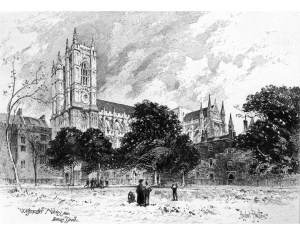
Westminster Abbey, thanks to reformationart.com
In chapter 30 of the Westminster Confession of Faith, “Of Church Censures,” a good summary of the biblical case for church discipline is outlined.
I. The Lord Jesus, as king and head of His Church, has therein appointed a government, in the hand of Church officers, distinct from the civil magistrate. (Isaiah 9:6-7; 1 Timothy 5:17; 1 Thessalonians 5:12; Acts 20:17-18; Hebrews 13:7, 17, 24; 1 Corinthians 12:28; Matthew 28:18-24)
II. To these officers the keys of the kingdom of heaven are committed; by virtue whereof, they have power, respectively, to retain, and remit sins; to shut that kingdom against the impenitent, both by the Word, and censures; and to open it unto penitent sinners, by the ministry of the Gospel; and by absolution from censures, as occasion shall require. (Matthew 16:19; 18:17-18; John 20:21-23; 2 Corinthians 2:6-8 )
III. Church censures are necessary, for the reclaiming and gaining of offending brethres, for deterring of others from the like offenses, for purging out of that leaven which might infect the whole lump, for vindicating the honor of Christ, and the holy profession of the Gospel, and for preventing the wrath of God, which might justly fall upon the Church, if they should suffer His covenant, and the seals thereof, to be profaned by notorious and obstinate offenders. (1 Corinthians 5; 1 Timothy 5:20; Matthew 7:6; 1 Timothy 1:20; 1 Corinthians 11:27-34; Jude 23)
IV. For the better attaining of these ends, the officers of the Church are to proceed by admonition; suspension from the sacrament of the Lord’s Supper for a season; and by excommunication from the Church; according to the nature of the crime, and demerit of the person. (1 Thessalonians 5:12; 2 Thessalonians 3:6, 14-15; 1 Corinthians 5:4, 13; Matthew 18:17; Titus 3:10).


 The Misadventures of Captain Headknowledge