Sister Aimee and the “Anabaptist Nation”

"Sister Aimee" McPherson
I heard an interesting description of how American Christianity effectively developed into a form of Anabaptism. Dr. R. Scott Clark, Professor of Church History and Historical Theology at Westminster Seminary California (WSC), was interviewed this past week on Christ the Center podcast episode #157 regarding his contribution to Always Reformed, a festschrift that has recently been published in honor of WSC President and Professor of Church History, Dr. Robert Godfrey (see Dr. Clark’s post here). From what I’ve been able to gather over the past couple of years, Dr. Godfrey is an earnest student of the phenomenon of Sister Aimee McPherson’s ministry in the 1920’s, and holds her up as an example of what American Christianity is. Clark’s chapter is entitled, “Magic and Noise: Reformed Christianity in Sister’s America.” To some extent, it seems that this very subject of the Anabaptistic flavor of American Christianity is at the heart of this chapter, as may be inferred by the chapter’s title itself.
About twenty-two minutes into the interview, Clark introduces this topic by urging the study of “Sister” (as she is wont to be called) on Reformed believers. He does this because, according to Clark, in many ways McPherson’s type of Christianity is more indicative of the nature of American Christianity than the Reformed faith can lay claim to anymore. America has come a long way since the faith of the pilgrims of Plymouth Rock and the Salem witch trials (which is probably all Americans remember about those early Christian settlers (for help with that, listen to this and this). Clark believes that the Reformed would be aided in reaching America for Christ, and American evangelicals for the Reformed faith if they would see themselves more as cross-cultural missionaries, rather than natives.
Dr. Clark offers the disclaimer that his Anabaptist diagnosis of American Christianity is largely due to the fact that his primary field of research is the sixteenth and seventeenth century Reformation, rather than early twentieth century Christianity. He admits that in part he is interpreting the McPherson phenomenon and the nature of “native” American Christianity in the light of the sixteenth century Anabaptist movement, but he does attempt to support his conclusion with appeals to others who have written more extensively on Christianity in the nineteenth and twentieth centuries.
There are parallels between the Anabaptist movement of the sixteenth century and current American Christianity. Clark explains that people tend to think of the Anabaptist movement as just another facet of the Protestant Reformation, but he points out that the Anabaptists (also known as “Radical Reformers”) more or less “rejected all of the key doctrinal commitments” of the Protestant Reformation in favor of much more radical positions. Clark’s thesis is that the way American Christians commonly think about the nature of authority, epistemology (how we know what we know), Scripture and its authority, the church and eschatology (the doctrine of the end times) often bears strong resemblance to sixteenth and seventeenth century Anabaptism. Dr. Clark goes into a little more detail on this in the interview between minutes 33:15 and 42:06.
This portion of the interview caught my attention because Clark’s comparison is consistent with a conclusion I came to in my own personal pilgrimage from independent Baptist fundamentalism to Reformed theology and practice. After learning that the ultimate source of the bulk of historic Baptist theology comes from the Reformed Westminster Confession of Faith (see my newly updated “Creeds, etc.” page), and the parallels I saw between Baptist distinctives and the historic Anabaptist movement, I concluded that everything that’s right in the Baptist tradition was learned from the Reformed tradition, and everything that’s wrong in the Baptist tradition was learned, or “caught,” if you will, from Anabaptism. I realize that the 1689 Baptist Confession disclaims any formal connection between their doctrines and those of the Anabaptists, but the parallels are just too striking to Reformed paedobaptists.
This is why I encourage you to take time to listen to at least this section of the interview, if you don’t have the time or inclination to enjoy all of it. It’ll be thought-provoking time well-spent, if you ask me.
Understanding KJV-Onlyism
 Understanding Our Times with Kevin Thompson has invited Bob Hayton of the blogs Fundamentally Reformed, KJV-Only Debate, and RE:Fundamentals to guest host the show tomorrow night at 5pm central time. It will be a call-in discussion hosted by Bob and his compatriot in Debating KJV-Onlyism, Damien Garofalo. Bob has been interviewed before about Fundamentalism and his journey to Calvinism on Understanding Our Times as well as Iron Sharpens Iron (a traditional radio show out of Long Island, NY–listen here).
Here’s Bob’s announcement if you desire more information.
“You Either Love Him Or You Hate Him”. . .
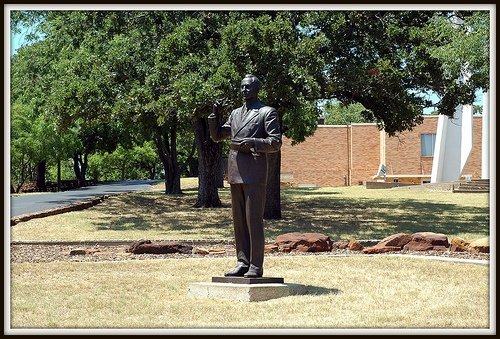
Statue of J. Frank Norris on the campus of Arlington Baptist College
. . . this is the kind of sentiment that a character like J. Frank Norris draws. For those whose lives were changed for the better, it seems the man can do no wrong, and watch out if you try to accurately paint a picture of such a saint–the way the Bible portrays it’s saints–warts and all. With Norris, most of those folks have gone on to their reward, as has their hero. But there of course remains a faithful remnant.
The segment of the fundamentalist independent Baptist movement that Norris spearheaded remains more or less the home of the majority of Norris’ faithful followers, but there are exceptions. There remain a few who are and have always been, members of First Baptist Church of Fort Worth, who, in the light of the publication of David Stokes’ work of narrative non-fiction on the life and ministry of J. Frank Norris and especially his murder trial, Apparent Danger, are unhappy that Norris’ warts are portrayed as prominently as they are. Back in June, one such member wrote on “J. Frank Norris’ lasting influence.” To Melissa Easter, Norris has had a lasting influence on several generations of her family. Without challenging Stokes’ facts or his documentation thereof, Easter was compelled to remind her Fort Worth neighbors there was lasting spiritual fruit that was borne through the ministry of J. Frank Norris, her family among them. Concluding her defense, Easter writes:
I do not know everything. But what I do know and what I believe is that J. Frank Norris had a good heart and a passion for God. Otherwise my great-grandparents would not have named my grandfather after him. Otherwise my family would not have attended that church after moving from Oklahoma. Otherwise my grandfather would not have asked J. Frank Norris to officiate his marriage to my grandmother.
It is unfortunate that Norris was involved in such an incident as that of July 1926, but that event should not overshadow the fact that he helped lead many people to the saving knowledge of Jesus Christ. I’m sure he asked the Lord for forgiveness, and, in my opinion, judgment was God’s alone to make.
Why is it that after so many years someone has seen fit to stir the pot once again? It is a futile matter; it brings up hurt to those who view J. Frank Norris in a positive light and potentially turns others away from the church.
Perhaps then we should all spend more time trying to bring people to the kingdom of heaven rather than shine light on an 84-year-old blemish.
Can you write a book that tells the whole truth about a man while there are still people alive who don’t want the whole truth to get out and complicate their fond memories? Not without criticism. But I believe it’s safe to say that David Stokes was aware of this fact and was thoroughly prepared to deal with it. Evangelism notwithstanding.
Meet the Godfather of Fundamentalism, J. Frank Norris
Fairfax, Virginia Baptist Bible Fellowship local church pastor David Stokes grew up as a member of Detroit’s Temple Baptist Church, not twenty years after J. Frank Norris pastored that church at the same time that he pastored First Baptist Church in Fort Worth, Texas. In his day, Norris was known as the “Texas Tornado,” and the “Pistol-Packing Parson.” The memory of J. Frank Norris casts a long shadow for those whose lives were touched by his sensationalistic and controversial ministry. It must be as true for those like Stokes who grew up in the decades following Norris’ death, as it is for us down here in Fort Worth, who boast of relatives with stories of personal connections to the famous fundamentalist firebrand. For example, my own mother grew up playing with Norris’ grandson, George. He was my mother’s best friend’s boyfriend. My great-grandmother hosted the visiting preacher at her house, where lively discussions are said to have ensued between Norris and my great-great grandmother, charming them with the admission that “the only person who could ever change his mind was Mrs. Freeman.” Not only that, J. Frank Norris even performed the wedding ceremony for my first wife’s grandparents. For better or worse, J. Frank Norris is one of the more colorful cast members in the dramatic history of Fort Worth, Texas. Featuring his battle with the Southern Baptist Convention over Baylor University’s teaching evolution and his own personal war against corruption in local politics as well as the Prohibition-era liquor trade itself, I’ve always said, even as a one-time devoted follower, that the life story of J. Frank Norris would make a great gangster movie!
It looks like the novel on which that movie could be based has just been written by David Stokes. The book is called Apparent Danger: The Pastor of America’s First Megachurch and the Texas Murder Trial of the Decade in the 1920’s. Just a couple of weeks ago, Stokes held a book signing at Barnes and Noble just a few blocks away from the site of FBCFW during Norris’ ministry. On his Facebook page, Stokes reports that about a hundred people turned out for a book and an autograph, and even an unnamed “very nice” 91 year-old former associate of Norris protested his book by passing out a pamphlet with the title “The Real J. Frank Norris.”
My only regret is that I first heard about the book the day after the signing. But now I have my copy, and I’m currently reading it aloud to my wife so that we might enjoy it together. Enjoying it, we are. I let Bob Hayton of the blog Fundamentally Reformed know about it, and he said he plans to review the book on his blog after he reads it, to which I will dutifully link you when it’s posted. But in the meantime, allow me to whet your appetite for the book with the following trailer. If you’ve never heard of him, or if you’ve always known about him–love him or hate him, you’ll be both shocked and in awe of the story of J. Frank Norris and the trial that failed to sentence Norris to “Sparky,” the state of Texas’ newly acquired electric chair for the death of D.E. Chipps.
The Rationalism of the “Biblicist”
 The April 25, 2010 episode of The Heidelcast, a weekly podcast by Dr. R. Scott Clark, Professor of Church History and Historical Theology at Westminster Seminary California, and writer of the Heidelblog, contains a discussion between Dr. Clark and Martin Downes, author of Risking the Truth, about how “biblicism” is fundamentally rationalistic, and so undermines the sole authority of Scripture, which it intends to uphold. What follows is a transcript of this short segment of their interview.
Clark: What happens when a fellow comes with his Bible open, as Faustus Socinus did (an anti-Trinitarian heretic)? He had his Bible open, and his uncle Laelius Socinus, managed to convince Heinrich Bullinger that he was basically orthodox. And so, both of these fellows said, “Listen, we believe the Bible, but we just don’t think that you’re getting it right. We’re more biblical than you. In fact, we want to get rid of all of this systematic theology and these confessions, and we just wanna follow the Bible.” What’s wrong with that approach, which scholars have called “Biblicism”?
Downes: The real problem is that, although it claims to be, upholding Sola Scriptura and the sole authority of Scripture, actually what’s really going on beneath that claim is a subtle form of rationalism.
Something that Jehovah’s Witnesses are always saying to people is, “Did you know the word “Trinity” isn’t in the Bible?” As if to say, “Ah, crums! It’s not there. Well, perhaps the idea isn’t really there.” Perhaps somebody invented that and imposed it upon the text.
I think what we find is that Biblicism demands that truth be stated in a certain way, and will not accept that we believe things, because of the express statements of Scripture, but also what “by good and necessary consequence may be deduced from Scripture” (Westminster Confession of Faith, chapter 1, section VI).
But it is very subtle, and I think that’s why it does take more people in. It’s an appeal to a standard of authority that we want to hold to whole-heartedly, but actually beneath that appeal, I think is a form of rationalism.
Clark: Doesn’t it also put the autonomous, individual Bible interpreter in charge of Scripture? And this is something of which Protestants are often accused, but it’s not really true. If someone pays attention to the history of Protestant theology, and the history of the Reformation, one would know right away that there was a huge difference between the Anabaptists, who were radicals and individualists and the Socinians, who were radicals and individualists…between them, and, the confessional Protestant Reformers, who actually worked within a churchly (ecclesiastical) context.
Downes: I remember once after an evening service, I chatted to a man at the door, and . . . I happened to mention what we are discussing—this particular issue—He said, “I’m not interested. That’s just a man made document.” But he wanted me to be interested in what he was saying, and his insights into the Scriptures.
So I said to him, “Look, why would I want to put aside a document that has churchly sanction, that represents the reflection from Scripture, and the thinking, not of an individual, but actually of the whole body of divines. And so, really what his claim was, “I’m not interested in what they think. I’m just interested in what I think. I just want you to believe what I’m saying. I struggle to find humility in that approach.
Clark: Not only is it arrogant, it’s essentially an Enlightenment-inspired, modernist approach to truth and error. At the end of the day, it’s not really God’s Word as understood and confessed by a body of believers, which is norming things, I’m norming things by my, private personal interpretation of Scripture. And so, at the end of the day, I, really, am the measure. I say I’m following the Bible, but I know better what the Bible says than anyone. And, unfortunately, I think, and maybe you’ll agree or not, I don’t know, that there’s a pretty radical misunderstanding of Sola Scriptura. What’s the real difference between Sola Scriptura as understood originally, and Biblicism?
Downes: I think it goes back to what you were saying about individualism. That it’s not seeing Christian belief in the context of the church, and the church is the pillar and ground of the truth, and maybe some of that is a fear of the Catholic element, with a large C and an R before it—maybe some of the squeamishness has to do with that—but I think fundamentally it is that individualistic mindset that it’s just me and my Bible. Well, it’s a big book. What does it teach? We ought to, if we are wise, consider very carefully two thousand years of Christian belief, in terms of the great creeds and the Reformed confessions.
Jack Chick Earns the Respect of the Underground Comics Industry

Rare photo of the reclusive and elusive Jack Chick
I should probably save this for another time when I’ve got more time to write all that I have to say about Jack Chick and his world famous “Chick tracts,” (see his site, Chick Publications) but I can’t wait to at least show you the trailer for a documentary about Jack Chick and his comic books and comic book-style tracts. As it relates to me, Jack Chick is one of the instrumental causes of my dropping out of Bible College. I didn’t do my homework because I was too busy devouring his comics purchased from a nearby Christian bookstore.
Anyway, the following trailer features mostly the ways Chick’s views are poked fun of in the film, but if you ever get a chance to watch the documentary itself, as I did on the Documentary Channel a few days ago, you would see how much the filmmakers and even some of the non-Christian interviewees have for his comics as works of art. They say his work is even featured in galleries across the country and I think they said it even has a presence at comic book conventions and other such forums in which such material is auctioned. Jack Chick is collectible. All you fundies out there better hold onto at least a few copies of his tracts in case you need to cash them in once the economy completely collapses!
The picture to the right was found on the site of Catholic lay apologist Jimmy Akin’s website. He found it on the church website of an Independent Fundamental Baptist church whose pastor (right) has a testimony similar to that of the “Bad Bob” featured in the Chick tract of the same name held by the author (aka, Jack Chick himself, left). If you want to read about this picture and the hand-drawn portrait of Jack Chick at the Catholic apologist’s website, click here, here, and here. They make for fascinating reading, and serve as a little background info to some things I may share in a future post when I’ve got more time.
Below is the trailer to God’s Cartoonist: The Comic Crusade of Jack T. Chick.
Oh yeah, there are a few bios you will want to read on Jack Chick and his associates at Wikipedia in conjunction with this video:
Fundamentally Reformed Radio
 Bob Hayton, of the Fundamentally Reformed blog, which is featured in my blogroll, was interviewed yesterday on the Iron Sharpens Iron radio show regarding the theme of his blog, “Reforming Fundamentalism through Reformed theology.” Bod discusses the issues he has with the Independent, Fundamental Baptist movement in general, his experiences within it and as he and his brother were leaving it, and explains the key ingredient that makes Reformed theology such a draw: the gospel of Jesus Christ, not only preached to unbelievers for their justification, but also applied on a consistent basis to believers for their sanctification. The life, death and resurrection of the Lord Jesus Christ is the one thing that will free a believer, not only from the guilt of sin, not only the ongoing power of sin, as the believer is built up in the message of God’s grace in Jesus Christ, but also from the need for legalistic standards and divisive forms of “separatism.”
Also, ten minutes from the end of the show, you’ll be treated to my call-in question, and Bob’s insightful answer. Click on the link below to listen. Don’t be deterred by the Spanish language programming at the beginning of the podcast–Iron Sharpens Iron will begin directly…
\20100308–“Reforming Fundamentalism Through Reformed Theology\”
Better Than Thanksgiving Day Football (If You’re Me, That Is…)!

Dr. James R. White's Reformed Twin
As many of you know, and a few others may be disappointed to learn, I’m a life-long Independent Baptist (though currently a member of a Southern Baptist church, by God’s wise and inscrutable providence) who has adopted Presbyterian views. That includes the Presbyterian view of infant baptism. Ever since having adopted this view, in the interests of “givning God a chance” to “make my life easier,” I’ve from time to time done a little more reading on the case for believer’s baptism (aka, credobaptism) as opposed to the Reformed doctrine of infant baptism (aka, paedobaptism). I’ve done so with an open mind, knowing that I’m not the most brilliant theologian in the world, being, after all, an IFB Bible college drop-out. I may just want to believe in paedobaptism, because there’s so much I disagree with (and/or dislike) about the Baptist tradition, so if I’m going to expect my wife and kids to adopt the Reformed view of paedobaptism (which they’ve yet to do, again in God’s wise and inscrutable and gracious wisdom), I’d better be right. So far, every time I’ve entered into this debate with an open mind, I find myself

Dr. R. Scott Clark's Baptist Twin
becoming more and more thoroughly convinced that the Reformed view of paedobaptism is the more biblically consistent view. But, I keep reminding myself, I’ve yet to listen to one of my favorite Reformed Baptists, Dr. James White, debate the subject. Dr. White is one of the more relentless, aggressive and capable apologists and debaters I’ve ever seen. If anyone could dissuade me from the case for paedobaptism, it would likely be him.
It looks like I may soon get my chance.
I just finished reading Dr. James White’s post, entitled “R. Scott Clark and ‘Reformed,'” and Dr. Clark’s response, “Post-Thanksgiving Cartoons: Reply to James White.” White attempted to demonstrate the fallacy of Clark’s refusal to accept Baptists under the umbrella “Reformed” on the basis of his contention that paedobaptism is essential to being Reformed. Naturally, White believes for obvious reasons that he’s more thoroughly Reformed than his Presbyterian and Continental Reformed brethren. Clark believes Baptists may have an affinity for “the five heads of doctrine of the Synod of Dort” (popularly known as the five points of Calvinism), but denies they’re Reformed. For the record, having heard Dr. Clark’s teaching and gotten a glimpse of his personality from interviews and his Facebook page (for example, his status update at one point yesterday read, “I’m not passive-aggressive, I’m just aggressive”), leads me to believe that Dr. R. Scott Clark may just be Dr. James R. White’s Reformed twin (I’ve always contended that my friend, Gage Browning, is White’s Presbyterian twin–there is a difference). It’s all about personality and hairdo. I guess that would make Gage Dr. Clark’s Presbyterian twin, too–but I digress.
Anyway, having read both of these esteemed theologians’ posts, I just wanted to put out there that my appetite is officially whetted for a new debate on credobaptism versus paedobaptism between Drs. James R. White and R. Scott Clark. Who’s with me?
YouTube Fundy vs. Calvinism
Steven L. Anderson, pastor of Faithful Word Baptist Church in Pheonix, AZ, has a very full YouTube page of videos featuring his preaching and teaching ministry. Some of the arguments made in some of the videos, it must be said, range from the average, to the illogical, to the hilariously absurd. StuffFundiesLike featured one of the more amusing ones (view it here), but Fundamentally Reformed once posted on one I’ve yet to see topped (view it here)! Compared to these two, the one I’m posting and commenting on today is rather ho-hum.
In this video, Pastor Anderson presents a few arguments from John 6 and John 15 against the doctrines of God’s foreordination of all things (Ephesians 1:11), predestination to salvation (Ephesians 1:5; Romans 9:23) and reprobation to condemnation (2 Peter 2; Romans 9:22).
Watch the video and interact with his arguments. I’m going to be out of town over the weekend and probably have little access to the internet. If you’re not familiar with the doctrines of Calvinism regarding the sovereignty of God over all things, even the salvation of sinners, feel free to ask questions. They’ll be welcomed and answered with gentleness and respect when I return, unless one of my Calvinist commenters is pleased to interact with you over the weekend (you know who you are–this is your cue!).
Here are the passages Pastor Anderson dealt with. View them for yourself and prayerfully examine their contexts and see the sovereign hand of a God who is not merely a one-dimensional “God of love” who is passive in the face of your sovereign self-determination, but “is love” and just at the same time.
“You did not choose me, but I chose you and appointed you that you should go and bear fruit and that your fruit should abide, so that whatever you ask the Father in my name, he may give it to you” (John 15:16)
“Jesus answered them, “Did I not choose you, the Twelve? And yet one of you is a devil.” He spoke of Judas the son of Simon Iscariot, for he, one of the Twelve, was going to betray him” (John 6:70-71; cf. Acts 1:16–indicating what Judas was actually chosen for).
If not a Protestant, then what?
 Last night, Saddleback Church pastor, Rick Warren, was interviewed on CNN’s Larry King Live. A couple of pastor Warren’s comments troubled me. Here’s one them.
KING: OK. Do you think Christianity is slipping in America? That’s the front cover of “Newsweek,” out today. Quite a loss occurring in the Christian community. There you see the headline.
WARREN: Well, I would say it’s the best of times and the worst of times. First place, I don’t think that all of the questions that are asked in surveys are always as objective as they could be. For instance, if you ask people, are you a Protestant — and the number of Protestants has gone down dramatically in the last 30 years. I don’t even call myself a Protestant. (emphasis mine) (read the transcript here)
Rick Warren is not a Protestant? What in the world is he? I didn’t think he was the sort that claimed to be “post-evangelical” like the Internet Monk, or a proponent of the “emerging church.” Even though I spent over twenty years in Baptist fundamentalism which denied being Protestants (even though they really are) because of their commitment to a view of Baptist history called “Landmarkism” or Baptist Successionism, I seriously doubt this is the case with Rick Warren.
I searched around the web looking for an answer and the only real lead I could find was found at Apprising Ministries, a discernment ministry blog. One post carries the title, “Southern Baptist Pastor Rick Warren Corrects Martin Luther.” In this post, Warren is quoted as saying:
“Now I don’t agree with everything in everybody’s denomination, including my own. I don’t agree with everything that Catholics do or Pentecostals do, but what binds us together is so much stronger than what divides us,” he said. “I really do feel that these people are brothers and sisters in God’s family. I am looking to build bridges with the Orthodox Church, looking to build bridges with the Catholic Church,….”
It appears he’s willing to seek common ground with other segments of “Christendom” which deny the gospel of justification by grace alone through faith alone, because of Christ alone, according to Scripture alone, to the glory of God alone–the gospel of the Protestant Reformation. I’m sure Warren affirms this gospel personally, I’m sure he’s aware the Roman Catholic Church anathematized this very gospel at the Council of Trent and has never rescinded such a blasphemous stance. I wonder, however, if Pastor Warren cares. Here’s the link to Apprising Ministries’ category of posts on Rick Warren, if you desire to read more about his activity regarding the relationship between Protestantism and Catholicism.
Do any of my readers know any more about Rick Warren’s stance on Protestant identity? Has anyone ever heard him deny that he’s a Protestant before? I’m interested to learn more about how he categorizes himself.
Why Saint Patrick Was NOT a Baptist, part 3: Catholic Associations
 “Successionists admit, of course, that the name “Baptist” cannot be found in every period of the Christian era, but if a group dissented from the Roman Catholic Church and suffered for its nonconformity, successionists have been quick to cite such groups as baptistic proponents of biblical Christianity. In this way, ancient and medieval religious movements such as the Montanists, Novations, Patarenes, Bogomils, Paulicians, Arnoldists, Henricians, Albigenses, and Waldenses have been inducted into the line of “Baptist” succession. A few successionists have claimed that even St. Patrick was a Baptist” [McGoldrick, Baptist Successionism: A Crucial Question in Baptist History, (1994, Scarecrow Press), page 2].
Attempting to prove that Saint Patrick was a Baptist involves majoring on the lack of Roman Catholic ecclesiastical terms or references in the two surviving documents that were written by Patrick himself. A critical look at all of the relevant evidence and historical context of Patrick, however, indicates the very thing Baptist Successionists would have their followers deny. In McGoldrick’s words, “Patrick accepted the vocation of a missionary by submitting to the standard ecclesiastical authorities, who invested him with a commission and ordained him a clergyman” (McGoldrick, page 25).
The rest of this post will be McGoldrick’s survey of Patrick’s ecclesiastical associations, his training, ordination and ministerial service that clearly associates him with the Roman Catholic Church, and disassociates him from any notion that he was some sort of dissenter from Roman Catholicism.
“Ordination came in Gaul, where Patrick had gone to receive further instruction to prepare him for his life’s work. Patrick was in Gaul at a time when Bishop Germanus of Auxerre received a plea from Britain to come there to combat the spread of heresy. Germanus’ mission had the approval of Celestine, Bishop of Rome, and it appears that Germanus, with Celestine’s concurrence, dispatched Patrick to Ireland (See St. Patrick : His Writings and Muirchu’s Life, ed. And tr. A. B. E. Hood, [Totowa, NJ: Rowmand & Littlefield, 1978], page 13; John B. Bury, The Life of St. Patrick and His Place in History [Freeport, NY: Books for Libraries, 1971 reprint of 1905 edition], 51-54; cf. John Healy, The Life and Writings of St. Patrick (Dublin: Gill & Son, 1905], 109-16. Bury, a Protestant, and Healy, a Roman Catholic Archbishop, agree that patrick’s commission came through authorized Episcopal channels. Cf. the Venerable Bede, History of the English Church and People, ed. Leo Sherley. Price, rev. R. E. Latham [Baltimore: Penguin Books, 1968], 1. 17).
“Contrary to popular belief, Patrick did not introduce the Christian faith into Ireland. Several Christian communities existed there prior to his arrival, and when Celestine first sent an emissary to the Irish it was not Patrick but the newly consecrated Bishop Palladius. Beyond all doubt, Palladius went forth as a representative of the Roman bishop. However, his ministry in Ireland, was, for reasons not entirely clear, very brief. Patrick followed as the next bishop sent to Ireland, and he too went in the service of Rome ( Bury, Life of St. Patrick, 54-59).
“The occasion for sending a bishop to Ireland appears to have been identical to the reason for sending Germanus to Britain: to combat the heresy of Pelagianism. . . .
“Although the evidence is far from abundant, the documents that remain appear to confirm the view that Patrick ministered in Ireland somewhat in the same way that Germanus served in Britain. That is, he strove to defeat Pelagianism while seeking the conversion of pagans at the same time. Patrick was consecrated a bishop in 432 at the hands of Germanus, and Patrick’s writings contain a few passages that seem to be of an Augustinian character proclaiming salvation by grace.” (pages 25-26).
Puritan Theology
The progress (or perhaps, regress) of my theological views from independent Baptist fundamentalism to confessional Reformed theology results from my desire to get to the true roots of the Baptist tradition. Sort of a “back to the basics” quest. Essential in the post-Reformation development of Reformed theology, and even the development of the original Baptist movement, is Puritan theology. As Baptist historian, Leon McBeth, writes at the Baptist History and Heritage Society website, “Our best historical evidence says that Baptists came into existence in England in the early seventeenth century. They apparently emerged out of the Puritan-Separatist movement in the Church of England.” Several notable Puritans, like the great John Owen, renounced their paedobaptistic distinctives in favor of the emerging Baptistic alternatives, which I still contend are due to Anabaptistic, rather than Reformed, influence. But I digress (for more on the ongoing debate about an Anabaptist/Baptist connection, read this article from the Baptist Standard).
One of the Reformed podcasts I follow weekly, “Christ the Center,” by the Reformed Forum, features an interview of Rev. James O’Brien, pastor of Reedy River PCA on the Christ-centered, and piety-enriching benefits of reading the Puritans (listen to the episode here). Puritan literature is available, not only from Banner of Truth Trust, and other Reformed publishers who reprint their works, but a world of Puritan literature is also available at Archive.org, and Google Books. But to get an easy start, you or some Christian you know probably has a copy of Matthew Henry’s commentary. Pull it off the shelf and peruse it. I bet you won’t regret it.
Why Saint Patrick was NOT a Baptist, part 2: Visions vs. Sola Scriptura
On pages 24 and 25 of his book, Baptist Successionism: A Crucial Question in Baptist History, Dr. James E. McGoldrick demonstrates that on the subject of revelation, and the teaching that would, during the Reformation, become known as Sola Scriptura, St. Patrick was not a Baptist:
Although details are lacking, Patrick’s time in slavery seems to have been the occasion for a growing devotion to God and the development of a powerful desire to evangelize the pagan Irish. The conviction that he should embrace the life of a missionary came, Patrick believed, in the form of a vision which included a voice from heaven.
I saw one night a vision, a man coming as it were from Ireland (his name was Victoricus), with countless letters, and I read the heading of the letter, “The Voice of the Irish,” and as I read . . . at that moment I heard voices of those who dwelt beside the wood of the Focluth, which is by the western sea; and thus they cried, as if with one mouth: “We beseech thee, holy youth, to come and work once more among us.” [See St. Patrick: His Writings and Muirchu’s Life, ed. And tr. A. B. E. Hood (Totowa, NJ: Rowman & Littlefield, 1978), 45-46].
This account of his call to the ministry reflects Patrick’s belief in continuing and direct revelations from God apart from scripture. He reported many such experiences and claimed that some of his converts received such revelations as well [Ibid., 50] [Baptist Successionism: A Crucial Question in Baptist History, James Edward McGoldrick (Scarecrow Press, 2000)].
In these three paragraphs, Dr. McGoldrick demonstrates that for St. Patrick to attribute to a supernatural vision his call to return to Ireland as a missionary, and to claim “many such experiences” in his writings, he sets himself at variance with the historic Baptist view of Sola Scriptura it had originally received from the magisterial reformation.
Although in the present day, there are a myriad of emphases among a broad range of movements and denominations which claim the name “Baptist,” including charismatic emphases that would claim unity with St. Patrick on supernatural revelations given directly by the Holy Spirit apart from the written Word of God, this is not the view of the historic Baptist tradition. The teaching of the Calvinistic wing of the historic Baptist tradition is contained in the 1689 Baptist Confession of Faith, which reads in its chapter, “Of the Holy Scriptures”:
Therefore it pleased the Lord at different times, and in various manners to reveal Himself, and to declare that His will unto His church (Heb 1:1); and afterward for the better preserving and propagating of the truth, and for the more sure establishment and comfort of the church against the corruption of the flesh, and the malice of Satan, and of the world, to commit the same wholly unto writing; which makes the Holy Scriptures to be most necessary, those former ways of God’s revealing His will unto His people being now ceased (Pr 22:19-21; Rom 15:4; 2 Pet 1:19,20) (emphasis mine).
These sentences from the Baptist Confession affirm that while God’s revelation of himself used to come in various supernatural manifestations like visions, among others, the Baptist tradition believes that Holy Scripture alone is the source of God’s revelation of himself to his church, precluding, since the completion of the canon, “continuing and direct revelations from God apart from scripture” of the sort St. Patrick claimed for himself and his followers. This is just one way in which St. Patrick was not a Baptist.
Why Saint Patrick was NOT a Baptist, part 1
To most people, this is almost a pointless distinction to make. “Everyone knows that Saint Patrick was a Roman Catholic priest, right?” Not so.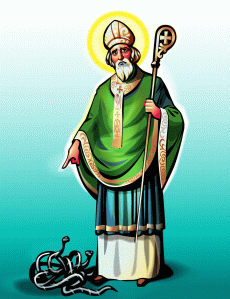 There are some wishful thinkers out there in the realm of Baptist fundamentalism who attempt to annex this 4th to 5th century missionary to Ireland into their pantheon of ancient prototypical “Baptists.” Granted, this is a minority view among Baptists, however, it is the view with which I was raised. This view of Baptist history is called by scholars “Baptist Successionism,” but among its adherents it’s usually known as “Landmarkism.”
As you know St. Patrick’s Day has come and gone two days ago. March 17th is officially recognized by Roman Catholics as the feast day of St. Patrick, commemorating the date of his death. Like most years, about a day before this holiday arrives, I think to myself, I ought to do a little homework to combat this notion that St. Patrick is a Baptist, but I usually run out of time before I can make any headway. So I drop it until about March 16th of the following year. Well, this year, I happened to read a St. Patrick’s Day devotional post by Bob Hayton at Fundamentally Reformed. I commented that I’d intended to post a view contrary to the successionist view of St. Patrick, and missed my “deadline,” but Bob encouraged me to go ahead and do it anyway, so here goes. Looks like this might turn into a series.
I’m by no means a historical scholar, just a Christian who cares to learn the truth about Baptist history, having been burned by so much bad history in the name of promoting the Baptist tradition. A few years ago, I read a book review in the Founders Journal of a book called Baptist Successionism: A Crucial Question in Baptist History, by Dr. James Edward McGoldrick, a professor of church history at Greenville Presbyterian Theological Seminary. I was encouraged by the review, ordered the book, and found that it does a very good job of examining the claims of Baptist Successionism in the light of academic  historical scholarship. Chapter 4 of this book, “St. Patrick: A Baptist?” will serve as the basis of this series.
The only concession one can make about the beliefs and practices of Saint Patrick is the undocumented and therefore uncertain nature of them. This is where Baptist successionists find the wiggle room to make the claims that they make. McGoldrick writes on page 24:
All who have undertaken serious research on the life and thought of Saint Patrick have discovered early that the materials available for the reconstruction of his career are few, and some that have been employed are of dubious reliability. Scholars, both within and without the Roman Catholic Church, have recognized this problem, and, consequently, they have had to admit that their findings are tentative. Only two brief, nontheological writings of Patrick are extant, so interpreters are not in a position to make dogmatic judgments about his doctrinal position. Collateral evidence from the period of Patrick’s life is very scant and does not enlarge our knowledge of his beliefs very much. Moreover, legends abound about practically every phase of Patrick’s life, and separating fact from fiction may, at points, be impossible. The saint’s own works, The Confession and the Letter to Coroticus, are the only unimpeachable sources of information about his views. These, and Muirchu’s monograph on Patrick composed in the seventh century, provide little more than a biographical sketch [see St. Patrick: His Writings and Muirchu’s Life, ed. and tr. A. B. E. Hood (Totowa, NJ: Rowman & Littlefield, 1978)].
So a little biographical material is all we can trust. His theological views, his views on the sacraments (ordinances, for my Baptist readers), his views on church government and ministry, if they are to be known at all, will have to be read carefully between the lines within the context of Patrick’s day and age. By the time this series is finished, I think Dr. McGoldrick will have helped us realize that the Baptist Successionist view is little more than wishful thinking.
Part two will examine Saint Patrick’s probable, or possible, views on revelation, and compare it with the Protestant, Reformed, Evangelical and Baptist view historically known as Sola Scriptura.
update: Dr. Russel Moore at his “Moore to the Point” blog directs us to a more constructive way to benefit from the legacy of St. Patrick (read blog here). He recommends Dr. Philip Freeman’s biography, St. Patrick of Ireland. You can also view a short television interview with Dr. Freeman about St. Patrick (view segment here).


 The Misadventures of Captain Headknowledge
Heresy in Defense of the Fundamentals
Council of Chalcedon, AD 451
“Since therefore the children share in flesh and blood, he himself likewise partook of the same things, that through death he might destroy the one who has the power of death, that is, the devil, and deliver all those who through fear of death were subject to lifelong slavery” (Hebrews 2:14-15 ESV).
Recently, I heard an Independent Fundamental Baptist preacher comment that he believes in salvation “by the blood of Christ, not his death.” One who heard this comment with me registered his shock at the statement. Having discussed this issue with this particular preacher in the past, I knew what he meant by it, and was able to fill in my companion. The following bullet points are a summary of the things I shared with him.
Suffice it to say that there is a segment of Independent Baptist Fundamentalism that so wants to defend the “literal” interpretation of Scripture that it will often deny simple figures of speech in Scripture to the extent that it begins to distort the very fundamentals it intends to defend. One such fundamental of the faith that has suffered such distortion is that of the hypostatic union of Christ’s human and divine natures, of which the historic conciliar statement produced by the Council of Chalcedon (AD 451) expresses the Biblical doctrine quite thoroughly and has served the church well in defining the orthodox position. Although an appeal to the so-called “Definition of Chalcedon” as an expression of Scriptural teaching on the matter falls on deaf fundamentalist ears, it does not change the fact that, historically speaking, for the Protestant as well as the Roman Catholic, to dissent from this Ecumenical Council on the hypostatic union is to be led by blind guides into the ditch of formal heresy. Sad to say, this is the fate of the kind of irresponsible Biblicism that often goes on in the Fundamentalist movement.
I’ve posted on this topic before here and here. The names I’ve used for this fundamentalist heresy are “Divine Blood” and “Celestial Flesh.” These titles describe the ways in which fundamentalists blur the distinction between Christ’s human and divine natures to a possibly heretical extent. This explains the use of these terms in the following bullet points:
I found an excellent, but lengthy, treatment of this doctrine by an Irish Reformed minister. If you’ve ever heard of this doctrine before, and are the least bit concerned about it, please invest the time in reading “Fundamentalists and the ‘Incorruptible’ Blood of Christ” by Martyn McGeown of Covenant Protestant Reformed Church in Ballymena, North Ireland. Although it’s by an Irish writer, much of his essay interacts with American fundamentalist contributions to the controversy as well.
Share this: