Church Signs Make Me "PASSION-ate!"
 A Lesson in Indicatives and Imperatives
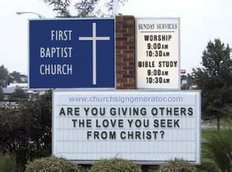
I was driving by a church yesterday and read a sign that contained the message in the picture at right. This is not a photo of the actual sign, but a simulation provided with the help of www.churchsigngenerator.com. A very entertaining site.
Well, what do you think is wrong with this picture, as it relates to what I’ve posted in the past about indicatives and imperatives?
1. Q. Which part of this sign’s question falls into the category of indicative?
A. ” . . . the love you seek from Christ”
2. Q. Which part falls into that of imperative?
A. “Are you giving others the love . . . “
3. Q. Which idea logically precedes the other?
A. The Imperative precedes the Indicative in this sign, which signifies that our obedience earns God’s love.
4. Q. Does this order of concepts constitute Biblical Christianity?
A. No, Biblical Christianity is constituted by God’s indicatives calling for our response in obedience to the imperatives.
The basic message of this sign is “God promises to give his love to those who will love others the way he promises to love them.” Or more starkly, if that’s possible, “If you love others the way you want Christ to love you, then you’ll earn the right for Christ to love you.” That’s an imperative-driven indicative.
Now many Christians will drive by and accept this clumslily worded message as a challenge to love others. If you asked them, they would affirm that they didn’t earn God’s love, but the truth has fallen on such hard times, that they don’t see any theological error in the sentiment on the sign. Christians today believe love is more important than truth. That’s why they see no value in taking signs like this to task for the “abstract, irrelevant” theology. Although they’ve learned that the theologically correct idea is that they don’t deserve God’s love, they live as if they can earn it by doing something for God. That’s the kind of preaching that’s most popular today. It goes largely unrecognized because it’s never put this frankly. But anytime you hear a preacher major on some command of Scripture and then work his way from the command to Scripture’s promises of God’s grace, he is preaching salvation by works, no matter what he calls it.
The Biblical order, once again, class, is that Christians who’ve received God’s grace are to respond in grateful love to God’s grace by obeying his commands to love others. Since I don’t have time now to spell out a laundry list of Scripture let my mantra suffice, “We love because he first loved us. (1 John 4:19; read the whole paragraph from verse 13-21 and you’ll need little other Scriptural proof of my assertions)”
Okay, gotta go. Remember, God has loved those of you who believe because Christ earned righteousness for you and then traded it with you for your sin. He did what you couldn’t and then suffered what you should’ve so you wouldn’t have to and also so that he can share with you the reward he, and he alone, deserves. Now once this truth hits you, you should feel grateful and love this person who gave his life for you on the cross so that you could live. He says, if you love me, keep my commandments. He commands us to love others. Therefore, the sign should read something like this:
“Are you giving others the love Christ gave you?”
Now that’s an indicative-driven imperative!

Theological and Doxological Meditation #8
Decretal Modes

Q. How doth God execute his decrees?
A. God executeth his decrees
in the works of creation and providence.
Let All Things Now Living (click title to play)
#125, The Trinity Hymnal (© 1990)
Let all things now living
a song of thanks giving
to God the Creator
triumphantly raise,
who fashioned and made us,
protected and stayed us,
who guides us and leads to
the end of our days.
His banners are o’er us,
his light goes before us,
a pillar of fire
shining forth in the night,
’til shadows have vanished
and darkness is banished,
as forward we travel
from light into light.
His law he enforces:
the stars in their courses,
the sun in its orbit,
obediently shine;
the hills and the mountains,
the rivers and fountains,
the deeps of the ocean
proclaim him divine.
We too should be voicing
our love and rejoicing,
with glad adoration
a song let us raise,
’til all things now living
unite in thanksgiving
to God in the highest,
hosanna and praise!
Theological and Doxological Meditation #7
The Decrees of God
Q. What are the decrees of God?
A. The decrees of God are his eternal purpose, according to the counsel of his will, whereby, for his own glory, he hath fore-ordained whatsoever comes to pass (Ephesians 1:11).
Whate’er My God Ordains Is Right (click title to play)
#108, Trinity Hymnal (© 1990)
Samuel Rodigast, 1675
Whate’er my God ordains is right:
his holy will abideth;
I will be still whate’er he doth,
and follow where he guideth.
He is my God; though dark my road,
he holds me that I shall not fall:
wherefore to him I leave it all.
Whate’er my God ordains is right:
he never will deceive me;
he leads me by the proper path;
I know he will not leave me.
I take, content, what he hath sent;
his hand can turn my griefs away,
and patiently I wait his day.
Whate’er my God ordains is right:
though now this cup, in drinking,
may bitter seem to my faint heart,
I take it, all unshrinking.
My God is true; each morn anew
sweet comfort yet shall fill my heart,
and pain and sorrow shall depart.
Whate’er my God ordains is right:
here shall my stand be taken;
though sorrow, or death be mine,
yet am I not forsaken.
My Father’s care is round me there;
he holds me that I shall not fall:
and so to him I leave it all.
The Captain Headknowledge Biblical and Theological Journal: The Prodigal and the Patriarch
Genesis 33:1-4
And Jacob lifted up his eyes and looked, and behold, Esau was coming, and four hundred men with him. So he divided the children among Leah and Rachel and the two female servants. And he put the servants with their children in front, then Leah with her children, and Rachel and Joseph last of all. He himself went on before them, bowing himself to the ground seven times, until he came near to his brother.
But Esau ran to meet him and embraced him and fell on his neck and kissed him, and they wept.
Jacob returns, fearing an envious, hateful brother. The prodigal son returned to his father in humiliation and poverty and his brother envied his gracious reception by their father. The attitude of Esau anticipated by Jacob is similar to the attitude exhibited by the prodigal’s brother who stayed among the father’s household, neither seeking nor desiring his grace.
However, in the narrative featuring Jacob and Esau, the roles are reversed. The recipient of the covenant blessings is the one who left home and prospered, and now he returns in prodigal-like humility to Isaac’s hairy prodigal son who stayed home and only troubled his father’s house.
Esau surprised Jacob, as the father surprised the prodigal. But, more accurately, the prodigal receives the patriarch as he ought. Jesus’ parable was a story told to point out the hypocrisy of the religious who resent God’s gracious reconciliation with sinners. Moses’ account of Esau’s reconciliation with Jacob thus parallels the parable, for Jacob equated his acceptance by Esau with his acceptance by God whom he not only saw face to face, but prevailed in wrestling with for his blessing.
Although Esau was passed over in God’s election of his younger brother, he is the better of the reprobates of Jesus’ day who received the Lord’s rebuke for their envy of God’s grace toward sinners. Esau may have initially envied Jacob, but time moved Esau to relent and acknowledge God’s will for the patriarch Jacob.
God graciously receives sinners who come to him, regardless how distasteful those sinners may seem to the present residents of God’s covenantal community. As we have been forgiven, may we rejoice at others who receive God’s grace though everything about them tempts us to treat them as second-class citizens. God doesn’t need the consent of sinners he’s previously received to justify the wicked who come to him in faith and repentance, receiveing the signs of the covenant alongside them. If they don’t deserve God’s grace, neither do we.
Theological and Doxological Meditation #6
The Persons of God
Q. How many persons are there in the Godhead?
A.There are three persons in the Godhead,
the Father, the Son, and the Holy Ghost
(Matthew 28:19);
and these three are one God,
the same in substance,
equal in power and glory (1 John 5:7 KJV)
O God, We Praise Thee (click title to play)
#105, Trinity Hymnal (© 1990)
Te Deum, 4th Century
Translated in Tate and Brady’s Supplement to the New Version, 1708
Scottish Psalter, 1615
DUNDEE C.M.
O God, we praise thee; and confess
that thou the only Lord
and everlasting Father art,
by all the earth adored.
To thee all angels cry aloud;
to thee the pow’rs on high,
both cherubim and seraphim,
continually do cry.
O holy, holy, holy Lord,
whom heav’nly hosts obey,
the world is with the glory filled
of thy majestic ray.
Th’apostles’ glorious company
and prophets crowned with light,
with all he martyrs’ noble host ,
thy constant praise recite.
The holy church throughout the world,
O Lord, confesses thee,
that thou Eternal Father art,
of boundless majesty;
Thine honored, true and only Son;
and Holy Ghost, the Spring
of never-ceasing joy: O Christ,
of glory thou art King.
Reformation Sunday, 2004 — Part One
 October 31,2004, I had a rare privilege to give a Power Point presentation at Shady Grove Baptist Church on the life of Martin Luther and a short summary of the “Pillars of the Reformation,” the five “solas” which encircle Luther in the portrait to the right designed by David Jacks, owner of Theological Pursuits Bookstore, in Fort Worth, Texas. My thanks go to him for both this portrait and the burning bush logo I feature on this weblog (www.reformationshirts.com).
In the previous post you should see an icon which reads “Play This Audio Post.” This is the first few minutes of my 14 minute, 45 second long presentation. Unfortunately, I exceeded the limit of the post, so you’ll have to endure something of a cliffhanger until I regroup and record the rest of the presentation in a future post very soon, tomorrow, God willing.

The Law of Love
1 John 4:13-19 ESV
By this we know that we abide in him and he in us, because he has given us of his Spirit. And we have seen and testify that the Father has sent his Son to be the Savior of the world. Whoever confesses that Jesus is the Son of God, God abides in him, and he in God. So we have come to know and to believe the love that God has for us. God is love, and whoever abides in love abides in God, and God abides in him. By this is love perfected with us, so that we may have confidence for the day of judgment, because as he is so also are we in this world. There is no fear in love, but perfect love casts out fear. For fear has to do with punishment, and whoever fears has not been perfected in love. We love because he first loved us. If anyone says, “I love God,” and hates his brother, he is a liar; for he who does not love his brother whom he has seen cannot love God whom he has not seen. And this commandment we have from him: whoever loves God must also love his brother.
“Things that go together should never be separated”
It’s amazing how easy it is for us to separate Biblical teachings which ought to remain unified. In a sermon preached a few years ago, Dr. Jeffrey Bingham of Dallas Theological Seminary sought to show the unified relationship between truth and love in 2 John.
His introduction was very humorous. He talked about the fact that in life there are many things that (not exact quotes) “go together, and should never be separated.” First example, poverty and home ownership: “Once I became a home owner, companies I’d never even heard of began asking for my money; therefore, poverty and home ownership always go together.”
Dr. Bingham’s second illustrative example featured (this is a more exact quote): “Chocolate chip cookies and milk. It is wickedness of the deepest darkness (!) to have a chocolate chip cookie without a cold glass . . . of milk.” Then he went on to show the necessary unity and unbreakable link that must remain between the Biblical notions of “Truth and Love.” But that’s another story. The point of this posting is that in this passage from John’s first letter, loving God and loving others are inseparable. Love for others gives credence to our claim to love God.
But I wanted to highlight this concept from 1 John 4 because John wrote that “we love (others, in this context) because [God] first loved us.”
The Logical Order of Biblical Indicatives and Biblical Imperatives
Now, to switch gears, notice the logical order: first, God loved us; second, we love others (as evidence that we love God). The logical order is vital. This is what I called “Indicative” and “Imperative” in a past posting a couple of weeks ago. It is imperative to keep in mind that in biblical Christianity, the “indicative” always precedes the “imperative.” In other words, in biblical Christianity, the reason we work is because of what God did for us. If we have a concept of a God who loves us because of our work (placing “imperative” logically before “indicative”), then we are legalists. The book of Galatians is one of Paul’s great treatises written to distinquish biblical Christianity from legalism (Galatians 3:3). We don’t get God to do for us by doing for him, we do for him because he did for us; that’s why John wrote, “We love (God and others) because he first loved us.” This is the point John makes and this is the point of my concern that all application (the imperatives, or precepts or commands, of Scripture) should be made in preaching on the basis of the Gospel preached (The Indicative of indicatives), and not only preached as an evangelistic appeal directed toward unbelievers, but preached also to the believers as the foundation, reason and source of the particular application of each and every “practical and relevant” sermon. If application is preached as separate from the gospel, you have legalism. It’s not good enough to assume the listeners understand the foundation, it must be presented as a unified, package deal.
It is “wickedness of the deepest darkness” to preach application without explicitly basing it on the gospel.
Imperative comes from Indicative; application comes from gospel; “do” comes from “be.” Kind of like that old saying, “we sin because we are sinners.” Likewise, we walk in righteousness because we are righteous, not “we become righteous by walking in righteousness.” How did we become righteous? Righteousness was given to us by God as a free gift of his grace (Romans 1:17; 3:24).
Third Gear
John Wesley made his mark on Chrisitian theology by emphasizing that Christians ought, to weave in my own language, to perform the imperatives of Scripture, based either on the motive of fear of punishment or hope of reward. This is one of the distinctives of the Wesleyan form of Arminianism (God does his part, man does his part). In Wesley’s scheme, what do we have? Man working in order to get God to reward him and in order to keep God from punishing him. What did we call that in the earlier paragraph? Legalism! Imperative preceding Indicative. Earning salvation by my own works. What is the alternative?
Wesley was lifelong friends with fellow revivalist, George Whitefield. Now Whitefield was a Calvinist. The two agreed that while out publicly preaching they would not debate Calvinism vs. Arminianism. Naturally, they failed to maintain this bond, poor John just couldn’t help himself, but that’s beside the point. The point is, Calvinist theology (the system of doctrine the great Baptist preacher, Charles Spurgeon called, “another name for the gospel” or “biblical theology”), in other words, the teaching of Scripture is that the proper motive for obedience is gratitude. A few scriptural phrases: “faith without works is dead” “faith works by love” “if you love me, you will keep my commandments.” See? Imperative follows Indicative. We love (keep his commandments) because he first loved us. That’s why Paul wrote that grace and faith establish the Law rather than eliminate it (Romans 3:31).
And now, the real point
The reason I’m belaboring all of this is because it’s the theology that lies behind a song I wrote. I wanted to write a song about the Ten Commandments, but as I thought about it, it became my theology of Christian obedience to the Ten Commandments. “We Love God Because He First Loved Us.”
The Love Song © 2004, John Douglas Chitty
We love God because he first loved usby sending us his Son.
Jesus kept the Lord our God’s commands, by him the work was done.
Every day we break God’s Law in thought, word or in deed.
Jesus died and rose again for the forgiveness we need.
How do we give thanks to him? What did the Savior say?
Jesus said, “If you love me, my commandments you’ll obey.”
We love God because he first loved us, and our love is of this kind:
Jesus said, “You shall love the Lord your God with all your heart . . .
and with all your soul . . .
and with all your mind.”
You shall have no other gods before me.
You shall not bow down or serve carved images.
You shall not take the name of the Lord your God in vain.
Sanctify the Sabbath day and so rest in the Lord;
in six days God made the world, and rested on one more.
That’s not all the Savior said would praise the Lord above.
Jesus said, “Your neighbor, too, needs you to show your love.”
Give honor to your father, and at your mother’s knee.
And you shall not murder, nor commit adultery.
You shall not take away your neighbor’s belongings.
Neither lie about him, nor desire to have his things.
We love God because he first loved us by sending us his Son.
Jesus kept the Lord our God’s commands, by him the work was done.
Every day we break God’s Law in thought, word or in deed.
Jesus died and rose again for the forgiveness we need.
How do we give thanks to him? What did the Savior say?
Jesus said, “If you love me, my commandments you’ll obey.”
The Right Story
 “You can’t help nobody if you can’t tell ’em the right story.” Jack Cash, brother of Johnny Cash, as portrayed in Walk the Line (PG 13)
Every story is about fall and redemption in one way or another. There would be no plot if there were no problem to solve or conflict to resolve. The story of the entir human race is that of its fall and redemption. Your stroy is about your fall and your redemption. The mission of the church is to tell this story; to introduce the characters to the plot: they’ve fallen and they can’t get themselves up on their own, their problem is so bad, they can’t solve it themselves, they need Another to solve it for them, the conflict that has entered their life has killed them, and they need Another to return them to life.
Stories are often considered mere entertainment. And to be sure, the church in this Laodecian (Rev. 2) generation have caught on to the idea that entertainment will help them tell the Story. Even if at times they’re telling the right story, that of the fall of man into sin and the sinless Christ crucified and risen for sinners, they’ve wrapped it up in so much entertainment that many are in danger of overlooking the Gift because they’re so fascinated by the wrapping paper. If sinners are distracted from the Story by trappings geared toward appealing to their interests, or meeting their felt needs, the church can’t help them. At other times, the church forgets to get around to the Story at all because they’re so aware of all the other stories in the Bible. “Christians don’t need to hear the Story this week, they’ve already heard and believed and received it, now they need to hear what they need to do,” and thus the Story is placed on the shelf in the interest of relevance or practicality. But no matter how much they mean to help, they “can’t help nobody if [they ain’t tellin’ ’em] the right story.”
The church seeks to tell a story, but all too often it’s not the Story they were commissioned to tell (Matthew 28:19-20). Many times they tell their own story. A story about how they’ve picked themselve up by their own bootstraps, a story about what a great example they are. When this is the story they tell, the Holy Spirit won’t bring sinners to life, nor will he empower believers to serve. All applications and all examples, and all pastoral autobiography are not to stand alone. They are to be built on the firm foundation of the Story, explicitly told each week.
We’ve fallen into sin so there’s nothing we can do to redeem ourselves:
the sinless Christ was crucified because we are sinners who deserve to die;
Christ rose from the dead on the third day because God has accepted Christ’s death in the place of sinners who come to believe and repent of their sins;
saved sinners are called to be holy and to serve others, which brings them into conflict with the sin thay yet remains in their natures and they aren’t always able to be holy and serve others (Romans 7). . .
. . . that’s why the Story must remain on center stage: The Gospel is for Christians, too!
They must be reminded that even though they’ve been saved they still need to hear the Gospel addressed to them (1 John 1:9) to cleanse them so they can progress on the journey to glorification by way of sanctification (Proverbs 4:18).
When the preacher neglects to tell the church the right Story, he can’t help the church grow in grace.
Theological and Doxological Meditation #5
The Uniqueness of God
Q. Are there more Gods than one?
A. There is but one only (Deuteronomy 6:4),the living and true God (Jeremiah 10:10).
My God, How Wonderful Thou Art (right click title to play in a new tab)
#35 Trinity Hymnal (© 1990)
Frederick W. Faber, 1848; alt. 1961, 1990
My God, how wonderful thou art,
thy majesty how bright!
How beautiful thy mercy seat,
in depths of burning light!
Wondrous are thine eternal years,
O everlasting Lord,
by holy angels day and night
unceasingly adored!
O how I fear thee, living God,
with deepest, tend’rest fears,
and worship thee with trembling hope,
and penitential tears.
Yet I may love thee too, O Lord,
almighty as thou art;
for thou hast stooped to ask of me
the love of my poor heart.
No earthly father loves like thee,
no mother half so mild
bears and forbears, as thou hast done
with me, thy sinful child.
How wonderful, how beautiful,
the sight of thee will be,
thine endless wisdom, boundless pow’r,
and awesome purity!
Basic Doctrine Quiz
from The White Horse Inn radio show
The following questions are offered to demonstrate the deeply practical and relevant nature of theological study. Salvation is not conditioned on perfect coherence on every question, but hopefully these questions and answers will spur us to dig deeper to gain a fuller understanding of our Christian faith.
True or False
God and Christ
1. Jesus was God but only appeared to be human.
2. Jesus was the first of all God’s created beings.
3. Jesus had a human body and a divine soul.
4. In the Old Testament, God was known as the Father, in the New Testament, as the Son and after Pentecost, as the Holy Spirit.
5. Mary is the Mother of God.
6. God chooses people because he knows in advance that they will choose him.
Salvation
7. The only way we can be saved is by perfect conformity to the Law of God.
8. We are saved by grace after all that we can do.
9. I am saved because of my decision to accept Christ.
10. God is so sovereign he can change his mind.
11. The Bible teaches that there is an age of accountability, and children who die before they reach this age go to heaven because they are innocent.
12. If I die with unconfessed sin, I will not go to heaven.
13. The main motivation for holiness is fear of punishment and hope of reward.
14. God cannot hold someone guilty for the sins of another.
15. Justification is the process by which a person through faith in Christ and sorrow for his sins receives the gift of the Holy Spirit and so becomes a child of God.
16. God cannot require anything of us which cannot be performed.
17. True Christians believe in a literal interpretation of the Bible.
18. “God helps those who help themselves” is a sound biblical principle.
19. Though no one is perfect, God looks on the heart to see who really loves him.
Basic Doctrine Quiz Key
Preface
I suppose “basic” is misleading, but this quiz is geared to motivate us to deepen our understanding of theology. The spirit of this age cries for the “practical” which usually leads us to neglect the finer points of theology due to the apparent lack of immediate practical value. However, doctrine may be considered the most practical thing about Christianity for it is what we believe about God, Christ and his salvation that provides the starting point in our sanctification into the image of Christ. Merely learning good practical tips for successful living may help us have a more pleasant existence for now, but it doesn’t necessarily accomplish that inward moral transformation which God intends to work in us through the knowledge of God which is learned in his Word and illuminated by his Spirit. This idea is reflected in Rich Mullins’ tribute to the Apostle’s Creed called, “I Believe,” in which he sings, “I believe what I believe is what makes me what I am—I did not make it, no, it is making me—it is the very truth of God, not the invention of any man.” Indeed, the truth of God which we confess as his church is what makes us. As Moses gazed on God’s visible glory on the mountain and came away reflecting God’s glory himself, as we study, learn, meditate and apply God’s revelation of himself in Scripture, so will we come away reflecting a little more of the light of God’s glory in our thoughts, words and deeds.
You may notice that much of the material in the following explanations deal with historical facts rather than solely Scriptural citations. The reason for this is that the task of growing in the knowledge of God (“theology”) is not performed in a vacuum. The vital truths that define the Christian Faith were built on the foundation of the Apostles and Prophets, with Christ as the Cornerstone in the first century. As time has worn on, however, some of the hard questions raised by the faith once delivered to the saints have had to be wrestled with and the answers our forefathers in the Faith formulated provide valuable building materials on Scripture’s apostolic foundation. They likewise provide a means of the Holy Spirit’s work of illuminating the truth of Scripture to us through God’s gift to the church in the teaching ministry of our Pastors and teachers throughout history.
When Joseph finally saw his brothers bow before him in fulfillment of the dreams given him by God, and as the brothers were expressing their remorse for their past sins toward him, Joseph readily forgave them, explaining, “what you meant for evil, God meant for good.” This well describes the net effect of the theological controversies of the past. As false teachers rise and mislead the sheep, the true shepherds have to go back to the Scriptures and utilize the sharp minds they developed for the task in order to combat these heresies. Consequentially, the church as a whole gains a sharper understanding of the essential truths of the Faith. What the devil in the persons of the false teachers meant for evil, God meant for good, in causing his people to cling closer to his Word and grow more mature in the Faith. This is a never ending process which God continues to use to this day.
C.S. Lewis once wrote something to the effect that “the value of reading old books is not that they don’t make mistakes, they just don’t make the same mistakes we make.” Looking to the wisdom of those who’ve gone before us and examining it in the light of Scripture broadens our understanding. If we know where we’ve come from, we can better see where we are, and we can tell where we are going. Sometimes we find that we’ve strayed from the right path and thus we can learn how to correct our course. All for the glory of God and the good of his people.
1. Jesus was God but only appeared to be human. False! To answer true is to affirm Docetism. Scripture teaches that Jesus took on a true human nature in every respect but sin.
2. Jesus was the first of all God’s created beings. False! To answer true is to affirm Arianism. Scripture teaches that Christ existed eternally as God with the Father (John 1:1-2) and the Holy Spirit — the Arian heresy today exists in the Jehovah’s Witness doctrine of Christ.
3. Jesus had a human body and a divine soul. False! To answer true is to affirm Apollonarianism, which taught matter is associated with humanness, and spirit is associated with deity. Scripture teaches that Christ took on a true human nature, body and soul, in every respect but sin.)
4. In the Old Testament, God was known as the Father, in the New Testament, God was known as the Son, and after Pentecost, God is known as the Holy Spirit. False! To answer true is to affirm Modalism. This heresy taught that God was One Person operating in three modes of being; much like Clark Kent was never around when Superman was on the job. The God of Scripture is immutable; he never changes. God is eternally three Persons,not parts or modes of being, and one God. Today, Oneness Pentecostals perpetuate this heresy (even T.D. Jakes and Joel Osteen).
One of the best ways to conceive the Trinity goes like this:
· The FATHER is God, but the Father is NOT the Son or the Spirit;
· The SON is God, but the Son is NOT the Father or the Spirit;
· The SPIRIT is God, but the Spirit is NOT the Father or the Son.
5. Mary is the Mother of God. True! This title was originally coined in defense of the Deity of Christ against Nestorianism, not to promote the deity of Mary or presuming a role for her in mediating with her Son between sinners and the Father. Over the centuries all of the Roman Catholic “Mariolatry” (combination of “Mary” and “idolatry”) became associated with it, which explains why it fell out of favor during the Reformation.
Nestorianism taught the doctrine affirmed in the question: Christ only appeared to be human, because spirit is good, and flesh is bad. They thought a good God couldn’t truly become an evil physical person.
6. God chooses people because he knew in advance that they would choose him. False! To answer true is to affirm Arminianism, which denied faith was God’s gift, but which merits God’s election of the believer, having foreseen his choice to believe before time began, and ordaining accordingly. Most evangelicals believe this today. Scripture defines foreknowledge not as foreseeing a choice, but as his choosing to know a people in an intimate sense before time began, thus electing them according to his own purpose.)
7. The only way we can be saved is by perfect conformity to the Law of God. True! God judges according to works. By whose works will you be judged? Your own? If so, you will be condemned. God saves by grace when he imputes the works of Jesus Christ to whoever believes. Eternal life is obtained not by lessening the severity of God’s Law, but by perfectly fulfilling the Law’s demands. God’s Law not only demanded obedient works, but the satisfaction of God’s justice for broken Laws by the death of a substitute, which, of course, Christ also provided.
8. We are saved by grace after all that we can do. False! The source of this statement is the Book of Mormon, Second Nephi 25:23.
9. I am saved because of my decision to accept Christ. False! Based on the Dispensationalist error called by its critics, “Decisional Regeneration,” in which man’s nature is a trichotomy of body, soul, and spirit; the soul being unaffected by the Fall into sin, thus has the capacity to will to receive Christ and thus please God by faith although the body and spirit are bound as slaves to sin. Scripture teaches that man is a dichotomy of the material and immaterial which entirely fell into the bondage of sin and spiritual death, only resurrected by the grace of God, simultaneously bestowing regeneration and the gift of faith which may only then receive Christ freely offered in the Gospel.
10. God is so sovereign he can change his mind. False! God is so sovereign that he can will and do anything that is consistent with his nature which happens to be immutable (unchangeable).
11. The Bible teaches that there is an age of accountability, and children who die before they reach this age go to heaven because they are innocent, or “safe.” False! All people are sinful from their conception. Scripture nowhere explicitly nor implicitly teaches that accountability for sin is conditioned on one’s comprehension of his accountability for sin. Adam’s sin was imputed to all his descendants, thus all are accountable from conception. Infants get to heaven based on the free grace of God which bestows the faith to receive the benefits of redemption in Christ even before they can comprehend it. This fact does not imply whether all dying infants are elect, or only some. We must trust in God whose wisdom and sovereignty are always to be accounted just.
12. If I die with unconfessed sin I will not go to heaven. False! If this were true, no one would ever make it to heaven. Christ died for all of your sins. In Christ the believer has died to the condemnation of the Law and there is therefore no condemnation for those whoare in Christ.
13. The main motivation for punishment is fear of punishment and hope of reward. False! This idea is based on a quote from John Wesley. The motivation for holiness is grateful love for the grace freely given by God.
14. God cannot hold someone guilty for the sins of another. False! If God cannot hold Adam’s children as guilty for Adam’s sin, then God cannot hold believers in Christ as justified by his death.
15. Justification is the process by which a person by faith in Christ and sorrow for sin receives the gift of the Holy Spirit and so becomes a child of God. False! This is a direct quote of Kenneth Baker in his book, Fundamentals of Catholicism. Justification is an act of God’s free grace wherein God pardons all our sins and accepts us as righteous in his sight, only for the righteousness of Christ imputed to us, and received by faith alone.
16. God cannot require anything of us which cannot be performed. False! First, Pelagius (4th century) and later by Arminius and John Wesley. John Wesley became convinced of this false notion by reasoning from Matthew 5:48 (“be perfect, as your heavenly Father is perfect”) that if God commands us to be perfect, then we can be. There is a difference between natural ability (the functional capacity to do that which we choose to do, which all have, saved and lost), and moral ability (the capacity to do that which is consistent with our nature– outside of Christ and dead in sin, man doesn’t have the ability to obey God’s righteous commands, but he is held accountable for his sin all the same).
17. True Christians believe in a literal interpretation of the Bible. False! Scripture is interpreted according to the rules governing each particular type of literature contained in Scripture. Poetry and symbolic (apocalyptic) literature are not to be taken at the same kind of face value which historical narrative and didactic (teaching) literature is to be taken. This was originally called, “sensus literalis,” the sense of the words. Thanks to modern Dispensationalism, “literal” interpretation means that apocalyptic literature is to be interpreted on the same literalistic sense in which historical narrative is, as if “literal” means “anti-figurative.”
18. “God helps those who help themselves” is a sound biblical principle. False! This is a proverb of Benjamin Franklin’s Poor Richard’s Almanac. In a recent poll 66% of American Evangelicals thought this was a biblical quotation.
19. Though no one is perfect, God looks on the heart to see who really loves him. False! When God looks on our hearts he sees only sin. God doesn’t grade on a curve; sin must be punished. God saves those who believe based on the sinlessness in Christ’s heart alone! Jesus said our love is shown by our obedience to his commands (John 14:15; cf. Exodus 20:4); by this standard we all are exposed as sinners who don’t love God (or Jesus) nearly enough to do us any spiritual good toward our salvation.
The Main Thing . . . What Else? The Gospel
“For I delivered to you as of first importance what I also received: that Christ died for our sins in accordance with the Scriptures, 4 that he was buried, that he was raised on the third day in accordance with the Scriptures . . . ” 1 Corinthians 15:3-4
How easily Christians are diverted from a focus on the Gospel of Christ in favor of their favorite theological hobby-horse! I’ve had a few. I remember back when all I could find the motivation to read were book, tracts, booklets, articles on the superiority (and even divine inspiration) of the 1611 Authorized King James Version of the Bible (I even wrote a song about it!), many people with whom I’d discuss the issues would ask me, why is it that I hear you talk more about King James than Jesus? This is a question that is appropriate for all theology geeks like myself who allow the subject in which they’re most interested to move to the center of their minds and hearts while the cross of Christ and the power of his resurrection slip to the back burner. Even now that I’m a Calvinist, I try to keep in mind the place from where I came and recall how annoying are those theological bulldogs who viciously and unrelentingly know how to turn every conversation from the topic at hand to an argument over the sovereignty of God, election, reprobation, and predestination. Although, after becoming acclamated to the truth (I don’t mean those Calvinistic bulldogs were wrong, just annoying), I was discussing with one of my friends about this very topic, how that every Christian tradition has its favorite theological emphases that are distinctive of that particular tradition. My friend replied, “That’s what verifies the truth of Calvinism to me: all they care about is making sure the gospel is accurately preached; hence the concern for the sovereignty of God in salvation.”
In other words, it’s all about the Gospel. The Gospel is the center. The Gospel is the foundation. The Gospel is the source of the power. The Gospel is the agent of life in Christ. The Gospel is the basis of all practical application. The Gospel is the fulfillment of all prophecy. The Gospel is the Main Thing. Paul was right, “…that Christ died for our sins in accordance with the Scriptures, that he was buried, that he was raised again the third day in accordance with the Scriptures [is of first importance].”
That’s why I would like to recommend that you go to the website for Sovereign Grace ministries right now and discover a wonderful book that reminds us how to keep the Gospel the main thing. It’s called Living the Cross Centered Life by C. J. Mahaney. The title of this post is a link to the webpage advertising this book. I found an earlier edition of this book a couple of years ago. It’s a tiny book. But, boy, was it packed with mind-altering material. What kind of material was it? Simply a reminder that the source of power for living a Christian life is to stay focused on the Gospel all the time. Read about it, talk to yourself and others about it, sing about it, examine your behavior in the light of it, you name it.
Speaking of writing songs about favorite theological hobby-horses, here’s one I wrote about that which is of first importance. I call it The Corinthian Creed. It’s simply a summary of 1 Corinthians 15. This chapter is a proclamation of Christ’s resurrection, an apologetic defense of resurrection in general and even a sermon on the believer’s hope and motivation to persevere inspired by the resurrection. Hope it helps you grasp the truths of this vital New Testament chapter as writing it has done for me.
The Corinthian Creed
© 2005, John Douglas Chitty
We believe that Chirst died for our sins
according to the Scriptures;
That he was buried, that he was raised on the third day
according to the Scriptures.
Then he was seen by Peter,
then by all the Twelve;
after that he was seen by more than
five hundred brothers at once as well.
Then he was seen by James,
then by all the Apostles;
and last of all, he was seen by Paul,
as by one born out of due time.
chorus
We believe this is of first importance:
Christ died for our sins,
According to the Scriptures,
the third day, he rose again.
We believe in resurrection
because if the dead don’t rise,
our faith is vain,
we’re still in sin,
and lost is he who dies.
But Christ in fact is risen,
the firstfruits of the dead.
For as all die in Adam,
so all live in Christ, their Head.
Christ our King rose first,
so, when he comes, shall we,
for he must reign and conquer
till his last foe, Death’s, defeat!
repeat chorus
Why, then, do we suffer,
if the dead in Christ won’t rise?
If so, let us eat and drink,
for tomorrow we will die.
Do not be deceived,
wake up and do what’s right.
Do not go on sinning
like the ones who lack God’s light.
But someone will ask,
“What kind of bodies will arise?”
You fool! No seed, when planted, will grow
unless first it dies!
repeat chorus
We believe there is a natural body,
and one of the Spirit.
The natural body perishes,
sin’s curse is buried with it.
As Christ raised the third day,
at last in all his glory,
so will those who follow him
and trust the Gospel story.
Adam of the earth,
Jesus Christ of heaven.
As we’ve borne Adam’s image,
We will bear Christ’s image, even!
repeat chorus
We believe when Christ our King returns
all sleeping saints to waken,
we may not all sleep,
but all will gain a transformation.
So will come to pass
the saying that is written:
“Death is swallowed up in victory,” sin is finally smitten.
But thanks be to God,
through Christ, our Victory!
Be strengthened in his service,
knowing death won’t end the story!
We believe this is of first importance:
Christ died for our sins.
According to the Scriptures,
the third day he rose again!
How Not To Promote Your Church!
 Church Signs Make Me “Passionate”
This was the subject line of an email I once wrote to my Pastor back when the church was on the brink of the “greatest evangelistic opportunity” in church history. Yes, you remember, that was the year the “Passion of the Christ” came out. Anyway, the week before Easter (the movie was released on Ash Wednesday of that year) I was innocently driving down the road when this sore thumb of a church sign jumped out into the road and accosted me. Perhaps no one else noticed, but it really bothered me. It read: “Experience the Passion of the Christ this Easter.” Experience the Passion on Easter? I thought Christ experienced his “passion” on Good Friday? Well, anyway, that was the thought that rushed to my head to defend myself against this assault on my logic. Of course, forgetting that I’m a member of a Southern Baptist Church in the 21st Century, all I got in response to my statement was an explanation of how Christ wasn’t actually crucified on Friday, but rather on Wednesday . . . or was it Thursday? You know how it goes.
Anyway, this is just one humorous example of the emotional response church signs engender in me. What other kinds drive me nuts, you may ask? Well, look in your email software and open any list of good sayings of church signs that someone has sent you in the past, and one or all of those qualify. Besides insulting the intelligence of driversby, and diminishing the dignity of church in general, the more clever they try to be, the worse the effect, in my humble opinion.
Today I discovered a new one. Here’s how not to promote your church, or brag about your orthodoxy. I’m a 5 point Calvinist, and this sign still makes me nuts! If you want to know why, then post a comment to this post.
May Our Pastors Give Themselves to the Word of God and Prayer
 “When you come bring the cloak which I left at Troas with Carpus, and the books, especially the parchments.” 2 Timothy 4:13
As a theological “bibliophile,” I have found another quality post on another quality blog to recommend to you. J. Ligon Duncan, a renowned minister in the Presbyterian Church in America, has posted a solid challenge to deepen our pastors’ well from which the Holy Spirit may draw in order to use them to feed the sheep (which am us)! Go to blog.togetherforthegospel.org and read the February 13 post entitled, “Pastors-Studying and Reading 1.”
Theological and Doxological Meditation #4
The Nature of God
Q. What is God?
A. God is a Spirit (John 4:24), infinite (Job 11:7), eternal (Psalm 90:2), and unchangeable (James 1:17), in his being (Exodus 3:14), wisdom (Psalm 147:5), power (Revelation 4:8), holiness (Revelation 15:4), justice, goodness and truth (Exodus 34:6-7).
Holy, Holy, Holy! (right click title to play in a new tab)
#100, Trinity Hymnal (© 1990)
Reginald Heber, 1783-1826
Holy, holy, holy! Lord God Almighty!
Early in the morning our song shall rise to thee.
Holy, holy, holy! Merciful and mighty!
God in three Persons, blessed Trinity!
Holy, holy, holy! All the saints adore thee,
casting down their golden crowns around the glassy sea;
cherubim and seraphim falling down before thee,
who wert, and art, and evermore shalt be.
Holy, holy, holy! Though the darkness hide thee,
though the eye of sinful man thy glory may not see,
only thou art holy; there is none beside thee
perfect in pow’r, in love, and purity.
Holy, holy, holy! Lord God Almighty!
All thy works shall praise thy name in earth and sky and sea.
Holy, holy, holy! Merciful and mighty!
God in three Persons, blessed Trinity!


 The Misadventures of Captain Headknowledge