A Call to Believing Biblical Studies
On the Tuesday, February 17th edition of Dr. James White’s The Dividing Line webcast (here’s the link), he read a scathing review (read it here) of evangelical scholar Dr. J. Harold Greenlee’s, book, The Text of the New Testament, by Dr. J. K. Elliott of the University of Leeds, U. K. Dr. White takes this opportunity to demonstrate how that so often, secular scholars of Biblical Studies do not engage their evangelical counterparts with dispassionate scholarly restraint, simply answering their scholarship with superior argumentation, but rather tend to resort to ridicule and derision. This review prompted a veritable eruption from Dr. White, who, in the wake of his debate with agnostic Religious Studies professor, Dr. Bart Ehrman (his website) had already been considering this phenomenon, and apparently just needed to get it off his chest. Dr. White winds up calling on enthusiastic young Reformed scholars to consider entering the field of Biblical Studies, learning all the truthful facts that the secularist academics have to teach, but, as Dr. White said, “combining it with faith.”
This is exactly the kind of call I wish to see get out, so in the interest of doing so, I have transcribed Dr. White’s monologue below. My request to you is, if you know a Christian young man who may fit this profile, pass this message on to him, and I will be in your debt.
“I was really bothered . . . I read this review. And those of you who have the RSS Feed to the Evangelical Textual Criticism blog may have read it as well. This is a review by J. K. Elliott, of the University of Leeds in the U. K. of J. Harold Greenlee’s Text of the New Testament: From Manuscript to Modern Edition. Now, I do not have this edition of Greenlee–it’s on it’s way, it’ll probably arrive today–but this is an update of the books I do have, and that was his original work on textual criticism, which then became updated I think in the eighties or nineties, to Scribes, Scrolls and Scripture, and now has a new name with Hendricksen’s publishers.
“There are things that are said by Elliott in this–I want to check them out and make sure they’re accurate–I don’t have any reason to question that they are. For example, he goes after Greenlee for a bad Scripture Index. I understand how that happens, especially if you’re updating an older book. I can understand how Scripture Index issues can arise, to be perfectly honest with you. And some of the other statements he makes here, I would take some issue with Greenlee on, but I want you to listen to the voice of modern scholarship.
“This bothers me. . . and I hope it will bother you as much, because it really has prompted me to do a lot of thinking about how to avoid the irrationality of those who are scared of scholarship. . . And who are afraid of tackling truth. Dan Wallace has a good point: he talks about people who are more desirous of having certainty than of having the truth. And I’ve met many people who are very certain of untruths. So I don’t want to go there. But, at the same time, I don’t want to be J. K. Elliott. Listen to what he says. I’m just reading two paragraphs. This is from his review–this is from SBL. The Society of Biblical Literature. This is the RBL of January of 2009, so this is brand new. . . .
“One of his ways to answer readers’ concerns is to offer palliative platitudes. Among such pacifying remarks are “The great majority of textual variants involve little or no difference in meaning” (83), and “The vast majority of the most theologically significant passages of the New Testament have no significant textual variations” (117), a blatantly unsustainable assertion that tests the gullibility of the readership. Also to be endured are his quoting Bengel’s pabulum that “the variations between the manuscripts did not shake any article of evangelical doctrine” (76) and his repeating Sir Frederic Kenyon’s words “we have in our hands, in substantial integrity, the veritable Word of God” (120), despite his not drawing attention to the unsettling get-out phrase “in substantial [i.e., not complete] integrity.” The fact that the majority of the text is secure may well be true, but what disturbs conservative readers is not the total percentage of variants that are insignificant as regards matters theological but that minority of readings that are indeed theologically important. More on these below.
“Another means used to placate the fundamentalists is to appeal to divine protection of the text. Surprisingly, in a book by a respected academic, is his appeal on more than one occasion to the Holy Spirit (although why the index has a reference to the Holy Spirit on 46–47 eludes this reviewer). On page 37 we do find: “we believe that the Holy Spirit guided the authors of the New Testament books so that their message would be protected from error” and “We likewise believe that the Holy Spirit operated providentially in the copying and preservation of the MSS through the centuries.” Oh! That is not the sort of presupposition one would find in works of textual criticism of the Greek or Latin classics or of other ancient literature. Nor is it warranted here. In any case, such a view is a hostage to fortune—the vast quantity of textual variants is hardly suggestive of providential preservation. It were better had Greenlee avoided such peculiar obiter dicta. Even Greenlee himself tells us in a prelude to a description of scribal habits that “we should not think that it was only by supernatural preservation that the New Testament was kept from being lost or hopelessly confused during those centuries” (37) Perversely, Greenlee allows (103) that Mark’s original ending has been lost. Mainly, though, Greenlee is concerned to show how the frail human agency of scribal copying resulted in accidental and deliberate change (and even he points to places such as 1 Thess 2:7 and 1 Cor 13:3 [!] where he is not certain which reading came from the “inspired” biblical author).”
“Now–ahem–listening to this was like chewing on aluminum foil for me. Here is someone who is, indeed, speaking the presuppositions of the modern Academy, represented by Bart Ehrman. It is not an argument to mock a position. It would be better to provide a meaningful interaction. But we do need to understand that this is the language of the modern Academy. Now I’ve never figured out why people who don’t believe in the inspiration of the Bible would spend their time studying the Bible, but there are a lot of people who do.
“Just a couple of things. He identifies as ‘pacifying remarks’, the statement, ‘the vast majority of textual variants involve little or no difference in meaning.’ I don’t know how many times I’ve heard Bart Ehrman say that. That is not even a disputable assertion. Given that the largest textual variant in the New Testament–and I don’t mean largest as in number of verses–but the most number of times this textual variant comes up–has to do with the “movable NU (watch this how to video on the movable NU).” The movable NU does not impact meaning. So, that’s a fact. How is that a pacifying thing? Or are we just not supposed to mention that? Does J. K. Elliot so live in the realm of variation that he can’t admit these facts?
Then the next quote: “The vast majority of the most theologically significant passages in the New Testament have no significant textual variation. Okay. I’ve got to agree with Elliott on that one. I wouldn’t say it that way. He says, “A blatantly unsustainable assertion that tests the gullibility of the readership.” I think Elliott is following Ehrman in his book review methodology, here, to be perfectly honest with you. But I wouldn’t say that. I think that there– any theologically significant is going to have either minor or major textual variation in it. Most of it is going to be minor . . . But the things that bug me– he identifies Bengel’s statement as “pabulum.”
If a conservative were writing about someone else–a liberal, they would be dismissed for this kind of clearly biased presentation. It’s amazing! But then, here’s what really hit me. . . .
“Another means used to ‘placate the fundamentalists.” That’s just bias. That’s bigotry. That’s prejudice. “To placate the fundamentalist” is to appear. . . face it folks, if you wanted to “placate the fundamentalists,” you’d be using the King James Version of the Bible, and you wouldn’t be writing the stuff that Greenlee’s writing in the first place! Trust me, I know!
“Another means used to placate the fundamentalist is to appeal to divine protection of the text.” See, it’s as if that can’t even be a possibility. It’s not even allowed on the table now. But how do you keep it off the table? You just mock the people who don’t believe it. You don’t argue against it. You don’t demonstrate any type of consistent worldview that would give you a reason for doing that. You just simply dismiss it. That’s how liberalism works, folks; it’s how it works in politics, that’s how it works in religion. That’s how it works in our seminaries. And this is what’s coming into the seminaries. This is the kind of attitude that’s producing the kind of literature that’s out there today.
“I think what we’ve got to realize is, we’ve got a bunch of unbelievers who have hijacked the “leading edge” of this discipline, and we need to start identifying that. What that also means is, those who are believers, who, by the work of the Spirit in their heart, have had the rebellion against God’s Word removed, and, I believe, a part of regeneration, a part of the change of the heart, is to cause a person to bow the knee before God’s Speech; before God’s Word.
“The men of old who have changed this world have been people who gave clear evidence of obedience to the Word of God. And those in whose lives the Spirit has moved in that way, I challenge you, I plead with you: if you’re a young man and you feel called to the ministry, you feel called to study, I challenge the young men of this generation–go into this field. Learn what these people have to say, yes, but don’t imitate their unbelief. Take the truth that they say, yes, but combine it with faith, and begin providing the kind of believing scholarship that goes beyond the circularity–I submit to you, secular humanism is no foundation for dealing with God’s universe–it will always result in the stunted viewpoints that we see in a Bart Ehrman. It can give us no reason for life, no reason to get up in the morning and do what is right. I call upon those young people, as you go into this field, don’t just dodge this, don’t dodge this area, dive into it in trust and faith that God’s Word is true, and let’s begin producing a kind of believing Biblical Studies. We have so much given the field over to the unbelievers, so they can say, “Look at all we write. We run SBL, and we do this and we do that.”
“There is such danger when the Christian Academy is so in love with the acceptance of the world that we are no longer willing to stand up and say, “I operate under the Lordship of Christ; you operate under the Lordship of your own mind. You are a rebel against Christ.” And that simply isn’t allowed in the Academy any longer. I hope there’s some listening right now, I know young Reformed men, they have a lot of zeal, they have a lot of desire. They desire to learn, they desire to study. I call you. Give consideration. Do you want to be a scholar? Do you want to teach? I’m not saying it’s going to be easy. You’re going to have to go against the flow. Anybody who believes in the Lordship of Christ, anyone who believes God is their Creator today has to go against the flow. But we need good, sound scholarship being produced out there. I’m not saying lower the level of scholarship, I’m saying go to a higher level of scholarship. Because I say to you, to do scholarship under the Lordship of Christ is the highest calling. To do scholarship under the lordship of Secular Humanism is not a high calling. We need to delve into this area and “give an answer for the hope that’s within us.”
The Denomination Blues
In case you don’t know, I’m a music lover. And although I decidedly come down on the “traditional” side in the worship wars (in fact, I just got my “Organ Music Rocks” t-shirt from Old Lutheran dot com!), I happen to enjoy some of the music produced by some of those who may differ with me on that issue, I just happen to reserve it “for entertainment purposes only”. Not that I don’t find it edifying as well, at times.
For instance, when it comes to Southern Gospel music, there is very little that I can stand for very long. One or two songs and I’m pretty well done. Any more than that, and I start getting visibly uncomfortable. But not so in the case of Reformed Presbyterian harmonica player extraordinaire, Buddy Greene (visit his official site). I could listen to him all day. I just added a few YouTube videos of Greene excercising his gift to my personal YouTube page (you can visit it here). The first song is “Denomination Blues” (no harmonica in this one) and he pokes fun at a few select denominations, starting with his own (even false churches like Roman Catholicism and Unitarianism). But I was surprised that he didn’t have a verse on the Baptist denomination. If you can write a good one in the vein of Buddy Greene’s song, post it in the comments. I’ll add mine when I come up with one, too.
Here’s one where he pulls out his harmonica. It’s one of my all-time favorite songs, “God Is With Us.” This has more of a black gospel feel to it:
Dad Rod on Repentance
Lutheran professor of Systematic Theology and Christian Apologetics, Dr. Rod Rosenbladt, co-host of The White Horse Inn radio show, was interviewed yesterday,
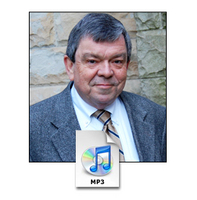
Rod is rad, he's our dad!
Thursday, February 4th, on “Lutheran Public Radio,” a show called Issues, Etc. on the topic of repentance. Dr. Rosenbladt’s WHI co-hosts, Mike Horton and Kim Riddlebarger, began calling him “Dad Rod,” chiefly, I think, because it was his sense of urgency that American Evangelicalism needs to be reintroduced to the gospel, that drives the vision of their show. Among other things, revivalism has transformed American Protestant Christianity into something more akin to the medieval Roman Catholic spirituality and Anabaptistic enthusiasm (don’t ignore this link!) than anything produced by the Protestant Reformation of the Magisterial Reformers, Martin Luther, John Calvin and Ulrich Zwingli. One of the things that revivalism has “De-formed” in America is the doctrine of repentance.
The revivalist version of the doctrine of repentance is one which puts all the emphasis on the work of the believer to be sorry or contrite enough, really mean it when he repents, and shows that he’s really repented because he has actually ceased and desisted of any recurrence of the particular sinful behavior repented of. “Dad Rod” clearly and simply summarized the Reformation view of repentance from the believer’s perspective when he said . . .
“Our repentance is always imperfect and always half-hearted. . . This is preparation for believing the gospel promise (of forgiveness). . . and we do that half-heartedly, too. But God saves us in Jesus anyway.”
If you didn’t just breathe a sigh of relief, watch out! You may just be one of those dishonest people who thinks they’ve got this obedience to the Law thing down.
By the way, you can learn more pearls of wisdom from our Lutheran Dad Rod at his very own website, New Reformation Press.
Misadventures in Dutch
Shortly after Angel Contrares finished drawing the new and improved Captain Headknowledge portrait, featuring John Calvin

The "Calvijn Glossy"
wearing Superman’s colors (see this post), and he posted it on his Facebook page, and I copied it with his permission and uploaded it to my Facebook page as well as adding it to the sidebar here, I got a surprising Facebook message from a lady in the Netherlands saying she works for a “glossy” (that’s apparently Dutch for magazine) that is planning to celebrate John Calvin’s 500th birthday (see this, that and the other post), featuring, in part, ways that Calvin is being celebrated around the world. Now, I may be mistaken, but I thought the glossy lady said she’d mail me a copy of the magazine, but I’ve yet to see it; however, I just peeked at the “Calvijnglossy” website and noticed that they’ve posted their collection of “Calvijn” images on the site. You can check it out here. Then you can click on the Captain’s image and see a full-size copy of it here.
Kinda fun, huh? I’ve never been published overseas before. Or is that Angel? Anyway, happy birthday to John “Calvijn”!
Did the Bible Misquote Jesus?
Back in 2005, Dr. Bart D. Ehrman wrote Misquoting Jesus: The Story Behind Who Changed the Bible And Why, and it became a bestseller. Ehrman’s works are often appealed to by the skeptical in the media to undermine the traditional, orthodox view of Scripture. A Princeton grad, Ehrman studied under the leading light Bruce Metzger, with whom I’m familiar because when he was alive he so often appeared in programs produced by Evangelicals in defense of the reliability of the New Testament, although he himself ran in the circles of the theologically liberal. Ehrman was originally a student at Moody Bible Institute, but began to lose his faith in the preservation of Scripture, then the inspiration of Scripture, and now I think he has even become an agnostic.
Last week, Reformed Baptist elder and Christian apologist James White faced off with Dr. Ehrman in a debate on the claims of his book. You can read a little about the debate here, and you can purchase the debate for $15.00 on CD here, and for $6.00 on mp3 here. Sometimes you have to listen fast, but it’s well worth the effort. While Ehrman seems to hold his own pretty well, later, on White’s webcast, The Dividing Line (haven’t found the link to the program yet), he points out how much of Ehrman’s defense is based on the logical fallacy of appeal to authority, which authority, of course, would be Ehrman’s own credentials. You gotta check this out, and pass the info on to those who spend too much time listening uncritically to the History Channel and the Discovery Channel and other popular forms of skepticism in the media.
The Political Conservative’s Obama-Era Survival Pack
I know many theological and political conservative Christian Republicans (as well as those to their right) are grieving the loss to their dream of rebuilding this “Christian nation.” They’re keeping a stiff upper lip as they say good-bye to the out-going evangelical President George Walker Bush, and endure, not without some respect for the historical nature of the event, the election, and now, inauguration of the first African-American President, Barak Hussein Obama. Hard times are coming to the evangelical dream of “taking America back” for Christ, but things are going well for the pluralistic civil religion.
During the next four to eight years, it may serve you well to think through a little more carefully just what is the Christian’s relationship to his government. What vision ought he to have for his nation? Should it be forced into the mold of Old Testament Israel, should a Christian theocracy be established, or are we to forswear all participation in the public square, and stop polishing the brass on the sinking ship of America?
I submit that a firmer grasp on the classical Christian distinction between what Augustine called the City of God and the City of  Man is in order. How is the Christian to live as citizens of the City of God without molding it into the image of the City of Man, and vice versa? This week’s episode of the White Horse Inn, “The City of God,” will tell you. You can read Michael Horton’s intro to the program here. Also, I found particularly helpful and interesting the programs on “Christianity and Politics,” part one and part two, in which, back in September, Dr. Horton interviewed D.G. Hart (author of A Secular Faith: Why Christianity Favors the Separation of Church & State), Dan Bryant (former Republican Assistant Attorney General for the Department of Justice) and Neil McBride (a strategist for the Democratic Party). Their introductions can likewise be read here.
I think learning a little more about what the Bible really expects of Christian citizens will help us all cope while the party who beat us in the last election has their turn at the helm of the ship of state. We, and our country, might just be the better for it. 
Riddlebarger on the Necessity of Church Discipline
I just wanted to post my “Amen!” to Dr. Kim Riddlebarger’s recent post which emphasizes the logical conclusion of an absence of church discipline.
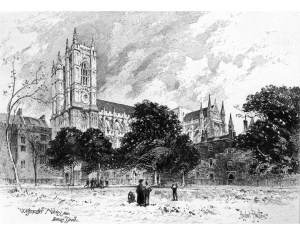
Westminster Abbey, thanks to reformationart.com
In chapter 30 of the Westminster Confession of Faith, “Of Church Censures,” a good summary of the biblical case for church discipline is outlined.
I. The Lord Jesus, as king and head of His Church, has therein appointed a government, in the hand of Church officers, distinct from the civil magistrate. (Isaiah 9:6-7; 1 Timothy 5:17; 1 Thessalonians 5:12; Acts 20:17-18; Hebrews 13:7, 17, 24; 1 Corinthians 12:28; Matthew 28:18-24)
II. To these officers the keys of the kingdom of heaven are committed; by virtue whereof, they have power, respectively, to retain, and remit sins; to shut that kingdom against the impenitent, both by the Word, and censures; and to open it unto penitent sinners, by the ministry of the Gospel; and by absolution from censures, as occasion shall require. (Matthew 16:19; 18:17-18; John 20:21-23; 2 Corinthians 2:6-8 )
III. Church censures are necessary, for the reclaiming and gaining of offending brethres, for deterring of others from the like offenses, for purging out of that leaven which might infect the whole lump, for vindicating the honor of Christ, and the holy profession of the Gospel, and for preventing the wrath of God, which might justly fall upon the Church, if they should suffer His covenant, and the seals thereof, to be profaned by notorious and obstinate offenders. (1 Corinthians 5; 1 Timothy 5:20; Matthew 7:6; 1 Timothy 1:20; 1 Corinthians 11:27-34; Jude 23)
IV. For the better attaining of these ends, the officers of the Church are to proceed by admonition; suspension from the sacrament of the Lord’s Supper for a season; and by excommunication from the Church; according to the nature of the crime, and demerit of the person. (1 Thessalonians 5:12; 2 Thessalonians 3:6, 14-15; 1 Corinthians 5:4, 13; Matthew 18:17; Titus 3:10).
Labels, Labels, Labels!
 Many Christians decry the use of “labels” to identify one’s distinctive beliefs and/or practices. I find this attitude intellectually
  dishonest. Everyone’s belief and practice, or approach to determining his own autonomous belief and practice, is learned either consciously or unconciously from some prior group’s or individual’s belief and practice. Being able to identify these is not some attack on the unity we have in Christ, but when used with a good and accepting attitude, it’s a way to know your brother or sister in Christ. And if you know your friend, you can love him better.
My personal attitude about labels can be likened to the way all you sports fans out there view your teams. Sure, there’s a little competition between teams, and maybe an animated discussion about your team’s strengths and the other teams’ weaknesses, but it’s all in fun. That’s the attitude I like to retain about our various distinctives. Everyone should just relax, and have a good time in the Lord, for cryin’ out loud!
Anyway, I bring all of this up simply to introduce one of R. Scott Clark’s entries in his live blogging of the Calvin’s Legacy Conference from Westminster Seminary California. Dr. Clark answers a question about the difference between the labels “Calvinist” and “Reformed.” You can read his interesting answer here. ” But in the meantime, he shares some history that reveals the origin and significance of other labels like “Lutheran,” “Evangelical,” and “Protestant.” It’s a good, short read.
 Now all you guys who admit to your own labels, remember to play fair! 🙂 If you like what you read, there’s plenty more where that came from. You can subscribe to the Calvin’s Legacy Conference RSS Feed and it’ll come to you, you won’t have to go get it!
(Deaf) & Dumb?
My wife and I teach a third & fourth grade Sunday School class at my local church.  Yesterday, it was my week to teach the lesson, which concerned the birth of John the Baptist and the prophecy of Zechariah from Luke 1:57-80. So having explained the activity in verses 59-63, where the neighbors and relatives assume the infant will be named after his father, and Elizabeth tells them his name is John “And they made signs to his father, inquiring what he wanted him to be called. And he asked for a writing tablet and wrote, ‘His name is John.’ And they all wondered” (vv. 62-63), one of my students immediately raised his hand and asked, “If his only problem was that he couldn’t speak, then why did they have to use sign language to talk to him?”
(gulp)?
Did you ever wonder about that? It never once crossed my mind. Are you as smart as a third grader?
Today, I looked it up at the online ESV Study Bible. Here’s what I learned.
They made signs to his father indicates that Zechariah was deaf as well as mute, or else they would simply have spoken to him (see note on v. 22). This is confirmed by the people’s amazement (v. 63) that he chose the same name as Elizabeth chose, something that would not have been surprising if he had been able to hear her.
So naturally I also checked out the note at verse 22, which explicitly states that Zechariah was “mute”. Here’s what that note reveals:
Mute (Gk. kōphos) can mean either “mute” or “deaf,” depending on the context, and there is some evidence that it can at times mean “deaf and mute” (see note on vv. 62-63).
So, once again, you learn something new every day. Are you smarter than a third grader? I’m not!
Live Blogging 3
for more info on this conference see: http://kimriddlebarger.squarespace.com/the-latest-post/2009/1/8/a-video-conference-on-eschatology-and-live-blogging-of-a-wes.html and follow the links.
10:41AM
Wow! New term from Voythress: protology–the study of first things, as opposed to eschatology, the study of last things. Stick that in your theological glossary.
Waldron’s now affirming that eschatology comes before soteriology in Scripture. Think Gen. 3.
Riddlebarger explained that a regenerate believer is not taken to the condition Adam was in before the fall, but that he is redeemed to the state Adam would have been in, had he been confirmed in righteousness, having succeeded in obeying the command to not eat the forbidden fruit.
Notes on Gaffin’s comments on “Get the Garden right, get Christ right.”1 Cor. 15 Resurrection hope of the church. Christ compares resurrected Christ with Adam before the fall. vs. 45, 47, Christ called the “Second Man.” The deepest perspective Paul provides on redemptive history. There’s no one between Adam, the first and Christ, the Second. Noah, Abraham, Moses, David are below the horizon of Paul’s concern in this chapter, Christ is literally the “eschatological one.” When you understand who Christ is as the esc. Adam, then everything else between Adam and Christ in redemptive history must fit into that.
Poythress: Both kinds of imagery are in Rev. 22. 22:1 shows a final garden, heightened from the original (Gen.3) and the language of the Bride of Christ. Here you have a connection of both “bridal and garden” in Gen 2.
Eph. 5:28ff . . . Was Eve typological of the Church in this passage? Riddlebarger says simply “clearly [she is]” but that he wouldn’t press it too far. Missed Waldron’s reply, but Poythress says there’s a comparison with Eve. Waldron asked if this connection somehow contributes to Mariology? I don’t get it. Anyone out there have a comment?
11:00AM
Moving on to questions about the competing attitudes about the world between dispensationalism and covenantal theology. Should we be optimistic about the success of the gospel, or pessimistic about any need to “polish the brass on a sinking ship?”
Gaffin speaks to the application of this question to suffering. We can be confident that Christ is now healing (I think he said healing) the earth with the gospel. References Mark 10:29-30. Promise of blessings with persecution to followers of Christ. References some passage in the “T books.” With many tribulations we must enter the kingdom of God. Opposition to the gospel results in suffering. There is a positive role of suffering in the church–“filling up the sufferings of Christ”
A short plug for Last Things First: Unlocking Genesis with the Christ of Eschatology.”
Poythress suspects that a hundred years ago, amillers didn’t have Vos’ and Gaffin’s “already/not yet” structure. This is optimistic in a way older amillers didn’t have the benefit of. Christ’s Body is the first fruits of the new heavens and earth. If we participate in that, it’s a spiritual optimism, looking forward to that which is yet to come.
Riddlebarger: the charge that amillers are pessimistic was made by Bahnsen. That amil is escapist like premil, says Bahnsen. Post mil Bahnsen would define optimism/pessimism differently. No economic, cultural, religious transformation before the Return. Optimistic about what God does through Ministry of the Word and administration of the sacraments. Not pessimistic about the gospel, but about human institutions.
Poythress believes it all will be thoroghly transformed in the new heavens and new earth. Amils aren’t giving up on transformation of the world, but don’t expect it until after the consummation. No guarantee to be successful in worldly terms, but should try to think and act Christianly in our worldly context. A Christianized society is not the atmosphere of the New Testament.
Waldron argues for optimism about the spread of the gospel. Optimistic about what? Matt. 16, Lk 13 parable of mustard seed teaches growth of gospel. Mt. 16 shows the church thoroughly on the attack, not under attack by Satan. (?) The gates of hell won’t prevail against the spread of the gospel. Parable of weeds show that good and evil grow together until the end. Not good to emphasize that as good grows, evil shrinks, or vice versa, but that they grow concurrently until the Return of Christ.
11:16AM
Ezk. 40-48 When does a biblical theology of the millennial Temple begin, and what does it look like?
Waldron: Doesn’t teach reinstitution of Old Testament ceremonial, sacrifical system in the Millennial Age.
Riddlebarger: see Beale’s book on the Temple. Hard to unlearn the wooden literal, dispensational interpretation. But it undercuts the beauty of what God is describing.
Poythress: The Temple theme is present by implication in the Garden of Eden. God communes with Adam and Eve as he does with Israel in the Temple. Jacob at Bethel–no physical structure, but a mediation of the presence of God is the point. Ezk. Temple is symbolic of God’s communion with his people. It shouldn’t be astonishing that John 2 indicates that Jesus spoke of his own body in speaking of the Temple. A vision is not a photograph. The Temple is the medium for speaking these concepts of mediated communion with God. You can’t dictate the details of final realities by looking at the type. The reality always exceeds the type.
Barcellos: Angels ascending, descending on the Son of Man?
Poythress: Seen carefully, the Son of Man is the ladder, a mediator between heaven and earth.
Gaffin: Related to the larger question of the biblical theology of the Temple, as you look at Ez 40-48 in its visionary and prophetic character, that whole chunk focuses on what Christ said about whatever promises held out in Old Testament Scriptures, they have their Amen (fulfillment) in Christ. 1 Cor. 3:9–We’re God’s fellow-workers, you’re God’s field/building. Is this an arbitrary connection? It’s a reference to the Garden (field) and the building (New Jerusalem). The New Jerusalem is a consummated Garden of Eden.
(Wow!jdc)
11:30
Supersuccessionism/Replacement theology:
Waldron: The idea that amil says the church replaces Israel as the people of God. It’s a pejorative label.
Poythress: Not replacement, but fulfillment. Christ is the true Israel (Matt. 2). Israel the Son in a subordinate sense. Jesus the heir of the promises made to both Abraham and David. Gal. 3:16 argues that Gentiles and Jews alike participate in these promises. If Christ’s, Abraham’s offspring–heirs according to promise. Jews don’t cease to participate in the promise, but the Gentiles are included. Jewish disbelief is what gets them cut off the tree (Rom 11).
Riddlebarger: Is OT “Judeocentric”? I’m unashamedly a Christian and not a Jew. But I’m reading the OT looking for Christ. Isa 53 and related passages are clear if looking for Christ in the OT.
Gaffin: What is OT Israel typological of? Israel’s God’s chosen Son. Christ is the true Israel. Every promise given to Israel has its focus in Christ and his work. Acts 1:6 asks a Jewish oriented question about the Kingdom of God. Jesus corrects the terms of the question. It’s not is Kingdom being restored to Israel, but will Israel be restored to the Kingdom? In Rom 9-11, Paul sets terms at beginning. 9:6 who is Israel? Not all Israel are Israel, but those who believe, whether Jew or Gentile. Gaffin accepts term supersession in sense of fulfillment not replacement.
Waldron: If Christianity is not the fulfillment of the Old Testament, then what is Christianity?
Poythress: Gal. 4 Jerusalem above is free. She’s our mother. Isa 54 about the expansion of the people of God. Christ is the heir and if you’re in Christ, then you’re the heir. Gal. 3 means you can’t divide Christ into eschatological and political.
Gotta bug out early, but here’s plenty to chew on. Hope some of my notes make sense.
Live Blogging TCTE, part 2
10:29AM
Dr. Poythress advises that the question of the millennium is complex, because it does not simply deal with the interpretation of Revelation 20 alone, but involves “a large swath of Old Testament” prophetic Scriptures.
Pastor Waldron’s emphasizes that little progress is made by Amillennialists in saying that they affirm a “literal interpretation.” This makes sense to me because there is a gap in understanding between Dispensationalists and Covenant theologians about what it means to interpret Scripture literally. The term “literal” was coined by Luther in the Latin phrase “sensus literalis” which means “the sense of the words” not “anti-figurative sense everywhere possible, regardless of the rules of the given type of literature in question.”
10:35AM
Helpful sound byte from Dr. Gaffin: “Soteriology is eschatological, and eschatology is soteriological.” The first coming of Christ inaugurates the “last things.”
Live Blogging “Then Comes the End”
Forgive my amateurish first attempt at live blogging, but I’m following online a web conference called “Then Comes the End” put on by the Midwest Center for Theological Studies.
It’s 10:15AM central time, and the host is just introducing the participants and waiting for others to log in, I suppose. So far, we’ve got Dr. Vern Poytress, R. Gaffin and Dr. Sam Waldron, and will have Dr. Kim Riddlebarger.
Some of us viewers had a little fun in the chat room early on, but we were cleared and summarily instructed to reserve our comments for questions to the professors.
more to come . . .
Rest, Renew, Rely

Living the Cross Centered Life by CJ Mahaney
I loaned my copy of C. J. Mahaney’s incredible book,
Living the Cross-Centered Life, to a co-worker who is a young believer trying to grow out of a severly sinful lifestyle. Bemoaning his lack of reading comprehension at times, he asked me what Mahaney meant when he wrote somewhere in the book (I haven’t seen the quote) something to the effect of, “even though I’m living in the flesh, I choose to live by faith.” Unclear as he was to the meaning of this statement, I told him I could only guess that the author meant that he was not going to rely on his own moral fortitude to be godly, but he was going to rely on God’s grace to empower him to obey his commands. He asked me to write something down about that, and the following is what came out of that effort. Hope you find it edifying, if not instructive in any way.
Rest in the Gospel–The Right Basis
The basis for your acceptance by God is the active and passive obedience of Christ. His active obedience is his 33 years of sinless obedience by which he earned eternal life for you; his passive obedience is his suffering and death on the cross, facing for you the consequences of your sin. Therefore, the basis for your acceptance by God is not your behavior. If the basis of your acceptance by God was your behavior, then you would be trying to earn some reward from God and you would be trying to avoid some punishment from God. The right motive for your behavior as a Christian is gratitude for Christ’s work for you.
Renew Your Gratitude–The Right Motive
Fear of punishment and hope of reward is the wrong motive for your behavior as a Christian; gratitude for Christ’s work is the right motive for your behavior as a Christian. Gratitude is what you feel when you are given a gift. When you earn what you have, you’re only thankful to yourself, and that’s not what glorifies God. Both the basis of your acceptance by God, the gospel of Christ’s death and resurrection, and your response characterized by grateful behavior are given to you freely by God’s grace, not procured by your own strength.
Rely on Grace–The Right Source
Grace is not a force like electricity which makes our appliances work, it’s God’s good attitude toward you based on his satisfaction with the obedience and death of his Son, the Lord Jesus Christ. When you successfully resist temptation, and successfully obey his commands, he has granted this success to you as a gift of his gracious disposition toward you because of Christ.
What’s in the Captain’s iPod This Week?
I don’t see anybody doing this anymore, but now that I’ve got an iPod, I thought I’d take a stab from time to time at promoting some of my favorite sources of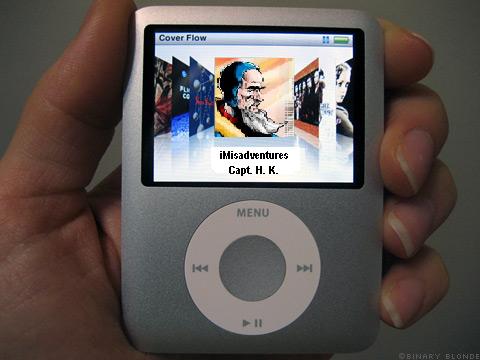 Reformed broadcasting and webcasting. This way, all the “True Believers”* out there can listen to what Captain Headknowledge listens to, too!
White Horse Inn, “Christ In a Post-Christian Culture”
Reformed Forum, “The Reformed Media Review #3”
The Dividing Line, “20090102” (James takes calls and continues his discussion of KJVOnlyism)
Dr. J. Ligon Duncan, “Communion in God’s Providence“ (Luke 1:39-45 morning sermon Dec. 28 at FPC, Jackson, MS)
Hymns of the Faith, “Rejoice the Lord is King“ (FPC, Jackson pastors, Ligon Duncan and Derek Thomas discuss with Bill Wymand(?) the music, theology and history related to the hymn which serves as the title of this episode)
Dr. Phil Ryken, “From Futility to Glory“ (Dr. Ryken of Tenth Presbyterian Church, Philadelphia, PA, preaches from the text Romans 8:20-21)
Dr. Hamp Linehan, “The Faithfulness of God” (Dr. Linehan, pastor of First Baptist Church, Richland Hills, TX, preaches the last of his eleven-sermon series, “The Living and True God”)
Rev. Tom Browning, “Who For Us and Our Salvation He Came Down“ (The Assistant Pastor of Grace Community Presbyterian Church, Fort Worth, TX, preaches from John 1:1-14).
* For those of you who didn’t grow up reading Marvel Comics, “True Believer” is what Marvel Comics founder Stan Lee calls his readers, so, no, I’m not questioning the salvation of those of you who don’t follow my blog regularly.


 The Misadventures of Captain Headknowledge