Memoir of the Rev. John Brown, Part 11

John Brown’s Self-Interpreting Bible (1859)
The Character of John Brown
Among the things which obviously claim our attention in the character of Mr. Brown, we must not pass over the astonishing extent of his scholastic acquirements. Though possessed of no very considerable fund of originality, his capabilities for the acquisition of almost every species of literary knowledge was such, that he outran most of all his contemporaries, though possessing every advantage of a regular education, and that from their infancy. Ordinary attainments, whether in languages or science, could by no means satisfy the ardour of his inquisitive mind. With a memory strongly retentive, a solid and discriminating judgment, and an inflexible and persevering assiduity, with the blessing of God on his labours, he acquired and secured an uncommon share with which, from a child, he had cultivated a very particular acquaintance, so that he could repeat almost every text, and state its meaning and connexion. His feet were early turned into the paths of wisdom. Apprehended by the grace of God while his mind was yet young and tender, he made choice of his law as the rule of his life, and solemnly devoted himself to his service. In prayer, public, secret, or domestic, he overstepped the rules of almost any prescribed routine; even amid the ordinary business of life, the breathings of his soul were continually breaking forth in ejaculations of gratitude and praise, particularly while composing, or committing his discourses to memory. He possessed such an habitual evenness of temper, that hopes realized or disappointed seemed neither to elate nor greatly depress his spirits. He lived always conscious of God’s presence, and as one who had learned to lay down the sinful suspicion that men by nature have of Him. On hearing a peal of thunder he remarked, “that is the low whisper of my God.” His Christian Journal, which presents a good index of the general tone of his mind, bears this inscription, “The soul that is ever attentive to God never hears a voice that speaks not to Him; the soul, whose eye is intent on Him, never sees an atom, in which she does not discern the face of her best beloved.” He was scarcely ever seen to weep, unless it were from the impressions of divine truth on his own heart, or compassion for perishing souls. Bodily pain, or the death of relatives, he suffered without a tear; but when warning sinners to flee from the wrath to come, and, in Christ’s stead, entreating and beseeching them to be reconciled to God, his heart got frequently too big for utterance.
Theological & Doxological Meditation #49
 Second Commandment: Worship the Right God the Right Way
49. Q. Which is the second commandment?
A. The second commandment is,
Thou shalt not make unto thee any graven image,
or any likeness of anything that is in heaven above,
or that is in the earth beneath,
or that is in the water under the earth:
thou shalt not bow down thyself to them, nor serve them:
for I the Lord thy God am a jealous God,
visiting the iniquity of the fathers upon the children
unto the third and fourth generation of them that hate me;
and showing mercy unto thousands of them that love me, and keep my commandments.
(Exodus 20:4-6; Deuteronomy 5:8-10)
All Praise to God, Who Reigns Above
#4, The Trinity Hymnal (©1990)
Johann J. Schutz, 1675
Tr. by Frances E. Cox, 1864
MIT FREUDEN ZART 8.7.8.7.8.8.7.
Bohemian Brethren’s Gesangbuch, 1566
All praise to God, who reigns above, the God of all creation,
The God of wonders, pow’r and love, the God of our salvation!
With healing balm my soul he fills, the God who every sorrow stills.
To God all praise and glory!
What God’s almighty pow’r hath made his gracious mercy keepeth;
By morning dawn or evening shade his watchful eye ne’er sleepeth;
Within the kingdom of his might, lo, all is just and all is right.
To God all praise and glory!
I cried to him in time of need: Lord God, O hear my calling!
For death he gave me life indeed and kept my feet from falling.
For this my thanks shall endless be; O thank him, thank our God with me.
To God all praise and glory!
The Lord forsaketh not his flock, his chosen generation:
He is their refuge and their rock, their peace and their salvation.
As with a mother’s tender hand he leads his own, his chosen band.
To God all praise and glory!
Ye who confess Christ’s holy name, to God give praise and glory!
Ye who the Father’s pow’r proclaim, to God give praise and glory!
All idols underfoot be trod, the Lord is God! The Lord is God!
To God all praise and glory!
Then come before his presence now and banish fear and sadness;
To your Redeemer pay your vow and sing with joy and gladness:
Though great distress my soul befell, the Lord, my God, did all things well.
To God all praise and glory!
American National Election Studies Quantify Anti-Christian Hostility

- UNT Sociologist George Yancey writes for Christianity Today on ANES.
Affluent, influential white progressives have been found to be the largest group with measurable hostility against politically conservative Christians, and they find repressing their right to free exercise of their religion acceptable if it means granting new rights to tiny minority groups who behave in ways contrary to biblical Christian beliefs and practices.
“Well, anti-Christian hostility is certainly real, captured by the American National Election Studies, which include questions about animosity toward various social groups. About third of respondents rated conservative Christians significantly lower (by at least one standard deviation) than other religious and racial groups.
The only group to fare worse was atheists, who received low rankings from nearly half the respondents. But while atheists drew more global hostility than any other group, the negative rankings for conservative Christians came from a disproportionate number of white, highly educated, politically progressive, and wealthy respondents.”
It’s amazing how shapers of American public opinion are so willing to hold such an unconstitutional view.
Congress shall make no law respecting an establishment of religion, or prohibiting the free exercise thereof; or abridging the freedom of speech, or of the press; or the right of the people peaceably to assemble, and to petition the Government for a redress of grievances. – See more at: http://constitution.findlaw.com/amendment1.html#sthash.TGO0MTsV.dpuf
Read “What Christianophobia Looks Like in America,” by George Yancey in Christianity Today magazine.
Creeds Before Deeds
 Here’s an absurd logical conclusion to the idea that Christianity is primarily moral and only secondarily doctrinal.
“And without faith it is impossible to please him, for whoever would draw near to God must believe that he exists and that he rewards those who seek him.” (Hebrews 11:6)
Read: Minister Who Denies God’s Existence: I Don’t Appreciate Being Told I’m Not a Christian
Michael Card on an “Informed Imagination”
Promoting his Biblical Imagination series of books and CDs, Michael Card (one of my favorites) discusses how a quote by his late mentor, William Lane, regarding “informed imagination” lead him to investigate what Scripture might have to say about such a concept, and concludes it is the bridge between the head and the heart. “Head” people being the argumentative doctrinal people, while “heart” people are appropriately experiential, yet tend to not do their homework. Where head and heart converge is what Michael Card believes constitutes an “informed imagination.” I’ll have to do something with that one day.
Pop-Apologetics and Biblical Archaeology
I am of two opinions regarding Patterns of Evidence: The Exodus by Evangelical filmmaker Timothy Mahoney. A product of his crisis of faith upon learning of the lack of archaeological evidence for the biblical Exodus event, I see Mahoney’s documentary as popularizing the contrarian view of two British scholars regarding the standard chronology of Egypt’s history. I also see it as demonstrating the weakness of what is known as evidential apologetics. On the other hand, there is a place for giving the consensus of skeptical scholarship a run for its money.
That’s exactly what this film tries to do. It was promoted on politically conservative talk shows, like that of my personal favorite, the Roman Catholic Bill Bennett (listen here), and two Jewish conservative pundits are featured in Mahoney’s work: Michael Medved debates a Rabbi who denies the historicity of the Exodus account in the documentary, and Dennis Prager steals the show on a typical Fox News panel lead by Fox personality Gretchen Carlson. Fox religion analyst Father Jonathan Morris, female evangelist Anne Graham Lotz and pop-scholar and humorist Eric Metaxas round out the panel. This panel seems stacked specifically for the purpose of briefing the viewers on the apologetic virtues of challenging the consensus, while admitting the lack of conclusiveness in the alternative view presented. Supportive statements by evidentialist apologist Norman Geisler and Archaeological Study Bible editor Walter Kaiser further embolden the apologetic appeal of the documentary.
John Bimson and David Rohl have been challenging the status quo on the chronology of Egypt for years. Bimson’s work reaches as far back as 1978, when his book Redating the Exodus “proposed that the end of the Middle Bronze Age provides the best matching evidence for the biblical Conquest and that the dates assigned to this period should be substantially revised.” His day job is that of Old Testament Ph.D. Tutor at Trinity College in Bristol, England.
Egyptologist and Author David Rohl’s work is much more recent. His books contain disputed claims that counter the consensus on the chronology of ancient Egypt and Palestine. He’s also produced a TV documentary called Pharaohs and Kings: A Biblical Quest. Much is made of Rohl’s agnosticism, intended to lend credibility to his controversial work.
In his documentary, Timothy Mahoney first of all appeals to the notion that real science looks for patterns of evidence, hence the title, and portrays six stages of Israel’s time in Egypt as the pattern which must be watched for in the Egyptian chronology. If I recall correctly, these stages are Arrival, Multiplication, Slavery, Judgment, Exodus and Conquest (I’m a terrible note-taker!). The consensus view is that Israel resided in Egypt during the era known as the New Kingdom (circa 1550-1069 BC—comprising the 18th-20th Egyptian dynasties). A primary reason for this era being supported by the consensus is the fact that Raamses reigned during this era, and one of the store cities Scripture says the Israelites built is called by his name. “Therefore they set taskmasters over them to afflict them with heavy burdens. They built for Pharaoh store cities, Pithom and Raamses” (Exodus 1:11b). The problem is, this pattern of events in the biblical account of Israel in Egypt has not been uncovered in the New Kingdom excavations.
Bimson and Rohl counter that the Scriptural name for the city is an anachronism because it was the name of the city at the time of the writing of the book of Exodus, rather than the actual name of the city the Israelites in fact built. The later name, they assert, would have been given to help the original readers of Exodus to locate the city. Plausible enough. They also look to impressive findings which date back to the Middle Kingdom (circa 2125-1773 BC). The ancient city of Avaris is chief among these findings. The site where the city of Raamses was excavated, which Scripture states the Israelites built, contains no evidence of Semitic peoples living there. However, the Middle Kingdom city of Avaris was dug up under the New Kingdom city of Raamses. In this lower site, artifacts and structures reflecting Syro-Palestinian culture are found. There is even a tomb which Bimson and Rohl and others suggest may have been the tomb of Joseph for various compelling and dramatic reasons.
Appeal is made to a document called the Ipuwer Papyrus, which contains writings which Egyptologists conclude is referring to the destruction of Memphis during the Old Kingdom, but wishful thinking Bible believers want to believe is an account of the plagues which preceded the Exodus. A number of other similar finds which predate the New Kingdom which most skeptical and believing scholars believe is the legitimate time of the biblical Exodus are pointed to as being consistent with each of the six stages of Israel’s Egyptian residency.
Don’t get me wrong. I do believe the biblical account of Israel’s stay in Egypt is historical. I do believe they were enslaved, that there were plagues which judged the gods of Egypt and that the Israelites indeed engaged in an exodus, a forty year sojourn in the wilderness and the conquest of Canaan. I am simply suspicious of efforts like this to popularize contrarian views which attempt to find positive evidence of every major event in Scripture. While it is true that much evidence consistent with the Old Testament’s historical narratives has been found, not everything has. I am persuaded that what has been found is sufficient to make a legitimate case for the historicity of the Bible in general, and even sufficient enough that we can trust that events like the Exodus truly happened despite the lack of tangible evidence. Such may indeed surface one day, but we must not rush to judgment about every superficial similarity and make more out of the evidence than may legitimately be made. The point is, our faith in the historicity of the Bible should not rest finally on the ground of sufficient archaeological evidence. It should rest on the self-attesting unity of the books of the Bible as an anthology of writings by various authors writing centuries apart from each other, which yet brought together reveal the history of God’s covenantal relationship with and redemption of his chosen people, those who share the faith of their father Abraham, a unity and consistency of which the Holy Spirit bears witness in our hearts (1 Corinthians 2).
To be sure, scholarly consensus deserves to be questioned. That’s what keeps the experts accountable and honest. But I’m not so sure the best means of doing so is by following every contrarian position that comes down the pike just for the sake of having a reason to dispute the status quo of scholarship. Scripture is sufficient to demonstrate its historicity and its inspiration. Evidence is nice, but insufficient and unnecessary. Like scientific theories, interpretations of archaeological evidence are subject to change, and one is wise to not put his faith in the sufficiency of evidence, but rather receive by faith the Scriptures for what they are, the Word of God. This is what the apostle Paul affirms in 1 Thessalonians 2:13 when he writes, “And we also thank God constantly for this, that when you received the word of God, which you heard from us, you accepted it not as the word of men but as what it really is, the word of God, which is at work in you believers.”
Public Service Announcement

The Missus has been very good to me this year!
Villainous theology ruining your Christmas? Call the Genevan Help Line!
genevanhelpline@gmail.com
I’m from Geneva, and I’m here to help!
Westminster West–Texas, that is!
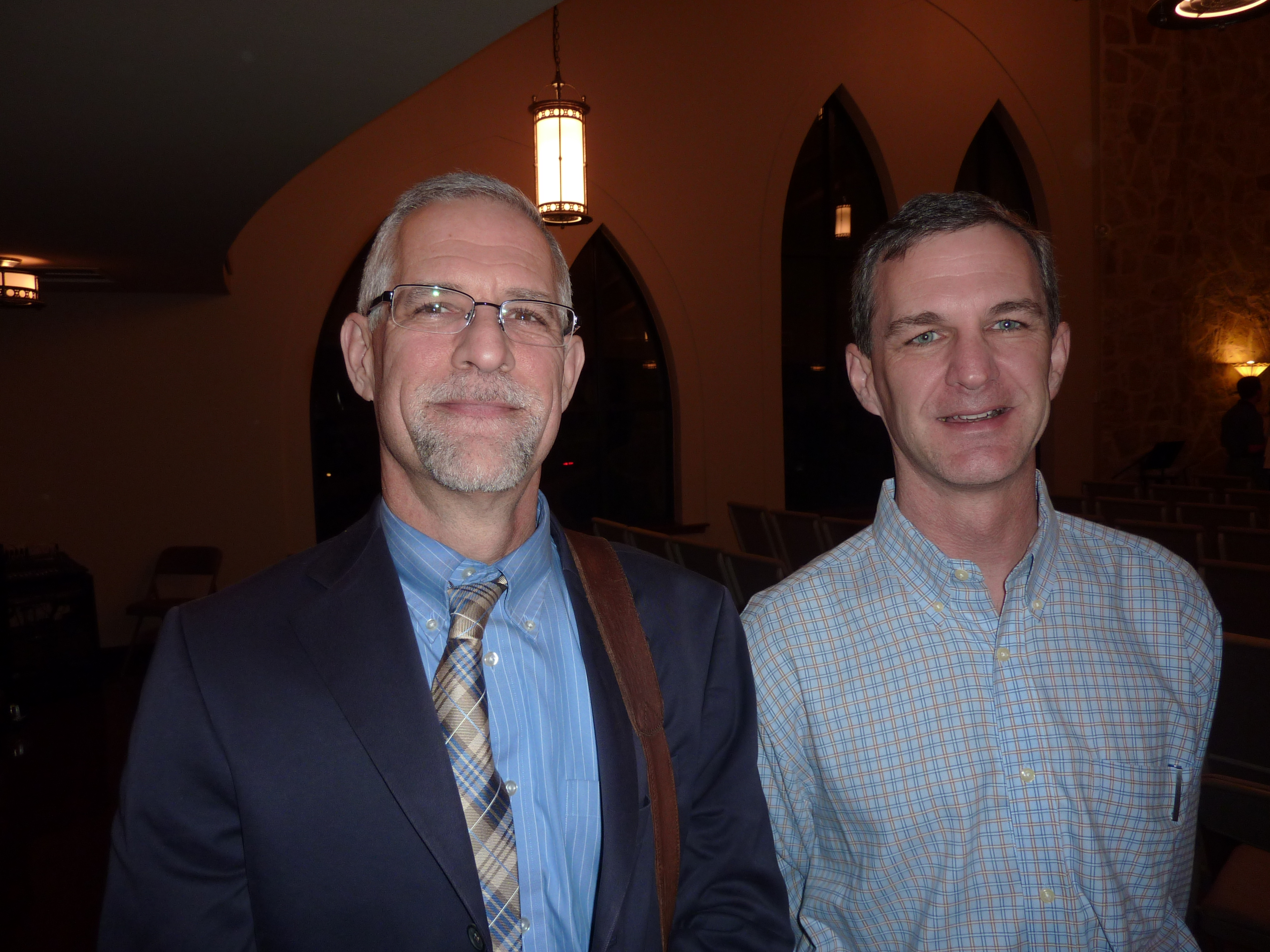
K. Scott and Kyle Oliphint
Congratulations to Rev. Jeremy Boothby, the newly ordained and installed pastor of Christ Covenant OPC in Amarillo, Texas. This is a sister church in my church’s Presbytery of the Southwest, which facilitates the connectedness of our Orthodox Presbyterian congregations located in Texas, Oklahoma and New Mexico. Last Friday was the day of the installation service, where Drs. Lane Tipton and K. Scott Oliphint both spoke. Amarillo is the hometown of Dr. Oliphint, along with his brother, Rev. Kyle Oliphint, who is now pastor of Grace Community PCA on the north side of Fort Worth, near Keller, Texas. I decided to post this playlist because I knew there would be a few of you out there who just have to see Lane Tipton and Scott Oliphint doing what they do. I can’t say that I blame you. The videos are courtesy of Pastor Andrew Moody of San Antonio Reformed Church. Don’t let the YouTube channel confuse you, the events in the videos take place in Amarillo, even though they are posted by a guy from San Antonio.
I got to know Pastor Boothby when my wife and I were counselors at camp down in Leakey, Texas. Jeremy and I led a team of campers in putting together a skit featuring the camp’s theme. Jeremy had the idea to imitate those commercials with the guy sitting at a table asking a group of kids “Which is better?” in which hilarity ensued. We had a unique combination of personalities on our team, which gave us some good “Kids Say the Darnedest Things” moments. I also got to see what a capable athlete he was on the basketball court, which I suppose is why I commented on the video of the newly installed Pastor Boothby giving his first real live benediction that his smile looks like he’s repressing the urge to dance in the end zone or something. I wish I could find those camp pictures but we’ve been slowly transferring files from an old computer to a new one and I haven’t been able to locate them, not even on our Carbonite account. If I find them soon, maybe I’ll update the post.
May Pastor Jeremy Boothby enjoy many fruitful and happy years pastoring Christ Covenant OPC in Amarillo, Texas!
Tullian Brings Reformed Gospel to TBN

The Daily Evangel: A subliminal reminder to preach the gospel to yourself every day.
I guess it had to happen someday. Turns out it did this past summer. Megachurch pastors tend to accept invitations to places where there are TV cameras, and that’s exactly what happened in this case. Tullian’s message of “radical grace” has reached the first family of the Trinity Broadcasting Network. While in many ways, this is an example of worlds colliding, I figure if Peter Lillback can accept an invitation to Glenn Beck’s TV show a few years ago with the intention of making sure the gospel is clearly communicated on his air, then why not Tullian on TBN? The world’s largest Christian television network could do a lot worse, and has built an empire on doing just that.
For those unaware, Tullian Tchividjian is the grandson of Billy Graham and the pastor of Coral Ridge Presbyterian Church in Ft. Lauderdale, Florida. He is a favorite among the New Calvinists and is notorious for his popularization of the Lutheranesque “law-gospel distinction” which is taken by many to his right, myself included, as repeating the mistakes of historic antinomianism in some of his rhetoric and in his application of the otherwise valid hermeneutic pioneered by the Protestant Reformer. Among Tullian’s influences are Steve Brown (RTS Orlando and Key Life) and the theologians associated with Modern Reformation magazine and The White Horse Inn radio show. While I believe Tullian when he says he affirms the Reformed teaching on the third use of the law , I also believe his critics when they say his rhetoric smacks too much of historic antinomianism (read about that here). Tullian’s intention is to minister to those burned by legalism, and I’m all for that, even if he may be pushing the envelope of Reformed theology further to the left than I think he should.
But I like Tullian in small doses. Few and far between. It has been a while since my last dose of Tullian, so I am prepared to have a good attitude about his appearance on TBN to promote his recent book One Way Love. Besides, it would be inconsistent of me to criticize him for accepting an invitation to speak on Word of Faith turf, since the seeds of Reformed theology were planted in my own mind when Michael Horton appeared on TBN to promote his very first book originally entitled Mission Accomplished (now Putting Amazing Back Into Grace) while still a student at the Bible Institute of Los Angeles (BIOLA). The difference between Horton’s and Tullian’s appearances is that the latter they post on YouTube, while the former they immediately erase, cancel the talk show that featured him, and have the host reassigned to a job behind the scenes. This reaction was due to the fact that Horton was a known critic of the Word of Faith heresy who would go on to edit The Agony of Deceit. My hope is that Tullian’s interview will likewise plant and water the seeds of Reformed theology and the true gospel of Christ among today’s regular TBN viewers.
While Tullian admits to being a one-sermon preacher, his message that Christ kept the law perfectly and earned eternal life for those who believe and so frees us to gratefully, though imperfectly, respond to his amazing grace with love toward our neighbors is one we need to be reminded of on a daily basis. In fact, it is this “preach the gospel to yourself daily” notion that motivated me to put “Daily Evangel” on the building in the background of my picture of Captain Headknowledge. We need the Evangel of the free grace of God in Christ every day, and may it spur us on to love and good works, though we’ll never do them as well as Jesus did them for us.
Reformation Creeds for Today — OPC DFW RefCon 2014 Audio & Picture Gallery
The audio of Dr. Carl Trueman’s three lectures at OPC DFW Reformation Conference 2014 hosted by Mid-Cities Presbyterian Church on Friday, October 10 through Saturday, October 11 are now available on the church’s website. Here are the links to the lecutures:
Why Creeds are Biblical (Friday, October 10, 7 PM)
Survey of Creeds from the Reformation (Saturday, October 11, 9:30 AM)
Usefulness of Creeds for Today (Saturday, October 11, 11:00 AM)
Download and share the above audio files and share as you please.
OPC DFW Reformation Conference 2014 Photo Gallery

A few members of Mid-Cities OPC enjoy lunch with Dr. Trueman on Friday at Spring Creek Barbeque in Bedford, Texas.

A few members of Mid-Cities OPC enjoy lunch with Dr. Trueman on Friday at Spring Creek Barbeque in Bedford, Texas.

Dr. Carl Trueman speaks with a friend of Mid-Cities OPC.

Daughter of Pastor Joe Troutman puts a smile on all of our faces as she enjoys a bowl of ice cream. With Dr. Trueman (left), and her mother, Jennifer (right).

Yours truly poses with Dr. Trueman, while Pastor Troutman’s daughter photo bombs us!

Group portrait of Mid-Cities OPC lunch with Dr. Carl Trueman at Spring Creek Barbeque.
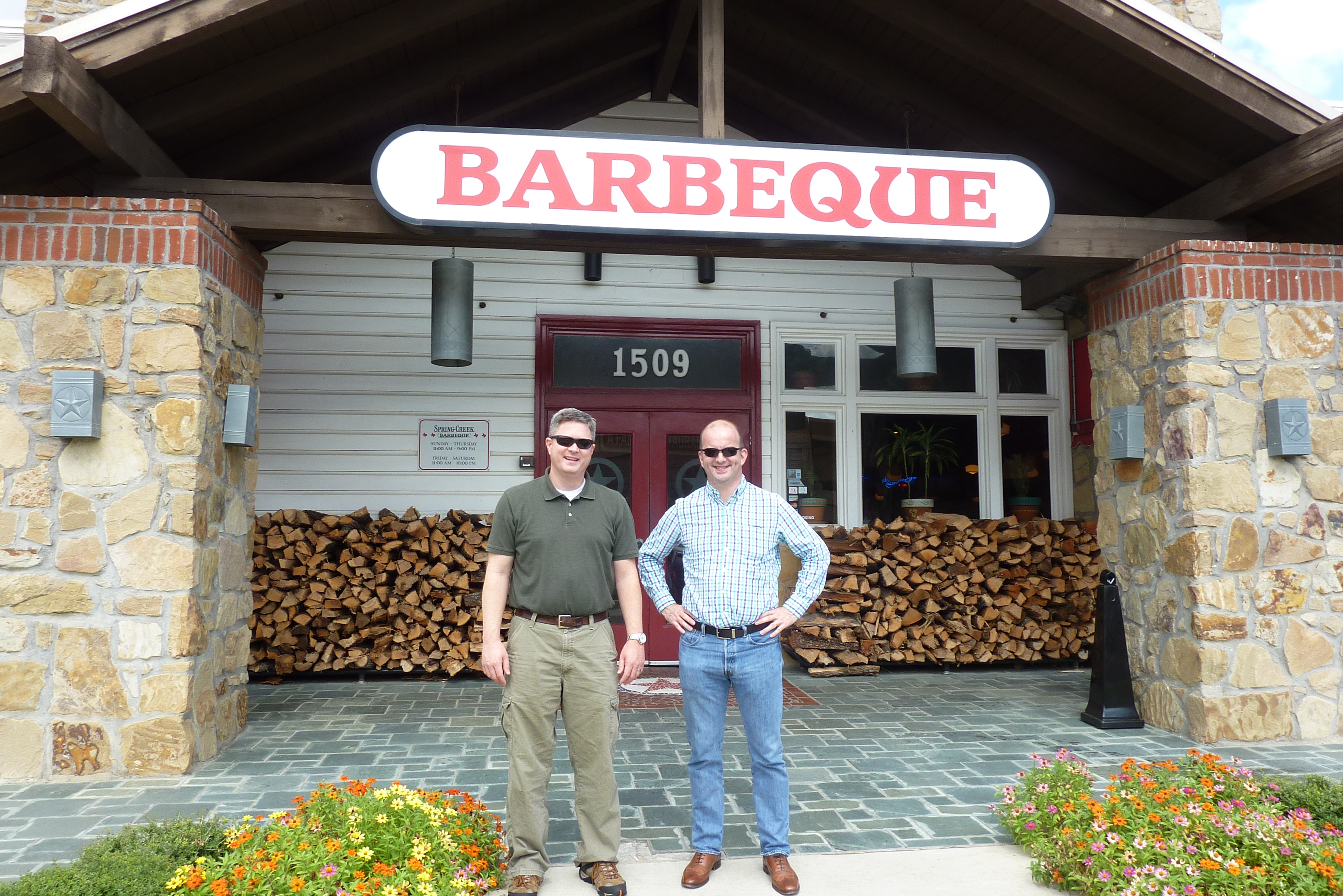
Rev. Joseph L. Troutman (left) with Dr. Carl R. Trueman (right) leaving Spring Creek Barbeque.

I’ll bet you can’t guess what we’re singing…A Mighty Fortress is Our God, of course!

The view from the front row. Dr. Trueman speaks on Friday night.

Conference attendees enjoy refreshments and conversation with Dr. Trueman after the Friday night lecture.

Conference attendees enjoy refreshments and conversation with Dr. Trueman after the Friday night lecture.

Dr. Trueman speaks on Saturday morning.

Dr. Trueman speaks on Saturday morning.

Attendees listen as Dr. Trueman speaks on Saturday morning.

Attendees listen as Dr. Trueman speaks on Saturday morning.
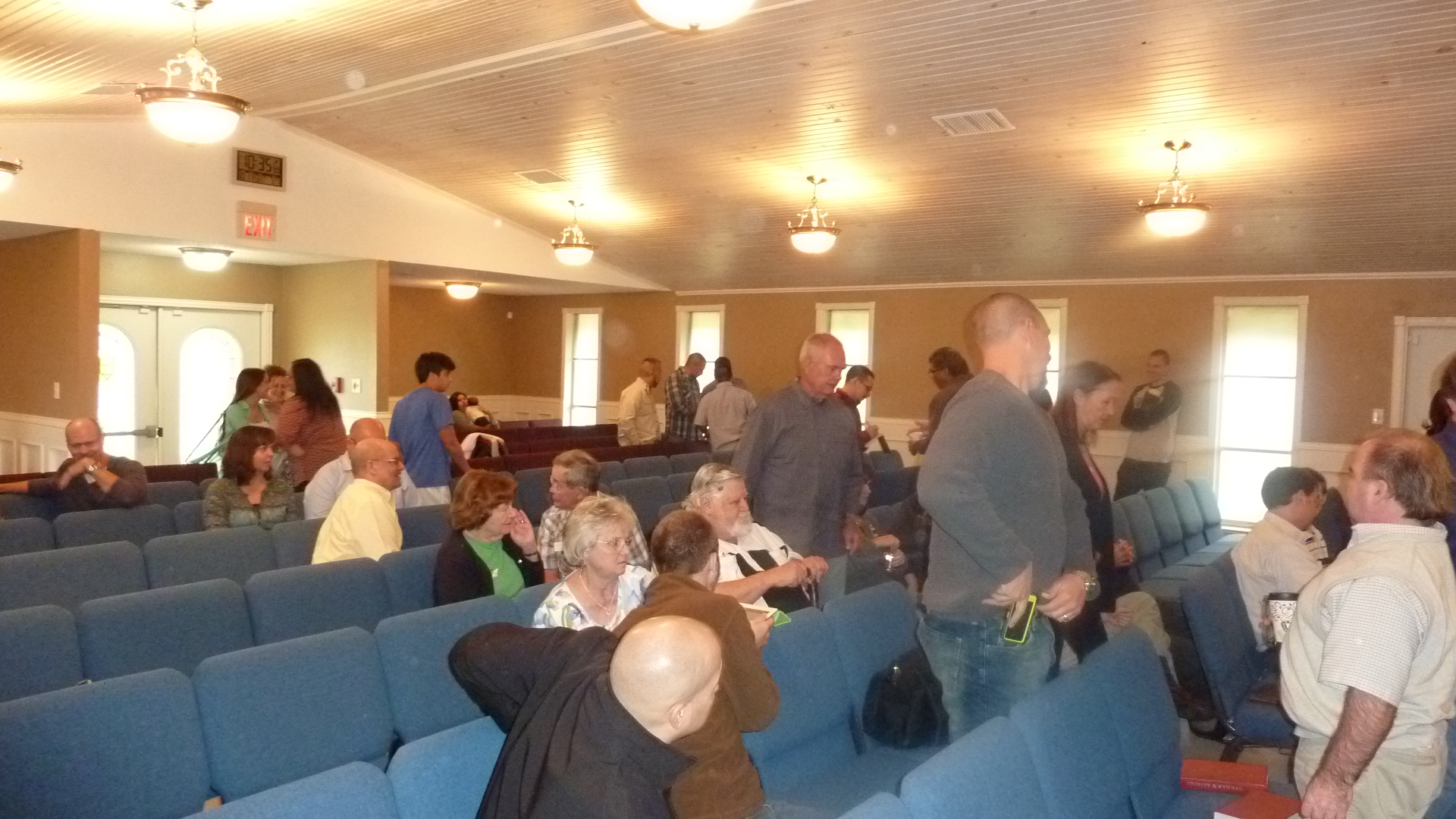
Attendees take a thirty minute break between the Saturday lectures.

More fellowship and refreshment on Saturday.

Mid-Cities OPC member watches some of our children on the playground during the conference sporting our conference t-shirt.
Plain Vanilla Presbyterian Church

The 10 marks of a “plain vanilla” Presbyterian church. Some are tongue-in-cheek–kinda!
- Lectio continua preaching. If you want topical preaching, then preach through the catechism in the evening.
- Is it a sanctuary or an auditorium?
- Evangelism is inherent in #1, while personal witnessing is commended and encouraged.
- Psalms and hymns sung from the Trinity Hymnal (1960, or 1990 edition) to piano accompaniment, at least.
- Resist the trend toward weekly communion, paedocommunion and intinction.
- Deaconess is not an ordained church office; pastors are men, too.
- If the Bible doesn’t say you can do it in the worship service, then you can’t!
- Congregational participation in worship: a) pray along with the elder during his public prayers, b) sing, recite the creed or Lord’s Prayer and responsively read like you mean it, c) actually hear and heed the Word preached.
- No hand raising until the benediction (but only if you know what it means).
- If you call people “Brother” and “Sister,” everyone will know you used to be a Baptist.
What other marks can you think of?
How Christ Restored the Gospel to His Church
I’ve added a link to the top of my sidebar to the right. It links to Post Tenebras Lux, the website of Dr. Thomas R. Browning, Assistant Pastor of Grace Community Presbyterian Church in Fort Worth, Texas. At his site is a lecture series about the life and ministry of Martin Luther and the story of the beginning of the Protestant Reformation. It is the month of October now, and Luther nailed the historic 95 Theses to the door of the Castle Church in Wittenberg, Germany on October 31, 1517, so it is time to begin gearing up to commemorate the Protestant Reformation, which was the providential way “How Christ Restored the Gospel to His Church.”
Carl Trueman Preaches at SWBTS
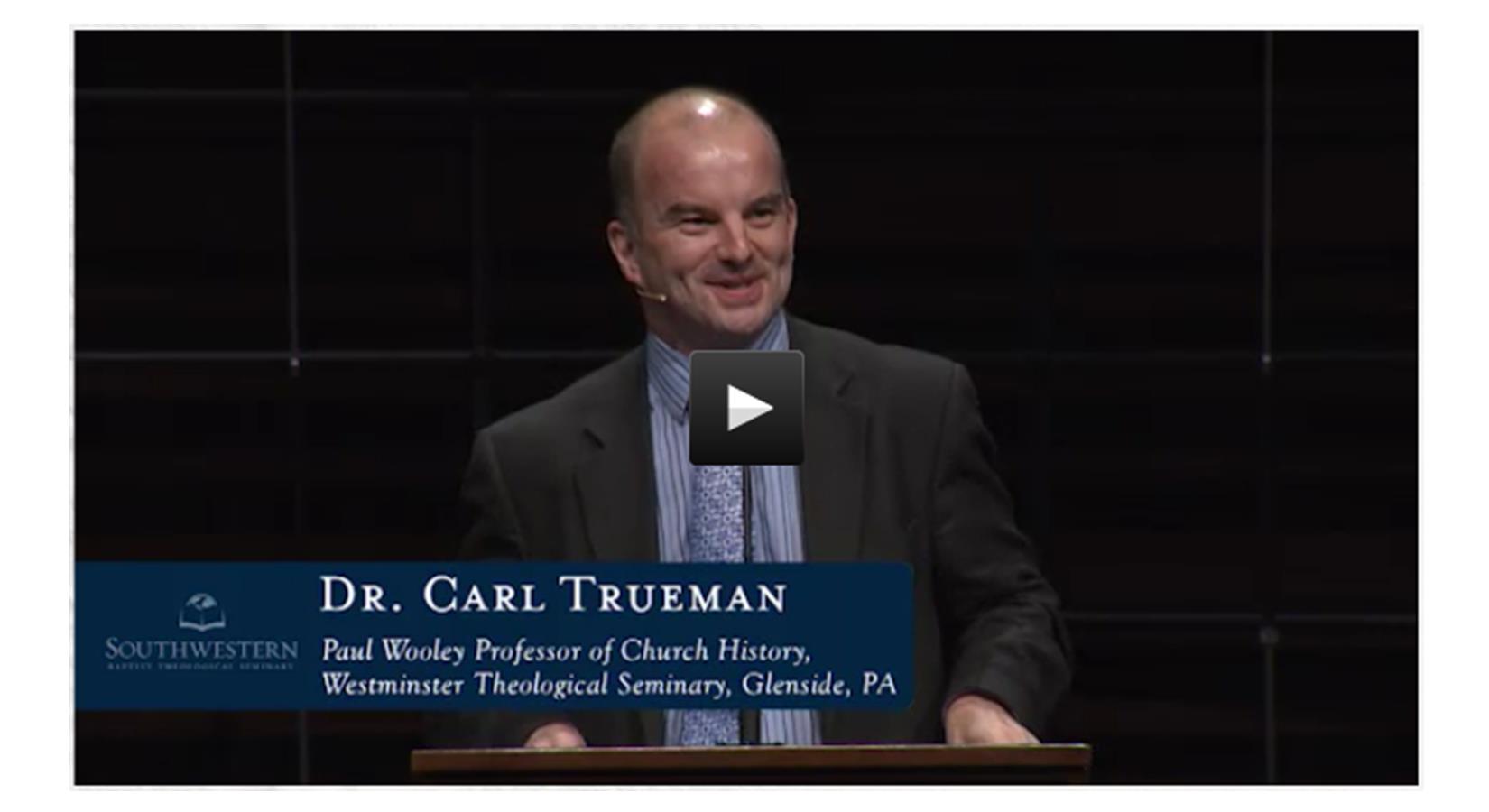
Dr. Carl Trueman speaks in the SWBTS chapel Thursday, October 9, 2014.
Yes, you heard that right. Dr. Carl Trueman was invited to speak in the chapel service at Southwestern Baptist Theological Seminary in Fort Worth, Texas yesterday. Seminary President Paige Patterson introduced Dr. Trueman as “my favorite Calvinist” for his activities as a “critic of the culture.” In the video of Dr. Trueman’s chapel sermon, you can see his friendly response in which he expresses his admiration for Dr. Patterson’s role in leading Southwestern and the SBC back to a more conservative theological position. Then he delivers a sermon on the advent of the prophet Elijah from 1 Kings 17:1-24 and proclaims the power of not only God’s Word, but also his holiness, his mercy and his power over death. My pastor, Joe Troutman, and I attended the service, got a bite to eat off campus while Dr. Patterson and his wife hosted Dr. Trueman for lunch (oh, to be a fly on the wall of that conversation!), gave him a tour of the campus, after which Mid-Cities Presbyterian Church officially took possession of him in preparation for tonight’s OPC DFW Reformation Conference 2014 on the role of creeds and confessions in the Protestant Reformation and their benefit to the life and worship of the church today. If you haven’t already registered, it’s not too late. Pictures and audio to follow on this blog in the coming days.
View “The Advent of the Prophet Elijah” (1 Kings 17:1-24)
Register for OPC DFW Ref Con 2014


 The Misadventures of Captain Headknowledge
Sermon Notes: The Lamb of God (John 1:18-34)

The following is an outline based on the notes taken during the sermon preached by Rev. Joe Troutman at Mid-Cities Presbyterian Church (OPC) in Bedford, Texas on October 26, 2014. AudioThe Lamb of God (John 1:18-34)
John the Baptist points away from himself to Christ, so that all may know that Christ is the Lamb of God who takes away the sin of the world.
I. Who Are You? (1:19-21)
A. Leaders’ First Question
1. “Who are you?” (1:19)
a. Not asking for genealogy—they likely know of his father, Zechariah.
b. Jewish leaders would be remiss to not examine John the Baptist.
B. John the Baptist’s First answer (1:20)
1. Confesses Christ by denying being him.
2. There were many itinerant claimants to Messiahship.
C. Leaders’ Second Question (1:21a)
1. “Are you Elijah?”
a. Matthew’s description of John the Baptist an allusion to Elijah (Matthew 3:4)
b. Rabbis frequently expounded on Elijah’s expected return (Malachi 4:5)
D. John the Baptist’s Second Answer
1. “I am not.”
E. Leaders’ Third Question (1:21b)
1. “Are you ‘The Prophet’?” (Deuteronomy 18:15)
F. John the Baptist’s Third Answer
1. “No.”
2. Christ himself is ‘The Prophet’ (Acts 3:22; 7:37).
II. The Voice (1:22-28)
A. Leaders’ Fourth Question (1:22)
1.“Who are you? We need to give an answer to those who sent us. What do you say about yourself?”
B. John the Baptist’s Fourth Answer
1. “I am the voice of one crying out in the wilderness, ‘Make straight the way of the Lord,’ as the prophet Isaiah said.” (1:23)
2. Prophesied in Isaiah 40:1-8; see v. 3
3. A metaphorical call to repair the roads to ease the return of repentant Jews from Babylonian Captivity—the literal near fulfillment.
4. John the Baptist and his baptism of repentance (Luke 3:3) is the spiritual and ultimate far fulfillment.
5. John the Baptist is like a pre-battle bombardment to soften a target before an attack.
C. Leaders’ Fifth Question (1:25)
1. “The why are you baptizing, if you are neither the Christ, nor Elijah, nor the Prophet?”
D. John the Baptist’s Fifth Answer (1:26-27)
1. “I baptize with water, but among you stands one you do not know, even he who comes after me, the strap of whose sandal I am not worthy to untie.”
2. Like his confession by denial above, John the Baptist magnifies Christ by diminishing his own importance (John 3:30).
3. Christ was there, yet remained unrecognized (cf. John 1:10).
III. That He Might Be Revealed (John 1:29-34)
A. John 1:32-34 takes place after Jesus’ baptism.
B. “The next day he (John the Baptist) saw Jesus coming toward him, and said, ‘Behold, the Lamb of God, who takes away the sin of the world!’
1. John 1:29 is the gospel in a nutshell.
a. John the Baptist refers to Christ in terms of the Passover Lamb.
b. “The world” in John 1:29 does refer to all people in the world, but not all people without exception (see John 1:12).
C. John the Baptist’s twofold ministry
1. Negatively, he calls the Jews to his baptism of repentance.
2. Positively, he points to the Lord Jesus Christ to bear witness that he is the Son of God that they might believe.
D. If you believe in Christ, he has borne your sins; therefore, repent of your sins and reaffirm your faith in him in Christian worship.
Share this: