Introduction and Review: Heresy and Orthodoxy in the History of the Church
For I delivered to you as of first importance what I also received: that Christ died for our sins in accordance with the Scriptures, that he was buried, that he was raised on the third day in accordance with the Scriptures, and that he appeared to Cephas, then to the twelve. Then he appeared to more than five hundred brothers at one time, most of whom are still alive, though some have fallen asleep. Then he appeared to James, then to all the apostles.
(1 Corinthians 15:3-7 ESV)
Outcasts Accepted (John 9:8-41)
The neighbors and those who had seen him before as a beggar were saying, “Is this not the man who used to sit and beg?” Some said, “It is he.” Others said, “No, but he is like him.” He kept saying, “I am the man.” So they said to him, “Then how were your eyes opened?” He answered, “The man called Jesus made mud and anointed my eyes and said to me, ‘Go to Siloam and wash.’ So I went and washed and received my sight.” They said to him, “Where is he?” He said, “I do not know.”
They brought to the Pharisees the man who had formerly been blind. Now it was a Sabbath day when Jesus made the mud and opened his eyes. So the Pharisees again asked him how he had received his sight. And he said to them, “He put mud on my eyes, and I washed, and I see.” Some of the Pharisees said, “This man is not from God, for he does not keep the Sabbath.” But others said, “How can a man who is a sinner do such signs?” And there was a division among them. So they said again to the blind man, “What do you say about him, since he has opened your eyes?” He said, “He is a prophet.”
The Jews did not believe that he had been blind and had received his sight, until they called the parents of the man who had received his sight and asked them, “Is this your son, who you say was born blind? How then does he now see?” His parents answered, “We know that this is our son and that he was born blind. But how he now sees we do not know, nor do we know who opened his eyes. Ask him; he is of age. He will speak for himself.” (His parents said these things because they feared the Jews, for the Jews had already agreed that if anyone should confess Jesus to be Christ, he was to be put out of the synagogue.) Therefore his parents said, “He is of age; ask him.”
So for the second time they called the man who had been blind and said to him, “Give glory to God. We know that this man is a sinner.” He answered, “Whether he is a sinner I do not know. One thing I do know, that though I was blind, now I see.” They said to him, “What did he do to you? How did he open your eyes?” He answered them, “I have told you already, and you would not listen. Why do you want to hear it again? Do you also want to become his disciples?” And they reviled him, saying, “You are his disciple, but we are disciples of Moses. We know that God has spoken to Moses, but as for this man, we do not know where he comes from.” The man answered, “Why, this is an amazing thing! You do not know where he comes from, and yet he opened my eyes. We know that God does not listen to sinners, but if anyone is a worshiper of God and does his will, God listens to him. Never since the world began has it been heard that anyone opened the eyes of a man born blind. If this man were not from God, he could do nothing.” They answered him, “You were born in utter sin, and would you teach us?” And they cast him out.
Jesus heard that they had cast him out, and having found him he said, “Do you believe in the Son of Man?” He answered, “And who is he, sir, that I may believe in him?” Jesus said to him, “You have seen him, and it is he who is speaking to you.” He said, “Lord, I believe,” and he worshiped him. Jesus said, “For judgment I came into this world, that those who do not see may see, and those who see may become blind.” Some of the Pharisees near him heard these things, and said to him, “Are we also blind?” Jesus said to them, “If you were blind, you would have no guilt; but now that you say, ‘We see,’ your guilt remains.
(John 9:8-41 ESV)
Bezalel and Oholiab (Exodus 35:20-38:8)
Mid-Cities Presbyterian Church Adult Sunday School Teacher, Chuck Cain on his next to last lesson through a fifty-two-week study of the book of Exodus! Incredible detail!
The Bible and Homosexual Practice: Texts and Hermeneutics
“Gagnon’s book powerfully challenges attempts to identify love and inclusivity with affirmation of homosexual practice.”
My New Library Blog
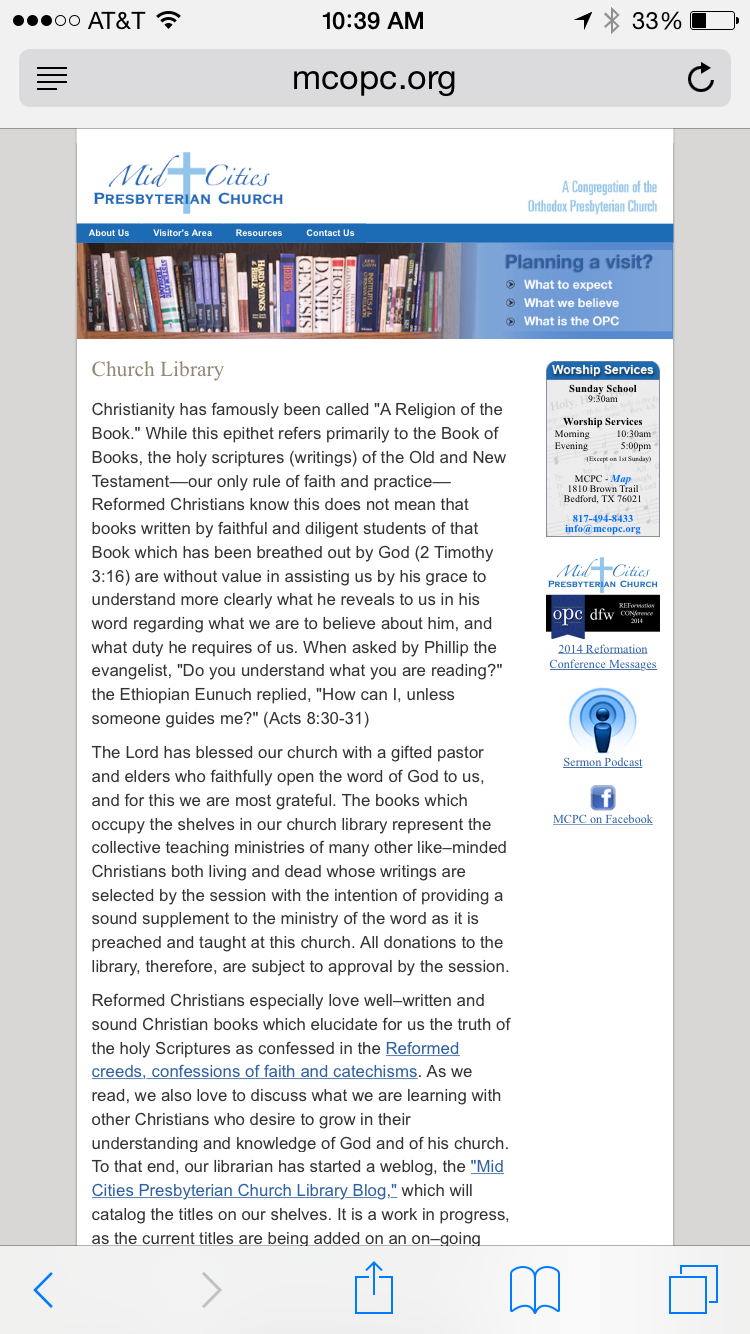
MCOPC Library Blog webpage
If you like Reformed books–and if you follow this blog, you probably do–then you may enjoy following the other blog that’s been dominating all of my blogging energy for the past few months. A deacon at my church asked me to take over our church library when we moved into our new building. More recently, we discussed putting the collection online for the use of members of our church who patronize our library to see what we have, and to serve as a resource to discuss, ask questions, review, recommend or criticize our titles. We thought about a few options, but I settled on using a blog for this purpose, given my nine years of experience at blogging.
First, you may enjoy reading my introduction to our church library which is posted at my church website. It will then link you to my library blog, Mid-Cities Presbyterian Church Library Blog (or more commonly, MCOPC Library). Even though you are not a member of my church, please feel free to subscribe and comment as you like. Thanks for your interest!
“Heart knowledge” of Scripture’s Self-Attesting Evidences Persuades of Its Divine Inspiration and Authority

Brown’s Self-Interpreting Bible (1859 edition)
The following continues a series of excerpts from “An Introduction to the Right Understanding of the Oracles of God,” by the Rev. John Brown of Haddington, as published in his Self-Intepreting Bible (1859 edition).
X. Though the above arguments are sufficient to silence gainsayers, and to produce a rational conviction that the Scriptures are of divine original and authority, it is only the effectual application of them to our mind, conscience, and heart, in their SELF-EVIDENCEING DIVINE LIGHT and POWER, which can produce a cordial and saving persuasion that they are indeed the word of God. But, when thus applied, this word brings along with it such light, such authority, and such sanctifying and comforting power, that there is no shutting our eyes nor hardening our hearts against it; no possibility of continuing stupid and concerned under it: but the whole faculties of our soul are necessarily affected with it, as indeed marked with divine evidence, and attended with almighty power; 1 Thes. 1:5; 2:13; John 6:63.
Public Service Announcement
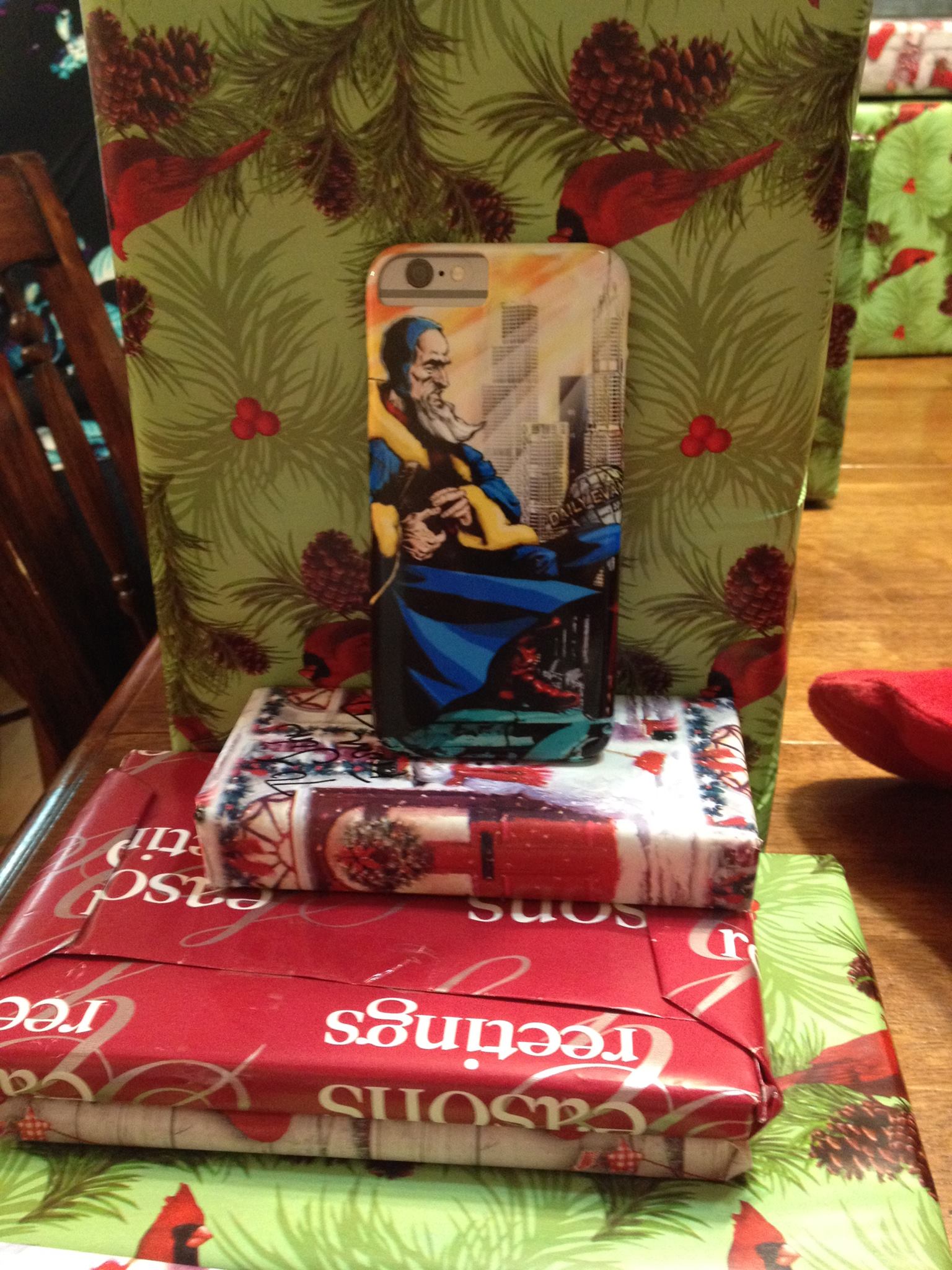
The Missus has been very good to me this year!
Villainous theology ruining your Christmas? Call the Genevan Help Line!
genevanhelpline@gmail.com
I’m from Geneva, and I’m here to help!
Reformation Creeds for Today — OPC DFW RefCon 2014 Audio & Picture Gallery
The audio of Dr. Carl Trueman’s three lectures at OPC DFW Reformation Conference 2014 hosted by Mid-Cities Presbyterian Church on Friday, October 10 through Saturday, October 11 are now available on the church’s website. Here are the links to the lecutures:
Why Creeds are Biblical (Friday, October 10, 7 PM)
Survey of Creeds from the Reformation (Saturday, October 11, 9:30 AM)
Usefulness of Creeds for Today (Saturday, October 11, 11:00 AM)
Download and share the above audio files and share as you please.
OPC DFW Reformation Conference 2014 Photo Gallery

A few members of Mid-Cities OPC enjoy lunch with Dr. Trueman on Friday at Spring Creek Barbeque in Bedford, Texas.

A few members of Mid-Cities OPC enjoy lunch with Dr. Trueman on Friday at Spring Creek Barbeque in Bedford, Texas.

Dr. Carl Trueman speaks with a friend of Mid-Cities OPC.

Daughter of Pastor Joe Troutman puts a smile on all of our faces as she enjoys a bowl of ice cream. With Dr. Trueman (left), and her mother, Jennifer (right).

Yours truly poses with Dr. Trueman, while Pastor Troutman’s daughter photo bombs us!

Group portrait of Mid-Cities OPC lunch with Dr. Carl Trueman at Spring Creek Barbeque.
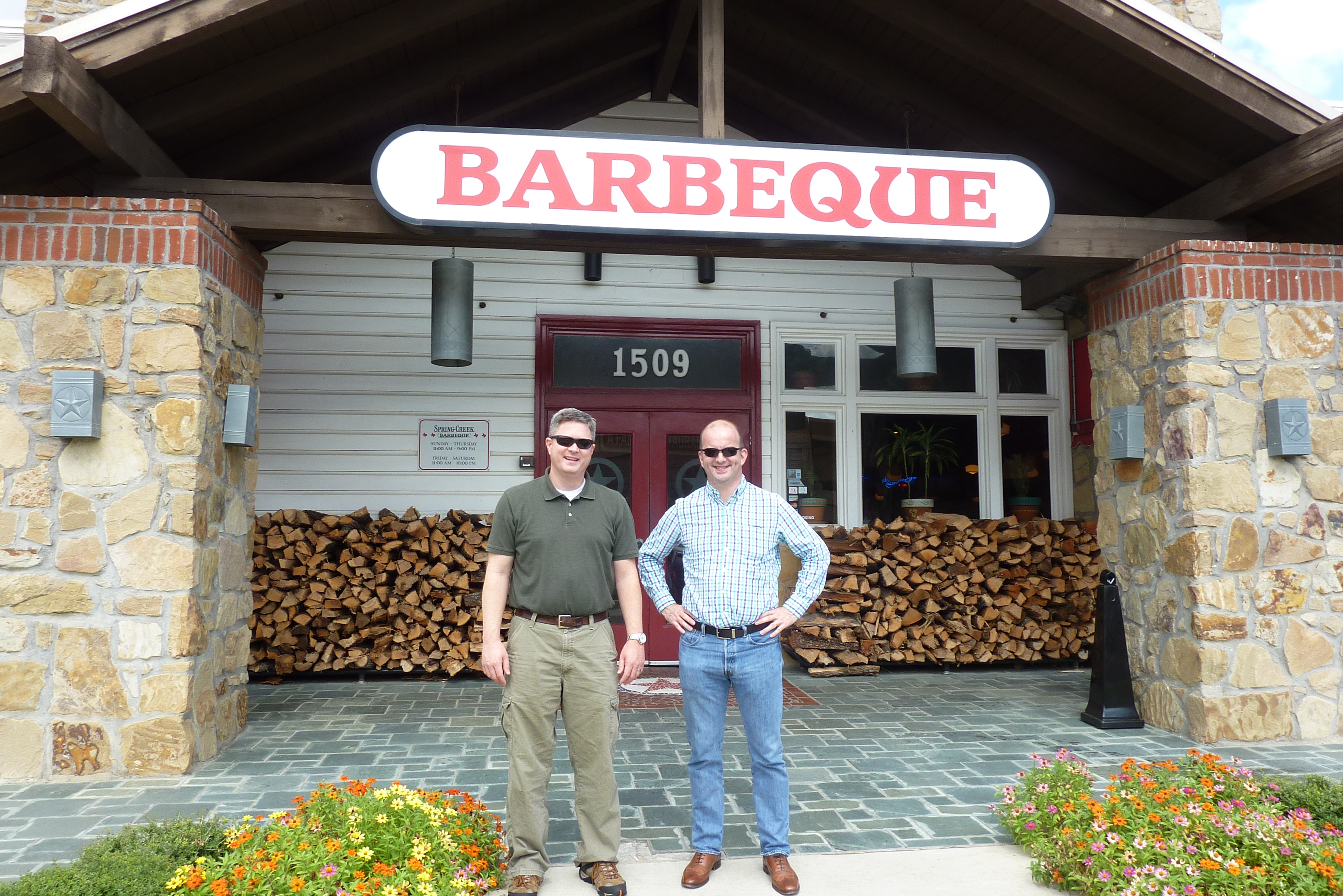
Rev. Joseph L. Troutman (left) with Dr. Carl R. Trueman (right) leaving Spring Creek Barbeque.

I’ll bet you can’t guess what we’re singing…A Mighty Fortress is Our God, of course!

The view from the front row. Dr. Trueman speaks on Friday night.

Conference attendees enjoy refreshments and conversation with Dr. Trueman after the Friday night lecture.

Conference attendees enjoy refreshments and conversation with Dr. Trueman after the Friday night lecture.

Dr. Trueman speaks on Saturday morning.

Dr. Trueman speaks on Saturday morning.

Attendees listen as Dr. Trueman speaks on Saturday morning.

Attendees listen as Dr. Trueman speaks on Saturday morning.
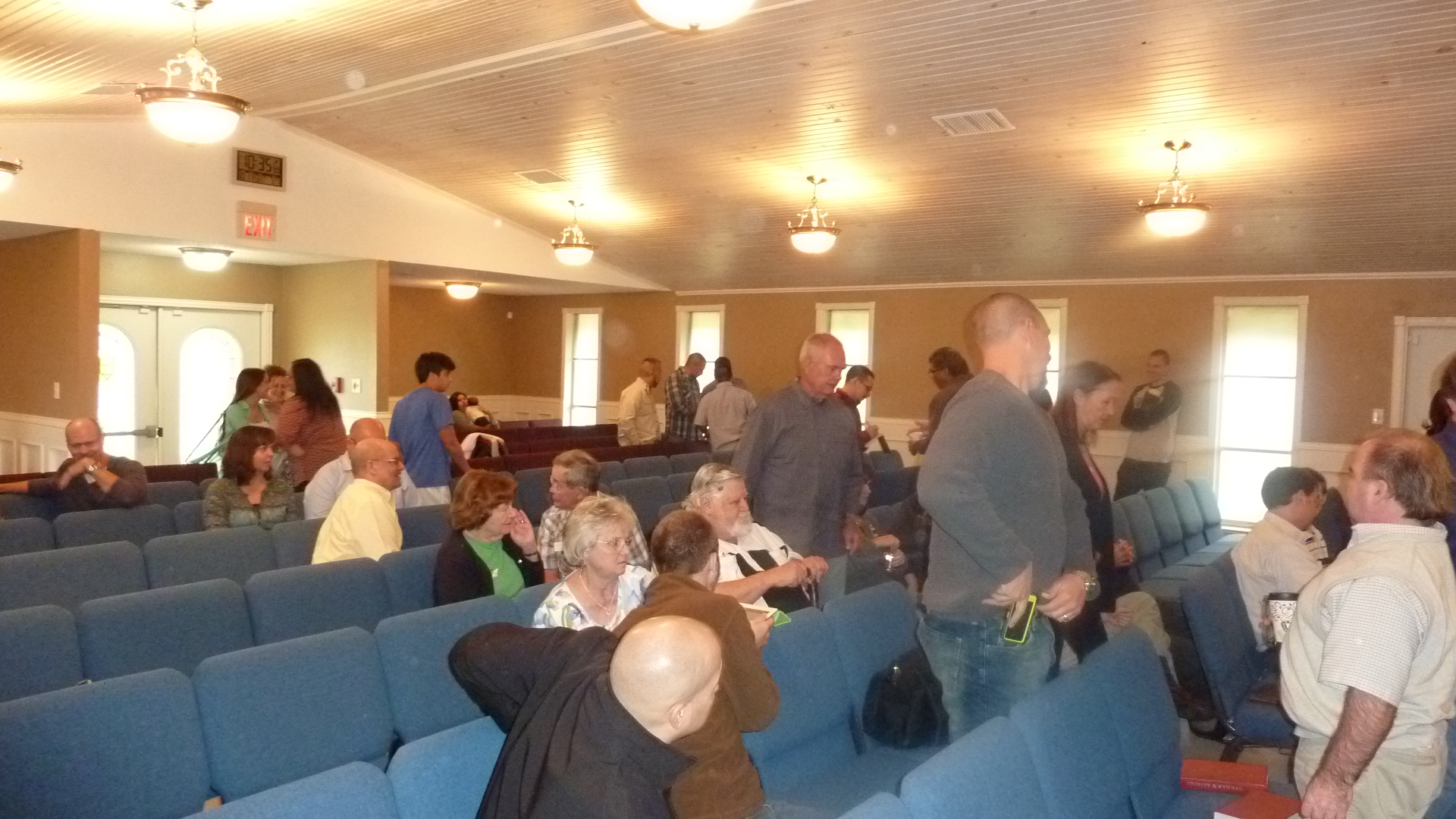
Attendees take a thirty minute break between the Saturday lectures.

More fellowship and refreshment on Saturday.

Mid-Cities OPC member watches some of our children on the playground during the conference sporting our conference t-shirt.
Why Baptism Has Replaced Circumcision as Sign of the Covenant of Grace

Robert Mossotti, OPC Licentiate
OPC Licentiate Robert Mossotti explains how the Bible teaches that baptism replaces circumcision as the sign of the covenant of grace. This lesson was delivered on August 31, 2014 at Mid-Cities Presbyterian Church. Subscribe to Robert’s SermonAudio page for more teaching and preaching.
Now let’s talk about whether baptism has replaced circumcision. That’s something that’s batted around between Baptists and Presbyterians, so let’s talk about that for a moment. Before I start dealing with a couple of texts, I would like to pose a couple of rhetorical questions to the group.
What was the sign of entry into the one covenant of grace, into the visible church, in the Old Testament? It was circumcision. What is the sign of admission into the one covenant grace in the New Testament visible church? Baptism. So we believe that if the one rite of admission into the visible church is now in effect, and that the old rite of admission into the visible church is no longer in effect, then the one has replaced the other.
We should also ask, what do these two signs, circumcision and baptism, signify? In short, both circumcision and baptism signify the same thing. Both signify spiritual regeneration, the putting off of the body of sin, of being cleansed, and of belonging to the Lord’s household. A couple of places you can go is Romans 2:29 and Philippians 3:3. They also both signify something that isn’t as obvious, but is, nevertheless a legitimate thing signified, and that is passing under God’s wrath, his judgment ordeal. I would direct you to Meredith Kline’s By Oath Consigned which may be obtained on the internet. This book explains how circumcision is passing under the judgment sword of God, and baptism is passing under the judgment waters of God, as 1 Peter mentions that baptism is analogous to the judgment waters of the flood. Kline draws this out, so I would direct you to that.
The fact that baptism fills the void left by circumcision’s removal, serving the same function of admittance into the visible church, and the fact that both signify the same spiritual realities, we believe that baptism has replaced circumcision. 25:38
The Scriptures also suggest this very thing in Colossians 2. The relationship between the participle and the finite verb is more obvious in the Greek grammar, but we can still talk about it and get the meaning here in English.
In him (Christ) also you were circumcised with a circumcision made without hands, by putting off the body of the flesh, by the circumcision of Christ, having been buried with him in baptism, in which you were also raised with him through faith in the powerful working of God, who raised him from the dead (Colossians 2:11-12 ESV).
The phrase in verse 11 “you were circumcised” is the finite verb. In verse 12, the phrase “having been buried,” is a participle in the Greek, and it relates to the finite verb. So you were circumcised by being buried with him in baptism. That’s what the grammatical shorthand of this is. If I were to say, “I went to the store riding on my bike,” you would understand that the participle “riding” is a participle of means. How did I get to the store? I got to the store by riding my bike. It’s the same in this Colossians passage: “you were circumcised…by being buried…in baptism.” So we believe that the Scriptures tell us in so many words that baptism replaces circumcision.
Little Studio Films partners with Author David R. Stokes for Hollywood Productions
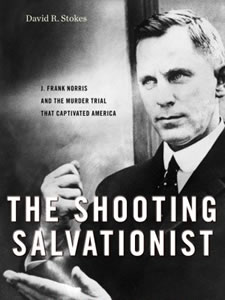
For decades, I have said, “The life story of J. Frank Norris would make a great gangster movie!” Well, it looks like I finally get my wish, although it comes in the form of a courtroom drama. I’ll take it! Congratulations to author David Stokes on accomplishing the goal I’ve been waiting years to see: the colorful and controversial story of J. Frank Norris on film.
I guess I’ll have to write the “gangster-movie” version someday… 😉
Read more about The Shooting Salvationist in my old posts categorized under the name J. Frank Norris.


LOS ANGELES, CA, USA, September 16, 2014 — Little Studio Films is pleased to announce a collaboration with author David R. Stokes. They will be working on promoting for Film and TV adaptations his novel, Camelot’s Cousin, as well as his narrative non-fiction bestseller, The Shooting Salvationist.
Camelot’s Cousin is an espionage thriller set against the backdrop of the Cuban Missile Crisis and other famous events during the Kennedy administration. The discovery of a long-buried journal indicates that one of President Kennedy’s most trusted friends was actually a Soviet mole. Templeton Davis, a scholar and media personality becomes lost in an investigation and travels far and wide in his quest to unravel one of the 20th century’s greatest mysteries.
The Shooting Salvationist, distributed by Random House, is the real-life story of the Reverend Doctor J. Frank Norris. A powerful pastor, publisher, and broadcaster in the 1920s, Norris is the subject…
View original post 278 more words
The Role of Creeds in the Protestant Reformation

You are invited to attend my church’s first annual OPC DFW Reformation Conference, Friday-Saturday, October 10-11, 2014. Dr. Carl Trueman will be the featured speaker. His subject will be the role of creeds in the Protestant Reformation.
Seating is limited, but free. You may register for the conference here.
The location of Mid-Cities Presbyterian Church is:
1810 Brown Trail
Bedford, TX 76021
I hope you can make it!
The Bible & Homosexual Practice with Robert Gagnon
Robert Gagnon summarizes his masterful work on what the Bible teaches about human sexuality in a series of short videos. You will find them very helpful.

Robert Gagnon is perhaps the world’s leading authority on Christianity and homosexuality. His The Bible & Homosexual Practice is a wealth of scholarship addressing just about every possible attempt to read the Bible as endorsing a homosexual lifestyle. Now, thanks to Jim Garlow, much of Gagnon’s wisdom on this pressing issue is available in a few relatively short clips. With the cultural pressure to accept homosexuality as a positive and even God-pleasing option for human sexuality, this is study time well spent and well invested. Enjoy!
Part 1: The Old Testament – Genesis 1 & 2
Part 2: The Old Testament – Sodom
Part 3: The Old Testament – The Levitical Prohibition
Part 4: The Old Testament – David & Jonathan
Part 5: The New Testament – The Witness of Jesus
Part 6: The New Testament – The Witness of Paul
Part 7: The Hermeneutical Relevance of the Bible
For more from Gagnon, see his exhaustive work:
A Rude Awakening
This weekend we are in Boerne, TX with a small band of church friends to attend the Texas Hill Country Bible Conference sponsored by the Alliance of Confessing Evangelicals. Today is the first day, and we spent last night in the local La Quinta Inn.
I dreamed that it was Halloween, or as we Reformed folk sometimes refer to it, Reformation Day, and two of my favorite local churches were celebrating the Reformation and promoting their churches by being out and about on their properties to interact with trick-or-treaters and fellow observers of Reformation Day. I have no idea why I’m home and not at church and participating, but the events were covered on the local news, and I noticed in the footage that legendary (in his circles) Reformed theologian and Ligonier Ministries founder, Dr. R.C. Sproul was at one of the churches!
What? I decided to call one of the elders of one of the churches to see if this was still going on so I could come meet Dr. Sproul, but couldn’t reach him! As I prepared to call another guy, my alarm goes off and I’m frustrated because I want to get through to someone!
I didn’t want to get up yet, but I reluctantly succumbed to consciousness. I laid there wallowing in my missed opportunity for a moment, and then I sighed with relief when I realized that it’s okay, because at least today I get to meet the current president of Wheaton College and former pastor of Philly’s Tenth Presbyterian Church, Dr. Phil Ryken.
#starstruckmuch?
Toward a More Public Profile

Our pastor, Rev. Joe Troutman, returned from an OPC Missions conference in Orlando, Florida last week with a head full of new outreach ideas and a heart full of motivation to begin doing more to look outward toward our community, having spent the last few months focusing on getting our own new building up to shape for regular worship services. God has been good to us during this time, in eliminating the headache of having to find a place to meet every Sunday morning, and a member’s home in which to meet for evening worship.
Our little body of believers has been being edified together in the gospel, and the Lord has been adding to our number in terms of covenant children born, and grown believers joining. A small part of this new outward focus now involves a public Facebook page for our church, Mid Cities Presbyterian Church (OPC) in Bedford, Texas. It is a work in progress as far as profile pics and such, but I wanted to take this opportunity to invite any of the readers of the blog who’d like to keep up with the ministry of this church in the heart of the Dallas/Fort Worth Metroplex. We’ll be posting sermon podcasts (which are also currently available in the sidebar of this blog) and events as they come up, and whatever else our pastor and we come up with in the future in the hopes it is a blessing to you. Like us at http://facebook.com/MCOPCpublic today for a little virtual Reformed communion.


 The Misadventures of Captain Headknowledge
Sermon Notes: Crossing the Jordan, Part 1
The following are notes from the sermon I heard yesterday, October 13, 2013 at Mid Cities Presbyterian Church. The sermon is called “Crossing the Jordan, Part 1,” and is based on Joshua 3:1-5. Rev. Joseph L. Troutman preached the sermon. Some of the material below is original to me, however.
The big idea of this sermon is that the gap between God and Man is caused by our sin, and is bridged only by Christ, who is God with us.
1. Follow Me (verses 1-3) they set out from Shittim. And they came to the Jordan The distance between Shittim and the Jordan River is about 12 miles. The trip took about a day.
and all the people of Israel, and lodged there before they passed over. Day 1:Their arrival, there for partial day; Day 2: “Lodged” all day; Day 3: There a partial day before crossing the river. Similar to the timing of Christ in the tomb–he wasn’t in the tomb for precisely 72 hours, but part of the first day, all of the second, and rose before sunup on day three.
Condition of the Jordan River, see verse 15: (now the Jordan overflows all its banks throughout the time of harvest) It was springtime, and the river was turbulent.
The ark of the covenant symbolized God’s presence. It was holy because God is holy. In the Bible, all visible signs of spiritual truths are so closely associated with the spiritual truth that it is identified as if it were the spiritual truth. In the Hebrew text of Joshua 3:17, the ark is not only called the ark of the covenant, but the covenant itself. This is why some mistake baptism as the thing that actually saves, and that the bread and wine of the Lord’s Supper are actually transformed into the literal body and blood of Christ. The sign is called by the name of the reality, but the sign only points to the reality; the sign is not the reality. That’s why, in chapter 27, section 2 of the Westminster Confession of Faith, it reads:
In a sense, the ark was treated by the Israelites the way the sacraments of baptism and the Lord’s Supper are treated by Bible-believing Christians today.
2. A Safe Distance (verse 4)
Two thousand cubits is about three thousand feet–over half a mile. This distance which the Israelites were to keep between themselves and the ark of the covenant symbolizes the distance between the holy God and sinful humanity. Although God was with his people, their sins still separate them from him; however, the Levites were graciously allowed to carry the ark, and thus the priesthood does its job of mediating between the holy God and sinners. They represent the people to God, and thus he is near his people while keeping a safe distance for the good of his people. This nearness of God with Man, while at the same time being separate from them is ultimately bridged in the person of Jesus, our Great High Priest.
3. Consecration (verse 5)
The people must set themselves apart from unclean things, as well as from common things. God is holy, so they must be holy. God is clean and he is uncommon, therefore, so should the Israelites make this spiritual fact ceremonially visible in the same way the ark makes the presence of the Lord ceremonially visible. They were to wash their clothes and abstain from sex, as in Exodus chapter 19, which gives a good description of the way the people must consecrate themselves and keep a safe distance from Mount Sinai, and the severity of the consequences if they do not.
Similarly, Christians should see themselves as called out from the unclean and the common, to be God’s chosen possession.
“…for tomorrow the Lord will do wonders among you.” Miracles are a sign of God’s power announcing that the observer is in the presence of God. Christ himself so far surpasses Old Testament miracles that if we are unaffected by the fact of his incarnation, righteousness, substitution for us on the cross, his resurrection and ascension to be enthroned on the right hand of God the Father, this speaks ill of our spiritual condition. Jesus, the God-Man bridges the gap between the holy God and sinful humanity, and consecrates those who repent and believe that they might draw near to God to serve and worship him.
Share this: