Pot Calls Kettle Black
John MacArthur, pastor of Grace Community Church in Sun Valley, California, and recent host of the controversial Strange Fire Conference, predicted in an interview with Christianity.com that what he calls the “Reformed Revival” will reverse itself in the next few years. He thinks this is so, because he sees so many of the younger generation who seem to be merely adding the doctrines of sovereign grace to their otherwise non-Reformed modes of operation like contemporary worship music, drinking beer, and Arminian forms of evangelism. He says in time, their Calvinist soteriology will fall by the way side because of the contradictory positions they hold.
Watch the video first, then read my comments below:
I find it ironic that this pastor should offer this critique of other pastors when he himself has added the five points of Calvinism to a non-Reformed view of eschatology. Reformed theology, after all, is not the home of Dispensational Premillennialism. Those who embrace total depravity, unconditional election, particular redemption, effectual calling and perseverance of the saints but reject the Covenantal theology in which these doctrines were developed, should think twice before criticizing others for selectively embracing popular elements of Reformed theology without embracing the whole system.
I also find it amusing that he should critique Calvinists for drinking beer. The enjoyment of alcoholic beverages in moderation is historically more Reformed than otherwise.
But I am in agreement with MacArthur that the five points of Calvinism isn’t enough. I would encourage him and members of the movement which a few years ago was called the Young, Restless and Reformed to take another look at the rest of Reformed theology. If it’s so right about the sovereignty of God in election, redemption and regeneration, what makes you think it’s so wrong about eschatology, church government and the sacraments?
Reforming Saint Nicholas Day
Saint Nicholas privately giving to save poor girls from slavery.
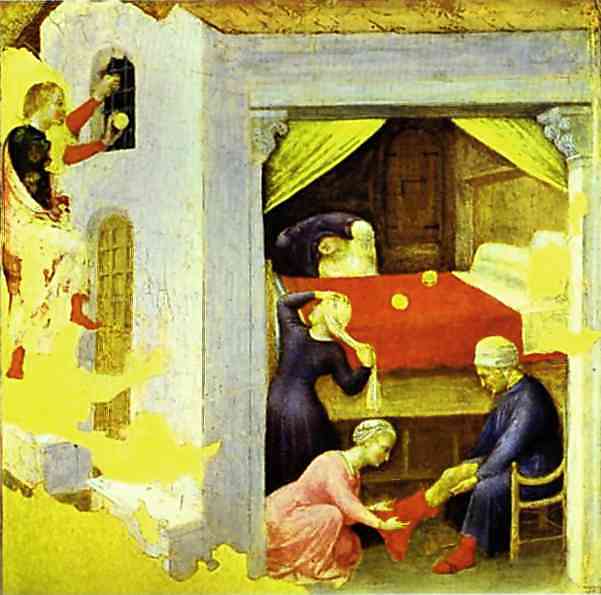
As much as I love the Reformed tradition, some of its more extreme instincts, in my humble opinion, lead it to throw out the baby of the communion of the saints with the bath water of Roman Catholic superstition. One case in point is the memory and example of the saints of the past. Not wanting to retain a Romanist veneration of the saints, we neglect the important and edifying discipline of gleaning from the history of the church the graces of the saints conveyed to us in the annals of church history. This may lead us to keep an eye on the historic church calendar, but we do not have to allow the entire worship of Christ to be distorted by this. There are ways to corporately remember the faith and works of the saints without violating the regulative principle of worship. What it takes is a little ingenuity on the part of Reformed congregations—their members under the informed supervision of their sessions.
The Westminster Confession of Faith, chapter 26, “Of the Communion of Saints,” presents the biblical principles that go along with the communion of believers with Christ by the Spirit through faith, and with each other in love.
All saints, that are united to Jesus Christ their Head, by the Spirit, and by faith, have fellowship with him in his graces, sufferings, death, resurrection, and glory (1 John 1:3; Eph. 3:16-18; John 1:16; Eph. 2:5-6; Phil. 3:10; Rom. 6:5-6; 8:17; 2 Tim. 2:12): and, being united to one another in love, they have communion in each other’s gifts and graces (Eph. 4:15-16; 1 Cor. 3:21-23; 12:7,12; Col. 2:19), and are obliged to the performance of such duties, public and private, as do conduce to their mutual good, both in the inward and outward man (1 Thess. 5:11,14; Rom. 1:11-12,14; 1 John 3:16-18; Gal. 6:10). [WCF 26.1, as adopted by the Orthodox Presbyterian Church]
With regard to this section of the confession, there are gifts and graces to be communicated by one believer to others. This does primarily intend to apply to all living believers who are physically present among the saints in their generation of the church militant. But just as our confession transmits to us the corporate Reformed understanding of biblical faith, piety and practice, so can church history communicate to us the benefit of the gifts and graces of great Christians of the past who are now numbered among the church triumphant in heaven, with whom we are lifted in the Spirit on a weekly basis to join them in worship of Christ.
In one sense, this takes place all the time in one Reformed church or another as pastors illustrate the teachings of Scripture with examples of the works and experiences of saints of the past. By so appropriating their examples in the exposition and application of the Scriptures to us, I submit that we are benefiting from the gifts and graces of these historic saints, and so are experiencing the communion of saints even with them, if only in a sense. If the teaching ministries of Calvin, Luther, Spurgeon, Warfield, Machen, etc., continue to build up and instruct the church, why not the lives and works of those who published nothing, as their lives are recorded in church history?
One of the Scripture proofs in the section of the confession above is Romans 1:11-12,14. In this passage, the apostle Paul expresses his desire to commune with the saints at Rome.
For I long to see you, that I may impart to you some spiritual gift to strengthen you—that is, that we may be mutually encouraged by each other’s faith, both yours and mine. I do not want you to be unaware, brothers, that I have often intended to come to you (but thus far have been prevented), in order that I may reap some harvest among you as well as among the rest of the Gentiles. I am under obligation both to Greeks and to barbarians, both to the wise and to the foolish. So I am eager to preach the gospel to you also who are in Rome.
If Paul desired to impart a spiritual gift to the Romans in person, for his strengthening with the Romans in their mutual faith in the Person and Work of Christ, he certainly did impart such not only to them, but also to all Christians who would follow to this present day, twenty centuries later in his writing the most comprehensive exposition of the gospel of Christ in his letter to the Romans.
Paul’s grace was the grace of apostleship. Other ministers of the gospel have spiritual gifts to impart which are outworkings of this Pauline gospel. In the case of Nicholas, the grace of generosity to the poor among his parishoners has been communicated to us today through sixteen centuries of church tradition. If we may demythologize the traditions of St. Nicholas’ “wonder-working” intercessions, among other fanciful traditions, what we find remains is the kernel of a godly example of generosity on a par with that first lived by Christ in his state of humiliation. As Paul wrote, “For you know the grace of our Lord Jesus Christ, that though he was rich, yet for your sake he became poor, so that you by his poverty might become rich. (2 Corinthians 8:9, ESV). Saint Nicholas was rich, and he used his wealth to relieve the poverty of those in his ministerial care. Truly, Saint Nicholas excelled in the grace of giving, taught in 2 Corinthians 8 and 9. His example can help us learn how to live out the teaching of this passage.
It seems to me that due to the Reformed tradition’s utter rejection of corporate recognition of such great saints from church history, depriving ourselves and our congregations of their gifts and graces, are we not also neglecting a sense of communion with those professing Christians, whether Protestant or Catholic, who do recognize these days? We may be appropriately divided from Roman Catholics and Orthodox Christians over essentials like justification by faith alone, or other Protestants over important doctrines like the sovereignty of God in the gospel, ecclesiology and the sacraments, but we can at the very least affirm the validity of, rather than despise, their edifying themselves with the gifts and graces of the saints of the past. We could furthermore, I propose, go a step further by not only affirming them in their commemoration, but perhaps exemplify a “more perfect way” of doing so in the context of Reformed theology, piety and practice.
Many Reformed churches are happy to commemorate Reformation Day on a yearly basis. We promote our commonly held Protestant distinctives, displaying our unity with Lutheran, Anglican, Methodist and Baptist Protestants. We also take it a step further and do it in a Reformed way. If we can do it with the memory of the works of Saint Martin Luther, why can we not do it with others like Saint Nicholas? Today is Saint Nicholas Day. December 6 is the anniversary of his death. It is on this day that Orthodox, Catholic, Anglican and Lutheran churches commemorate his life and ministry in their various ways. Yet the Reformed ignore it, although many of them have borrowed from the Anglicans at Christmas and found a way to bring into greater conformity to the Refomred confessions the Anglican Service of Lessons and Carols.
I say we should find a way to bring into greater conformity to our confessions the commemoration of the life and ministry of Saint Nicholas (read all about him here) and so reform in a more winsome and attractive way, the commercialized specter of Santa Claus, rather than merely turning up our noses to it and saying “Bah! Humbug.” Saint Nicholas is the world’s favorite saint. Sure, they’ve refashioned him in their own image, but we shouldn’t just leave him to them. Let us keep alive the true Saint Nicholas, who currently enriches our Christmas seasons with his emphasis on sacrificial generosity to the poor, and perhaps, through such edifying efforts build bridges over which some of the elect may find their way into the communion of saints through faith in Christ by the power of the Spirit and love for one another, and we can learn from Saint Nicholas how to better minister to the needy among us, as well as in the world, without feeling like we’re capitulating to some liberal “social gospel” or postmodern version of progressive “social justice.” Let us reform Saint Nicholas day and perhaps in his providence the Lord will use us to reform the way Christian charity is done in a more perfect way.
Happy Saint Nicholas Day!
Strange Fire Conference Kindles Controversy
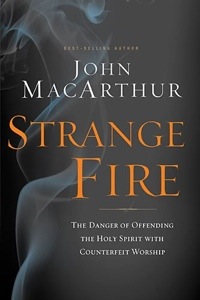
For the past week or so, evangelical sites have been critiquing John MacArthur’s Strange Fire conference, which condemns “the Charismatic Movement” as a tradition that performs false worship practices. Featuring, in addition to himself, messages by Joni Eareckson Tada and R. C. Sproul, along with a number of lesser known associates of MacArthur, this conference anticipates the November 12 release of a book by the same title (pre-order the hardback here). One of MacArthur’s stated purposes was to “start a conversation” about the errors, extremes and dangers of the movement as a whole; judging from the reaction, I’d say he started something more akin to a cyber-riot.
But MacArthur probably isn’t surprised. He’s been the provocateur of tremendous controversy before, over the relationship between the Lordship of Christ and the freeness of God’s grace in salvation, back in the 1980’s, centering around his book, The Gospel According to Jesus. In both cases, I think it is fair to say that the intensity of the reaction is partly due to ways in which MacArthur’s message misses the mark, and opens himself up, as one Cessationist reviewer put it, to easy refutation due to his failure to draw careful distinctions between the various movements–in this case, within the Pentecostal tradition and the Charismatic Renewal, Word of Faith Movement, the Brownsville Revival, New Apostolic Reformation, and any number of other varieties which feature distinctive forms of the so-called “charismata,” or purportedly supernatural manifestations of the power of the Holy Spirit.
In addition to his denial of the legitimacy of the focus on the miraculous in this multi-faceted tradition, the Strange Fire Conference also intends to focus on ways in which the movement in general promotes false forms of worship, as the conference name implies, being an allusion to the account of the deaths of Aaron’s sons, Nadab and Abihu, in Leviticus 10:1-3 upon their offering of “unauthorized” (ESV), or “strange” (KJV), fire in their censers, in direct violation of God’s explicit and detailed prescription for Israelite worship.
1 Now Nadab and Abihu, the sons of Aaron, each took his censer and put fire in it and laid incense on it and offered unauthorized fire before the LORD, which he had not commanded them.
2 And fire came out from before the LORD and consumed them, and they died before the LORD.
3 Then Moses said to Aaron, “This is what the LORD has said: ‘Among those who are near me I will be sanctified, and before all the people I will be glorified.'” And Aaron held his peace.
Fair or not, MacArthur and his fellow conference speakers would all advocate worship derived solely from the clear teaching of Scripture, a distinctive of Reformed theology known as the Regulative Principle of Worship. Undoubtedly, MacArthur, et al desire to see them come into closer conformity to Scriptural modes of worship, in essence calling the movement as a whole to Reformation as the Calvinistic Reformed tradition understands it.
Now it is possible for us not only to read, watch and hear what critics of the Strange Fire Conference have to say, we can all, friend or foe, see for ourselves how the messages of the conference were presented. Audio files of the have now been released, and are available for free download, with video and transcripts of each session forth-coming. Judge for yourself whether MacArthur’s charges against so-called Continuationism (the view that New Testament sign gifts are ongoing today) and his distinctive case for Cessationism (the view that these came to an end with the close of both the Apostolic era and the canon of Scripture–with which I agree) are legitimate, and where he misses the mark.
Visit Grace To You’s blog post, “John MacArthur on Making an Informed Response to Strange Fire” to watch a short introductory video and to download the audio files for each session of the conference which has set the evangelical blogosphere ablaze, in my view, both rightly and wrongly.
Sermon Notes: Crossing the Jordan, Part 1

The following are notes from the sermon I heard yesterday, October 13, 2013 at Mid Cities Presbyterian Church. The sermon is called “Crossing the Jordan, Part 1,” and is based on Joshua 3:1-5. Rev. Joseph L. Troutman preached the sermon. Some of the material below is original to me, however.
1Then Joshua rose early in the morning and they set out from Shittim. And they came to the Jordan, he and all the people of Israel, and lodged there before they passed over. 2 At the end of three days the officers went through the camp 3 and commanded the people, “As soon as you see the ark of the covenant of the Lord your God being carried by the Levitical priests, then you shall set out from your place and follow it. 4 Yet there shall be a distance between you and it, about 2,000 cubits in length. Do not come near it, in order that you may know the way you shall go, for you have not passed this way before.” 5 Then Joshua said to the people,“Consecrate yourselves, for tomorrow the Lord will do wonders among you.”
The big idea of this sermon is that the gap between God and Man is caused by our sin, and is bridged only by Christ, who is God with us.
1. Follow Me (verses 1-3) they set out from Shittim. And they came to the Jordan The distance between Shittim and the Jordan River is about 12 miles. The trip took about a day.
and all the people of Israel, and lodged there before they passed over. Day 1:Their arrival, there for partial day; Day 2: “Lodged” all day; Day 3: There a partial day before crossing the river. Similar to the timing of Christ in the tomb–he wasn’t in the tomb for precisely 72 hours, but part of the first day, all of the second, and rose before sunup on day three.
Condition of the Jordan River, see verse 15: (now the Jordan overflows all its banks throughout the time of harvest) It was springtime, and the river was turbulent.
“As soon as you see the ark of the covenant of the Lord your God being carried by the Levitical priests, then you shall set out from your place and follow it. Yet there shall be a distance between you and it, about 2,000 cubits in length. Do not come near it, in order that you may know the way you shall go, for you have not passed this way before.”
The ark of the covenant symbolized God’s presence. It was holy because God is holy. In the Bible, all visible signs of spiritual truths are so closely associated with the spiritual truth that it is identified as if it were the spiritual truth. In the Hebrew text of Joshua 3:17, the ark is not only called the ark of the covenant, but the covenant itself. This is why some mistake baptism as the thing that actually saves, and that the bread and wine of the Lord’s Supper are actually transformed into the literal body and blood of Christ. The sign is called by the name of the reality, but the sign only points to the reality; the sign is not the reality. That’s why, in chapter 27, section 2 of the Westminster Confession of Faith, it reads:
There is, in every sacrament, a spiritual relation, or sacramental union, between the sign and the thing signified: whence it comes to pass, that the names and effects of the one are attributed to the other.
In a sense, the ark was treated by the Israelites the way the sacraments of baptism and the Lord’s Supper are treated by Bible-believing Christians today.
2. A Safe Distance (verse 4)
Yet there shall be a distance between you and it, about 2,000 cubits in length. Do not come near it,
Two thousand cubits is about three thousand feet–over half a mile. This distance which the Israelites were to keep between themselves and the ark of the covenant symbolizes the distance between the holy God and sinful humanity. Although God was with his people, their sins still separate them from him; however, the Levites were graciously allowed to carry the ark, and thus the priesthood does its job of mediating between the holy God and sinners. They represent the people to God, and thus he is near his people while keeping a safe distance for the good of his people. This nearness of God with Man, while at the same time being separate from them is ultimately bridged in the person of Jesus, our Great High Priest.
3. Consecration (verse 5)
Then Joshua said to the people, “Consecrate yourselves, for tomorrow the Lord will do wonders among you.”
The people must set themselves apart from unclean things, as well as from common things. God is holy, so they must be holy. God is clean and he is uncommon, therefore, so should the Israelites make this spiritual fact ceremonially visible in the same way the ark makes the presence of the Lord ceremonially visible. They were to wash their clothes and abstain from sex, as in Exodus chapter 19, which gives a good description of the way the people must consecrate themselves and keep a safe distance from Mount Sinai, and the severity of the consequences if they do not.
the Lord said to Moses, “Go to the people and consecrate them today and tomorrow, and let them wash their garments and be ready for the third day. For on the third day the Lord will come down on Mount Sinai in the sight of all the people. And you shall set limits for the people all around, saying, ‘Take care not to go up into the mountain or touch the edge of it.Whoever touches the mountain shall be put to death. No hand shall touch him, but he shall be stoned or shot; whether beast or man, he shall not live.’ When the trumpet sounds a long blast, they shall come up to the mountain.” So Moses went down from the mountain to the people and consecrated the people; and they washed their garments. And he said to the people, “Be ready for the third day; do not go near a woman.”
Similarly, Christians should see themselves as called out from the unclean and the common, to be God’s chosen possession.
But you are a chosen race, a royal priesthood, a holy nation, a people for his own possession, that you may proclaim the excellencies of him who called you out of darkness into his marvelous light (1 Peter 2:9).
“…for tomorrow the Lord will do wonders among you.” Miracles are a sign of God’s power announcing that the observer is in the presence of God. Christ himself so far surpasses Old Testament miracles that if we are unaffected by the fact of his incarnation, righteousness, substitution for us on the cross, his resurrection and ascension to be enthroned on the right hand of God the Father, this speaks ill of our spiritual condition. Jesus, the God-Man bridges the gap between the holy God and sinful humanity, and consecrates those who repent and believe that they might draw near to God to serve and worship him.
An Ordinary Reformation

Westminster Confession of Faith 1.7. All things in Scripture are not alike plain in themselves, nor alike clear unto all: yet those things which are necessary to be known, believed, and observed for salvation, are so clearly propounded, and opened in some place of Scripture or other, that not only the learned, but the unlearned, in a due use of the ordinary means, may attain unto a sufficient understanding of them.
Westminster Confession of Faith 5.3. God, in his ordinary providence, maketh use of means, yet is free to work without, above, and against them, at his pleasure.
Westminster Confession of Faith 18.3. This infallible assurance doth not so belong to the essence of faith, but that a true believer may wait long, and conflict with many difficulties before he be partaker of it: yet, being enabled by the Spirit to know the things which are freely given him of God, he may, without extraordinary revelation, in the right use of ordinary means, attain thereunto. And therefore it is the duty of everyone to give all diligence to make his calling and election sure, that thereby his heart may be enlarged in peace and joy in the Holy Ghost, in love and thankfulness to God, and in strength and cheerfulness in the duties of obedience, the proper fruits of this assurance; so far is it from inclining men to looseness.
If everything in the Christian life is “dynamic,” “epic,” “impactful,” “powerful,” and “extraordinary,” then the extraordinary becomes the expected norm, rather than the exception. It’s easy to see that with such high spiritual expectations, disillusionment is sure to follow. For this reason, I’d like to direct you to a series of episodes of the White Horse Inn called “Ordinary.” Along with concepts like “sovereignty,” and “predestination,” one of the unsung distinctive doctrines of Reformed theology is the way that God ordinarily works through ordinary means in our lives by His Word and sacraments. He reveals himself and his work of redemption to us in the Scriptures, grants to his chosen regeneration, faith, justification, repentance, sanctification, communion with him in grace and assurance. That he ordinarily does so through the “ordinary means of grace” (the Word read and preached, the sacraments and prayer), means that, indeed, in extraordinary circumstances, he is free to work by extraordinary means. The extraordinary nature of these means should be our first hint that this will not be what Christians should expect every Sunday during their so-called “worship experience.” Take some time to listen and be reformed to a liberatingly ordinary Christian spirituality.
ACE and WHI Remember Dr. C. Everett Koop (1916-2013)
Yesterday I tweeted a request to Reformed bloggers in the know to post on the Reformed side of American medical icon, the late Dr. C. Everett Koop, who died Monday at the age of 96. Dr. Koop’s medical and public service bonafides are a matter of public record. One quick and easy summary may of course be accessed, where else? Wikipedia! Here also is a press release from HHS Secretary, Kathleen Sabelius, detailing his legacy from the point of view of the federal government. But in addition to his service to the City of Man, Dr. C. Everett Koop was an accomplished lay leader in the City of God, serving as a Presbyterian church elder, and until the day of his death, a board member of the Alliance of Confessing Evangelicals (ACE), the para-church organization which was so instrumental in introducing me to and cultivating in me the Reformed faith and theology.
Incidentally, tomorrow afternoon, my pastor and I depart for ACE’s Texas Hill Country Bible Conference in Boerne, Texas. It’ll be interesting to see what kind of tribute they put together for him there. For now, though, the ACE website offers a “Koop Classic”: Life, Bioethics and Christianity (2010, ACE).
But in answer to my (“all about me”–apologies to Dr. D.G. Hart 😉 request, two of my favorite Reformed bloggers has indeed posted remembrances of Dr. C. Everett Koop: Drs. Michael Horton and Kim Riddlebarger. You may read Dr. Horton’s at the White Horse Inn blog, and Dr. Riddlebarger’s post at the Riddleblog. Horton gives a nice summary of meeting Dr. Koop and his service to his church, Tenth Presbyterian Church in Philadelphia, PA and the Alliance of Confessing Evangelicals, featuring the audio of a 2001 interview and a link to Dr. Koop’s contribution (“Faith-Healing and the Sovereignty of God”) to Horton’s out of print 1990 expose of televangelism, The Agony of Deceit–download it as soon as possible! Riddlebarger adds an amusing anecdote of Dr. Koop’s sobering reaction to his sense of humor. Both posts are great reads.
Be sure to peruse the other links I tweeted yesterday regarding the late Dr. C. Everett Koop from Christianity Today and Banner of Truth magazines and the Gospel Coalition blog featuring both compliment and criticism. Finally, in search of an image of Dr. Koop inside the building of Tenth Pres, I ran across a video of his 2010 marriage to Cora Hogue (pray comfort for her in her loss), officiated by former pastor, Phil Ryken, who is now the President of Wheaton College, whose sermons are still featured on ACE’s broadcast, Every Last Word. For those who are interested in viewing this heartwarming moment, the service begins about 30 minutes into the video, after the beautiful music of Westminster Brass.
Koop-Hogue Wedding Ceremony from Tenth Presbyterian Church on Vimeo.
Hearing Frame’s Side of the Story

Dr. John Frame, Professor of Theology and Philosophy at RTS, Orlando
As one who was first introduced to Reformed theology by Dr. Michael Horton in a televised interview promoting his first book, I have a great affection and appreciation for the work of those who are, in Reformed circles, associated with what Dr. John Frame (RTS, Orlando) calls “The Escondido Theology.” Frame and others seem to think that for Reformed folks to interact with Lutheran theology on the things with which they agree is some sort of compromise of the integrity of Reformed theology. As a layman who hasn’t read it all on this controversy, that’s the impression I get. Frame’s book is promoted as a discussion primarily of the Two Kingdom approach to Christ and culture, but I’ve just learned that there is more to Dr. Frame and the Escondido Theology that this one issue.
In terms of coming to a greater understanding of the broader controversy myself, I was pleased to find that Scott Oakland interviewed Dr. Frame on a recent episode of ReformedCast. Agree or disagree, it is important to understand Frame’s point of view on the matter. Looking back to the days in which he helped found Westminster Seminary California, Dr. Frame portrays himself as not fitting in with any of the “parties” that formed among the faculty there. I also found it helpful to hear him express his concerns with how closely many among the faculty wanted to stick to the Reformed confessions, while he, in my opinion, thought the Reformed principle of sola scriptura was better honored by not “turning biblical and systematic theology into historical theology” (or something like that–it’s been a few days since I heard the interview). This helped me understand why Dr. Frame was willing to be a little more “progressive” in his approach to worship, and became a veritable whipping boy among many in the so-called “worship wars” (see, for example, how Frame’s writing is treated in Hart and Muether’s With Reverence and Awe: Returning to the Basics of Reformed Worship.) While I do not doubt Dr. Frame’s commitment to the Reformed interpretation of Scripture, it does seem to me that he has a more moderate approach. Neither side of this Escondido debate deny that the Reformed Confessions are subject to the authority of Scripture, but I perceive that in some ways Dr. Frame seems so much more openly self-conscious of highlighting the authority of Scripture over the Confessions that he runs the risk of coming off more broadly evangelical than Reformed on the issue of worship. I could be wrong, but this is my initial impression.
Many of you have read more Frame than I have, and have a more informed opinion of his approach to Reformed theology. Feel free to enlighten and correct my impressions in the comments. I simply wanted to share my thoughts on the interview as I recommend it to you. If any of you have wondered about the back and forth that sometimes takes place online about the so-called “Escondido Theology,” this interview is an important resource for gaining some insight into both sides of the debate.
Theological & Doxological Meditation #48

Theology in the First Commandment
Q. 48. What are we specially taught by these words before me in the first commandment?
A. These words before me in the first commandment
teach us that God,
who seeth all things,
taketh notice of,
and is much displeased with,
the sin of having any other god (Deuteronomy 30:17-18; Psalm 44:20-21; Ezekiel 8:12) .
Jesus, Priceless Treasure
#656, Trinity Hymnal (© 1990)
Johann Franck, 1655
Tr. By Catherine Winkworth, 1863
JESU, MEINE FREUDE
Johann Crüger, 1649
Jesus, priceless treasure,
Source of purest pleasure,
Truest Friend to me:
Ah, how long in anguish
Shall my spirit languish,
Yearning, Lord, for thee?
Thine I am, O spotless Lamb!
I will suffer naught to hide thee,
Naught I ask beside thee.
In thine arms I rest me;
Foes who would molest me
Cannot reach me here.
Though the earth be shaking,
Ev’ry heart be quaking,
Jesus calms my fear.
Lightnings flash and thunders crash;
Yet, though sin and hell assail me,
Jesus will not fail me.
Satan, I defy thee;
Death, I now decry thee;
Fear, I bid thee cease.
World, thou shalt not harm me
Nor thy threats alarm me while I sing of peace.
God’s great pow’r
Guards ev’ry hour;
Earth and all its depths adore him,
Silent bow before him.
Hence, with earthly treasure!
Thou art all my pleasure,
Jesus, all my choice.
Hence, thou empty glory!
Naught to me thy story,
Told with tempting voice.
Pain or loss or shame or cross
Shall not from my Savior move me,
Since he deigns to love me.
Hence, all fear and sadness!
For the Lord of gladness,
Jesus, enters in.
Those who love the Father,
Though the storms may gather,
Still have peace within.
Yea, whate’er I here must bear,
Thou art still my purest pleasure,
Jesus, priceless treasure.
Heresy in the Headlines: Camping & Schuller
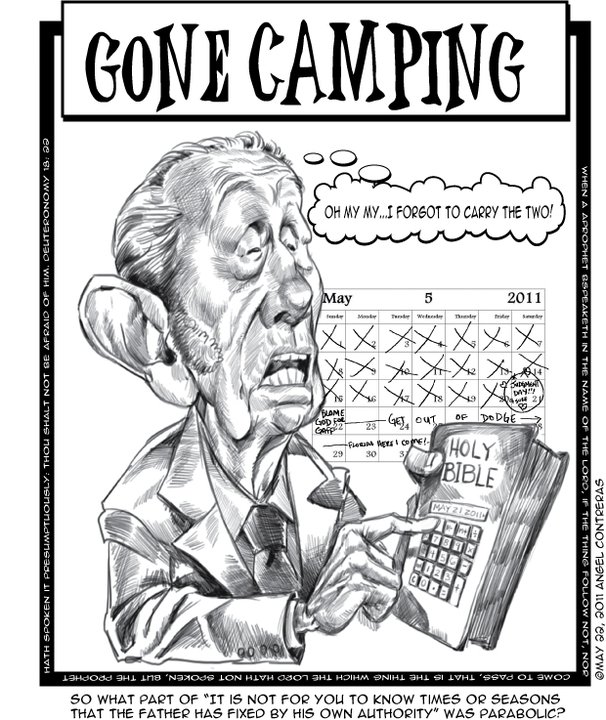
Strike Three and You’re Out
You may have heard that last week Harold Camping apologized for setting dates for the rapture. His bizarre application of civil engineer math geekiness to biblical hermeneutics misleads him to believe he could calculate the date of the rapture and the final judgment (See Robert Godfrey’s posts on Camping parts 1, 2, 3, 4 and 5). Strike one was back in 1994—No rapture. Camping discovers his miscalculation, and revises his date to May 21, 2011, which is also to kick off five months of judgment apparently in the form of rolling earthquakes that were to begin at a certain time of day all around the globe. Perhaps you noticed the billboards in some parts of the country, but most of you will recall the media attention given to it in the weeks leading up to Camping’s second date. May 21, 2011 comes and goes: strike two! Upon this failure, he claims that the rapture really did happen, but it was a spiritual rapture, and that a spiritual judgment has begun which will culminate in the complete end of the world all at once on October 21, 2011. Nothing. Strike three and you’re out, Harold Camping! In the stressful aftermath of this publicly humiliating fiasco, which brought much grief, consternation, and in some parts of the world, persecution, Camping suffers a stroke, and he is removed from regular broadcasting on Family Radio. I don’t know if the strike was brought on by the stress of the events, but a stroke he suffered, nonetheless.
Now that he’s had time to recover, this past week, Camping posts a letter on the Family Radio website apologizing for his “sin” of setting dates (read the letter here). In some ways it is an impressive statement. I was particularly moved to see his state in no uncertain terms that those of us who harped on Jesus’ words that “no man will know the day or hour” were right, and that he was wrong:
…we now realize that those people who were calling our attention to the Bible’s statement that “of that day and hour knoweth no man” (Matthew 24:36 & Mark 13:32), were right in their understanding of those verses and Family Radio was wrong. Whether God will ever give us any indication of the date of His return is hidden in God’s divine plan.
But this candid concession and apology was not good enough for Dan Elmendorf, former Family Radio broadcaster and now founder of Redeemer Broadcasting. In his weekly program, “A Plain Answer,” Elmendorf reminds us that the sin of date-setting was the least of Camping’s doctrinal problems. Absent from Camping’s open letter is any expression of repentance for having called on Christians to leave organized churches in which the gospel is preached and the sacraments of baptism and the Lord’s Supper are administered under the oversight by elders with the authority of exercising church discipline on members whose lives are persistently refusing to conform to a biblical standard of holiness and obedience to Scripture. Apparently, Camping still believes, and would have his listeners believe, that “the church age has ended.” So, it’s not that Camping has repented of the more heretical nature of his controversial “ministry.” I recommend that you listen to Elmendorf’s program, the first segment of which addresses Camping’s “weak apology.” The host shares some insight and experience which you can’t get from the Associated Press stories.
The Schuller’s Take Their Ball and Leave
In another recent instance of heresy in the headlines, it is reported that the entire family of positive-thinking televangelist, Robert Schuller, are leaving Crystal Cathedral Ministries. The 85 year-old Schuller, having retired from weekly “ministry” in 2009, was succeeded by his daughter, Sheila Schuller Coleman. According to the LA Times, Coleman announced this past Sunday that she will leave the Crystal Cathedral to start a new church citing a “hostile working environment” stemming from a growing divide between the Schuller family and the Crystal Cathedral’s board of directors. Robert Schuller and his wife applaud Coleman’s decision, but announce they will not be joining her at her new church, and that their plans for weekly worship are not yet finally decided. They will not, however, have any further public association with the work of the Crystal Cathedral and it’s broadcast The Hour of Power, started by Robert Schuller back in 1970. It seems that all positive (as opposed to “good”) things must come to an end. In my humble opinion, this end has been long overdue.
How to make Joel Osteen nervous
Ask him a politically-charged question about biblical sexual morality.
It’s good that Joel was able to get what he’s bound to believe out of his mouth. He would do well to work toward not only believing these things, but also ministering these truths in the way Paul advised Timothy in 2 Timothy 4:1-5, which reads,
I charge you in the presence of God and of Christ Jesus, who is to judge the living and the dead, and by his appearing and his kingdom: preach the word; be ready in season and out of season; reprove, rebuke, and exhort, with complete patience and teaching. For the time is coming when people will not endure sound teaching, but having itching ears they will accumulate for themselves teachers to suit their own passions, and will turn away from listening to the truth and wander off into myths. As for you, always be sober-minded, endure suffering, do the work of an evangelist, fulfill your ministry.
For the record, according to Joel Osteen, he believes that the Bible teaches the following:
“You shall not lie with a male as with a woman; it is an abomination” (Leviticus 18:22).
“If a man lies with a male as with a woman, both of them have committed an abomination…” (Leviticus 20:13).
“…and the men likewise gave up natural relations with women and were consumed with passion for one another, men committing shameless acts with men and receiving in themselves the due penalty for their error”(Romans 1:27).
“…just as Sodom and Gomorrah and the surrounding cities, which likewise indulged in sexual immorality and pursued unnatural desire, serve as an example by undergoing a punishment of eternal fire” (Jude 1:7; cf. Gen. 19).
But this next passage shows Joel should have also qualified his initially reassuring assertion to Oprah that “I think [homosexuals] will [go to heaven].” He does clarify that “they need forgiveness of their sins,” but this was an attempt to evade putting the two together until Oprah had to pull it out of him in uncertain terms. In this, he sounds nothing like the apostle Paul, whose inspired assertion is much clearer:
“Or do you not know that the unrighteous will not inherit the kingdom of God? Do not be deceived: neither the sexually immoral, nor idolaters, nor adulterers, nor men who practice homosexuality, nor thieves, nor the greedy, nor drunkards, nor revilers, nor swindlers will inherit the kingdom of God” (1 Corinthians 6:9-10).
Fortunately for homosexuals who repent and for Joel Osteen, Paul goes on in verse 11 to proclaim:
“And such were some of you. But you were washed, you were sanctified, you were justified in the name of the Lord Jesus Christ and by the Spirit of our God” (1 Corinthians 6:11).
It is the desire of every loving, right-minded Christian that the homosexuals should, by the grace of the Spirit of God,
- believe the good news of forgiveness through the sinless life, atoning death and enlivening resurrection of the Lord Jesus Christ, and so be justified through faith alone…
- repent of his sins, including the sin of homosexuality…
- be washed clean in the waters of baptism…
- learn to obey all that Christ taught, including his and his apostles’ teachings on sexual morality. Or, as Paul put it above “[be] sanctified.”
Short of this, the regrettable fact remains that the homosexual, as well as the sexually immoral, the idolater, the adulterer, the thief, the greedy, the drunkard, the reviler and the swindler, among other kinds of sinner, will not inherit the kingdom of God.
The Christ of the Bible
HT: Cado Odac
Sermon Notes: “Invited to the Supper” (Matthew 22:1-14)
The following sermon was preached by Rev. Joe Troutman at Mid-Cities Presbyterian Church in Bedford, Texas. Listen online or subscribe to the podcast.
God calls all to repent and believe and many refuse, but others believe and are welcome to the feast.
The parable of the wedding feast is the third parable of judgment spoken by Jesus on the week leading to his crucifixion. While the first two primarily targeted the Pharisees, Saducees and Jewish priesthood, this parable applies to all in the nation of Israel who do not follow Christ in faith, but are guilty of rebellion against God.
God will judge everyone who refuses to repent and believe, but will show mercy by bringing to himself repentant believers who had not previously been associated with his covenant people.
Rejection of the Call (Matthew 22:1-7) And again Jesus spoke to them in parables, saying, “The kingdom of heaven may be compared to a king who gave a wedding feast for his son, and sent his servants to call those who were invited to the wedding feast, but they would not come. Again he sent other servants, saying, ‘Tell those who are invited, “See, I have prepared my dinner, my oxen and my fat calves have been slaughtered, and everything is ready. Come to the wedding feast.”’ But they paid no attention and went off, one to his farm, another to his business, while the rest seized his servants, treated them shamefully, and killed them. The king was angry, and he sent his troops and destroyed those murderers and burned their city.
- The setting of the parable of the wedding feast is a feast thrown in a kingdom by the king for his son.
- It was customary to send invitations with the expectation of a response of intention to attend, followed by a second call—an announcement that the meal is now ready, and that those invited are to now come to the feast.
- Historically it was often a crime for those who promise to attend to then refuse to do so.
- Jesus’ parable portrays an absurd exaggeration of this scenario.
- In verses 5 and 6, the rejection of the invited guests evidences their ingratitude: some ignored the servant sent to call them, others mistreated and killed him, just as the Israelites always did the Old Testament prophets.
- In verse 7, the king is rightfully angry and sends troops to kill the invited guests and burns down their city.
- The guests reflect what Israel had been doing to God for generations. The king’s judgment in the parable reflects the wrath to come both in AD 70 and the Final Judgment upon Christ’s return.
Invitation to All (Matthew 22:8-10) Then he said to his servants, ‘The wedding feast is ready, but those invited were not worthy. Go therefore to the main roads and invite to the wedding feast as many as you find.’ And those servants went out into the roads and gathered all whom they found, both bad and good. So the wedding hall was filled with guests.
- In verse 8, the food is made ready.
- In verse 9, the servants are sent to anyone who will come, who demonstrate a faith not found among the invited guests, as the Centurion whose servant Jesus healed in Matthew 8, of which Jesus said “Truly, I tell you, with no one in Israel have I found such faith I tell you, many will come from east and west and recline at table with Abraham, Isaac, and Jacob in the kingdom of heaven, while the sons of the kingdom will be thrown into the outer darkness. In that place there will be weeping and gnashing of teeth” (Matthew 8:10-12).
- Throughout all of the Scriptures, one plan of salvation is revealed: both Jew and Gentile must have faith in the Messiah of Israel. Just as Old Testament Judaism sometimes included Gentiles, so Christianity does not exclude all Jews—for example, first century Christianity was largely Jewish—but all who respond to the invitation are welcome to the wedding feast.
- Thus the invitation in the parable is what is expressed in the Westminster Shorter Catechism (Q&A 31) as “the free offer of the gospel.”
- The church offers salvation to all—God sorts out those who respond from those who do not respond. The church gives a general call which may be rejected or falsely received. The Holy Spirit gives an effectual call by which those who respond will necessarily be saved.
Responsibiltiy (11-14) “But when the king came in to look at the guests, he saw there a man who had no wedding garment. And he said to him, ‘Friend, how did you get in here without a wedding garment?’ And he was speechless. Then the king said to the attendants, ‘Bind him hand and foot and cast him into the outer darkness. In that place there will be weeping and gnashing of teeth.’ For many are called, but few are chosen.”
- The king of the parable goes in disguise to inquire of one who attends the wedding feast without a wedding garment, and throws him out into outer darkness.
- The wedding garment represents the fruit of faith: grateful, obedient works.
- In the local church, all respond to the call to worship, but not all truly believe, evidenced by a life of unrepentant disobedience. Thus, some in the local church will be found to be without their “wedding garment.”
- In verse 14, God’s choice is shown to be the ultimate factor. If God doesn’t effectually call his chosen, all would refuse to come as the invited guests at the beginning of the parable, and as the citizens of Israel who will not have Jesus to be their Messiah.
- Though many be called, few are chosen. True believers must humbly and charitably receive all who profess faith in Christ, they must not proudly exclude those who differ on non-essentials, as if they belonged to the one true church.
- There is a visible church comprised of all professing believers (all who have responded to the general call), and there is an invisible church comprised of the elect (all brought effectively to Christ by the Holy Spirit’s effectual call).
- Thus, church membership alone is not saving; renewal of the heart by the Holy Spirit to repent and believe is necessary.
- Without faith, there is no hope. With faith comes true membership in the invisible church, which the parable portrays by those who come to the wedding feast wearing their wedding garment.
Sermon Notes: A Tale of Two Sons (Matthew 21:23-32)
The following sermon was preached on October 30, 2011 by Rev. Joe Troutman at Mid-Cities Presbyterian Church in Bedford, Texas. Listen to the sermon at this link, or subscribe to the podcast.
In fulfillment of the old Testament Scriptures, Jesus Christ came to bring salvation to every sinner who repents and believes in him.
A Question of Authority (Matthew 21:23) And when he entered the temple, the chief priests and the elders of the people came up to him as he was teaching, and said, “By what authority are you doing these things, and who gave you this authority?”
- The beginning of a long series of exchanges between Jesus and the Temple leaders which culminates in the seven woes pronounced upon their hypocrisy in Matthew 23.
- The leaders should have known Jesus’ authority was from heaven.
A Question in Response (Matthew 21:24-27) Jesus answered them, “I also will ask you one question, and if you tell me the answer, then I also will tell you by what authority I do these things. The baptism of John, from where did it come? From heaven or from man?” And they discussed it among themselves, saying, “If we say, ‘From heaven,’ he will say to us, ‘Why then did you not believe him?’ But if we say, ‘From man,’ we are afraid of the crowd, for they all hold that John was a prophet.” So they answered Jesus, “We do not know.” And he said to them, “Neither will I tell you by what authority I do these things.
- Jesus demonstrates his authority by asking a question of the chief priests.
- Jesus’ question makes them weigh the politics of their answer. They want to admit John’s authority from heaven, but knew doing so would be to regard Jesus as something more than just a rabble rouser.
- The leaders lie when they claim to not know the source of John’s authority, and Jesus, knowing this, refuses to answer them.
The Answer (Matthew 21:28-32) “What do you think? A man had two sons. And he went to the first and said, ‘Son, go and work in the vineyard today.’ And he answered, ‘I will not,’ but afterward he changed his mind and went. And he went to the other son and said the same. And he answered, ‘I go, sir,’ but did not go. Which of the two did the will of his father?” They said, “The first.” Jesus said to them, “Truly, I say to you, the tax collectors and the prostitutes go into the kingdom of God before you. For John came to you in the way of righteousness, and you did not believe him, but the tax collectors and the prostitutes believed him. And even when you saw it, you did not afterward change your minds and believe him.
- Jesus’ parable illustrates the chief priests’ weakness and inability which comes from unbelief.
- Neither the first nor the second son were honorable in their response to the command of their father.
- The tax collectors and prostetutes represent the first son of the parable.
- The chief priests and elders represent the second son who professes faith and obedience yet fails in both regards. They should have known
- Christian churches are full of unbelieving, unrepentant sinners who profess faith but do not demonstrate this faith in their walk.
- It is often asked how can we hold accountable to God those who never hear about Jesus? But this parable, and Jesus’ encounter with the chief priests and elders of Israel show us that knowing about Jesus is no guarantee of faith and repentance.
- Without God working in your heart, you will not be able to believe but God is working, using his Word, calling each of us, believer and unbeliever, to repentance and faith.
- Christ suffered the consequences of the sins of the first son in the parable, and likewise those of sinners today who come to Christ in faith. Repent of your sins and trust Christ today, and you will be forgiven of your sins, and you will have done the will of your Father in heaven.
Theological & Doxological Meditations #48

Theology in the First Commandment
Q. What are we specially taught by these words, before me, in the first commandment?
A. These words, before me, in the first commandment, teach us, that God, who seeth all things, taketh notice of, and is much displeased with, the sin of having any other God (Deuteronomy 30:17-18; Psalm 44:20-21; Ezekiel 8:12)
Now Blessed Be the Lord Our God
Scottish Psalter, 1650 Mod.
McKEE C.M.
Spiritual
Arr. By Harry T. Burleigh, 1939
Now blessed be the Lord our God,
The God of Israel,
For he alone does wondrous works
In glory that excel.
And blessed be his glorious name
To all eternity;
The whole earth let his glory fill.
Amen, so let it be.
His wide dominion shall extend
From sea to utmost sea,
And unto earth’s remotest bounds
His peaceful rule shall be.
Yea, all the kings shall bow to him,
His rule all nations hail;
He will regard the poor man’s cry
When other helpers fail.


 The Misadventures of Captain Headknowledge
Visible Church Membership for Covenant Children
Robert Mossotti, our summer intern at Mid-Cities Presbyterian Church in Bedford, Texas taught a Sunday School series on Ecclesiology. All of the lessons are available online here. They’re also available on Robert’s SermonAudio page here. My favorite lesson in the series was the following on the biblical case for infant baptism and the Reformed inclusion of the infant and unbelieving children of believers into church membership. The following is a transcript of his remarks, lightly edited at some points. I hope you find it as helpful and enlightening as we have. You can listen to this particular lesson online here. We begin with his introductory remarks regarding principles that govern our interpretation on this issue, and an exposition of Paul’s words regarding covenants from Galatians 3. The rest will follow in the coming days and weeks.
Why do Presbyterians baptize babies and count them as members of the visible church?
Let’s restate some principles first, before we get into some passages.
The visible covenant community is the visible church—Old Testament and New Testament—and what makes it visible are the sacraments. These place a mark on the church to identify it as belonging to the Lord. The sacraments mark God’s people off from the world. Another principle we have to keep in mind is that there is only one covenant of grace in Scripture. The covenant by which Abraham and the Old Testament church were saved is our covenant, too. By God’s grace, in the Scriptures we are all called children of Abraham through faith. There is no essential difference between the Old Covenant church and the New Covenant church. There are differences, but no essential differences. No differences as to substance, just form. The church is one across all the ages, because the covenant of grace is one. To embrace the one idea is to embrace the other. If you accept that there is one covenant of grace throughout Scripture by which we are all saved, then you have to accept that the church is one across both Old and New Testaments. We affirm this over against dispensationalism, which maintains an essential difference between Israel and the church. So the Abrahamic Covenant, the Mosaic Covenant (the one at Mount Sinai mediated through Moses), and the New Covenant are all different administrations of the one covenant of grace. In section 5 of chapter 7 of the Westminster Confession of Faith, the Mosaic Covenant is called an administration of the covenant of grace. Alright, now that those principles have been stated, let’s go to Galatians 3.
The apostle Paul is going to give us in this passage a principle of covenant theology. A principle of Interpretation of Covenants, of Application of Covenants, the Nature of Covenants. Paul says not only biblical covenants, but all covenants. Let’s go to Galatians 3:15.
In verse 15, this idea of “ratified” in the ESV comes from the Greek word kuro’o, and Bauer-Danker, the premier Greek lexicon or dictionary defines it as “to confirm, to ratify, to validate or to make legally binding.” Although the covenant of grace goes all the way back to Eden, note that Paul is saying here that it was not ratified until Abraham. Now note that in verse 15, Paul begins with a general principle of covenants. Then, as he moves down through verses 16 and 17 he applies that general principle of covenants to the particular case of the Mosaic administration of the one covenant of grace—that’s what he means by the Law coming in. Paul says that once the covenant of grace was ratified at the time of Abraham, no modifications may be introduced even by later administrations of the covenant of grace, including the Mosaic administration.
So, it is because there is only one covenant of grace throughout Scripture that we Presbyterians apply the sign of admission into the visible church to the children of believers, for we are not free to change the way the covenant is administered. It is not because the Reformers didn’t sufficiently push off from Rome that we baptize babies, it is because of our covenant theology which we receive, we believe, from the Scriptures. It is also because the covenant of grace is one across the various administrations that we need not seek for proof of continuity between the Abrahamic administration and the New Covenant administration of the one covenant of grace. In fact, because of the underlying unity of the one covenant of grace across the ages, which cannot be altered once ratified, says Paul, that we actually would need to find evidence in the New Testament that God intends to change who it is who receives the rite of admission to the covenant community. Because of the underlying continuity of the one covenant of grace, it is discontinuities, and not continuities, between the Old Covenant and New Testament administrations, that need positive proofs from the New Testament. We don’t have to go to the New Testament and ask if there are specific cases where it says in explicit terms that babies were baptized. Because of the underlying unity of the one covenant of grace, you have to look for a command to no longer give the sign of the covenant of grace to the children of believers. The underlying unity drives the belief that we assume continuity unless there is evidence in the New Testament of discontinuity.
So the absence of explicit revelation in the New Testament on whether children are to be included in the visible church actually works in favor, not against, the inclusion of children in the visible church. Because of this principle of covenant administration, the default setting, says Paul, is covenantal continuity. But, in fact, we can find more evidence than just these principles of covenant theology that the children of believers are to be included in the visible church as members.
Share this: