Live Blogging TCTE, part 2
10:29AM
Dr. Poythress advises that the question of the millennium is complex, because it does not simply deal with the interpretation of Revelation 20 alone, but involves “a large swath of Old Testament” prophetic Scriptures.
Pastor Waldron’s emphasizes that little progress is made by Amillennialists in saying that they affirm a “literal interpretation.” This makes sense to me because there is a gap in understanding between Dispensationalists and Covenant theologians about what it means to interpret Scripture literally. The term “literal” was coined by Luther in the Latin phrase “sensus literalis” which means “the sense of the words” not “anti-figurative sense everywhere possible, regardless of the rules of the given type of literature in question.”
10:35AM
Helpful sound byte from Dr. Gaffin: “Soteriology is eschatological, and eschatology is soteriological.” The first coming of Christ inaugurates the “last things.”
“Those who don’t learn the lessons of history . . . “
Back on December 3rd, Todd Wilken interviewed Dr. Larry Rast, of Concordia Theological Seminary in Fort Wayne, Indiana  on the Lutheran radio show, “Issues, Etc.” Dr. Rast explains that American Evangelicalism ascribes little relevance to the lessons of Church history, or the wisdom of building theologically on the efforts of those who’ve gone before us in the faith. Please listen and consider Dr. Rast’s words, and learn the lessons of history, lest you, too, join the ranks of those who are “doomed to repeat them.” He also reinforces the axiom that is sometimes repeated on this blog: “If you don’t know where you come from, then you don’t know where you are, and you can’t see where you’re going.”
Listen to “American Evangelicalism: Ahistorical.”
Live Chat with Michael Horton on “Christless Christianity”
 Back on Reformation Day, aka Halloween, aka October 31st, the Washington Post hosted a Live Web Chat with Michael Horton (White Horse Inn, Modern Reformation) helping to promote the release of his new book, Christless Christianity. The title of this book was also the focus of the programs during the past year on the White Horse Inn radio show. Horton attained a bit of media attention because of his recent statements critical of Joel Osteen’s theology, who serves as a good poster boy for what Horton calls “Christless Christianity,” but his book and the topic is far more extensive than a mere attempt to pull Osteen off of his pedastal. According to Horton, we all have the natural bent toward some form of Christless Christianity. We all tend to some degree to focus on ourselves and what we do at the expense of God and what he does for us in Christ. But to paraphrase the emphasis of Horton both on the radio and in his book(s), the grace and faith and love to serve Christ comes from the same source as the grace and faith and love that moved us to receive Christ in the first place: the good news of the sinless life, sacrifical death, glorious resurrection of the Lord Jesus Christ.
Our problem is, we keep falling back on focusing on the Law of God or the various commands of Scripture, to such a degree that we forget it’s primary use is to expose our sin while its secondary use is to only guide believing obedience. It doesn’t impart the grace and faith and love to obey, it merely charts out for the believer what obedience ought to look like. The grace and faith and love to obey, again, comes from the gospel. So any exposition of Scripture that never gets around to the Person and Work of Christ, won’t convey to us the power to live the Christian life by the Spirit.
The Morning After Reformation Day
R. Scott Clark, Professor of Church History and Historical Theology at Westminster Seminary California, and Associate Pastor at Oceanside United Reformed Church, splashes a little water in the faces of those of us who get excited about the Reformation on Halloween. If you want your Reformation myths challenged (if they are myths), then read his post at the Heidelblog entitled, “What Reformation Day Really Is.” But be of good cheer, true believer–the doctor not only invalidates the legends, he bestows a sharper knowledge of the true Reformation! Read, and rejoice in the truth!
Calvinism, Coming to a Young Christian Near You!

Click image to purchase at WTS Books
There’s a book out chronicling the resurgence of Calvinism among the, pardon the expression (keep in mind, I’m using it correctly), emerging generation of teens, twenty-, and thirty-somethings (including myself) who are disillusioned with the shallow theology and over-emphasis on you name it, revivalism, pietism, experientialism, commercialism of the twentieth century. As you know, the list of misguided varieties could go on.
So many of us who’ve grown up as a either a fundamentalist or evangelical Christian have come to the conclusion that what is needed is for the church to get back to the basics of what it means to be a Christian. The basics of Christianity as understood in a broader way than just re-examining my Bible and reconstructing my own version of what I think is the clear teaching of Scripture regarding faith and practice (which is what most of the previous generation think it means to get back to the basics).
Such a tactic is part of the problem–it’s too self-centered and individualistic and often far too reductionistic. It’s not a matter of just throwing out current traditions and starting over with a clean slate. It’s not about reinventing the wheel–those are the kinds that never turn out round. What I’m talking about is getting on the right track–yes, the most biblical track, the most Christian track, the most Protestant track, the most truly evangelical track–a track I didn’t lay myself, but was laid by the faithful followers of Christ who genuinely changed the world in their generation as did the first century apostolic generation.
What generation am I talking about? I’m talking about the generation that laid the tracks of conservative evangelical, confessionally Reformed, Christ-centered Protestant theology. The generation identified in the history books as the Reformers.
I read once that Socrates is known for saying, “Sometimes regress is progress.” The bill of goods that we were sold in the 20th century told us that what’s happening now is better than what happened back then. The present is always preferable to the past. The new is more relevant than the old. Well, some of us have learned that sticking “new and improved” on something doesn’t mean a thing. Some of us have learned that if conservative evangelical, or fundamentalist Christianity is going to make any progress, we’re going to have to regress back to a time when things were genuinely being done right and learn from both their successes and mistakes, receiving the faith in tact as handed down by them and not as re-imagined by modern philosophical influences, be they pragmatism, modernism or post-modernism. Progress will only come through this kind of regress.
Second Timothy 2:2 puts it best: “and what you have heard from me in the presence of many witnesses entrust to faithful men who will be able to teach others also.” But lots of people are entrusting lots of things to lots of “faithful men.” Which version of Christianity is best? There’s a number of us in this new generation who are firmly convinced that what the apostolic churches passed on to faithful men who led the post-apostolic generation, got deformed in the medieval era and was reformed in the sixteenth and seventeenth centuries is the “basics” to which the 21st Century generation of Christians needs to get back to. So much that has transpired since the Reformation era leaves so much to be desired that we don’t trust much of it at all. That’s why we’re turning to Calvinism, also known as Reformed theology.
Journalist Collin Hansen has written Young, Restless, Reformed: A Journalist’s Journey with the New Calvinists. It tells our story. Martin Downes has reviewed the book over at Reformation21.org. Read all about it, then find your place in the 21st Century Reformation.
Chinese Christian Headknowledge

Christian History & Biography, Spring 2008
Read the feature article from the Spring 2008 issue of Christian History & Biography, called, “Christianity Fever.” It’s about how “Through a century of political turmoil and disillusionment, waves of Chinese intellectuals have come to Christ.” We Western Christians must remember we’re losing our central post in global Christiainity. Learn a little about what’s going on elsewhere in terms of revival, and begin praying for reformation.
The Late Tony Snow, Journalist with Christian Headknowledge

Tony Snow
Today I’m mourning the death of my favorite journalist, conservative political commentator and former White House Press Secretary, Tony Snow. Tony died at about 2am Eastern on Saturday, July 12, 2008. You can read about his accomplishments at Wikipedia.
Besides his transparent genuineness, cheerful goodwill and thoughtful manner of communicating his ideas in defense of his conservative political ideals, as well as, for a time, in defense of the Bush administration, one of the things I really appreciated about him as a conservative commentator, was the fact that even though Tony Snow was a Roman Catholic and I’m a confessionally Reformed conservative evangelical, whenever he spoke on religious issues, he didn’t make me want to pull my hair out, as Rush Limbaugh (United Methodist) and D/FW local radio host, Mark Davis (Episcopalian–but don’t get me wrong, he’s an incredible radio personality in every other respect), often can. In fact, he originally made me suspect he may have been Reformed, before I learned better. He was informed on religious and theological issues in a way that seemed to surpass his peers in the secular news media. To read more on his personal faith, see evangelical columnist, Cal Thomas’ column, “The Tony Snow I Know,” and you may gain some insight in his recent Christianity Today article, “Cancer’s Unexpected Blessings.”
His intelligence and warmth in an often cold and stupid industry will be sorely missed. Thanks, Tony, for what you brought to politics and religion.
Happy Birthday, John Calvin

On this day, July 10, in 1509, John Calvin was born.
I wasn’t aware until I noticed Justin Taylor’s link to John Piper’s blog in which he recognizes Calvin’s 499th birthday with a focus on Calvin’s prodigious output of Scriptural exposition (on which, see here), from which all Protestant Christians have benefited immensely (whether they realize it or not).
You may also find something to enjoy from the Calvin College website. The Calvin Alumni Association recognizes Calvin’s birthday each year. Here’s the archives of their celebrations.
Do what you can to raise awareness of John Calvin and the amazing theology he represents (not invented out of whole cloth!). You might start by buying this T-Shirt from my friend, David Jacks at Theological Pursuits Bookstore in the shadow of Southwestern Baptist Theological Seminary in Fort Worth, Texas. David’s Reformation Shirts are the classiest Reformed Ware on the web, in my humble opinion. He’s got a great selection!
Historical Revisionism in Defense of the Prosperity Gospel
 Ever heard of H. Vinson Synan? He’s an important Pentecostal historian, according to Wikipedia. He earned his credentials by being the first to conclude based on the facts of history that the Pentecostal movement is rooted in Wesleyan Holiness theology. This conclusion has apparently been affirmed by his peers who have checked his sources and found a there there. This is the view I’ve always heard about Pentecostal origins. I guess Synan is a scholarly force to be reckoned with.
This past week, however, on Kenneth Copeland’s daily television show, the Prosperity preacher extraordinaire has been interviewing Doug Wead, former member of George H. W. Bush’s staff, a presidential and religious historian who has written a few books and earned some experience researching history for himself. Wead is speaking out against Senator Grasseley’s investigation into the financial goings on of six major Prosperity Gospel ministries, which may have some basis, considering this is the nation built in part on the ideal of absolute religious liberty. Of course, it’s not the theology the government’s worried about, but rather the extravagent lifestyles of the heads of these supposedly non-profit organizations.
Well, as Wead was discussing issues related to the above, he blew my mind with a little historical revisionism, apparently hoping to legitimize the prosperity gospel by being able to say this doctrine doesn’t come from Copeland or Hagin or Creflo Dollar (which is the greatest last name for a prosperity preacher, if you ask me!) He said there is historical precedent for the prosperity gospel in the wealth of the medieval Roman Catholic church until St. Francis began teaching something a little less prosperity-minded. This fascinated me, because I recall in Hank Hanegraaff’s book, Counterfeit Revival, how that the Holy Laughter revivalists pointed to ecstatic outbursts of laughter and barking and what not in the revival meetings of the First Great Awakening to legitimize the same phenomena among their number nowadays. Hanegraaff pointed out in his book, though, that there was a little detail overlooked by the Holy Laughter crowd–how that Wesley and Edwards and Whitefield, et al, viewed these phenomena as inappropriate, and made efforts to curtail such disorderly outbursts.
So, the tradition continues in relation to the prosperity gospel! I looked up Doug Wead’s website and contacted him by email to inquire into more detail about such claims. After all, he just touched on it on Copeland’s show. Wead told me he read an article by Synan which mentioned this association. So, naturally, my first trip was to Wikipedia, to find out what information the online community has collected there about this seemingly important historian. You can read all about him here.
So, after reading up on Synan, I went back to one of Wead’s blogs, and did a search for Synan or prosperity theology related blogging, and I hit paydirt. Wead had recently posted on his blog an article by H. Vinson Synon on “What’s so attractive about the Prosperity Gospel?” If you haven’t had your credulity stretched lately, I recommend this read as a good opportunity to catch up for lost incredulity. Suffice it to say, medieval Romanism is just the tip of the iceberg of prosperity preaching in church history, if you ask Synan. Read the article and then join me in telling Doug and his readers what you think and then come back here and share your thoughts with me, too. I only wish I could snap a picture of the look on your face when you see what Prosperity history has in store for you!
John MacArthur Makes the Rounds
Last year I heard John MacArthur on his radio show, Grace to You, talk about his philosophy of preaching. He believes that the deeper he goes in exposition, the higher it can lift up the hearers in worship of God. MacArthur has dug until he hit paydirt in his latest book, A Tale of Two Sons: The Inside Story of a Father, His Sons, and a Shocking Murder. This book is an exposition of the most famous of Jesus’ parables: The Prodigal Son (Luke 15:11-32). In his exposition, MacArthur goes into the background cultural implications of the words of the parable to show that at every point in the action, the story is geared to offend the sensibilities of the original Jewish hearers. Being a culture steeped in their focus on honor and shame, this parable stirs up the Jews, interrupts them in their honorable comfort zones and forces them to grapple with a concept of God that is willing to suffer the shame of filthy, worthless sinners who come to repentance. In fact, he takes great joy in doing so!
To make the long story short, MacArthur points out that the Father represents Jesus in the parable, the Prodigal Son represents the tax collectors and sinners who’d just gathered to hear Jesus speak (Luke 15:1), and the older brother represents the Pharisees (v. 2). In the two parables preceding that of the Prodigal Son, Jesus highlights the joy God takes in recovering lost sinners. MacArthur points out that Pharisees, by contrast, take no joy in the repentance of shameful sinners, but rather, take joy in the recovery of lost sheep and coins ($$$!). These themes show up in spades in Jesus’ “Inside Story of a Father, [and] His Sons.”
The worship begins when, after hearing how the son’s shameful demad for his inheritance, his subsequent prodigal living and his rock bottom experience communing with shameful swine and his eventual determination to return to his Father, MacArthur compares the compassionate, watchful father who runs through the village in the most shameful way possible [by (1) lifting his robe so he can (2) run (!)] to protect his repentant son from the violent mistreatment he would have certainly received from the honorable local citizenry, to Jesus, who, being the most Honorable of them all, suffered the shame which my shameful behavior has incurred, so he could rejoice over my repentance and return to his loving embrace! You gotta read this book, or at least look up the series on the radio show, repent of your sins and worship Christ who has given and suffered so much for you.
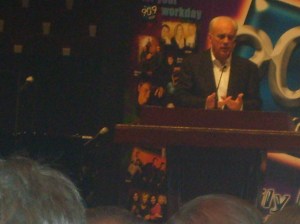
Now that this book is available, naturally, MacArthur has to promote the book. That’s what brought him last Friday to Crossroads Christian Church in Grand Prairie, Texas. I took the opportunity of accompanying my wife to the event to hear him preach all of the above, and then some, for just over an hour (as is his usual habit). Following, are a few pictures from the event:



Worshiping With the Mind
 I started reading Paul S. Jones’ 2006 publication, Singing and Making Music: Issues in Church Music Today. I’m enjoying it very much. Having scanned ahead, I must concur with J. Ligon Duncan’s endorsement which is emblazoned across the front cover. He says, “Theologically astute, musically adept, construcively provocative.” Provocative, indeed. There are some thought-provoking preferences publicshed and recommendations made, of which only someone of Jones’ level of training would ever get around to thinking. But that shouldn’t make us shy away from considering the value of those opinions, but lead us to think a little more thoroughly about all facets of the way we worship God through music in corporate worship.
I thought I’d share an interesting excerpt with you from chapter six, “Leading in Worship as Accompanist.” Jones writes a few paragraphs that reminds us of the importance of spiritual, theological and biblical depth in the words we sing as a church, as well as the fact that accompanists can help highlight the lyrical content of the music in an effort to aid us in comprehending and understanding (and thus properly participating in) what we sing. Jones writes the following on pages 42-44 of his book:
The Accompanist’s Role
The accompanist directly influences singing. This is true not only of congregations, but of choirs and soloists. An accompanist can influence the singer as much as the choir director can (and often more). Why? Because we respond naturally in music to what we hear more than to what we see, read, or are told. For example, in a band or orchestra, the percussion section must be especially attentive to the conductor. If the snare drum moves a little faster or slower than the baton, the entire ensemble will move with the drummer. The percussive nature of the piano has a similar rhythmic effect. The choir or congregation will typically move along with what it hears. The organ, if it is a good one, has sufficient sound capacity to lead with force; but even here it is articulation that provides much of the rhythmic clarity.
So, then, if the accompanist influences the way in which a congregation sings, in what ways is this true? In addition to tempo and rhythm, which have already been mentioned, the accompanist influences volume and dynamic. Pacing (time between verses and how long chords are held), style, and articulation can also be included in the list, as can breathing and ensemble (togetherness/unity). Most significantly, through these various parameters one can affect people’s thinking as well as their connection to the truths being sung.
This last sphere of influence–thought–is the most important, and all the others are connected to it. Thought is missing more and more in worship today. Apparently we are more concerned about our emotional connection and what we are “getting” out of the worship experience than in being cognitively engaged or spiritually awakened. This mindset is one of the primary reasons that hymns have fallen out of popularity and use in many churches. It is because they require thought; and as a people, we do not want to think. Not many years ago I read a short article by a seminary professor in a prominent Christian periodical. He wrote something along the lines of, “Let’s stop being enslaved to the present rationalistic, intellect-centered approach to church that characterizes much of evangelicalism.” Well, he got his wish. Today most evangelicals come to church to be refreshed, not to work or think.
Yet proper worship does take work. It also takes thought, preparation, and action. If we understood that our singing is not for ourselves or directed principally to each other, but to and for God, that understanding would make a difference in how we engage in it. If we were more conscious of the fact that when we sing we are praising God and praying to him, that we are in the presence of the King of Glory, we would realize how important it is to know what we are singing.
Congregational music should deliver Christian doctrine, quote Scripture, or offer a message of challenge or encouragement to fellow believers while pointing all to Christ. Often, congregational song is prayer. How we think about these songs and how we sing them matters. The accompanist has a lot to do with that. I would venture that it is the single most important thing that one does as an accompanist. Such responsibility demands preparation on our parts. It requires practice. . . . “
Presbyterian & Reformed Publishing currently has this listed among their “Bargain Books” going for $8.50, if you’re interested in obtaining a copy. I recommend it for those who want to learn more about how to worship God well through the gift of music.
“Fruit of the Vine”: Three Parts Water, One Part Wine
 A new commenter recently posted a comment on my post from July 31, 2006 on “The Church’s Witness to the Responsible Use of Wine.” Convinced that Keith Mathison’s information about the Church’s early and ongoing use of alcoholic wine, while true, is also misleading, due to Mathison’s lack of reference to its dilution, Barry Traver adds valuable scholarship to the fact that, while the wine used in the Passover before the cross and the Lord’s Supper afterward was certainly fermented, it was also as certainly diluted by three parts water. Following are his remarks which can also be found at the old site at Blogger. I’m posting it here, linking to as many of his references as possible, so that it may benefit those of you who are presently keeping up with this WordPress site. Here are links to the related posts to which Traver responds:
Your post says this:
“We have already mentioned that wine was universally used by the entire church for the first 1,800 years of her existence. During those years, there was never any suggestion that another drink should be used. In the early church, for example, we find clear testimony to the use of wine by such men as Justin Martyr (The First Apology, 65) and Clement of Alexandria (The Instructor, 2.2).”
True, but misleading, since it fails to mention the ancient practice (including 250 B.C. to A.D. 250) of using diluted wine. That fact is brought out clearly in both Justin Martyr and Clement of Alexandria. Read on!
First, let’s look at Charles Hodge’s comments in his Systematic Theology (volume 3, pages 617):”The Elements to be used in the Lord’s Supper…. In most churches, the wine used in the Lord’s Supper is mixed with water. The reasons assigned for this custom, are,
(1.) The eucharist having been instituted at the table of the Paschal supper, and the wine used in the Passover being mixed with water, it is morally certain that the wine used by Christ when instituting this sacrament, was also thus mixed. Hence it was inferred that his disciples in all ages should follow his example. That the Paschal cup contained wine mixed with water rests on the authority of Jewish writers. “It was the general practice of the Jews to dilute their wine with water….” It is certain, from the writings of the fathers, that this custom prevailed extensively in the primitive Church. As the Greeks and Romans were in the habit of mixing water with their wine on all ordinary occasions, it is the more natural that the same usage should prevail in the Church. It is still retained, both by Romanists [i.e., Roman Catholics] and by the Oriental [i.e., Eastern Orthodox] Church.
(2.) Besides this historical reason for the usage in question, it was urged that it adds to the appropriate significance of the ordinance. As water and blood flowed from the side of our Lord on the cross, it is proper, it is said, that water should be mixed with the wine in the service intended to be commemorative of his death….”
Note that Hodge — an advocate of the use of wine in the Lord’s Supper — indicates that “[i]n most churches, the wine used in the Lord’s Supper is mixed with water ….” for two reasons, one based on ancient practice (the “historical reason”) and the other based on “the appropriate significance of the ordinance.” (Hodge is using the word “significance” in its older meaning of a “symbol” or “sign” with a theological reference.)
Like Charles Hodge, Robert Stein — New Testament seminary professor and author of Difficult Passages in the New Testament (Baker, 1990, pp. 233-238) — believes that it “is obvious that the term wine in the Bible does not mean unfermented grape juice….” Stein provides many interesting specifics that support Charles Hodge’s references to “the Greeks and Romans,” “Jewish writers,” and “the writings of the [Church] fathers” on the “prevailing custom” of diluting wine with water:”
In ancient Greek culture, … [w]hat is important to note is that before wine was drunk, it was mixed with water…. The ratio of water to wine varied. Homer (Odyssey 9.208-9) mentions a ratio of twenty parts water to one part wine. Pliny (Natural History, 14.6.54) mentions a ratio of eight parts water to one part wine…. [Stein also mentions Hesiod (three to one), Alexis (four to one), Diocles (two to one), Ion (three to one), Nicochares (five to two), and Anacreon (two to one).] [As] a beverage [wine] was always thought of as a mixed drink. Plutarch (Symposiacs 3.9), for instance, states, ‘We call a mixture “wine,” although the larger of the component parts is water.’ The ratio of water might vary, but only barbarians drank wine unmixed, and a mixture of wine and water of equal parts was seen as ’strong drink’ and frowned upon. The term wine or oinos in the ancient Greek world, then, did not mean wine as we understand it today, but wine mixed with water. Usually a writer simply referred to the mixture of water and wine as ‘wine.’…”
And we … have examples in both Jewish and Christian literature … that wine was likewise understood as being a mixture of wine and water. In several instances in the Old Testament a distinction is made between ‘wine’ and ’strong drink.’…. The 1901 Jewish Encyclopedia (vol. 12, p. 533) states that in the rabbinic period at least, ‘ “yayin”‘ [wine] is to be distinguished from “shekar” [strong drink]: the former is diluted with water…; the latter is undiluted….’ In the Talmud, which contains the oral traditions of Judaism from about 200 B.C. to A.D. 200 (the Mishnah)…, there are several tractates in which the mixture of water and wine is discussed…. In a most important reference (Pesahim 108b) the writer states that the four cups every Jew was to drink during the Passover ritual were to be mixed in a ratio of three parts water to one part wine. From this we can conclude with a fair degree of certainty that the fruit of the vine used at the institution of the Lord’s Supper was a mixture of three parts water to one part wine. In another Jewish reference from around 60 B.C. we read, ‘It is harmful to drink wine alone, or again, to drink water alone, while wine mixed with water is sweet and delicious and enhances one’s enjoyment’ (2 Macc.15:39). In ancient times there were not many beverages that were safe to drink…. The drinking of wine (i.e., a mixture of water and wine) served therefore as a safety measure, since often the water available was not safe….”The burden of proof … is surely upon anyone who would say that the wine of the New Testament is substantially different from the wine mentioned by the Greeks, the rabbis during the Talmudic period, and the early church fathers.
In the writings of the early church fathers it is clear that ‘wine’ means wine mixed with water. Justin Martyr around A.D. 150 described the Lord’s Supper in this way: ‘Bread is brought, and wine and water, and the president sends up prayers and thanksgiving’ (Apology 1.67.5)…. Cyprian around A.D. 250 stated….: ‘Nothing must be done by us but what the Lord first did on our behalf….. Thus, therefore, in considering the cup of the Lord, water alone cannot be offered, even as wine alone cannot be offered….’ (Epistle 62.2, 11, 13). Here it is obvious that unmixed wine and plain water were both found unacceptable at the Lord’s Supper. A mixture of wine and water was the norm…. Earlier (the latter part of the second century) Clement of Alexandria had stated: ‘It is best for the wine to be mixed with as much water as possible…. To … the water, which is in the greatest quantity, there is to be mixed in some of the [wine]….” (Instructor, Book II, Chapter 2, page 243 [A.D. 182-212]).
If wine in Bible times had a maximum alcoholic content of 12% undiluted and if it is true that “we can conclude with a fair degree of certainty that the fruit of the vine used at the institution of the Lord’s Supper was a mixture of three parts water to one part wine,” then that would put the alcohol content of wine used for the Lord’s Supper at 3% or less.
–Barry Traver
First Edition of the Daily Evangel Rolls Off the Press!
 Spider-Man has the Daily Bugle; Superman has the Daily Planet; now, your (all ten of you) favorite Reformed superhero, Captain Headknowledge features a newspaper of his own . . . The Daily Evangel!
That’s right: The Daily Evangel. I thought this would not only be a clever imitation of Clark Kent’s newspaper, but that it would also be a daily reminder to those of you who believe in Christ-Centered Preaching, and Living the Cross-Centered Life, to “preach the gospel to yourself.”
I know that a few days ago, I set up RSS feeds to Reformation Theology and Out of Ur, to direct you to more solid Reformed reading and to keep your finger on the pulse of “The State of Evangelicalism.” Well, the idea took root in that condition, but now it is bearing fruit in a different form.
Just under the list of pages in the sidebar, you’ll notice the Daily Planet-like logo of the Daily Evangel, under which will follow the ESV Daily Bible Verse, “Reformed News & Views,” featuring the RSS feed from Reformation21, and “Evangelical News & Views,” featuring that of Christianity Today Magazine. I’m toying with politics and sports (don’t get excited, guys, sports to me is arguing theology–hint-hint!), but those sections haven’t gelled just yet, so, to mix my metaphors, “stay tuned.” In the meantime, I hope you benefit from the daily short Scripture reading and from keeping up with current events and “commentary” on the Reformed and Evangelical fronts in the headlines of the Daily Evangel–and most of all, don’t forget to preach the gospel to yourself everyday to strengthen your faith and sanctification!
Reforming Your Best Life Now
 January 31, 2008 was the release date for J. I. Packer’s latest short book, Keeping the Ten Commandments, published by Crossway. I was notified by Amazon.com a few days before its release and immediately placed the order. Now that it’s in my hands, and I’ve begun reading it, I would like to recommend the book to you as a great introduction to the Reformed theology of the relevance of the Ten Commandments in the Christian life. At the same time, it will serve as a great antidote to the man-centered, motivational self-help pop-psychology that passes itself off nowadays as teaching on practical Christian living, or the victorious Christian life. In other words, set aside your “What Would Jesus Do” moralism, Osteen’s “Your Best Life Now,” and anything else that fits in that category and go straight to the source, the Ten Commandments, and learn how to properly apply it to your life as a Christian.
Some may wonder what place the Law has if Christ has fulfilled the Law, and the New Testament says simply to “love one another.” This book will explain it to you. The New Testament didn’t eliminate the Christian’s need to be regulated by God’s moral Law. True Christ-centered living involves a certain kind of reference to the Ten Commandments. I call it the “Law-Gospel Cycle”: The Law points to the Gospel that sinners may be justified by grace through faith; the Gospel points saints to the Law that they may be sanctified by grace through faith which works by love. But enough of my misadventures in exposition, I want you to see some excerpts from Packer himself.
Rightly, Reformation theology did not separate God’s law from God himself, but thought of it personally and dynamically, as a word that God is continually publishing to the world through Scripture and conscience, and through which he works constantly in human lives. Spelling out this approach, Reformed theologians said that God’s law has three uses or functions: first to maintain order in society; second, to convince us of sin and drive us to Christ for life; third, to spur us on in obedience, by means of its standards and its sanctions, all of which express God’s own nature (p. 110).
For the Commandments are God’s edict to persons he has loved and saved, to whom he speaks in “I-you” terms at each point. “I am the LORD your God, who brought you out . . . You shall . . . ” The ten directives, which embody the Creator’s intention for human life as such, are here presented as means of maintaining a redeemed relationship already given by grace. And for Christians today, as for the Jews at Sinai, law-keeping (that is, meeting the claims of our God, commandments 1-4, and our neighbor, commandments 5-10) is not an attempt to win God’s admiration and put him in our debt, but the form and substance of grateful, personal response to his love (pages 30-31).
Place your order soon. It’s a great eight-to-ten dollar investment in Reforming your best life now for God’s glory.
At Last! The Captain on Luther–Audio!

 On Reformation Sunday, 2004, which happened to be Reformation Day itself, my
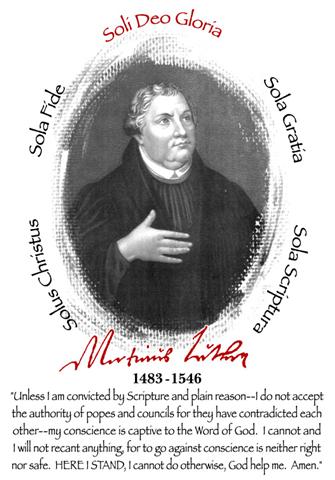 Southern Baptist pastor allowed me to give an oral presentation on Martin Luther at church. Not being a trained, or even talented, speaker, I desired a crutch, so I put together a Power Point slide show to illustrate my presentation. I thought it would also help me make it through my outline as well. I always hoped I’d be able to share it with you, but back when I did the show, I was even more green computer-wise than I am now, so I just recently figured out how to get one of those “My Public Box” thingies in my sidebar and uploaded it. If you’d like to listen, you are certainly invited.
Some of you Luther scholars out there may detect a less than accurate date or fact or two, but give me a break, I’m an amateur. I did what I could with what I had. So, without further ado, if you go over to the black box in the sidebar and click on the top selection, entitled “Reformation Sunday and Gideon Report” (that’s right those Gideons, remeber them?), then you can give it a listen. I know it’s not October or anything, but some of you may enjoy it, if you like mediocre speaking. You can also view the slide show below. . .


 The Misadventures of Captain Headknowledge