The “Deformed” Theological Pedigree of Murder
Here’s an interesting article from the Weekly Standard on the theological background of those who believe it’s justifiable to murder abortion doctors. What’s scary about it is how people can get so close to the truth and then twist it to extremes. The other scary thing is how closely tied to Reformed theology this aberration is.
Changing of the Guard at Coral Ridge
 The news has just reached me that the search for a new pastor has come to an end at Coral Ridge Presbyterian Church, in Fort Lauderdale, Florida. Last year’s loss of Dr. D. James Kennedy has certainly brought much change and transition to the local congregation. It certainly came immediately to the Coral Ridge Hour television show. The formerly hour-long program was immediately reduced to a half hour, cutting out my favorite part of the program, the music. From the exhilerating one verse processional, during which the choir and pastor enter the sanctuary and take their places to open the service, to the choir specials and classical solo features, it was part of my weekly preparation for worship at my own church. As a concession, I noticed that they began to squeeze in the song that is sung after the sermon, for which I was grateful, but it certainly was not the same.
 But I digress. The Session (or, board of Ruling Elders) of Coral Ridge Presbyterian Church, whose concern is to shepherd a large, influential church without a Teaching Elder (Pastor), has recently called a young minister of some noteriety who is building a church which has yet to obtain its own building. In this way, its quite an interesting match–a church without a pastor offers its building to a church with a pastor but not a building. That’s right, they’re not just calling the pastor, they’re negotiating a merger. The name of said minister of note, who has received a call to pastor Coral Ridge, is Tullian Tchividjian (the last name rhymes with “religion”). Rev. Tchividjian is an up-and-coming pastor in the Evangelical Presbyterian Church, (Coral Ridge is in the Presbyterian Church in America) who happens to be the grandson of “America’s Pastor,” Evangelist Billy Graham. But many Reformed believers may know him better as the guy featured in the promotional videos that recently introduced the Bible reading public to the new ESV Study Bible (which study Bible I highly recommend).
You can read the SunSentinel.com report on Rev. Tchividjian’s call and the subsequent merger negotiations here, and you can also keep up with the ongoing process at his New City Presbyterian Church blog (here, here, here, for starters). While this is an interesting event, I must say that in the inevitable changes that will come to the church, especially grievous to me personally will be any metamorphosis of Coral Ridge’s amazing music ministry, which, while it was technically “blended” (combining the singing of traditional hymns with contemporary music), it was effectively presented in a manner that majored on the classical, “traditional,” even the liturgical. One Reformed blog, Green Baggins, expresses concerns (read it here) similar to mine. I share some of this blogger’s concerns, especially about the implications of contemporary worship music, and the possibility of a “seeker sensitive” approach to the church’s ministry, although some of the comments on his post help alleviate my concerns.
Be that as it may, I’m glad to see that a changing of the guard is in the works, and I wish both churches (Coral Ridge and Tchividjian’s New City Pres.) the reformation and revival for which both are praying and working. May the Lord grant it to the advancement of his Kingdom throughout Florida, and, through their various TV and radio ministries, America and the world.
The Denomination Blues
In case you don’t know, I’m a music lover. And although I decidedly come down on the “traditional” side in the worship wars (in fact, I just got my “Organ Music Rocks” t-shirt from Old Lutheran dot com!), I happen to enjoy some of the music produced by some of those who may differ with me on that issue, I just happen to reserve it “for entertainment purposes only”. Not that I don’t find it edifying as well, at times.
For instance, when it comes to Southern Gospel music, there is very little that I can stand for very long. One or two songs and I’m pretty well done. Any more than that, and I start getting visibly uncomfortable. But not so in the case of Reformed Presbyterian harmonica player extraordinaire, Buddy Greene (visit his official site). I could listen to him all day. I just added a few YouTube videos of Greene excercising his gift to my personal YouTube page (you can visit it here). The first song is “Denomination Blues” (no harmonica in this one) and he pokes fun at a few select denominations, starting with his own (even false churches like Roman Catholicism and Unitarianism). But I was surprised that he didn’t have a verse on the Baptist denomination. If you can write a good one in the vein of Buddy Greene’s song, post it in the comments. I’ll add mine when I come up with one, too.
Here’s one where he pulls out his harmonica. It’s one of my all-time favorite songs, “God Is With Us.” This has more of a black gospel feel to it:
Riddlebarger on the Necessity of Church Discipline
I just wanted to post my “Amen!” to Dr. Kim Riddlebarger’s recent post which emphasizes the logical conclusion of an absence of church discipline.
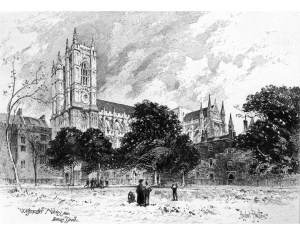
Westminster Abbey, thanks to reformationart.com
In chapter 30 of the Westminster Confession of Faith, “Of Church Censures,” a good summary of the biblical case for church discipline is outlined.
I. The Lord Jesus, as king and head of His Church, has therein appointed a government, in the hand of Church officers, distinct from the civil magistrate. (Isaiah 9:6-7; 1 Timothy 5:17; 1 Thessalonians 5:12; Acts 20:17-18; Hebrews 13:7, 17, 24; 1 Corinthians 12:28; Matthew 28:18-24)
II. To these officers the keys of the kingdom of heaven are committed; by virtue whereof, they have power, respectively, to retain, and remit sins; to shut that kingdom against the impenitent, both by the Word, and censures; and to open it unto penitent sinners, by the ministry of the Gospel; and by absolution from censures, as occasion shall require. (Matthew 16:19; 18:17-18; John 20:21-23; 2 Corinthians 2:6-8 )
III. Church censures are necessary, for the reclaiming and gaining of offending brethres, for deterring of others from the like offenses, for purging out of that leaven which might infect the whole lump, for vindicating the honor of Christ, and the holy profession of the Gospel, and for preventing the wrath of God, which might justly fall upon the Church, if they should suffer His covenant, and the seals thereof, to be profaned by notorious and obstinate offenders. (1 Corinthians 5; 1 Timothy 5:20; Matthew 7:6; 1 Timothy 1:20; 1 Corinthians 11:27-34; Jude 23)
IV. For the better attaining of these ends, the officers of the Church are to proceed by admonition; suspension from the sacrament of the Lord’s Supper for a season; and by excommunication from the Church; according to the nature of the crime, and demerit of the person. (1 Thessalonians 5:12; 2 Thessalonians 3:6, 14-15; 1 Corinthians 5:4, 13; Matthew 18:17; Titus 3:10).
Are you a populist, or cosmopolitan?
Those are the categories utilized by Michael Lindsay, assistant professor of sociology at Rice University,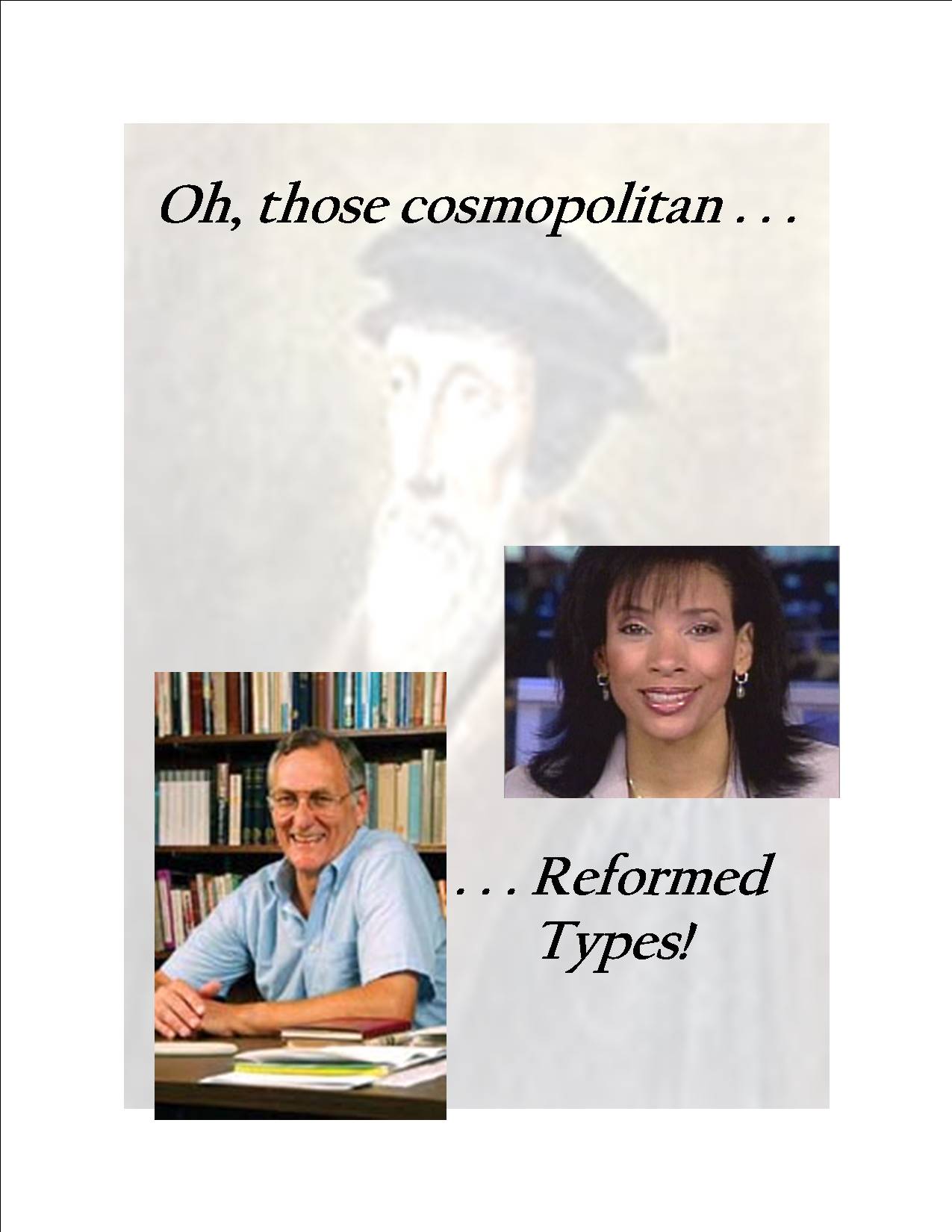 and author of Faith in the Halls of Power: How Evangelicals Joined the American Elite. When Lindsay spoke recently at the Pew Forum’s semi-annual Faith Angle Conference on religion, politics and public life, he used these categories to describe the division in the ranks of politically active American evangelicals.
Lindsay on Populists: “You see, populist evangelicals are what we oftentimes think about evangelicals. These are the folks who are culture warriors, who say that they want to take back the country for their faith. They see themselves as embattled against secular society. They are very much concerned that they are in a minority position, and they’ve got to somehow use very strong-arm tactics to win the day.”
Lindsay on Cosmopolitans: “They are less interested in taking back the country for their faith. They really are more interested in their faith being seen as authentic, reasonable, and winsome. So they still have an evangelistic impulse, but their whole modus operandi looks quite different. Because of that they have different ultimate goals of what they are actually trying to achieve. They want to have a seat at the table. They want to be seen as legitimate. They are concerned about what The New York Times or TIME magazine thinks about evangelicals because they [the cosmopolitan evangelicals] are concerned about cultural elites. They want legitimacy. Legitimacy is actually more important to them than necessarily taking back the country.”
Notable among the cosmopolitan group were Reformed Christians. Here’s what he said about them.
“There are some theologically literate cosmopolitan evangelicals, people who are able to articulate how their faith matters and drives them to particular positions, but the interesting thing about that is that almost all of them come from the Reformed tradition. The rise of Presbyterian kind of theology has been very interesting to observe. Abraham Kuyper has been one of the figures that is oftentimes cited among the people I interviewed.”
Then Lindsay mentions one significant Reformed theologian who is partly to be credited with the emergence of Reformed theology in the American evangelical community. David Wells. “I got in touch with a theologian named David Wells who has just written a book. I’ll promote his book since I don’t have one of my own. His book is The Courage to be Protestant: Truth Lovers, Marketers, and Emergents in the Postmodern World. And he has a different dichotomy of the outlook of the evangelical landscape.” So Lindsay explains Wells’ breakdown. But I don’t want to spoil it for you. I want you to go read the whole transcript. It will give you a good idea of what is going on among us voting evangelicals.
Normally, I don’t post on politics, but politics is only one factor. I’m interested in this also for the historical and theological associations. If you want my views on politics, you’ll have to email me or send me a message at my Facebook page.
Finally, there was another Reformed individual, who, in her vocation, is associated with all of this. The chief religion correspondent from FOXNews Channel, Lauren Green, happened to be in attendance at the conference and piped up with some questions when she heard her church referenced. That church would be Redeemer Presbyterian in New York City. I found that interesting. It’s nice to learn about the faith of the talking heads you listen to. So now Lauren is “outed” if you will as Reformed!
You Just Gotta Check Out The ESV Study Bible!
You just gotta see this! If you don’t own a study Bible yet, don’t bother shopping around. The ultimate study Bible is going to be released on October 15, 2008. Many of my Reformed blogging buddies are already aware of this monumental achievement, and most are undoubtedly awaiting it’s arrival as eagerly as I am, even though we’ve already got a shelf full of various study Bibles. But for those of you who are shy of solid resources that can help you understand the meaning of Scripture, the backgrounds of the places in the Bible, even instruction on Christian living, ethics and material that can clue you in on what many of the major world religions believe as compared with what the Bible teaches (and who knows what else?), your search need go no further. The ESV Study Bible will provide all of this for you, and then some, with full color maps and illustrations all over the place!
I just watched some of the promotional videos describing the project, the vision behind it and the contents of the product, and it is intended to be the equivalent of a miniature version of a multi-volume library on a broad cross-section of information vital to not only learning the Word of God, but also to personal growth in grace, and even to aid in the work of gospel ministry. The ESV Study Bible promises to be useful to layman, teacher and pastor alike.
Take a look at the following videos, hosted by PCA pastor and grandson to Billy Graham, Tullian Tchividjian , in which he will introduce the purpose of the ESV Study Bible and then take you on a guided tour of the contents. Seeing is believing . . .
If you’d like to see more of the videos, they are available at the Video Resources page of the ESV Study Bible website, which you can access by clicking on the colorful button near the top of the sidebar, just under the portrait of our blog mascot and namesake.
Even though the ESV Study Bible will come in a variety of bindings including the traditional leather, it’s so chock full of amazing resources that it may prove a bit cumbersome, were one wanting to carry it to church. In my opinion, this isn’t that kind of Bible. It’s a study resource, not a tag along Sunday-go-to-meetin’ Bible. For that reason, I’m getting the hardback edition, which comes with the additional feature of being the least expensive of all the varieties. But I must confess, that when, Lord willing, I obtain my copy, I may not be able to part with it for a few weeks, so it may in fact tag along with me to church now and then. But I’ll try to pay attention to the sermon, anyway. 😉
Calvinism, Coming to a Young Christian Near You!

Click image to purchase at WTS Books
There’s a book out chronicling the resurgence of Calvinism among the, pardon the expression (keep in mind, I’m using it correctly), emerging generation of teens, twenty-, and thirty-somethings (including myself) who are disillusioned with the shallow theology and over-emphasis on you name it, revivalism, pietism, experientialism, commercialism of the twentieth century. As you know, the list of misguided varieties could go on.
So many of us who’ve grown up as a either a fundamentalist or evangelical Christian have come to the conclusion that what is needed is for the church to get back to the basics of what it means to be a Christian. The basics of Christianity as understood in a broader way than just re-examining my Bible and reconstructing my own version of what I think is the clear teaching of Scripture regarding faith and practice (which is what most of the previous generation think it means to get back to the basics).
Such a tactic is part of the problem–it’s too self-centered and individualistic and often far too reductionistic. It’s not a matter of just throwing out current traditions and starting over with a clean slate. It’s not about reinventing the wheel–those are the kinds that never turn out round. What I’m talking about is getting on the right track–yes, the most biblical track, the most Christian track, the most Protestant track, the most truly evangelical track–a track I didn’t lay myself, but was laid by the faithful followers of Christ who genuinely changed the world in their generation as did the first century apostolic generation.
What generation am I talking about? I’m talking about the generation that laid the tracks of conservative evangelical, confessionally Reformed, Christ-centered Protestant theology. The generation identified in the history books as the Reformers.
I read once that Socrates is known for saying, “Sometimes regress is progress.” The bill of goods that we were sold in the 20th century told us that what’s happening now is better than what happened back then. The present is always preferable to the past. The new is more relevant than the old. Well, some of us have learned that sticking “new and improved” on something doesn’t mean a thing. Some of us have learned that if conservative evangelical, or fundamentalist Christianity is going to make any progress, we’re going to have to regress back to a time when things were genuinely being done right and learn from both their successes and mistakes, receiving the faith in tact as handed down by them and not as re-imagined by modern philosophical influences, be they pragmatism, modernism or post-modernism. Progress will only come through this kind of regress.
Second Timothy 2:2 puts it best: “and what you have heard from me in the presence of many witnesses entrust to faithful men who will be able to teach others also.” But lots of people are entrusting lots of things to lots of “faithful men.” Which version of Christianity is best? There’s a number of us in this new generation who are firmly convinced that what the apostolic churches passed on to faithful men who led the post-apostolic generation, got deformed in the medieval era and was reformed in the sixteenth and seventeenth centuries is the “basics” to which the 21st Century generation of Christians needs to get back to. So much that has transpired since the Reformation era leaves so much to be desired that we don’t trust much of it at all. That’s why we’re turning to Calvinism, also known as Reformed theology.
Journalist Collin Hansen has written Young, Restless, Reformed: A Journalist’s Journey with the New Calvinists. It tells our story. Martin Downes has reviewed the book over at Reformation21.org. Read all about it, then find your place in the 21st Century Reformation.
Theological & Doxological Meditation #45
 Q. Which is the first commandment?
A. The first commandment is, You shall have no other gods before me (Exodus 20:3).
Holy, holy, holy! Lord God Almighty!
Early in the morning our song shall rise to thee.
Holy, Holy, holy! Merciful and mighty
God in three Persons, blessed Trinity!
Holy, holy, holy! All the saints adore thee,
casting down their golden crowns around the glassy sea;
cherubim and seraphim falling down before thee,
who wert, and art, and evermore shalt be.
Holy, holy, holy! Though the darkness hide thee,
though the eye of sinful man thy glory may not see,
only thou art holy; there is none beside thee
perfect in pow’r, in love, and purity.
Holy, holy, holy! Lord God Almighty!
All thy works shall praise thy name in earth and sky and sea.
Holy, holy, holy! Merciful and mighty!
God in three Persons, blessed Trinity!
#100 Trinity Hymnal; Reginald Heber, 1783-1826; NICEA 11.12.12.10.; John B. Dykes, 1861
Theological & Doxological Meditation #44
Preface’s Teaching
Q. What does the preface to the ten commandments teach us?
A. The preface to the ten commandments teaches us, that because God is the Lord, and our God, and Redeemer, therefore we are bound to keep all his commandments (Luke 1:74-75; 1 Peter 1:15-18).
What shall I render to my God for all his kindness shown? My feet shall visit thine abode, my songs address thy throne.
How much is mercy thy delight, thou ever-blessed God! How dear thy servants in thy sight! How precious is their blood!
How happy all thy servants are! How great thy grace to me! My life, which thou hast made thy care, Lord, I devote to thee.
Now I am thine, forever thine, nor shall my purpose move; thy hand hath loosed my bonds of pain, and bound me with thy love.
Here in thy courts I leave my vow, and thy rich grace record; witness, ye saints who hear me now, if I forsake the Lord.
#637, Trinity Hymnal; from Psalm 116:12-19; Isaac Watts, 1719; DOWNS C.M.; Lowell Mason, 1832
First Edition of the Daily Evangel Rolls Off the Press!
 Spider-Man has the Daily Bugle; Superman has the Daily Planet; now, your (all ten of you) favorite Reformed superhero, Captain Headknowledge features a newspaper of his own . . . The Daily Evangel!
That’s right: The Daily Evangel. I thought this would not only be a clever imitation of Clark Kent’s newspaper, but that it would also be a daily reminder to those of you who believe in Christ-Centered Preaching, and Living the Cross-Centered Life, to “preach the gospel to yourself.”
I know that a few days ago, I set up RSS feeds to Reformation Theology and Out of Ur, to direct you to more solid Reformed reading and to keep your finger on the pulse of “The State of Evangelicalism.” Well, the idea took root in that condition, but now it is bearing fruit in a different form.
Just under the list of pages in the sidebar, you’ll notice the Daily Planet-like logo of the Daily Evangel, under which will follow the ESV Daily Bible Verse, “Reformed News & Views,” featuring the RSS feed from Reformation21, and “Evangelical News & Views,” featuring that of Christianity Today Magazine. I’m toying with politics and sports (don’t get excited, guys, sports to me is arguing theology–hint-hint!), but those sections haven’t gelled just yet, so, to mix my metaphors, “stay tuned.” In the meantime, I hope you benefit from the daily short Scripture reading and from keeping up with current events and “commentary” on the Reformed and Evangelical fronts in the headlines of the Daily Evangel–and most of all, don’t forget to preach the gospel to yourself everyday to strengthen your faith and sanctification!
The Pelagian Drinking Song
 Several years ago, back when I worked at “The Reformation Station,” Dr. Tom Browning taught a series on “The History of the Doctrine of Justification” (which I hear will be available in the future from his website!) at Arlington Presbyterian Church, Arlington, Texas. One of the lessons was on the debate between Augustine and Pelagius over the necessity of God’s grace in overcoming original sin. Dr. Browning had requested that my then boss, Randy Buster (founder of “The Reformation Station”), arrange a tune to a song he’d dug up in his studies about Pelagianism. It’s a hilarious song called “The Pelagian Drinking Song.”
I recently thought to email these dear brothers of mine to request the recording of Randy Buster’s arrangement of Hillaire Belloc’s “The Pelagian Drinking Song” and permission to blog about it. You can listen to this recording in the black Box.net widget toward the bottom of my sidebar.
And now, without further ado, I give you, “The Pelagian Drinking Song,” by Hilaire Belloc, through the teaching ministry of Dr. Tom Browning and the musical arrangement and perfomance of Randy Buster:
The Pelagian Drinking Song, by Hillaire Belloc (1870 – 1953)
Pelagius lived at Kardanoel
And taught a doctrine there
How, whether you went to heaven or to hell
It was your own affair.
It had nothing to do with the Church, my boy,
But was your own affair.
No, he didn’t believe
In Adam and Eve
He put no faith therein!
His doubts began
With the Fall of Man
And he laughed at Original Sin.
With my row-ti-tow
Ti-oodly-ow
He laughed at original sin.
Then came the bishop of old Auxerre
Germanus was his name
He tore great handfuls out of his hair
And he called Pelagius shame.
And with his stout Episcopal staff
So thoroughly whacked and banged
The heretics all, both short and tall –
They rather had been hanged.
Oh he whacked them hard, and he banged them long
Upon each and all occasions
Till they bellowed in chorus, loud and strong
Their orthodox persuasions.
With my row-ti-tow
Ti-oodly-ow
Their orthodox persuasions.
Now the faith is old and the Devil bold
Exceedingly bold indeed.
And the masses of doubt that are floating about
Would smother a mortal creed.
But we that sit in a sturdy youth
And still can drink strong ale
Let us put it away to infallible truth
That always shall prevail.
And thank the Lord
For the temporal sword
And howling heretics too.
And all good things
Our Christendom brings
But especially barley brew!
With my row-ti-tow
Ti-oodly-ow
Especially barley brew!


 The Misadventures of Captain Headknowledge