Daniel’s Place in the Canon and Among the Prophets
4. The position which the book of Daniel occupies in the Hebrew Canon seems at first sight remarkable. It is placed among the Holy writings between Esther and Ezra, or immediately before Esther (cf. Hody, De Bibl. Text. p. 614, 645), and not among the prophets. This collocation, however, is a natural consequence of the right apprehension of the different functions of the prophet and seer. It is not, indeed, certain at what time the triple division of the Scriptures which is preserved in the Hebrew Bibles was first made; but the characteristics of the classes show that it was not based on the supposed outward authority, but on the inward composition of the books. Daniel, as the truth has been well stated, had the spirit but not the work of a prophet; and as his work was a new one, so was it carried out in a style of which the Old Testament offers no other example. His Apocalypse is as distinct from the prophetic writings as the Apocalypse of St. John from the apostolic epistles. The heathen court is to the one seer what the isle of Patmos is to the other, a place of exile and isolation, where he stands alone with his God, and is not like the prophet active in the midst of a struggling nation (Auberlen, p. 34).
From, Daniel, Book of.
Dr. William Smith’s Dictionary of the Bible (Link on editor; Link on Dictionary)
Comprising its
ANTIQUITIES, BIOGRAPHY, GEOGRAPHY, AND NATURAL HISTORY.
Revised and Edited by Professor H. B. Hackett, D. D.
with the cooperation of Ezra Abbot, LL. D., Assistant Librarian of Harvard College
Copyright, 1868 and 1896, by HURD AND HOUGTON and HOUGHTON, MIFFLIN & CO.
Reprinted 1981 by Baker Book House Company
Four-volume Set ISBN: 0-8010-8211-0
The Masculine Mandate, part 2
The following is Q&A #2 from Christ the Center, episode 87 on Richard Phillips’ soon-to-be-released title The Masculine Mandate, published by Reformation Trust. In this discussion, Phillips explains the difference between his approach to applying Genesis 2:15 and that of John Eldridge in his best-selling book, Wild at Heart.
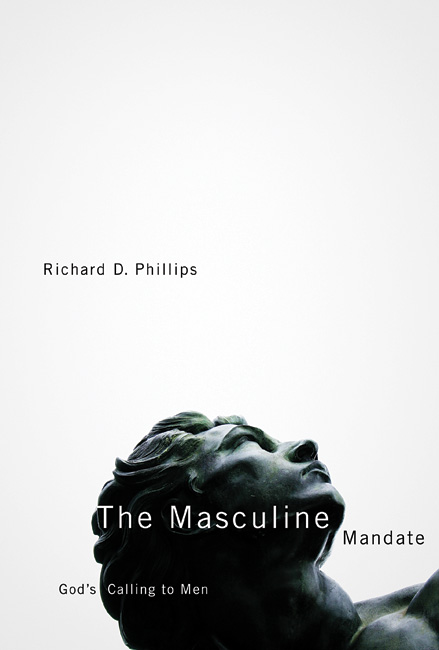 Host: I was intrigued by how you unpacked the mandate given to Adam to dress and keep the garden and how they work out in the physical realm of work and whatever labor you’re doing and in regard to your wife and children. It reminded me of the way Murray goes back in Principles of Conduct and roots everything in the creation ordinance. I had never heard that developed as much. Were these things you were reading, or was it just from your own study of Scripture that you were thinking about what was the principal work–what made a man a man, out of Genesis?
Richard Phillips: Well, you know, I mean, for the sake of the people who haven’t read the unpublished book, in Genesis 2:15, God says he placed Adam in the garden, and charged him to work it and keep it, and this book is an exposition of Genesis 2:15, which I’m describing as the masculine mandate. God put him in the garden to work it and keep it.
You know, what got me going on this was the book Wild at Heart. Because the first time I was asked to speak on this stuff, I got a copy of Wild at Heart, because I knew it was a massive best-seller, and I was absolutely mortified to read the first couple of chapters. He actually makes the statement that man was made out of the garden, and so he is undomesticated, and a male’s life is a life long quest to get in touch with your masculine side. Can you imagine Ronald Reagan making a statement like that?
No real men talk that way! “I’m on a quest for my masculinity.” That what life is, because Genesis 2:15 says–this is what he actually says–it’s a classic example of Bizarro hermeneutics–dominating today: God placed him in the garden, therefore he belongs out of the garden! And the way to get in touch with your masculine self is to get out of the place where God put you, and, as I put it in the book–I think you gotta think in these terms–you know, God placed Adam in the created, covenantal world with God-given relationships, duties and obligations. And Eldridge says, no no, you gotta go on a wilderness quest–ego trips, basically–self-quest. He actually goes so far as to say that Jesus’ forty days’ fast in the wilderness was Jesus seeking his masculine identity. I was just utterly horrified!
Well, I started reflecting on it, and I started thinking well he is right that this verse is paradigmatic. But it’s the exact opposite of what he’s teaching.
And I think, you know, two or three years ago, I did some men’s conferences, I just said, “Hey, let’s look at Genesis 2:15.” And I’m well aware that people are reading this book. I got my first copy of Wild at Heart, when an elder at my church (not this church) handed me a copy–how great the book was, and we need to buy the DVD curriculum of Wild at Heart to show all of our men.
Well, I read the book, and I go ballistic! But it occurs to me that he’s right that Genesis 2:15 is a very important statement. That’s what got me going in this direction. . .
. . . to be continued.
The Masculine Mandate, part 1
Episode #87 of Christ the Center, podcast by the Reformed Forum featured an interview with Dr. Richard Phillips regarding his new book The Masculine Mandate. Dr. Phillips says it’s primarily an exposition and application of Genesis 2:15, which reads, “The LORD God took the man and put him in the Garden of Eden to work it and keep it.” This verse, he says, is the foundational paradigm of the Scripture’s entire revelation of the male’s, or husband’s, role.
Since whenever I link to programs such as this, almost no one takes the time to go and listen, I’m transcribing the interview in a series of blog posts because I find this material to be especially needful for everyone. In this first post in the series, Dr. Phillips explains his reasons for writing the book.
Host: What did you see in men’s lives that needed to be addressed, which lead you to write this book? (Summary of the host’s actual wording)
Dr. Phillips: As is usually the case with books, there are several reasons why I wrote this book: one is, I was frustrated by the low quality of many evangelical books dealing with masculinity. Most especially, John Eldridge’s mega best-seller Wild at Heart, which is just unbiblical.
I was actually having dinner with Jerry Bridges, probably three or four years ago—and he lives out there in Colorado Springs—and we were lamenting this. I said, “Jerry, you ought to write a book on this.” And he didn’t have time, or whatever.
Meanwhile, I was asked by several conferences to speak on things like this. There was a group in Georgia two years ago who asked me to do a multi-day men’s conference.
Lig Duncan had me out to Jackson last year, to the Mid-South Men’s Rally. And so I was needing just for ministry requests, to put together biblical material. My own approach is always to exposit the Word, so if I’m asked to do a men’s conference, I’m going to exposit the Word. That got me dealing with these things.
And also, just as a pastor, I’m well aware, just as everybody is, today we’ve got a real masculinity problem in the culture and in the church. I mean, it is my view that, we talk about feminism, and all of those problems—look, we’ve got a far bigger problem with godly masculinity. In many of our churches we’ll have tlots more available, godly, marriageable women. Then we have . . . men in the church, but they’re not as mature so often. And I do believe that we have a great need for biblical instruction on masculinity.
Now, you start working on this stuff, and you start thinking about it, and you start becoming very impressed with the power of what the Bible says. As I say early on in the book, we know that when it comes to marriage and men in ministry and these sorts of things, that the New Testament directs us back to the early chapters of Genesis. If we’re going to say, “What does it mean to be a man? What is my calling as a man? What am I supposed to do to be a godly man? The answer is, go back and read Genesis 2. And what we’ll find is biblical teaching that is, in fact, a biblical paradigm.
What we read in Genesis 2 about God’s calling to Adam as the man, does in fact, have a paradigmatic influence that we will see pervading all of Scripture. And yet there’s very little teaching about the masculine mandate—that’s what I call Genesis 2:15. That there is a clear calling given to men, that will be seen playing out through the book of Proverbs, playing out through biblical examples of fatherhood, husband and Christian leadership. And it plays straight into the New Testament teaching. And I just came to believe that there is a need for some clear biblical teaching on this.
To be honest with you, it was a hard book to write, because most of my books will come out of my pulpit ministry. My working life is geared that way. I do a sermon on Sunday morning, I preach Sunday evening, I teach Wednesday night. I don’t have a lot of free time beyond that. So this book killed me. I mean, to write a book on the side—most of my books are biblical exposition flowing out of my pulpit ministry-but this one was a labor of love, because I just felt I had to get it done. Not that the world needs my book, but, I just felt an obligation to write this book.
It was not a book that I had time to do, but I just felt that there’s a great need for this, and I’m hopeful the Lord will bless it. You know, I ended up getting in about a year late, because you want to do it right.
But that’s why I wrote the book, just out of my own experiences, being asked to do work in it, and a profound sense that this material has to get out there.
The Outlined Book of Daniel
3. The book is generally divided into two nearly equal parts. The first of these (1-6) contains chiefly historical incidents, while the second (7-12) is entirely apocalyptic. This division is further supported by the fact that the details of the two sections are arranged in order of time, and that the commencement of the second section falls earlier than the close of the first, as if the writer himself wished to mark the division of suject. But on the other hand this division takes no account of the difference of language, nor of the change of person at the beginning of chapter 8. And though the first section is mainly historical, yet the vision of chapter 7 finds its true foundation and counterpart in chapter 2.
From these circumstances it seems better to divide the book (Auberlen, p. 36 ff.) into three parts. The first chapter forms an introduction. The next six chapters (2-7) give a general view of the progressive history of the powers of the world, and of the principles of the divine government as seen in events of the life of Daniel. The remainder of the book (8-12) traces in minuter detail the fortunes of the people of God, as typical of the fortunes of the Church in all ages.
The second section (2, 7) is distinguished by a remarkable symmetry. It opens (in chapter 2) with a view of the great kingdoms of the earth revealed to a heathen sovereign, to whom they appeared in their outward unity and splendor, and yet devoid of any true life (a metal colossus); it closes (in chapter 7) with a view of the same powers as seen by a prophet of God, to whom they were displayed in their distinct characters, as instinct with life, though of a lower nature, and displaying it with a terrible energy of action (thuria, four beasts). The image under which the manifestation of God’s kingdom is foreshown corresponds exactly with this twofold exhibition of the worldly powers. “A stone cut without hands,” “becoming a great mountain and filling the whole earth” (Dan. 2:34, 35)–a rock and not a metal–is contrasted with the finite proportions of a statue moulded by man’s art, as “the Son of man,” the representative of humanity, is the true Lord of that lower creation (Gen. 1:30) which symbolizes the spirit of mere earthly dominions (Dan. 7:13, 14).
The intermediate chapters (3-6) exhibit a similar correspondence, while setting forth the action of God among men. The deliverance of the friends of Daniel from the punishment to which they were condemned for refusing to perform an idolatrous act at the command of Nebuchadnezzar (ch. 3), answers to the deliverance of Daniel from that to which he was exposed by continuing to serve his God in spite of the edict of Darius (ch. 6); and in the same way the degradation, the repentance, and the restoration of Nebuchadnezzar (ch. 4), forms a striking contrast to the sacrilegious pride and death of Belshazzar (ch. 5:23-31).
The arrangement of the last section (8-12) is not equally distinct, though it offers traces of a similar disposition. The description of the progress of the Grecian power in ch. 8 is further developed in the last vision (10-12), while the last chapter appears to carry on the revelation to the first coming of Messiah in answer to the prayer of Daniel.
In summary, in this portion of the entry on the Book of Daniel from Smith’s Dictionary of the Bible, Bishop Westcott has suggested two ways to outline the material in the Book of Daniel. The first, and simpler, outline is something like as follows:
1. Historical Narratives of Daniel (1-6)
2. Apocalyptic Visions of Daniel (7-12)
In terms of chronology, according to Westcott, this two point outline works (see first paragraph above), but in terms of language and author, a more sophisticated outline seems in order. In this effort, Westcott follows the lead of Dr. Karl August Auberlen (I’ve linked to an online text of Auberlen’s book which seems to be the very one Westcott cites above) in dividing the book into a three point outline with several subpoints as follows:
1. Introduction (1:1-21)
2. Progressive History of World Powers and Principles of Divine Government (2-7)
A. Great Kingdoms of the Earth Revealed to a Heathen Sovereign (2)
B. Daniel’s Friends Delivered from Fiery Furnace (3)
C. Degredation, Repentance and Restoration of Nebuchadnezzar (4)
D. Handwriting on the Wall for Belshazzar (5)
E. Daniel Delivered from Lion’s Den (6)
3. Fortunes of the People of God, as Typical of the Fortunes of the Church in All Ages (8-12)
A. ( See paragraph 5 above for topical breakdown)
Also, don’t miss Pastor Kyle Oliphint’s exposition of Daniel Chapter 2 entitled, “A Bad Dream for a King, and Wisdom Sought from the King“
Tullian’s “Unfashionable” Book Tour
 The new pastor of Coral Ridge Presbyterian Church, Rev. Tullian Tchividjian (last name rhymes with “religion”), is making the rounds promoting his book, Unfashionable. Last week, he appeared on James Robison’s television talk show along with his wife, Kim.
This show is filmed not five miles from my house, but I missed when they were in town for the shooting several weeks ago, otherwise, you probably would have been able to spot my wife and me in the audience. Guess I need to put my name back on the Life Today email list so I’m prepared when people I’ll actually want to see are in town. It doesn’t happen often, but it does happen.
The episode was broadcast last week, but you can view it online here, and read about it at Tchividjian’s own blog here. Also, here’s the search results for “unfashionable” at his blog which lists the posts that contain more about the book.
It turns out that this Unfashionable author’s interview with the White Horse Inn was this Sunday morning as well. You can listen to this more in-depth interview here.
You can read about the book at the Multnomah Books website here.
On the Robison show, Tchividjian cites an anecdote from the life of his legendary grandfather, Billy Graham, who back in the 1950’s was approached by a Hollywood celebrity who gave him the kind of advice about which his grandson now writes. The celebrity told Graham: “Don’t ever try to do Hollywood, because Hollywood will always do it better than you. You give this world the one thing Hollywood can’t–the timeless truth of the Gospel.” That’s similar to one of my mottoes: Leave the entertainment to the entertainers, and leave the ministry to the ministers. The church and the world will both be the better for it.
The Multilingual Book of Daniel
 2. The language of the book, no less than its general form, belongs to an era of transition. Like the book of Ezra, Daniel is composed partly in the vernacular Aramaic (Chaldee), and partly in the sacred Hebrew. The introduction (1-2:4a) is written in Hebrew. On the occasion of the “Syriac” answer of the Chaldaeans, the language changes to Aramaic, and this is retained till the close of the seventh chapter (2:4b–7:28).
The personal introduction of Daniel as the writer of the text (8:1) is marked by the resumption of the Hebrew, which continues to the close of the book (8-12). The character of the Hebrew bears the closest affinity to that of Ezekiel and Habakkuk, or in other words to those prophets who lived nearest to the assumed age of Daniel; but it is less marked by peculiar forms and corruptions than that of Ezekiel.
The Aramaic, like that of Ezra, is also of an earlier form (cf. Maurer, Comm. in Dan. p. 87) than exists in any other Chaldaic document, but as the Targums–the next most ancient specimens of the language–were not committed to writing till about the Christian era, this fact cannot be insisted on as a proof of remote antiquity. It is, however, worthy of notice that J. D. Michaelis affirmed, on purely linguistic grounds, that the book was no late compilation though he questions the authenticity of some part of it (c. 3-7, cf. Keil, Lehr. d. Einl. §135, n. 4).
In addition to these two great elements–Aramaic and Hebrew–the book of Daniel contains traces of other languages which indicate the peculiar position of the writer. The use of Greek technical terms (cf. § 10) marks a period when commerce had already united Persia and Greece; and the occurrence of peculiar words which admit of an explanation by reference to Aryan and not to Semitic roots (Delitzsch, p. 274) is almost inexplicable on the supposition that the prophecies are a Palestinian forgery of the Maccabaean age.
Pastor Kyle Oliphint’s second sermon in his exposition of Daniel was preached last Sunday. The sermon title is “Life in Exile” based on Daniel 1:1-21. You can listen to it here. Here’s an excerpt:
“Daniel knew his God. And Daniel knew that his God was a God of grace. In the midst of circumstances that may beto the common observer look like God had abandoned him altogether. But Daniel knew that God had promised mercy and grace to a thousand generations. He had giant faith, even while feeling the discipline from his heavenly Father. Daniel knew he was loved; Daniel knew he was being cared for; Daniel knew that God was at work, even in the midst of not being able to point to evidence for it.
You remember when I said a minute ago that God is intricately and intimately involved in every aspect of our lives. I say that because I believe that’s what the Bible teaches. Now I wonder if we together know what that means. It means that those of us in this room, like me, who do not have the giant faith of Daniel–those of us in this room who can make a list of where and how we have lacked faith–and how that list, like mine, would be miles and miles long–those of us who fit in this category, have a God who is a part of your life, and determined through your life to bringing himself glory and to doing you good, even in the midst of your weak faith.”
The Apocalyptic Book of Daniel
The following is from Smith’s Dictionary of the Bible. I have supplied links to Scripture references, and highlighted key words, phrases and ideas to help catch the various points made by the scholar who penned this particular entry, Rev. B. F. Westcott. I’m posting on this, first, because I’m interested in learning more about the genre of apocalyptic literature, and this excerpt does a good job of presenting a few basics; second, because I’ll be following an expository series of sermons on Daniel by Kyle Oliphint (for you Westminster Seminary fans, yes, he’s K. Scott Oliphint’s brother–can’t you see the resemblance?), and third because the four-volume set of Smith’s Dictionary of the Bible which I had the privilege of discovering at a local antique mall several years ago is apparently a facsimile edition of the original dictionary set from which all modern editions of Smith’s Bible Dictionary have been condensed. It goes into detail I’ve rarely found in more recent editions. It’s a fascinating read in and of itself. Whichever of these three reasons may compel you to join me as I learn about the apocalypse of Daniel matter not to me, but you are certainly invited all the same. I don’t know how much I’ll be posting, but I may wind up simply transcribing the present entry in a series of several posts for your further study. You’ll be able to listen along to Kyle’s expositions every week if you like at the Grace Community Presbyterian Church website’s Online Sermons page, or you can subscribe to the podcast on iTunes. The first sermon is entitled “God and Men at Work” based on verses one and two of Daniel 1.
DANIEL, THE BOOK OF, is the earliest example of apocalyptic literature, and in a great degree the model, according to which all later apocalypses were constructed. In this aspect it stands at the head of a series of writings in which the deepest thoughts of the Jewish people found expression after the close of the prophetic era. The book of Enoch, the Jewish Sibyllines, and the fourth book of Ezra [2 Esdras], carry out with varied success and in different directions, the great outlines of universal history which it (Daniel) contains; and the “Revelation” of Daniel received at last its just completion in the Revelation of St. John. Without an inspired type it is difficult to conceive how the later writings could have been framed; and whatever judgment be formed as to the composition of the book, there can be no doubt that it exercised a greater influence upon the early Christian Church than any other writing of the Old Testament, while in the Gospels it is specially distinguished by the emphatic quotation of the Lord (Matt. 24:15).
- In studying the book of Daniel it is of the utmost importance to recognize its apocalyptic character. It is at once an end and a beginning, the last form of prophecy and the first “philosophy of history.” The nation is widened into the world: the restored kingdom of Judah into a universal kingdom of God. To the old prophets Daniel stands, in some sense, as a commentator (Dan. 9:2-19): to succeeding generations, as the herald of immediate deliverance. The form, the style, and the point of sight of prophecy, are relinquished upon the verge of a new period in the existence of God’s people, and fresh instruction is given to them suited to their new fortunes. The change is not abrupt and absolute, but yet it is distinctly felt. The eye and not the ear is the organ of the Seer: visions and not words are revealed to him. His utterance is clothed in a complete and artificial shape, illustrated by symbolic imagery and pointed by a specific purpose. The divine counsels are made known to him by the ministry of angels (7:16; 8:16; 9:21), and not by “the Word of the Lord.” The seer takes his stand in the future rather than in the present, while the prophet seized on the elements of good and evil which he saw working around him and traced them to their final issue. The one (the seer) looked forward from the present to the great “age to come”; the other (the prophet) looked backward from “the last days” to the trials in which he is still placed. In prophecy the form and the essence, the human and divine were inseparably interwoven; in revelation the two elements can be contemplated apart, each in its greatest vigor,–the most consummate art, and the most striking predictions. The Babylonian exile supplied the outward training and the inward necessity for this last form of divine teaching; and the prophetic visions of Ezekiel form the connecting link between the characteristic types of revelation and prophecy.
Derek Thomas on the Regulative Principle of Worship
 Put simply, it’s about worshiping God according to Scripture.
Don’t miss Christ the Center, episode 80, “The Regulative Principle of Worship.”
The Reverend Derek Thomas, Minister of Teaching at First Presbyterian Church, Jackson, Mississippi, first explains the threefold aspects of worship– form, element, and circumstance–then demonstrates that the Reformed emphasis on the Regulative Principle of Worship (RPW) is not merely an invention of the Puritans, as J.I. Packer and others maintain, but is the application of the Reformation ideal of Sola Scriptura. In other words, the final authority of Scripture in the faith and practice of the church is the foundation on which the RPW is built. Rev. Thomas is also very helpful on many debatable issues like the frequency and symbolisms of the Lord’s Supper and the appropriateness of the inclusion of original hymnody and musical instruments in New Covenant worship. Finally, he makes a compelling and edifying case for Sunday evening worship. Would that more churches returned to such a practice in the interests of keeping holy the Lord’s Day.
Listen and learn a little more about what it means to worship God according to Scripture by Reading the Word, Praying the Word, Singing the Word and Hearing the Word Preached.
John Calvin and Michael Servetus
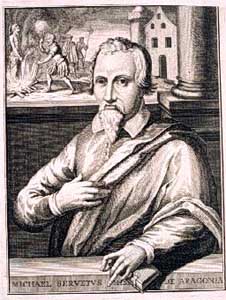 The following is part 7, concluding an excerpt from Presbyterians: Their History and Beliefs by Walter Lingle (John Knox Press, 1950). Click here to read part 1, part 2, part 3, part 4 ,part 5 and part 6.
Calvin and Servetus. It is sometimes said that John Calvin burned Michael Servetus at the stake. Servetus was burned at the stake just outside Geneva on October 27, 1553. John Calvin had some connection with the affair, and the part he played is not excusable in the light of the twentieth century, but it is not accurate to say that Calvin did the burning. Let us look at the facts.
Michael Servetus was a Spaniard with a brilliant but erractic mind. He renounced Roman Catholicism, but did not embrace Protestantism. He was a prolific writer and wrote vehemently against some of the most chedrished doctrines of Christianity. Both Catholics and Protestants considered his writings not only heretical but horribly blasphemous.
In 1553 Servetus was arrested by the Roman Catholic authorities in Vienne, France, and sentenced to be burned. While awaiting execution he escaped, and went direct to Geneva. With all the world before him, why did he go to Geneva when he had been warned to stay away? He knew that Calvin had many bitter enemies, and probably knew that at that particular moment the majority of the City Council were opposed to Calvin. The City Council had banished him once, and might be induced to do it again. Servetus probably went to Geneva to ally himself with the enemies of Calvin and thus help to overthrow Calvin and his work. When Calvin heard of the presence of Servetus in Geneva he reported the matter to the City Council. Bear in mind that Calvin was not a member of the City Council and that the majority of the Council were opposed to him. The Council arrested Servetus and put him on trial for heresy and blasphemy. John Calvin appeard as a witness against him.
After a long trial the City Council found Servetus guilty of heresy and blasphemy, and sentenced him to be burned. Accoring to the Old Testament, blasphemy was punishable with death. John Calvin urged the Council not to burn Servetus, but to take a more humane method of executing him. The Council refused. The whole story is a sad one, and Calvin does not appear at his best in it, but we should judge him by the light of the century in which he lived. The large majority of both Protestants and Catholics in that century approved of the death penalty for heresy and blasphemy.
Notwithstanding this blot and other blots on the name of Calvin which might be mentioned. Ernest Renan, the French skeptic and critic, had this to say aobut Calvin: “He succeeded more than all, in an age and in a country which called for reaction towards Christianity, simply because he was the most Christian man of his century.”
The Closing Years. The trial of Servetus was in reality a contest between Calvin and his enemies. Calvin won. The backbone of the opposition was broken. The last ten years were the most peaceful and in many respects the most fruitful years of his life.
John Calvin died on May 27, 1564, the year in which Willam Shakespeare was born. A noted scoffer intimates, in language which is none too reverent, that it was a blessed exchange for the world. But many informed and thoughtful people, with a full appreciation of Shakespeare, do not agree with the scoffer. Here is what Philip Schaff, the distinguised church historian, says: “Calvin’s moral power extended over all the Reformed Churches, and over several nationalities–Swiss, French, German, Polish, Bohemian, Hungarian, Butch, English, Scottish, and American. His religious influence upon the Anglo-Saxon race of both continents is greater than that of any native Englishman, and continues to this day.”
John Calvin: Christian Education
The following is part 6 of an excerpt from Presbyterians: Their History and Beliefs by Walter Lingle (John Knox Press, 1950). Click here to read part 1, part 2, part 3, part 4 and part 5.
John Calvin believed in Christian education. He believed that religion and learning should always go hand in hand. He accordingly organized a complete system of education in Geneva, beginning with the primary schools for children and ending with the Academy (or University) where young men might be prepared for the ministry and other walks of life. These schools were controlled and supervised by the church. Only Christian teachers were employed. Thus John Calvin set up standards for Christian education which have been admired and followed by Presbyterians from that day to this. Bancroft, the American historian, says: “We boas of our common schools; Calvin was the father of popular education, the inventor of the system of free schools.”
John Calvin: Erecting “the most perfect school of Christ.”
The following is part 5 of an excerpt from Presbyterians: Their History and Beliefs by Walter Lingle (John Knox Press, 1950). Click here to read part 1, part 2, part 3 and part 4.

courtesy of ReformationArt.com
The Consistory. The five pastors in Geneva and the twelve elders were organized into a Consistory. In some respects it was like the session in a modern Presbyterian church; in other respects it was somewhat like presbytery. It was the duty of the Consistory to govern the church and to administer discipline. It is well to keep in mind that Calvin was not able to put into practice his ideal for the free election of elders by the people, as the City Council insisted on having a part in their selection. So in the Consistory we see a mixing of the church and the civil government in a way that would be repugnant to Presbyterians today. But that was four hundred years ago.
The Consistory placed great emphasis upon discipline. Detailed rules for Christian living were drawn up, and it was the duty of the Consistory to see that the people observed these rules. The records show that people were disciplined for various offenses, including these: cursing and swearing, adultery, attempting to commit suicide, for spending their time in taverns, for playing cards on Sunday evenings, for arranging a marriage between a woman of seventy and a man of twenty-five, for singing obscene songs, for wife-beating, for betrothing a daughter to a Papist, and so forth. Thus they were disciplined for gross sins and for some that did not seem so gross.
Church attendance was made compulsory. Excuses given for non-attendance are interesting and some of them sound very modern. One man had to stay at home with a three-year-old child; another was too deaf to hear; another had to work on Sunday; still another had to stay at home and look after the house and cattle.
The Confession of Faith. Calvin and Farel had prepared a Confession of Faith and a Catechism before they were banished. These were revised and enlarged and adopted by the church. In the Confession of Faith and Catechism we have set forth in clear and fairly simple form the Calvinistic system of doctrine. This Confession of Faith was to have a marked influence upon Confessions and Creeds that were formulated later in France, the Netherlands, Scotland and England. While the Presbyterian Church gets its name from its form of government, it also stands for a system of doctrine. Presbyterianism and Calvinism usually go hand in hand.
Reforming Geneva. John Calvin, armed with the Bible as the word of God, the Confession of Faith, and the Form of Government and Discipline, with the Consistory behind him, set out upon the great task of reforming Geneva. In so doing, he started a movement which has profoundly influenced the whole of Christendom.
No man ever worked harder at a task than did John Calvin. He preached several times each week, taught theology, wrote commentaries, superintended a whole system of schools, wrote books and pamphlets, carried on an extensive correspondence with Reformation leaders all over Europe, and took oversight of the Reform movement in Geneva. He was interested in everything that affected the lives and welfare of the people. He believed that Christianity should be carried into every relationship of life. A distinguished historian states it this way:
“The material prosperity of the city was not neglected. Greater cleanliness was introduced, which is next to Godliness, and promotes it. Calvin insisted upon the removal of filth from houses and the narrow and crowded streets. He induced the magistrates to superintend the markets, and to prevent the sale of unhealthy food, which was to be cast into the Rhone. Low taverns and  drinking shops were abolished, and intemperance diminished. Mendicancy in the streets was prohibited. A hospital and poor-house were provided and well-conducted. Efforts were made to give useful employment to every man who could work. Altogether Geneva owes her moral and temporal prosperity, her intellectual and literary activity, her social refinement, and her world-wide fame very largely to the reformation and the discipline of Calvin. He set a high and noble example of a model community.”
John Knox, the great Scottish reformer, was a refugee in Geneva during the years 1554-1559. He afterwards gave this testimony concerning the work of Calvin in Geneva:
“It is the most perfect school of Christ that ever was in the earth since the days of the Apostles. In other places I confess Christ to be truly preached; but manners and religion to be so seriously reformed, I have not yet seen in any place besides.”
John Calvin: Back By Popular Demand (Never Thought You’d Hear Those Words, Did You?)

The following is part 4 of an excerpt from Presbyterians: Their History and Beliefs by Walter Lingle (John Knox Press, 1950). Click here to read part 1, part 2 and part 3. Today marks John Calvin’s 500th birthday. May Calvin’s life, piety and ministry serve to reform yours by God’s glorious grace according to the Word of God.
Return to Geneva. After Calvin and Farel were banished, things went badly at Geneva. The immoral element got control, and the moral life of the city became unspeakable. The Roman Catholic Church made a determined effort to overthrow Protestantism. Visitors, strangers, and refugees who had come to Geneva because John Calvin was there ceased to come. The people of Geneva began to realize that John Calvin was a great spiritual, moral, and financial asset. There was a growing sentiment for his return.
In the autumn of 1540 the City Council sent an invitation to Calvin by a special messenger, urging him to return to Geneva. He made a cordial response but declined. They sent him one invitation after another, and brought great pressure to bear upon him. They even had William Farel write one of his characteristic letters pronouncing a curse upon him if he did not return. Feeling that the call must be from God, Calvin yielded and returned to Geneva, arriving September 13, 1541. There was great rejoicing and his friends gave hi a triumphal entrance into the city. But there were still bitter enemies who gave him no end of trouble in the years that followed.
Beginning Anew. John Calvin took up his work in Geneva where he had left off at the time of his banishment, and he did it without apology. Going before the City Council he urged the importance of having a thoroughgoing Form of Government and Discipline for the church and the city. The doctrine of complete separation of the church and the civil government, as held by Presbyterians today, was not held in Geneva, nor anywhere else in those days.
The City Council approved of Calvin’s request and appointed a committee, with Calvin as chairman, to prepare the necessary documents. In due time he presented the City Council with a very complete Form of Government and Discipline for their approval. In this notable document we have what Calvin believed to be the Scriptural principles of church government and discipline.
As stated above, Calvin went back to the bible for everything pertaining to the church–for government, doctrine, worship, discipline, and life. When he studied church government in the Bible he did not find any popes, cardinals, archbishops, and bishops, such as he had known in the Roman Catholic Church from his youth up. Instead he found a church with a very simple form of representative government by elders. He also found in the Bible other church officials called pastors, teachers and deacons. So in the Form of Government drawn up by Calvin there were pastors, elders, deacons, and teachers. When the City Council approved of this Form of Government, the church in Geneva became a Presbyterian church in fact, if not in name. It was called the Reformed Church.
John Calvin: Pastor, Reformer and Husband
The following is part 3 an excerpt from Presbyterians: Their History and Beliefs, by Walter L. Lingle (1950, John Knox Press). Read part one here. And read part two here.
 Begins His Work in Geneva. John Calvin began his work in Geneva on September 1, 1536, by preaching a sermon in St. Peter’s Cathedral. The sermon created a sensation, and the people crowded around him insisting that he must preach again the next day. What was it about the sermon of this twenty-seven-year-old preacher that created such a stir? It was simply an expository sermon on one of Paul’s Epistles. That does not sound very sensational to us, but it was something new to that audience. They had never heard any opening up of the Scriptures like that. This sermon was followed by many more just like it. John Calvin became a great expository preacher and a great interpreter of the Scriptures. It is here that we find the main secret of his power. He went back to the Bible for everything relating to the Christian life and to the church. The Bible was the seat of authority in religion so far as John Calvin was concerned. To the Roman Catholic the church was the seat of authority. The results of the kind of preaching and teaching that John Calvin did were summed up by Thomas Carlyle in the following paragraph: “The period of the Reformation was a judgment day for Europe, when all the nations were presented with an open Bible and all the emancipation of heart and intellect which an open Bible involves.” No man did more to open up the Bible for the people of his generation and all generations than John Calvin did.

Courtesy of ReformationArt.com
The Reformer.
But Calvin was more than a preacher; he was a reformer. He felt called upon to reform the religion and morals of all the people of Geneva. He and Farel accordingly prepared a Confession of Faith, a Catechism, and a Book of Discipline. After these had been approved by the City Council on July 29, 1537, all citizens of Geneva, men and women, were ordered to give their assent to these standards and to live by them. Many gladly gave their assent, but many others refused. A great furor was raised. This opposition grew until it resulted in the banishment of Calvin and Farel from Geneva by the City Council on April 22, 1538. Farel settled in Neuchatel and never returned to Geneva. Calvin went to Strassburg, a Protestant city of Germeny, with no thought of ever returning to Geneva.
Strassburg received Calvin with open arms, and promptly made him assistant professor theology in their new Protestant College. There were many French-speaking, Protestant refugees in Strassburg. Calvin organized them into a church and became the pastor. In this church he was able to put his ideals for a churhc more fully into practice than he had been able to do in Geneva because of the interference of the City Council.
Calvin followed a very simple order of service in his church. Emphasis was placed upon the reading of the Scriptues and prayer. There was congregational singing, which was not usual in the Roman Catholic Church. They sang from a French translation of the Psalms. There were no musical instruments in John Calvin’s church. The sermon occupied the central place. In the Roman Catholic Church the altar was central.
In August, 1540, Calvin married Idelette de Bure, a widow with a small son and daughter. William Farel, in writing to a friend, said that she was “not only good and honorable but also handsome.” She and Calvin seem to have been very happy together. They had one son who died a few hours after birth.
John Calvin: From the Institutes to Geneva
The following is part 2 an excerpt from Presbyterians: Their History and Beliefs, by Walter L. Lingle (1950, John Knox Press). Read part one here.
Publishes His Institutes. In the spring of 1536, Calvin published a profound little book on theology, which he named The Institutes of the Christian Religion. Today we would call it a book on systematic theology. The book created a real sensation, and theologians knew that a new star of the first magnitude had arisen on the theological horizon. Calvin kept on revising this little book for the next twenty-three years, until it grew into two large volumes. He lived to see this work translated into practically every language of Europe. Theologians still study and refer to “Calvin’s Institutes.”
Find His Life Work in Geneva. John Calvin was only twenty-seven years of age when he published his Institutes, but from that time on he was a marked man. The publication of that book probably determined his life work. It came about in this way. As the persecutions of Protestants in France grew more severe, Calvin decided to leave France and pass over into the Protestant part of Germany. The safest journey was through Switzerland. So one hot night in August, 1536, he pulled up at an inn in Geneva to spend the nigh expecting to continue on his journey the next day. But God had other plans for him.
William Farel, a fiery Protestant with red hair, glittering eyes and a thunderous voice, had begun Christian work in Geneva in 1532. Under his preachng a great deal had been accomplished. He had blasted away the debris of centuries and laid the foundation for real constructive leadership. When Farel heard that John Calvin, the author of the Institutes, was in Geneva, he felt that he had come to the kingdom for such a time as this. So he sought him out and invited and implored him to remain in Geneva and help him. Calvin begged to be excused that he might continue on his journey and devote himself to his studies.
Let Calvin tell the rest of his story as recorded in the Preface to his Commentary on the Psalms: “Then Farel, finding he gained nothing by entreaties, besought God to curse my retirement and the tranquility of my studies if I should withdraw and refuse to give assistance when the necessity was so urgent. By this imprecation I was so struck with terror that I desisted from the journeyI had undertaken, but being sensible of my natural timidity, I would not bring myself under obligations to discharge any particular office.” So John Calvin, who had planned to spend only one night in Geneva, spent the rest of his life there, with the exception of about three years which he spent in exile in Germany.


 The Misadventures of Captain Headknowledge
The Masculine Mandate, part 3
In this post, Richard Phillips gets into the details of his exposition and application of the “masculine mandate” in Genesis 2:15.
Richard Phillips: A couple of years ago, I was speaking at a men’s conference. So I’m sitting at a barber shop, and I’m reading ESPN Magazine. They have an article about Brian Deacon, this hooligan, X-game, trick-bike jumper. He’s like the Michael Jordan of that quasi-sport. He has a near-death crash. He got his girlfriend pregnant, and she’s off living with her parents. Meanwhile, he has this nationally televised crash, and he loses half his blood, and he goes to his girlfriend’s house to be medically rehabilitated. Meanwhile, she’s been converted to Christ at her parents’ church. He starts going to the parents’ church, and he gets converted. He heals up, and he comes back to the Metal Militia and starts leading a Bible study, and, one by one, leads most of these guys … he leads them all, one by one, to Christ.
Then I read another interview, where the typical thing’s happening: some guys saying, you know, “Dude, you’ve change! What happened to you? You’re Brian Deacon!” And Deacon says, “You know what? I’ve realized that I’ve got to become a man.” Now, the last thing this guy needs to be told is that being a man is going off on ego trips (see parts 1 & 2). You know, what he needs to be told is what his duty is as a husband and father biblically and what biblical love is. And biblically, what it means to be a covenantally faithful man. And I’m reading all this stuff, and I’m thinking, “I gotta write a book on this.”
Host: So let’s talk about that. The mandate involves two aspects, working and keeping; that’s what man was placed in the garden to do. Could you help us to understand what you mean by “work”? What is man’s specific duty in working, and what is he supposed to do?
Richard Phillips: Yeah, thanks. The two in the Hebrew, the two verbs are abad and shamar. Very simple, basic Hebrew words appear hundreds of times in the Old Testament. They’re kind of, you know, building block common verbs.
Abad, in a construction context, means “to build.” In a Temple context, it’s used of the priests serving the Temple. And in an agricultural setting, such as the garden, it’s used as farming. You know, cultivating, causing things to grow. And, what we see is, the man is given the mandate by God–and this is all in the agricultural meaning–what God calls a man to do. The first thing is, that he is to engage in labor that is to have the result of causing good things to grow. Now that alone is paradigm shifting.
Now one thing that strikes me is that in American culture, we don’t think of the man as the nurturer. Biblically he is. I’m not saying women aren’t nurturers. But I am saying that it is the role of a man in a relationship to grow and cultivate and engage in activity and ministry and labor that will cause others to grow. It may be to cause a business to grow. In marriage, it means your job is to, your wife’s heart is the garden in which you’re to have a spade and you’re to minister in that garden so that she grows spiritually.
I mean, you know, as a pastor, how often do I have someone come into my office and say, “Help, pastor. I’ve got a lot of problems in my relationship with my mother.” The answer is, virtually never. It may happen once or twice, you know. But how often do I have someone come and say, “Oh, my relationship with my dad…” All the time. Why? Because the father is the one through whose ministry we gain so much of our identity and who we are, and the cultivation of character and faith and all those things result from the man’s role.
And so, it’s enormously helpful for Brian Deacon to be told, “Hey, Brian, if you want to be a man now, what you are to do is, like Adam, you’re put by God to work the garden. To engage in sacrifical ministry that would cause us to grow. You’re to do that in all your relationships. And so the book works that out. First in principle, that in various relationships–marriage, fatherhood, church, friendship, those kinds of things.
The other verb is shamar. Another very common word. It means “to watch over and protect.” In Psalm 121, “the LORD will keep you.” The LORD watches over you, he neither slumbers nor sleeps. He will keep your life. That’s shamar. And so, Adam was placed by God into his covenantal world of relationships and duties, to cause the garden to grow and to keep the garden safe. And likewise, godly men are to engage in a life of labor, the effect of which is that those under our care are to be kept safe, and their growth will be nurtured by our ministry.
That’s it. Isn’t that beautifully simple?
Host: It is. It’s profound as well….
Richard Phillips: Profoundly simple, but it requires the redeeming work of Jesus Christ in my life fully expressing itself for me to do it. It’s anything but easy. But to me that is so helpfully clear: I’m a husband–what am I to do? My wife is to feel safe in our relationship, and I’m to make her–I’m to make her safe, to promote her safety, and I am to engage in ministry to her so that she grows.
Now you read Ephesians 5:22 and following and 1 Peter 3:1-6 and that is a good summary of what the apostles are teaching. So it’s a profoundly simple, but powerful paradigm.
Listen to Christ the Center episode #87 on The Masculine Mandate today!
Share this: