Distinctions Regarding Sanctification in the Household Principle

Robert Mossotti, OPC Licentiate
OPC Licentiate Robert Mossotti explores a distinction between the holiness of the children of a believing parent and the way an unbelieving spouse is sanctified by a believing spouse. These remarks conclude his lesson delivered on August 31, 2014 at Mid-Cities Presbyterian Church. Subscribe to Robert’s SermonAudio page for more worthwhile teaching and preaching.
Let’s not forget that in Hebrews 6, there are some who are in the visible church who actually enjoy many spiritual benefits including tasting the heavenly gift, and the good word of God, and the powers of the age to come, and sharing in the Holy Spirit. But not, as we have discussed in a previous lesson, sharing in the Spirit’s work of regeneration, but in other very real, but lesser, blessings of the Holy Spirit, blessings which our Confession calls “common operations of the Spirit” in chapter 10, paragraph 4.
There is one other text that I would like to examine briefly. These are broad brush strokes, these may not even be the best arguments for why we baptize infant children of believers, but I think that they’re fairly good ones: the continuity of the one covenant of grace, the unalterability of covenants once they’re ratified in Abraham, and all the things we’ve gone through so far in this lesson.
Let’s go to 1 Corinthians chapter 7.
For the unbelieving husband is made holy because of his wife, and the unbelieving wife is made holy because of her husband. Otherwise your children would be unclean, but as it is, they are holy (1 Corinthians 7:14 ESV).
In the Greek text of this verse, the children of a believer, whether it’s mother or father, are called saints in the Greek. They are called “holy ones,” that’s what “saints” means. Now, this is a noun, it’s not an adjective, like it appears in the text here in English. It’s not a description of them as an adjective, it is a statement that they are a noun, they are saints; they are holy ones.
Let’s go to chapter 1 and verse 2 of this epistle.
To the church of God that is in Corinth, to those sanctified in Christ Jesus, called to be saints together with all those who in every place call upon the name of our Lord Jesus Christ, both their Lord and ours: (1 Corinthians 1:2 ESV)
It’s not as obvious in the English, here, but in the Greek it is the same noun. It’s not a verb, it’s not an adjective, it’s a noun, they’re being called saints, holy ones. So, let’s go back to chapter 7. The thing is, that although the children seem to be called by the same noun as other members of the visible church, and that is the point that I want to make, nevertheless, it says something odd about the unbelieving spouse as well, doesn’t it? It would seem to create a problem for my thesis because you can’t say that an unbeliever is a member of the church, and it says that he is being sanctified by the believing wife, or vice versa, and the children are called holy ones. That creates an apparent problem, I’m trying to say with this text that children are members of the church just like the ones Paul addresses at the beginning of the epistle, so there is some difficulty there. But I think the explanation is to be found in the grammar. The children, like the visible church members in chapter 1 verse 2 are declared to be saints, holy ones. That is not what happens, here, with the unbelieving spouse. They are not called saints, they are not called holy ones, it’s says with a passive verb, they “are sanctified.” It is a different idea; it’s slight, I admit, but it is a distinction that Paul actually puts in there. He doesn’t say, “the children are saints, and the unbelieving parents are saints, too.” He doesn’t say that the children “are sanctified,” in the Greek, the way the unbelieving parent is sanctified. He makes a distinction. He calls the children “saints” the way he calls all of them saints at the beginning, and with the unbelieving parent, he says that they “are sanctified,” and I think the explanation for this distinction in the grammar is this idea of being sanctified by virtue of being in proximity to something holy.
Let’s go to Matthew 23:17-19.
You blind fools! For which is greater, the gold or the temple that has made the gold sacred? And you say, ‘If anyone swears by the altar, it is nothing, but if anyone swears by the gift that is on the altar, he is bound by his oath.’ You blind men! For which is greater, the gift or the altar that makes the gift sacred? (Matthew 23:17-19 ESV)
The gold was sanctified, not because of what it is, but because of its proximity to something else.
Now let’s go to Exodus 30:29
You shall consecrate them, that they may be most holy. Whatever touches them will become holy (Exodus 30:29 ESV).
You can see it much more clearly in the Septuagint and in the Hebrew text that it is the same idea of sanctifying, but it’s not that these things were holy in themselves, but whatever they touched was holy, so going back to 1 Cortinthians 7, the unbelieving spouse is made holy in that sense, by virtue of their proximity to the believing parent and the child, in their marital and parental relationship to holy ones, they are in a sense sanctified. I can’t do much better than that, I think, in explaining in what sense the unbelieving spouse can be sanctified. It’s not as if they are holy, “holy ones,” but they are sanctified, receiving holiness by the unbelieving spouse’s proximity to holy things.
One more note on the unbelieving spouse being described as being sanctified, if we were to take the time to go to Leviticus 27:28, especially in the Masoretic Hebrew text and the Septuagint, we would see that there is all kinds of sanctifying in the Scriptures. I don’t think this is the kind of sanctifying we’re talking about in Leviticus 27, where it is those that are set apart for God’s destruction are called holy as well, so I don’t mean the unbelieving spouse is sanctified in the sense that he is set apart for destruction. I only introduce this to make the point that in the Scriptures there is more than one meaning for “sanctifying.” It doesn’t always have the meaning of which we typically think.
So, what is the overall argument that I want to make from 1 Corinthians 7:14? It’s not ambitious. I don’t want to make too much out of my grammatical distinctions, but simply that children of believers are to be admitted as members of the visible church, and are to be granted the rite of admission to the same. I think surely the New Testament language stands at least for that. They are called saints just like anybody else in the church at Corinth.
I have said that Genesis 17 makes clear that the household principle is not simply the physical descendants of the believer that are to be included into the visible church. It’s a household principle, not so much a genetic line kind of principle. Now we in the United States of the 21st century don’t have slavery. So how would you apply that? We should keep in mind that they did have slavery in the first century as well as during the time of Abraham. So by the first century, where this principle of admission into the visible church by household would include slaves it is the same as saying that in the twenty-first century the household would not include slaves. Slavery is an historical accident of local, civil law. It’s something that the Bible does not confront head on, nor does it warrant it. That’s how we would apply it today. We would do the same thing, we would admit by households, but since households no longer include slaves we wouldn’t even consider that, but children would still be a part of that, according to Genesis 17.
Visible Church Membership for Covenant Children
Robert Mossotti, our summer intern at Mid-Cities Presbyterian Church in Bedford, Texas taught a Sunday School series on Ecclesiology. All of the lessons are available online here. They’re also available on Robert’s SermonAudio page here. My favorite lesson in the series was the following on the biblical case for infant baptism and the Reformed inclusion of the infant and unbelieving children of believers into church membership. The following is a transcript of his remarks, lightly edited at some points. I hope you find it as helpful and enlightening as we have. You can listen to this particular lesson online here. We begin with his introductory remarks regarding principles that govern our interpretation on this issue, and an exposition of Paul’s words regarding covenants from Galatians 3. The rest will follow in the coming days and weeks.
Why do Presbyterians baptize babies and count them as members of the visible church?
Let’s restate some principles first, before we get into some passages.
The visible covenant community is the visible church—Old Testament and New Testament—and what makes it visible are the sacraments. These place a mark on the church to identify it as belonging to the Lord. The sacraments mark God’s people off from the world. Another principle we have to keep in mind is that there is only one covenant of grace in Scripture. The covenant by which Abraham and the Old Testament church were saved is our covenant, too. By God’s grace, in the Scriptures we are all called children of Abraham through faith. There is no essential difference between the Old Covenant church and the New Covenant church. There are differences, but no essential differences. No differences as to substance, just form. The church is one across all the ages, because the covenant of grace is one. To embrace the one idea is to embrace the other. If you accept that there is one covenant of grace throughout Scripture by which we are all saved, then you have to accept that the church is one across both Old and New Testaments. We affirm this over against dispensationalism, which maintains an essential difference between Israel and the church. So the Abrahamic Covenant, the Mosaic Covenant (the one at Mount Sinai mediated through Moses), and the New Covenant are all different administrations of the one covenant of grace. In section 5 of chapter 7 of the Westminster Confession of Faith, the Mosaic Covenant is called an administration of the covenant of grace. Alright, now that those principles have been stated, let’s go to Galatians 3.
The apostle Paul is going to give us in this passage a principle of covenant theology. A principle of Interpretation of Covenants, of Application of Covenants, the Nature of Covenants. Paul says not only biblical covenants, but all covenants. Let’s go to Galatians 3:15.
“To give a human example, brothers: even with a man-made covenant, no one annuls it or adds to it once it has been ratified. Now the promises were made to Abraham and to his offspring. It does not say, “And to offsprings,” referring to many, but referring to one, “And to your offspring,” who is Christ. This is what I mean: the law, which came 430 years afterward, does not annul a covenant previously ratified by God, so as to make the promise void” (Galatians 3:15-17 ESV).
In verse 15, this idea of “ratified” in the ESV comes from the Greek word kuro’o, and Bauer-Danker, the premier Greek lexicon or dictionary defines it as “to confirm, to ratify, to validate or to make legally binding.” Although the covenant of grace goes all the way back to Eden, note that Paul is saying here that it was not ratified until Abraham. Now note that in verse 15, Paul begins with a general principle of covenants. Then, as he moves down through verses 16 and 17 he applies that general principle of covenants to the particular case of the Mosaic administration of the one covenant of grace—that’s what he means by the Law coming in. Paul says that once the covenant of grace was ratified at the time of Abraham, no modifications may be introduced even by later administrations of the covenant of grace, including the Mosaic administration.
So, it is because there is only one covenant of grace throughout Scripture that we Presbyterians apply the sign of admission into the visible church to the children of believers, for we are not free to change the way the covenant is administered. It is not because the Reformers didn’t sufficiently push off from Rome that we baptize babies, it is because of our covenant theology which we receive, we believe, from the Scriptures. It is also because the covenant of grace is one across the various administrations that we need not seek for proof of continuity between the Abrahamic administration and the New Covenant administration of the one covenant of grace. In fact, because of the underlying unity of the one covenant of grace across the ages, which cannot be altered once ratified, says Paul, that we actually would need to find evidence in the New Testament that God intends to change who it is who receives the rite of admission to the covenant community. Because of the underlying continuity of the one covenant of grace, it is discontinuities, and not continuities, between the Old Covenant and New Testament administrations, that need positive proofs from the New Testament. We don’t have to go to the New Testament and ask if there are specific cases where it says in explicit terms that babies were baptized. Because of the underlying unity of the one covenant of grace, you have to look for a command to no longer give the sign of the covenant of grace to the children of believers. The underlying unity drives the belief that we assume continuity unless there is evidence in the New Testament of discontinuity.
So the absence of explicit revelation in the New Testament on whether children are to be included in the visible church actually works in favor, not against, the inclusion of children in the visible church. Because of this principle of covenant administration, the default setting, says Paul, is covenantal continuity. But, in fact, we can find more evidence than just these principles of covenant theology that the children of believers are to be included in the visible church as members.
OPC’s Doctrine of Assurance Blamed for Bergdahl’s Religious Uncertainty
In this day when America is, for better or worse, trying to wind down its war against radical Islamist jihadists, Skidmore College Professor and Director of Religious Studies, Mary Zeiss Stange, opines in a USA Today piece that we don’t think enough today about how religion can be a source of evil as well as good. Just let that sink in for a moment. But Stange’s focus is not on radical strains of Islam. Hers is on the Orthodox Presbyterian Church. You know, that “hyperconservative offshoot of the mainstream Presbyterian Church USA” which she calls “Calvinism on steroids” because it “sees the world in stark either/or terms” in which you are either “saved and bound for heaven. Or you are a sinner, treading a one-way path to the fiery pit of hell.” She characterizes the struggle to discern one’s eternal destiny as “making extraordinary demands on a sensitive young person’s conscience and conduct.” Having painted this dramatic portrait of my denomination with such colorful brush strokes, broad as they may be, she then proposes the possible diagnosis for the “chaotic mood swings” which lead to Bowe Bergdahl’s “transformation from gung-ho warrior to pacifistic deserter”: “The Orthodox Presbyterian Church compels followers to feel the inner spark of absolute certainty of one’s own God-given righteousness.” This is what we hyperconservative Calvinists on steroids call “assurance of salvation.” But Stange’s description of this teaching is overly simplistic, and with the use of the phrase “absolute certainty,” she is associating the OPC with that predominant flaws of the fundamentalist movement. In the doctrinal standard of the OPC, the Westminster Confession of Faith, we find a little more nuance in what we confess about the Bible’s teaching on assurance. Chapter 14, “Of Saving Faith,” section 3, reads,
This faith is different in degrees, weak or strong; may be often and many ways assailed, and weakened, but gets the victory: growing up in many to the attainment of a full assurance, through Christ, who is both the author and finisher of our faith.
Likewise, in Chapter 18, “Of the Assurance and Grace of Salvation,” the doctrine is treated more fully. Section 3 again demonstrates our allowance for degrees of assurance which may often fall far short of Stange’s portrayal of “absolute certainty.”
This infallible assurance doth not so belong to the essence of faith, but that a true believer may wait long, and conflict with many difficulties before he be partaker of it: yet, being enabled by the Spirit to know the things which are freely given him of God, he may, without extraordinary revelation, in the right use of ordinary means, attain thereunto. And therefore it is the duty of everyone to give all diligence to make his calling and election sure, that thereby his heart may be enlarged in peace and joy in the Holy Ghost, in love and thankfulness to God, and in strength and cheerfulness in the duties of obedience, the proper fruits of this assurance; so far is it from inclining men to looseness.
These excerpts indicates that not all will come to “absolute certainty” regarding their assurance of salvation, but this lack of absolute certainty does not necessarily entail the absence of faith. A weak faith, maybe, but a saving faith nonetheless. Since 2012, the congregations of the OPC have been praying that Bowe Bergdahl would come to faith in Christ, if he truly does not believe, or, if he does, that the Lord would strengthen that faith, that he might grow up “to the attainment of a full assurance, through Christ, who is both the author and finisher of [Bowe’s] faith.” We are careful to point out that assurance is a goal, yet it is not a constant, unwavering quality of the genuine Christian life. For those who find this assurance of faith elusive, it is our desire to comfort, encourage, and point them again to the imputed righteousness which Christ procured by his humble, sinless life, propitiatory death and glorious resurrection in the Word of God preached, and signified and sealed to them in the sacraments of baptism and the Lord’s Supper. Each of these are ordinary means of God’s grace which can develop an assurance that is not contingent upon the strength of one’s faith, or the quality of his works. So it’s not as if those of us who believe in assurance of salvation strive to keep the heat turned up on people to make sure they get some “feeling” of certainty, or else they’re in trouble. That is mischaracterization of the doctrine of the grossest sort on the part of Professor Stange.
Yet it is just such a one-dimensional view of the doctrine of assurance which Professor Stange would have us believe makes my religion a “source of evil.” The idea that moral absolutes and the search for assurance of salvation are bad is consistent with the contemporary religious and philosophical culture in Western civilization, where secularism and relativism are the virtues of our time. I can’t help but see the climactic light saber duel between Obi Wan Kenobi and Anakin Skywalker in Star Wars Episode III: Revenge of the Sith, in which the latter paraphrases Jesus (and George W. Bush) by declaring the ultimate either/or proposition, “if you’re not with me, then you are my enemy,” to which the former replies, “only a Sith deals in absolutes.”
That’s right, dear reader, if you affirm the Ten Commandments, and believe that only through repentance of sin and faith in Christ can one find assurance of salvation from eternal conscious torment, then to liberals like Mary Zeiss Stange, whose kind of view is currently in favor, you have embraced the Dark Side, and your form of religious extremism is what makes people want to kill the innocent and take over the world, and it may even be what stresses our kids out when they can’t “feel” this “absolute certainty” and makes Bowe Bergdahls of them. I never cease to be amazed by the logical leaps which liberals make about orthodox Christianity. It’s positively fundamentalistic.
But Bergdahl’s woes cannot be the sole responsibility of the Orthodox Presbyterian Church, because, from what I’ve read, the Bergdahl family were members of two different OPC congregations in the past, neither of which exist today. I’ve heard that it is possible that they may remain under the oversight of their regional presbytery, and Bob and Jani do retain an ongoing relationship with pastor turned missionary Phil Proctor, but the OPC does not seem to be as solely influential in the life of the Bergdahl’s, Bowe least of all, as it may appear.
The Bergdahls: Muslims? Christians? Traitors? Patriots?
For five years, citizens of the United States have waited, wondered and prayed for US Army Sergeant Bowe Bergdahl who was taken into custody by the Taliban on June 30, 2009 after leaving his outpost (OP) in Afghanistan. While there were indications of possible desertion on Bergdahl’s part, and a 2012 Rolling Stone article reporting email correspondence between Bowe and Bob Bergdahl in which Bowe expressed rather distressing sentiments critical of the United States, many of us did not follow the story closely enough to be aware of these things. As far as people like me were concerned, Bowe Bergdahl was a straightforward victim of the war in Afghanistan, who was bravely suffering for his country in the hands of the enemy.
As you may or may not be aware, I am a member of a congregation in the Orthodox Presbyterian Church (OPC). One Sunday in 2012, a flyer was distributed to our churches, calling on us to pray for the health, safety and faith of Bowe Bergdahl, and peace of mind for his family. Responding to this call, our congregation, and many like ours, corporately prayed for the Bergdahls. This flyer was the most I would read about Bowe Bergdahl until this past weekend when he was released, and his father, Bob, raised eyebrows by reciting a Muslim prayer from the Koran in a personal statement to Bowe. This, added to the growing awareness of Bowe’s desertion and possibly traitorous intentions while among the Taliban, and Bob’s recently publicized tweet expressing his desire for the closure of Guantanamo Bay, has made the person of Bob Bergdahl the object of much controversy as well. People wonder if he converted to Islam, or if he is an Islamist sympathizer.
Even I began to wonder, given our denomination-wide efforts to pray for the Bergdahls, if they were at least still members in good standing of an OPC church, and inquired about this on Facebook, hoping for some input from OPC ministers with which I am in contact. I did learn much in private messages with my FB friends which was reassuring regarding the ongoing Christian faith of the Bergdahl family. It is safe to presume that Bob and Jani Bergdahl have become all too familiar with the Christian grace of perseverance over the last several years, and, despite the release of their son, no end of their need for perseverance seems to be in sight. Prayer on behalf of the Bergdahl family remains a tremendous obligation.
Details about Bowe and his leaving his outpost, statements by fellow soldiers who knew or were involved with recovery operations, and the political and national security implications of releasing the Taliban figures from indefinite detention, continue to dominate the daily news. Yesterday, the Washington Post published a profile of Bob Bergdahl and World Magazine has now also run a story featuring the perspective of the Bergdahl’s former pastor and friend, Phil Proctor, who remains in contact with the Bergdahl family.
Today in my Facebook newsfeed, I discovered another statement from Proctor who wishes to silence the rumors that the Bergdahls have converted to Islam or seek to aid Islamist efforts against the United States. This statement was posted by Andy Webb, Pastor of Providence Presbyterian Church (PCA) in Fayetteville, North Carolina, on his Facebook page, The Outer Monologue. Phil Proctor writes:
I appreciate your asking about the Bergdahls. I’ve really been saddened about how the Christian community is jumping all over this. Here’s the deal…
I pastored the Bergdahl family in 2003, prior to going to Uganda. We were very close, and remained so throughout my time in Uganda (I just found out this evening that apparently I’m referenced in some important Rolling Stone article from 2012).
Bowe was a young man with all the dangers of home-schooling—a brilliant and inquisitive mind, a crisp thinker, and someone who had never really been exposed to evil in the world. He was wanting to determine whether the Christian faith was his own, or his parents’ and was doing a lot of exploring of ideas—never drugs or alcohol, but trying to be an outdoors/Renaissance type figure. We’ve stayed in close contact with Bob and Jani, especially since Bowe’s capture. Since we moved here to Northern Virginia, Bod and Jani have stayed in our home on a couple of occasions and I’ve spoken on the phone with Bob once a month or so.
Bob felt (with some justification) that the US government was not going to engage with diplomatic efforts and so decided to try to free his son himself. He learned Pashtun and developed a lot of contacts in the Middle East. The Qatar connection is one that either originated with Bod or, at the very least, became very personally connected to Bob. Bob has, for quite some time, been saying that the closure of Guantanamo is integrally connected to the release of his son.
Whatever one thinks of Bob’s political views, I can attest to both he and Jani’s unwavering commitment to Christ and trust in him. I’ve prayed with both of them regularly. They both have been through a torture mill that I cannot begin to comprehend—5 years of a living death. It has affected their health, both physically and mentally, as Bob has been completely obsessed with tracking down any possible communication avenue to get his son home. There are a number of things I would disagree with Bob on in terms of political statements, but at the end of the day, I think this whole mess is a WHOLE lot more complicated than a 30 second sound bite (sic) can explore—the very existence of Gitmo attests to the complicated nature from the very beginning, and it’s only gotten worse over the years.
To the foundational issue: Bob and Jani both have regularly confessed their dependence upon Christ and rest in him—the most recent being Bob’s conversation with me about a month ago. They are broken peop;le who need prayer, love, and compassion. I personally intend to run as hard as I can in the opposite direction of judging his words in the moment of his crucible—I would HATE to have that standard applied to my moments of stress, which have never reached anything approaching his intensity and duration!
Feel free to forward this and use it as widely as you like.
Yours in Christ,
Phil Proctor
Pastor, Sterling Presbyterian Church (OPC)
Sterlingopc.org
FYI, My most recent conversation with Bob and Jani was 30 minutes ago. Still Christians.
Analyzing the Character and State of the PCA
“The Christian Curmudgeon” was a member of the Presbyterian Church in America (PCA) since its founding. He recently left the PCA for his own reasons and is now ministering in the Reformed Episcopal Church. In the past few weeks, you may have noticed that The Aquila Report has posted two articles expressing the growing concern over the state of the PCA. In light of this, The Christian Curmudgeon has written a very helpful post characterizing the various theological and practical trajectories represented by the first generation of the PCA. The point being that the PCA was never intended to be a strictly confessional Reformed denomination. This sheds light on how they got into the chaotic state they are in today. Read his informative post, “I Don’t Have a Dog in this Fight, But That Doesn’t Keep Me From Having an Opinion.”
Westminster Releases Tome on Doctrine of Scripture
Pleasing to the eye, desirable to make one wise 😉 Get one for yourself, and one for your church library!
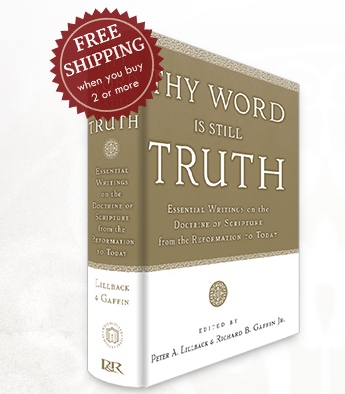
Edited by Richard Gaffin and Peter Lillback of Westminster Theological Seminary, Philadelphia, PA. Click image to view at wtsbooks.com.
Sermon Notes: Crossing the Jordan, Part 1

The following are notes from the sermon I heard yesterday, October 13, 2013 at Mid Cities Presbyterian Church. The sermon is called “Crossing the Jordan, Part 1,” and is based on Joshua 3:1-5. Rev. Joseph L. Troutman preached the sermon. Some of the material below is original to me, however.
1Then Joshua rose early in the morning and they set out from Shittim. And they came to the Jordan, he and all the people of Israel, and lodged there before they passed over. 2 At the end of three days the officers went through the camp 3 and commanded the people, “As soon as you see the ark of the covenant of the Lord your God being carried by the Levitical priests, then you shall set out from your place and follow it. 4 Yet there shall be a distance between you and it, about 2,000 cubits in length. Do not come near it, in order that you may know the way you shall go, for you have not passed this way before.” 5 Then Joshua said to the people,“Consecrate yourselves, for tomorrow the Lord will do wonders among you.”
The big idea of this sermon is that the gap between God and Man is caused by our sin, and is bridged only by Christ, who is God with us.
1. Follow Me (verses 1-3) they set out from Shittim. And they came to the Jordan The distance between Shittim and the Jordan River is about 12 miles. The trip took about a day.
and all the people of Israel, and lodged there before they passed over. Day 1:Their arrival, there for partial day; Day 2: “Lodged” all day; Day 3: There a partial day before crossing the river. Similar to the timing of Christ in the tomb–he wasn’t in the tomb for precisely 72 hours, but part of the first day, all of the second, and rose before sunup on day three.
Condition of the Jordan River, see verse 15: (now the Jordan overflows all its banks throughout the time of harvest) It was springtime, and the river was turbulent.
“As soon as you see the ark of the covenant of the Lord your God being carried by the Levitical priests, then you shall set out from your place and follow it. Yet there shall be a distance between you and it, about 2,000 cubits in length. Do not come near it, in order that you may know the way you shall go, for you have not passed this way before.”
The ark of the covenant symbolized God’s presence. It was holy because God is holy. In the Bible, all visible signs of spiritual truths are so closely associated with the spiritual truth that it is identified as if it were the spiritual truth. In the Hebrew text of Joshua 3:17, the ark is not only called the ark of the covenant, but the covenant itself. This is why some mistake baptism as the thing that actually saves, and that the bread and wine of the Lord’s Supper are actually transformed into the literal body and blood of Christ. The sign is called by the name of the reality, but the sign only points to the reality; the sign is not the reality. That’s why, in chapter 27, section 2 of the Westminster Confession of Faith, it reads:
There is, in every sacrament, a spiritual relation, or sacramental union, between the sign and the thing signified: whence it comes to pass, that the names and effects of the one are attributed to the other.
In a sense, the ark was treated by the Israelites the way the sacraments of baptism and the Lord’s Supper are treated by Bible-believing Christians today.
2. A Safe Distance (verse 4)
Yet there shall be a distance between you and it, about 2,000 cubits in length. Do not come near it,
Two thousand cubits is about three thousand feet–over half a mile. This distance which the Israelites were to keep between themselves and the ark of the covenant symbolizes the distance between the holy God and sinful humanity. Although God was with his people, their sins still separate them from him; however, the Levites were graciously allowed to carry the ark, and thus the priesthood does its job of mediating between the holy God and sinners. They represent the people to God, and thus he is near his people while keeping a safe distance for the good of his people. This nearness of God with Man, while at the same time being separate from them is ultimately bridged in the person of Jesus, our Great High Priest.
3. Consecration (verse 5)
Then Joshua said to the people, “Consecrate yourselves, for tomorrow the Lord will do wonders among you.”
The people must set themselves apart from unclean things, as well as from common things. God is holy, so they must be holy. God is clean and he is uncommon, therefore, so should the Israelites make this spiritual fact ceremonially visible in the same way the ark makes the presence of the Lord ceremonially visible. They were to wash their clothes and abstain from sex, as in Exodus chapter 19, which gives a good description of the way the people must consecrate themselves and keep a safe distance from Mount Sinai, and the severity of the consequences if they do not.
the Lord said to Moses, “Go to the people and consecrate them today and tomorrow, and let them wash their garments and be ready for the third day. For on the third day the Lord will come down on Mount Sinai in the sight of all the people. And you shall set limits for the people all around, saying, ‘Take care not to go up into the mountain or touch the edge of it.Whoever touches the mountain shall be put to death. No hand shall touch him, but he shall be stoned or shot; whether beast or man, he shall not live.’ When the trumpet sounds a long blast, they shall come up to the mountain.” So Moses went down from the mountain to the people and consecrated the people; and they washed their garments. And he said to the people, “Be ready for the third day; do not go near a woman.”
Similarly, Christians should see themselves as called out from the unclean and the common, to be God’s chosen possession.
But you are a chosen race, a royal priesthood, a holy nation, a people for his own possession, that you may proclaim the excellencies of him who called you out of darkness into his marvelous light (1 Peter 2:9).
“…for tomorrow the Lord will do wonders among you.” Miracles are a sign of God’s power announcing that the observer is in the presence of God. Christ himself so far surpasses Old Testament miracles that if we are unaffected by the fact of his incarnation, righteousness, substitution for us on the cross, his resurrection and ascension to be enthroned on the right hand of God the Father, this speaks ill of our spiritual condition. Jesus, the God-Man bridges the gap between the holy God and sinful humanity, and consecrates those who repent and believe that they might draw near to God to serve and worship him.
Gender Roles, part 2–Patriarchalism
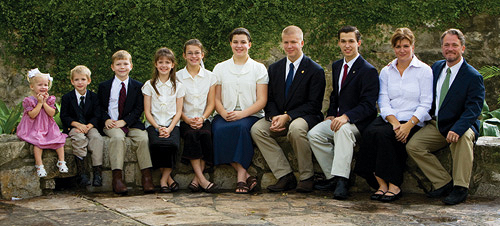
Vision Forum founder Doug Phillips and family
I’ve been aware of Vision Forum (VF) ever since I began searching the internet for Reformed websites back in the late 1990’s into the early years of the first decade of the twenty-first century. What I saw in Vision Forum was a site promoting traditional, conservative Americana of all kinds. Cool reprints of things like Of Plymouth Plantation and the writings of John Quincy Adams, the sixth American President who dabbled with Calvinism in his early adulthood, but would ironically return to the Unitarianism of his father and the intellectual elite of his day. Fun stuff, if you are into strident third party ultra-conservatism (for the record, VF founder Doug Phillips is son of Nixon-era figure and third party founder, Howard Phillips, whom I was providentially prevented from voting for in the 1992 election, but that’s another post!).
But then I found Phil Johnson’s Hall of Church History and any fledgling interest in Vision Forum fell by the wayside. My initial introduction to Vision Forum and its association with homeschooling and conservative politics raised no red flags. To me, it was what it was.
It was not until more recent years that I grew in my familiarity with the details of Vision Forum’s vision for families by their promotion of concepts like patriarchalism among others like the so-called family-integrated church (FIC), quiverfull and multi-generational faithfulness movements. Classified under these headings we find the dark side of the homeschooling movement. At the time of this writing, I have nothing against homeschooling, per se, but these movements which find their origin within the homeschool movement leave much to be desired, in my humble opinion. For more information on the latter movements, see here, here, and here.
Please recall that in the last post, I summarized my understanding of egalitarianism as practiced among “mainline” liberal Protestant denominations and an increasing number of Evangelical denominations and movements, and noted that there have been two major responses to this movement: namely, patriarchalism and complementarianism. The former is an extreme response, the latter is more moderate, unless you’re an egalitarian.
Complementarianism agrees with patriarchalism that:
(1) Eve was created to serve as “an help meet”(KJV) for Adam, or a “helper suitable” (NASB) for him, and that this is a creation ordinance binding on all human marital relationships; that a relationship of loving leadership by example and sacrificial protection on the part of the husband, and of respectful and voluntary submission on the part of the wife typifies the relationship between Christ and the church for which he died (Ephesians 5:22-33),
(2) and that consistent with this state of affairs, the New Testament explicitly limits offices of ordained church leadership to men (1 Timothy 3:1-7, notice candidates for church office are assumed to be male, and evidence to the contrary is lacking elsewhere in the New Testament).
Nevertheless, complementarianism disagrees with patriarchalism that wives, or women in general, should therefore necessarily refrain from seeking work or leadership roles in civic or commercial society outside the home. In short, complementarianism respects a greater degree of liberty for women than does its more extremist counterpart, patriarchalism.
In what ways does patriarchalism restrict the Christian liberty of women in the name of following the teaching of Scripture? To answer this question, let us consult a Vision Forum Ministries-published semi-creedal statement, “The Tenets of Biblical Patriarchy” drafted by Phil Lancaster, in consultation with Doug Phillips and R.C. Sproul, Jr. This statement lists 26 points under the following headings:
(1) God as Masculine (point 1)
(2) The Image of God and Gender Roles (points 2-4)
(3) The Authority of Fathers (points 5-7)
(4) Family, Church and State (points 8-11)
(5) Men & Women: Spheres of Dominion (points 12-14)
(6) Procreation (point 15)
(7) Education and Training of Children (points 16-21)
(8) A Father and His Older Children (points 22, 23)
(9) The Sufficiency and Application of Scripture (points 24-26)
Let’s look at point 11, under the heading of “Family, Church and State”:
11. Male leadership in the home carries over into the church: only men are permitted to hold the ruling office in the church. A God-honoring society will likewise prefer male leadership in civil and other spheres as an application of and support for God’s order in the formative institutions of family and church.(1 Tim. 3:5) (emphasis mine)
By this statement, patriarchalists cannot state that the Bible teaches that women shouldn’t work outside the home (among other things, like vote, for instance!), but appeals to the biblical mandates of male leadership in the home and the church and asserts that a society can only honor God if it “prefers” male leadership in societal spheres. By implication, this means that a society actively dishonors God if it allows women to vote, work outside the home and lead in other societal venues. They do allow for exceptions in the case of single women—“unmarried women may have more flexibility” (point 14), but I submit that in patriarchal circles, this exceptional circumstance will likely be discouraged, if not frowned upon. They only concede the possibility that single women may have more flexibility, which means, when in doubt, see point 11.
While we’re on this point, let us consider the Tenets’ reference to “a God-honoring society.” Did I mention that Vision Forum is postmillennial (not necessarily a problem) and theonomist (a big problem!)? Political liberals commonly refer to theonomy as “Dominionism,” which is a movement among interdenominational charismatic churches. The fact is, dominionism is based on theonomy, aka Christian Reconstructionism. Vision Forum’s vision for patriarchalism is a means to the end of taking dominion over the nations of the world and subjecting them all to the Law of God, and it is in this way that they believe Christ’s Millennial Kingdom will be established in the earth. These facts are implicit in their notion of a “God-honoring society.” In the radical patriarchalist’s perfect world, therefore, all women will be restricted to the domestic vocation of housewife, barring the undesirable exception of singleness. But in a future glorious Kingdom of Christ, would not He be willing to provide a husband to provide for and protect every woman? In the meantime we have to make due with conceding the possibility that single women may have the flexibility to work outside the home, and perhaps even vote.
Then there is the matter of “A Father and His Older Children,” points 22 and 23. Notice the extra restriction on adult daughters as compared to adult sons.
22. Both sons and daughters are under the command of their fathers as long as they are under his roof or otherwise the recipients of his provision and protection. Fathers release sons from their jurisdiction to undertake a vocation, prepare a home, and take a wife. Until she is given in marriage, a daughter continues under her father’s authority and protection. Even after leaving their father’s house, children should honor their parents by seeking their counsel and blessing throughout their lives. (Gen. 28:1-2; Num. 30:3ff.; Deut. 22:21; Gal. 4:1,2; Eph. 6:2-3) (emphasis mine)
23. Fathers should oversee the process of a son or daughter seeking a spouse. While a father may find a wife for his son, sons are free to take initiative to seek and “take a wife.” A wise son will desire his parents’ involvement, counsel, and blessing in that process. Since daughters are “given in marriage” by their fathers, an obedient daughter will desire her father to guide the process of finding a husband, although the final approval of a husband belongs to her. Upon a Marriage taking place, a new household with new jurisdiction is established, separate from that of the father. (Gen. 24:1ff.; 25:20; 28:2; Ex. 2:21; Josh. 15:17; Jdg. 12:9; 1 Sam. 18:27; Jer. 29:6; 1 Cor. 7:38; Gen. 24:58)
The implication is that an adult daughter of a Christian patriarch ought not move out of her father’s home until she has been “given” by him in marriage. There is a dangerous wooden-literalism in patriarchalist biblical hermeneutics which leads to imposing this aspect of Ancient Near Eastern culture on twenty-first century Christians. Here is one of the other problems with patriarchalism as a response to egalitarianism: it looks back fondly on the way things were done in the past and makes some of the customs of that era moral absolutes for the present.
Another era which patriarchalists mine for unbiblical moral absolutes is the ante-bellum American South. This era is considered by Phillips, and other patriarchalist leaders as the greatest form of Christian culture ever experienced on earth, and patterns much of its ideals accordingly. Arch patriarchalist Doug Phillips is a huge fan of southern Presbyterian theologian R.L. Dabney, who was in many ways a fine Reformed theologian, with the exception that he was a bitter opponent of emancipation for slaves, and is a poster-child for the use of the Bible in support of the institution of chattel slavery. You can read more about the inherent racism and sexism of patriarchalism in a blog post entitled “Patriarchy, Christian Reconstruction and White Supremacy” at the blog Diary of an Autodidact. The fact that Southern idealism is a strong influence on this movement is further evidence of the extra- and unbiblical nature of the patriarchalist movement as directed and informed by Vision Forum.
For these and other reasons, it would be unwise for an Evangelical Christian to resist the cultural pressures of liberal egalitarianism by subjecting one’s self and one’s family to the so-called “Tenets of Biblical Patriarchy.” In the gracious providence of God, complementarianism is the name of the more biblical approach to the roles of husbands and wives in the family, the church and society. Keeping in mind what we’ve discussed about it above in contrast with patriarchalism, we’ll look at complementarianism in more detail in the next post.
ACE and WHI Remember Dr. C. Everett Koop (1916-2013)
Yesterday I tweeted a request to Reformed bloggers in the know to post on the Reformed side of American medical icon, the late Dr. C. Everett Koop, who died Monday at the age of 96. Dr. Koop’s medical and public service bonafides are a matter of public record. One quick and easy summary may of course be accessed, where else? Wikipedia! Here also is a press release from HHS Secretary, Kathleen Sabelius, detailing his legacy from the point of view of the federal government. But in addition to his service to the City of Man, Dr. C. Everett Koop was an accomplished lay leader in the City of God, serving as a Presbyterian church elder, and until the day of his death, a board member of the Alliance of Confessing Evangelicals (ACE), the para-church organization which was so instrumental in introducing me to and cultivating in me the Reformed faith and theology.
Incidentally, tomorrow afternoon, my pastor and I depart for ACE’s Texas Hill Country Bible Conference in Boerne, Texas. It’ll be interesting to see what kind of tribute they put together for him there. For now, though, the ACE website offers a “Koop Classic”: Life, Bioethics and Christianity (2010, ACE).
But in answer to my (“all about me”–apologies to Dr. D.G. Hart 😉 request, two of my favorite Reformed bloggers has indeed posted remembrances of Dr. C. Everett Koop: Drs. Michael Horton and Kim Riddlebarger. You may read Dr. Horton’s at the White Horse Inn blog, and Dr. Riddlebarger’s post at the Riddleblog. Horton gives a nice summary of meeting Dr. Koop and his service to his church, Tenth Presbyterian Church in Philadelphia, PA and the Alliance of Confessing Evangelicals, featuring the audio of a 2001 interview and a link to Dr. Koop’s contribution (“Faith-Healing and the Sovereignty of God”) to Horton’s out of print 1990 expose of televangelism, The Agony of Deceit–download it as soon as possible! Riddlebarger adds an amusing anecdote of Dr. Koop’s sobering reaction to his sense of humor. Both posts are great reads.
Be sure to peruse the other links I tweeted yesterday regarding the late Dr. C. Everett Koop from Christianity Today and Banner of Truth magazines and the Gospel Coalition blog featuring both compliment and criticism. Finally, in search of an image of Dr. Koop inside the building of Tenth Pres, I ran across a video of his 2010 marriage to Cora Hogue (pray comfort for her in her loss), officiated by former pastor, Phil Ryken, who is now the President of Wheaton College, whose sermons are still featured on ACE’s broadcast, Every Last Word. For those who are interested in viewing this heartwarming moment, the service begins about 30 minutes into the video, after the beautiful music of Westminster Brass.
Koop-Hogue Wedding Ceremony from Tenth Presbyterian Church on Vimeo.
Hearing Frame’s Side of the Story

Dr. John Frame, Professor of Theology and Philosophy at RTS, Orlando
As one who was first introduced to Reformed theology by Dr. Michael Horton in a televised interview promoting his first book, I have a great affection and appreciation for the work of those who are, in Reformed circles, associated with what Dr. John Frame (RTS, Orlando) calls “The Escondido Theology.” Frame and others seem to think that for Reformed folks to interact with Lutheran theology on the things with which they agree is some sort of compromise of the integrity of Reformed theology. As a layman who hasn’t read it all on this controversy, that’s the impression I get. Frame’s book is promoted as a discussion primarily of the Two Kingdom approach to Christ and culture, but I’ve just learned that there is more to Dr. Frame and the Escondido Theology that this one issue.
In terms of coming to a greater understanding of the broader controversy myself, I was pleased to find that Scott Oakland interviewed Dr. Frame on a recent episode of ReformedCast. Agree or disagree, it is important to understand Frame’s point of view on the matter. Looking back to the days in which he helped found Westminster Seminary California, Dr. Frame portrays himself as not fitting in with any of the “parties” that formed among the faculty there. I also found it helpful to hear him express his concerns with how closely many among the faculty wanted to stick to the Reformed confessions, while he, in my opinion, thought the Reformed principle of sola scriptura was better honored by not “turning biblical and systematic theology into historical theology” (or something like that–it’s been a few days since I heard the interview). This helped me understand why Dr. Frame was willing to be a little more “progressive” in his approach to worship, and became a veritable whipping boy among many in the so-called “worship wars” (see, for example, how Frame’s writing is treated in Hart and Muether’s With Reverence and Awe: Returning to the Basics of Reformed Worship.) While I do not doubt Dr. Frame’s commitment to the Reformed interpretation of Scripture, it does seem to me that he has a more moderate approach. Neither side of this Escondido debate deny that the Reformed Confessions are subject to the authority of Scripture, but I perceive that in some ways Dr. Frame seems so much more openly self-conscious of highlighting the authority of Scripture over the Confessions that he runs the risk of coming off more broadly evangelical than Reformed on the issue of worship. I could be wrong, but this is my initial impression.
Many of you have read more Frame than I have, and have a more informed opinion of his approach to Reformed theology. Feel free to enlighten and correct my impressions in the comments. I simply wanted to share my thoughts on the interview as I recommend it to you. If any of you have wondered about the back and forth that sometimes takes place online about the so-called “Escondido Theology,” this interview is an important resource for gaining some insight into both sides of the debate.
Thankful for the Committee on Christian Education
I just finished watching the latest video uploaded to the Reformed Audio YouTube page, Rev. John Galbraith, Address at GA on 75th Anniversary of the Orthodox Presbyterian Church. The Rev. Galbraith, age 98 at the time of the delivery of this address back in June of 2011, was in attendance and stood to vote for the founding of the Orthodox Presbyterian Church on June 11, 1936. The extent of his service to the church is outlined in the introductory material under the video on the YouTube page as follows:
Rev. John P. Galbraith, founding member of the Orthodox Presbyterian Church in 1936 and retired minister, addresses the General Assembly of the OPC’s Committee on Christian Education on the 75th Anniversary of the OPC on June 11, 2011. Rev. Galbraith graduated from Westiminster Theological Seminary in 1937 (where he studied under J. Gresham Machen until his untimely death) and was ordained to the gospel ministry that same year. During his 75 years as a minister in Christ’s church, Rev. Galbraith served as the pastor of three OPC churches, clerk of the OPC General Assembly for six years (1940, 1984-88), General Secretary of the Committee for Foreign Missions for thirty years, General Secretary of the Committee for Home Missions, and on numerous other denominational committees. In this address, at the age of 98 years old, he reflects on the mission of the OPC and God’s goodness to the church for 75 years, as well as challenges the church faces. Introduction by Rev. Danny Olinger. For more of Rev. John Galbraith, please visit www.reformedaudio.org/Galbraith
In his address, Rev. Galbraith comments that J. Gresham Machen’s “two pillars” of the church are that 1)The Bible is the Word of God, and 2) It Must Be Obeyed! Built upon these pillars, the young denomination would organize the Committees on Home and Foreign Missions in order to “speak to those who are without,” and underscores how that it is the mission of the Committee on Christian Education to “speak to those who are within”–to teach the teachers. He goes on to urge the OPC to watch out for the inclusivism which ultimately destroyed the PCUSA, and commends toward that end a firm committment to the Westminster Standards as our corporate confession of our ultimate guide, the Bible. Finally, upon his conclusion and stirring recommendation, those in attendance rise to sing “All Hail the Power of Jesus Name.”
You will be challenged and encouraged to renew your faith in and obedience to the Bible in this address.
Memoir of the Rev. John Brown, part 10

Celebrated Author
But Mr. Brown was not only distinguished as a minister of the gospel, and a teacher of divinity, he is celebrated also as an author. A strong desire to contribute towards the moral and religious improvement of mankind, and that he might, in some measure, be useful to the church of Christ, when he rested from his labours, weighed down every consideration of either profit or applause connected with his writings; indeed the pecuniary reward of all his labours, in this way, was but a matter of small account, never exceeding forty pounds. It was reserved, however, for his booksellers to reap a much more bountiful harvest; several of his works having already appeared in upwards of thirty, and some even in forty editions.
His first attempt as an author was his large work on the Catechism, which appeared in the year 1758; the next was a lesser work, also on the Catechism; and the rest of his works succeeded one another as circumstances seemed to render them necessary. (A modern edition is available from Reformation Heritage Books) That the doctrines he taught might appear with all the solidity and perspicuity in his power, he was at the extraordinary pains of writing his manuscripts thrice, and occasionally four times over, before they went to press; and frequently, after all this trouble in correcting, adding, and retrenching them, to request some one of his brethren to examine, and give his candid opinion concerning them.
But on none of his works has he bestowed so much labour as on his Dictionary of the Bible; a book of such diversified information, extensive research, and generally acknowledged utility, that it is doubtful if any work, of equal size, has hitherto appeared better calculated for assisting in the study of the Holy Scriptures, although now from the increased amount of information on scientific, historical, and other subjects, it necessarily is imperfect as compared with what he doubtless would have made it, had he possessed the opportunities of our day.
Memoir of the Rev. John Brown, part 9

Lithograph of the Reverend John Brown of Haddington
Professor of Divinity
On the death of the Rev. J. Swanston of Kinross (1768), the professor of divinity for the Burgher branch of the Secession, Mr. Brown was elected to fill the vacant office; nor were they at all disappointed in their choice. The ability and attention with which he fulfilled the various duties of that important charge, met with universal approbation. He found it was absolutely necessary to support the dignity of a teacher amongst his students, but could not help discovering, at the same time, the affection and anxious solicitude of a father for his children, which, on their parts, was rewarded with confidence, love, and obedience.
He treated them with the greatest impartiality; or, if piety, talents, application, or exemplary conduct, in any case inclined him to a preference, he was careful that it should never be observed. To promote their best interests, he was unwearied in his labours of love. That he might satisfy himself that the young men were improving their time, he used to visit them at their lodgings early in the morning, to see that they were properly engaged.
The ordinary course of attendance on the divinity lectures was five sessions, of two months each. In his View of Natural and Revealed Religion, and the Cases of Conscience subjoined to his Practical Piety, we have a connected view of the substance of all these lectures. His General History of the Church, as well as that of the British Churches, were originally intended for the use of his students. He ever considered personal piety the most essential qualification for successfully discharging the various and important duties of the ministerial office; and accordingly pressed on his students the pre-eminent interest they themselves had in the doctrines they were to preach to others; assuring them, that divinity was to be studied in a very different way from that of a system of philosophy; and that, without heart-religion, they must necessarily continue unprofitable students of theology.
He urged, moreover, by all means to make themselves thoroughly acquainted with the oracles of God in the original languages; and, next to these, with the writings of Turretine, Owen, Boston, Fisher’s Marrow of Modern Divinity, the Erskines, and Hervey’s Theron and Aspasio, with his Defence against Wesley. The serious and solemn manner in which, on particular occasions, he was in the habit of addressing his students, but especially on parting at the end of the sessions, seldom failed in melting both the speaker and hearer into tears and of leaving the best impressions on their young minds; and the many able and acceptable ministers, in Great Britain and Ireland, who had been trained up under his tuition, afford the most convincing proof of his success in this department of his manifold labours.
Memoir of the Rev. John Brown, part 8

John Brown’s Self-Interpreting Bible (1859)
Presbyterian Polymath
The pastor of a large congregation has but little time to spare from the duties of his office, compared with one engaged with a less numerous charge. In this respect Mr. Brown found himself in his proper element at Haddington. There, without trenching on the duties of his office, he could devote a very considerable portion of his time to study; and this privilege he improved to the best advantage.
In the summer months his constant rule was to rise between four and five, and during the winter by six. From these early hours, till eight in the evening, excepting the time allotted to bodily refreshment, family worship, or when called away on the duties of office, he continued to prosecute his studies with unremitting application. To a mind so ardent in the acquisition of knowledge, with a judgment so clear, a retentive memory, and exertions so intense, it was by no means surprising that he became greatly superior to most men engaged in discharging the same sacred duties.
In acquiring the knowledge of languages, ancient or modern, he possessed a facility altogether his own. Without an instructor, unless for one month to start him in the Latin, as formerly mentioned, he soon got so far acquainted with that language as to relish its beauties; and, left to his own resources, though frequently but indifferently provided with the proper books, he soon became critically acquainted with the Greek, and especially the Hebrew. Of the living languages, he could read and translate the Arabic, Syriac, Persic, and Ethiopic, the French, Spanish, Italian, Dutch, and German.
With him natural history, civil law, natural and moral philosophy, were particular objects of research; but divinity, and the history of human affairs, sacred or civil, were his favourite studies; and his success in these departments of knowledge are visible in his various works.Among the writers on divinity with whom he was versant, we find that Turretine, Pietet, Mastrecht, and Owen, with Boston, Erskine, and Hervey, were the chief; which shows that he accounted sound divinity and accurate sentiment a far better recommendation of his author, than the flowing fancy, the brilliant style, or the harmonious period.
Though stimulated by a sense of duty, and strongly excited by inclination, to the study of divinity, such was his anxiety to become a universal scholar, that he made himself acquainted with the whole round of the sciences. In his reading, especially important works, he was in the habit of compendizing his author as he went along. In this way he abridged the whole of Blackstone’s Commentaries, the ancient Universal History, and a number of other important works. This, however, is a method concerning which the learned hold different opinions. To lay aside the book, and abridge entirely from memory, and that in the writer’s own language, without regarding the style of the author, will make the substance of the work more his own; which, with other reasons that might be named, seems to render it the more eligible method.


 The Misadventures of Captain Headknowledge
Inclusion of Whole Households and Covenantal Continuity
The following is part two of a series featuring OPC Licentiate Robert Mossotti’s August 31, 2014 Sunday School Lesson on Why Presbyterians Baptize Children of Believers, taught at Mid-Cities Presbyterian Church in Bedford, Texas. Read Part 1. Subscribe to Robert’s podcast at SermonAudio.
.
In this passage, we see that Ishmael is commanded to be given the sign of the covenant, even though Abraham knows God’s covenant is actually with Isaac, and not with Ishmael. In other words, Ishmael is admitted into the visible church even though Abraham knows he’s not a member of the invisible church. He knows it—he’s told it by God. God’s covenant is really and truly with Isaac. But since Ishmael is in Abraham’s household, and under Abraham in God’s eyes, he, too is to receive the covenant sign. In other words, if the household principle that we see in Genesis 17 dictates that even definite reprobates like Ishmael are to receive the sign and be admitted into the visible church, then the household principle means that possible reprobates should be given the sign and admitted to the visible church. The greater includes the lesser, if you follow my meaning.
We don’t give children the sign of the covenant because we believe they are elect; we give them the sign of the covenant because that’s what we’re supposed to do, even when it is the case that, even by divine revelation God has told the parent, “My covenant is not with this boy. My covenant is with the boy that Sarah is actually going to have. Now give Ishmael the sign of the covenant.” Abraham knew that Ishmael would not be a member of the invisible church–he was not God’s chosen—Isaac was going to enjoy that position. God told him to circumcise Ishmael, and that’s because of this household principle: the believer is in charge of the household, the parent is a Christian, the parent is in the visible church, and the child is to be admitted into the visible church.
In Genesis 17, in verse 7, we see that the covenant of grace is established on these terms. It is between God and Abraham, and God and his seed after him for an everlasting covenant to be his God, and the God of his offspring. Now in verse 9 of Genesis 17, we can see that Abraham and his offspring are to keep this covenant. Think of Galatians 3:29 here: if we are in Christ, then we are Abraham’s offspring.
Now let’s look at verses 12 and 13 of this chapter.
He who is eight days old among you shall be circumcised. Every male throughout your generations, whether born in your house or bought with your money from any foreigner who is not of your offspring, both he who is born in your house and he who is bought with your money, shall surely be circumcised. So shall my covenant be in your flesh an everlasting covenant.
These verses reveal that the sign and seal of the covenant of grace was not contemplated by God as being only based on the principle of fleshly descent from Abraham, but on a different principle. It was not only the physical descendants of Abraham who were to receive the sign, it was his whole household. Abraham’s household had slaves and servants numbering in the hundreds (I direct you to Genesis 14:14 to see that). Because Abraham, the head of the household, was a believer, every member of Abraham’s household was to come into the visible church. In the covenant of grace, then, those who are under the authority of the believing head of a household are likewise to receive the sign and seal of the one covenant of grace, and verse 14 of this chapter says that if you don’t, then that person is to be cut off. The uncircumcised child is to be cut off from my people. He is a covenant breaker.
This is all established by divine appointment, so we maintain that only by divine appointment it may be altered, according to Galatians 3:15-17, which we read at the beginning. Nothing has changed with respect to this principle in the New Testament church, which is why the whole household was granted the sign and seal of the one covenant of grace during the days of the apostles. We see this same principle of household admission to the visible church. It is still in effect in the New Covenant administration of the one covenant of grace. The New Testament, therefore, does not need to be careful to point out that children are being baptized in order for us to baptize children. We must only be careful to point out that households are being taken into the New Testament church, which, indeed, the New Testament is careful to do in many instances. So the household principle of Genesis 17 is carried over into the New Covenant, and because it is, we believe it is appropriate to baptize the children of believers.
Regarding whether the New Testament explicitly mentions the baptism of infants, I would direct you to sermon Pastor Troutman preached on Joshua chapter 5. The grown men of the children of Israel who invaded Canaan all had to be circumcised as adults. That’s because their parents in the 40 years in the wilderness never circumcised them like they were supposed to. If we just looked at Joshua 5 and we did not look at prior revelation—Genesis 17—one would mistakenly assume that only adult males were to be circumcised because there is no explicit mention of children being circumcised in Joshua chapter 5. But one must look at the Abrahamic administration of the one covenant of grace to understand that children are to receive the sign, too. That’s why, as a matter of literary inclusion, if you will, the writers of the New Testament didn’t go out of their way to say that infants are being baptized as well because the explicit household principle comes into play and the rest is assumed. Because people who are coming into the church as the apostles preached the gospel are all adults, that’s what gets explicit mention in the same way that the adults that went into Canaan got explicit mention that they were receiving the sign of the covenant, and you would have to go prior to that, into earlier revelation, like we’re trying to do now, to establish that it’s children as well as adult males.
We’ve covered a lot of territory about the distinction between the visible and invisible church. We know from John 15 that even branches that are fruitless are for a time united to Christ externally only to be broken off later and cast into the fire, Jesus says, like the thorny and rocky ground in the parable of the sower, or like the bad fish in the parable of the dragnet, many reprobates are, in fact, in the visible church by profession, and, as we know from the Scriptures, by birth as well, and we have the explicit example of Ishmael and Esau. That’s important to keep in mind: baptism is not an assertion that this person is elect, it’s a rite of admission into the visible church, not the invisible church.
Share this: