The Bible’s Inconvenient Truth

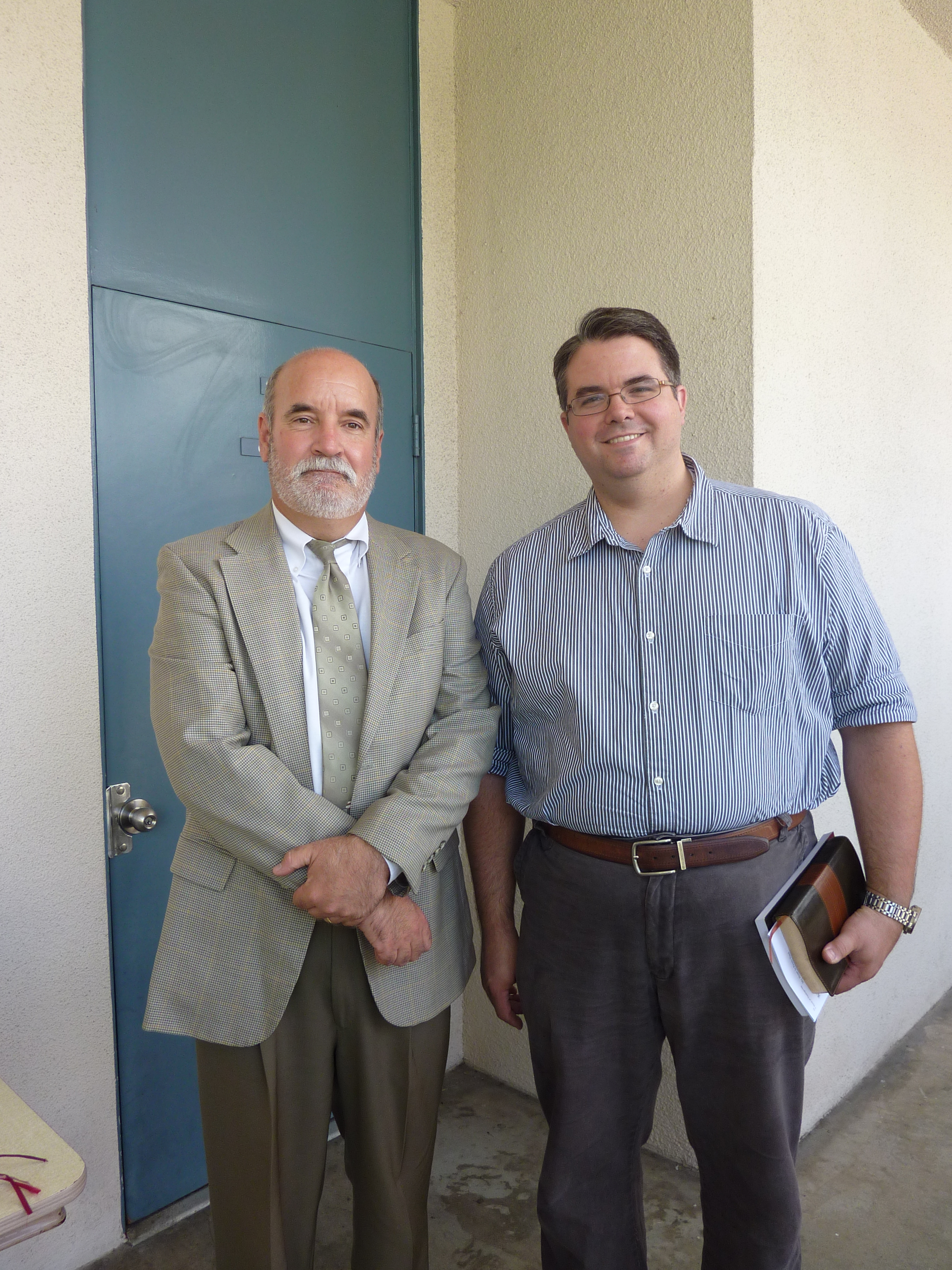
Dr. K. Scott Oliphint (left) with Rev. Joe Troutman (right)
The following was preached on March 6, 2011 by Rev. Joe Troutman, pastor of Mid Cities Presbyterian Church, in Bedford, Texas. This just happened, in the providence of God, to be the weekend after the controversy about which I’ve been posting for the past couple of weeks. The heresy of some becomes an opportunity for the orthodox to proclaim the truths of the Bible with all the more clarity. I hope you find the following words at the same time edifying and challenging.
“Again, the kingdom of heaven is like a net that was thrown into the sea and gathered fish of every kind. When it was full, men drew it ashore and sat down and sorted the good into containers but threw away the bad. So it will be at the close of the age. The angels will come out and separate the evil from the righteous and throw them into the fiery furnace. In that place there will be weeping and gnashing of teeth.” (Matthew 13:47-50 ESV)
The third parable, which is found in verses 47-50, is the longest of the four. There is some similarity here to the first two, but overall it is different. Some commentators group it with the parable of the wheat and the tares because it describes a harvest–a harvest of the sea, as opposed to a harvest of the field. In this parable, Jesus says again, “The Kingdom of heaven is like a net that was thrown into the sea, and gathered fish of every kind. Like the second parable, there is a great search taking place. But instead of a search for a precious pearl, it is a search for fish. This search is being done, it says, by angels.
The first two parables describe men who find the Kingdom, but this parable is about the Kingdom finding men. We may think we found God. We may think that in some way we stumbled across him; that in our search in the marketplace, we have found the pearl of great price. But in reality, the parable shows, Jesus is continuing to tell us that it is God who found us. It is God, the Lord Jesus Christ himself—who sought us out. Jesus said in Luke 19:10, “The Son of Man came to seek and to save the lost.” The value of God’s Kingdom, and the place of God’s elect in it, are so great that the purchase price was nothing less than Jesus Christ himself. It is, in fact, more than you and I could pay. More than we could ever pay. It is a debt that is too great for us. Because God made a covenant with himself to save a people for himself, he was willing to go to any length to procure his people’s salvation. He was willing to give his Son as a ransom for lost sinners like you and me. This is what the Lord was willing to do for all who truly believe.
In this parable, the Kingdom of heaven is compared to a net. Don’t think of a fishing net, don’t think of a net that’s at the end of a pole, that people use to scoop up a fish at the end of a fishing line. Don’t necessarily even think of a net that is cast out into the water. This is a large net. This is a dragnet. This is what may be termed a seine. One of the things my dad, my grandfather, my brother and I would do when we were younger, we had a creek running through the property of our farm, and every so often we would take a seine and we would go, men on one side and men on the other, and go up the creek and catch whatever we could find–turtles, snakes, fish–whatever it was, we would try to catch it. This is the kind of thing that Jesus is describing here in this parable. The angels, the reapers, are catching whatever they can get, and the sorting of the good fish from the bad ones would take place on the shore, which is what Jesus says in verse 48. He says, “When it was full, men drew it ashore, and sat down and sorted the good into containers, and threw away the bad.”
Then he explains this part of the parable in verses 49-50. He says, “So it will be at the close of the age. The angels will come out and separate the evil from the righteous, and throw them into the fiery furnace. In that place there will be weeping and gnashing of teeth.” What is Jesus talking about? He’s talking about the final judgment. He’s talking about when he returns; when he returns as the Savior of his people and the Judge of those who have rejected him. What is he saying will happen? He is saying that some will be kept, and some will be thrown away. There will be a final sorting that takes place: some will be welcomed into glory by their Savior, and others will be cast into hell by their Judge.
This is what Jesus is teaching. Yet if we affirm this, we are in danger, we need to know, as being regarded as radical fundamentalists by most of the people in our society–even by fellow evangelicals. Yet there is an inconvenient truth for those who would deny the existence of hell and eternal punishment in it by the Lord. And this is it: Scripture says it exists! Scripture repeatedly talks about the existence of hell. The weeping and the gnashing of teeth, the casting of those who refuse to believe into hell, Jesus himself–regarded by many on the more liberal side of the church as just a friendly and nice guy, a lovable teddy-bear type of Savior–Jesus himself talks about hell. It is inescapable.
Now we are not to revel in it; it should sadden us that some are lost. And yet, in God’s casting unbelievers into hell, he is glorified. This may be difficult for us, but just because it is difficult does not give us the right to throw this doctrine away. In so doing, we are throwing portions of Scripture away. In Matthew 10:28, Jesus warned his followers not to fear someone who could kill the body but not the soul; he says instead to fear him who can destroy both the body and the soul in hell. In other words, fear God.
The book of Revelation also has something to say about that. It is the place where Satan and his angels and everyone whose name is not written in the Lamb’s Book of Life. It is described in Revelation 21:8 as the lake that burns with fire and sulfur, which is the Second Death. There are many today who are challenging Jesus’ teaching in our passage, and many others that say he will save some and send others to hell, but they are denying God’s Word. If they’re denying that he sends some to hell, they are denying his Word, and they have nothing left to stand on when they make their own pronouncements.
In the photo above, Rev. Troutman is posing with Dr. K. Scott Oliphint, professor of Apologetics and Systematic Theology at Westminster Theological Seminary in Philadelphia, Pennsylvania. He came to town as a speaker at the recent Full Confidence Conference, about which I posted a few weeks ago. In the Q & A Session at the end of the conference, Dr. Oliphint concludes the entire event with some very compelling words on the nature of hell as eternal, conscious torment. I highly recommend you give it a listen as well.
Interviewing the Interviewer and “Heaven & Hell”

Martin Bashir
You just have to listen to this program. Martin Bashir, the MSNBC journalist who gave Rob Bell a challenging interview about the contents of his new book Love Wins, was interviewed himself on the Paul Edwards Program about that interview. Edwards not only wanted to know how Bashir prepared for his interview with Bell, but also wanted him to confirm or squash the rumor that’s been going around that he is himself a Christian and a member of Redeemer PCA in New York City. Bashir explains his own motives and methods for his Bell interview.
It’s an awesome program! Gene Veith or someone else well versed in the Protestant doctrine of vocation should interview him further as an example of a Christian pursuing excellence in his journalistic vocation for the glory of God. I think that would be an interesting discussion.
Listen to “MSNBC’s Martin Bashir on the Paul Edwards Program.”
Also listen to this special episode of the White Horse Inn, “Heaven and Hell,” in which the “usual cast of characters” discuss Rob Bell and Love Wins with Kevin DeYoung, a leader of the so-called “New Calvinism,” or “The Young, Restless and Reformed” movement, the orthodox alternative to the postmodern liberalism of Rob Bell, Brian McLaren, Doug Pagitt, etc.
Full Confidence Audio

I can't wait to load these messages on my iPod!
At last we are able to download the lectures delivered at the recent Full Confidence Conference at Grace Community Presbyterian Church in Ft. Worth, Texas. A link to the messages may be found on GCPC’s home page, or you can simply link to the messages from the list below.
Having heard the lectures in person myself, I must say that I was awed by Dr. Oliphint’s ability to make the point of his messages (both the one at the conference, and his Sunday morning sermon at Mid Cities OPC, which I will provide in a future post) very powerfully by presenting opposing viewpoints, effectively dismantling them, and then so unpacking the truth of God’s Word in such a way, that the hearer (at least, I was) has such a clear concept in his mind of the given topic that it is simply overwhelming, effectively prompting a spontaneous response of worship of the Lord.
Also, don’t miss Dr. Oliphint’s remarks about hell at the end of the Q&A session. It’ll prove a helpful defense of the orthodox doctrine of eternal conscious torment in hell in the light of the current controversy with Rob Bell.
Likewise, Dr. David Garner’s communication skills shone through in his messages. He is a genuine word smith.
I’m sure that you, too, will find much to admire and learn from each of the three conference speakers.
Session 1: The Context for Confidence (Dr. K. Scott Oliphint)
Session 2: the Gospel from Above (Dr. David Garner–not recorded due to technical difficulties)
Session 3: Who Says? (Dr. Timothy Witmer)
Session 4: Vital Inspiration in a Virtual World and Q&A Session (Dr. David Garner/All of the above)
Rev. John Brown on the Inabilities of Natural Reason

John Brown’s Self-Interpreting Bible (1859)
The recent unpleasantness regarding Rob Bell’s rejection of orthodox thinking and teaching is sparking a concerted effort among my fellow Reformed bloggers and other online ministries to raise awareness that evangelicalism has been in decline for many years, and it is only accelerating. Bible believing Christians need to get back to the basics of what it means to believe the Bible.
To that end, I will begin a new series of excerpts from my antiquarian Self-Interpreting Bible, by the Rev. John Brown of Haddington, Scotland. One of his numerous helps in highlighting the Bible’s self-attestation to it’s inspiration as well as its self-interpretation, is an essay entitled, “An Introduction to the Right Understanding of the Oracles of God.” Chapter one of this lengthy introduction is called, “Of the Divine Authority of the Scriptures of the Old and New Testament.”
In this chapter, Rev. Brown begins by demonstrating that there are some things which natural reason is unable to accomplish on its own. Such things are impossible to it without the aid of divine revelation. This fact is often something that even the most devout believer of the Bible forgets, and in such cases, the faith and practice of the church are undermined. Such is undoubtedly the case in the present controversy that has been sparked by natural reason in the form of Rob Bell’s postmodern liberalism.
No man, who is an unbiased free-thinker, can soberly hearken to the dictates of his natural reason, and seriously ponder the absurd and contradictory principles and practices which have been or are prevalent among mankind, without perceiving that the light, or even the law of nature, is altogether insufficient to direct us to true holiness, or lasting happiness, in our present lapsed condition.
It can give us no plain, distinct, convincing, pleasant, powerful, and lasting ideas of God. It cannot direct us in the right manner of worshipping him with due love, resignation, humility, self-denial, zeal, wisdom, sincerity, and fervent desire of the eternal enjoyment of him. It cannot show us our true happiness, which is suited to our highest powers, which may always be enjoyed without shame, suspicion, fear, or dread of loss or danger, and which will in every situation support and comfort us.
It can discover no true system of morality, perfect in its rules, means, and motives. It can discover no effectual incitements to virtue, drawn from the excellency and presence of God the law-giver, from the authority of his law, or from his discovering a proper regard to it in rewarding virtue and punishing vice. It cannot manifest in a striking manner the certainty, excellence, pleasure, and allurement of virtue in our heart, which will ripen us to that proper pitch of religion and virtue in our heart, which will ripen us for the full and immediate enjoyment of God. It cannot show us one perfect example of virtue, either among learned or unlearned heathens; nor give us any promise of God’s assisting us in the study of it.
It can discover no certainty that God will pardon our sins;
no proper atonement;
no actually pardoned sinner;
no happy soul, praising God for his pardoning mercy;
no spiritual worship, appointed by God for rebellious sinners;
no purpose, promise, perfection, or name of God, that his honour, or is intended in his patient bearing with sinners on earth;
nor does it afford any divine proclamation of pardon, nor even any incitement to us to forgive our injurers;
and, in fine, it cannot effectually sanctify our heart, nor produce that bent of will and affection, that inward peace with God, that sufficiency of light and strength from God, or that solid hope of eternal happiness, which is necessary to produce true holiness and virtue.
It cannot support us under heavy and bitter afflictions, by showing us God’s fatherly care of us, his promises to us, or his making all things to work together for our good; nor can it comfort us against death by certain views of his love to us, and providing everlasting life and happiness for us.
The Scriptures’ Guardrails on Divine Sovereignty, Human Responsibility, etc.

Westminster Seminary California has posted what is probably my favorite article by Dr. Michael Horton, their J. Gresham Machen professor of apologetics and systematic theology. The title is “Reformed Theology vs. Hyper-Calvinism.” It deals with how Scripture presents passages that relate both concepts. The great contribution of Reformed theology has been to attempt to properly interpret each in the light of the other, allowing, for example, the passages on the sovereignty of God to prevent us from falling off one side into sheer Pelagianism, and the passages on human responsibility from falling off into Hyper-Calvinism.
Many foes of Reformed theology are guilty of mis-characterizing it in terms of what is formally classified as Hyper-Calvinism. They refuse to notice that Calvinists are just as critical of Hyper-Calvinism as moderate Calvinists and Arminians are. This article helps the reader see the difference between the two.
Full Confidence Conference Photo Gallery
The folks at the Full Confidence Conference didn’t know they had a representative from the shallow end of the Refomred blogosphere covering them until I stuck my camera in their faces. When the audio of the messages are made available, I’ll provide summaries and links, but for now, here are a few photos of some of the folks involved:
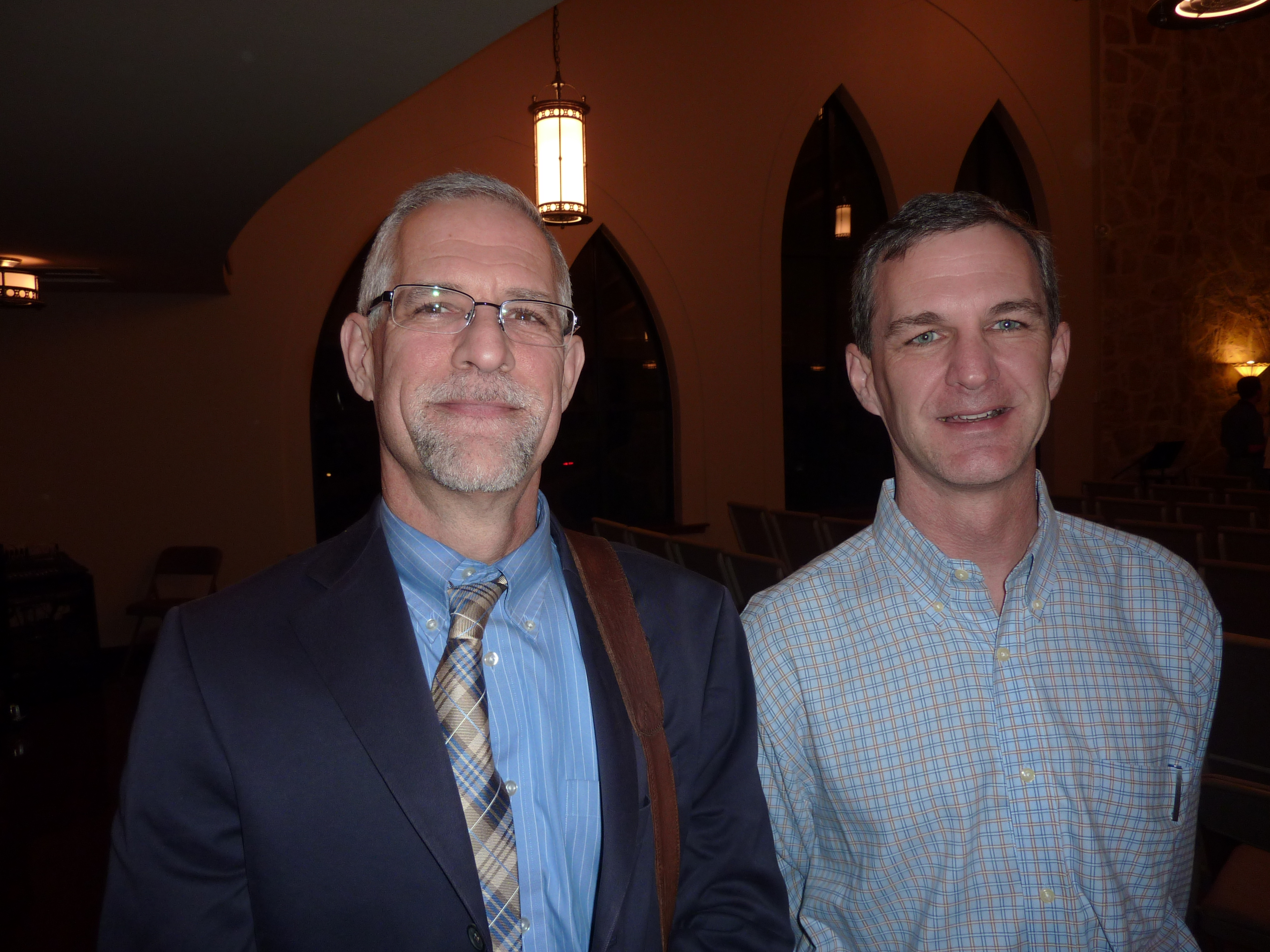
Dr. K. Scott Oliphint (left), with brother Pastor Kyle (right).
Here’s a blooper I just can’t resist sharing with you. Here are Pastor Kyle Oliphint and Dr. David Garner losing focus and starting to chat and look around just as I snap their picture…Hey Kyle! I’m over here! 🙂
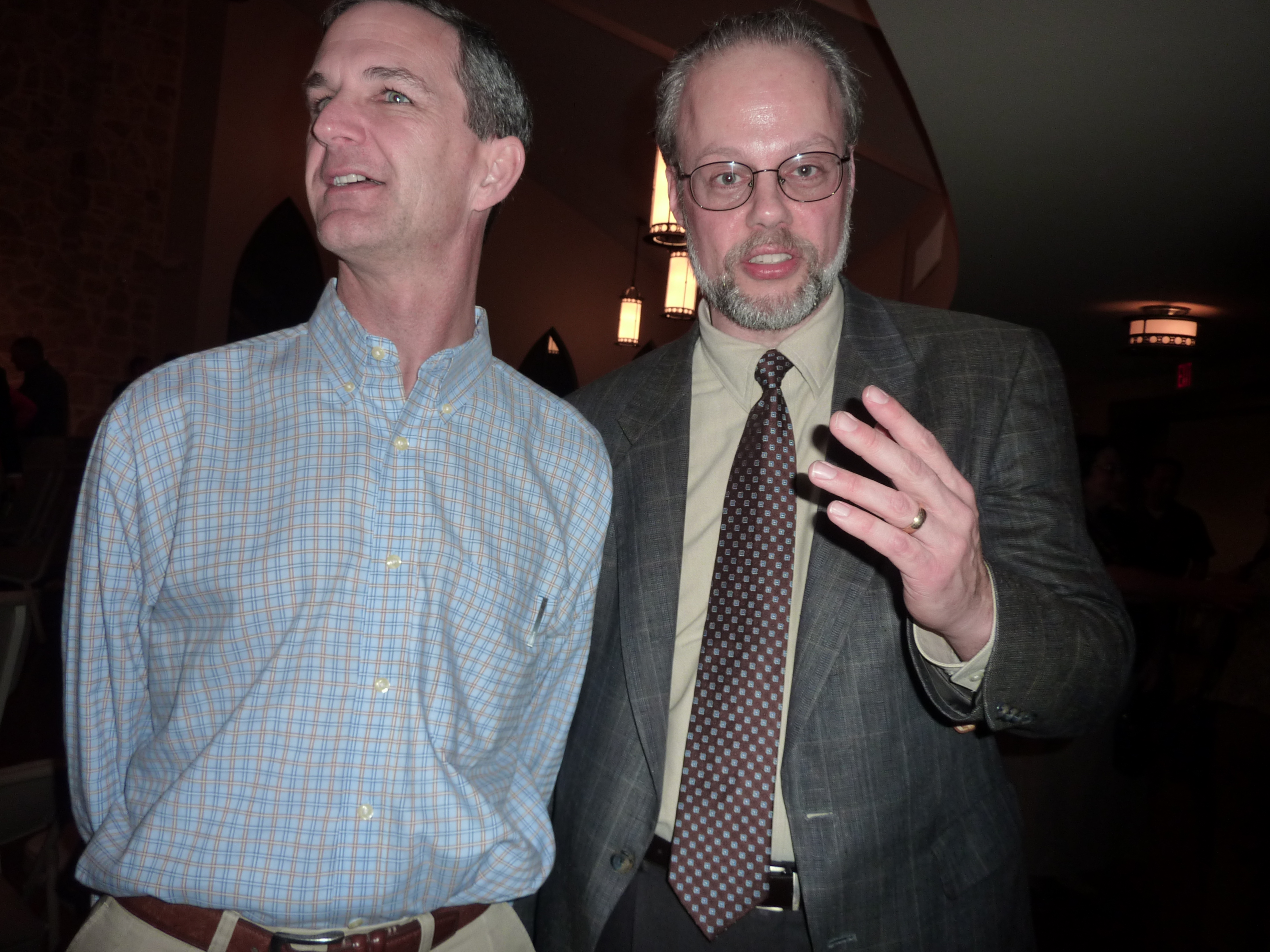
Kyle (right) with Conference organizer, Dr. David Garner.
Next is a look at the “emerging” Westminster generation–Jonathan Brack with Dean of Admissions and son of Dr. K. Scott Oliphint, Jared Oliphint. I hope they enjoyed their little family reunion.
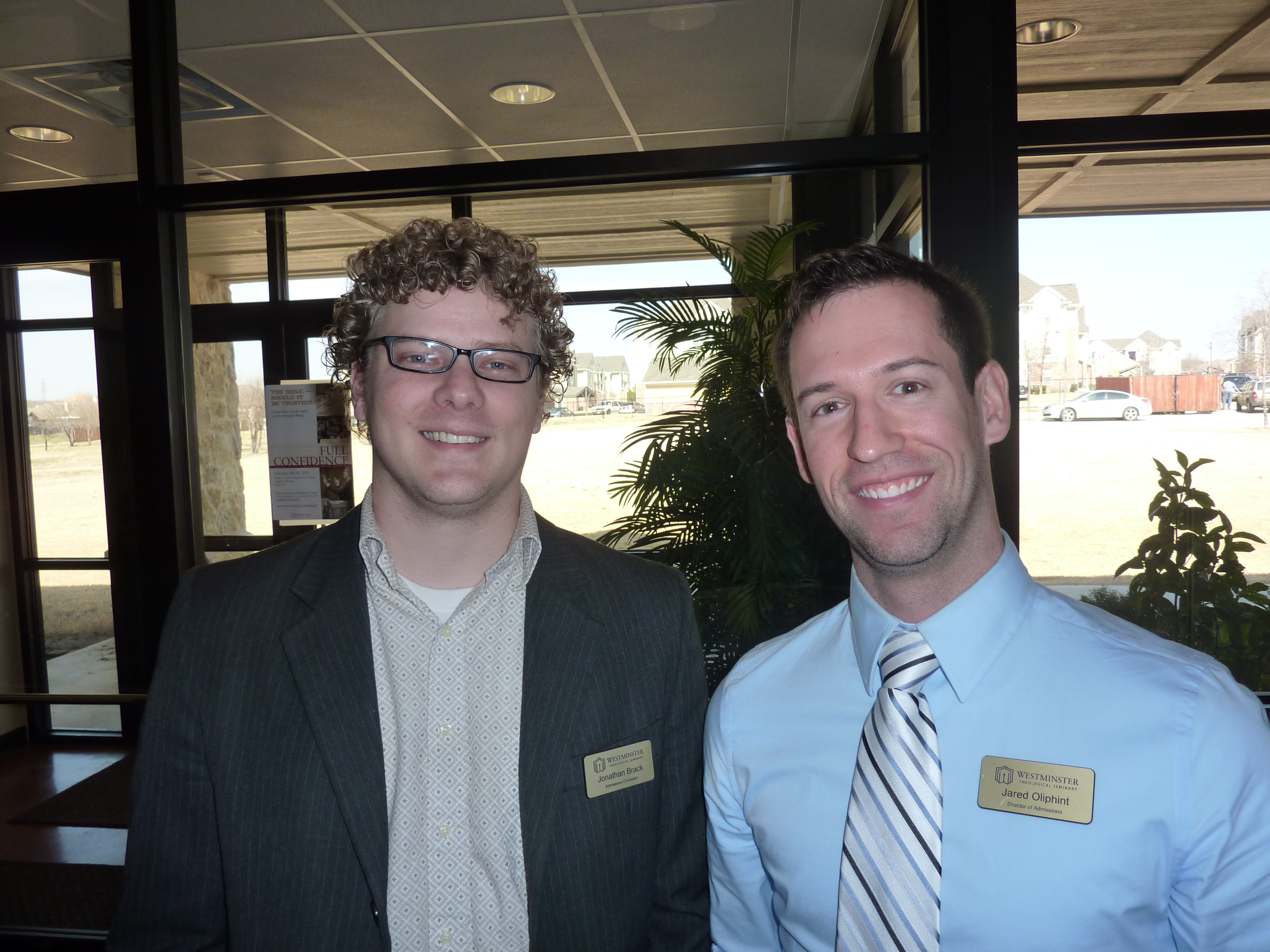
Jonathan Brack (left) with Jared Oliphint (right)
And finally, I took the opportunity to get a snapshot with one of my heroes of the faith, a man who successfully lead his family out of fundamentalism and into the Reformed faith intact, Dr. Thomas R. Browning (Hey, Bob Hayton! Here’s a real, live “Fundamentalist Reformer” for you!). He is the Assistant Pastor of Grace Community Presbyterian Church, and can be found teaching the adult Bible study in the sanctuary most Sunday mornings. In many ways, I am indirectly a product of his influence, in that he taught the guys who, after years of on-again, off-again considering of the doctrines of grace, lovingly latched onto my ankle (like the Calvinist bulldogs they are) and didn’t let up until I said “Uncle!” Every time I think of this guy, I recall the touching tribute once spoken by his son, Gage (a former co-worker): “My dad is my favorite preacher.” Learn more about Dr. Browning and his ministry of preaching and teaching here and here.

John Chitty (left) with Dr. Thomas R. Browning (right)
The Words of Life
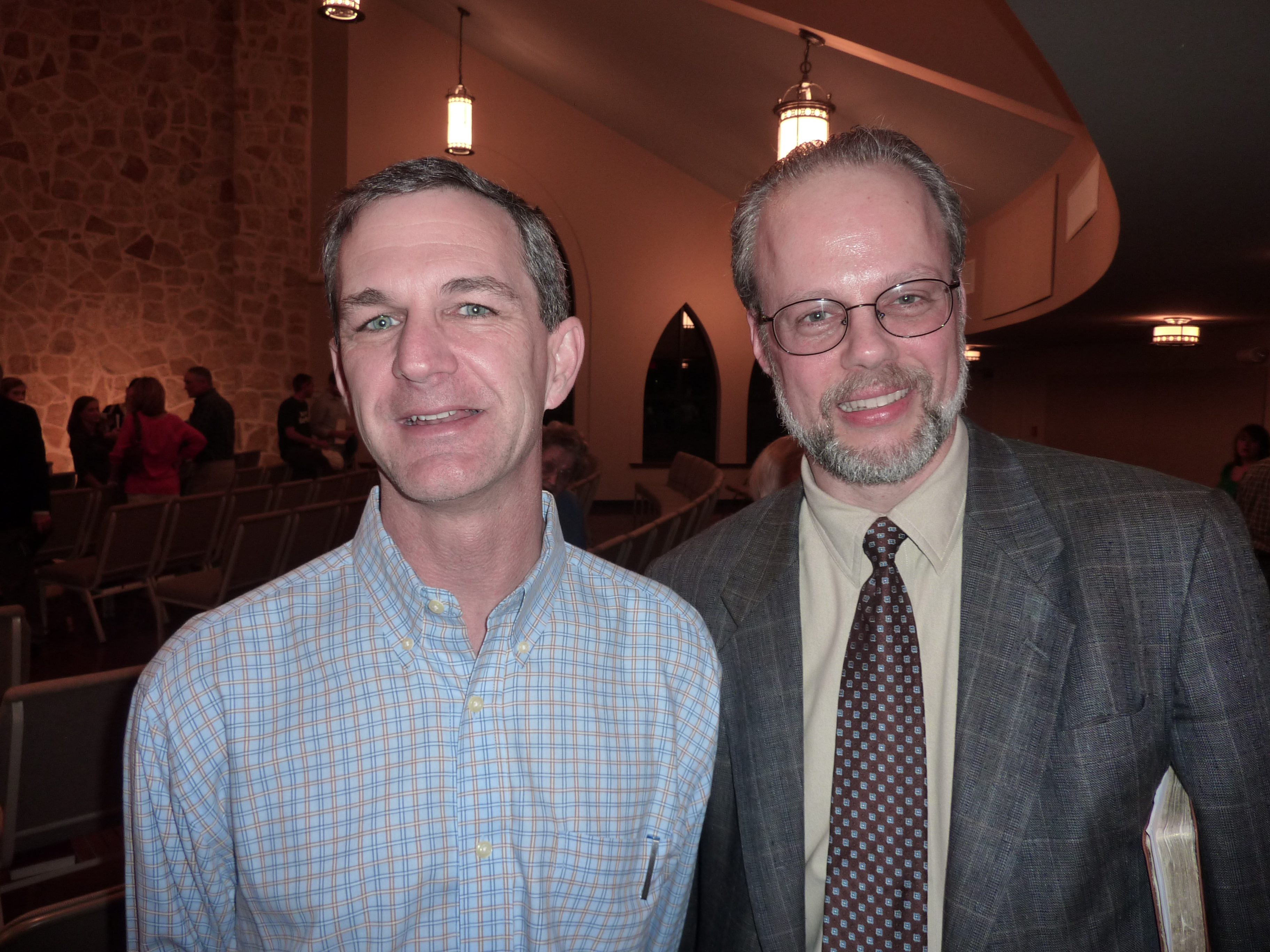
GCPC Pastor Kyle Oliphint (left) with Dr. David Garner (right)
Thought I’d tease you with a Luther quote given by Dr. David Garner in his message, “The Gospel From Above,” last night at the Full Confidence Conference at Grace Community Presbyterian Church in Ft. Worth, Texas. The highlighted portion is the portion to which Dr. Garner made reference, the rest shows a little context of what Luther was discussing:
“The neglect of Scripture, even by spiritual leaders, is one of the greatest evils in the world. Everything else, arts or literature, is pursued and practiced day and night, and there is no end of labor and effort; but Holy Scripture is neglected as though there were no need of it. Those who condescend to read it want to absorb everything at once. There has never been an art or a book on earth that everyone has so quickly mastered as the Holy Scriptures. But its words are not, as some think, mere literature (Lesewort); they are words of life (Lebewort), intended not for speculation and fancy but for life and action. By why complain? No one pays any attention to our lament. May Christ our Lord help us by His Spirit to love and honor His holy Word with all our heart. Amen.” (LW 14:46)
More to come next week…
Full Confidence Conference Coming to Fort Worth This Weekend!
Just to give you a heads up, this Friday night, February 18, 2011 (that’s tomorrow night from the time of this posting), my wife and I will be attending the Fort Worth wing of the Full Confidence Conference Tour put on by Westminster Theological Seminary in Philadelphia, Pennsylvania and hosted by Grace Community Presbyterian Church (PCA) with a small group of friends from my church. In the light of many assaults on the inspiration, inerrancy and authority of Scripture in both the broadly evangelical world, and even the Reformed tradition itself in a few cases, WTS has been traveling the country to reaffirm and build up the Body of Christ to have full confidence in the Word of God.
The Fort Worth, Texas conference is going to feature as speakers, Dr. K. Scott Oliphint (elder brother of GCPC’s pastor, Rev. Kyle Oliphint), Dr. Tim Witmer, Dr. David Garner and Dr. John Currie. You can read their bios at the Full Confidence link above. Pastor Kyle Oliphint has been preaching a series on having full confidence in the Word of God for the past three weeks. I’ve been following them and will share the links next week, but if you want to hear them now just find the link to GCPC’s podcast from their church website and listen for yourself. An exciting bonus for my church, Mid-Cities Orthodox Presbyterian Church, in Bedford, Texas, will have the honor of welcoming Dr. Scott Oliphint to preach in our morning service the Lord’s Day following the conference, Sunday, February 20. I’ll post a link to his sermon as it becomes available.
Here’s a video intro of the conference by one of our speakers:
From KJV Onlyism to Calvinism

Perhaps one day I’ll write something on how King James Onlyism opened my mind and heart to Reformed theology. It had a little to do with this book, The King James Version Defended, by Edward F. Hills.
In an attempt to bring the work of John William Burgon into the twentieth century, Hills, a Westminster Theological Seminary graduate (along with Yale, Harvard, Columbia Theological Seminary and the University of Chicago) made probably the most interesting case in favor of retaining the Textus Receptus as it has been translated in the KJV as the Protestant New Testament, applying the presuppositional apologetic of Cornelius Van Til who developed and taught it at Westminster Theological Seminary in order to arm confessional Reformed Presbyterians, among others, with a consistently Reformed, confessional and covenantal method for defending the faith.
I just got the 2006 edition of it in the mail today. It was updated in conjunction with the Encylcopedia Puritannica Project. Boy, I hope they didn’t screw it up! Hills deserves better than that! Here’s something I posted about this book in the past.
Total Depravity Implies Total Inability

Matthew 19:16-26 ESV
And behold, a man came up to him, saying, “Teacher, what good deed must I do to have eternal life?”
And he said to him, “Why do you ask me about what is good? There is only one who is good. If you would enter life, keep the commandments.”
He said to him, “Which ones?”
And Jesus said, “You shall not murder, You shall not commit adultery, You shall not steal, You shall not bear false witness, Honor your father and mother, and, You shall love your neighbor as yourself.”
The young man said to him, “All these I have kept. What do I still lack?”
Jesus said to him, “If you would be perfect, go, sell what you possess and give to the poor, and you will have treasure in heaven; and come, follow me.”
When the young man heard this he went away sorrowful, for he had great possessions. And Jesus said to his disciples, “Truly, I say to you, only with difficulty will a rich person enter the kingdom of heaven. Again I tell you, it is easier for a camel to go through the eye of a needle than for a rich person to enter the kingdom of God.”
When the disciples heard this, they were greatly astonished, saying, “Who then can be saved?” But Jesus looked at them and said, “With man this is impossible, but with God all things are possible.”
You see? The doctrines of grace are biblical, if one would only open his mind, heart and eyes to find them on the surface of the text of the Bible.
The doctrine of Total Depravity is the foundation of the rest of the doctrines of grace, also known as the TULIP. Edwin H. Palmer, in his book, The Five Points of Calvinism (©1972, Baker Books), outlines the doctrine of Total Depravity as follows (pages 9-16):
- What It Is Not
- It is not absolute depravity
- It is not a complete absence of relative good
- What It Is
- Positively: only and always sinning
- Negatively: total inability
i. Man cannot do the good
ii. Man cannot understand the good
iii. Man cannot desire the good
Palmer’s conclusion: “There are three lessons to be drawn from the Biblical teaching of the total depravity of man” (page 19)
- Total depravity explains the troubles in our world.
- A knowledge of total depravity should also teach us that we are thoroughly bad and in a terrible state of affairs unless God helps us.
- A knowledge of total depravity will teach a person that if he has a desire to ask God to help him, it is only because it is God who is working within him to will and to do according to His good pleasure (Philippians 2:12, 13).
Finding Your Way
 Dr. Kim Riddlebarger has written a helpful article in the January/February 2011 issue of Modern Reformation Magazine called “‘You Are Here'”: The Map of Redemptive History.” Especially enlightening for us recovering Dispensationalists is his treatment of the ever-popular “signs of the times.” If you like scouring current events for prophetic fulfillment, be ready to have your bubble burst! You’ll have to subscribe at the Modern Reformation website to view the entire article.
I’ve frequently repeated the saying of apparently unknown origin, “you can’t know where you’re going until you know where you’ve been.” I, however, usually modify it this way: “When you learn where you’ve been, you can see where you are, and know where you’re going.” In other words, as this applies to the visible church, when we’re informed by church history, we learn from many of the valuable lessons learned in the past, and it helps us figure out how to avoid those mistakes in the future. But if we ignore the past lessons learned, we in the present are doomed to repeat the mistakes of the past (an allusion to a better known saying). Dr. Riddlebarger assists us by appropriately moving us further back into our formative collective past by summarizing the history of redemption as progressively revealed in the Bible. His article helps us see where the church has been from the very beginning, the book of Genesis, and the promise and fulfillment of redemption in the Person and Work of Christ. But especially, we learn how to better interpret those signs of the times which we recognize in the present, and the portions of Scripture that reveal them, and how they point forward to the future coming of the Lord Jesus Christ. If you want the theological terminology, Dr. Riddlebarger helps the Dispensational-Premillennialist see how the Amillennial view of eschatology interprets end-times prophecy. If you’d like to learn more about Amillennial eschatology, I’d like to recommend Dr. Riddlebarger’s audio series “Amillennialism 101” located in the sidebar of his Riddleblog, and his books, A Case for Amillennialism, and Man of Sin. If you give this position some thought, I think you’ll find it makes clear some things that remain fuzzy for the average Dispensationalist.
In “You Are Here,” His synopsis of the article is as follows:
In this article, I will concentrate upon the nature of the course of the post-apostolic history of the church as defined in the New Testament itself, and consider several of the signposts—given to us by those same New Testament writers—that serve as indicators of what to expect as post-apostolic history continues to unfold until the end of the age.
Dr. Kim Riddlebarger (Left) and myself (Right) after services at Christ Reformed Church, Anaheim, CA.
Dr. Riddlebarger illustrates the history of redemption and the end times by the image of a Mall Directory with it’s “You Are Here” sign. He writes:
The practical ramifications of finding the “You Are Here” arrow are immediately apparent. Since we live in the post-apostolic age—some two thousand years removed from the time of the apostles—how do we relate to the apostolic age so long ago? Should we do as many Pentecostals do and understand the dramatic events found in the book of Acts as normative for what should go on in the church today? Or should we see ourselves as living in a different age entirely—one that has little or no connection to the time of the apostles?
We can push this matter even further. How do we as Christians living in the post-apostolic age relate to the old covenant era that preceded the time of the apostles? Can we look to the history of ancient Israel to help us understand how we are to relate to non-Christians around us? Should we look to the monarchy in Israel for guidance as to how the nations of the earth should govern themselves in the modern world?
These questions find their answers in knowing where we are in terms of the progress of history after the close of the canon of Scripture with the composition of the book of Revelation, written in the early- to mid-nineties of the first century. For those of us who live nearly two thousand years after “Bible times,” where do we place the “You Are Here” arrow? In order to place that arrow properly, we need to have a good understanding of what has gone before, especially since those living during the apostolic era (that is, Jesus and the apostles) told us what to expect after the close of the apostolic age.
We are also introduced to the so-called “Already/Not Yet” approach to the Kingdom of God in the New Testament:
In the so-called prison letters (Ephesians, Philippians, and Colossians), Paul speaks of a believer’s heavenly citizenship (Phil. 3:20) based on the believer’s assurance that Jesus’ bodily resurrection guarantees our own resurrection at the end of the age (Phil. 3:21). Paul also tells us to seek the things above where Christ is (Col. 3:1-3) because this gives us a heavenly perspective on earthly things. Paul reminds us that all those who trust in Christ are seen as though they were already raised with Christ and seated with him in the heavenly realms (Eph. 2:4-7). For Paul, Christ’s death and resurrection (the critical historical events of the apostolic era) ensure our own salvation and grant us a heavenly perspective on earthly things. Even though the “You Are Here” arrow is placed in our own day and age some two thousand years after the apostolic age, the placement of the arrow itself must be seen as the guarantee that the same Savior—who was crucified, died, and was buried—will also ensure we reach our final goal: the redemption of our bodies and life eternal.
This future hope based upon certain historical events reflects another major theme running throughout the New Testament: What God has done in Jesus Christ (“the already”) ensures that everything God has promised his people will come to pass (“the not yet”). Paul speaks this way in Romans 8:23-25 when he talks of understanding our present sufferings in the light of that glory yet to be revealed when Christ returns at the end of the age. Because we trust in the finished work of Jesus Christ, we are indwelt by the Holy Spirit, who not only grants us hope (based on what God has already done for us through the doing and dying of Jesus), but the Spirit’s indwelling is itself the guarantee of the redemption of our bodies (Eph. 1:13-14).
This “already/not yet” perspective on things reminds us that we are pilgrims making our journey to the heavenly city. Although God has ordained all things in this life—giving everything we do meaning and purpose—the journey is not complete until we reach our final destination. Like the ancient Israelites who wandered through the wilderness of the Sinai desert awaiting entrance into the Promised Land of Canaan, we too look forward to our entrance into that heavenly city of which the earthly Canaan was but a dim shadow. Material blessings are not an end in themselves, but point to heavenly blessings far greater than our minds can conceive. This is what the author of Hebrews was getting at when he commended Abraham for looking beyond the land of the promise to what lies ahead at the end of the age (Heb. 11:9-10).
When we see God’s record of faithfulness in the past, we are able to look to the future, knowing that God keeps his promises. Knowing how things will turn out in the end gives us the “big picture” perspective we need to make sense of a life lived between the time of Christ’s first advent and his second. The “You Are Here” arrow makes sense only when placed on a map of the whole shopping mall. An arrow on a blank sheet of plastic does us no good. The same holds true for seeing our current place in redemptive history in the light of all God has done before we came along, knowing that Christ’s finished work is the guarantee of reaching our final destiny. The arrow makes sense only against the big-picture backdrop of redemptive history.
But what about the signs of the times? Here’s an excerpt of Dr. Riddlebarger’s treatment of them:
There are three categories of “signs” of the end in the New Testament. The first category of signs includes those that are specific to the apostolic era. The second group deals with those signs that characterize the entire interadvental age (the time between Christ’s first and second coming). The third group of signs includes those that specifically serve to herald the end of the age.
As for those signs that are specific to the apostolic age—those signs to be witnessed by the disciples in their lifetimes (“this generation,” Matt. 24:23)—there are four specific events foretold by Jesus. There will be false prophets, along with the arrest and persecution of the disciples (Matt. 24:9-14; Mark 13:9-13; Luke 21:12-19). Jesus also predicts the Roman siege of Jeru-salem, as the so-called “times of the Gentiles” begins (Luke 19:41-44; 21:24). Our Lord also speaks of the destruction of the city and the temple in A.D. 70 (Matt. 24:1-2; 14-22; Mark 13:1-2; 14-20; Luke 24:56; 20-24). Finally, Jesus speaks of the desolation and the Diaspora of Israel (Matt. 23:37-38), which came to pass with the complex of events associated with the Jewish Wars. These signs have been fulfilled with an amazing accuracy.
Then there are a series of signs that characterize the entire interadvental-period birth pains of the age to come. Jesus warns of false Christs (Matt. 24:3-8; Mark 13:3-8; Luke 21:7-11), wars and rumors of wars (Matt. 24:3-8; Mark 13:3-8; Luke 21:7-11), earthquakes and famine (Matt. 24:3-8; Mark 13:3-8; Luke 21:7-11), false teachers and false doctrine (2 Tim. 3:1-5), as well as the persecution of believers (2 Tim. 3:12-17). These things are not only present during the lifetimes of the apostles, but may be said to characterize the entire post-apostolic era. Given the presence of such things until our Lord returns, Jesus compared the interadvental age to the days of Noah (Matt. 24:37-38). God has announced that judgment is at hand, yet unbelievers go on with their immorality as though nothing important was about to happen.
Finally, the New Testament speaks of certain signs that particularly serve to herald the end of the age and the return of our Lord. The first such sign is that the gospel must be preached to the ends of the earth (Matt. 24:14)….
The second sign that foretells of the end is the salvation of “all Israel” as recounted by Paul in Romans 11:25-26….I take Paul to be speaking of the dramatic conversion of large numbers of ethnic Jews immediately before the time of the end as gospel progress rebounds from a largely Gentile mission to a Jewish one. I understand “all Israel” to be a reference to those ethnic Jews who embrace Jesus as their Messiah because God once again has mercy upon his ancient people. These folk become members of Christ’s church as a testimony to the grace of God. This mass conversion of “all Israel” tells us the end is at hand….
The land promise God made to Abraham (Gen. 15:18-21) has already been fulfilled—at least that is what Joshua reports (Josh. 23:14). It is Paul who universalizes the original land of promise far beyond the narrow confines from the rivers of Egypt and the Euphrates to include the whole world (Rom. 4:13). Although Israel’s national role in redemptive history has run its course with the coming of Jesus, when we see large number of Jews becoming Christians we know that the end is rapidly drawing near. The presence of a modern nation-state of Israel in the ancient land of promise is certainly tied to God’s mysterious purposes for the Jews, because all of the promises God made to the true children of Abraham (those Jews and Gentiles alike), who believe the promise and receive the Holy Spirit, have come to pass because Christ has come and the gospel has been preached to the Gentile nations….
The third sign of the impending dawn of the end of the age is a great apostasy, which is closely connected to the appearance of the man of sin (“the antichrist”), who is the final eschatological enemy of the church (2 Thess. 2:1-12; Rev. 20:7-10). Although Christians have often been tempted to see any moral decline in their own age as a sign of the end, the final apostasy will surpass anything witnessed to date. Even though there have been many “wannabe” antichrists since the apostolic era, and many of the signs associated with the antichrist have been present to some degree throughout the post-apostolic period, at some point in the future God will cease his restraint of the mystery of lawlessness (2 Thess. 2:7), when Satan is released from the abyss (Rev. 20:7-10). Only then will the final antichrist appear, soon to be crushed by Jesus at his return.
When this final apostasy occurs and the final antichrist is revealed, God’s people will face horrific persecution from a reinvigorated beast (the state) and its leader (the antichrist) who insist that the people of God declare “Caesar is Lord.” This is the one thing Christians will refuse to do, while at the same time refusal to do so is that which provokes the beast to its great fury against the people of God. Thankfully, the reign of this archenemy of Christ and his people will be short, as he is revealed only to go to his destruction (2 Thess. 2:8; Rev. 20:7-10).
Although it would behoove you to invest in a subscription to Modern Reformation Magazine to read the entire article for yourself, and benefit from the other helpful features, I’ve pretty much given you the heart of the article. I don’t want you to wonder as you wander, unnecessarily fearing things you shouldn’t as you look forward to the return of Christ. Reformed theology in general, and Reformed Amillennial eschatology in particular, is a liberating, comforting and most importantly, Biblical approach to our redemption in Christ from “In” (see Genesis 1:1) to “Amen” (see Revelation 22:21).
David Prays Like a Calvinist
“What do you have that you did not receive? If then you received it, why do you boast as if you did not receive it?” 1Corinthians 4:7
Since the turn of the New Year, our family decided to work our way together through the ESV Study Bible reading plan. Each night, we stop what we’re doing for a good half hour or so, and take turns reading aloud each of the four sections of Scripture, as divided up in the plan. A few days ago, we finished the book of 1 Chronicles, and this prayer of David’s caught my attention:
Therefore David blessed the LORD in the presence of all the assembly. And David said: “Blessed are you, O LORD, the God of Israel our father, forever and ever. Yours, O LORD, is the greatness and the power and the glory and the victory and the majesty, for all that is in the heavens and in the earth is yours. Yours is the kingdom, O LORD, and you are exalted as head above all. Both riches and honor come from you, and you rule over all. In your hand are power and might, and in your hand it is to make great and to give strength to all. And now we thank you, our God, and praise your glorious name.
“But who am I, and what is my people, that we should be able thus to offer willingly? For all things come from you, and of your own have we given you. For we are strangers before you and sojourners, as all our fathers were. Our days on the earth are like a shadow, and there is no abiding. O LORD our God, all this abundance that we have provided for building you a house for your holy name comes from your hand and is all your own. I know, my God, that you test the heart and have pleasure in uprightness. In the uprightness of my heart I have freely offered all these things, and now I have seen your people, who are present here, offering freely and joyously to you. O LORD, the God of Abraham, Isaac, and Israel, our fathers, keep forever such purposes and thoughts in the hearts of your people, and direct their hearts toward you. Grant to Solomon my son a whole heart that he may keep your commandments, your testimonies, and your statutes, performing all, and that he may build the palace for which I have made provision.”(1 Chronicles 29:10-19 ESV, emphasis mine)
When reading through the passage above, I had to chuckle a little, as I was reminded of this passage from Charles Spurgeon’s sermon, “Free Will—A Slave.”
Your fallen nature was put out of order; your will, amongst other things, has clean gone astray from God. But I tell you what will be the best proof of that; it is the great fact that you never did meet a Christian in your life who ever said he came to Christ without Christ coming to him. You have heard a great many Arminian sermons, I dare say; but you never heard an Arminian prayer—for the saints in prayer appear as one in word, and deed and mind. An Arminian on his knees would pray desperately like a Calvinist. He cannot pray about free-will: there is no room for it. Fancy him praying, “Lord,I thank thee I am not like those poor presumptuous Calvinists. Lord, I was born with a glorious free-will; I was born with power by which I can turn to thee of myself; I have improved my grace. If everybody had done the same with their grace that I have, they might all have been saved. Lord, I know thou dost not make us willing if we are not willing ourselves. Thou givest grace to everybody; some do not improve it, but I do. There are many that will go to hell as much bought with the blood of Christ as I was; they had as much of the Holy Ghost given to them; they had as good a chance, and were as much blessed as I am. It was not thy grace that made us to differ; I know it did a great deal, still I turned the point; I made use of what was given me, and others did not—that is the difference between me and them.” That is a prayer for the devil, for nobody else would offer such a prayer as that. Ah! when they are preaching and talking very slowly, there may be wrong doctrine; but when they come to pray, the true thing slips out; they cannot help it. If a man talks very slowly, he may speak in a fine manner; but when he comes to talk fast, the old brogue of his country, where he was born, slips out. I ask you again, did you ever meet a Christian man who said, “I came to Christ without the power of the Spirit?” If you ever did meet such a man, you need have no hesitation in saying, “My dear sir, I quite believe it—and I believe you went away again without the power of the Spirit, and that you know nothing about the matter, and are in the gall of bitterness and the bond of iniquity.” Do I hear one Christian man saying, “I sought Jesus before he sought me; I went to the Spirit, and the Spirit did not come to me”? No, beloved; we are obliged, each one of us, to put our hands to our hearts and say—
“Grace taught my soul to pray,
And made my eyes to o’erflow;
‘Twas grace that kept me to this day,
And will not let me go.”
Is there one here—a solitary one—man or woman, young or old, who can say, “I sought God before he sought me?” No; even you who are a little Arminian, will sing—
“O yes! I do love Jesus—
Because he first loved me.”
So you see, that in attributing to the LORD himself all that David and the people freely and willingly did, David betrays a theology that is not unlike that theology which has been derived from Scripture from the earliest days of the church, against which the ungrateful and self-sufficient regularly hurl accusations. Augustine’s prayerful confession of God’s absolute sovereignty and grace to empower the believer’s very obedience provoked Pelagius to twist Scripture to his own destruction in order to make man the source of his own salvation; Calvin’s systematization of this Biblical and Augustinian faith entrusted to him by his fathers in the faith provoked, after his death, a Dutch Reformed theologian named Jakob Hermanszoon, that is, Jacob Arminius (in Latin), to, if not distort the Word as devastatingly as Pelagius had before him, so distort the doctrines of grace that his followers would later remonstrate against them, creating the need for the Synod of Dort, which produced the world famous Canons of Dort (find them at my Creeds, etc. page) which serve as the source and inspiration of the infamous, yet Biblical acronym, TULIP. Even Great Awakening revivalist, George Whitefield endured the fiery darts of his beloved friend and fellow revivalist, John Wesley. How gracious is the Lord, who generously grants salvation to even those who do not properly recognize his absolute sovereignty, suffering the remaining sin within them which persists in grasping for some way to have a hand in his own eternal salvation.
Praise the Lord that King David’s eyes were clear in this regard as he lead the people of Israel in freely and willingly making generous donations toward the planned building of the temple in Jerusalem, which was entrusted to David’s son, Solomon. King David’s public confession of their unworthiness to even do so at all, and acknowledgement of the LORD’s gracious provision of the very materials which they would freely and willingly offer, contrasts sharply with the self-congratulatory words of that proto-Pelagian king, Nebuchadnezzar, who would one day take David’s kingdom into the original Babylonian captivity (see Daniel 4:28-33).
How beautiful is the corporate confession of the Reformed in this regard! In the words of the Belgic Confession (also linked to from the Creeds, etc. page), the Reformed confess the teaching of the Scriptures that “’A person cannot receive even one thing unless it is given him from heaven(John 3:27’” and so confess:
Therefore we reject everything taught to the contrary concerning man’s free will, since man is nothing but the slave of sin and cannot do a thing unless it is “given him from heaven.”
For who can boast of being able to do anything good by himself, since Christ says, “No one can come to me unless my Father who sent me draws him”? (John 6:44)
Who can glory in his own will when he understands that “the mind of the flesh is enmity against God”? (Romans 8:7) Who can speak of his own knowledge in view of the fact that “the natural man does not understand the things of the Spirit of God”? (1 Cor. 2:14)
In short, who can produce a single thought, since he knows that we are “not able to think a thing” about ourselves, by ourselves, but that “our ability is from God”? (2 Corinthians 3:5)
And therefore, what the apostle says ought rightly to stand fixed and firm: “God works within us both to will and to do according to his good pleasure.” (Philippians 2:13)
For there is no understanding nor will conforming to God’s understanding and will apart from Christ’s involvement, as he teaches us when he says, “Without me you can do nothing.” (John 15:5)
In this way it is clear that the content of King David’s “Calvinist” prayer demonstrates how consistent with Scripture is the Reformed confession of faith.
A Review of Dr. John Fesko’s Lecture on Word, Water and Spirit, part 3

In Part II of Dr. John Fesko’s book, Word, Water and Spirit: A Reformed Perspective on Baptism (2010, Reformation Heritage Books), he, in 3 chapters deals with the Biblical data related to baptism as “New Creation” (chapter 8), “Covenant Judgment” (9) and as “Eschatalogical Judgment” (10). The following is my summary of his remarks on this material at the Christ Reformed Church Friday Night Author’s Forum in Anaheim, California last Friday, January 21, 2011.
When you look at New Testament texts that teach about baptism, not merely the occurrences of the event, but which present the theology behind the event, the passages tend to point back to Old Testament passages and concepts. In 1Peter 3, the apostle shows the correspondence between the flood and baptism:
For Christ also suffered once for sins, the righteous for the unrighteous, that he might bring us to God, being put to death in the flesh but made alive in the spirit, in which he went and proclaimed to the spirits in prison, because they formerly did not obey, when God’s patience waited in the days of Noah, while the ark was being prepared, in which a few, that is, eight persons, were brought safely through water. Baptism, which corresponds to this, now saves you, not as a removal of dirt from the body but as an appeal to God for a good conscience, through the resurrection of Jesus Christ, who has gone into heaven and is at the right hand of God, with angels, authorities, and powers having been subjected to him.(1 Peter 3:18-22).
Elsewhere, the apostle Paul mentions the Israelites were baptized while crossing the Red Sea.
For I want you to know, brothers, that our fathers were all under the cloud, and all passed through the sea, and all were baptized into Moses in the cloud and in the sea, and all ate the same spiritual food, and all drank the same spiritual drink. For they drank from the spiritual Rock that followed them, and the Rock was Christ. Nevertheless, with most of them God was not pleased, for they were overthrown in the wilderness (1 Corinthians 10:1-5).
Notice that not only did the adults of the nation of Israel cross the sea and so become baptized into Moses, but so did the entire households of those adults, which necessarily includes any and all infants that were present at the time. Even the cloud, we learn, typifies the Holy Spirit in 1 Corinthians 10, says Dr. Fesko (see Isaiah 63:10-14).
Colossians 2:11-12 has been the field of a pitched battle between credobaptists and paedobaptists:
In him also you were circumcised with a circumcision made without hands, by putting off the body of the flesh, by the circumcision of Christ, having been buried with him in baptism, in which you were also raised with him through faith in the powerful working of God, who raised him from the dead (Colossians 2:11-12).
Critical of the paedobaptist appeal to such a correspondence between circumcision and baptism based on this text, some Baptists argue that circumcision is a physical, national rite–the “Jewish passport,” if you will–whereas baptism is entirely spiritual. To this, Fesko responds by pointing out that water of baptism is physical. Old Testament circumcision had spiritual connotations as well as baptism. For example, in Deuteronomy 10:16, the Israelites are commanded to circumcise their hearts. “Circumcise therefore the foreskin of your heart, and be no longer stubborn” (Deuteronomy 10:16). Later, we find that in chapter 30, this command becomes a promise, when Moses proclaims that the LORD will circumcise their hearts. “And the LORD your God will circumcise your heart and the heart of your offspring, so that you will love the LORD your God with all your heart and with all your soul, that you may live” (Deuteronomy 30:6). Paul in Romans 2:28-29 says the true Jew has had his heart circumcised.
“For no one is a Jew who is merely one outwardly, nor is circumcision outward and physical. But a Jew is one inwardly, and circumcision is a matter of the heart, by the Spirit, not by the letter. His praise is not from man but from God (Romans 2:28-29).
Thus Fesko describes the spiritual referent of circumcision.
But why was the act of circumcision chosen to serve as the sign of the covenant in the first place? Remember the first gospel promise in Genesis 3:15?
“And I will put enmity between you and the woman, and between your seed and her seed; he shall bruise you on the head, and you shall bruise him on the heel” (Genesis 3:15 NASB).
It is the seed of the woman who will bruise the serpent’s head. Elsewhere in the Old Testament, it is the seed of Abraham who will be “cut off.” The prophets applies the terminology of circumcision to the cross of Christ. Consider Isaiah’s great 53rd chapter alludes to circumcision in the sacrificial death of the Servant of the LORD: “By oppression and judgment he was taken away; and as for his generation, who considered that he was cut off out of the land of the living, stricken for the transgression of my people?” (Isaiah 53:8)
In Genesis 17, those who are circumcised are included in the covenant, and those who are not are said to be “cut off” from covenantal relationship with the LORD.
He who is eight days old among you shall be circumcised. Every male throughout your generations, whether born in your house or bought with your money from any foreigner who is not of your offspring, both he who is born in your house and he who is bought with your money, shall surely be circumcised. So shall my covenant be in your flesh an everlasting covenant. Any uncircumcised male who is not circumcised in the flesh of his foreskin shall be cut off from his people; he has broken my covenant” (Genesis 17:12-14).
Finally, the sex of the recipient of circumcision was significant in its allusion to the fact that the Seed of Abraham to come, who would be cut off for his people, would be a male—the Lord Jesus Christ. These are some of the reasons that the act of circumcision is the appropriate sign of the Covenant of Grace. Therefore it makes sense that when we go to the New Testament, we find in Colossians 2 that when Paul makes reference to the “circumcision of Christ,” it is to his crucifixion, when Christ was cut off for his people, that he refers.
But why is it, then, that circumcision is replaced as the sign of the Covenant of Grace by a rite such as water baptism? What is it about the application of water that so well fulfills in the New Testament the significance of Old Testament circumcision? In the opening of the Gospels, John the Baptist announces:
“I baptize you with water for repentance, but he who is coming after me is mightier than I, whose sandals I am not worthy to carry. He will baptize you with the Holy Spirit and fire. His winnowing fork is in his hand, and he will clear his threshing floor and gather his wheat into the barn, but the chaff he will burn with unquenchable fire” (Matthew 3:11-12).
Did John simply pull this ceremony out of thin air? Did he appropriate the immersion ceremonies of the Qumran community with whom he is considered to have possibly resided for a time? Was he simply applying Jewish proselyte baptism to repentant Jews? In the case of Jewish proselyte baptism, Dr. Fesko’s research seemed to indicate that, in fact, this baptism may have been devised only sometime after Christians began baptizing in the name of Jesus, and it may have been that they did so in imitation of Christian baptism. Instead, Dr. Fesko affirms that the true point of origin of John’s baptism is found in the Old Testament itself.
Joel refers to an outpouring of the Spirit (Joel 2:28); again, the Genesis flood corresponds to baptism in Peter (1 Peter 3:18-22); Ezekiel’s vision of the Temple features water flowing out from underneath it which makes fruitful everything it touches (Ezekiel 47:1-12); in Isaiah, the Spirit is poured out, making the desert bloom like the garden of Eden (Isaiah 51:3; cf. 35:5-7). John, then, would have concluded from passages like these that the Messiah would come and would baptize his people in the Spirit. Therefore, now, under the New Covenant, we baptize young and old, male and female to testify to the fact that the Christ has come and fulfilled circumcision by being cut off for his people and he has baptized his people in the Spirit.
For the most part, baptism is presented as a blessing, but what about the baptized who apostatize? Is baptism somehow neutralized, or rendered ineffective? Dr. Fesko declares that there are no neutral encounters with the living God, according to the Word of God. You do not enter God’s presence and leave unchanged. The professing believer, and his household, receives the visible sign of the baptism of the Spirit either to their blessing or to their cursing. When Christ was crucified between two thieves, was the thief who asked him to remember him the only one affected by his encounter with the Son of God? No, the other thief, who mocked Christ, went to his doom. Scripture identifies Christ either as the Rock on which the believing fall upon, or he is the Rock which crushes those on whom it falls (Matthew 21:44). Thus, the revelation of Christ is double-edged.
Ministers often fear that when they see no tangible results to their preaching in terms of conversion, that perhaps the preaching of the Word is an ineffective enterprise. But the faithful minister who sees no results isn’t a failure, for the unresponsive will be judged. Just as the Old Testament prophets preached with no prospect of positive response. Isaiah was called to preach a message of judgment. Paul, in 2 Corinthians 2:14-16 says that ministers are either the fragrance of life to some, and the fragrance of death to others. Consider the warnings for unworthy reception of the Lord’s Supper—Paul indicated that for this reason, some were sick and dead among the Corinthians (1 Corinthians 11:27-32). Likewise, water baptism is either the water of new creation, or it is the water of judgment. Again, during the flood, those sealed in the ark were saved through the waters (1 Peter 3:20), while those outside of the ark were lost in judgment. Similarly, the Israelites in the exodus were saved through their Red Sea baptism, while their Egyptian pursuers were drowned (Exodus 14:26-29).
Subjecting the New Testament doctrine of baptism to the classical Protestant hermeneutic of the analogy of faith, by interpreting unclear passages in light of the clear parallel passages, demonstrates how it corresponds in many of its particulars to circumcision. I find it especially helpful to see how the connection between the two is found ultimately in the Lord Jesus Christ himself. The Great Seed of Abraham has been cut off from the covenant for the transgressions of his people, and he now baptizes his redeemed with cleansing influence of the Holy Spirit, but false professors who receive the sign of the Spirit’s cleansing will instead be burned with unquenchable fire (Matthew 3:11b-12).
A Review of Dr. John Fesko’s Lecture on Word, Water and Spirit, part 1
 On Friday, January 21st, 2011, Dr. John Fesko, Academic Dean and Associate Professor of Systematic Theology at Westminster Seminary California, was the featured speaker at Christ Reformed Church in Anaheim, California, pastored by Dr. Kim Riddlebarger. He was invited to speak on his comprehensive new book, Word, Water and Spirit: A Reformed Perspective on Baptism (© 2010 by J. V. Fesko, published by Reformation Heritage Books). The link to Dr. Fesko’s lecture may be downloaded from this post at the Riddleblog. First, Dr. Fesko describes the background to his book, then he summarizes respectively the history of the doctrine of infant baptism (paedobaptim–Part I of his book), the Biblical-Theological Survey of the Doctrine (Part II), and finally he briefly describes Part III: Systematic-Theological Construction of the Doctrine. This first in a series of posts will review Dr. Fesko’s discussion of the background to his writing of the book.
The background, we learn, is ultimately connected to his upbringing. As an infant, Dr. Fesko was baptized in the mainline denomination of the Presbyterian Church (USA). His parents apparently held nominal ties to this Reformed heritage, and the Fesko family wound up attending a number of churches over the years, landing among the Baptists in the end. While in college, Dr. Fesko listened to R. C. Sproul tapes on his Walkman, which lead him to realize that he was more Reformed than he was Baptist, and so he resolved to examine the outstanding Reformed doctrines he’d yet to deal with to be sure they were true–issues like infant baptism, so that, were he to minister in a Reformed church one day, he would not have to “hold his breath” as he administered the sacrament.
After seminary, while attending the University of Aberdeen in Scotland, Dr. Fesko read a book by Paul Jewett which he says is called, A Case Against Infant Baptism, which inadvertently impressed upon him the indispensability of covenant theology and laid the groundwork to his finally embracing paedobaptism. In searching the web for this title, however, I was unsuccessful in tracking it down, but found instead a book by the same author called Infant Baptism and the Covenant of Grace: An Appraisal of the Argument That As Infants Were Once Circumcised, So They Should Now Be Baptized, which apparently argues for the practice. Unfortunately, Dr. Fesko has a little trouble with recall on this and another title below, but, we can afford to forgive him this minor oversight. I share a marginally similar experience to the one Dr. Fesko describes, in my own examination of the issues related to the biblical doctrine of baptism. Over the past several years since my transition to theologically Reformed convictions, including the truth of infant baptism, I would periodically revisit the case for the Baptist view of believer’s baptism (credobaptism). Each time, after re-exposing my newfound paedobaptistic persuasion to the critique of the Baptist doctrine, I would come away with new reasons to believe that Scripture in fact does command and exemplify infant baptism, although not in a manner that satisfies the Baptistic hermeneutic (method of interpretation) which emphasizes as central the differences between the Mosaic Covenant and the New Covenant, rather than their points of continuity.
The Reformed covenantal hermeneutic emphasizes how the nature, promises and signs of the Covenant of Grace outweigh the various administrative changes between the Mosaic and New Covenants. Big-picture issues like these bring into sharper relief the seemingly unclear Biblical testimony to infant baptism. In other words, with all due respect to my Baptist friends, when it comes to the Mosaic and New Covenant administrations of the overarching Covenant of Grace, they seem unable to see the whole covenantal forest for the New Covenant trees.
The second element in the background to Dr. Fesko’s writing of Word, Water and Spirit comes from his ministerial environment in the South. He says, “if you cannot throw a rock in the Bible without hitting a covenant, in the South, you cannot throw a rock without hitting a Baptist church.” Many Baptists, who, in the providence of God, come to embrace Reformed theology and appreciate so much about the doctrine and practice of a Reformed Presbyterian church will hold out on the Reformed practice of infant baptism. In his ministry to such believers in his congregation, Dr. Fesko tried to provide comprehensive evidence to help his converted Baptist congregants understand and believe in infant baptism, and the degree to which he would prepare such material for their benefit also facilitated his desire to publish on the subject of the Biblical and historical case for infant baptism.
Dr. Fesko was also interested in making sure his congregants understood the Biblical doctrine of baptism as a whole, not just the aspect of it that related to its administration to the infant children of believers. He observes that there is a troubling trend toward church growth by downplaying more objectionable doctrines, like paedobaptism. He desired not only to help people understand infant baptism, he wants them to understand what a sacrament is, what Biblical covenants are, and even the true nature of God’s grace itself. Many struggle to understand what grace is. I, too, struggled to understand the classical definition of grace as “unmerited favor” until I was introduced to the Reformed doctrines of grace. Once I came to grips with the fact that a sinner is unwilling to believe because as one who is dead in sin, he cannot (“Total Depravity”); that God’s election of him is not conditioned on God’s foreknowing or foreseeing that he would receive Christ (“Sovereign Election”); that the atonement of Christ for the elect in particular is properly understood in terms of his mercy, rather than his resentfully seeing such an act as inherently unjust of God’s part (“Particular Redemption”); that when the Holy Spirit enables a sinner who was dead in sin to believe and to willingly embrace Christ as his own crucified and risen Lord (“Effectual Calling”); and that God will not only prevent me from “losing my salvation,” but will graciously preserve me in such a way that I will, by his grace, persevere in my faith in him (“Perseverance of the Saints”–for more biblical testimony on these doctrines of grace, see the link in my Featured Sites widget in the sidebar), then and only then did it make sense to me how it is that grace is God’s favor for me which I in no way earned. It is in this way that God’s grace is truly unmerited favor. Just as Reformed theology helps one truly understand the nature of grace, so does Reformed covenant theology as a whole help the believer understand the Bible’s full teaching on the significance, proper candidates and proper attitude toward the mode of baptism.
God’s progressive revelation of his redemption of the elect in Christ was something Dr. Fesko often found insufficiently treated in the typical book or essay promoting the Reformed doctrine of baptism. Why is redemptive history important in relation to baptism? It helps us to better understand the nature of circumcision and baptism, the connection between the two, and why the sign of the Covenant of Grace is changed from the former to the latter with the transition from the Mosaic to the New Covenant at the first advent of Christ. Dr. Fesko finds that Reformed presentations of infant baptism often focus more on the New Testament in defense of infant baptism, and not quite enough on the Old Testament revelation of the subject. He would remind his readers that as important as the New Testament witness to infant baptism is, Christians ought not to build their doctrines on only half of the Bible, but on the entirety of the Scriptures. Too many do not realize that indeed the doctrine of baptism is, in fact, found in the Old Testament. Pierre Marcel’s book, Baptism and the Covenant of Grace (actually, Marcel wrote Biblical Doctrine of Infant Baptism), which was possibly re-titled Infant Baptism (again, we’re apparently relying on Dr. Fesko’s memory), writes, for example, that for Karl Barth, the Old Testament matters little when it comes to most doctrines, with the possible exception of the doctrine of the atonement.
Dr. Fesko finds that theological journals provide perhaps some of the most helpful information on any doctrinal question, baptism among them. He therefore desired the readers of Word, Water and Spirit, who ordinarily have no access to such information, to benefit from such journals and show them where they can go to learn more on the subject of baptism. This was another compelling reason for him to write the book.
In the next post, we’ll follow Dr. Fesko’s summary of the historical-theological section of the book, which makes up roughly half of its contents.


 The Misadventures of Captain Headknowledge
John D. Davis on the “Sons of God”
A Dictionary of the Bible, 2nd Edition (1903), John D. Davis, editor
The following is a fascinating Bible Dictionary entry of the biblical useage of the phrase “Sons of God,” with a special treatment on the various interpretations thereof in Genesis 6. The editor of this Bible Dictionary, John D. Davis, was a member of the faculty of the “Old Princeton.” B.B. Warfield himself even contributed a few of the entries in this dictionary as well. It’s written on a very accessible level for laymen to grasp, and now that I have an antiquarian copy of the 1903 Second edition, I’ll be consulting it in my own Bible study, and most likely, this will not be the last you read from it on this blog, as well.
Sons of God
A Dictionary of the Bible by John D. David, Ph.D. D.D., LL.D.
Professor of Oriental and Old Testament Literature in the Theological Seminary, Princeton, N. J.
1898, 1903 by The Trustees of the Presbyterian Board of Publication and Sabbath-School Work.
Pages 701-702
Worshipers and beneficiaries of God…Such was its common Semitic meaning in early times. There is abundant reason to believe that this is its signification in the celebrated passage where it first appears in the Bible. “It came to pass, when men began to multiply on the face of the ground, and daughters were born unto them, that the sons of God saw the daughters of men that they were fair; and they took them wives of all that they chose” (Gen. 6:1-2).
Three interpretations have been proposed. The Sons of God are:
The first interpretation has no longer any advocates.
In favor of the second, it is asserted that the term denotes angels everywhere else in the O.T. (Job 1:6; 2:1; 38:7; cf. a similar expression Ps. 29:1; 89:6; RV margin; but not Dan. 3:25); that the designation describes angels according to their nature, whereas the ordinary word for angels,mal’akim, messengers, refers to their official employment; and that this interpretation is confirmed by Jude 6 and 2 Pet. 2:4. But that the term relates to the nature of angels lacks proof; it is quite as natural that it should describe angels as worshipers of God. As to the passages in Jude and Peter, to cite them is begging the question, since exegetes point out other references, as Is. 24:21-23. And unless the title be restricted to the special form which it has in the passage under discussion, it is not true that the term denotes angels in all other places where it occurs in the O.T.
Taking a broader survey, and examining Semitic literature other than Hebrew, one observes the same fact. Many a Babylonian styled himself the son of the god whom he worshiped and upon whom he relied for protection and care.
Furthermore, the opinion that the title in Gen. 6:2 means angels is not the earliest view, so far as the records go. The earliest attested interpretation, that of the Samaritan version, regarded the sons of God as men; and later when the angelic theory arose, it was the opinion of a particular school among the Jews, while the more influential party in religious matters still taught that the sons of God were men.
Icon of Seth
The interpretation that the sons of God in Gen. 6:2 were pious people, the worshipers of the true God, more especially that they were the godly descendants of Adam through Seth, whose genealogy is given in Gen. 5, is not only in accordance with Semitic, and particularly biblical, usage of the designation, as already shown, but it is consistent with the context. The sons of God are contrasted with the daughters of men, that is of other men. So Jeremiah says, “God did set signs in Israel and among men;” and the English version supplies the word other before men, in order to bring out the sense (Jer. 32:20). Likewise the psalmist says that the wicked “are not in trouble as men; neither are they plagued like men;” and again the English version supplies the word other (Ps. 73:5). After the same manner Gen. 6:1-2 may be read: “When mankind began to multiply on the face of the ground, and daughters of other men that they were fair; and they took them wives of all that they chose.” The meaning of the writer is that when men began to increase in number, the worshipers of God so far degenerated that in choosing wives for themselves they neglected character, and esteemed beauty of face and form above piety. The offspring of these marriages were perhaps stalwart and violent. Mixture of race in marriage often produces physical strength in the descendants, and lack of religion in the parents is apt to be reproduced in the children. The intermarriage of the sons of God and the daughters of men was offensive in the sight of God. Sentence was pronounced against the wrongdoers. The penalty is not denounced on angels, who were not only implicated, but were the chief sinners, if the sons of God were angels. The punishment is pronounced against man only. Man, not angels, had offended.
Sons of God everywhere in Scripture, from the earliest to the latest times, means the worshipers and beneficiaries of God, both among mortal in immortal beings. But the content of this idea did not remain the same through the ages. It became larger with increasing knowledge of the riches of God. It enlarged, for example, at the time when the Israelites were delivered from Egypt.
Heretofore the title had emphasized a filial relation of men to God, their dependence upon him for protection and care, and their duty of reverence and obedience. Now God formally accepts the obligations which implicitly devolve on him. The content of the title was further enlarged through the teaching of Jesus Christ. He took truths already known, shed light on them, and connected them with this designation.
Share this: