New Site! ReformationShirts.Com

Tip of the iceberg! Other designs include each of these dead theologians alone, Credo, TULIP, simil justus et peccator. Click this image to see more.
The following is from the About Us page at Fort Worth’s Theological Pursuits Bookstore owner David Jacks’ new website, ReformationShirts.Com. Get yours today! I’ve got three of them myself.
About ReformationShirts.com
David Jacks, in 1995 while studying at SWBTS, circulated a shirt bearing the names and likenesses of Martin Luther, John Calvin, Jonathan Edwards and Charles Spurgeon. The shirt was affectionately known as the “Dead Theologians Society t-shirt.” Since that time, the “DTS” shirt has been re-vamped and has now taken the form of the shirt shown on this web site.
Reformation theology has played an important role in the history of Christianity. With the recent resurgence of Reformation theology, many adhering to the Doctrines of Grace search for ways to expose the world to their beliefs. This shirt “with a bunch of dead guys on the back of it” peaks the interest of onlookers and provides an excellent bridge for introducing these “dead guys'” Biblical beliefs.
About the Logo & Its History
The front of the shirt bears a likeness from the symbol of the 16th Century Protestant Reformation – a “burning bush” with the phrase “After Darkness, Light.” The “burning bush” symbol and the phrase were used by the Reformers to represent the light of the Gospel of Grace overcoming the darkness of the Law of Works propagated by the Roman Catholic Church in the centuries leading up to the Reformation.
The back of the shirt bears the names and likenesses of four of the best-known Protestant Reformers spanning a period of 400 years. A German monk named Martin Luther (1483-1546), whose heart was captured by the belief of Sola Fide (Faith Alone for one’s Justification), sparked the Protestant Reformation on October 31, 1517, when he nailed his 95 Theses to the door of the Cathedral in Wittenberg, Germany. Swiss theologian John Calvin (1509-1564) with his emphasis on God’s sovereignty and union with Christ, helped codify the teachings of the Reformation with his first edition of The Institutes of the Christian Religion in 1539. New England Puritan Jonathan Edwards (1703-1758), best known for his sermon “Sinners in the Hands of an Angry God” and his book Freedom of the Will, helped fan the spark of revival in The First Great Awakening and spread flames of salvation concerning the holiness and grace of God in America in the early to mid 18th century. Englishman preacher Charles Spurgeon (1834-1892) spread the Doctrines of Grace in the mid to late 19th century with his passionate and eloquent sermons on the sovereignty and grace of God.
These faithful men best symbolize in the Church’s recent history the beliefs summarized in the five Solas of the Protestant Reformation. These solas are found on the back of the shirt surrounding Luther, Calvin, Edwards and Spurgeon:
Sola Fide ~ Faith Alone
Sola Scriptura ~ Scripture Alone
Sola Gratia ~ Grace Alone
Soli Deo Gloria ~ Glory to God Alone
Solus Christus ~ Christ Alone
May you, too, be inspired and blessed by the truths conveyed on this shirt each time you wear it. And may your whole life be lived in loving obedience. Soli Deo Gloria – TO THE GLORY OF GOD ALONE!
Christology 101 by James White

Tuesday’s The Dividing Line podcast, by Reformed Baptist elder and apologist Dr. James R. White, features a 2 1/2 hour long discussion of the Christological controversies of the first several hundred years of church history. Today, churches by and large are negligent in informing their members on the facts of the church history. This makes the average Christian a viable target for informed unbelievers who are out to smear the truth of God’s infallible Word as it has been defended and preserved in the earthen vessels (2 Corinthians 4:7 KJV) of fallible servants of God and the church. Please take the time to listen to Dr. White’s summary of this important segment of Christian history warts and all, and share this with any believing friend who would benefit from the information that you think might actually listen to it. Click here to listen to “Christology 101”
Mixing Politics and Religion
Despite the last few posts on the New Apostolic Reformation, I generally reserve my political views for my Facebook page, but the intersection of this current political issue with theological issues commends its appearing on my blog to some extent. You may have heard that the next weekly Republican debate will feature questions submitted by the general population via YouTube. I simply could not resist taking this opportunity to question the logic of this association of Rick Perry with the so-called Dominionists of the New Apostolic Reformation. I’m neither endorsing Rick Perry nor Dominionism, just attempting to point out how the political Left are demagoguing on this issue (at which they are masters, if you ask me), at least in the blogosphere. A prime source of Left-wing blogging on the topic of the New Apostolic Reformation is called NAR Watch. Much of the information is interesting and useful, but I still contend that they engage in too much assumption as it relates to just what members of this movement wants out of any presidential candidates they may endorse.
The following video is my question submitted for consideration to be used on the night of the debate. I’m not holding my breath that it’ll actually be aired, but I’d like to share it with you. Most of you could probably take it or leave it, but if you either enjoyed it very much, or seriously take issue with it, please take the opportunity to go to the FoxNews Channel’s YouTube page, browse through the hundreds of videos which are apparently organized in no particular order, and click on either the thumbs up or thumbs down icon so others can see whether my question warrants attention.
No jokes about my booming announcer voice 😉
All in all, this whole episode is a great argument for Two Kingdom theology (also see here).
Interacting with the New Apostolic Reformation: Political Activism and Theocracy

C. Peter Wagner, "Intellectual Godfather" of the New Apostolic Reformation
Over the next several weeks, I’m going to attempt to interact with Dr. C. Peter Wagner’s defense of what he has called the New Apostolic Reformation (NAR). The statement is simply titled, “The New Apostolic Reformation: An Update by C. Peter Wagner, Ph. D.” Wagner taught Church Growth for thirty years at Fuller Theological Seminary (which is no bastion of theological orthodoxy). According to his statement, NAR is simply a label given to trends in rapidly growing sectors of global Christianity. Wagner writes:
The NAR is not an organization. No one can join or carry a card. It has no leader. I have been called the “founder,” but this is not the case. One reason I might be seen as an “intellectual godfather” is that I might have been the first to observe the movement, give a name to it, and describe its characteristics as I saw them. When this began to come together through my research in 1993, I was Professor of Church Growth at Fuller Theological Seminary, where I taught for 30 years. The roots of the NAR go back to the beginning of the African Independent Church Movement in 1900, the Chinese House Church Movement beginning in 1976, the U.S. Independent Charismatic Movement beginning in the 1970s and the Latin American Grassroots Church Movement beginning around the same time. I was neither the founder nor a member of any of these movements. I was simply a professor who observed that they were the fastest growing churches in their respective regions and that they had a number of common characteristics.
The distinctives to which Wagner refers are listed in his statement as “Apostolic Governance,” “The Office of Prophet,” “Dominionism,” “Extra-biblical revelation,” and “Supernatural Signs and Wonders.” These are the elements which are most commonly criticized by theological critics such as myself. The political activism of the movement in America is what is being focused on in media reports, and political water-cooler discussions.
The political Left in the United States is expressing tremendous alarm about the fact that some who have associations with this movement of radical charismatic churches are lending political support to leading conservative Republican candidates. In 2008, they criticized the fact that Sarah Palin had been formally “prayed over” by such figures. When Wisconsin Congresswoman, Michelle Bachmann, began running for the Republican Presidential nomination this year, political opponents began connecting dots between her and the NAR, but it was not until Texas Governor, Rick Perry, entered the same contest that the media hype about certain NAR-aligned figures who joined Perry in organizing a non-denominational, and arguably non-political, prayer rally days prior reached a fever pitch.
In light of this fact, Dr. Wagner stated a position on the concept of theocracy, as it relates to the political activity of NAR personalities:
The usual meaning of theocracy is that a nation is run by authorized representatives of the church or its foundational religious equivalent. Everyone I known in NAR would absolutely reject this idea, thinking back toConstantine’s failed experiment or some of the oppressive Islamic governments today. The way to achieve dominion is not to become “America’s Taliban,” but rather to have kingdom-minded people in every one of the Seven Mountains: Religion, Family, Education, Government, Media, Arts & Entertainment, and Business so that they can use their influence to create an environment in which the blessings and prosperity of the Kingdom of God can permeate all areas of society.
I agree at least to this extent with Wagner. The broad coalition of politically active American evangelicals known popularly as the Religious Right, far from setting their sights on theocracy, grant to the U. S. Constitution and the Bill of Rights, as they stand written today, for better or worse, a kind of inspiration that arguably rivals that of the Holy Scriptures themselves. In light of the imminently important Establishment and Free Expression Clauses of the First Amendment, it is grossly inaccurate to accuse even NAR figures as theocrats, much less Governor Perry.
One of the concerns of NAR’s political critics is that should America collapse, the danger is that radical fringe elements could take over the Federal Government. In my view, it is more likely that radical Muslim groups would try that to a greater extent than any radical elements associated with Christianity.
John Hendryx at Monergism.com has addressed the issues of theocracy and the proper goals of Christian influence on the government in an article entitled, “Do Christians Want a Theocratic or Secularist State? Or Neither?” This is a well-written article which emphasizes Christians’ recognition of the need for checks and balances and the separation of powers.
Too much power in the hands of anyone, including certain denominations of Christians, is dangerous because man is corruptible. That is why limited government and a balance of power is a reasonable idea, because it understands the sinful limitations of human beings, whether they be secularist, Christian, Muslim or Buddhist.
Even though Christians know the only truth, they also know themselves too well as sinners to be without the restraint of law or a balance of power.
Finally, Hendryx included a note on the issue of theocracy which he points out highlights the importance and impact of biblical eschatology. For it is specifically the Postmillennial factions on both sides of the political aisle (Liberation theology on the Left, Theonomy on the Right) which would promote something that would more accurately be characterized as theocracy. To the extent that NAR draws from the wells of R. J. Rushdoony’s theonomy, criticism is fair. But as Wagner notes, “NAR has no official statements of theology or ecclesiology.” This means not all Christian political activists aligned with the New Apostolic Reformation necessarily have the same eschatological view.
In support of Hendryx’s claim about the “theocratic” Postmillenial views of Liberation theology, consider the controversy in the last presidential election cycle during which then candidate Barack Obama was criticized for his twenty-year membership in Chicago’s Trinity United Church of Christ, pastored by Black Liberation Theologian, Dr. Jeremiah Wright. According to Stanley Kurtz, writing in Radical-In-Chief: Barack Obama and the Untold Story of American Socialism (© 2010, Threshold Editions):
Wright openly denies the distinction between religion and politics, disdaining preachers who refuse to connect Jesus to liberationist militancy. Obama has indeed taken political instruction from Wright, and Wright’s history strongly suggests that this was a common occurrence. Obama’s greatest hope, in fact, was to build a political movement around Wright and preachers like him (p. 327).
I don’t personally believe that the New Apostolic Reformation will be nearly as successful at influencing (read: “taking dominion over”) the so-called “SevenMountains” for Christ as they would desire, nor as much as the political Left fears. I predict they will simply counteract the Light provided by the more traditional, and less cultic, strains of orthodox Christianity before the watching world.
Evangelicals, Meet the Two Kingdoms

It may just begin to be “all about” Dr. Darryl G. Hart from now on. (But I jest–read Hart’s post to know what I mean by that–and notice my comment on his post). Hart, his new book, and his Augustinian approach to the relationship of the church to culture and politics, known to conservative Protestants (as opposed to “Evangelicals”) as the Two Kingdoms view, have been introduced to the broadly Evangelical listeners to Christian talk radio.
Janet Mefferd is appropriately the host of Salem Radio Network‘s The Janet Mefferd Show, which is broadcast here in the Dallas/Fort Worth Metroplex on 100.7 FM KWRD. Mefferd may have just given Dr. Hart his big break–and may it redound to the benefit and enrichment of Evangelical understanding of their place in the political and cultural life of the United States of America. On her Thursday, Sept. 1st program, Mefferd interviewed Dr. Darryl G. Hart about his latest book, From Billy Graham to Sarah Palin: Evangelicals and the Betrayal of American Conservatism (2011, Wm. B. Eerdmans Publishing Co.). This book “provides an iconoclastic new history of the entrance of evangelical Christians into national American politics. Examining the key players of the Religious Right–Billy Graham, Jerry Falwell, Chuck Colson, James Dobson, Pat Robertson, and many others–D. G. Hart argues that evangelicalism is (and always has been) a bad fit with classic political conservatism” (punctuation improved by me).
On the air, before God and the Religious Right, Janet Mefferd encouraged Dr. Hart by her agreement with him that politically conservative Evangelicals could learn a thing or two from St. Augustine’s ancient classic City of God, which is the theological progenitor of the Two Kingdoms approach to “Christ and Culture.”
Here’s a transcript of Hart’s description of this Augustinian Two Kingdom view of Christ and Culture and how it applies to the Religious Right:
Mefferd: …This concept that we need to embrace, I think, and you’re absolutely right about this, is this Augustinian view of the relationship between the city of God and the city of Man as we’re examining politics. Explain briefly what that is, the City of God and the City of Man.
Hart: Well, Augustine wrote this book at the time when the Roman Empire was falling, and people were blaming the Christian Church for that fall—that Rome had turned from its own gods to this other God, and so Christians were to blame. And part of Augustine’s defense, was to say that God’s ways are higher than Man’s ways, and you cannot identify the history of salvation with the history of any particular place or empire, like the Roman Empire, so there is this City of God that transcends the City of Man. And the application for America, as for any nation, would be that God doesn’t have necessarily a special relationship with any particular nation, though he did at one time with Israel, but now has a special relationship with his church which transcends all nations. You find churches and church members around the world, and that is where God’s plan of redemption is being carried out, in the “City of God,” the Church being sort of the earthly representation of it. And the “City of Man,” the affairs of nations, are things that God controls through his providential power, but you cannot correlate what God is doing necessarily in a redemptive way with the rise and fall of empires or nations.
Mefferd: Which may be sounding sort of heretical to a lot of very patriotic Evangelical conservatives who say, you know, this is a nation founded in large part by Christians, on Christian principles, etc., etc., and yet, you almost set yourself up for, if and when, God forbid, America does have a decline or a fall, as the Roman Empire did, then we may be in a bad place of saying, while, you know, this is somehow the Church’s fault, and, I think you’re absolutely right, we have to think in a different way as Christians about God’s purposes in the world beyond just who we want to get into office at a particular time, you know?
Hart: Right. I think we’re all prone to think this way. Though, I mean, even if I trip, or if I oversleep, you know, I wonder if it’s because yesterday I yelled at my wife that these things are happening to me. So, we always want to view our relationship to God, and what happens in our lives, as whether we’re living in favor or out of favor, and we do that in politics as well, but it’s not a very helpful way for looking at politics. And political conservatives have actually drawn on that Augustinian perspective often.
Dr. Hart also has a thought-provoking defense of Rick Perry’s recent appeal to states rights as a way to deal with the issue of gay marriage. But I’ll leave that for you to find for yourself on the podcast.
Shooting Salvationist Author on Book-TV
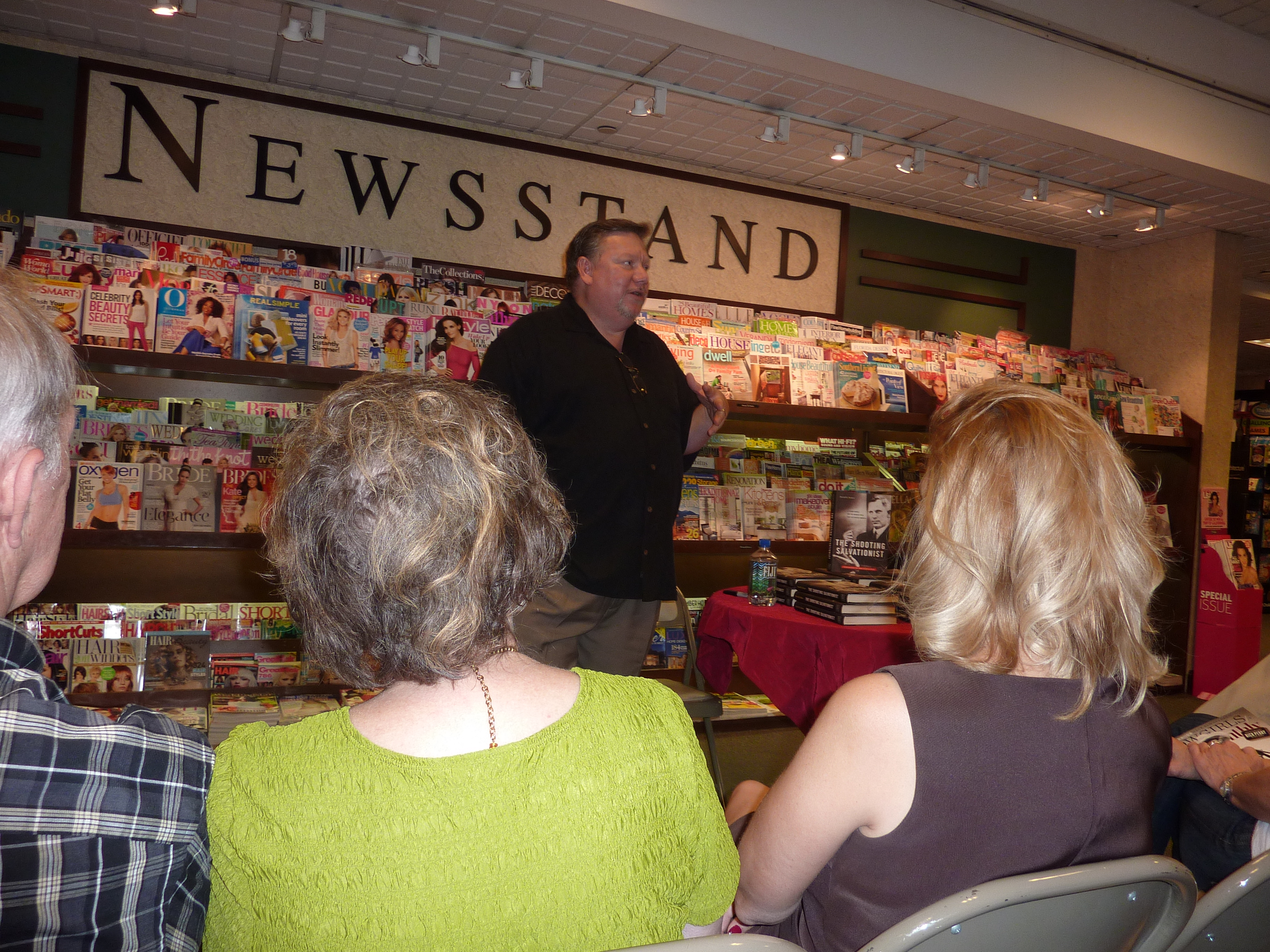
David R. Stokes speaks before his book signing at the Fort Worth Sundance Square Barnes& Noble two blocks from the site of Norris' shooting of Chipps
This weekend C-SPAN2 is airing a speech delivered by David R. Stokes, the author of The Shooting Salvationist: J. Frank Norris and the Murder Trial that Captivated America (©2011 Steerforth Press) at a recent book signing in Austin, TX. It played last night at 9pm (Eastern), it has replayed once this morning, but you can still catch it one final time this afternoon at 3pm (Eastern).
The program has already been added to the BookTV online archive, so it may be accessed there if you miss this afternoon’s showing.
Don’t forget to purchase your copy of The Shooting Salvationist at Amazon.com or from the book’s official website.
A Case Study in Sin

The following long, tedious post is a small way of demonstrating just how comprehensively God’s law condemns the sin of man. It highlights the depth and breadth of our fallen nature that is bent on violating God’s law in every conceivable manner, and shows just how much we all, believer and unbeliever alike, deserve God’s eternal anger and torment.
The following extensive description of what it means to keep God’s law also shows us just how thoroughly successful the Lord Jesus Christ was in keeping God’s law in every conceivable manner for his elect—those who come to believe.
Finally, it shows the many-faceted way in which we who believe and have been forgiven for such egregious, heinous sin, can express our gratitude for the active obedience of Christ in perfectly keeping God’s law for us, and for his passive obedience in suffering the penalty of divine wrath which such deep, dark, extensive sin deserves.
The church my family has been attending for the past year or more, has recently been going through the Heidelberg Catechism. Last Lord’s Day evening we recited, received instruction on, and discussed Lord’s Day 40, which consists of Question & Answer numbers 105-107, regarding what is required in the sixth commandment, “You shall not murder.”
Last night, the Lord showed me just how easy it is to violate the spirit of God’s command against murder. Several ladies converged on my house to carpool to a ladies meeting. One of those ladies brought her husband with her to stay with me and share a pizza and a movie while they are away. My wife and I used to attend another church with this couple, which church has a distinct reputation for hurting many of its members, and used to be a little more legalistic than it is today. In fact, in some ways, it appears to be changing into the very kind of church it used to stand against. Being a wounded former member of such a church provides many temptations to violate the spirit of God’s command against murder, namely by “dishonoring” and “hating” it in our “thoughts,” “words,” and “gestures” and “deeds,” as we neglect to “lay aside all desire of revenge.”
This kind of sin has become such a habit for me, in particular, that it didn’t dawn on me that this was what we were doing, not even when one of the other members who were in attendance last Sunday evening during the catechism discussion walked in, and I felt compelled to jokingly explain that we were having a little fun at our former church’s expense. It didn’t dawn on me until several hours later. Hence the occasion for the following post.
While it may appear so, this is not an exercise in self-flagellation, but, as I explained above, an amplification of the Heidelberg Catechism’s explanation of what the Bible teaches about what all God requires of us in the sixth commandment. May it open your eyes to the depth of your sin, the extent of Christ’s righteousness and grace, and may it guide you in expressing your loving gratitude for his free gift of righteousness which can only be received by faith in Christ.
Question 105. What does God require in the sixth commandment?
Answer: That neither in thoughts, nor words, nor gestures, much less in deeds, I dishonour, hate, wound, or kill my neighbour, by myself or by another: (Matt. 5:21-22;26:52; Gen. 9:6) but that I lay aside all desire of revenge: (Eph. 4:26; Rom. 12:19; Matt. 5:25; 18:35) also, that I hurt not myself, nor wilfully expose myself to any danger. (Rom. 13:14; Col. 2:23; Matt. 4:7) Wherefore also the magistrate is armed with the sword, to prevent murder. (Gen. 9:6; Ex. 21:14; Matt. 26:52; Rom. 13:4)
Question 106. But this commandment seems only to speak of murder?
Answer: In forbidding murder, God teaches us, that he abhors the causes thereof, such as envy, (Pr. 14:30; Rom. 1:29) hatred, (1 John 2:9,11) anger, (James 1:20; Gal. 5:19-21) and desire of revenge; and that he accounts all these as murder. (1 John 3:15)
Question 107. But is it enough that we do not kill any man in the manner mentioned above?
Answer: No: for when God forbids envy, hatred, and anger, he commands us to love our neighbour as ourselves; (Matt. 7:12; 22:39; Rom. 12:10) to show patience, peace, meekness, mercy, and all kindness, towards him, (Eph. 4:2; Gal. 6:1-2; Matt. 5:5,7,9; Rom. 12:18; Luke 6:36; 1 Peter 3:8; Col. 3:12; Rom. 12:10,15) and prevent his hurt as much as in us lies; (Ex. 23:5) and that we do good, even to our enemies. (Matt. 5:44-45; Rom. 12:20-21)
What does God require in the sixth commandment?
In the sixth commandment, God requires that I not dishonor my neighbor in my thoughts, but that I rather lay aside all desire of revenge;
In the sixth commandment, God requires that I not hate my neighbor in my thoughts, but that I rather lay aside all desire of revenge;
In the sixth commandment, God requires that I not wound my neighbor in my thoughts, but that I rather lay aside all desire of revenge;
In the sixth commandment, God requires that I not murder my neighbor in my thoughts, but that I rather lay aside all desire of revenge;
In the sixth commandment, God requires that I not dishonor my neighbor in my words, but that I rather lay aside all desire of revenge;
In the sixth commandment, God requires that I not hate my neighbor in my words, but that I rather lay aside all desire of revenge;
In the sixth commandment, God requires that I not wound my neighbor in my words, but that I rather lay aside all desire of revenge;
In the sixth commandment, God requires that I not murder my neighbor in my words, but that I rather lay aside all desire of revenge;
In the sixth commandment, God requires that I not dishonor my neighbor in my gestures, but that I rather lay aside all desire of revenge;
In the sixth commandment, God requires that I not hate my neighbor in my gestures, but that I rather lay aside all desire of revenge;
In the sixth commandment, God requires that I not wound my neighbor in my gestures, but that I rather lay aside all desire of revenge;
In the sixth commandment, God requires that I not murder my neighbor in my gestures, but that I rather lay aside all desire of revenge;
In the sixth commandment, God requires that I not dishonor my neighbor in my deeds, but that I rather lay aside all desire of revenge;
In the sixth commandment, God requires that I not hate my neighbor in my deeds, but that I rather lay aside all desire of revenge;
In the sixth commandment, God requires that I not wound my neighbor in my deeds, but that I rather lay aside all desire of revenge;
In the sixth commandment, God requires that I not murder my neighbor in my deeds, but that I rather lay aside all desire of revenge;
In the sixth commandment, God requires that I not be a party to another who would dishonor my neighbor in his thoughts, but that I rather lay aside all desire of revenge;
In the sixth commandment, God requires that I not be a party to another who would hate my neighbor in his thoughts, but that I rather lay aside all desire of revenge;
In the sixth commandment, God requires that I not be a party to another who would wound my neighbor in his thoughts, but that I rather lay aside all desire of revenge;
In the sixth commandment, God requires that I not be a party to another who would murder my neighbor in his thoughts, but that I rather lay aside all desire of revenge;
In the sixth commandment, God requires that I not be a party to another who would dishonor my neighbor in his words, but that I rather lay aside all desire of revenge;
In the sixth commandment, God requires that I not be a party to another who would hate my neighbor in his words, but that I rather lay aside all desire of revenge;
In the sixth commandment, God requires that I not be a party to another who would wound my neighbor in his words, but that I rather lay aside all desire of revenge;
In the sixth commandment, God requires that I not be a party to another who would murder my neighbor in his words, but that I rather lay aside all desire of revenge;
In the sixth commandment, God requires that I not be a party to another who would dishonor my neighbor in his gestures, but that I rather lay aside all desire of revenge;
In the sixth commandment, God requires that I not be a party to another who would hate my neighbor in his gestures, but that I rather lay aside all desire of revenge;
In the sixth commandment, God requires that I not be a party to another who would wound my neighbor in his gestures, but that I rather lay aside all desire of revenge;
In the sixth commandment, God requires that I not be a party to another who would murder my neighbor in his gestures, but that I rather lay aside all desire of revenge;
In the sixth commandment, God requires that I not be a party to another who would dishonor my neighbor in his deeds, but that I rather lay aside all desire of revenge;
In the sixth commandment, God requires that I not be a party to another who would hate my neighbor in his deeds, but that I rather lay aside all desire of revenge;
In the sixth commandment, God requires that I not be a party to another who would wound my neighbor in his deeds, but that I rather lay aside all desire of revenge;
In the sixth commandment, God requires that I not be a party to another who would murder my neighbor in his deeds, but that I rather lay aside all desire of revenge;
In the sixth commandment, God requires that I not hurt myself;
In the sixth commandment, God requires that I not willfully expose myself to any danger;
For this reason, God has granted the right to human government alone to put murderers to death, as the just punishment of murder, and as a deterrent to murder by others.
But this commandment seems only to speak of murder?
In forbidding murder, God teaches us that he abhors envy as the cause of murder, and that he accounts it as murder;
In forbidding murder, God teaches us that he abhors hatred as the cause of murder, and that he accounts it as murder;
In forbidding murder, God teaches us that he abhors anger as the cause of murder, and that he accounts it as murder;
In forbidding murder, God teaches us that he abhors desire of revenge as the cause of murder, and that he accounts it as murder;
But is it enough that we do not kill any man in the manner mentioned above?
No: for when God forbids envy, he commands us to love our neighbor as ourselves;
No: for when God forbids envy, he commands us to to show patience towards our neighbor;
No: for when God forbids envy, he commands us to to show peace towards our neighbor;
No: for when God forbids envy, he commands us to to show meekness towards our neighbor;
No: for when God forbids envy, he commands us to to show mercy towards our neighbor;
No: for when God forbids envy, he commands us to to show all kindness towards our neighbor;
No: for when God forbids envy, he commands us to to prevent his hurt as much as lies in us;
No: for when God forbids envy, he commands us to to do good to our neighbor, even to our enemy;
No: for when God forbids hatred, he commands us to love our neighbor as ourselves;
No: for when God forbids hatred, he commands us to to show patience towards our neighbor;
No: for when God forbids hatred, he commands us to to show peace towards our neighbor;
No: for when God forbids hatred, he commands us to to show meekness towards our neighbor;
No: for when God forbids hatred, he commands us to to show mercy towards our neighbor;
No: for when God forbids hatred, he commands us to to show all kindness towards our neighbor;
No: for when God forbids hatred, he commands us to to prevent his hurt as much as lies in us;
No: for when God forbids hatred, he commands us to to do good to our neighbor, even to our enemy;
No: for when God forbids anger, he commands us to love our neighbor as ourselves;
No: for when God forbids anger, he commands us to to show patience towards our neighbor;
No: for when God forbids anger, he commands us to to show peace towards our neighbor;
No: for when God forbids anger, he commands us to to show meekness towards our neighbor;
No: for when God forbids anger, he commands us to to show mercy towards our neighbor;
No: for when God forbids anger, he commands us to to show all kindness towards our neighbor;
No: for when God forbids anger, he commands us to to prevent his hurt as much as lies in us;
No: for when God forbids anger, he commands us to to do good to our neighbor, even to our enemy.
Confessions of a Restlessly Reforming Evangelical Fundamentalist

Old Life--Home of the Nicotine Theological Journal. Picture by The Sacred Sandwich
Dig my latest comment at Darryl G. Hart’s Old Life Theological Society. His post is titled, “Young, Restless and Lutheran?” He questions whether the broad approach of the Young, Restless and Reformed movement isn’t so broad that it might be more accurate to call it “Young, Restless and Lutheran,” given that, in Hart’s view, it’s less about Reformed theology in general or the five points of Calvinism in particular (no pun intended), and more about having been inspired by a bigger vision of God at the hands of John Piper channeling Jonathan Edwards, and generally begins reminding us all how much less Reformed they are than he and his Truly Reformed OPC brethren are (among whom I eagerly anticipate numbering me and mine). This is my summary, anyway, be it accurate or not.
I found the post and some of the resultant comments engaging enough that I just had to share my own experience at moving from Fundamentalism, through Evangelicalism and into Reformed Confessionalism. Although I write with tongue-in-cheek, the experiences are all very real (and they’re just the tip of the iceberg).
Confessions of a Restlessly Reforming Evangelical Fundamentalist:
Fortunately, I bypassed the whole Piper YRR movement (Piper’s creative and independent streak is waaay too Baptist for my taste) and swallowed the whole TR thing hook, line and sinker…Or so I thought. The further one goes, the more one discovers which exaggerates the differences between what it means to be Evangelical (in modern Western Christianity, that is) and what it means to be Reformed.
First, you fall for the 5 points; then you get over the hump about baptism (my logic was, “if the seventeenth century Baptists agreed with Presbyterians on so much,” as I was then coming to perceive, “then what makes them think Presbyterians are so wrong about baptism?”)…
…then you deal with stuff like exclusive “Acapulco” psalmody, and, for me living in a region where there is no glut of Reformed churches, I take the lazy man’s approach and say this isn’t an issue I have the luxury of standing for, even if I were persuaded of it. And some of their arguments I do find attractively compelling. If it weren’t for those of the advocates of instrumental hymnody.
Now that I’m preparing to join an OPC church, and begin reading all this vast literature about this “splinter group” of a denomination, I feel I’ve come full circle in some ways back to a Presbyterian version of my separatistic IFB background (even the local church planting missions emphasis is reminiscent of the IFB, without the Faith Promise giving campaigns), if you consider some of you more outspoken OPC guys’ position and attitude about TGC and T4G.
Yes, growing up among separatistic fundamentalists, yet consuming my fair share of big tent Evangelical media, it is quite a process in coming to a point where you can confidently call yourself “Reformed” without crossing your fingers behind your back.
This Is No Texas Tall Tale
“J. Frank Norris Week” continues! Last night I joined David R. Stokes, author of The Shooting Salvationist: J. Frank Norris and the Murder Trial that Captivated America at the Fort Worth Sundance Square Barnes & Noble Bookstore, where he spoke for a few minutes before sitting down to sign books. The pictures in this post are from last night’s signing. The text is my semi-formal, though concise, review of the book, which has also been posted at the book’s Amazon.com page. As emotionally dependent as I have become on this book, it was hard for me to step back and write an objective review that is comparable to a professional, or at least experienced, reviewer’s work until I decided to recommend the book in an email to another writer, who shall remain nameless. I gave him the following summary, and decided that this is about as good a review as anyone’s ever going to get out of me. Hope you find it helpful, and feel free to help us spread the word about this story that has been gratefully recovered from historical obscurity.
David R. Stokes speaks before his book signing at the Fort Worth Sundance Square Barnes& Noble two blocks from the site of Norris' shooting of Chipps
David R. Stokes is a columnist for Townhall.com. He is also a pastor of a non-denominational church in Fairfax, VA. He studied for the ministry at the same Missouri Bible College from which the late Jerry Falwell got his Bachelors degree before he moved on to bigger and better things. This Bible College, Baptist Bible College, to be precise, has its roots in the ministry of the man who is the subject of the book he is now promoting, The Shooting Salvationist: J. Frank Norris and the Murder Trial That Captivated America (2011 Steerforth Press).
Norris was the pastor of the First Baptist Church of Fort Worth Texas between the years 1909 and 1952 (the year of his death). In the early years of his ministry, he ditched the tame, sane, responsible approach to ministry in which one makes an effort to get along with everyone, for an approach that would generate so much heat it would draw huge crowds to him so he could introduce them to the Light, if you know what I mean. In the process, he was a self-appointed thorn in the side of the underground liquor and gambling interests in Texas, the budding theological liberalism in his alma mater, Baylor, the mayor of Ft. Worth and Star-Telegram founder and all-around entrepreneur Amon G. Carter. This got Norris in hot water with one of the mayor’s friends, another Ft. Worth business leader, Dexter Elliot Chipps, who stormed into Norris’ office one day, threatened to kill him, then walked out. Chipps’ mistake was that he didn’t keep going. He turned for some unknown reason and attempted to reenter the pastor’s office and was met with three or four bullets in the chest. The resulting 1926 murder trial was as big of a media circus as Norris’ hero, William Jennings Bryan’s, recent Skopes Monkey Trial had been, or for those of us in the 21st century, Casey Anthony’s.

Yours truly (left); David R. Stokes (right)
The book is a narrative non-fiction work. It reads somewhat like a novel, but all the dialogue, and much of the narration, even, is directly lifted from his sources which include not only older bios of Norris (pro and con), but much of the most prominent journalistic accounts, legal transcripts and records, as well as personal archives of Norris, Meacham and Carter. The outrageous tactics of Norris in his early ministry make for quite a train wreck, and the history is fascinating, but for folks like myself who grew up in Fort Worth, it gives a lot of new information to an old legend that has lingered in the background of all of our lives, and provides quite a bit of closure as well. I’d like to share with you this fascinating tale that we could only wish were nothing more than a “Texas Tall Tale.”
Politics, Religion and a Gun

David Stokes’ interview with 90.1FM KERA host Krys Boyd on her D/FW local NPR talk show, Think with Krys Boyd, has been uploaded. You can listen to it here.
And so, J. Frank Norris week continues at The Misadventures of Captain Headknowledge! Just wait until tomorrow…
The Shooting Salvationist Author Comes to Ft. Worth

Make that "Wednesday, July 20" at the Sundance Square Barnes & Noble in Ft. Worth
Fairfax, Virginia Baptist Bible Fellowship local church pastor David Stokes grew up as a member of Detroit’s Temple Baptist Church, not twenty years after J. Frank Norris pastored that church at the same time that he pastored First Baptist Church in Fort Worth, Texas. In his day, Norris was known as the “Texas Tornado,” and the “Pistol-Packing Parson.” The memory of J. Frank Norris casts a long shadow for those whose lives were touched by his sensationalistic and controversial ministry. It must be as true for those like Stokes who grew up in the decades following Norris’ death, as it is for us down here in Fort Worth, who boast of relatives with stories of personal connections to the famous fundamentalist firebrand. For example, my own mother grew up playing with Norris’ grandson, George. He was my mother’s best friend’s boyfriend. My great-grandmother hosted the visiting preacher at her house, where lively discussions are said to have ensued between Norris and my great-great grandmother, charming them with the admission that “the only person who could ever change his mind was Mrs. Freeman.” Not only that, J. Frank Norris even performed the wedding ceremony for my son’s great-grandparents on his mother’s side. For better or worse, J. Frank Norris is one of the more colorful cast members in the dramatic history of Fort Worth, Texas. Featuring his battle with the Southern Baptist Convention over Baylor University’s teaching evolution and his own personal war against corruption in local politics as well as the Prohibition-era liquor trade itself, I’ve always said, even as a one-time devoted follower, that the life story of J. Frank Norris would make a great gangster movie!
It looks like the novel on which that movie could be based has just been written by David Stokes. The book is called The Shooting Salvationist: J. Frank Norris and the Murder Trial that Captivated America (©2011 Steerforth Press). The only difference is, Stokes’ story is more of a courtroom drama. But that’s alright with me. At 1pm Central time today, Stokes will be interviewed on the local NPR station, 90.1FM KERA on “Think with Krys Boyd.” (you can sign up for the podcast here if you miss it live). Tomorrow night, from 7:00 to 9:00pm Central time, Stokes will hold a book signing at Barnes and Noble in Fort Worth’s Sundance Square just a few blocks away from the site of FBCFW during Norris’ ministry (see my previous post). On his Facebook page, Stokes reports “apparently there will be some “protesters” on Tuesday night when I speak at the Barnes and Noble in Fort Worth — should be interesting.” You can get familiar with one of those potential protesters at The J. Frank Norris Historical Society, started a year ago by a former associate of Norris’, Roy Emerson Falls.
If you’ve never heard of J. Frank Norris, or if you’ve always known about him–love him or hate him, you’ll be both shocked and in awe of the story of J. Frank Norris and the trial that failed to sentence Norris the electric chair for the death of Dexter Elliott Chipps.
The Shooting Salvationist Released Today!

2011 Steerforth Press--Foreword by Bob Scieffer of CBS News
Join me next Wednesday night, July 20 at the Barnes and Noble in Sundance Square in Fort Worth to meet the author of The Shooting Salvationist, David R. Stokes, get his autograph and/or a pic. I’m planning to post a review of the book just as soon as I finish my Advance Reading Copy. Probably next week.
PS–As an added bonus, you’ll probably also get to meet Rev. Roy E. Falls of The J. Frank Norris Historical Society protesting out front. When Stokes met him last year, he said he was sweet. A good time should be had by all (with the possible exception of Rev. Falls)!
Date: Wednesday, July 20, 2011
Start Time: 6:00 pm End Time: 8:00 pm
(Time Zone: US/Central)
Location: Barnes and Noble – Sundance Square
Category: The Shooting Salvationist Book Tour
Description
Phone: (817) 332-7178
Contact: Debby White
Email: debby@theshootingsalvationist.com
More Info: http://store-locator.barnesandnoble.com/store/2788
Barnes and Noble – Sundance Square
401 Commerce Street
Fort Worth TX 76102
Theological & Doxological Meditation #45

The First Commandment: Worship the Right God
Q. Which is the first commandment?
A. The first commandment is, Thou shalt have no other gods before me (Exodus 20:3; Deuteronomy 5:7).
God Is Known Among His People
(play file 066 in “T&D mp3″ sidebar widget)
#66, Trinity Hymnal (© 1990)
From Psalm 76
The Psalter 1912; alt. 1990, mod.
God is known among his people,
every mouth his praises fill;
From of old he has established
his abode onZion’s hill;
There he broke the sword and arrow,
bade the noise of war be still.
Excellent and glorious are you,
With your trophies from the fray;
You have slain the mighty warriors,
Wrapped in sleep of death are they;
When your anger once is risen,
Who can stand in that dread day?
When from heav’n your sentence sounded,
All the earth in fear was still,
While to save the meek and lowly
God in judgment wrought his will;
e’en the wrath of man shall praise you,
your designs it shall fulfill.
Vow and pay unto Jehovah,
Him your God forever own;
All men, bring your gifts before him,
Worship him, and him alone;
Mighty kings obey and fear him,
Princes bow before his throne.


 The Misadventures of Captain Headknowledge
This Just In! Blind Squirrel Finds Nut!
To fully understand this passage, one must read the entirety of chapter one. The literary structure can be summarized simply using our key term “dominion.” God created kingdoms: outer space, the sky, the sea, and the land; then God created three kings to exercise “dominion” in each “kingdom”: celestial bodies, birds, sea life of every kind, and the race of Man. There is a progressive significance in this creation week, with the creation of Man as the climax.
With God’s creation of Man, he gives him a vocation: fill the earth, subdue it, and take dominion over the lesser forms of life. Man lives on the earth as a kind of vice-regent of God.
This passage is applied in many ways by many people, but it can be reduced to something more or less like this. God created Man, then he gave him something to do. How this idea has been applied varies according to the theological tradition to which the believer subscribes.
Throughout the middle ages, Roman Catholic traditions drove a wedge between the sacred and the secular in such a way that those who were inclined to a vocation of church ministry were seen as inherently superior to everyone else in the ordinary, profane occupations that seemed anything but spiritual. There were priests who worked for God (good), everyone else worked for the world (not so good).
In the sixteenth century, the Protestant Reformers recovered the biblical truth which they called “the priesthood of the believer.” This doctrine emphasized the fact that Christ was the High Priest who mediates between God and Man, and all believers, ordained minister or not, are priests who may now approach God and offer spiritual sacrifices on the basis of Christ’s mediation and intercession. But the Reformers didn’t leave this truth at this point. Application of the priesthood of the believer was made to every aspect of his life. In short, what are his responsibilities? That is his ministry. This idea brought a renewed dignity to labor and developed what is known as the Protestant work ethic. This work ethic taught each believer-priest to work for the glory of God and the good of his neighbor in whatever way his interests, skills and opportunities allow. Much of the productive, technological and industrial development in the modern world finds part of its roots in this Protestant work ethic, which influenced Western culture for the better.
As the centuries wore on, this truth became less and less clear, and Christians became less aware of the spiritual significance of their secular vocations, and the work ethic largely fell by the way side. While historic orthodox Protestants retained this doctrine at least in their theological volumes, if not always preached and lived in their lives, but others kept it in mind, working for the glory of God in their own personal way as the Reformation doctrine of vocation went largely neglected.
In the great cultural shift that took place in the 1960’s, some Protestant ministers, notable among them, Francis Schaeffer, sought ways to recover this truth by encouraging Christians to “engage the culture,” in order to be used by God to once again be the “Light of the World” and “The Salt of the Earth,” in other words, Christians whom God may use to bring glory to God by enlightening their neighbors to the Light of the truth which is in Christ, as well as by being a benefit to their neighbors in their work and their service.
In the decade of the seventies, a few ministers in the charismatic movement had a similar desire to encourage their congregants and the church at large to live more consistently and more visibly as Christians in a sinful world. They, too, had a sense that evangelical Christians had largely ceased being influential members of society, and wanted to do something about it in their way, according to the understanding of their theological tradition. To put it inelegantly, I consider these efforts by Schaeffer and these charismatics, among others as blind squirrels who found a nut, as the old saying goes. The “nut” being some concept of the historic doctrine of vocation.
Fast forward to 2011. This desire to glorify God and serve and evangelize their neighbors becomes misinterpreted by the Left Wing of the American political system as efforts to “take dominion” over the federal government of the United States and establish a theocratic form of government. Looked at in this light, now, doesn’t it sound silly?
Now let’s engage in a comparative study. First read Lutheran journalist and blogger, Edward Gene Veith’s blog post “Vocation as the Christian Life,” and learn more about Luther’s doctrine of vocation and how it ought to be applied in this generation. Then watch the following video posted at www.the7mountains.com and see if you can detect similar motives. Then stop listening to reactionary political Leftists who think those crazy extremist Right Wing Christians are out to overthrow the government and start stoning adulterers and burning witches.
Share this: