Misadventures in Fundamentalism

2011 Steerforth Press--Foreword by Bob Scieffer of CBS News
The following is best read aloud in a booming announcer voice 😉
Allow me to introduce you to the book I’ve been anticipating most for the past year–The Shooting Salvationist: J. Frank Norris and the Murder Trial That Captivated America (2011, Steerforth Press–Distributed by Random House. Foreword by Ft. Worth native Bob Schieffer of CBS News). Perhaps you’ll recall how last year I went on and on about a book about J. Frank Norris‘ murder trial. Well, that caterpillar quickly entered its cocoon and the butterfly is soon to be released! July 12 is the scheduled date for Pastor David Stokes’ thorough narrative non-fiction work on one of the most colorful fundamentalists of the early 20th century.
A rising star in the Southern Baptist Convention, J. Frank Norris resolved to spread God’s Word in a populist and sensationalist manner–taking on every villain, real or perceived, that crossed his path–doing battle royal in the most public manner as he could to make a big name, not only for himself, but also for the Savior whose cause he strove to promote. Norris’ tactics however, epitomized the very definition of “misadventure.” A burr in the saddle of local Fort Worth, Texas powerful elites, a sworn enemy of the “liquor interests” and self-appointed defender of the faith against the liberalizing tendencies at his alma mater, Baylor University, almost all agree that J. Frank Norris generated more heat than light. The growing crescendo of sensational exploits on these and other fronts would culminate in devastating tragedy and make headlines across the country when Norris shot an infuriated opponent to his death.
The murder trial of J. Frank Norris in the 1920’s was literally the “OJ Trial” of that generation. A relentless media circus hung on every detail of the trial as they kept the country buying paper after paper to learn the fate of this ambitious religious ringleader. You’ll never believe that a story like this is true. You simply have to read it for yourself!
The Shooting Salvationist: J. Frank Norris and the Murder Trial That Captivated America is available for pre-order at the book’s new website. I’ll also be adding The Shooting Salvationist Blog to my blogroll so we may all keep up with it.
The Reformed Approach to Holidays
As my family experiences its first Easter together as regular attenders of a Reformed church, we are experiencing a distinct difference from the approach our former non-Reformed fundamentalist and evangelical churches have approached it. Following is a couple of paragraphs from an entry on Calvinism from the Encyclopedia of the Early Modern World, by the Gale Group, Inc. This should help us (and you) put the Reformed approach to holidays in general into historical context.
This morning our family is celebrating the resurrection of the Lord Jesus Christ. May this Easter Sunday find you worshiping the risen Lord in your house of worship.
Another distinctive feature of Reformed Protestantism was its remarkably small number of official holidays. Calvin himself saw no need and no scriptural basis for any holiday other than Sunday, and Reformed Protestants usually celebrated extremely few of them. Their most austere churches,GenevaandScotland(or seventeenth-centuryNew England), observed none at all—not untilGeneva’s magistrates overruled their pastors and finally declared Christmas an official holiday in 1694. Such situations were, however, exceptional. The mainstream of established Calvinism, the Reformed churches ofZurich,Bern,France, theNetherlands, and thePalatinate, celebrated four holidays besides Sundays: Christmas, Easter, Ascension Day, and Pentecost; the Dutch and thePalatinatealso added New Year’s Day. Keeping only a handful of holy days marked an enormous departure from Catholic practices, which in most places celebrated anywhere from forty to sixty holidays each year. Other mainstream Protestants were far less radical than Calvinists: Lutherans kept a large number of holy days, while the Church of England became a target for Puritan scorn by observing a total of twenty-seven holidays. Early Massachusetts went further and took the most extreme Calvinist position about the Christian calendar: not only did the colony ban all holidays, but its General Court briefly reformed the “pagan” names of the months as well, dating by “first month,” “second month,” and so forth.
Many Calvinists compensated for this paucity or absence of other holidays with a strict observance of Sunday, almost in an exact correlation.ScotlandbecameEurope’s most notorious example in 1579, when serious punishments were first threatened for Sabbath-breakers; by 1649, they had forbidden such practices as fishing on Sunday.Scotland’s extremely rigid taboos about Sabbath observance lasted far into modern times; it has been suggested that “Thou Shalt Not” made the best title for a history ofScotland, with its longest chapter called “Never on Sunday.” Another specifically Calvinist ritual was the special day of community fasting, proposed by pastors and decreed by secular authorities, usually intended to divert God’s wrath at times of extraordinary danger. We find fast days observed as early as the 1560s by the beleaguered churches of theLow CountriesorFrance, and later in seventeenth-centuryNew England; they remained a feature of Genevan life until the nineteenth century.
Two and a Half Hours Until the White/Moorman KJV Only Debate!
Be sure to visit this page to watch live the debate between Dr. James White and Dr. Jack Moorman of London, England debating the question “Should We Exclusively Use the King James Version?”
“Should We Exclusively Use the King James Version?”
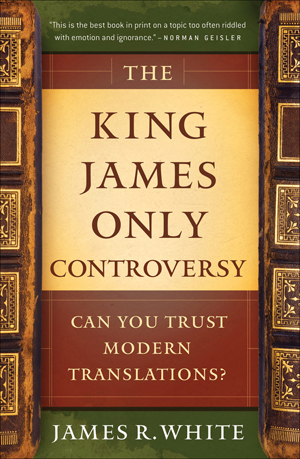 How appropriate that during the year of the quadricentennial of the King James Version of the Bible, a debate on the question of King James Onlyism should be held. Reformed Baptist apologist Dr. James White of Alpha and Omega Ministries is just on his way to London, England. RevelationTV in London is hosting a debate Wednesday night at 9pm GMT (if I’m not mistaken, that should be 3 pm CST), between Dr. White and Dr. Jack Moorman, an American fundamentalist Independent Baptist missionary in England, pastoring Bethel Baptist Church, Wimbeldon, London. The subject of the debate is, “Should we exclusively use the King James Version?” To my knowledge, it has been quite a while since a KJV Onlyist has stepped forward willing to debate Dr. White, author of The King James Only Controversy: Can You Trust Modern Translations?
This should be good. Dr. White never disappoints.
Revisiting “The Right Story”

- (The following was originally posted on March 3, 2006. It reappears here in a slightly edited form.)
“You can’t help nobody if you can’t tell ‘em the right story.” Jack Cash, brother of Johnny Cash, as portrayed in the movie, Walk the Line.
Every story is about fall and redemption in one way or another. There would be no plot if there were no problem to solve or conflict to resolve. The story of the entire human race is that of its fall and redemption. Your story is about your fall and your redemption. The mission of the church is to tell this story; to introduce the characters to the plot: they’ve fallen and they can’t get themselves up on their own, their problem is so bad, they can’t solve it themselves, they need Another to solve it for them, the conflict that has entered their life has killed them, and they need Another to return them to life.
Stories are often considered mere entertainment. And to be sure, the church in this Laodicean (Revelation 3:14-22) generation has caught on to the idea that entertainment will help them tell the Story. Even if at times they’re telling the right story, that of the fall of man into sin and the sinless Christ who was crucified and raised for sinners, they’ve wrapped it up in so much entertainment that many are in danger of overlooking the Gift because they’re so fascinated by the wrapping paper. If sinners are distracted from the Story by trappings geared toward appealing to their interests, or meeting their felt needs, the church can’t help them. At other times, the church forgets to get around to the Story at all because they’re so aware of all the other stories in the Bible. “Christians don’t need to hear the Story this week, they’ve already heard and believed and received it, now they need to hear what they need to do,” and thus the Story is placed on the shelf in the interest of relevance or practicality. But no matter how much they mean to help, they “can’t help nobody if [they ain’t tellin’ ’em] the right story.”
The church seeks to tell a story, but all too often it’s not the Story they were commissioned to tell (Matthew 28:19-20). Many times they tell their own story. A story about how they’ve picked themselves up by their own bootstraps, a story about what a great example they are. When this is the story they tell, the Holy Spirit won’t bring sinners to life, nor will he empower believers to serve. All applications and all examples, and all pastoral autobiography are not to stand alone. They are to be built on the firm foundation of the Story, explicitly told each week.
We’ve fallen into sin so there’s nothing we can do to redeem ourselves:
the sinless Christ was crucified because we are sinners who deserve to die;
Christ rose from the dead on the third day because God has accepted Christ’s death in the place of sinners who come to believe and repent of their sins;
saved sinners are called to be holy and to serve others, which brings them into conflict with the sin that yet remains in their natures and they aren’t always able to be holy and serve others (Romans 7).
That’s why the Right Story must remain central: The Gospel is for Christians, too!
They must be reminded that even though they’ve been saved they still need to hear the Gospel addressed to them (1 John 1:9) to cleanse them so they can progress on the journey to glorification by way of sanctification (Proverbs 4:18).
When the preacher neglects to tell the church the Right Story, he can’t help the church grow in grace.
- (Dr. R. Scott Clark gives a fuller, more Christ-centered summary of the Right Story at Westminster Seminary California’s Valiant for Truth blog. Read his post, “The Christian Life.”)
Christianity and Liberalism Revisited
 This past weekend, Westminster Seminary California’s (WSC) annual conference was held. It was called, “Christianity and Liberalism Revisited,” referring to the title of a book by the founder of Westminster Theological Seminary in Philadelphia, PA, and “the principal figure in the founding” of the Orthodox Presbyterian Church (OPC) in 1936, which in 2011 is celebrating its 75th anniversary. This conference is WSC contribution toward that celebration.
The conference was webcast live on Ustream and the videos are still posted there for your viewing pleasure, and audio is posted at the WSC Resource Center, but I’ll link to them below for your convenience.
- Christianity and Liberalism Today “Michael Horton shows the prophetic insight of Machen’s most famous book in Christianity today.”
- The Perennial (Problem with) Machen “Daryl Hart critiques evangelicals’ use of Machen today.”
- Machen and the Bible “Joel Kim explains the relevance of Machen’s view of the inspiration and authority of the Bible.”
- Machen and the Gospel “J. V. Fesko gives a summary of Machen’s view of the gospel and its relevance today.”
- Machen and Ethics “David VanDrunen explains how Liberalism, in its day, was fundamentally dishonest.”
- Machen, Christianity and the Church “W. Robert Godfrey explains how the church is the mission of God to carry his doctrines to the ends of the earth.”
- Question and Answer Session “The question and answer session from the 2011 Conference ‘Christianity and Liberalism Revisited’”
Bonus! If you’d like to know more about J. Gresham Machen and the Orthodox Presbyterian Church (a local congregation of which denomination my family is currently attending, Mid-Cities OPC), then start with conference speaker Daryl Hart’s page at the OPC website, called, “Machen and the OPC.”
Also, the Rev. Jason Stellman has posted a thought-provoking reflection on Hart’s lecture at his blog Creed, Code, Cult, called, “Catholicity and Liberalism.”
Sister Aimee and the “Anabaptist Nation”

"Sister Aimee" McPherson
I heard an interesting description of how American Christianity effectively developed into a form of Anabaptism. Dr. R. Scott Clark, Professor of Church History and Historical Theology at Westminster Seminary California (WSC), was interviewed this past week on Christ the Center podcast episode #157 regarding his contribution to Always Reformed, a festschrift that has recently been published in honor of WSC President and Professor of Church History, Dr. Robert Godfrey (see Dr. Clark’s post here). From what I’ve been able to gather over the past couple of years, Dr. Godfrey is an earnest student of the phenomenon of Sister Aimee McPherson’s ministry in the 1920’s, and holds her up as an example of what American Christianity is. Clark’s chapter is entitled, “Magic and Noise: Reformed Christianity in Sister’s America.” To some extent, it seems that this very subject of the Anabaptistic flavor of American Christianity is at the heart of this chapter, as may be inferred by the chapter’s title itself.
About twenty-two minutes into the interview, Clark introduces this topic by urging the study of “Sister” (as she is wont to be called) on Reformed believers. He does this because, according to Clark, in many ways McPherson’s type of Christianity is more indicative of the nature of American Christianity than the Reformed faith can lay claim to anymore. America has come a long way since the faith of the pilgrims of Plymouth Rock and the Salem witch trials (which is probably all Americans remember about those early Christian settlers (for help with that, listen to this and this). Clark believes that the Reformed would be aided in reaching America for Christ, and American evangelicals for the Reformed faith if they would see themselves more as cross-cultural missionaries, rather than natives.
Dr. Clark offers the disclaimer that his Anabaptist diagnosis of American Christianity is largely due to the fact that his primary field of research is the sixteenth and seventeenth century Reformation, rather than early twentieth century Christianity. He admits that in part he is interpreting the McPherson phenomenon and the nature of “native” American Christianity in the light of the sixteenth century Anabaptist movement, but he does attempt to support his conclusion with appeals to others who have written more extensively on Christianity in the nineteenth and twentieth centuries.
There are parallels between the Anabaptist movement of the sixteenth century and current American Christianity. Clark explains that people tend to think of the Anabaptist movement as just another facet of the Protestant Reformation, but he points out that the Anabaptists (also known as “Radical Reformers”) more or less “rejected all of the key doctrinal commitments” of the Protestant Reformation in favor of much more radical positions. Clark’s thesis is that the way American Christians commonly think about the nature of authority, epistemology (how we know what we know), Scripture and its authority, the church and eschatology (the doctrine of the end times) often bears strong resemblance to sixteenth and seventeenth century Anabaptism. Dr. Clark goes into a little more detail on this in the interview between minutes 33:15 and 42:06.
This portion of the interview caught my attention because Clark’s comparison is consistent with a conclusion I came to in my own personal pilgrimage from independent Baptist fundamentalism to Reformed theology and practice. After learning that the ultimate source of the bulk of historic Baptist theology comes from the Reformed Westminster Confession of Faith (see my newly updated “Creeds, etc.” page), and the parallels I saw between Baptist distinctives and the historic Anabaptist movement, I concluded that everything that’s right in the Baptist tradition was learned from the Reformed tradition, and everything that’s wrong in the Baptist tradition was learned, or “caught,” if you will, from Anabaptism. I realize that the 1689 Baptist Confession disclaims any formal connection between their doctrines and those of the Anabaptists, but the parallels are just too striking to Reformed paedobaptists.
This is why I encourage you to take time to listen to at least this section of the interview, if you don’t have the time or inclination to enjoy all of it. It’ll be thought-provoking time well-spent, if you ask me.
Christianity and Liberalism Revisited
Here’s a conference I wish I could attend. Believe it or not, I first discovered J. Gresham Machen’s book Christianity and Liberalism in a catalog for Peter Ruckman’s bookstore in the mid-nineties (see also here and here), but I only read it about two years ago. Growing up I was conscious of my fundamentalist pastor talking about “modernism,” but only had a very vague notion of what that might be. So vague, in fact, I couldn’t then, nor could I now define with any certainty just how much I understood about it then.
It is so important that Christians understand that the most basic and foundational thing about Christianity is not how you live, it is what you believe. This is not a denial of the importance of how you live, just a denial that it is what makes you a Christian. Actually, how you live is the product or fruit of what you believe. If you live the cleanest life in the most loving and charitable way, yet deny the deity of Christ, the trinitarian nature of God, or the virgin birth of Christ, etc., then you are not a Christian. This is what liberalism is, although it is so much more at the same time. It exalts the necessity of works over the necessity of orthodox doctrine. That’s why Machen said liberalism is not another form of Christianity, it is an entirely different religion.
Balm for Believing Victims of Christianity
The following is a sermon by Lutheran (Missouri Synod) Seminary professor, Dr. Rod Rosenbladt, who is also co-host of The White Horse Inn radio show. The title of the sermon is “The Gospel for Those Broken by the Church.” He addresses two kinds of believers who have given up on going to church: the “sad,” who feel they couldn’t measure up, so they quit trying; and the “mad,” who’ve been “used up and spit out” by the church, or who have been justly scandalized by Christianity’s many historic misdeeds. Dr. Rosenbladt’s premise is that the good news of Christ’s cross and blood shed for sinners will save not only the pagan unbeliever, but also the wounded believer who, for whatever reason, has given up on Christianity.
In some ways, Dr. Rosenbladt’s presentation may come off a bit academic, but if you hang with him, you’ll find that the heart of the message is clear as a bell. If you’ve got friends or relatives who are mad or sad at the church, please forward this post to them.
Understanding KJV-Onlyism
 Understanding Our Times with Kevin Thompson has invited Bob Hayton of the blogs Fundamentally Reformed, KJV-Only Debate, and RE:Fundamentals to guest host the show tomorrow night at 5pm central time. It will be a call-in discussion hosted by Bob and his compatriot in Debating KJV-Onlyism, Damien Garofalo. Bob has been interviewed before about Fundamentalism and his journey to Calvinism on Understanding Our Times as well as Iron Sharpens Iron (a traditional radio show out of Long Island, NY–listen here).
Here’s Bob’s announcement if you desire more information.
Get A Copy While You Still Can!
Apparent Danger author, David Stokes, has posted that his great new book about J. Frank Norris is now being picked up by Random House Publishers to be released next year, possibly under a different title. Now it’s time for him to move some merchandise. These original editions may just be collectibles some day. They certainly are for some of us here in Fort Worth, Texas. Read all about it over at his blog.
“You Either Love Him Or You Hate Him”. . .
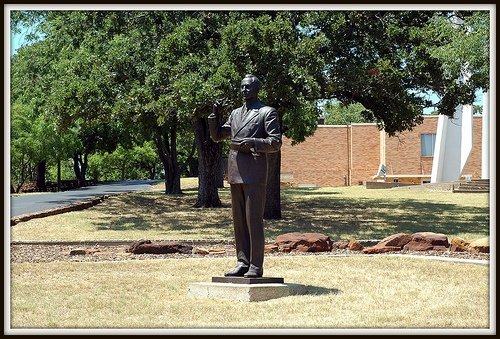
Statue of J. Frank Norris on the campus of Arlington Baptist College
. . . this is the kind of sentiment that a character like J. Frank Norris draws. For those whose lives were changed for the better, it seems the man can do no wrong, and watch out if you try to accurately paint a picture of such a saint–the way the Bible portrays it’s saints–warts and all. With Norris, most of those folks have gone on to their reward, as has their hero. But there of course remains a faithful remnant.
The segment of the fundamentalist independent Baptist movement that Norris spearheaded remains more or less the home of the majority of Norris’ faithful followers, but there are exceptions. There remain a few who are and have always been, members of First Baptist Church of Fort Worth, who, in the light of the publication of David Stokes’ work of narrative non-fiction on the life and ministry of J. Frank Norris and especially his murder trial, Apparent Danger, are unhappy that Norris’ warts are portrayed as prominently as they are. Back in June, one such member wrote on “J. Frank Norris’ lasting influence.” To Melissa Easter, Norris has had a lasting influence on several generations of her family. Without challenging Stokes’ facts or his documentation thereof, Easter was compelled to remind her Fort Worth neighbors there was lasting spiritual fruit that was borne through the ministry of J. Frank Norris, her family among them. Concluding her defense, Easter writes:
I do not know everything. But what I do know and what I believe is that J. Frank Norris had a good heart and a passion for God. Otherwise my great-grandparents would not have named my grandfather after him. Otherwise my family would not have attended that church after moving from Oklahoma. Otherwise my grandfather would not have asked J. Frank Norris to officiate his marriage to my grandmother.
It is unfortunate that Norris was involved in such an incident as that of July 1926, but that event should not overshadow the fact that he helped lead many people to the saving knowledge of Jesus Christ. I’m sure he asked the Lord for forgiveness, and, in my opinion, judgment was God’s alone to make.
Why is it that after so many years someone has seen fit to stir the pot once again? It is a futile matter; it brings up hurt to those who view J. Frank Norris in a positive light and potentially turns others away from the church.
Perhaps then we should all spend more time trying to bring people to the kingdom of heaven rather than shine light on an 84-year-old blemish.
Can you write a book that tells the whole truth about a man while there are still people alive who don’t want the whole truth to get out and complicate their fond memories? Not without criticism. But I believe it’s safe to say that David Stokes was aware of this fact and was thoroughly prepared to deal with it. Evangelism notwithstanding.
Meet the Godfather of Fundamentalism, J. Frank Norris
Fairfax, Virginia Baptist Bible Fellowship local church pastor David Stokes grew up as a member of Detroit’s Temple Baptist Church, not twenty years after J. Frank Norris pastored that church at the same time that he pastored First Baptist Church in Fort Worth, Texas. In his day, Norris was known as the “Texas Tornado,” and the “Pistol-Packing Parson.” The memory of J. Frank Norris casts a long shadow for those whose lives were touched by his sensationalistic and controversial ministry. It must be as true for those like Stokes who grew up in the decades following Norris’ death, as it is for us down here in Fort Worth, who boast of relatives with stories of personal connections to the famous fundamentalist firebrand. For example, my own mother grew up playing with Norris’ grandson, George. He was my mother’s best friend’s boyfriend. My great-grandmother hosted the visiting preacher at her house, where lively discussions are said to have ensued between Norris and my great-great grandmother, charming them with the admission that “the only person who could ever change his mind was Mrs. Freeman.” Not only that, J. Frank Norris even performed the wedding ceremony for my first wife’s grandparents. For better or worse, J. Frank Norris is one of the more colorful cast members in the dramatic history of Fort Worth, Texas. Featuring his battle with the Southern Baptist Convention over Baylor University’s teaching evolution and his own personal war against corruption in local politics as well as the Prohibition-era liquor trade itself, I’ve always said, even as a one-time devoted follower, that the life story of J. Frank Norris would make a great gangster movie!
It looks like the novel on which that movie could be based has just been written by David Stokes. The book is called Apparent Danger: The Pastor of America’s First Megachurch and the Texas Murder Trial of the Decade in the 1920’s. Just a couple of weeks ago, Stokes held a book signing at Barnes and Noble just a few blocks away from the site of FBCFW during Norris’ ministry. On his Facebook page, Stokes reports that about a hundred people turned out for a book and an autograph, and even an unnamed “very nice” 91 year-old former associate of Norris protested his book by passing out a pamphlet with the title “The Real J. Frank Norris.”
My only regret is that I first heard about the book the day after the signing. But now I have my copy, and I’m currently reading it aloud to my wife so that we might enjoy it together. Enjoying it, we are. I let Bob Hayton of the blog Fundamentally Reformed know about it, and he said he plans to review the book on his blog after he reads it, to which I will dutifully link you when it’s posted. But in the meantime, allow me to whet your appetite for the book with the following trailer. If you’ve never heard of him, or if you’ve always known about him–love him or hate him, you’ll be both shocked and in awe of the story of J. Frank Norris and the trial that failed to sentence Norris to “Sparky,” the state of Texas’ newly acquired electric chair for the death of D.E. Chipps.
The Rationalism of the “Biblicist”
 The April 25, 2010 episode of The Heidelcast, a weekly podcast by Dr. R. Scott Clark, Professor of Church History and Historical Theology at Westminster Seminary California, and writer of the Heidelblog, contains a discussion between Dr. Clark and Martin Downes, author of Risking the Truth, about how “biblicism” is fundamentally rationalistic, and so undermines the sole authority of Scripture, which it intends to uphold. What follows is a transcript of this short segment of their interview.
Clark: What happens when a fellow comes with his Bible open, as Faustus Socinus did (an anti-Trinitarian heretic)? He had his Bible open, and his uncle Laelius Socinus, managed to convince Heinrich Bullinger that he was basically orthodox. And so, both of these fellows said, “Listen, we believe the Bible, but we just don’t think that you’re getting it right. We’re more biblical than you. In fact, we want to get rid of all of this systematic theology and these confessions, and we just wanna follow the Bible.” What’s wrong with that approach, which scholars have called “Biblicism”?
Downes: The real problem is that, although it claims to be, upholding Sola Scriptura and the sole authority of Scripture, actually what’s really going on beneath that claim is a subtle form of rationalism.
Something that Jehovah’s Witnesses are always saying to people is, “Did you know the word “Trinity” isn’t in the Bible?” As if to say, “Ah, crums! It’s not there. Well, perhaps the idea isn’t really there.” Perhaps somebody invented that and imposed it upon the text.
I think what we find is that Biblicism demands that truth be stated in a certain way, and will not accept that we believe things, because of the express statements of Scripture, but also what “by good and necessary consequence may be deduced from Scripture” (Westminster Confession of Faith, chapter 1, section VI).
But it is very subtle, and I think that’s why it does take more people in. It’s an appeal to a standard of authority that we want to hold to whole-heartedly, but actually beneath that appeal, I think is a form of rationalism.
Clark: Doesn’t it also put the autonomous, individual Bible interpreter in charge of Scripture? And this is something of which Protestants are often accused, but it’s not really true. If someone pays attention to the history of Protestant theology, and the history of the Reformation, one would know right away that there was a huge difference between the Anabaptists, who were radicals and individualists and the Socinians, who were radicals and individualists…between them, and, the confessional Protestant Reformers, who actually worked within a churchly (ecclesiastical) context.
Downes: I remember once after an evening service, I chatted to a man at the door, and . . . I happened to mention what we are discussing—this particular issue—He said, “I’m not interested. That’s just a man made document.” But he wanted me to be interested in what he was saying, and his insights into the Scriptures.
So I said to him, “Look, why would I want to put aside a document that has churchly sanction, that represents the reflection from Scripture, and the thinking, not of an individual, but actually of the whole body of divines. And so, really what his claim was, “I’m not interested in what they think. I’m just interested in what I think. I just want you to believe what I’m saying. I struggle to find humility in that approach.
Clark: Not only is it arrogant, it’s essentially an Enlightenment-inspired, modernist approach to truth and error. At the end of the day, it’s not really God’s Word as understood and confessed by a body of believers, which is norming things, I’m norming things by my, private personal interpretation of Scripture. And so, at the end of the day, I, really, am the measure. I say I’m following the Bible, but I know better what the Bible says than anyone. And, unfortunately, I think, and maybe you’ll agree or not, I don’t know, that there’s a pretty radical misunderstanding of Sola Scriptura. What’s the real difference between Sola Scriptura as understood originally, and Biblicism?
Downes: I think it goes back to what you were saying about individualism. That it’s not seeing Christian belief in the context of the church, and the church is the pillar and ground of the truth, and maybe some of that is a fear of the Catholic element, with a large C and an R before it—maybe some of the squeamishness has to do with that—but I think fundamentally it is that individualistic mindset that it’s just me and my Bible. Well, it’s a big book. What does it teach? We ought to, if we are wise, consider very carefully two thousand years of Christian belief, in terms of the great creeds and the Reformed confessions.


 The Misadventures of Captain Headknowledge
Heresy in Defense of the Fundamentals
Council of Chalcedon, AD 451
“Since therefore the children share in flesh and blood, he himself likewise partook of the same things, that through death he might destroy the one who has the power of death, that is, the devil, and deliver all those who through fear of death were subject to lifelong slavery” (Hebrews 2:14-15 ESV).
Recently, I heard an Independent Fundamental Baptist preacher comment that he believes in salvation “by the blood of Christ, not his death.” One who heard this comment with me registered his shock at the statement. Having discussed this issue with this particular preacher in the past, I knew what he meant by it, and was able to fill in my companion. The following bullet points are a summary of the things I shared with him.
Suffice it to say that there is a segment of Independent Baptist Fundamentalism that so wants to defend the “literal” interpretation of Scripture that it will often deny simple figures of speech in Scripture to the extent that it begins to distort the very fundamentals it intends to defend. One such fundamental of the faith that has suffered such distortion is that of the hypostatic union of Christ’s human and divine natures, of which the historic conciliar statement produced by the Council of Chalcedon (AD 451) expresses the Biblical doctrine quite thoroughly and has served the church well in defining the orthodox position. Although an appeal to the so-called “Definition of Chalcedon” as an expression of Scriptural teaching on the matter falls on deaf fundamentalist ears, it does not change the fact that, historically speaking, for the Protestant as well as the Roman Catholic, to dissent from this Ecumenical Council on the hypostatic union is to be led by blind guides into the ditch of formal heresy. Sad to say, this is the fate of the kind of irresponsible Biblicism that often goes on in the Fundamentalist movement.
I’ve posted on this topic before here and here. The names I’ve used for this fundamentalist heresy are “Divine Blood” and “Celestial Flesh.” These titles describe the ways in which fundamentalists blur the distinction between Christ’s human and divine natures to a possibly heretical extent. This explains the use of these terms in the following bullet points:
I found an excellent, but lengthy, treatment of this doctrine by an Irish Reformed minister. If you’ve ever heard of this doctrine before, and are the least bit concerned about it, please invest the time in reading “Fundamentalists and the ‘Incorruptible’ Blood of Christ” by Martyn McGeown of Covenant Protestant Reformed Church in Ballymena, North Ireland. Although it’s by an Irish writer, much of his essay interacts with American fundamentalist contributions to the controversy as well.
Share this: