Memoir of the Rev. John Brown, part 1
Brown’s Self-Interpreting Bible (1859) contains an extensive biography of the editor. It’s a great story, but it’s going to take quite a while to get the entire thing transcribed and posted. In the meantime, I’ll be mixing it up a little with other features from my new favorite study Bible. The author of this biography is not credited. But you can download Robert Mackenzie’s 1918 biography, John Brown of Haddington, in a 178 page PDF file from Still Waters Revival Books for 99 cents at this link.
The REV. JOHN BROWN was born in the year 1722, at Carpow, a small village in the parish of Abernethy, and county of Perth. His parents ranked in that class of society who earn their bread by the sweat of their brow. His father could boast of no rent-rolls, nor had he any title of honour, save that of an honest man and an industrious mechanic, who, during the greater part of his life, laboured in the profession of an operative weaver. Though destitute of all the advantages arising from a regular education, he was nevertheless a man of considerable intelligence, moral worth, and Christian sincerity. He made conscience of keeping up the worship of God in his family, and set a Christian example before them, though living in a neighbourhood remarkably careless of these things. His external circumstances were so narrow, that it was little he could afford to promote the intellectual improvement of his son; so that the subject of this momoir found his situation in this respect but little superior to that of his father. He was sent to school; but the time allowed him to acquire the elements of reading, writing, and arithmetic, was so very short, that nothing but an excellent genius, and the most intense application, could have enabled him to attain the ordinary education of the lowest orders in the country. This, however, with one solitary month which he bestowed on the Latin, and that without the consent of his parents, appears to have been all the regular education he ever received, till we find him studying philosophy and divinity under the superintendence of the Rev. Ebenezer Erskine and James Fisher. It does not appear that his father ever intended him for the church, or even contemplated the possibility of his accomplishing such a design; though the strong propensity of his mind to learning, and particularly to that species of learning the nearest allied to divinity, seems to have suggested to his mother the possibility, that the day might come when his literary predilection might find room for its gratification in the service of the church; and often and again has she pictured to herself that happy day, when her darling child should emerge from his obscurity, clothed in the emblems of the most honourable employment—an ambassador of the Prince of Peace. In the mean time, his personal piety, the most important of all the prerequisite qualifications for an office so sacred, afforded her the lively hope that his labours, should her ardent wishes be ever realized would not be in vain in the Lord. In a short narrative of his experiences written by himself, Brown acknowledges the delight which he had while at school, in committing to memory the Catechisms of Vincent, Flaw, and the Westminster Assembly; and the profit he afterwards derived while yet a boy, from the perusal of the Bible, Rutherford’s Letters, and Gouge’s Directions how to Walk with God, His God was preparing him inconsciously for the service of Christ. He had separated him from the womb, and was even now calling him by his grace, (Gal. i. 15.) that he might reveal his Son in him, and send him to preach. In the same memoir he records the solemn impressions made on his young mind, by witnessing the dispensation of the Sacrament, and listening to the addresses delivered during the service; and, from his experience of profit argues against the impropriety of excluding children from witnessing a service so calculated to engage the affections. This exclusion appears to have been practiced in the Church of Scotland at the commencement of last century; and was perhaps a remnant of Episcopal feeling, remaining after the restoration of Presbytery. “About the eighth year of my age,” says he, “I happened, in a crowd, to push into the church at Abernethy, on a sacrament Sabbath. Then it was common for all but intended communicants to be excluded. Before I was excluded I heard one or two tables served by the minister, who spake much to the commendation of Christ, which in a sweet and delightful manner so captivated my young affections, as has since made me think that children should never be kept out of the church on such occasions.”
Rev. John Brown’s Original Preface
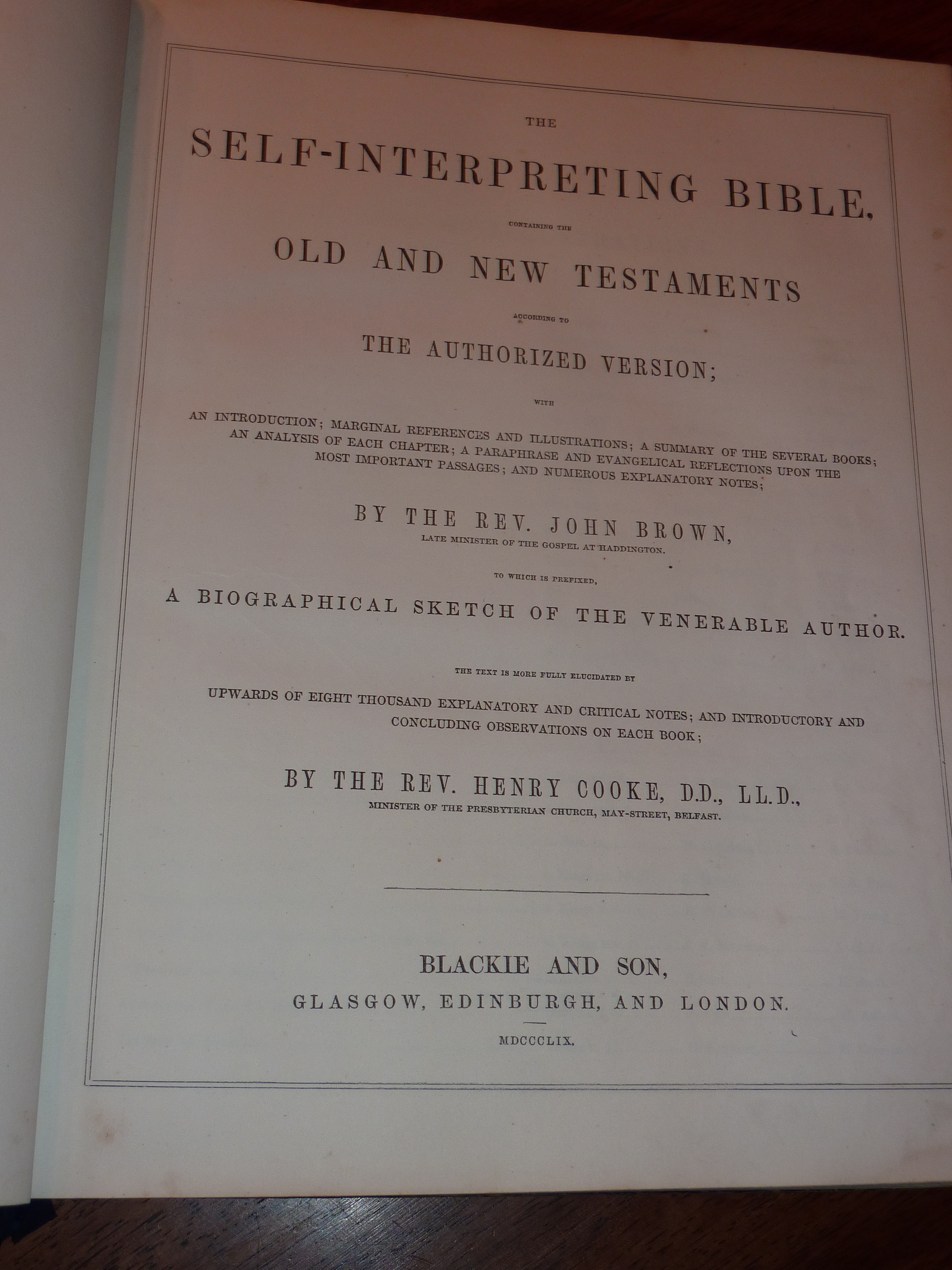
Title Page to Brown's Self-Interpreting Bible
The following is the original preface to Rev. John Brown’s Self-Interpreting Bible, in which he explains the various features he’s included, and shows how they will aid the reader in understanding and profiting spiritually from the Word of God. I’ve highlighted the features as they occur throughout. The rest is original to the editor.
My intention in the coming posts will be to demonstrate to varying degrees, each of these features, along with pictures of the numerous beautiful lithographs that are found along the way.
PREFACE TO THE ORIGINAL EDITION
Not to depreciate the valuable commentaries of Pool, Patrick, Clarke, Henry, Burkitt, Gill, and Doddridge, &c., but to exhibit their principal substance with all possible advantage, in a manner that might best comport with the ability and leisure of the poorer and labouring part of mankind; and especially to render the oracles of God their own interpreter, and enable every serious reader to judge for himself what doctrines ought to be believed, and what duties practiced by the Christian, are the avowed aims of this publication.
In the copious INTRODUCTION, the principal proofs of the Divine Authority of the Old and New Testaments, and the rules necessary to promote the profitable perusal of the oracles of God therein contained, are largely exhibited. The connected scheme of the Hebrew Laws, and their evangelical signification,–and of the fate of nations, narrated or predicted in Scripture, as subservient to the glorious work of our redemption,–together with the large Chronological Index,–form a summary of the most celebrated labours of the learned world on these diversified subjects. An accurate attention thereto will, through the blessing of God, greatly assist in searching the Scriptures with success.
The contents of the sacred books, and their respective chapters, are an accurate, full and explicatory representation of their subject. Properly attending to these, the reader must discern of whom, or of what, the Holy Ghost there speaks, and understand the passage accordingly. He may easily fix in his mind a general, but distinct view of the whole system of inspiration; and thus be capable, with the utmost readiness, to find out or compare whatever passages of Scripture he may desire.
The EXPLANATORY NOTES are chiefly confined to the figurative, the prophetic, and the practical parts. Here the obscurity of Scripture, or the importance of faith and holiness, chiefly required them.
In our Saviour’s delightful discourses, and the epistles of his inspired Messengers, our holy religion is most fully delineated; and there the explication is peculiarly extensive, and attempts to exhibit the substance of many learned and expensive commentaries, in a manner which, attending to the beautiful connexion, clearly unfolds the scope and meaning of the Spirit of God.
A particular and lively application of divine truth to the heart, and an unspotted holiness of conversation, being the immediate end of God’s revelations to men, the contents of each chapter, which are often in an explicatory manner, are in the Reflections practically summed up, and directed home to the reader himself, for enlightening his understanding, awakening his conscience, warming his heart, and for directing and animating his practice.
An exact knowledge of the seasons in which the oracles of God were delivered, or the events mentioned in them took place, being of no small importance for obtaining a distinct perception of their meaning, the dates before and after our Saviour’s incarnation have been adjusted from the best chronologers, and marked in the margin.

Lithograph of the Reverend John Brown of Haddington
But, as every Protestant must allow the Scripture itself to be its own best interpreter—as God, to oblige men to a diligent search of his word, comparing spiritual things with spiritual, has seldom fully unfolded any of his more important truths in one particular passage—the uncommon collection of Parallel Scriptures, such as is not to be found anywhere else that I know of, has formed the most laborious, and will, to the diligent peruser, be found by far the most valuable part of the work. Some of these are similar in phrase, others in meaning, and, in fine, others in their scope and design. In these, and others which may be added, we have a delightful view of the harmony of the Scripture, and multiplied proofs of every article of our Christian faith; we have a real Concordance, which may abundantly furnish preachers and others with their desired quotations; we have, in little room, a large Commentary, infinitely more certain than any dictates of men; and of which the very words are, as nails and as goads, pointed and fastened by the great Master of assemblies. In a truly diligent comparison of them, many texts all at once explain, and are explained by each other. Nor, unless at first, will the careful reader find much trouble in comparing the texts: but the mere view of the marginal quotations will direct his memory to that part of them which corresponds with the sentence to which they are annexed for explication. And, for his encouragement, I can only say, that my labour, in collecting the parallel texts in this work, has afforded me much more pleasant insight into the oracles of God than all the numerous commentaries which I ever perused.
Thus we may listen to, and converse with God, and lay our consciences open to the inspired arrows of our all-conquering Redeemer;–we find his words, and eat them, to the joy and health of our soul; we hide them in our heart, that we may not sin against him; we become mighty in the Scriptures, and expert in handling this sword of the Spirit, in opposition to every enemy of our soul: in fine, we are made wise unto salvation; are reproved, corrected, and instructed in righteousness, and perfectly furnished for every good work. May the Lord himself prosper it for these ends!
J. BROWN
“Bunyan, Brown and Boston”

John Brown's Self-Interpreting Bible (1859)
“For now I’m grown sae cursed douce
I pray and ponder butt the house;
My shins, my lane, I there sit roastin’,
Perusing Bunyan, Brown, an’ Boston,”
These lines are from a Robert Burns poem of 1789 entitled, “Epistle To James Tennant of Glenconner.” (The rest of his poetry is linked to from this page) The final line of this excerpt features the names of three figures from church history: John Bunyan, John Brown, and Thomas Boston. This poem references these writers in passing, highlighting what household names these three were in the eighteenth century.
Many of us are already familiar with the first, John Bunyan, seventeenth century Baptist preacher, who penned Pilgrim’s Progress during a twelve year sabbatical in jail. The third figure, Thomas Boston, may be less familiar nowadays, but he still has currency among readers within the Reformed tradition. He’s the author of The Fourfold State of Man. But the least familiar of these to modern Americans (perhaps even most Presbyterian and Reformed Americans) is the second figure, the Reverend John Brown of Haddington. The volume that elevated John Brown to household name status was his then-widely read Self-Interpreting Bible. Originally published in 1778, it went through at least 26 known editions.
 I recently came into possession of the 1859 edition. It’s in very good shape, and I hope I’m able to preserve that condition as I regulary mine it’s pages for it’s amazing lithographs and it’s even more amazing Reformed study notes, devotional applications and indices. I found it at a local antique store, and purchased it for my wife (and, of course, myself) as a gift for a significant milestone birthday that shall remain confidential. This is an appropriate gift for her because we share a love of old books and lithographs. The extensive study notes are more of interest to me, but she enjoys listening to them as I read them aloud to her on occasion.
So far, I’ve found little online about the book, but there was one very informative article that will make many of you desire along with me that this Reformed study Bible would find a publisher that would reintroduce it to the modern world during this period of renewed interest in Reformed theology. Since I’m not a publisher, and since this book is so old it’s bound to not be under any copyright restrictions, I’ll begin posting freely from it from now on for who knows how long. There’s so much wonderful material in here that I want to share with you, so subscribe to this blog either by email or RSS feed, and keep up with every entry. I know I’m not the most regular blogger, but now that I’ve got an antiquarian Bible full of stuff you’ve likely never read, I’ll be doing so more regularly.
The article “John Brown’s Bibles” may be read at this link; John Brown of Haddington’s Wikipedia entry may be read here, but I’ll be posting even more detailed biographical information about him in the days and weeks to come from the pages of his claim to fame. Banner of Truth Trust sells Life of John Brown with Select Writings.
If you browse through online Reformed booksellers, you will encounter a later theologian named John Brown who wrote many exegetical commentaries. I ordered his commentary on Galatians recently thinking it was the Brown of Haddington, only to be disappointed upon its arrival. But that’s alright, it looks like it’ll be a useful help itself. You can read an interesting article about the later John Brown here.
President Reagan’s “Evil Empire” Speech
This week, I’m on vacation in California. Today, I’m about to visit the Ronald Reagan Presidential Library in Simi Valley. Here’s their website; here’s their YouTube page; and here’s Reagan’s famous “Evil Empire” Speech…
The Caffeinated Captain!

I know it’s been a few weeks, but I just had to share one of the two coffee mugs my wife got me for Father’s Day. Does she love me, or what?
For Email Subscribers And A Reminder About One Earthly Enemy

A Muslim home in Jerusalem's Old City, exterior decorated following pilgrimages to Mecca and/or other sites important to Islam.
Here’s an idea. Since I’m no longer linking to my feedburner email subscription service and whenever I get my Google account mess straightened out, I’m going to be closing that account, which will affect those of you who have been receiving email notifications of my posts for the past couple of years. It might be wise if you just go ahead and unsubscribe from that service yourself and then subscribe to my new WordPress subscriber service. I think that would be the simplest route for now.
Also, if any of you are interested in a great interview regarding Islam, you might enjoy checking out this Sunday’s episode of The White Horse Inn, “Christianity Confronts Islam.” Michael Horton interviews former Muslim and converted Christian, Sam Solomon, regarding the nature of Islam. In the light of all the popular reassurances that “Islam is a relgion of peace,” even though we see little popular moderate Muslim resistance to Islamic terrorism, Solomon’s words will be a sober reminder that things aren’t as rosy as the politically correct culture would have us believe. We in the West must not forget what an ever-present threat and danger Islamic terrorism is to us all. Let this interview be your next reminder.
“On” or “After”? Defending the Friday Crucifixion

Shrine in Church of the Holy Sepulchre
In case you didn’t perceive it in the light of my series on St. Patrick (which is still ongoing–stay tuned, true believer!), one of my pet peeves about the anti-traditional wing of Christianity is that they will deny the established, sound views on things seemingly for the sole reason of not being in agreement with Roman Catholicism. It may just be me, but that’s the way things look to me. One example of this is the two competing sites in Israel for which the claim is made that it is the genuine site of Calvary and Christ’s tomb. The Church of the Holy Sepulchre has the vote of all the ancient churches, be they Roman Catholic, Eastern Orthodox, Coptic, what have you. Then there’s the Garden Tomb (formerly Gordon’s tomb), for which the claim was not made until a nineteenth century Protestant made it against the prevailing established evidence which overwhelmingly supports the validity of the Church of the Holy Sepulchre. Speaking generally, many Protestants tend to prefer the Garden tomb because it doesn’t have a big, old medieval or Crusader-era church built on top of it, ruining the view.
In the realm of traditional biblical claims, the question of on which day of the week Christ died is divided between those who aren’t uncomfortable with historic, established, orthodox traditional views and those who are. I was reading the Wikipedia article on Good Friday yesterday (here’s the link), in which the Good Friday customs of various groups are outlined. After the ancient Eastern and Western groups are treated, naturally the historic Protestant customs are described, followed by a section entitled, “Other Protestant Traditions.” The second paragraph of this section reflects the tendency I’m addressing:
Some Baptist, Pentecostal and many Sabbatarian and non-denominational churches oppose the observance of Good Friday, instead observing the Crucifixion on Wednesday to coincide with the Jewish sacrifice of the Passover Lamb (which Christians believe is an Old Testament pointer to Jesus Christ). A Wednesday Crucifixion of Jesus Christ allows for Christ to be in the tomb (heart of the earth) for three days and three nights as he told the Pharisees he would be (Matthew 12:40), rather than two nights and a day if he died on Friday.
I think this paragraph does a good job of highlighting part of the reason for the debate: wooden literalism. Firstly, the desire is to make sure the crucifixion of the Lamb of God takes place at the precise moment the copies and shadows of the heavenly things are offered, as if it just couldn’t happen at any other moment. Secondly, just because Jesus used the language in this one exchange that in modern English vernacular corresponds literally to a seventy-two hour period, the rest of the Gospel references to when Christ rose must be interpreted in the light of this verse understood this particular way. Anything else is unacceptable to such interpreters. Again, the fear being agreement with Rome on something. The net result becomes that Jesus couldn’t have died on Friday because it wasn’t a “literal” three days and three nights. Only Catholics and those other denominations that retain more Roman Catholic like practices than we do would be so gullible as to agree with the Friday view of the crucifixion.
One of the most popular denials the anti-traditional interpreters make is the traditional appeal to the fact that in the first century Jewish idiom a “day” can refer to either part of a day, or the entire day. I’ve yet to hear a persuasive argument against this linguistic phenomenon out of those who hold the Wednesday view, I just hear the unbroken mantra of “three days and three nights.” In other words, it seems to me those who hold this view simply don’t want to be confused by facts because they’ve got their proof text and they’re sticking with it.
All I’d like to do is focus on the other Gospel passages that refer to when Christ would rise from the dead. They tend to fall into two categories: those that have Christ rising “on the third day,” and those that have Christ rising “after three days.”
If the Wednesday crucifixion were true, and Christ did lie in the tomb for a literal seventy-two hour period, then perhaps the “after three days” verses are preferable. These passages are Matthew 27:63; Mark 8:31; 9:31; 10:34. Here’s the first of Mark’s references, Mark 8:31–
“And he began to teach them that the Son of Man must suffer many things and be rejected by the elders and the chief priests and the scribes and be killed, and after three days rise again” (emphasis mine).
On the other hand, if Christ did die on Friday, spend Saturday in the tomb and rise before sunrise on Sunday morning, then this scenario is more easily reflected by the “on the third day” verses. These passages are Matthew 16:21; 17:23; 20:19; 27:64; Luke 9:22; 18:33; 24:7, 21, 46. Let’s use Luke’s final verse as an example, Luke 24:46–
“and said to them, ‘Thus it is written, that the Christ should suffer and on the third day rise from the dead . . . . ‘”
If life were simple and we could resort to a majority vote, the traditional view wins. But I know it’s not that easy. However, it is worthy of note that the time frame references that don’t explicitly reveal a seventy-two hour period outnumber the ones more favorable to the Wednesday crucifixion view. No wonder when the early church compiled the New Testament teachings of the apostles into creedal form, they used the language that favors the Friday crucifixion view:
I believe in God, the Father Almighty,
the Maker of heaven and earth,
and in Jesus Christ, His only Son, our Lord:
Who was conceived by the Holy Ghost,
born of the virgin Mary,
suffered under Pontius Pilate,
was crucified, dead, and buried;
He descended into hell.
The third day He arose again from the dead;
He ascended into heaven,
and sitteth on the right hand of God the Father Almighty;
from thence he shall come to judge the quick and the dead.
I believe in the Holy Ghost;
the holy catholic church;
the communion of saints;
the forgiveness of sins;
the resurrection of the body;
and the life everlasting.
Amen.
Out of Judean Caves into Cyberspace!
Did I ever tell you that I got to go to Israel last November? If you were in a cave back when I posted far too little about it several months ago, let me tell you that the thing I looked most forward to seeing was the Dead Sea Scrolls

Shrine of the Book Museum
exhibit at the Shrine of the Book Museum in Jerusalem. The experience was well worth the cost. I even discovered two books that I really want to get around to buying and reading someday. One is The Dead Sea Scrolls Bible, a translation into English of all the Dead Sea Scrolls that contained books of the Old Testament. The other is The Complete Dead Sea Scrolls in English, which contains all of the writings of the Essenes, detailing their beliefs and customs and other glimpses of first century life in Israel.
Now, however, CNN tells us that the scrolls will be coming to us in addition to our having to go to them. Not that I don’t want people to keep going to see them in person. Nothing could ever beat that. Read the article at CNN.com called, “Dead Sea Scrolls Go From Parchment to the Internet.”
Corinthian Creed Added to My Box
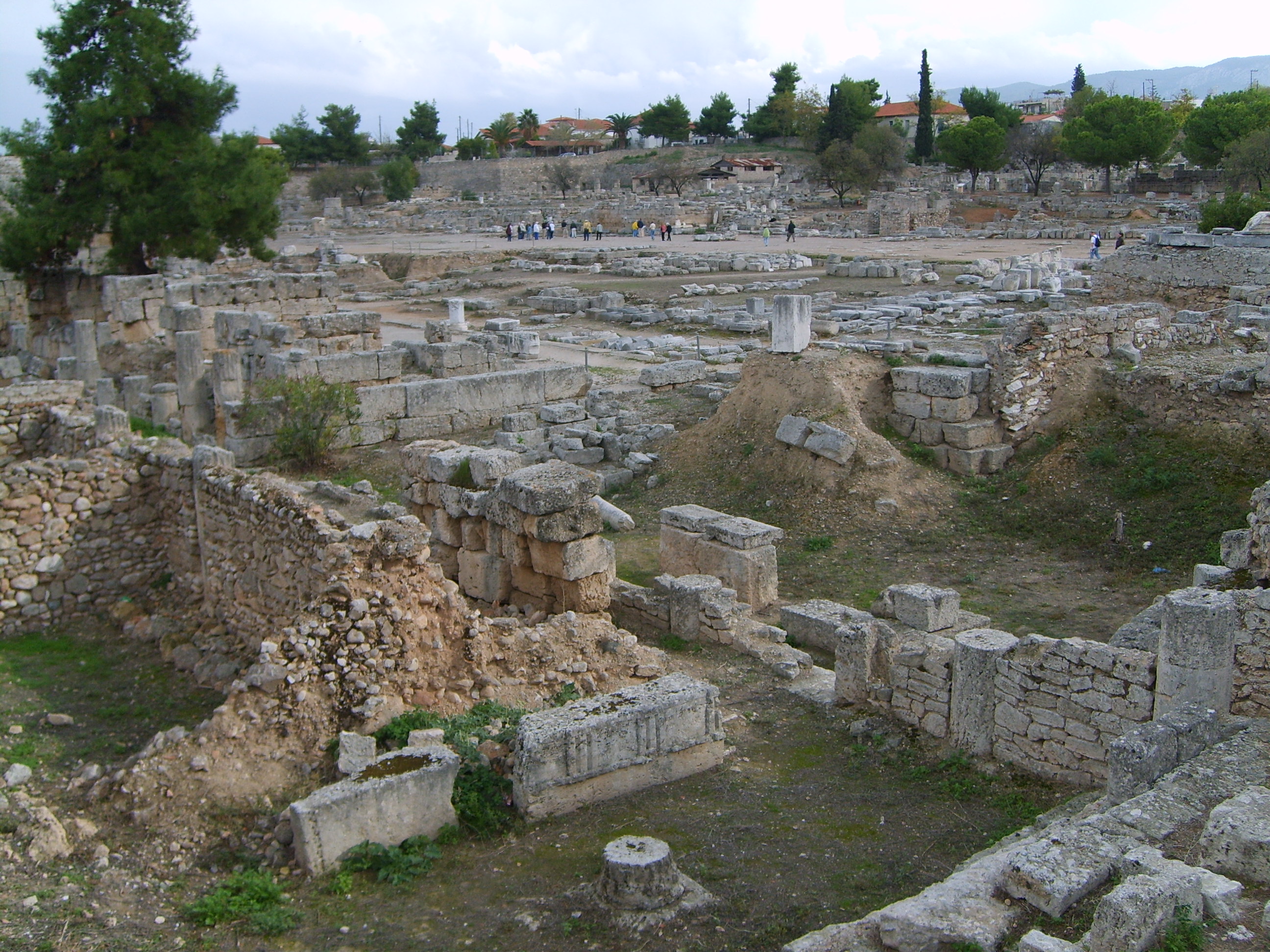
Over in my sidebar, you will find the recording made of the quartet who performed the song, “Corinthian Creed,” which I wrote to summarize the teaching of 1 Corinthians 15 on Paul’s defense of, teaching about and exhortations in light of the resurrection of Christ and our future resurrection at his Second Coming. Just find the black box on the lower right side of this page and select the file at the top of the list called “Corinthian Creed” and you’ll be able to hear our performance.
For a further introduction, read what I wrote about it back on September 30, 2006. Above, you may enjoy a view scanning across the ruins of Ancient Corinth which I shot on my Holy Land Tour in November of 2007, of which, more pictures are available for viewing in my Flikr photo box which is also in the sidebar to the right.
Jesus’ “Lost Years” Found In the New Testament

In my post last Sunday morning, I blogged about Lee Strobel’s book defending “the Real Jesus.” With this topic fresh in my mind, as well as the Sunday School lesson which I’d prepared for that morning, when class began, during our conversation with the children before the lesson, one of them asked out of the blue where Jesus was between the time he was a kid and the time he began his public ministry. I could tell immediately where he was going. Naturally, he followed up by saying his dad had been watching the History Channel and heard that people say Jesus went to India for some time between the ages of 12 and thirty. In the providence of God, my lesson for the day was from Luke 2:39-52, the account of “The Boy Jesus in the Temple,” as the heading over this passage in the English Standard Version describes it.
I’m not terribly familiar with the claims regarding Jesus’ reputed trip to India, spread by those outside the realm of orthodox Christianity. However, having perused the search engine and scanned a few sites (like this one, for example) and Wikipedia articles (like the one on the gnostic Acts of Thomas and the theosophical Aquarian Gospel), I’ve hit upon the apparent basis for the theory that Jesus went to India as a boy. I’d probably already be more clued in about it if I didn’t avoid History Channel programs of this nature and other popular sources of info on the secularized revisionist research on the “historical Jesus.” But I’m getting ahead of myself.
My immediate response to my student was that there are a lot of people who like Jesus, but who don’t believe the Bible. Often, they are people or groups from other religions that associate Jesus with their beliefs in an attempt to lend credibility to them, or for some other reason. In the middle of giving this summary of where stories like that come from, a verse from my lesson came to mind. “Now his parents went to Jerusalem every year at the Feast of the Passover” (Luke 2:41). After I glanced at the passage for a minute, it became clear to me that even though the verse doesn’t say, “Now Jesus and his parents went . . . ” the context indicates that when his parents went to Jerusalem every year, so did Jesus.
It seems I’ve found a piece of New Testament evidence that would indicate that Jesus of Nazareth did not, in fact, ever go to India, or on any fanciful “magical mystery tour” of eastern religions between the ages of 12 and 30, as suggested by the Aquarian Gospel, but was with his parents every year when they went to Jerusalem to celebrate the Feast of Passover.
Audio of Adrian and Dr. Tolar!
May I introduce to you our fascinating tour guide, Adrian?

This interesting little British guy was brought to Israel as a child by his devout, Jewish parents. He works primarily for the Israeli national parks service around the Dead Sea area, but also teaches English as a second language to his fellow Israeli citizens in addition to his brilliant career as a tour guide for eager American evangelicals like myself. He can speak Hebrew, Arabic, and Spanish in addition to his native tongue, the Queen’s English.
I have posted a few recordings of Adrian’s fascinating presentations on the bus and at various sites around Israel on my Box.net account, which can be accessed here, or in the future, from my CHK Multimedia page, on which you can click the “Audio for Mind and Heart” link and listen to the files posted December 12, 2007. Adrian’s talks include info regarding all sides of all issues (as much as he’s aware, anyway, which is quite a bit!), historical, geographical, economic, religious (often representing Christian, Jewish and Muslim views).
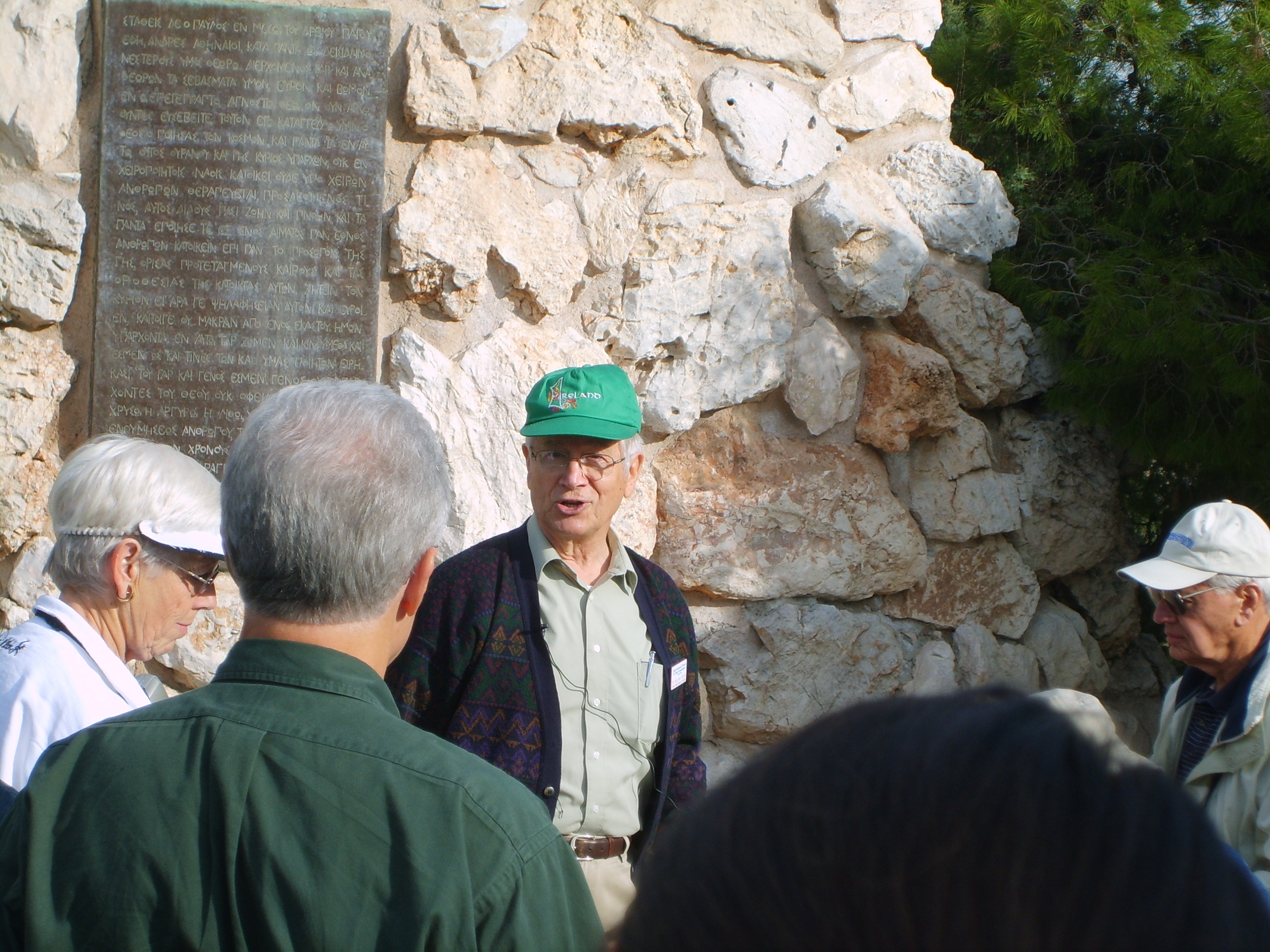
Some of the audio files also include recordings of Dr. William Tolar (more on his credentials later), interspersed throughout. He is equally interesting, considering he is a retired professor of Biblical Backgrounds from Southwestern Baptist Theological Seminary. In the image above, Dr. Tolar is standing at the foot of the Areopagus in Greece, the site where Paul preached the famous sermon about the “Unknown God” of the Athenians (Acts 17:16-34). The Greek text of Paul’s sermon is inscribed on the plaque over Dr. Tolar’s shoulder.
Here’s Where Jesus Cleansed the Temple

Do you see what appear to be the ruins of ramps outside that wall in the center of the picture? Our guide told us that used to be the porch leading to the temple complex where moneychangers gathered. Which means it’s the place where Jesus exhibited his zeal for his Father’s House and cleansed the Temple and dared them to crucify him, the True Temple, so that he may rebuild the Temple of his body on the third day, obtaining eternal redemption and assuring us who believe of our justification on the basis of the righteousness of Christ alone!
Jesus Cleanses the Temple (John 2:13-22)
13 The Passover of the Jews was at hand, and Jesus went up to Jerusalem. 14 In the temple he found those who were selling oxen and sheep and pigeons, and the money-changers sitting there. 15 And making a whip of cords, he drove them all out of the temple, with the sheep and oxen. And he poured out the coins of the money-changers and overturned their tables. 16 And he told those who sold the pigeons, “Take these things away; do not make my Father’s house a house of trade.” 17 His disciples remembered that it was written, “Zeal for your house will consume me.”
18 So the Jews said to him, “What sign do you show us for doing these things?” 19 Jesus answered them, “Destroy this temple, and in three days I will raise it up.” 20 The Jews then said, “It has taken forty-six years to build this temple, and will you raise it up in three days?” 21 But he was speaking about the temple of his body. 22 When therefore he was raised from the dead, his disciples remembered that he had said this, and they believed the Scripture and the word that Jesus had spoken.
Some good, and some not-so good pix
Herod’s Vaults at his Caesarea palace complex on the Mediterranean shore facing Rome, his own personal Mecca! Click the following images to enlarge.
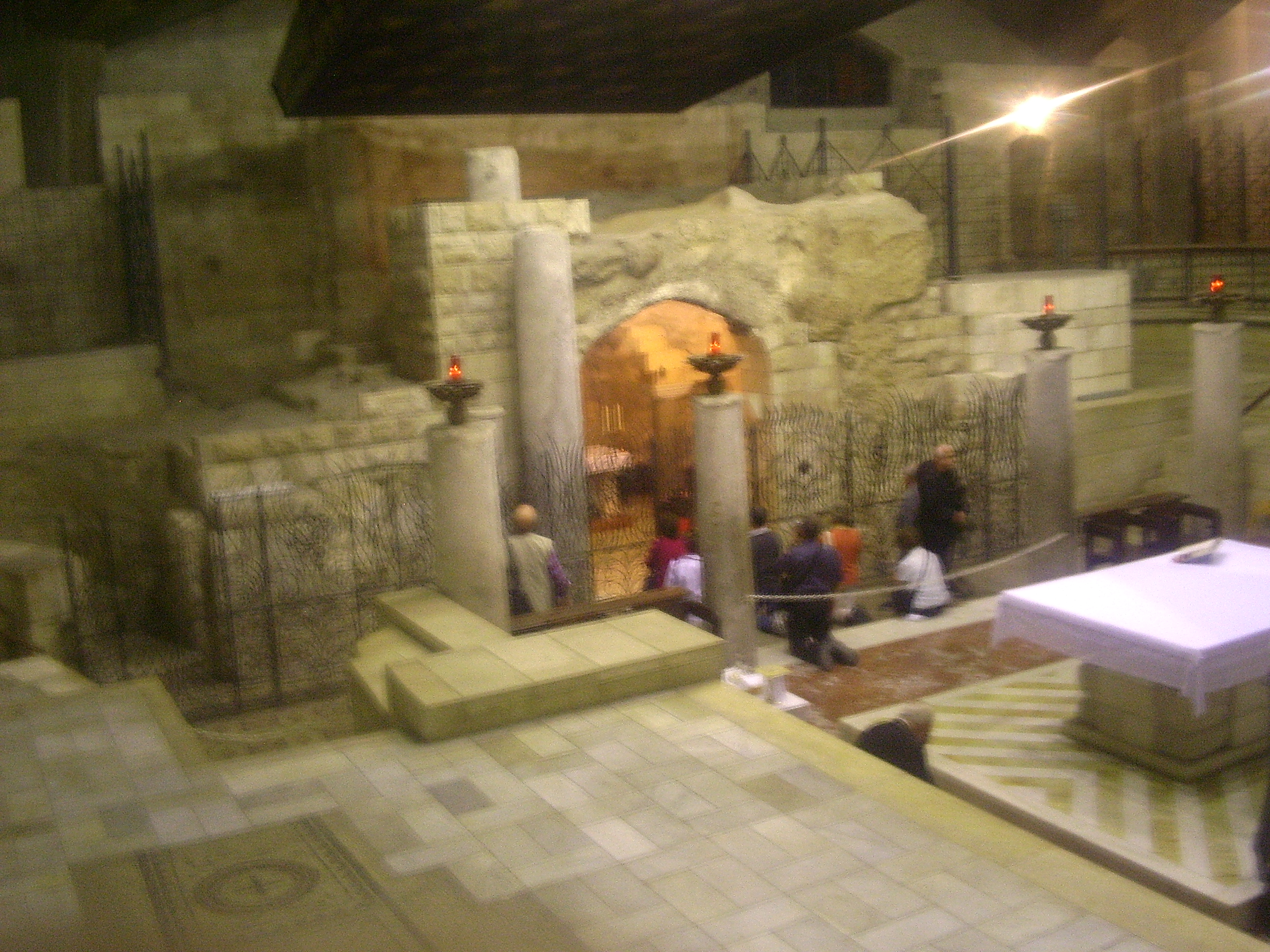
Mary’s Home, Church of the Annunciation in Nazareth
The Sea of Galilee, from our boat ride

Dr. William Tolar at Corinth part 2
Here’s a second excerpt from Dr. Tolar’s remarks at the ruins of Corinth in Greece.


 The Misadventures of Captain Headknowledge
God’s Law Reveals Your Misery
3. How do you come to know your misery?
A. The law of God tells me.1
1. Romans 3:20 “For by works of the law no human being will be justified in his sight, since through the law comes knowledge of sin.”
Romans 7:7-25 “What then shall we say? That the law is sin? By no means! Yet if it had not been for the law, I would not have known sin. For I would not have known what it is to covet if the law had not said, ‘You shall not covet.’ But sin, seizing an opportunity through the commandment, produced in me all kinds of covetousness. For apart from the law, sin lies dead. I was once alive apart from the law, but when the commandment came, sin came alive and I died. The very commandment that promised life proved to be death to me. For sin, seizing an opportunity through the commandment, deceived me and through it killed me. So the law is holy, and the commandment is holy and righteous and good.
“Did that which is good, then, bring death to me? By no means! It was sin, producing death in me through what is good, in order that sin might be shown to be sin, and through the commandment might become sinful beyond measure. For we know that the law is spiritual, but I am of the flesh, sold under sin. For I do not understand my own actions. For I do not do what I want, but I do the very thing I hate. Now if I do what I do not want, I agree with the law, that it is good. So now it is no longer I who do it, but sin that dwells within me. For I know that nothing good dwells in me, that is, in my flesh. For I have the desire to do what is right, but not the ability to carry it out. For I do not do the good I want, but the evil I do not want is what I keep on doing. Now if I do what I do not want, it is no longer I who do it, but sin that dwells within me. So I find it to be a law that when I want to do right, evil lies close at hand. For I delight in the law of God, in my inner being, but I see in my members another law waging war against the law of my mind and making me captive to the law of sin that dwells in my members. Wretched man that I am! Who will deliver me from this body of death? Thanks be to God through Jesus Christ our Lord! So then, I myself serve the law of God with my mind, but with my flesh I serve the law of sin.”
4. What does God’s law require of us?
A. Christ teaches us this in summary in Matthew 22: Love the Lord your God with all your heart and with all your soul and with all your mind [and with all your strength—KJV].1 This is the first and greatest commandment. And the second is like it: Love your neighbor as yourself.2 All “the Law and the Prophets” (the Old Testament) hang on these two commandments.
1. Deuteronomy 6:5 “You shall love the LORD your God with all your heart and with all your soul and with all your might.”
2. Leviticus 19:18 “You shall not take vengeance or bear a grudge against the sons of your own people, but you shall love your neighbor as yourself: I am the LORD.”
5. Can you live up to all this perfectly?
A. No.1 I have a natural tendency to hate God and my neighbor.2
1. Romans 3:9-20,23 “What then? Are we Jews any better off? No, not at all. For we have already charged that all, both Jews and Greeks, are under sin, as it is written: ‘None is righteous, no, not one;no one understands;no one seeks for God.All have turned aside; together they have become worthless;no one does good, not even one.’Their throat is an open grave;they use their tongues to deceive.’‘The venom of asps is under their lips.’‘Their mouth is full of curses and bitterness.’ ‘Their feet are swift to shed blood;in their paths are ruin and misery, and the way of peace they have not known.’‘There is no fear of God before their eyes.’ Now we know that whatever the law says it speaks to those who are under the law, so that every mouth may be stopped, and the whole world may be held accountable to God. For by works of the law no human being will be justified in his sight, since through the law comes knowledge of sin.”
“for all have sinned and fall short of the glory of God”
1 John 1:8,10 “If we say we have no sin, we deceive ourselves, and the truth is not in us.” “If we say we have not sinned, we make him a liar, and his word is not in us.”
2. Genesis 6:5 “The LORD saw that the wickedness of man was great in the earth, and that every intention of the thoughts of his heart was only evil continually.”
Jeremiah 17:9 “The heart is deceitful above all things, and desperately sick; who can understand it?”
Romans 7:23-24 “but I see in my members another law waging war against the law of my mind and making me captive to the law of sin that dwells in my members. Wretched man that I am! Who will deliver me from this body of death?”
Romans 8:7 “For the mind that is set on the flesh is hostile to God, for it does not submit to God’s law; indeed, it cannot.”
Ephesians 2:1-3 “And you were dead in the trespasses and sins in which you once walked, following the course of this world, following the prince of the power of the air, the spirit that is now at work in the sons of disobedience— among whom we all once lived in the passions of our flesh, carrying out the desires of the body and the mind, and were by nature children of wrath, like the rest of mankind.”
Titus 3:3 “For we ourselves were once foolish, disobedient, led astray, slaves to various passions and pleasures, passing our days in malice and envy, hated by others and hating one another.”
Share this: