Star Wars, Episode VII: The Force Awakens Theatrical Poster Released
 The jurisdiction of this blog just expanded. I know many Reformed blogs have always posted on personal interests that lay outside the realm of Reformed theology, but I had rarely, or never done so myself. This changes today.

Yours truly, nerding out.
Facebook friends of mine have become painfully aware of the fact that I have, in the past year, reverted to where I left off at about age nineteen, in my interest in comic books and Star Wars. I have been calling 2015 “The Year of Star Wars” since the announcement that George Lucas had decided to sell Lucasfilm to Disney and the joint announcement that Disney’s newly acquired company would begin a new trilogy of Star Wars feature films, along with a handful of spin-off films. There is also talk of a live-action Netflix series in the works (see this for the new canon). But, most significantly for myself, is the fact that now that both Marvel Comics and Lucasfilm are under the Disney umbrella, the twenty-plus year run of Dark Horse brand Star Wars comics is coming to an end, and Lucasfilm’s new sister company will resume publishing Star Wars comics, which they originally did since the 1977 release of the ground-breaking original Star Wars film when I was six years old, which somehow managed to wrap its tentacles around my brain.
Some of you may be aware that yesterday, the long-awaited official theatrical poster of Star Wars, Episode VII: The Force Awakens was released, as a fore-runner to the fashionably late debut of the first full trailer for the film, to be aired during half-time on Monday Night Football on ESPN tonight.

HT: Star Wars Episode VII: The Force Awakens Facebook Page
But, thank the Maker for DVR technology! I needn’t sit through a game I’m not interested in to catch the trailer. I’ll record it, watch my normal shows, probably check in on the progress of the game in order to catch it live, then back to my preferred viewing. Then I’ll protect it in my DVR so I can re-watch it as often as I like.
The infrequency of my blogging on theological issues may largely be explained by the fact that since 2010, when my family finally joined an Orthodox Presbyterian Church, my formerly frustrated need for sound theology began being met, and my compulsion to seek interaction with others who believe as I do–few and far between as we often find ourselves–has found relief in my enjoyment of weekly ministry of the ordinary means of grace at Mid-Cities Presbyterian Church in Bedford, Texas.
In 2013, we moved from our original rental facility, the Airport Area YMCA to a small building on 1.6 acres on Brown Trail in Bedford. With that move, the deacon in charge of the library asked me to take over directorship of our small collection of books, and also requested that I come up with a way to facilitate online discussion of our books among our library patrons. This lead to the launch of my second blog, the MCOPC Library Blog. I have been posting our titles on this blog, which will serve as an online card catalog in the hopes that one day I will learn how to provoke a church full of ordinary people who are not already avid bloggers to open up and review, comment, raise questions and engage in discussion or debate on our humble blog with other library patrons. This strikes me as a daunting task. But perhaps with time, more of that will begin to happen.
I will begin reblogging those posts here as well, if only to increase the frequency of Reformed-content blogging. I also have intentions to resume my devotional series I started in 2006, which broke down with the increased difficulty in pairing questions and answers from the Westminster Shorter Catechism on the Ten Commandments with hymns featuring related content from the Trinity Hymnal. But I have a source which will assist me in that, my pastor has managed to do so in his Sunday evening service teaching ministry on the catechism, and has invited me to benefit from his work in that area, for which I am grateful.
But in the meantime, I hope you will enjoy geeking out with me about Star Wars and Marvel Comics from time to time. Let me know what you think about the Force Awakens poster, speculate about why you think Luke is missing, and check back here for more forty-something fanboy misadventures.
Craig Troxel on Trends and Biblical Reformation of the Church

Bethel OPC Wheaton Pastor and Author Craig Troxel
Craig Troxel, Pastor of Bethel Presbyterian Church (OPC) in Wheaton, Illinois, will be speaking at Mid-Cities Presbyterian Church’s 2015 DFW Reformation Conference (Nov. 13-14, 2015) on the subject of “With All Your Heart: Thinking (again) About What We Think, Love and Choose.”
Pastor Troxel has spoken on Reformed theology in Texas previously down in Pflugerville, Texas, at our sister congregation, Providence Presbyterian Church at their 2009 Calvin Conference.
 Perhaps a few of you who are thinking about attending this year’s conference in Bedford would enjoy sampling Pastor Troxel’s work.
Semper Reformanda: Under Renovation or Seeking
The Emerging Church: The New Voice in the Conversation
Every Member Matters: The Priesthood of All Believers
Presbyterian Salsa: Westminster Calvinism’s Recipe for “The Communion of the Saints”
Register for the 2015 DFW Reformation Conference (Nov. 13-14, 2015) at Mid-Cities Presbyterian Church (1810 Brown Trail, Bedford, TX 76021).
Sermon Notes: The Lamb of God (John 1:18-34)

The Lamb of God (John 1:18-34)
John the Baptist points away from himself to Christ, so that all may know that Christ is the Lamb of God who takes away the sin of the world.
I. Who Are You? (1:19-21)
A. Leaders’ First Question
1. “Who are you?” (1:19)
a. Not asking for genealogy—they likely know of his father, Zechariah.
b. Jewish leaders would be remiss to not examine John the Baptist.
B. John the Baptist’s First answer (1:20)
1. Confesses Christ by denying being him.
2. There were many itinerant claimants to Messiahship.
C. Leaders’ Second Question (1:21a)
1. “Are you Elijah?”
a. Matthew’s description of John the Baptist an allusion to Elijah (Matthew 3:4)
b. Rabbis frequently expounded on Elijah’s expected return (Malachi 4:5)
D. John the Baptist’s Second Answer
1. “I am not.”
E. Leaders’ Third Question (1:21b)
1. “Are you ‘The Prophet’?” (Deuteronomy 18:15)
F. John the Baptist’s Third Answer
1. “No.”
2. Christ himself is ‘The Prophet’ (Acts 3:22; 7:37).
II. The Voice (1:22-28)
A. Leaders’ Fourth Question (1:22)
1.“Who are you? We need to give an answer to those who sent us. What do you say about yourself?”
B. John the Baptist’s Fourth Answer
1. “I am the voice of one crying out in the wilderness, ‘Make straight the way of the Lord,’ as the prophet Isaiah said.” (1:23)
2. Prophesied in Isaiah 40:1-8; see v. 3
3. A metaphorical call to repair the roads to ease the return of repentant Jews from Babylonian Captivity—the literal near fulfillment.
4. John the Baptist and his baptism of repentance (Luke 3:3) is the spiritual and ultimate far fulfillment.
5. John the Baptist is like a pre-battle bombardment to soften a target before an attack.
C. Leaders’ Fifth Question (1:25)
1. “The why are you baptizing, if you are neither the Christ, nor Elijah, nor the Prophet?”
D. John the Baptist’s Fifth Answer (1:26-27)
1. “I baptize with water, but among you stands one you do not know, even he who comes after me, the strap of whose sandal I am not worthy to untie.”
2. Like his confession by denial above, John the Baptist magnifies Christ by diminishing his own importance (John 3:30).
3. Christ was there, yet remained unrecognized (cf. John 1:10).
III. That He Might Be Revealed (John 1:29-34)
A. John 1:32-34 takes place after Jesus’ baptism.
B. “The next day he (John the Baptist) saw Jesus coming toward him, and said, ‘Behold, the Lamb of God, who takes away the sin of the world!’
1. John 1:29 is the gospel in a nutshell.
a. John the Baptist refers to Christ in terms of the Passover Lamb.
b. “The world” in John 1:29 does refer to all people in the world, but not all people without exception (see John 1:12).
C. John the Baptist’s twofold ministry
1. Negatively, he calls the Jews to his baptism of repentance.
2. Positively, he points to the Lord Jesus Christ to bear witness that he is the Son of God that they might believe.
D. If you believe in Christ, he has borne your sins; therefore, repent of your sins and reaffirm your faith in him in Christian worship.
Tullian Brings Reformed Gospel to TBN

The Daily Evangel: A subliminal reminder to preach the gospel to yourself every day.
I guess it had to happen someday. Turns out it did this past summer. Megachurch pastors tend to accept invitations to places where there are TV cameras, and that’s exactly what happened in this case. Tullian’s message of “radical grace” has reached the first family of the Trinity Broadcasting Network. While in many ways, this is an example of worlds colliding, I figure if Peter Lillback can accept an invitation to Glenn Beck’s TV show a few years ago with the intention of making sure the gospel is clearly communicated on his air, then why not Tullian on TBN? The world’s largest Christian television network could do a lot worse, and has built an empire on doing just that.
For those unaware, Tullian Tchividjian is the grandson of Billy Graham and the pastor of Coral Ridge Presbyterian Church in Ft. Lauderdale, Florida. He is a favorite among the New Calvinists and is notorious for his popularization of the Lutheranesque “law-gospel distinction” which is taken by many to his right, myself included, as repeating the mistakes of historic antinomianism in some of his rhetoric and in his application of the otherwise valid hermeneutic pioneered by the Protestant Reformer. Among Tullian’s influences are Steve Brown (RTS Orlando and Key Life) and the theologians associated with Modern Reformation magazine and The White Horse Inn radio show. While I believe Tullian when he says he affirms the Reformed teaching on the third use of the law , I also believe his critics when they say his rhetoric smacks too much of historic antinomianism (read about that here). Tullian’s intention is to minister to those burned by legalism, and I’m all for that, even if he may be pushing the envelope of Reformed theology further to the left than I think he should.
But I like Tullian in small doses. Few and far between. It has been a while since my last dose of Tullian, so I am prepared to have a good attitude about his appearance on TBN to promote his recent book One Way Love. Besides, it would be inconsistent of me to criticize him for accepting an invitation to speak on Word of Faith turf, since the seeds of Reformed theology were planted in my own mind when Michael Horton appeared on TBN to promote his very first book originally entitled Mission Accomplished (now Putting Amazing Back Into Grace) while still a student at the Bible Institute of Los Angeles (BIOLA). The difference between Horton’s and Tullian’s appearances is that the latter they post on YouTube, while the former they immediately erase, cancel the talk show that featured him, and have the host reassigned to a job behind the scenes. This reaction was due to the fact that Horton was a known critic of the Word of Faith heresy who would go on to edit The Agony of Deceit. My hope is that Tullian’s interview will likewise plant and water the seeds of Reformed theology and the true gospel of Christ among today’s regular TBN viewers.
While Tullian admits to being a one-sermon preacher, his message that Christ kept the law perfectly and earned eternal life for those who believe and so frees us to gratefully, though imperfectly, respond to his amazing grace with love toward our neighbors is one we need to be reminded of on a daily basis. In fact, it is this “preach the gospel to yourself daily” notion that motivated me to put “Daily Evangel” on the building in the background of my picture of Captain Headknowledge. We need the Evangel of the free grace of God in Christ every day, and may it spur us on to love and good works, though we’ll never do them as well as Jesus did them for us.
Carl Trueman Preaches at SWBTS
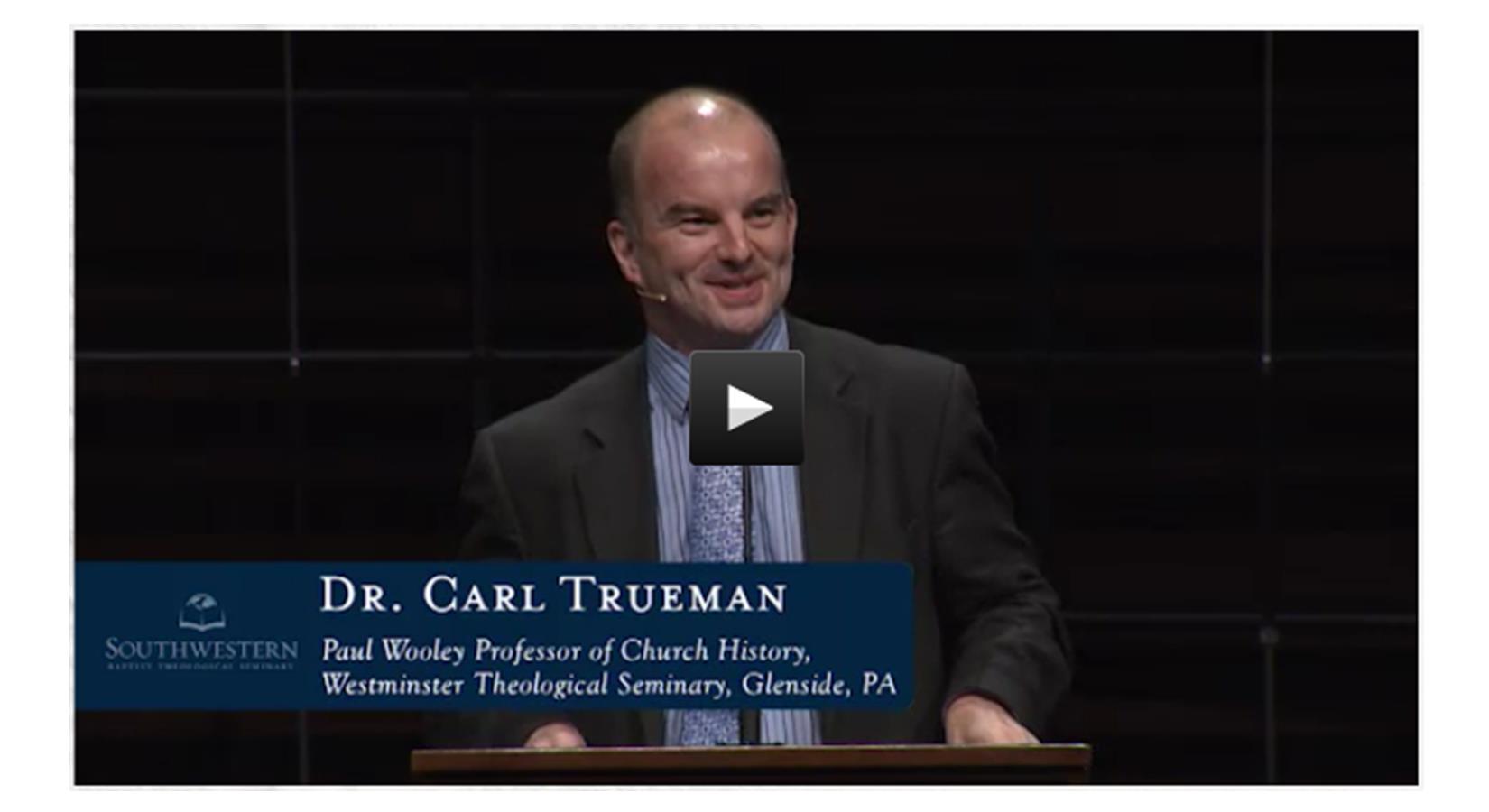
Dr. Carl Trueman speaks in the SWBTS chapel Thursday, October 9, 2014.
Yes, you heard that right. Dr. Carl Trueman was invited to speak in the chapel service at Southwestern Baptist Theological Seminary in Fort Worth, Texas yesterday. Seminary President Paige Patterson introduced Dr. Trueman as “my favorite Calvinist” for his activities as a “critic of the culture.” In the video of Dr. Trueman’s chapel sermon, you can see his friendly response in which he expresses his admiration for Dr. Patterson’s role in leading Southwestern and the SBC back to a more conservative theological position. Then he delivers a sermon on the advent of the prophet Elijah from 1 Kings 17:1-24 and proclaims the power of not only God’s Word, but also his holiness, his mercy and his power over death. My pastor, Joe Troutman, and I attended the service, got a bite to eat off campus while Dr. Patterson and his wife hosted Dr. Trueman for lunch (oh, to be a fly on the wall of that conversation!), gave him a tour of the campus, after which Mid-Cities Presbyterian Church officially took possession of him in preparation for tonight’s OPC DFW Reformation Conference 2014 on the role of creeds and confessions in the Protestant Reformation and their benefit to the life and worship of the church today. If you haven’t already registered, it’s not too late. Pictures and audio to follow on this blog in the coming days.
View “The Advent of the Prophet Elijah” (1 Kings 17:1-24)
Register for OPC DFW Ref Con 2014
Countdown to OPC DFW Ref Con 2014!
![image[1]](https://capthk.com/wp-content/uploads/2014/10/image1.jpeg) This morning, my pastor, Joe Troutman, my friend Chris and I erected our conference banner in front of the church. Then we got in the car and drove by the church to see just how visible it is from the road. Pastor Troutman said, “It pops!”
This morning, my pastor, Joe Troutman, my friend Chris and I erected our conference banner in front of the church. Then we got in the car and drove by the church to see just how visible it is from the road. Pastor Troutman said, “It pops!”
![image[1]](https://capthk.com/wp-content/uploads/2014/10/image11.jpeg)
![image[2]](https://capthk.com/wp-content/uploads/2014/10/image2.jpeg) I can’t wait for OPC DFW Reformation Conference 2014!
I can’t wait for OPC DFW Reformation Conference 2014!
Join us by clicking here for free registration. There are 93 seats available at present. I hope you can make it to see Dr. Carl Trueman speak on the biblical case for creeds and probably survey the development of the ancient Apostles’, Nicene and other creeds on Friday night at 7:00pm CT. Then at 9:30am CT Saturday he will survey the confessions of the Protestant Reformation, and finally at 11:00am he will commend the usefulness of creeds and confessions in the life and worship of the Christian church today.
What if “No creed but the Bible” is unbiblical?
Distinctions Regarding Sanctification in the Household Principle

Robert Mossotti, OPC Licentiate
OPC Licentiate Robert Mossotti explores a distinction between the holiness of the children of a believing parent and the way an unbelieving spouse is sanctified by a believing spouse. These remarks conclude his lesson delivered on August 31, 2014 at Mid-Cities Presbyterian Church. Subscribe to Robert’s SermonAudio page for more worthwhile teaching and preaching.
Let’s not forget that in Hebrews 6, there are some who are in the visible church who actually enjoy many spiritual benefits including tasting the heavenly gift, and the good word of God, and the powers of the age to come, and sharing in the Holy Spirit. But not, as we have discussed in a previous lesson, sharing in the Spirit’s work of regeneration, but in other very real, but lesser, blessings of the Holy Spirit, blessings which our Confession calls “common operations of the Spirit” in chapter 10, paragraph 4.
There is one other text that I would like to examine briefly. These are broad brush strokes, these may not even be the best arguments for why we baptize infant children of believers, but I think that they’re fairly good ones: the continuity of the one covenant of grace, the unalterability of covenants once they’re ratified in Abraham, and all the things we’ve gone through so far in this lesson.
Let’s go to 1 Corinthians chapter 7.
For the unbelieving husband is made holy because of his wife, and the unbelieving wife is made holy because of her husband. Otherwise your children would be unclean, but as it is, they are holy (1 Corinthians 7:14 ESV).
In the Greek text of this verse, the children of a believer, whether it’s mother or father, are called saints in the Greek. They are called “holy ones,” that’s what “saints” means. Now, this is a noun, it’s not an adjective, like it appears in the text here in English. It’s not a description of them as an adjective, it is a statement that they are a noun, they are saints; they are holy ones.
Let’s go to chapter 1 and verse 2 of this epistle.
To the church of God that is in Corinth, to those sanctified in Christ Jesus, called to be saints together with all those who in every place call upon the name of our Lord Jesus Christ, both their Lord and ours: (1 Corinthians 1:2 ESV)
It’s not as obvious in the English, here, but in the Greek it is the same noun. It’s not a verb, it’s not an adjective, it’s a noun, they’re being called saints, holy ones. So, let’s go back to chapter 7. The thing is, that although the children seem to be called by the same noun as other members of the visible church, and that is the point that I want to make, nevertheless, it says something odd about the unbelieving spouse as well, doesn’t it? It would seem to create a problem for my thesis because you can’t say that an unbeliever is a member of the church, and it says that he is being sanctified by the believing wife, or vice versa, and the children are called holy ones. That creates an apparent problem, I’m trying to say with this text that children are members of the church just like the ones Paul addresses at the beginning of the epistle, so there is some difficulty there. But I think the explanation is to be found in the grammar. The children, like the visible church members in chapter 1 verse 2 are declared to be saints, holy ones. That is not what happens, here, with the unbelieving spouse. They are not called saints, they are not called holy ones, it’s says with a passive verb, they “are sanctified.” It is a different idea; it’s slight, I admit, but it is a distinction that Paul actually puts in there. He doesn’t say, “the children are saints, and the unbelieving parents are saints, too.” He doesn’t say that the children “are sanctified,” in the Greek, the way the unbelieving parent is sanctified. He makes a distinction. He calls the children “saints” the way he calls all of them saints at the beginning, and with the unbelieving parent, he says that they “are sanctified,” and I think the explanation for this distinction in the grammar is this idea of being sanctified by virtue of being in proximity to something holy.
Let’s go to Matthew 23:17-19.
You blind fools! For which is greater, the gold or the temple that has made the gold sacred? And you say, ‘If anyone swears by the altar, it is nothing, but if anyone swears by the gift that is on the altar, he is bound by his oath.’ You blind men! For which is greater, the gift or the altar that makes the gift sacred? (Matthew 23:17-19 ESV)
The gold was sanctified, not because of what it is, but because of its proximity to something else.
Now let’s go to Exodus 30:29
You shall consecrate them, that they may be most holy. Whatever touches them will become holy (Exodus 30:29 ESV).
You can see it much more clearly in the Septuagint and in the Hebrew text that it is the same idea of sanctifying, but it’s not that these things were holy in themselves, but whatever they touched was holy, so going back to 1 Cortinthians 7, the unbelieving spouse is made holy in that sense, by virtue of their proximity to the believing parent and the child, in their marital and parental relationship to holy ones, they are in a sense sanctified. I can’t do much better than that, I think, in explaining in what sense the unbelieving spouse can be sanctified. It’s not as if they are holy, “holy ones,” but they are sanctified, receiving holiness by the unbelieving spouse’s proximity to holy things.
One more note on the unbelieving spouse being described as being sanctified, if we were to take the time to go to Leviticus 27:28, especially in the Masoretic Hebrew text and the Septuagint, we would see that there is all kinds of sanctifying in the Scriptures. I don’t think this is the kind of sanctifying we’re talking about in Leviticus 27, where it is those that are set apart for God’s destruction are called holy as well, so I don’t mean the unbelieving spouse is sanctified in the sense that he is set apart for destruction. I only introduce this to make the point that in the Scriptures there is more than one meaning for “sanctifying.” It doesn’t always have the meaning of which we typically think.
So, what is the overall argument that I want to make from 1 Corinthians 7:14? It’s not ambitious. I don’t want to make too much out of my grammatical distinctions, but simply that children of believers are to be admitted as members of the visible church, and are to be granted the rite of admission to the same. I think surely the New Testament language stands at least for that. They are called saints just like anybody else in the church at Corinth.
I have said that Genesis 17 makes clear that the household principle is not simply the physical descendants of the believer that are to be included into the visible church. It’s a household principle, not so much a genetic line kind of principle. Now we in the United States of the 21st century don’t have slavery. So how would you apply that? We should keep in mind that they did have slavery in the first century as well as during the time of Abraham. So by the first century, where this principle of admission into the visible church by household would include slaves it is the same as saying that in the twenty-first century the household would not include slaves. Slavery is an historical accident of local, civil law. It’s something that the Bible does not confront head on, nor does it warrant it. That’s how we would apply it today. We would do the same thing, we would admit by households, but since households no longer include slaves we wouldn’t even consider that, but children would still be a part of that, according to Genesis 17.
Visible Church Membership for Covenant Children
Robert Mossotti, our summer intern at Mid-Cities Presbyterian Church in Bedford, Texas taught a Sunday School series on Ecclesiology. All of the lessons are available online here. They’re also available on Robert’s SermonAudio page here. My favorite lesson in the series was the following on the biblical case for infant baptism and the Reformed inclusion of the infant and unbelieving children of believers into church membership. The following is a transcript of his remarks, lightly edited at some points. I hope you find it as helpful and enlightening as we have. You can listen to this particular lesson online here. We begin with his introductory remarks regarding principles that govern our interpretation on this issue, and an exposition of Paul’s words regarding covenants from Galatians 3. The rest will follow in the coming days and weeks.
Why do Presbyterians baptize babies and count them as members of the visible church?
Let’s restate some principles first, before we get into some passages.
The visible covenant community is the visible church—Old Testament and New Testament—and what makes it visible are the sacraments. These place a mark on the church to identify it as belonging to the Lord. The sacraments mark God’s people off from the world. Another principle we have to keep in mind is that there is only one covenant of grace in Scripture. The covenant by which Abraham and the Old Testament church were saved is our covenant, too. By God’s grace, in the Scriptures we are all called children of Abraham through faith. There is no essential difference between the Old Covenant church and the New Covenant church. There are differences, but no essential differences. No differences as to substance, just form. The church is one across all the ages, because the covenant of grace is one. To embrace the one idea is to embrace the other. If you accept that there is one covenant of grace throughout Scripture by which we are all saved, then you have to accept that the church is one across both Old and New Testaments. We affirm this over against dispensationalism, which maintains an essential difference between Israel and the church. So the Abrahamic Covenant, the Mosaic Covenant (the one at Mount Sinai mediated through Moses), and the New Covenant are all different administrations of the one covenant of grace. In section 5 of chapter 7 of the Westminster Confession of Faith, the Mosaic Covenant is called an administration of the covenant of grace. Alright, now that those principles have been stated, let’s go to Galatians 3.
The apostle Paul is going to give us in this passage a principle of covenant theology. A principle of Interpretation of Covenants, of Application of Covenants, the Nature of Covenants. Paul says not only biblical covenants, but all covenants. Let’s go to Galatians 3:15.
“To give a human example, brothers: even with a man-made covenant, no one annuls it or adds to it once it has been ratified. Now the promises were made to Abraham and to his offspring. It does not say, “And to offsprings,” referring to many, but referring to one, “And to your offspring,” who is Christ. This is what I mean: the law, which came 430 years afterward, does not annul a covenant previously ratified by God, so as to make the promise void” (Galatians 3:15-17 ESV).
In verse 15, this idea of “ratified” in the ESV comes from the Greek word kuro’o, and Bauer-Danker, the premier Greek lexicon or dictionary defines it as “to confirm, to ratify, to validate or to make legally binding.” Although the covenant of grace goes all the way back to Eden, note that Paul is saying here that it was not ratified until Abraham. Now note that in verse 15, Paul begins with a general principle of covenants. Then, as he moves down through verses 16 and 17 he applies that general principle of covenants to the particular case of the Mosaic administration of the one covenant of grace—that’s what he means by the Law coming in. Paul says that once the covenant of grace was ratified at the time of Abraham, no modifications may be introduced even by later administrations of the covenant of grace, including the Mosaic administration.
So, it is because there is only one covenant of grace throughout Scripture that we Presbyterians apply the sign of admission into the visible church to the children of believers, for we are not free to change the way the covenant is administered. It is not because the Reformers didn’t sufficiently push off from Rome that we baptize babies, it is because of our covenant theology which we receive, we believe, from the Scriptures. It is also because the covenant of grace is one across the various administrations that we need not seek for proof of continuity between the Abrahamic administration and the New Covenant administration of the one covenant of grace. In fact, because of the underlying unity of the one covenant of grace across the ages, which cannot be altered once ratified, says Paul, that we actually would need to find evidence in the New Testament that God intends to change who it is who receives the rite of admission to the covenant community. Because of the underlying continuity of the one covenant of grace, it is discontinuities, and not continuities, between the Old Covenant and New Testament administrations, that need positive proofs from the New Testament. We don’t have to go to the New Testament and ask if there are specific cases where it says in explicit terms that babies were baptized. Because of the underlying unity of the one covenant of grace, you have to look for a command to no longer give the sign of the covenant of grace to the children of believers. The underlying unity drives the belief that we assume continuity unless there is evidence in the New Testament of discontinuity.
So the absence of explicit revelation in the New Testament on whether children are to be included in the visible church actually works in favor, not against, the inclusion of children in the visible church. Because of this principle of covenant administration, the default setting, says Paul, is covenantal continuity. But, in fact, we can find more evidence than just these principles of covenant theology that the children of believers are to be included in the visible church as members.
The Bergdahls: Muslims? Christians? Traitors? Patriots?
For five years, citizens of the United States have waited, wondered and prayed for US Army Sergeant Bowe Bergdahl who was taken into custody by the Taliban on June 30, 2009 after leaving his outpost (OP) in Afghanistan. While there were indications of possible desertion on Bergdahl’s part, and a 2012 Rolling Stone article reporting email correspondence between Bowe and Bob Bergdahl in which Bowe expressed rather distressing sentiments critical of the United States, many of us did not follow the story closely enough to be aware of these things. As far as people like me were concerned, Bowe Bergdahl was a straightforward victim of the war in Afghanistan, who was bravely suffering for his country in the hands of the enemy.
As you may or may not be aware, I am a member of a congregation in the Orthodox Presbyterian Church (OPC). One Sunday in 2012, a flyer was distributed to our churches, calling on us to pray for the health, safety and faith of Bowe Bergdahl, and peace of mind for his family. Responding to this call, our congregation, and many like ours, corporately prayed for the Bergdahls. This flyer was the most I would read about Bowe Bergdahl until this past weekend when he was released, and his father, Bob, raised eyebrows by reciting a Muslim prayer from the Koran in a personal statement to Bowe. This, added to the growing awareness of Bowe’s desertion and possibly traitorous intentions while among the Taliban, and Bob’s recently publicized tweet expressing his desire for the closure of Guantanamo Bay, has made the person of Bob Bergdahl the object of much controversy as well. People wonder if he converted to Islam, or if he is an Islamist sympathizer.
Even I began to wonder, given our denomination-wide efforts to pray for the Bergdahls, if they were at least still members in good standing of an OPC church, and inquired about this on Facebook, hoping for some input from OPC ministers with which I am in contact. I did learn much in private messages with my FB friends which was reassuring regarding the ongoing Christian faith of the Bergdahl family. It is safe to presume that Bob and Jani Bergdahl have become all too familiar with the Christian grace of perseverance over the last several years, and, despite the release of their son, no end of their need for perseverance seems to be in sight. Prayer on behalf of the Bergdahl family remains a tremendous obligation.
Details about Bowe and his leaving his outpost, statements by fellow soldiers who knew or were involved with recovery operations, and the political and national security implications of releasing the Taliban figures from indefinite detention, continue to dominate the daily news. Yesterday, the Washington Post published a profile of Bob Bergdahl and World Magazine has now also run a story featuring the perspective of the Bergdahl’s former pastor and friend, Phil Proctor, who remains in contact with the Bergdahl family.
Today in my Facebook newsfeed, I discovered another statement from Proctor who wishes to silence the rumors that the Bergdahls have converted to Islam or seek to aid Islamist efforts against the United States. This statement was posted by Andy Webb, Pastor of Providence Presbyterian Church (PCA) in Fayetteville, North Carolina, on his Facebook page, The Outer Monologue. Phil Proctor writes:
I appreciate your asking about the Bergdahls. I’ve really been saddened about how the Christian community is jumping all over this. Here’s the deal…
I pastored the Bergdahl family in 2003, prior to going to Uganda. We were very close, and remained so throughout my time in Uganda (I just found out this evening that apparently I’m referenced in some important Rolling Stone article from 2012).
Bowe was a young man with all the dangers of home-schooling—a brilliant and inquisitive mind, a crisp thinker, and someone who had never really been exposed to evil in the world. He was wanting to determine whether the Christian faith was his own, or his parents’ and was doing a lot of exploring of ideas—never drugs or alcohol, but trying to be an outdoors/Renaissance type figure. We’ve stayed in close contact with Bob and Jani, especially since Bowe’s capture. Since we moved here to Northern Virginia, Bod and Jani have stayed in our home on a couple of occasions and I’ve spoken on the phone with Bob once a month or so.
Bob felt (with some justification) that the US government was not going to engage with diplomatic efforts and so decided to try to free his son himself. He learned Pashtun and developed a lot of contacts in the Middle East. The Qatar connection is one that either originated with Bod or, at the very least, became very personally connected to Bob. Bob has, for quite some time, been saying that the closure of Guantanamo is integrally connected to the release of his son.
Whatever one thinks of Bob’s political views, I can attest to both he and Jani’s unwavering commitment to Christ and trust in him. I’ve prayed with both of them regularly. They both have been through a torture mill that I cannot begin to comprehend—5 years of a living death. It has affected their health, both physically and mentally, as Bob has been completely obsessed with tracking down any possible communication avenue to get his son home. There are a number of things I would disagree with Bob on in terms of political statements, but at the end of the day, I think this whole mess is a WHOLE lot more complicated than a 30 second sound bite (sic) can explore—the very existence of Gitmo attests to the complicated nature from the very beginning, and it’s only gotten worse over the years.
To the foundational issue: Bob and Jani both have regularly confessed their dependence upon Christ and rest in him—the most recent being Bob’s conversation with me about a month ago. They are broken peop;le who need prayer, love, and compassion. I personally intend to run as hard as I can in the opposite direction of judging his words in the moment of his crucible—I would HATE to have that standard applied to my moments of stress, which have never reached anything approaching his intensity and duration!
Feel free to forward this and use it as widely as you like.
Yours in Christ,
Phil Proctor
Pastor, Sterling Presbyterian Church (OPC)
Sterlingopc.org
FYI, My most recent conversation with Bob and Jani was 30 minutes ago. Still Christians.
Sermon Notes: Crossing the Jordan, Part 1
The following are notes from the sermon I heard yesterday, October 13, 2013 at Mid Cities Presbyterian Church. The sermon is called “Crossing the Jordan, Part 1,” and is based on Joshua 3:1-5. Rev. Joseph L. Troutman preached the sermon. Some of the material below is original to me, however.
1Then Joshua rose early in the morning and they set out from Shittim. And they came to the Jordan, he and all the people of Israel, and lodged there before they passed over. 2 At the end of three days the officers went through the camp 3 and commanded the people, “As soon as you see the ark of the covenant of the Lord your God being carried by the Levitical priests, then you shall set out from your place and follow it. 4 Yet there shall be a distance between you and it, about 2,000 cubits in length. Do not come near it, in order that you may know the way you shall go, for you have not passed this way before.” 5 Then Joshua said to the people,“Consecrate yourselves, for tomorrow the Lord will do wonders among you.”
The big idea of this sermon is that the gap between God and Man is caused by our sin, and is bridged only by Christ, who is God with us.
1. Follow Me (verses 1-3) they set out from Shittim. And they came to the Jordan The distance between Shittim and the Jordan River is about 12 miles. The trip took about a day.
and all the people of Israel, and lodged there before they passed over. Day 1:Their arrival, there for partial day; Day 2: “Lodged” all day; Day 3: There a partial day before crossing the river. Similar to the timing of Christ in the tomb–he wasn’t in the tomb for precisely 72 hours, but part of the first day, all of the second, and rose before sunup on day three.
Condition of the Jordan River, see verse 15: (now the Jordan overflows all its banks throughout the time of harvest) It was springtime, and the river was turbulent.
“As soon as you see the ark of the covenant of the Lord your God being carried by the Levitical priests, then you shall set out from your place and follow it. Yet there shall be a distance between you and it, about 2,000 cubits in length. Do not come near it, in order that you may know the way you shall go, for you have not passed this way before.”
The ark of the covenant symbolized God’s presence. It was holy because God is holy. In the Bible, all visible signs of spiritual truths are so closely associated with the spiritual truth that it is identified as if it were the spiritual truth. In the Hebrew text of Joshua 3:17, the ark is not only called the ark of the covenant, but the covenant itself. This is why some mistake baptism as the thing that actually saves, and that the bread and wine of the Lord’s Supper are actually transformed into the literal body and blood of Christ. The sign is called by the name of the reality, but the sign only points to the reality; the sign is not the reality. That’s why, in chapter 27, section 2 of the Westminster Confession of Faith, it reads:
There is, in every sacrament, a spiritual relation, or sacramental union, between the sign and the thing signified: whence it comes to pass, that the names and effects of the one are attributed to the other.
In a sense, the ark was treated by the Israelites the way the sacraments of baptism and the Lord’s Supper are treated by Bible-believing Christians today.
2. A Safe Distance (verse 4)
Yet there shall be a distance between you and it, about 2,000 cubits in length. Do not come near it,
Two thousand cubits is about three thousand feet–over half a mile. This distance which the Israelites were to keep between themselves and the ark of the covenant symbolizes the distance between the holy God and sinful humanity. Although God was with his people, their sins still separate them from him; however, the Levites were graciously allowed to carry the ark, and thus the priesthood does its job of mediating between the holy God and sinners. They represent the people to God, and thus he is near his people while keeping a safe distance for the good of his people. This nearness of God with Man, while at the same time being separate from them is ultimately bridged in the person of Jesus, our Great High Priest.
3. Consecration (verse 5)
Then Joshua said to the people, “Consecrate yourselves, for tomorrow the Lord will do wonders among you.”
The people must set themselves apart from unclean things, as well as from common things. God is holy, so they must be holy. God is clean and he is uncommon, therefore, so should the Israelites make this spiritual fact ceremonially visible in the same way the ark makes the presence of the Lord ceremonially visible. They were to wash their clothes and abstain from sex, as in Exodus chapter 19, which gives a good description of the way the people must consecrate themselves and keep a safe distance from Mount Sinai, and the severity of the consequences if they do not.
the Lord said to Moses, “Go to the people and consecrate them today and tomorrow, and let them wash their garments and be ready for the third day. For on the third day the Lord will come down on Mount Sinai in the sight of all the people. And you shall set limits for the people all around, saying, ‘Take care not to go up into the mountain or touch the edge of it.Whoever touches the mountain shall be put to death. No hand shall touch him, but he shall be stoned or shot; whether beast or man, he shall not live.’ When the trumpet sounds a long blast, they shall come up to the mountain.” So Moses went down from the mountain to the people and consecrated the people; and they washed their garments. And he said to the people, “Be ready for the third day; do not go near a woman.”
Similarly, Christians should see themselves as called out from the unclean and the common, to be God’s chosen possession.
But you are a chosen race, a royal priesthood, a holy nation, a people for his own possession, that you may proclaim the excellencies of him who called you out of darkness into his marvelous light (1 Peter 2:9).
“…for tomorrow the Lord will do wonders among you.” Miracles are a sign of God’s power announcing that the observer is in the presence of God. Christ himself so far surpasses Old Testament miracles that if we are unaffected by the fact of his incarnation, righteousness, substitution for us on the cross, his resurrection and ascension to be enthroned on the right hand of God the Father, this speaks ill of our spiritual condition. Jesus, the God-Man bridges the gap between the holy God and sinful humanity, and consecrates those who repent and believe that they might draw near to God to serve and worship him.
ACE and WHI Remember Dr. C. Everett Koop (1916-2013)
Yesterday I tweeted a request to Reformed bloggers in the know to post on the Reformed side of American medical icon, the late Dr. C. Everett Koop, who died Monday at the age of 96. Dr. Koop’s medical and public service bonafides are a matter of public record. One quick and easy summary may of course be accessed, where else? Wikipedia! Here also is a press release from HHS Secretary, Kathleen Sabelius, detailing his legacy from the point of view of the federal government. But in addition to his service to the City of Man, Dr. C. Everett Koop was an accomplished lay leader in the City of God, serving as a Presbyterian church elder, and until the day of his death, a board member of the Alliance of Confessing Evangelicals (ACE), the para-church organization which was so instrumental in introducing me to and cultivating in me the Reformed faith and theology.
Incidentally, tomorrow afternoon, my pastor and I depart for ACE’s Texas Hill Country Bible Conference in Boerne, Texas. It’ll be interesting to see what kind of tribute they put together for him there. For now, though, the ACE website offers a “Koop Classic”: Life, Bioethics and Christianity (2010, ACE).
But in answer to my (“all about me”–apologies to Dr. D.G. Hart 😉 request, two of my favorite Reformed bloggers has indeed posted remembrances of Dr. C. Everett Koop: Drs. Michael Horton and Kim Riddlebarger. You may read Dr. Horton’s at the White Horse Inn blog, and Dr. Riddlebarger’s post at the Riddleblog. Horton gives a nice summary of meeting Dr. Koop and his service to his church, Tenth Presbyterian Church in Philadelphia, PA and the Alliance of Confessing Evangelicals, featuring the audio of a 2001 interview and a link to Dr. Koop’s contribution (“Faith-Healing and the Sovereignty of God”) to Horton’s out of print 1990 expose of televangelism, The Agony of Deceit–download it as soon as possible! Riddlebarger adds an amusing anecdote of Dr. Koop’s sobering reaction to his sense of humor. Both posts are great reads.
Be sure to peruse the other links I tweeted yesterday regarding the late Dr. C. Everett Koop from Christianity Today and Banner of Truth magazines and the Gospel Coalition blog featuring both compliment and criticism. Finally, in search of an image of Dr. Koop inside the building of Tenth Pres, I ran across a video of his 2010 marriage to Cora Hogue (pray comfort for her in her loss), officiated by former pastor, Phil Ryken, who is now the President of Wheaton College, whose sermons are still featured on ACE’s broadcast, Every Last Word. For those who are interested in viewing this heartwarming moment, the service begins about 30 minutes into the video, after the beautiful music of Westminster Brass.
Koop-Hogue Wedding Ceremony from Tenth Presbyterian Church on Vimeo.
The Only Thing Not Bigger In Texas…
…is our White Christmas.
But we’ll take it!

December 25, 2012
A “Friend” Tells Our Story
 In case I’ve never mentioned it, I love the way Penguin publishes their books! It’s probably just the nostalgia associated with the first Penguin Classic I ever bought as a teenager, Pilgrim’s Progress.
Recently, I was browsing at Barnes and Noble and discovered a recent church history book published by Viking (Published by the Penguin Group). Naturally, I was drawn in. The book is called Christianity: The First Three Thousand Years, by Oxford Professor of Church History, Diarmaid MacCulloch.
Perusing the introduction, it became clear that, while this writer may be a super scholar (he’s got a long list of awards and other honors to his name), he is not a believer, although he used to profess faith. In fact, he was an Anglican deacon, but refused to enter the priesthood due, fortunately, to controversy swirling around homosexual clergy. See his Wikipedia entry linked above for more on this story.
Although intrigued, I was not quite sure if I should spend my money on the book, so I visited that old place where people can check out books temporarily without having to pay for them, unless they are returned late. Remember libraries? Pretty cool places.
Reading the introduction is a roller coaster ride for an orthodox Christian like myself. MacCulloch, as close as he has always lived to Christianity, makes some rather odd observations about the development of Christianity, but he assures the reader he is a “candid friend of Christianity” (p11). Fair enough. The writing is very engaging, and I have a healthy respect for common grace as it relates to the vocation of unbelievers, and I am sure there is much good information I can gain from this book.
My pastor and his family swung by our house this afternoon, and I showed him that I was reading MacCulloch’s Christianity, and wanted to learn what he knew about the writer. He said they used his previous history, Reformation, as a textbook at Westminster Theological Seminary. He also said that the British WTS Church History prof, Carl Trueman, knows MacCulloch and respects his work. My pastor also wants me to let him know what I think after I read it. If any of my readers are familiar with MacCulloch’s work, please share your thoughts and reactions with us in the comments section.
So, with such a hearty endorsement, I suppose I can afford to set aside the other books I’m bogged down in, and focus on this one for a few weeks until I can’t continue. As much as I love books, I’m a slow and easily distracted reader. My “ADD” will kick in at some point, I’ll return the book to the library (on time, hopefully), and then go purchase the paperback edition of both Christianity: The First Three Thousand Years, and Reformation: A History.
Here’s a BBC interview of MacCulloch on his history of Christianity, in case you’re interested in what’s in store for me as I read his book:
The Biblical Basis of the Reformed Confessions and Catechisms
As a member of a local confessional Presbyterian church and coming from my background as an Independent Baptist, I can’t help but notice how easy it is to confirm the common accusation that “Presbyterians often seem to cite the Confession more readily than they do the Bible.” As I listen to teaching (that of no one in particular, and this is not restricted to my own congregation), I often find myself listening to it as if I were a Baptist who was hearing this presentation for the first time. It doesn’t take long before all the biblicist defenses go up. A Reformed teacher will teach a vital biblical truth and then they will cite the Westminster Standards or something from the Three Forms of Unity (click on the “Creeds, Etc.” link at the top of this webpage for more information on these Reformed doctrinal standards). The response a self-respecting biblicist is trained to make to a presentation like this is, “That’s nice, now what does the Bible say about it?” or, more boldly, they might declare, “I don’t care what your confession or catechism says, what does the Bible say?”
It occurs to me that if Presbyterians and those of other confessional Reformed denominations want to persuade those from outside their tradition, like Baptists, to believe that what Reformed confessions and catechisms teach is based on the Bible, then perhaps it would be time well spent to express their biblically based confessional statements by first disclosing what the Bible says and working from this to showing how what the confession or catechism says is solidly based on what the Bible says.
After all, a “Confession” is not intended to be a rival for the Bible, but an expression of what Reformed churches believe the Bible teaches. To use the word “Confession” alone does not necessarily communicate this ultimate point to those from outside the tradition. That’s why when I personally explain things related to the Confession of Faith, I will put the word “Confession” in a sentence that attempts to fully express what a Confession of Faith is. For example, “This biblical truth (whatever it may be) is worded this way, or that way, in the Confession of what Reformed churches believe best summarizes the teaching of the Bible.”
Now I realize there are many good Reformed teachers who are careful to base their arguments on Scripture, but the stereotype that the Reformed in general have a bad habit of quoting the confession more than they do the Bible is grounded in verifiable reality. I love hearing an explanation of what the Confession teaches, but then, I have already gotten over the hurdle of being persuaded that what the Confession teaches is what the Bible teaches, although not infallibly, of course.
For this reason, I have decided to engage in a little exercise for a while, which I will share with my readers. In the spirit of how I would like to hear the teaching of the Reformed confessions and catechisms expressed, I’m simply going to take the Scripture Proofs cited for almost any given phrase in the Westminster Larger Catechism (which my church currently happens to being going through), summarize the point being highlighted in the verses, cite the verses themselves, then explain that this is the reason the Catechism reads the way it reads.
Sound like fun? I hope you’ll join me! In the following post, I will give this treatment to the first clause in Question and Answer #73 of the Westminster Larger Catechism.


 The Misadventures of Captain Headknowledge
With All Your Heart | DFW RefCon 2015!
Click here to registe
Dr. Craig Troxel, pastor of Bethel OPC in Wheaton, Illinois, will be speaking on the biblical meaning of the heart. He’s working on a book on this subject, so this conference will be a preview. The conference will take place at my church, Mid-Cities Presbyterian Church in Bedford, Texas (1810 Brown Trail, Bedford, TX, to be exact)
The subject of this conference is specially related to a major theme underlying this blog. There is a distinction assumed by fundamentalists and evangelicals between the head, where one supposedly only crams facts about the Bible, and the heart, where it is said, that knowledge of the Bible must move before one genuinely benefits from his knowledge of the Bible. Dr. Troxel will explain how this is a fallacious concept. I look forward to being enlightened on the biblical teaching on the heart, and passing it on to you.
If you live in the Dallas/Fort Worth area, I highly recommend you join us by registering by first clicking at the link in the sidebar. If you live outside this region of north Texas, I hope some of you will make the effort to come.
Event Details
“With All Your Heart:” Thinking (again) about What You Know, Love & Choose
If you are going to get at your real motives; if you want to grow in repentance and faith; if you desire true Spiritual renewal; if you are going to pursue sincerity and avoid the pitfalls of hypocrisy; if you need honest communication in your marriage; if you want to encourage believing friends with more clarity; if you long to pray and examine yourself with greater transparency—then you need to know what the heart is and where it is in your relationship with God. Interested? You should be. If you want to love God, obey God, seek God and know God, you must do so with “all your heart.”
Schedule
Bethel OPC Wheaton Pastor and Author Craig Troxel
Speaker Bio
A. Craig Troxel was born and raised in rural western Nebraska by the sixth generation of immigrants from Switzerland.
He is a graduate of Anderson University (B.A.), Gordon-Conwell Theological Seminary (M.A.T.S.), and Westminster Theological Seminary (Ph.D.).
He has served as the pastor of Bethel Orthodox Presbyterian Church in Wheaton, Illinois since 2007. He is Adjunct Professor of Systematic Theology at Westminster Theological Seminary in Philadelphia and an Adjunct professor of Ministerial Studies at Mid-America Reformed Seminary in Dyer, Indiana. He also serves on his denomination’s Committee on Christian Education. In addition he served as moderator of the 81st General Assembly of the Orthodox Presbyterian Church.
He has published scholarly articles in Trinity Journal, Calvin Theological Journal, Westminster Theological Journal, Fides et Historia,Presbyterion, and in popular publications like Ordained Servant, New Horizons, and Modern Reformation.
Pastor Craig’s interests lie in preaching, spirituality, the doctrine of the church, and he is currently writing a book on what the Bible teaches about the heart.
He and his wife Carolyn live in Wheaton together with three of their five children, Phil, Tommy and Maggie. The Troxel family enjoys playing all sports, taking excessively long road trips, reading books and growing the ingredients for salsa in their garden.
Lastly, and most relevant to this blogger, Pastor Troxel was my pastor’s pastor when he attended Westminster Theological Seminary! I am very much looking forward to learning from him on this much-misunderstood topic. Register today and do so along with me!
http://www.dfwrefcon2015.eventbrite.com
Share this: