Activism or Confessionalism?

Ever watched Adult Swim’s Moral Orel? It’s like a spoof of Davey and Goliath, and serves as a platform for heavy-handed satire of the moralistic idiosyncrasies of some Christians. Most Christians would find it distasteful to watch, although it probably reflects more truth than our kind are willing to admit—when it isn’t’ caricaturing moralistic Christianity.
Upon watching a few clips of this show and seeing just how much they make it look like an edgy version of Davey and Goliath, I was reminded that this show isn’t only a satire of politically Right-wing Christians, but can step on the toes of liberal Christians as well. The fact is that Davey and Goliath was a production of the Evangelical Lutheran Church in America, a theologically liberal denomination of Lutherans despite the presence of the word “Evangelical” in their name. But it is also true that a generation or more of conservative fundamentalists and evangelicals were raised loving Davey and Goliath and being conditioned to liberal forms of moralism. This must be a small reason why moral and social do-good-ism is an example of common ground shared by today’s conservative culture warriors and liberal progressives. The development of the contemporary political spectrum among Western Christians has a long and storied past, involving the influence of eschatology, pietism and revivalism among other things. These influences raise a question, the answer to which we may find instructive.
“On which is it better for the Christian church to focus her efforts:
civic moral activism, or her own doctrine and practice?”
I submit the following:
- Organized religious efforts toward civic moral activism are derived from a fundamentally utopian vision of eschatology and therefore society, and generally tends to minimize doctrine and practice.
- Organized religious efforts to maintain the purity of each denomination’s own doctrine and practice are drawn from a fundamentally realistic vision of eschatology and therefore society, and generally tends to minimize organized religious civic moral activism.
What’s eschatology got to do with it?
- An Augustinian interpretation of the millennium shared in its broadly among Roman Catholic, Lutheran and Reformed branches of Christendom
- The Roman Catholic version promoted medieval Constantinianism (church over state).
- Lutheran and Reformed reformed amillennialism, tended to focus on doctrine and practice (confessionalism), but had little opportunity to engage in organized religious civic moral activism as we know it today.
- Post-Reformation Protestant Europe replaced Constantinism with ecclesiastical establishmentarianism (state over church); Confessional Protestants complied, affirmed the state’s role in defending the church from heresy, and theoretically denied the state’s right to affect church’s doctrine.
- Twentieth/Twenty-first century Reformed Amillennialism of three varieties (at least): Kuyperian, Two-Kingdom and Theonomic (aka, “Dominionist”)
- An “over-realized” (or utopian) form of amillennial eschatology
- Tended to engage in organized religious civic moral activism
- Held by theologically liberal progressives as well as fundamentalists in the early 20th century.
- Twentieth/twenty-first century Reformed Postmillenialists of two varieties (at least): Kuyperian and Theonomic.
Premillennialism
- Anabaptist eschatology (Anabaptism a non-Roman Catholic version of medieval monastic mysticism)
- Tended to retreat from society and thus avoided both organized religious and individual civic moral activism.
- Adopted by fundamentalist Protestants during the bulk of the 20th century in reaction against theologically liberal Postmillennialists.
Two religious trends add complexity to the preceding eschatological and social tendencies: Pietism and Revivalism:
- Lutheran deviation
- Focused on personal piety, neglected doctrine and practice
- An essentially Wesleyan trend adapted by Calvinists (Reformed); partly inspired by Pietism.
- Focused on individual conversion and piety and promoted organized religious civic moral activism.
Conclusion
- It is better for the church to focus on maintaining the purity of her own doctrine, piety and practice, and to leave civic activism (moral or otherwise) to the individual.
- Thus, I find that an Amillennial, Confessional Protestantism that is relatively uninfluenced by pietism and revivalism is the ideal approach for the Christian church.
The preceeding is my attempt to organize the many things I’ve been learning over the years regarding the development of modern American Protestant confessionalism, liberalism, fundamentalism and evangelicalism. This being merely a blog post, and not an academic essay, those of you who are more informed on these issues are invited to critique my bullet points for the sake of accuracy. Those readers for whom the above raises questions or critical comments, these are especially welcome. You sharpen my iron, I’ll sharpen yours!
New Site! ReformationShirts.Com
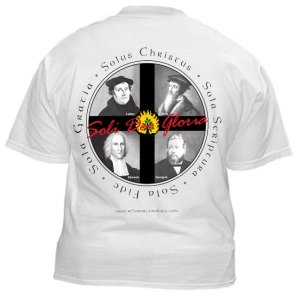
Tip of the iceberg! Other designs include each of these dead theologians alone, Credo, TULIP, simil justus et peccator. Click this image to see more.
The following is from the About Us page at Fort Worth’s Theological Pursuits Bookstore owner David Jacks’ new website, ReformationShirts.Com. Get yours today! I’ve got three of them myself.
About ReformationShirts.com
David Jacks, in 1995 while studying at SWBTS, circulated a shirt bearing the names and likenesses of Martin Luther, John Calvin, Jonathan Edwards and Charles Spurgeon. The shirt was affectionately known as the “Dead Theologians Society t-shirt.” Since that time, the “DTS” shirt has been re-vamped and has now taken the form of the shirt shown on this web site.
Reformation theology has played an important role in the history of Christianity. With the recent resurgence of Reformation theology, many adhering to the Doctrines of Grace search for ways to expose the world to their beliefs. This shirt “with a bunch of dead guys on the back of it” peaks the interest of onlookers and provides an excellent bridge for introducing these “dead guys'” Biblical beliefs.
About the Logo & Its History
The front of the shirt bears a likeness from the symbol of the 16th Century Protestant Reformation – a “burning bush” with the phrase “After Darkness, Light.” The “burning bush” symbol and the phrase were used by the Reformers to represent the light of the Gospel of Grace overcoming the darkness of the Law of Works propagated by the Roman Catholic Church in the centuries leading up to the Reformation.
The back of the shirt bears the names and likenesses of four of the best-known Protestant Reformers spanning a period of 400 years. A German monk named Martin Luther (1483-1546), whose heart was captured by the belief of Sola Fide (Faith Alone for one’s Justification), sparked the Protestant Reformation on October 31, 1517, when he nailed his 95 Theses to the door of the Cathedral in Wittenberg, Germany. Swiss theologian John Calvin (1509-1564) with his emphasis on God’s sovereignty and union with Christ, helped codify the teachings of the Reformation with his first edition of The Institutes of the Christian Religion in 1539. New England Puritan Jonathan Edwards (1703-1758), best known for his sermon “Sinners in the Hands of an Angry God” and his book Freedom of the Will, helped fan the spark of revival in The First Great Awakening and spread flames of salvation concerning the holiness and grace of God in America in the early to mid 18th century. Englishman preacher Charles Spurgeon (1834-1892) spread the Doctrines of Grace in the mid to late 19th century with his passionate and eloquent sermons on the sovereignty and grace of God.
These faithful men best symbolize in the Church’s recent history the beliefs summarized in the five Solas of the Protestant Reformation. These solas are found on the back of the shirt surrounding Luther, Calvin, Edwards and Spurgeon:
Sola Fide ~ Faith Alone
Sola Scriptura ~ Scripture Alone
Sola Gratia ~ Grace Alone
Soli Deo Gloria ~ Glory to God Alone
Solus Christus ~ Christ Alone
May you, too, be inspired and blessed by the truths conveyed on this shirt each time you wear it. And may your whole life be lived in loving obedience. Soli Deo Gloria – TO THE GLORY OF GOD ALONE!
Christology 101 by James White

Tuesday’s The Dividing Line podcast, by Reformed Baptist elder and apologist Dr. James R. White, features a 2 1/2 hour long discussion of the Christological controversies of the first several hundred years of church history. Today, churches by and large are negligent in informing their members on the facts of the church history. This makes the average Christian a viable target for informed unbelievers who are out to smear the truth of God’s infallible Word as it has been defended and preserved in the earthen vessels (2 Corinthians 4:7 KJV) of fallible servants of God and the church. Please take the time to listen to Dr. White’s summary of this important segment of Christian history warts and all, and share this with any believing friend who would benefit from the information that you think might actually listen to it. Click here to listen to “Christology 101”
Shooting Salvationist Author on Book-TV
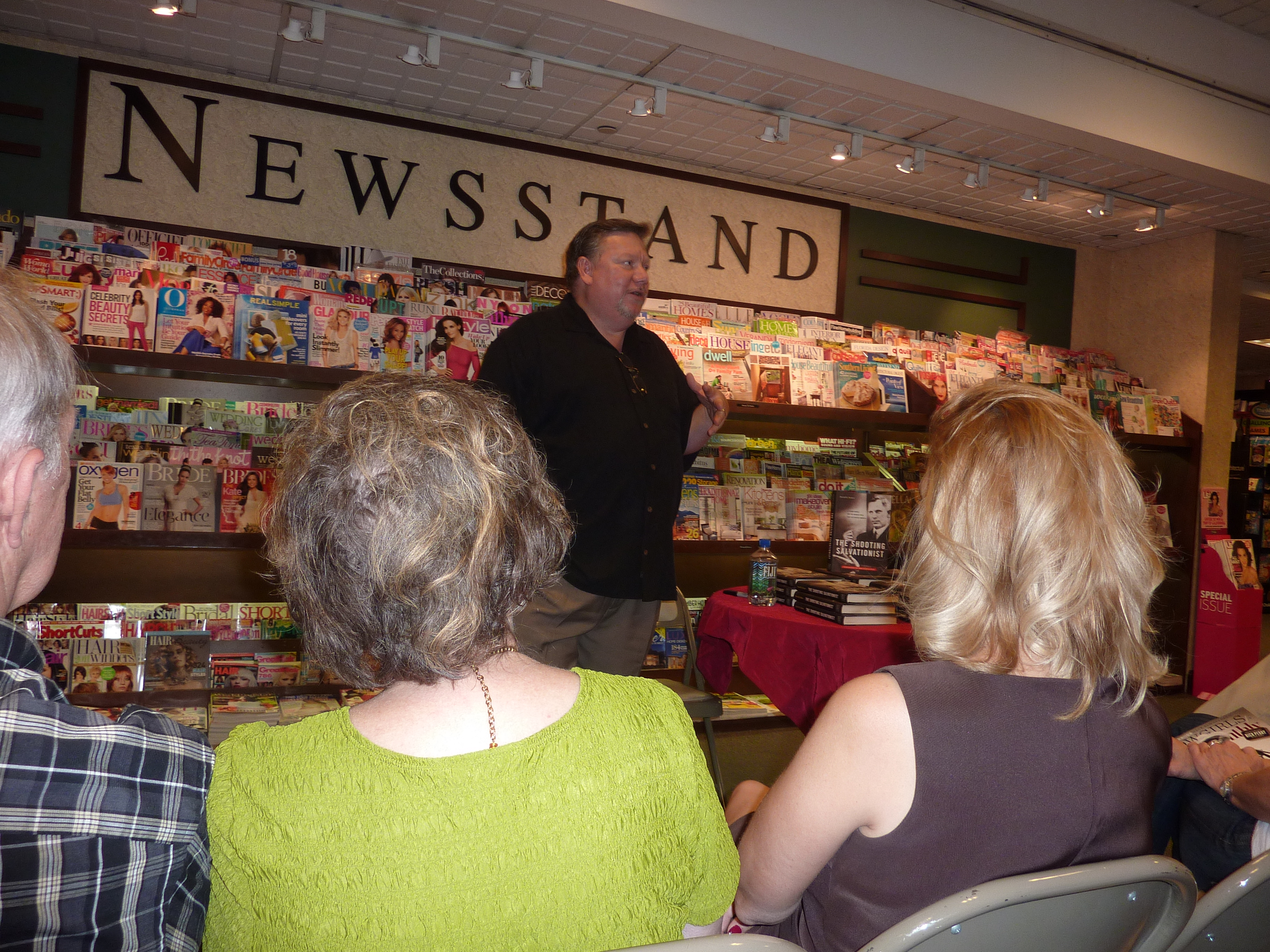
David R. Stokes speaks before his book signing at the Fort Worth Sundance Square Barnes& Noble two blocks from the site of Norris' shooting of Chipps
This weekend C-SPAN2 is airing a speech delivered by David R. Stokes, the author of The Shooting Salvationist: J. Frank Norris and the Murder Trial that Captivated America (©2011 Steerforth Press) at a recent book signing in Austin, TX. It played last night at 9pm (Eastern), it has replayed once this morning, but you can still catch it one final time this afternoon at 3pm (Eastern).
The program has already been added to the BookTV online archive, so it may be accessed there if you miss this afternoon’s showing.
Don’t forget to purchase your copy of The Shooting Salvationist at Amazon.com or from the book’s official website.
This Is No Texas Tall Tale
“J. Frank Norris Week” continues! Last night I joined David R. Stokes, author of The Shooting Salvationist: J. Frank Norris and the Murder Trial that Captivated America at the Fort Worth Sundance Square Barnes & Noble Bookstore, where he spoke for a few minutes before sitting down to sign books. The pictures in this post are from last night’s signing. The text is my semi-formal, though concise, review of the book, which has also been posted at the book’s Amazon.com page. As emotionally dependent as I have become on this book, it was hard for me to step back and write an objective review that is comparable to a professional, or at least experienced, reviewer’s work until I decided to recommend the book in an email to another writer, who shall remain nameless. I gave him the following summary, and decided that this is about as good a review as anyone’s ever going to get out of me. Hope you find it helpful, and feel free to help us spread the word about this story that has been gratefully recovered from historical obscurity.
David R. Stokes speaks before his book signing at the Fort Worth Sundance Square Barnes& Noble two blocks from the site of Norris' shooting of Chipps
David R. Stokes is a columnist for Townhall.com. He is also a pastor of a non-denominational church in Fairfax, VA. He studied for the ministry at the same Missouri Bible College from which the late Jerry Falwell got his Bachelors degree before he moved on to bigger and better things. This Bible College, Baptist Bible College, to be precise, has its roots in the ministry of the man who is the subject of the book he is now promoting, The Shooting Salvationist: J. Frank Norris and the Murder Trial That Captivated America (2011 Steerforth Press).
Norris was the pastor of the First Baptist Church of Fort Worth Texas between the years 1909 and 1952 (the year of his death). In the early years of his ministry, he ditched the tame, sane, responsible approach to ministry in which one makes an effort to get along with everyone, for an approach that would generate so much heat it would draw huge crowds to him so he could introduce them to the Light, if you know what I mean. In the process, he was a self-appointed thorn in the side of the underground liquor and gambling interests in Texas, the budding theological liberalism in his alma mater, Baylor, the mayor of Ft. Worth and Star-Telegram founder and all-around entrepreneur Amon G. Carter. This got Norris in hot water with one of the mayor’s friends, another Ft. Worth business leader, Dexter Elliot Chipps, who stormed into Norris’ office one day, threatened to kill him, then walked out. Chipps’ mistake was that he didn’t keep going. He turned for some unknown reason and attempted to reenter the pastor’s office and was met with three or four bullets in the chest. The resulting 1926 murder trial was as big of a media circus as Norris’ hero, William Jennings Bryan’s, recent Skopes Monkey Trial had been, or for those of us in the 21st century, Casey Anthony’s.

Yours truly (left); David R. Stokes (right)
The book is a narrative non-fiction work. It reads somewhat like a novel, but all the dialogue, and much of the narration, even, is directly lifted from his sources which include not only older bios of Norris (pro and con), but much of the most prominent journalistic accounts, legal transcripts and records, as well as personal archives of Norris, Meacham and Carter. The outrageous tactics of Norris in his early ministry make for quite a train wreck, and the history is fascinating, but for folks like myself who grew up in Fort Worth, it gives a lot of new information to an old legend that has lingered in the background of all of our lives, and provides quite a bit of closure as well. I’d like to share with you this fascinating tale that we could only wish were nothing more than a “Texas Tall Tale.”
Politics, Religion and a Gun

David Stokes’ interview with 90.1FM KERA host Krys Boyd on her D/FW local NPR talk show, Think with Krys Boyd, has been uploaded. You can listen to it here.
And so, J. Frank Norris week continues at The Misadventures of Captain Headknowledge! Just wait until tomorrow…
The Shooting Salvationist Author Comes to Ft. Worth

Make that "Wednesday, July 20" at the Sundance Square Barnes & Noble in Ft. Worth
Fairfax, Virginia Baptist Bible Fellowship local church pastor David Stokes grew up as a member of Detroit’s Temple Baptist Church, not twenty years after J. Frank Norris pastored that church at the same time that he pastored First Baptist Church in Fort Worth, Texas. In his day, Norris was known as the “Texas Tornado,” and the “Pistol-Packing Parson.” The memory of J. Frank Norris casts a long shadow for those whose lives were touched by his sensationalistic and controversial ministry. It must be as true for those like Stokes who grew up in the decades following Norris’ death, as it is for us down here in Fort Worth, who boast of relatives with stories of personal connections to the famous fundamentalist firebrand. For example, my own mother grew up playing with Norris’ grandson, George. He was my mother’s best friend’s boyfriend. My great-grandmother hosted the visiting preacher at her house, where lively discussions are said to have ensued between Norris and my great-great grandmother, charming them with the admission that “the only person who could ever change his mind was Mrs. Freeman.” Not only that, J. Frank Norris even performed the wedding ceremony for my son’s great-grandparents on his mother’s side. For better or worse, J. Frank Norris is one of the more colorful cast members in the dramatic history of Fort Worth, Texas. Featuring his battle with the Southern Baptist Convention over Baylor University’s teaching evolution and his own personal war against corruption in local politics as well as the Prohibition-era liquor trade itself, I’ve always said, even as a one-time devoted follower, that the life story of J. Frank Norris would make a great gangster movie!
It looks like the novel on which that movie could be based has just been written by David Stokes. The book is called The Shooting Salvationist: J. Frank Norris and the Murder Trial that Captivated America (©2011 Steerforth Press). The only difference is, Stokes’ story is more of a courtroom drama. But that’s alright with me. At 1pm Central time today, Stokes will be interviewed on the local NPR station, 90.1FM KERA on “Think with Krys Boyd.” (you can sign up for the podcast here if you miss it live). Tomorrow night, from 7:00 to 9:00pm Central time, Stokes will hold a book signing at Barnes and Noble in Fort Worth’s Sundance Square just a few blocks away from the site of FBCFW during Norris’ ministry (see my previous post). On his Facebook page, Stokes reports “apparently there will be some “protesters” on Tuesday night when I speak at the Barnes and Noble in Fort Worth — should be interesting.” You can get familiar with one of those potential protesters at The J. Frank Norris Historical Society, started a year ago by a former associate of Norris’, Roy Emerson Falls.
If you’ve never heard of J. Frank Norris, or if you’ve always known about him–love him or hate him, you’ll be both shocked and in awe of the story of J. Frank Norris and the trial that failed to sentence Norris the electric chair for the death of Dexter Elliott Chipps.
The Shooting Salvationist Released Today!

2011 Steerforth Press--Foreword by Bob Scieffer of CBS News
Join me next Wednesday night, July 20 at the Barnes and Noble in Sundance Square in Fort Worth to meet the author of The Shooting Salvationist, David R. Stokes, get his autograph and/or a pic. I’m planning to post a review of the book just as soon as I finish my Advance Reading Copy. Probably next week.
PS–As an added bonus, you’ll probably also get to meet Rev. Roy E. Falls of The J. Frank Norris Historical Society protesting out front. When Stokes met him last year, he said he was sweet. A good time should be had by all (with the possible exception of Rev. Falls)!
Date: Wednesday, July 20, 2011
Start Time: 6:00 pm End Time: 8:00 pm
(Time Zone: US/Central)
Location: Barnes and Noble – Sundance Square
Category: The Shooting Salvationist Book Tour
Description
Phone: (817) 332-7178
Contact: Debby White
Email: debby@theshootingsalvationist.com
More Info: http://store-locator.barnesandnoble.com/store/2788
Barnes and Noble – Sundance Square
401 Commerce Street
Fort Worth TX 76102
A True Presbyterian Hymnal for “A True Presbyterian Church”

1961 Edition of the Trinity Hymnal
One of the many factors that won me over to embrace Reformed theology and practice was the fascinating Trinity Hymnal (c. 1990). Back when I worked at what I endearingly call “The Reformation Station,” the print shop where God cornered me after years of on-again, off-again confrontation by the TULIP and other aspects of Reformed belief and behavior, I had the opportunity to print the bulletins for a local PCA church, which would include in its liturgy hymns selected from the Trinity Hymnal, printed in the bulletin, music and all! For this reason, there was a copy of the hymnal in the office, which they could use to prepare those bulletins, and which I could peruse from time to time and thereby enter the world of Reformed psalmody and English hymnody, and further tie my heart to my future spiritual and theological home in the Reformed tradition.
Due to my abundance of affection for the Trinity Hymnal, I was very pleased to notice that I wouldn’t have to wait long to learn its history in Daryl Hart’s OPC history, Between the Times: The Orthodox Presbyterian Church in Transition, 1945-1990 (c. 2011, The Committee for the Historian of the Orthodox Presbyterian Church). The reader of this volume is treated to the story of the hymnal in chapter two, under the simple title, “Trinity Hymnal, 1944-1961.” Here’s a synopsis of what you’re in for if you purchase Hart’s history.
In 1933, the PCUSA revised their hymnal, dropping 400 traditional hymns in favor of songs that reflect the liberalizing trend in the mainline denomination. J. Gresham Machen knew this was a problem. Reasoning from the old adage that the laity learn more theology from singing hymns than from systematic theology, he resolved that something had to be done about it. In the Lord’s providence, from the seed of this thought process on the part of Machen in response to the PCUSA’s threat to further corrupt the doctrine of rank and file Presbyterians, until the final publication of the Trinity Hymnal, a truly orthodox Presbyterian hymnal, 28 years would come and go. But what a glorious harvest of sound theology and biblical doxology would result from such a careful process of cultivation and fertilization.
With this opening anecdote, Dr. Hart surveys the history of American Presbyterian hymnals. Since the first one rolled off the press in 1831 there had been an average of one new hymnal per decade due to the number of controversies and divisions within the PCUSA between 1831 and 1961 (the date of Trinity Hymnal’s eventual publication). Although it would not be published under the auspices of the liberal mainline denomination, the Trinity Hymnal shares this common origin with its predecessors in the crucible of theological controversy. For this reason, it would be compiled with a commitment to aid the worship of the church in accordance with eternal truths, not contemporary trends.
American Presbyterians also produced so many hymnals so frequently because Reformed and Presbyterian practice regarding the Word of God sung as an element of corporate worship was undergoing a transformation from the Scottish and Dutch commitment to exclusive psalmody, to embrace the English hymnody of Isaac Watts, Charles Wesley and others, in order to better respond to the gospel of Christ in terms of the full revelation of Christ in both Testaments.
Much discussion among the members of the Committee on Song in the Public Worship of God over the propriety of this historic move away from the stance of earlier Reformed churches would consume a number of General Assemblies between 1944 and 1961. Dr. Hart reports for us the discussions between the “foreign” element of “psalm-singers” on the committee lead by the Scottish John Murray and his cadre of Scottish and Dutch dissenters and the more Americanized majority who would eventually prevail in the appropriation of English hymn into the practice of not only orthodox Presbyterians in general, but the OPC in particular.

1990 edition of Trinity Hymnal in three colors
With the conclusion of this discussion would arise more rubber-meets-the-road problems like financing the hymnal. We learn the various ideas considered and how the Lord would provide just in time, enabling them to pay off the loans obtained to supplement the giving of Orthodox Presbyterians toward this end, neither too soon, nor too late.
Finally, the reader is pleased to learn just how successful the hymnal was once it hit the market. There really was a need for just such a hymnal among many conservative Protestants outside the OPC.
Chapter two of Hart’s Between the Times is a joy to read, especially if you love the Trinity Hymnal as much as this reviewer does. But with the recent 78th General Assembly of the OPC, we learn that the work of compiling psalms, hymns and spiritual songs to aid the worship of the Reformed is to march forward as it was announced that the OPC will be teaming up with the URCNA to publish a new Psalter-Hymnal in the years to come. I believe there will be enough love in my heart for both of these hymnals to share!
How “Doctrinal Indifferentism” Leads to Works Righteousness
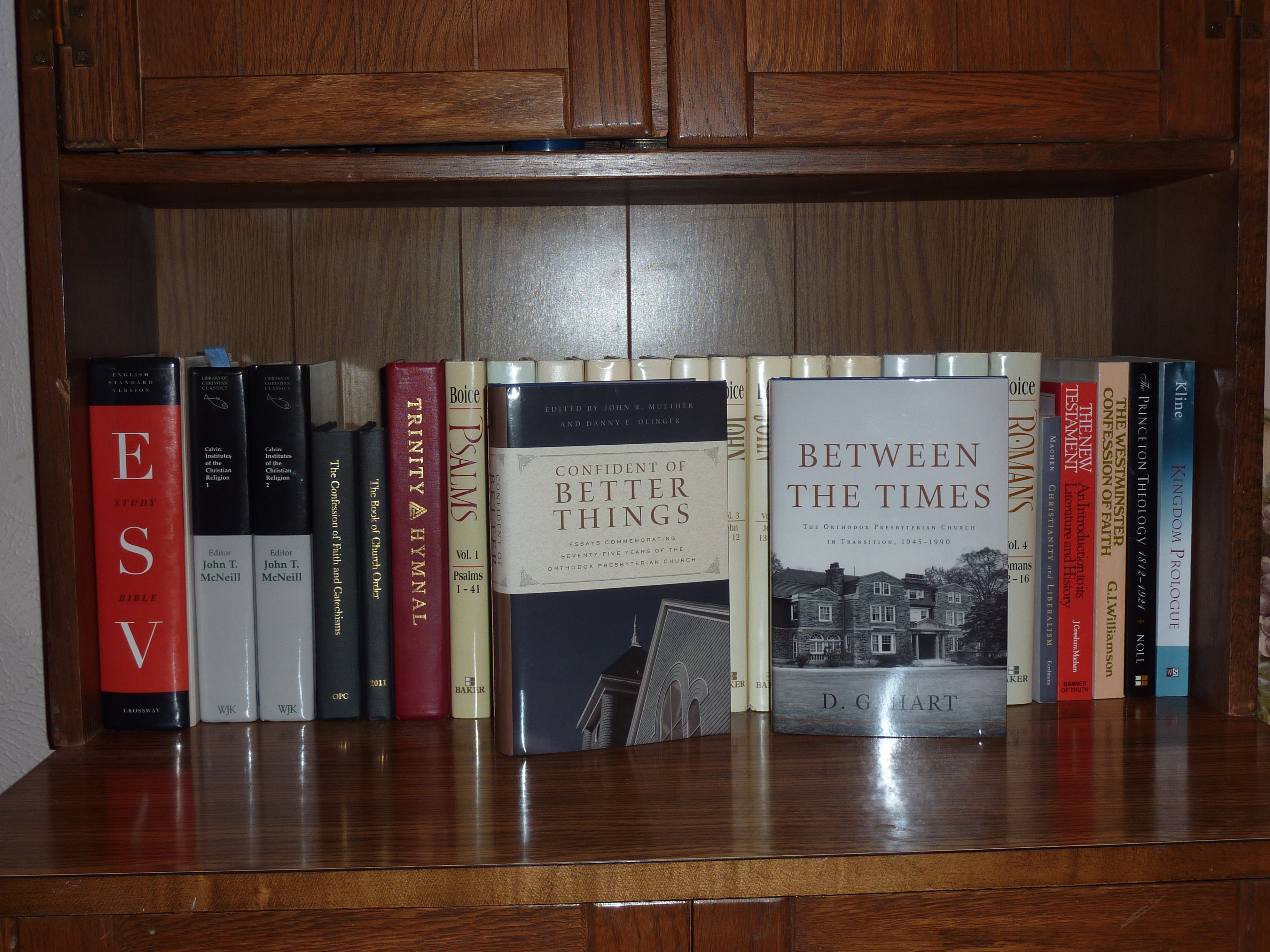
OPC 75 Titles--Confident of Better Things/Between the Times
Here’s a helpful paragraph from D. G. Hart’s new history of the Orthodox Presbyterian Church (OPC), released at the 78th General Assembly of the OPC two weeks ago in celebration of the OPC’s 75th anniversary. Here, Hart describes J. Gresham Machen’s reasons for objecting to Princeton Seminary President, J. Ross Stevensons proposal at the 1920 General Assembly of the PCUSA “for a grand plan to unite the largest Protestant denominations into one denomination” (p. 16). Hart writes:
The disadvantage of the plan for union, as Machen and most of his Princeton colleagues pointed out, was that by entering into a united church, Presbyterians would be abandoning those aspects of Protestantism that made them Presbyterian. If predestination, infant baptism, and Presbyterian polity, for instance, were actually revealed in God’s word as true and necessary for faithful witness, how could Presbyterians give away their teaching and practice to join with Baptists, Methodists, Lutherans, and Episcopalians in a generic Protestant church? The other problem with organic union, as Machen argued in a series of articles for church periodicals, was that it was based upon doctrinal indifferentism. Union turned away from serious doctrinal and ecclesiastical differences among Protestants and implied that these were less important than the greater good that a united church could achieve by transforming American society. Opposition to this sort of ecumenism, which was directly linked to the Social Gospel’s goal of ushering in the kingdomof God, was precisely the impetus for Machen’s important book, Christianity and Liberalism (1923). Not only did he argue that Christianity and liberalism were two different religions, and so liberalism needed to be excluded from the church. Machen also showed how American Protestant interdenominational cooperation stemmed from an indifference to Christian teaching and so distorted the gospel into a message of works righteousness.
D. G. Hart, Between the Times: The Orthodox Presbyterian Church in Transition, 1945-1990 (2011, The Committee for the Historian of the Orthodox Presbyterian Church,Willow Grove,PA), pp. 16-17. opc.org/publications.html Check out Hart’s blog, Old Life: Reformed Faith and Practice.
Confessional Creationism
In all my searching and discussing the issue of the interpretation of the days of creation in Genesis 1, Google directed me to a statement from Westminster Theological Seminary declaring the results of their research into the history of how this issue has been treated by the leaders of the Augustinian and Reformed traditions going all the way back to Augustine himself. The statement is called, “Westminster Theological Seminary and the Days of Creation.“
The discussion among Presbyterians revolves around the reasons the Westminster Divines selected the language they did in when they framed the chapter on Creation in the Westminster Confession of Faith. The phrase in question will be highlighted in the following citation:
I. It pleased God the Father, Son, and Holy Ghost, for the manifestation of the glory of His eternal power, wisdom, and goodness, in the beginning, to create, or make of nothing, the world, and all things therein whether visible or invisible, in the space of six days; and all very good.
The question is raised as to why the wording “in the space of six days.” Why not simply “in six days”? The statement explains:
“The paraphrase view is doubtful because if the Standards had intended simply to utilize biblical language, “in six days” would have sufficed and been a more natural choice. The words “the space of,” as the other view above recognizes, seem deliberately chosen as an interpretive or clarifying addition that functions both to affirm and to exclude or negate.
To make the long story short, the statement concludes that the divines intended to exclude Augustine’s view that God created everything instantaneously inspiring the six days, as Calvin described the view (which he did not hold), “for the mere purpose of conveying instruction.” You can read more about this discussion in the statement itself. You can link to it from the title above, and I have also added a link to the page on my “Recommended Sites” page for future reference.
Finally, here’s a quote that sums up the entire issue as they see it. I find it rather helpful:
With Augustine and E. J. Young, the revered teacher of our senior faculty members, we recognize that the exegetical question of the length of the days of Genesis 1 may be an issue which cannot be, and therefore is not intended by God to be, answered in dogmatic terms. To insist that it must comes dangerously close to demanding from God revelation which he has not been pleased to bestow upon us, and responding to a threat to the biblical world view with weapons that are not crafted from the words which have proceeded out of the mouth of God.
What’s the Difference?
What’s the difference between the Jesus People of the 1970’s and the Postmodern Liberals of the Twenty-First Century?

Don’t Engage in Anabaptist Handwringing Over Osama bin Laden
There is quite a debate underway online regarding how Christians should respond to the death of Osama bin Laden. Are we to rejoice over the justice in the death of one who is responsible for the deaths of tens of thousands, most notably the three thousand souls lost on September 11, 2001? Or are we supposed to so major on the fact that “God is not pleased by the death of the wicked” (Ezekiel 33: 11 ) that we should stoically stand by and not “rejoice with those who rejoice,” even though we’ve been previously weeping with them (Romans 12:15)?
The book of Proverbs does read, “When it goes well with the righteous, the city rejoices, and when the wicked perish there are shouts of gladness” (Proverbs 11:10). Furthermore, “When justice is done, it is a joy to the righteous, but a terror to evildoers” (Proverbs 21:15). Methinks the instinct to worry about being too happy over Osama bin Laden’s death is a reflection of the influence of Anabaptist pacifism. It’s pervasive in Western Christianity nowadays. Try not to let it unduly influence you. For an example of what I mean, compare this blogger’s dilemma over how to react. Should he listen to the Anabaptist on the one shoulder, or the red-blooded American patriot chanting “U-S-A!” on the other? That he attributes his angst over the death of a mass-murdering terrorist to Anabaptism shows how this is the application of Anabaptist pacifism. For you Star Wars fans, remember Alderaan? They were a peaceful planet with no weapons, weren’t they? Look what happened to them.
While it is regrettable that Osama bin Laden never repented of his sins and trusted Christ for salvation from sin and the wrath of God—none of us are glad because he’s now suffering eternal conscious torment in hell. We’re relieved with the loved-ones of bin Laden’s and al Qaida’s victims that justice is served. There is no contradiction here.
At Underdog Theology, Warren Cruz takes the approach that our deceitfully depraved hearts may take us down the slippery slope of rejoicing in bin Laden’s eternal destiny though we intended to only rejoice in the temporal justice in his demise. Be that as it may, I’m inclined to take Luther’s approach (HT: Wikiquote):
If you are a preacher of mercy, do not preach an imaginary but the true mercy. If the mercy is true, you must therefore bear the true, not an imaginary sin. God does not save those who are only imaginary sinners. Be a sinner, and let your sin be strong (sin boldly), but let your trust in Christ be stronger and rejoice in Christ who is the victor over sin, death and the world. We commit sins while we are here, for this life is not a place where justice resides. We however, says Peter (2 Peter 3:13), are looking forward to a new heaven and a new earth where justice will reign.
Letter 99, Paragraph 13. Erika Bullmann Flores, Tr. from:Dr. Martin Luther’s Saemmtliche Schriften Dr. Johann Georg Walch Ed. (St. Louis: Concordia Publishing House, N.D.), Vol. 15, cols. 2585-2590
In other words, don’t let the fact that you may imperfectly rejoice in the justice of bin Laden’s death keep you from so rejoicing. Christ’s perfect righteousness covers the imperfect righteousness of those who trust him.
U-S-A! U-S-A!
Update: For a tad more balanced and scholarly approach to making the same point, try Michael Horton writing for Christianity Today today in “The Death of Osama bin Laden: What Kind of Justice Has Been Done?” Here’s the second of Horton’s three implications of the so-called Reformation doctrine of the Two Kingdoms as it relates to the only event in today’s headlines:
Second, it means that we cannot rejoice in the death of the wicked any more than does God (Ezek. 18:23). We may take satisfaction that temporal justice has been served, but Christians should display a sober restraint. When Christ returns, bringing infinite justice in his wake, his saints will rejoice in the death of his enemies. For now, however, he calls us to pray for our enemies, even for those who persecute us (Matt. 5:44). This is the day of salvation, calling sinners to repent and believe the gospel. We may delight in the temporal justice shown to evildoers, but leave the final justice to God. (HT: Riddleblog).
Misadventures in Fundamentalism
2011 Steerforth Press--Foreword by Bob Scieffer of CBS News
The following is best read aloud in a booming announcer voice 😉
Allow me to introduce you to the book I’ve been anticipating most for the past year–The Shooting Salvationist: J. Frank Norris and the Murder Trial That Captivated America (2011, Steerforth Press–Distributed by Random House. Foreword by Ft. Worth native Bob Schieffer of CBS News). Perhaps you’ll recall how last year I went on and on about a book about J. Frank Norris‘ murder trial. Well, that caterpillar quickly entered its cocoon and the butterfly is soon to be released! July 12 is the scheduled date for Pastor David Stokes’ thorough narrative non-fiction work on one of the most colorful fundamentalists of the early 20th century.
A rising star in the Southern Baptist Convention, J. Frank Norris resolved to spread God’s Word in a populist and sensationalist manner–taking on every villain, real or perceived, that crossed his path–doing battle royal in the most public manner as he could to make a big name, not only for himself, but also for the Savior whose cause he strove to promote. Norris’ tactics however, epitomized the very definition of “misadventure.” A burr in the saddle of local Fort Worth, Texas powerful elites, a sworn enemy of the “liquor interests” and self-appointed defender of the faith against the liberalizing tendencies at his alma mater, Baylor University, almost all agree that J. Frank Norris generated more heat than light. The growing crescendo of sensational exploits on these and other fronts would culminate in devastating tragedy and make headlines across the country when Norris shot an infuriated opponent to his death.
The murder trial of J. Frank Norris in the 1920’s was literally the “OJ Trial” of that generation. A relentless media circus hung on every detail of the trial as they kept the country buying paper after paper to learn the fate of this ambitious religious ringleader. You’ll never believe that a story like this is true. You simply have to read it for yourself!
The Shooting Salvationist: J. Frank Norris and the Murder Trial That Captivated America is available for pre-order at the book’s new website. I’ll also be adding The Shooting Salvationist Blog to my blogroll so we may all keep up with it.


 The Misadventures of Captain Headknowledge
This Just In! Blind Squirrel Finds Nut!
To fully understand this passage, one must read the entirety of chapter one. The literary structure can be summarized simply using our key term “dominion.” God created kingdoms: outer space, the sky, the sea, and the land; then God created three kings to exercise “dominion” in each “kingdom”: celestial bodies, birds, sea life of every kind, and the race of Man. There is a progressive significance in this creation week, with the creation of Man as the climax.
With God’s creation of Man, he gives him a vocation: fill the earth, subdue it, and take dominion over the lesser forms of life. Man lives on the earth as a kind of vice-regent of God.
This passage is applied in many ways by many people, but it can be reduced to something more or less like this. God created Man, then he gave him something to do. How this idea has been applied varies according to the theological tradition to which the believer subscribes.
Throughout the middle ages, Roman Catholic traditions drove a wedge between the sacred and the secular in such a way that those who were inclined to a vocation of church ministry were seen as inherently superior to everyone else in the ordinary, profane occupations that seemed anything but spiritual. There were priests who worked for God (good), everyone else worked for the world (not so good).
In the sixteenth century, the Protestant Reformers recovered the biblical truth which they called “the priesthood of the believer.” This doctrine emphasized the fact that Christ was the High Priest who mediates between God and Man, and all believers, ordained minister or not, are priests who may now approach God and offer spiritual sacrifices on the basis of Christ’s mediation and intercession. But the Reformers didn’t leave this truth at this point. Application of the priesthood of the believer was made to every aspect of his life. In short, what are his responsibilities? That is his ministry. This idea brought a renewed dignity to labor and developed what is known as the Protestant work ethic. This work ethic taught each believer-priest to work for the glory of God and the good of his neighbor in whatever way his interests, skills and opportunities allow. Much of the productive, technological and industrial development in the modern world finds part of its roots in this Protestant work ethic, which influenced Western culture for the better.
As the centuries wore on, this truth became less and less clear, and Christians became less aware of the spiritual significance of their secular vocations, and the work ethic largely fell by the way side. While historic orthodox Protestants retained this doctrine at least in their theological volumes, if not always preached and lived in their lives, but others kept it in mind, working for the glory of God in their own personal way as the Reformation doctrine of vocation went largely neglected.
In the great cultural shift that took place in the 1960’s, some Protestant ministers, notable among them, Francis Schaeffer, sought ways to recover this truth by encouraging Christians to “engage the culture,” in order to be used by God to once again be the “Light of the World” and “The Salt of the Earth,” in other words, Christians whom God may use to bring glory to God by enlightening their neighbors to the Light of the truth which is in Christ, as well as by being a benefit to their neighbors in their work and their service.
In the decade of the seventies, a few ministers in the charismatic movement had a similar desire to encourage their congregants and the church at large to live more consistently and more visibly as Christians in a sinful world. They, too, had a sense that evangelical Christians had largely ceased being influential members of society, and wanted to do something about it in their way, according to the understanding of their theological tradition. To put it inelegantly, I consider these efforts by Schaeffer and these charismatics, among others as blind squirrels who found a nut, as the old saying goes. The “nut” being some concept of the historic doctrine of vocation.
Fast forward to 2011. This desire to glorify God and serve and evangelize their neighbors becomes misinterpreted by the Left Wing of the American political system as efforts to “take dominion” over the federal government of the United States and establish a theocratic form of government. Looked at in this light, now, doesn’t it sound silly?
Now let’s engage in a comparative study. First read Lutheran journalist and blogger, Edward Gene Veith’s blog post “Vocation as the Christian Life,” and learn more about Luther’s doctrine of vocation and how it ought to be applied in this generation. Then watch the following video posted at www.the7mountains.com and see if you can detect similar motives. Then stop listening to reactionary political Leftists who think those crazy extremist Right Wing Christians are out to overthrow the government and start stoning adulterers and burning witches.
Share this: