Memoir of the Rev. John Brown, part 1
Brown’s Self-Interpreting Bible (1859) contains an extensive biography of the editor. It’s a great story, but it’s going to take quite a while to get the entire thing transcribed and posted. In the meantime, I’ll be mixing it up a little with other features from my new favorite study Bible. The author of this biography is not credited. But you can download Robert Mackenzie’s 1918 biography, John Brown of Haddington, in a 178 page PDF file from Still Waters Revival Books for 99 cents at this link.
The REV. JOHN BROWN was born in the year 1722, at Carpow, a small village in the parish of Abernethy, and county of Perth. His parents ranked in that class of society who earn their bread by the sweat of their brow. His father could boast of no rent-rolls, nor had he any title of honour, save that of an honest man and an industrious mechanic, who, during the greater part of his life, laboured in the profession of an operative weaver. Though destitute of all the advantages arising from a regular education, he was nevertheless a man of considerable intelligence, moral worth, and Christian sincerity. He made conscience of keeping up the worship of God in his family, and set a Christian example before them, though living in a neighbourhood remarkably careless of these things. His external circumstances were so narrow, that it was little he could afford to promote the intellectual improvement of his son; so that the subject of this momoir found his situation in this respect but little superior to that of his father. He was sent to school; but the time allowed him to acquire the elements of reading, writing, and arithmetic, was so very short, that nothing but an excellent genius, and the most intense application, could have enabled him to attain the ordinary education of the lowest orders in the country. This, however, with one solitary month which he bestowed on the Latin, and that without the consent of his parents, appears to have been all the regular education he ever received, till we find him studying philosophy and divinity under the superintendence of the Rev. Ebenezer Erskine and James Fisher. It does not appear that his father ever intended him for the church, or even contemplated the possibility of his accomplishing such a design; though the strong propensity of his mind to learning, and particularly to that species of learning the nearest allied to divinity, seems to have suggested to his mother the possibility, that the day might come when his literary predilection might find room for its gratification in the service of the church; and often and again has she pictured to herself that happy day, when her darling child should emerge from his obscurity, clothed in the emblems of the most honourable employment—an ambassador of the Prince of Peace. In the mean time, his personal piety, the most important of all the prerequisite qualifications for an office so sacred, afforded her the lively hope that his labours, should her ardent wishes be ever realized would not be in vain in the Lord. In a short narrative of his experiences written by himself, Brown acknowledges the delight which he had while at school, in committing to memory the Catechisms of Vincent, Flaw, and the Westminster Assembly; and the profit he afterwards derived while yet a boy, from the perusal of the Bible, Rutherford’s Letters, and Gouge’s Directions how to Walk with God, His God was preparing him inconsciously for the service of Christ. He had separated him from the womb, and was even now calling him by his grace, (Gal. i. 15.) that he might reveal his Son in him, and send him to preach. In the same memoir he records the solemn impressions made on his young mind, by witnessing the dispensation of the Sacrament, and listening to the addresses delivered during the service; and, from his experience of profit argues against the impropriety of excluding children from witnessing a service so calculated to engage the affections. This exclusion appears to have been practiced in the Church of Scotland at the commencement of last century; and was perhaps a remnant of Episcopal feeling, remaining after the restoration of Presbytery. “About the eighth year of my age,” says he, “I happened, in a crowd, to push into the church at Abernethy, on a sacrament Sabbath. Then it was common for all but intended communicants to be excluded. Before I was excluded I heard one or two tables served by the minister, who spake much to the commendation of Christ, which in a sweet and delightful manner so captivated my young affections, as has since made me think that children should never be kept out of the church on such occasions.”
“Bunyan, Brown and Boston”

John Brown's Self-Interpreting Bible (1859)
“For now I’m grown sae cursed douce
I pray and ponder butt the house;
My shins, my lane, I there sit roastin’,
Perusing Bunyan, Brown, an’ Boston,”
These lines are from a Robert Burns poem of 1789 entitled, “Epistle To James Tennant of Glenconner.” (The rest of his poetry is linked to from this page) The final line of this excerpt features the names of three figures from church history: John Bunyan, John Brown, and Thomas Boston. This poem references these writers in passing, highlighting what household names these three were in the eighteenth century.
Many of us are already familiar with the first, John Bunyan, seventeenth century Baptist preacher, who penned Pilgrim’s Progress during a twelve year sabbatical in jail. The third figure, Thomas Boston, may be less familiar nowadays, but he still has currency among readers within the Reformed tradition. He’s the author of The Fourfold State of Man. But the least familiar of these to modern Americans (perhaps even most Presbyterian and Reformed Americans) is the second figure, the Reverend John Brown of Haddington. The volume that elevated John Brown to household name status was his then-widely read Self-Interpreting Bible. Originally published in 1778, it went through at least 26 known editions.
 I recently came into possession of the 1859 edition. It’s in very good shape, and I hope I’m able to preserve that condition as I regulary mine it’s pages for it’s amazing lithographs and it’s even more amazing Reformed study notes, devotional applications and indices. I found it at a local antique store, and purchased it for my wife (and, of course, myself) as a gift for a significant milestone birthday that shall remain confidential. This is an appropriate gift for her because we share a love of old books and lithographs. The extensive study notes are more of interest to me, but she enjoys listening to them as I read them aloud to her on occasion.
So far, I’ve found little online about the book, but there was one very informative article that will make many of you desire along with me that this Reformed study Bible would find a publisher that would reintroduce it to the modern world during this period of renewed interest in Reformed theology. Since I’m not a publisher, and since this book is so old it’s bound to not be under any copyright restrictions, I’ll begin posting freely from it from now on for who knows how long. There’s so much wonderful material in here that I want to share with you, so subscribe to this blog either by email or RSS feed, and keep up with every entry. I know I’m not the most regular blogger, but now that I’ve got an antiquarian Bible full of stuff you’ve likely never read, I’ll be doing so more regularly.
The article “John Brown’s Bibles” may be read at this link; John Brown of Haddington’s Wikipedia entry may be read here, but I’ll be posting even more detailed biographical information about him in the days and weeks to come from the pages of his claim to fame. Banner of Truth Trust sells Life of John Brown with Select Writings.
If you browse through online Reformed booksellers, you will encounter a later theologian named John Brown who wrote many exegetical commentaries. I ordered his commentary on Galatians recently thinking it was the Brown of Haddington, only to be disappointed upon its arrival. But that’s alright, it looks like it’ll be a useful help itself. You can read an interesting article about the later John Brown here.
WHI on the Effects of eDistraction
This week’s episode of the White Horse Inn radio show featured an interview with Grove City College Media Ecology professor T. David Gordon. Gordon is the author of two books that are of special interest to this blogger and will be hopefully to his readers also. The books are Why Johnny Can’t Preach (2009) and Why Johnny Can’t Sing Hymns (2010).
Why Johnny Can’t Preach is “an analysis of shifts in dominant media forms and their effects on the sensibilities of the culture as a whole. Many of those shifts have profound, and unfortunate, effects on preaching.” About Gordon’s newer book, Why Johnny Can’t Sing Hymns, the publisher’s website has this to say:
Changes in music have affected the way we think, the way we worship—even the way we are able to worship. We are steeped in a culture of pop music that makes other genres seem strangely foreign and unhelpful. Worship has become a conflict area, rather than a source of unity.
T. David Gordon looks at these changes in worship and not only examines the problems, but also provides solutions. They are solutions of great importance to us all—because how we sing affects how we live. Dr. Gordon not only shows the problems, he also provides solutions – it’s important, because how we sing affects how we live.
The White Horse Inn blog has also posted additional resources on the current phenomenon of media distraction and its effect on our minds, as Christians or otherwise, let alone culture at large (see blogpost here).
Get A Copy While You Still Can!
Apparent Danger author, David Stokes, has posted that his great new book about J. Frank Norris is now being picked up by Random House Publishers to be released next year, possibly under a different title. Now it’s time for him to move some merchandise. These original editions may just be collectibles some day. They certainly are for some of us here in Fort Worth, Texas. Read all about it over at his blog.
Jesus Storybook Bible as a bible study material (via Mission NPIC)
The next time you’re in a Christian bookstore, see if you can find this book on their shelves. If so, look through it and you’ll see why this story makes perfect sense. I recall seeing a blogpost back when this book was first published that quoted the author’s pastor, Tim Keller, as saying that every pastor should read this book, because it would improve their preaching. It really is true!

via Mission NPIC
Meet the Godfather of Fundamentalism, J. Frank Norris
Fairfax, Virginia Baptist Bible Fellowship local church pastor David Stokes grew up as a member of Detroit’s Temple Baptist Church, not twenty years after J. Frank Norris pastored that church at the same time that he pastored First Baptist Church in Fort Worth, Texas. In his day, Norris was known as the “Texas Tornado,” and the “Pistol-Packing Parson.” The memory of J. Frank Norris casts a long shadow for those whose lives were touched by his sensationalistic and controversial ministry. It must be as true for those like Stokes who grew up in the decades following Norris’ death, as it is for us down here in Fort Worth, who boast of relatives with stories of personal connections to the famous fundamentalist firebrand. For example, my own mother grew up playing with Norris’ grandson, George. He was my mother’s best friend’s boyfriend. My great-grandmother hosted the visiting preacher at her house, where lively discussions are said to have ensued between Norris and my great-great grandmother, charming them with the admission that “the only person who could ever change his mind was Mrs. Freeman.” Not only that, J. Frank Norris even performed the wedding ceremony for my first wife’s grandparents. For better or worse, J. Frank Norris is one of the more colorful cast members in the dramatic history of Fort Worth, Texas. Featuring his battle with the Southern Baptist Convention over Baylor University’s teaching evolution and his own personal war against corruption in local politics as well as the Prohibition-era liquor trade itself, I’ve always said, even as a one-time devoted follower, that the life story of J. Frank Norris would make a great gangster movie!
It looks like the novel on which that movie could be based has just been written by David Stokes. The book is called Apparent Danger: The Pastor of America’s First Megachurch and the Texas Murder Trial of the Decade in the 1920’s. Just a couple of weeks ago, Stokes held a book signing at Barnes and Noble just a few blocks away from the site of FBCFW during Norris’ ministry. On his Facebook page, Stokes reports that about a hundred people turned out for a book and an autograph, and even an unnamed “very nice” 91 year-old former associate of Norris protested his book by passing out a pamphlet with the title “The Real J. Frank Norris.”
My only regret is that I first heard about the book the day after the signing. But now I have my copy, and I’m currently reading it aloud to my wife so that we might enjoy it together. Enjoying it, we are. I let Bob Hayton of the blog Fundamentally Reformed know about it, and he said he plans to review the book on his blog after he reads it, to which I will dutifully link you when it’s posted. But in the meantime, allow me to whet your appetite for the book with the following trailer. If you’ve never heard of him, or if you’ve always known about him–love him or hate him, you’ll be both shocked and in awe of the story of J. Frank Norris and the trial that failed to sentence Norris to “Sparky,” the state of Texas’ newly acquired electric chair for the death of D.E. Chipps.
Tullian’s “Unfashionable” Book Tour
 The new pastor of Coral Ridge Presbyterian Church, Rev. Tullian Tchividjian (last name rhymes with “religion”), is making the rounds promoting his book, Unfashionable. Last week, he appeared on James Robison’s television talk show along with his wife, Kim.
This show is filmed not five miles from my house, but I missed when they were in town for the shooting several weeks ago, otherwise, you probably would have been able to spot my wife and me in the audience. Guess I need to put my name back on the Life Today email list so I’m prepared when people I’ll actually want to see are in town. It doesn’t happen often, but it does happen.
The episode was broadcast last week, but you can view it online here, and read about it at Tchividjian’s own blog here. Also, here’s the search results for “unfashionable” at his blog which lists the posts that contain more about the book.
It turns out that this Unfashionable author’s interview with the White Horse Inn was this Sunday morning as well. You can listen to this more in-depth interview here.
You can read about the book at the Multnomah Books website here.
On the Robison show, Tchividjian cites an anecdote from the life of his legendary grandfather, Billy Graham, who back in the 1950’s was approached by a Hollywood celebrity who gave him the kind of advice about which his grandson now writes. The celebrity told Graham: “Don’t ever try to do Hollywood, because Hollywood will always do it better than you. You give this world the one thing Hollywood can’t–the timeless truth of the Gospel.” That’s similar to one of my mottoes: Leave the entertainment to the entertainers, and leave the ministry to the ministers. The church and the world will both be the better for it.
John Calvin: From the Institutes to Geneva
The following is part 2 an excerpt from Presbyterians: Their History and Beliefs, by Walter L. Lingle (1950, John Knox Press). Read part one here.
Publishes His Institutes. In the spring of 1536, Calvin published a profound little book on theology, which he named The Institutes of the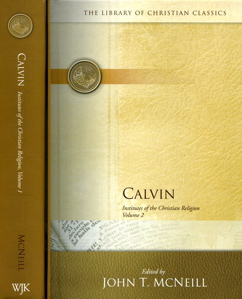 Christian Religion. Today we would call it a book on systematic theology. The book created a real sensation, and theologians knew that a new star of the first magnitude had arisen on the theological horizon. Calvin kept on revising this little book for the next twenty-three years, until it grew into two large volumes. He lived to see this work translated into practically every language of Europe. Theologians still study and refer to “Calvin’s Institutes.”
Find His Life Work in Geneva. John Calvin was only twenty-seven years of age when he published his Institutes, but from that time on he was a marked man. The publication of that book probably determined his life work. It came about in this way. As the persecutions of Protestants in France grew more severe, Calvin decided to leave France and pass over into the Protestant part of Germany. The safest journey was through Switzerland. So one hot night in August, 1536, he pulled up at an inn in Geneva to spend the nigh expecting to continue on his journey the next day. But God had other plans for him.
William Farel, a fiery Protestant with red hair, glittering eyes and a thunderous voice, had begun Christian work in Geneva in 1532. Under his preachng a great deal had been accomplished. He had blasted away the debris of centuries and laid the foundation for real constructive leadership. When Farel heard that John Calvin, the author of the Institutes, was in Geneva, he felt that he had come to the kingdom for such a time as this. So he sought him out and invited and implored him to remain in Geneva and help him. Calvin begged to be excused that he might continue on his journey and devote himself to his studies.
Let Calvin tell the rest of his story as recorded in the Preface to his Commentary on the Psalms: “Then Farel, finding he gained nothing by entreaties, besought God to curse my retirement and the tranquility of my studies if I should withdraw and refuse to give assistance when the necessity was so urgent. By this imprecation I was so struck with terror that I desisted from the journeyI had undertaken, but being sensible of my natural timidity, I would not bring myself under obligations to discharge any particular office.” So John Calvin, who had planned to spend only one night in Geneva, spent the rest of his life there, with the exception of about three years which he spent in exile in Germany.
Wake Up, America!
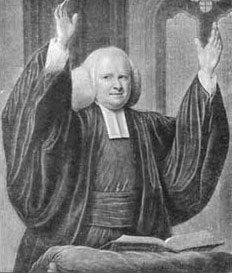 Read Burk Parson’s Tabletalk Magazine article, “A Sower Went Out To Sow . . . ” in which you will be introduced to George Whitefield, the great Calvinistic Methodist evangelist who, along with Jonathan Edwards (of “Sinners in the Hands of an Angry God” fame–aka, “the theologian of revival“), and John Wesley, for whom “the world [was his] parish,” with his earnest and sometimes blunt preaching, was the agent of God in the First Great Awakening.
As I read Parson’s article, it occured to me that I’ve heard evangelicals praying for and even “claiming” revival all of my life, with little to show for it, but a few enthusiastic excesses on the fringe of the charismatic movement. Considering the cultural climate in which we now live, perhaps God is bringing the American people to a greater place of hunger and thirst after righteousness. Pray for revival as we are all providentially confronted with some harsh economic and cultural realities. But, lest another explosion of error results, pray for reformation along with revival. Revival without reformation will bring spiritual life, but can also spread doctrinal error; reformation without revival will improve the church’s theological integrity whether or not spiritual integrity accompanies it. Reformation and revival is what America desparately needs.
The Truth About “Angels & Demons”
This weekend, the companion to The DaVinci Code, called Angels & Demons, hit the theaters. Just a few days before the movie came out, some scholars from Westminster Theological Seminary in Philadelphia, Pennsylvania, announced their website called “The Truth About Angels & Demons,” devoted to addressing the issues raised by Dan Brown’s book and the new movie based thereon. You may have noticed there has not been nearly the controversy swirling around this movie, but that doesn’t mean the story doesn’t distort the truths with which it deals. Hence the concern that, in this generation in which many people learn their history, science and theology from novels and movies, often accepting uncritically that which they read and watch, inaccuracies be corrected on a popular level.
In addition, Dr. Peter Lillback, one of the men behind the website, was interviewed on Issues, Etc., introducing the website and discussing some of the issues dealt with on the site. These issues range from the true identity of the historical secret society called the Illuminati to the conflict between science and religion, to the reason this film hasn’t been quite as controversial as the last. You can listen to this interview here.
Dr. Peter Lillback is a professor of historical theology at Westminster Theological Seminary, and is the author of The Binding of God, Lessons on Liberty: A Primer for Young Patriots, Wall of Misconception: Does the Separation of Church and State Mean the Separation of God and Government?, and George Washington’s Sacred Fire.
Jesus Christ: Sinless Man/Eternal God
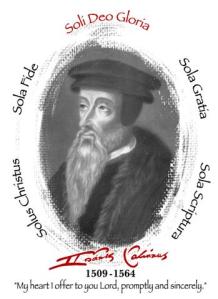
Get this on a t-shirt from reformationshirts.com!
Here’s a follow-up on my series of posts on “Compromising the Full Humanity of Christ” which dealt with the “heavenly flesh of Christ” heresy. In my reading through Calvin’s Institutes in commemoration of his quincentenary, I recently got to a passage in which he deals with this very issue, which he indicates that it predates Anabaptism, tying it to Manichaeism. Let’s read Calvin himself on this . . .
Indeed, the genuineness of his human nature was impugned long ago by both the Manichees and the Marcionites. The Marcionites fancied Christ’s body a mere appearance, while the Manichees dreamed that he was endowed with heavenly flesh. But many strong testimonies of Scripture stand against both (Book 2, chapter 13, section 1)…Marcion imagines that Christ put on a phantasm instead of a body because Paul elsewhere says that Christ was “made in the likeness of man . . . . being found in fashion as a man” (Phil. 2:7-8)…Mani forged him a body of air, because Christ is called “the Second Adam of heaven, heavenly” (1 Cor. 15:47) (Book 2, chapter 13, section 2).
You can read summaries of both of these sections at “Blogging the Institutes” from Reformation21.org, just follow the links in the two parenthetical references in the excerpt above.
Finally, in section 4, Calvin concludes his defense of the biblically orthodox view of Christ’s full humanity (which accords with the Definition of Chalcedon), explaining how it is that Christ’s human nature could be identical to our human nature without original sin–for Calvin, it’s simple, the Holy Spirit sanctified his human nature:
The absurdities with which they wish to weigh us down are stuffed with childish calumnies. They consider it shameful and dishonorable to Christ if he were to derive his origin from men, for he could not be exempted from the common rule, which includes under sin all of Adam’s offspring without exception. But the comparison that we read in Paul readily disposes of this difficulty: “As sin came in . . . through one man, and death through sin . . . so through the righteousness of one man grace abounded” (Rom. 5:12, 18). Another comparison of Paul’s agrees with this: “The first Adam was of the earth, and earthly and natural man, the Second of the heaven, heavenly” (1 Cor. 15:47). The apostle teaches the same thing in another passage, that Christ was sent “in the likeness of sinful flesh” to satisfy the law (Rom. 8:3-4). Thus, so skillfully does he distinguish Christ from the common lot that he is true man but without fault and corruption. But they babble childishly: if Christ is free from all spot, and through the secret working of the Spirit was begotten of the seed of Mary, then woman’s seed is not unclean, but only man’s (you can hear that from many independent Baptist fundamentalists in the 21st century–I heard it all my life.) For we make Christ free of all stain not just because he was begotten of his mother without copulation with man, but because he was sanctified by the Spirit that the generation might be pure and undefiled as would have been true before Adam’s fall. And this remains for us an established fact: whenever Scripture calls our attention to the purity of Christ, it is to be understood of his true human nature, for it would have been superfluous to say that God is pure. Also, the sanctification of which John, ch. 17, speaks would have no place in divine nature (John 17:19). Nor do we imagine that Adam’s seed is twofold, even though no infection came to Christ. For the generation of man is not unclean and vicious of itself, but is so as an accidental quality arising from the Fall. No wonder, then, that Christ, through whom integrity was to be restored, was exempted from common corruption! They thrust upon us as something absurd the fact that if the Word of God became flesh, then he was confined within the narrow prison of an earthly body. This is mere impudence! For even if the Word in his immeasurable essence united with the nature of man into one person, we do not imagine that he was confined therein. Here is something marvelous: the Son of God descended from heaven in such a way that, without leaving heaven, he willed to be borne in the virgin’s womb, to go about the earth, and to hang upon the cross; yet he continuously filled the world even as he had done from the beginning!
That Christ’s human nature is equally sinless and at the same time the product of Mary’s reproductive system is easily seen in Scripture. The Spirit illumined this to my understanding by a simple reading of Luke 1:35 once I came to realize the modern fundamentalist heavenly flesh view with which I was raised had to be wrong:
And the angel answered her, “The Holy Spirit will come upon you, and the power of the Most High will overshadow you; therefore the child to be born will be called holy—the Son of God.”
See the word “therefore” in this verse? The former activity is the reason for the latter condition; the Holy Spirit’s overshadowing Mary in Jesus’ conception is the reason for his holiness. It’s as simple as that! Long ago, I got a grasp of the fact that names in Scripture usually reflect something of the nature or behavior of the people who bear them. In this case, the Spirit’s name is “Holy Spirit.” In short, he’s the Spirit who makes people holy. The human nature of Jesus was holy because of his conception via the Holy Spirit. And believers today are being sanctified (being made holy) by the Holy Spirit through the ordinary means of the preaching of Law and Gospel, signified and sealed to them in the sacraments of baptism and the Lord’s Supper.
Love or Apostasy?

"Extra! Extra! Read all about it!"
Today’s headlines from the Daily Evangel, in the Evangelical News & Views section, includes Christianity Today’s interview with Rick Warren in which he clarifies some of the comments he made during his interview with Larry King on CNN Monday night (click on “Q & A: Rick Warren” in the sidebar). In my last post, I introduced the topic with the statement that “a couple of pastor Warren’s comments troubled me,” then I only blogged on one of them. The second thing was his announcement, as an example of what he calls “interfaith projects” (which he finds far superior to “interfaith dialogue”), that he would attend a Jewish Passover seder hosted by a rabbi friend of his, Elie Spitz. Spitz’s congregation is hosting a “community seder” (see this advertisement).
Larry King had sought a comment from Warren about President Obama’s recent comments regarding Islam in Turkey. Here’s the exchange:
KING: Obama has traveled to Turkey, first president to visit a Muslim country. He had this to say about the United States and Islam in a speech to Turkish parliament. Watch. I’d like you to comment.
(BEGIN VIDEO CLIP)
OBAMA: The United States is not and will never be at war with Islam. In fact, our partnership with the Muslim world is critical, not just in rolling back the violent ideologies that people of all faiths reject, but also to strengthen opportunity for all people.
(END VIDEO CLIP)
KING: What do you think of that?
WARREN: You know, I think that’s the exact right tone, Larry. There are 600,000 Buddhists in the world. There are 800,000 Hindus in the world. There are a billion Muslims in the world. There are 2.3 billion Christians in the world. You have to get along together. That’s why I speak with Jewish groups. I speak to Muslim groups.
We’re all human beings. We have to work on issues we don’t always agree on. I’m not really into what I call inter-faith dialogue. I think that’s a lot of wasted time. I’m interested in what I call inter-faith projects. In other words, I’m not going to convince a lot of people who have other beliefs to change their beliefs and vice versa. But we can work together on issues like poverty, disease, illiteracy and things that — problems common to all humanity.
This week, for instance, tomorrow night, I’m going to a Seder dinner with my dear friend Elie Spitz (ph), who is a local rabbi. We’ll celebrate Passover together. And then later in the work [week? jdc], I’ll do Easter, which is — they’re both all about redemption. My next door neighbor is Muslim. I traveled with him to the Middle East. We’re dear, dear friends. And there’s no reason — what people don’t seem to understand is that you don’t have to agree with everybody in order to love them.
In the CT interview, Warren elaborates on these remarks:
People see me out there — I speak to Muslim groups and Jewish groups, I’m actually having a Passover Seder tomorrow night. People never need to doubt why I do what I do, even when associating with people gets me in all kinds of hot water. Jesus got into hot water for the people he associated with. Fundamentalist groups say Warren hangs out with Jews and Muslims and gays and on and on. The point is, I’m not allowed to not love anybody.
With these words, Warren blurs the lines between loving people regardless of religion or lack thereof, which is of course appropriate, and worshiping with them. It’s not hard to distinguish between the two, yet Warren seems to see no distinction. The apostle Paul wrote in Romans 13:10, “Love does no wrong to a neighbor; therefore love is the fulfilling of the law.” However, in the book of Hebrews, the author of that letter warns Christians against engaging in the worship of unbelieving Jews (Hebrews 5:11-6:8). To do so, according to the author of Hebrews, is tantamount to apostasy. The elements of the Passover seder, like the Old Testament temple worship, are a “copy” and “shadow of the heavenly things” (Hebrews 8:5).
I submit that it is not unloving to refrain from worshiping with those who reject the gospel, while still living a life that does no harm to them. At the same time, I find that this announcement of participating in the copies and shadows of things fulfilled by the Lord Jesus Christ, in the context and company of those who deny his fulfillment of them, is just the logical conclusion of the kind of fuzzy thinking Warren engages in when he calls Roman Catholics and others who distort the gospel, “brothers and sisters in God’s family” (see my previous post).
 Dearly beloved, this type of activity on the part of Protestant (yes, I said “Protestant”) leaders is indicative of the spiritual decline in Christianity that I believe is linked to the kind of sociological decline reported on by Newsweek magazine. What American Christianity needs is a revival and a Reformation. It needs to regain the courage to be Protestant. I would ask you to consider the words of the Cambridge Declaration, a recent statement and call to reformation and revival prepared by the Alliance of Confessing Evangelicals. This statement is found on my “Creeds, Confessions, Catechisms and Statements” page, but here’s the link for your convenience.
The introduction to the Cambridge Declaration describes well the state of affairs and the need of the hour. Please consider them seriously:
Evangelical churches today are increasingly dominated by the spirit of this age rather than by the Spirit of Christ. As evangelicals, we call ourselves to repent of this sin and to recover the historic Christian faith.
In the course of history words change. In our day this has happened to the word “evangelical.” In the past it served as a bond of unity between Christians from a wide diversity of church traditions. Historic evangelicalism was confessional. It embraced the essential truths of Christianity as those were defined by the great ecumenical councils of the church. In addition, evangelicals also shared a common heritage in the “solas” of the sixteenth century Protestant Reformation.
Today the light of the Reformation has been significantly dimmed. The consequence is that the word “evangelical” has become so inclusive as to have lost its meaning. We face the peril of losing the unity it has taken centuries to achieve. Because of this crisis and because of our love of Christ, his gospel and his church, we endeavor to assert anew our commitment to the central truths of the Reformation and of historic evangelicalism. These truths we affirm not because of their role in our traditions, but because we believe that they are central to the Bible.
The Devil is a Degenerate Creation of God
The following is from Institutes of the Christian Religion by John Calvin, published in its final form in 1559 (for more on Calvin and the Institutes, read this). In his summary of the origin of Satan, see if you can tell what’s conspicuous by its absence, and what Calvin writes that has some bearing on what 21st century Christians generally would expect to see here. This passage is from Book 1, chapter 14, section 16.
Yet, since the devil was created by God, let us remember that this malice, which we attribute to his nature, came not from his creation but from his perversion. For, whatever he has that is to be condemned he has derived from his revolt and fall. For this reason, Scripture warns us lest, believing that he has come forth in his present condition from God, we should ascribe to God himself what is utterly alien to him. For this reason, Christ declares that “when Satan lies, he speaks according to his own nature” and states the reason, because “he abode not in the truth” [John 8:44 p.]. Indeed, when Christ states that Satan “abode not in the truth,” he hints that he was once in it, and when he makes him “the father of lies,” he deprives him of imputing to God the fault which he brought upon himself.
But although these things are briefly and not very clearly stated, they are more than enough to clear God’s majesty of all slander. And what concern is it to us to know anything more about devils or to know it for another purpose? Some persons grumble that Scripture does not in numerous passages set forth systematically and clearly that fall of the devils, its cause, manner, time, and charater. But because this has nothing to do with us, it was better not to say anything, or at least to touch upon it lightly, because it did not befit the Holy Spirit to feed our curiosity with empty histories to no effect. And we see that the Lord’s purpose was to teach nothing in his sacred oracles except what we should learn to our edification. Therefore, lest we ourselves linger over superfluous matters, let us be content with this brief summary of the nature of devils: they were when first created angels of God, but by degeneration they ruined themselves, and became the instruments of ruin for others. Because this is profitable to know, it is plainly taught in Peter and Jude. God did not spare those angels who sinned [2 Peter 2:4] and kept not their original nature, but left their abode [Jude 6]. And Paul, in speaking of the “elect angels” [1 Timothy 5:21], is no doubt tacitly contrasting them with the reprobate angels.
Give up? Calvin didn’t identify the pre-fallen Satan as bearing the name Lucifer, based on Isaiah 14:12! That would be because the word Lucifer is used to translate the Hebrew word for “morning star” or “day star” in the King James Version. This was carried over from the Latin Vulgate by the King James translators. “Lucifer” was historically a name for the planet Venus, which happens to be the morning star. Besides, the passage in Isaiah is a prophecy of judgment against the King of Babylon. It’s use in reference to the chief fallen angel is allegorical at best and simply out of context at worst. Before he fell, the Lord and his angels up in heaven did not call him Lucifer as if it were his name. This was popularized in Dante’s Inferno, and Milton’s Paradise Lost. See this Wikipedia article on Lucifer, and this one on Venus for more information.
Furthermore, our eagerness to derive a portrayal of the fall of Satan in Isaiah’s passage is just the kind of “lingering over superfluous matters” that “feed our curiosity with empty histories to no effect.” Calvin writes that things like this have “nothing to do with us” and that “the Lord’s purpose was to teach nothing in his sacred oracles except what we should learn to our edification.” Justin Taylor’s post at “Blogging the Institutes” summarizes Calvin’s remarks well (read Justin’s post here).
Therefore, class, your homework assignment is to memorize what the Bible explicitly (and actually), albeit sketchily, teaches about the fall of Satan and his angels–Jude 6. “And the angels who did not stay within their own position of authority, but left their proper dwelling, he has kept in eternal chains under gloomy darkness until the judgment of the great day—”
Class dismissed.
Christ-Centered Counseling
Along with a local PCA Church, Grace Community Presbyterian in Fort Worth, Texas, I am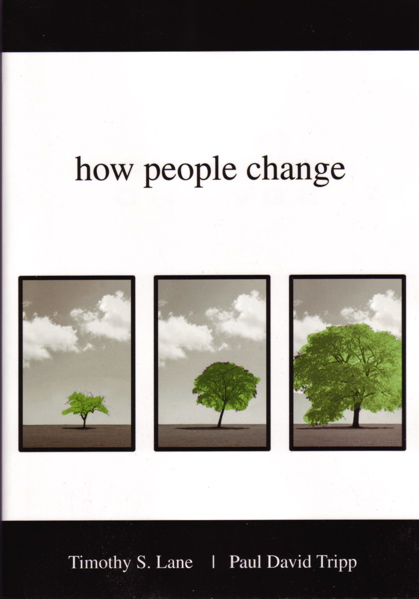 reading through several books this year. For the months of March and April, I’m reading through How People Change by biblical counselors Dr. Timothy Lane, executive director and faculty member of the Christian Counseling and Educational Foundation (CCEF), and Dr. Paul David Tripp, president of Paul Tripp Ministries, pastor, and adjunct professor at Westminster Theological Seminary as well as adjunct faculty member of CCEF. The slogan across the top of the CCEF website (www.ccef.org) is “Restoring Christ to Counseling and Counseling to the Church.” We’re off to a good start.
As you may have guessed, I’m not the sort who naturally gravitates toward such “practical” material. But that’s my own problem. This volume, however, proves promising. I’ve only gotten through chapter one, so far, and it appears to have already gotten my number. The title of chapter one is “the gospel gap” (all titles are in lower case in this book), which the authors summarize in this way:
The good news of the gospel of Jesus Christ is a “then-now-then” gospel…First, there is the “then” of the past. When I embrace Christ by faith, my sins are completely forgiven, and I stand before God as righteous. There is also the “then” of the future, the promise of eternity with the Lord, free of sin and struggle. The church has done fairly well explaining these two “thens” of the gospel, but it has tended to understate or misunderstand the “now” benefits of the work of Christ. What difference does the gospel make in the here and now? How does it help me as a father, a husband, a worker, and a member of the body of Christ? How does it help me respond to difficulty and make decisions? How does it give me meaning, purpose and identity? How does it motivate my ministry to others?
It is in the here and now that many of us experience a gospel blindness. Our sight is dimmed by the tyranny of the urgent, by the siren call of success, by the seductive beauty of physical things, by our inability to admit our own problems, and by the casual relationships within the body of Christ that we mistakenly call fellowship. This blindness is often encouraged by preaching that fails to take the gospel to the specific challenges that people face. People need to see that the gospel belongs in their workplace, their kitchen, their school, their bedroom, their backyard and their van. They need to see the way the gospel makes a connection between what they are doing and what God is doing. They need to understand that their life stories are being lived out within God’s larger story so that they can learn to live each day with a gospel mentality (pages 3-4).
If you’ve been reading my blog for any length of time, you know I’m a big believer in the Christ-centered emphasis of Reformed theology. You may have read previous posts where I’ve recommended books like Christ Centered Preaching and Living the Cross Centered Life. This book on biblical counselling is right up the Christ-centered alley. Here’s a helpful guide for learning to live life in light of the gospel.
Two great passages of Scripture give us a picture of this so-called “then-now-then” application of the gospel to the believer. In his letter to Titus, the apostle Paul writes that the gospel is the basis for the instructions he gives in the first ten verses of chapter two.
11 For the grace of God has appeared, bringing salvation for all people, training us to renounce ungodliness and worldly passions, and to live self-controlled, upright, and godly lives in the present age, waiting for our blessed hope, the appearing of the glory of our great God and Savior Jesus Christ, who gave himself for us to redeem us from all lawlessness and to purify for himself a people for his own possession who are zealous for good works (Titus 2:11-14).
Back “then” the grace of God appeared, bringing salvation for people in every nation (v. 11). “Now,” or as Paul writes, “in the present age” (v. 12), this grace of God trains us to renounce ungodliness and worldly passions, embracing self-control, uprightness, and godliness, “waiting for our blessed hope” (v. 13), in other words, looking forward to “then,” when Christ returns, who, back “then,” gave himself for our redemption from lawlessness to “purify . . . a people for his own posession who are zealous for good works” (v. 14). As you can see, the authors draw directly from Scripture for their approach to counseling, with no modern psychological influences evident. This is Christ-centered counseling if I’ve ever seen it.
Likewise, Peter gives a bit more extensive treatment in his second letter. In fact, in 2 Peter 1:9, the apostle explicitly indicates a professing believer’s tendency to “forget” about what Christ did for him in the gospel. Here is Lane’s and Tripp’s “gospel gap.” Let’s take a look at the passage–2 Peter 1:3-11.
His divine power has granted to us all things that pertain to life and godliness, through the knowledge of him who called us (back “then“) to his own glory and excellence, by which he has granted to us his precious and very great promises (again, past tense), so that through them you may become partakers of the divine nature, having escaped (detecting a pattern yet?) from the corruption that is in the world because of sinful desire.
For this very reason, (“now“) make every effort to supplement your faith with virtue, and virtue with knowledge, and knowledge with self-control, and self-control with steadfastness, and steadfastness with godliness, and godliness with brotherly affection, and brotherly affection with love. For if these qualities are yours and are increasing, they keep you from being ineffective or unfruitful in the knowledge of our Lord Jesus Christ.
For whoever lacks these qualities is so nearsighted that he is blind, having forgotten that he was cleansed from his former sins (here’s the “gospel gap”). Therefore, brothers, be all the more diligent to make your calling and election sure, for if you practice these qualities you will never fall. For in this way there will (“then“) be richly provided for you an entrance into the eternal kingdom of our Lord and Savior Jesus Christ.
For these reasons, and a few others (so far), I’m inclined to believe the promotional synopsis at the Westminster Books website when it claims “This book explains the biblical pattern for change in a clear, practical way that you can apply to the challenges of daily life.”


 The Misadventures of Captain Headknowledge
Rev. John Brown’s Original Preface
Title Page to Brown's Self-Interpreting Bible
The following is the original preface to Rev. John Brown’s Self-Interpreting Bible, in which he explains the various features he’s included, and shows how they will aid the reader in understanding and profiting spiritually from the Word of God. I’ve highlighted the features as they occur throughout. The rest is original to the editor.
My intention in the coming posts will be to demonstrate to varying degrees, each of these features, along with pictures of the numerous beautiful lithographs that are found along the way.
PREFACE TO THE ORIGINAL EDITION
Not to depreciate the valuable commentaries of Pool, Patrick, Clarke, Henry, Burkitt, Gill, and Doddridge, &c., but to exhibit their principal substance with all possible advantage, in a manner that might best comport with the ability and leisure of the poorer and labouring part of mankind; and especially to render the oracles of God their own interpreter, and enable every serious reader to judge for himself what doctrines ought to be believed, and what duties practiced by the Christian, are the avowed aims of this publication.
In the copious INTRODUCTION, the principal proofs of the Divine Authority of the Old and New Testaments, and the rules necessary to promote the profitable perusal of the oracles of God therein contained, are largely exhibited. The connected scheme of the Hebrew Laws, and their evangelical signification,–and of the fate of nations, narrated or predicted in Scripture, as subservient to the glorious work of our redemption,–together with the large Chronological Index,–form a summary of the most celebrated labours of the learned world on these diversified subjects. An accurate attention thereto will, through the blessing of God, greatly assist in searching the Scriptures with success.
The contents of the sacred books, and their respective chapters, are an accurate, full and explicatory representation of their subject. Properly attending to these, the reader must discern of whom, or of what, the Holy Ghost there speaks, and understand the passage accordingly. He may easily fix in his mind a general, but distinct view of the whole system of inspiration; and thus be capable, with the utmost readiness, to find out or compare whatever passages of Scripture he may desire.
The EXPLANATORY NOTES are chiefly confined to the figurative, the prophetic, and the practical parts. Here the obscurity of Scripture, or the importance of faith and holiness, chiefly required them.
In our Saviour’s delightful discourses, and the epistles of his inspired Messengers, our holy religion is most fully delineated; and there the explication is peculiarly extensive, and attempts to exhibit the substance of many learned and expensive commentaries, in a manner which, attending to the beautiful connexion, clearly unfolds the scope and meaning of the Spirit of God.
A particular and lively application of divine truth to the heart, and an unspotted holiness of conversation, being the immediate end of God’s revelations to men, the contents of each chapter, which are often in an explicatory manner, are in the Reflections practically summed up, and directed home to the reader himself, for enlightening his understanding, awakening his conscience, warming his heart, and for directing and animating his practice.
An exact knowledge of the seasons in which the oracles of God were delivered, or the events mentioned in them took place, being of no small importance for obtaining a distinct perception of their meaning, the dates before and after our Saviour’s incarnation have been adjusted from the best chronologers, and marked in the margin.
Lithograph of the Reverend John Brown of Haddington
But, as every Protestant must allow the Scripture itself to be its own best interpreter—as God, to oblige men to a diligent search of his word, comparing spiritual things with spiritual, has seldom fully unfolded any of his more important truths in one particular passage—the uncommon collection of Parallel Scriptures, such as is not to be found anywhere else that I know of, has formed the most laborious, and will, to the diligent peruser, be found by far the most valuable part of the work. Some of these are similar in phrase, others in meaning, and, in fine, others in their scope and design. In these, and others which may be added, we have a delightful view of the harmony of the Scripture, and multiplied proofs of every article of our Christian faith; we have a real Concordance, which may abundantly furnish preachers and others with their desired quotations; we have, in little room, a large Commentary, infinitely more certain than any dictates of men; and of which the very words are, as nails and as goads, pointed and fastened by the great Master of assemblies. In a truly diligent comparison of them, many texts all at once explain, and are explained by each other. Nor, unless at first, will the careful reader find much trouble in comparing the texts: but the mere view of the marginal quotations will direct his memory to that part of them which corresponds with the sentence to which they are annexed for explication. And, for his encouragement, I can only say, that my labour, in collecting the parallel texts in this work, has afforded me much more pleasant insight into the oracles of God than all the numerous commentaries which I ever perused.
Thus we may listen to, and converse with God, and lay our consciences open to the inspired arrows of our all-conquering Redeemer;–we find his words, and eat them, to the joy and health of our soul; we hide them in our heart, that we may not sin against him; we become mighty in the Scriptures, and expert in handling this sword of the Spirit, in opposition to every enemy of our soul: in fine, we are made wise unto salvation; are reproved, corrected, and instructed in righteousness, and perfectly furnished for every good work. May the Lord himself prosper it for these ends!
J. BROWN
Share this: