Gender Roles, part 1–Egalitarianism

As the father of a young lady who is growing in her understanding of Reformed theology, I have had to wrestle with the relative merits of “patriarchalism” versus “complementarianism.” What are the definitions of these fifty cent words, you ask? How glad I am that you asked!
Allow me to preface these definitions with yet another term—egalitarianism–and the environment in which these three terms have become points around which various parties rally. With the advent of feminism in the late nineteenth and twentieth centuries, efforts to free women from all forms of tyranny, real or perceived, in society, the home and the church have sparked a two-pronged response. Feminism promotes the ideal of egalitarianism, which asserts the absolute equality of men and women in every way, so that the institution of marriage is often disparaged, women are encouraged to work outside the home and pressured to refrain from the honorable vocation of domestic engineering (that is, being a housewife), and to answer an unbiblical call to pastoral ministry in the Christian church. This movement became part and parcel of the ideals of liberal Protestant theology and practice throughout the twentieth century. Toward the end of that century, however, the movement began making inroads into otherwise conservative Evangelical churches.
Throughout the history of the development of Christian theology, orthodoxy was commonly believed among the whole church, and remained generally agreed upon and largely unwritten, since there was little to no disagreement about the orthodox interpretation of Scripture. This is why we see in church history how that it is the aggressive assertion of heresy which forces the orthodox to go back to the drawing board and more carefully work out and put into writing the correct understanding of the Bible. In theology as well as commerce, competition forces one to work harder to increase the quality of their philosophical principles, goods and services.
How, in this environment, are Christian families to insulate their children from the erroneous claims of modern feminist egalitarianism? In the next post, we’ll deal with conservative Evangelical responses to egalitarianism which have resulted in the spectrum with which we must deal today.
Why Reformed Churches Don’t Rebaptize
Why two baptisms are one too many.

 Confessional Reformed/Presbyterian churches don’t rebaptize a Christian who comes from another church to join theirs. The Westminster Confession of Faith (28:7) says “the sacrament of baptism is but once to be administered to any person.” For example, if a person was baptized in a Roman Catholic, Methodist, Brethren, or Baptist church, he or she would not have to be baptized again to join a Reformed/Presbyterian church.
Why not?
Well, there are quite a few historical and biblical answers to the question. I don’t have the space here to discuss how the Reformers spoke against the Anabaptists who began rebaptizing Christians during and after the Reformation. You can read Luther’s 1528 treatise, “Concerning Rebaptism” for more information on this. The (short) historical answer to the above question (Why not?) is simply this: because we’re not Anabaptists!
At the heart of the biblical answer is the fact that baptism is primarily God’s
View original post 386 more words
Mid-Cities OPC’s First Building

The most recent incarnation of the banner which announced the presence of a congregation of Orthodox Presbyterians at the YMCA in Bedford, Texas–for only a few hours each Sunday morning over a period of about eight years.

Dr. K. Scott Oliphint (left) with MCPC pastor, Rev. Joe Troutman (right) inside the YMCA.
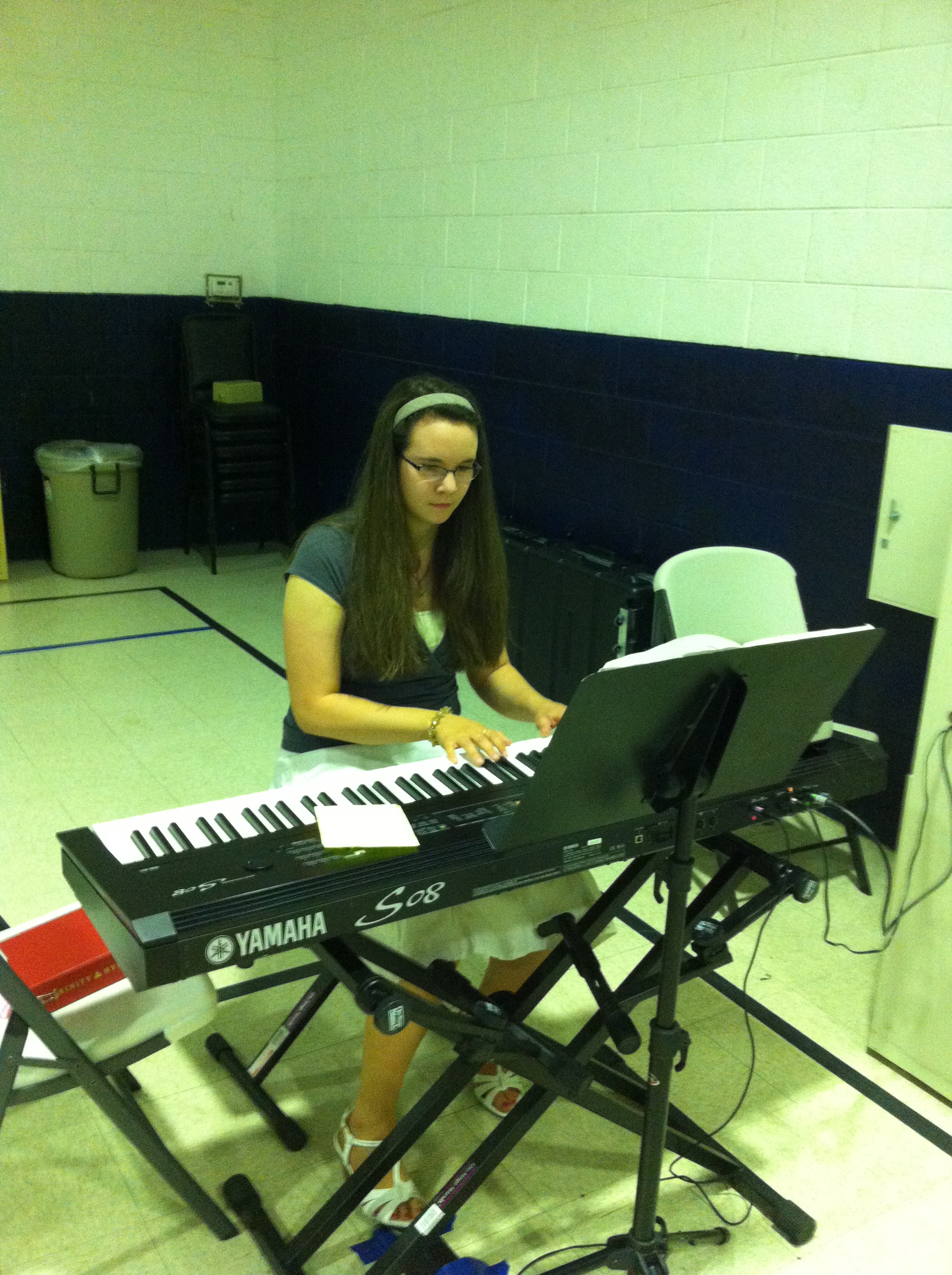
My gifted daughter, Abigail, fills in as pianist during morning worship at the Bedford YMCA.

After years of shopping for buildings in a fairly full suburb, this sign is discovered.

Here’s the building which came with the sign.

After months of negotiating, inspecting, and work days, a date is set.

At long last, a place of our own to worship and glorify our faithful covenant God.
If any of my readers ever find themselves in the Dallas/Fort Worth Metroplex, please worship with us at…
Mid-Cities Presbyterian Church (OPC)
1810 Brown Trail
Bedford, Texas 76021
Profaned Pulpit
Profaned Pulpit: The Jack Schaap Story was written by one-time member of FBC Hammond, Ind., student of Hyles-Anderson College, and close personal friend of Jack Schaap, Jerry D. Kaifetz, Ph. D. The book is part analysis of how cultic tendencies can distort the ministry of a local church, part treatment for victims of such abuse, as well as Kaifetz’s prescription for how a church can prevent such cultic distortion through accountability among their own leadership and congregation.
“The Lord is Risen!”
Happy Easter! The Lord is risen! He is risen indeed!
The following is an excerpt from the Gospel According to Luke, chapter 24, verses 1-35 as edited by David Norton in The New Cambridge Paragraph Bible. If you are an experienced reader of the King James Version, you will be surprised to notice quotation marks around the dialogue. These were added by the editor. But in his edition, the paragraphs are extended pericopes. I have further broken up the paragraphs to make the narrative read more as a novel, to increase the reader’s appreciation for the action and dialogue in the narrative.
The reason I selected this passage was because I was curious as to the origin of the traditional Easter greeting in which one believer meets another and salutes him with “The Lord is risen!” to which the other believer replies, “He is risen indeed!” One source directed me to this passage regarding the men who met Jesus on the road to Emmaus who were greeted by the disciples when they came to report their experience to them.
May this reminder of the truth of the resurrection of our Lord Jesus Christ comfort us, and encourage us in our faith and hope in him as we await his return.
“Christ is risen!”
“He is risen indeed!”
* * *
Now upon the first day of the week, very early in the morning, they came unto the sepulchre, bringing the spices which they had prepared, and certain others with them. And they found the stone rolled away from the sepulcher. And they entered in, and found not the body of the Lord Jesus. And it came to pass, as they were much perplexed thereabout, behold, two men stood by them in shining garments.
And as they were afraid, and bowed down their faces to the earth, they said unto them, ‘Why seek ye the living among the dead? He is not here, but is risen: remember how he spoke unto you when he was yet in Galilee, saying, “The Son of man must be delivered into the hands of sinful men, and be crucified, and the third day rise again”.’
And they remembered his words, and returned from the sepulchre, and told all these things unto the eleven, and to all the rest. It was Mary Magdalene, and Joanna, and Mary the mother of James, and other women that were with them, which told these things unto the apostles. And their words seemed to them as idle tales, and they believed them not.
Then arose Peter, and ran unto the sepulchre, and stooping down, he beheld the linen clothes laid by themselves, and departed, wondering in himself at that which was come to pass.
* * *
And behold, two of them went that same day to a village called Emmaus, which was from Jerusalem about threescore furlongs. And they talked together of all these things which had happened. And it came to pass that while they communed together and reasoned, Jesus himself drew near, and went with them. But their eyes were held that they should not know him.
And he said unto them, ‘What manner of communications are these that ye have one to another, as ye walk and are sad?’
And the one of them, whose name was Cleopas, answering said unto him, ‘Art thou only a stranger in Jerusalem, and hast not known the things which are come to pass there in these days?’
And he said unto them, ‘What things?’
And they said unto him, ‘Concerning Jesus of Nazareth, which was a prophet mighty in deed and word before God and all the people. And how the chief priests and our rulers delivered him to be condemned to death, and have crucified him. But we trusted that it had been he which should have redeemed Israel: and besides all this, today is the third day since these things were done.
‘Yea, and certain women also of our company made us astonished, which were early at the sepulchre: and when they found not his body, they came, saying, that they had also seen a vision of angels, which said that he was alive. And certain of them which were with us went to the sepulchre, and found it even so as the women had said: but him they saw not.’
Then he said unto them, ‘O fools, and slow of heart to believe all that the prophets have spoken: ought not Christ to have suffered these things, and to enter into his glory?’ And beginning at Moses and all the prophets, he expounded unto them in all the scriptures the things concerning himself.
And they drew nigh unto the village, whither they went, and he made as though he would have gone farther. But they constrained him, saying, ‘Abide with us: for it is towards evening, and the day is far spent’. And he went in to tarry with them.
And it came to pass, as he sat at meat with them, he took bread, and blessed it, and broke, and gave to them. And their eyes were opened, and they knew him, and he vanished out of their sight.
And they said one to another, ‘Did not our heart burn within us, while he talked with us by the way, and while he opened to us the scriptures?’
And they rose up the same hour, and returned to Jerusalem, and found the eleven gathered together, and them that were with them, saying, ‘The Lord is risen indeed, and hath appeared to Simon’.
And they told what things were done in the way, and how he was known of them in breaking of bread.
Luke 24:1-35 (Norton, David, ed. The New Cambridge Paragraph Bible. © Cambridge University Press 2005, 2011.)
Today is Palm Sunday, 2013. Today’s post is a rerun of my notes on my pastor’s sermon on Christ’s Triumphal Entry. Don’t miss the discussion of the donkey in the comments thread.

Sermon Notes from Sunday, October 9, 2011. Delivered by Rev. Joe Troutman at Mid-Cities Presbyterian Church (OPC).Listen online.
Jesus comes into Jerusalem as king, but in a week’s time he will have been crucified and raised from the dead for sinners like you and me.
Westminster Shorter Catechism 26
Q. How doth Christ execute the office of a king?
A. Christ executeth the office of a king, in subduing us to himself, in ruling and defending us (Psalm 110:3; Matthew 28:18-20; John 17:2; Colossians 1:13), and in restraining and conquering all his and our enemies (Psalm 2:6-9; Psalm 110:1-2; Matthew 12:28; 1 Corinthians 15:24-26; Colossians 2:15).
“The Lord Has Need of Them” (Matthew 21:1-5) Now when they drew near to Jerusalem and came to Bethphage, to the Mount of Olives, then Jesus sent two disciples, saying to them, “Go into the village in front of…
View original post 1,118 more words
Thinking through the Campbellite Denial of Original Sin
If you are a Campbellite, a former Campbellite, or otherwise knowledgable about the nuances of Campbellite doctrine and logic, please critique the following syllogism I have devised in my attempt to think through the reason Campbellites would deny the doctrine of original sin.

Alexander Campbell
It is my understanding that Campbellism does affirm that Adam’s posterity inherited a natural predisposition to commit sins, so the only distinction between Augustinians and Campbellites with which I’m dealing lies in the Campbellite denial of the imputation of the guilt of Adam’s sin to his posterity.

Augustine of Hippo
I am also prepared for the possibility that Campbellites might object to my assertion in the first proposition “that baptism literally washes away sin.” It would also be good if anyone could help me articulate this proposition more precisely.
Here is my working syllogism:
Campbellites agree with Augustine that baptism literally washes away sin;
Campbellites disagree with Augustine that baptism is for infants;
Therefore, Campbellites conclude that infants are not affected by original sin, but are rather born innocent.
ACE and WHI Remember Dr. C. Everett Koop (1916-2013)
Yesterday I tweeted a request to Reformed bloggers in the know to post on the Reformed side of American medical icon, the late Dr. C. Everett Koop, who died Monday at the age of 96. Dr. Koop’s medical and public service bonafides are a matter of public record. One quick and easy summary may of course be accessed, where else? Wikipedia! Here also is a press release from HHS Secretary, Kathleen Sabelius, detailing his legacy from the point of view of the federal government. But in addition to his service to the City of Man, Dr. C. Everett Koop was an accomplished lay leader in the City of God, serving as a Presbyterian church elder, and until the day of his death, a board member of the Alliance of Confessing Evangelicals (ACE), the para-church organization which was so instrumental in introducing me to and cultivating in me the Reformed faith and theology.
Incidentally, tomorrow afternoon, my pastor and I depart for ACE’s Texas Hill Country Bible Conference in Boerne, Texas. It’ll be interesting to see what kind of tribute they put together for him there. For now, though, the ACE website offers a “Koop Classic”: Life, Bioethics and Christianity (2010, ACE).
But in answer to my (“all about me”–apologies to Dr. D.G. Hart 😉 request, two of my favorite Reformed bloggers has indeed posted remembrances of Dr. C. Everett Koop: Drs. Michael Horton and Kim Riddlebarger. You may read Dr. Horton’s at the White Horse Inn blog, and Dr. Riddlebarger’s post at the Riddleblog. Horton gives a nice summary of meeting Dr. Koop and his service to his church, Tenth Presbyterian Church in Philadelphia, PA and the Alliance of Confessing Evangelicals, featuring the audio of a 2001 interview and a link to Dr. Koop’s contribution (“Faith-Healing and the Sovereignty of God”) to Horton’s out of print 1990 expose of televangelism, The Agony of Deceit–download it as soon as possible! Riddlebarger adds an amusing anecdote of Dr. Koop’s sobering reaction to his sense of humor. Both posts are great reads.
Be sure to peruse the other links I tweeted yesterday regarding the late Dr. C. Everett Koop from Christianity Today and Banner of Truth magazines and the Gospel Coalition blog featuring both compliment and criticism. Finally, in search of an image of Dr. Koop inside the building of Tenth Pres, I ran across a video of his 2010 marriage to Cora Hogue (pray comfort for her in her loss), officiated by former pastor, Phil Ryken, who is now the President of Wheaton College, whose sermons are still featured on ACE’s broadcast, Every Last Word. For those who are interested in viewing this heartwarming moment, the service begins about 30 minutes into the video, after the beautiful music of Westminster Brass.
Koop-Hogue Wedding Ceremony from Tenth Presbyterian Church on Vimeo.
How Could God Command Genocide in the Old Testament?
Check out Justin Taylor’s explanation of a difficult and emotional, but important question…
Hearing Frame’s Side of the Story

Dr. John Frame, Professor of Theology and Philosophy at RTS, Orlando
As one who was first introduced to Reformed theology by Dr. Michael Horton in a televised interview promoting his first book, I have a great affection and appreciation for the work of those who are, in Reformed circles, associated with what Dr. John Frame (RTS, Orlando) calls “The Escondido Theology.” Frame and others seem to think that for Reformed folks to interact with Lutheran theology on the things with which they agree is some sort of compromise of the integrity of Reformed theology. As a layman who hasn’t read it all on this controversy, that’s the impression I get. Frame’s book is promoted as a discussion primarily of the Two Kingdom approach to Christ and culture, but I’ve just learned that there is more to Dr. Frame and the Escondido Theology that this one issue.
In terms of coming to a greater understanding of the broader controversy myself, I was pleased to find that Scott Oakland interviewed Dr. Frame on a recent episode of ReformedCast. Agree or disagree, it is important to understand Frame’s point of view on the matter. Looking back to the days in which he helped found Westminster Seminary California, Dr. Frame portrays himself as not fitting in with any of the “parties” that formed among the faculty there. I also found it helpful to hear him express his concerns with how closely many among the faculty wanted to stick to the Reformed confessions, while he, in my opinion, thought the Reformed principle of sola scriptura was better honored by not “turning biblical and systematic theology into historical theology” (or something like that–it’s been a few days since I heard the interview). This helped me understand why Dr. Frame was willing to be a little more “progressive” in his approach to worship, and became a veritable whipping boy among many in the so-called “worship wars” (see, for example, how Frame’s writing is treated in Hart and Muether’s With Reverence and Awe: Returning to the Basics of Reformed Worship.) While I do not doubt Dr. Frame’s commitment to the Reformed interpretation of Scripture, it does seem to me that he has a more moderate approach. Neither side of this Escondido debate deny that the Reformed Confessions are subject to the authority of Scripture, but I perceive that in some ways Dr. Frame seems so much more openly self-conscious of highlighting the authority of Scripture over the Confessions that he runs the risk of coming off more broadly evangelical than Reformed on the issue of worship. I could be wrong, but this is my initial impression.
Many of you have read more Frame than I have, and have a more informed opinion of his approach to Reformed theology. Feel free to enlighten and correct my impressions in the comments. I simply wanted to share my thoughts on the interview as I recommend it to you. If any of you have wondered about the back and forth that sometimes takes place online about the so-called “Escondido Theology,” this interview is an important resource for gaining some insight into both sides of the debate.
The Only Thing Not Bigger In Texas…
…is our White Christmas.
But we’ll take it!

December 25, 2012
Thankful for the Committee on Christian Education
I just finished watching the latest video uploaded to the Reformed Audio YouTube page, Rev. John Galbraith, Address at GA on 75th Anniversary of the Orthodox Presbyterian Church. The Rev. Galbraith, age 98 at the time of the delivery of this address back in June of 2011, was in attendance and stood to vote for the founding of the Orthodox Presbyterian Church on June 11, 1936. The extent of his service to the church is outlined in the introductory material under the video on the YouTube page as follows:
Rev. John P. Galbraith, founding member of the Orthodox Presbyterian Church in 1936 and retired minister, addresses the General Assembly of the OPC’s Committee on Christian Education on the 75th Anniversary of the OPC on June 11, 2011. Rev. Galbraith graduated from Westiminster Theological Seminary in 1937 (where he studied under J. Gresham Machen until his untimely death) and was ordained to the gospel ministry that same year. During his 75 years as a minister in Christ’s church, Rev. Galbraith served as the pastor of three OPC churches, clerk of the OPC General Assembly for six years (1940, 1984-88), General Secretary of the Committee for Foreign Missions for thirty years, General Secretary of the Committee for Home Missions, and on numerous other denominational committees. In this address, at the age of 98 years old, he reflects on the mission of the OPC and God’s goodness to the church for 75 years, as well as challenges the church faces. Introduction by Rev. Danny Olinger. For more of Rev. John Galbraith, please visit www.reformedaudio.org/Galbraith
In his address, Rev. Galbraith comments that J. Gresham Machen’s “two pillars” of the church are that 1)The Bible is the Word of God, and 2) It Must Be Obeyed! Built upon these pillars, the young denomination would organize the Committees on Home and Foreign Missions in order to “speak to those who are without,” and underscores how that it is the mission of the Committee on Christian Education to “speak to those who are within”–to teach the teachers. He goes on to urge the OPC to watch out for the inclusivism which ultimately destroyed the PCUSA, and commends toward that end a firm committment to the Westminster Standards as our corporate confession of our ultimate guide, the Bible. Finally, upon his conclusion and stirring recommendation, those in attendance rise to sing “All Hail the Power of Jesus Name.”
You will be challenged and encouraged to renew your faith in and obedience to the Bible in this address.
Memoir of the Rev. John Brown, part 10

Celebrated Author
But Mr. Brown was not only distinguished as a minister of the gospel, and a teacher of divinity, he is celebrated also as an author. A strong desire to contribute towards the moral and religious improvement of mankind, and that he might, in some measure, be useful to the church of Christ, when he rested from his labours, weighed down every consideration of either profit or applause connected with his writings; indeed the pecuniary reward of all his labours, in this way, was but a matter of small account, never exceeding forty pounds. It was reserved, however, for his booksellers to reap a much more bountiful harvest; several of his works having already appeared in upwards of thirty, and some even in forty editions.
His first attempt as an author was his large work on the Catechism, which appeared in the year 1758; the next was a lesser work, also on the Catechism; and the rest of his works succeeded one another as circumstances seemed to render them necessary. (A modern edition is available from Reformation Heritage Books) That the doctrines he taught might appear with all the solidity and perspicuity in his power, he was at the extraordinary pains of writing his manuscripts thrice, and occasionally four times over, before they went to press; and frequently, after all this trouble in correcting, adding, and retrenching them, to request some one of his brethren to examine, and give his candid opinion concerning them.
But on none of his works has he bestowed so much labour as on his Dictionary of the Bible; a book of such diversified information, extensive research, and generally acknowledged utility, that it is doubtful if any work, of equal size, has hitherto appeared better calculated for assisting in the study of the Holy Scriptures, although now from the increased amount of information on scientific, historical, and other subjects, it necessarily is imperfect as compared with what he doubtless would have made it, had he possessed the opportunities of our day.
Memoir of the Rev. John Brown, part 9

Lithograph of the Reverend John Brown of Haddington
Professor of Divinity
On the death of the Rev. J. Swanston of Kinross (1768), the professor of divinity for the Burgher branch of the Secession, Mr. Brown was elected to fill the vacant office; nor were they at all disappointed in their choice. The ability and attention with which he fulfilled the various duties of that important charge, met with universal approbation. He found it was absolutely necessary to support the dignity of a teacher amongst his students, but could not help discovering, at the same time, the affection and anxious solicitude of a father for his children, which, on their parts, was rewarded with confidence, love, and obedience.
He treated them with the greatest impartiality; or, if piety, talents, application, or exemplary conduct, in any case inclined him to a preference, he was careful that it should never be observed. To promote their best interests, he was unwearied in his labours of love. That he might satisfy himself that the young men were improving their time, he used to visit them at their lodgings early in the morning, to see that they were properly engaged.
The ordinary course of attendance on the divinity lectures was five sessions, of two months each. In his View of Natural and Revealed Religion, and the Cases of Conscience subjoined to his Practical Piety, we have a connected view of the substance of all these lectures. His General History of the Church, as well as that of the British Churches, were originally intended for the use of his students. He ever considered personal piety the most essential qualification for successfully discharging the various and important duties of the ministerial office; and accordingly pressed on his students the pre-eminent interest they themselves had in the doctrines they were to preach to others; assuring them, that divinity was to be studied in a very different way from that of a system of philosophy; and that, without heart-religion, they must necessarily continue unprofitable students of theology.
He urged, moreover, by all means to make themselves thoroughly acquainted with the oracles of God in the original languages; and, next to these, with the writings of Turretine, Owen, Boston, Fisher’s Marrow of Modern Divinity, the Erskines, and Hervey’s Theron and Aspasio, with his Defence against Wesley. The serious and solemn manner in which, on particular occasions, he was in the habit of addressing his students, but especially on parting at the end of the sessions, seldom failed in melting both the speaker and hearer into tears and of leaving the best impressions on their young minds; and the many able and acceptable ministers, in Great Britain and Ireland, who had been trained up under his tuition, afford the most convincing proof of his success in this department of his manifold labours.


 The Misadventures of Captain Headknowledge
The Hermeneutics of Insider Syncretism
On this week’s episode of the Christ the Center podcast (#263, “Insider Movements“), Dr. David Garner is interviewed about his recent article in Themelios, “High Stakes: Insider Movement Hermeneutics and the Gospel,” analyzing the hermeneutics underlying the Insider Movement, a sociological and anthropological approach to contextualizing evangelism without calling on people whose identities are tied to other world religions like Judaism, Islam and Hinduism to disassociate themselves from those religious, cultural and family ties, but to work inside them and transform their approach to those religions in light of the teachings of Jesus. While it is noble to attempt to find a way to minimize the risk of loss or danger a Jew, Muslim or Hindu (for example) may face upon becoming a Christian, it is unfaithful to the Jesus they claim to follow if they would settle for living to distort their new-found faith with the teachings and practices of the religion with which they have previously been associated. Living to syncretize Christianity with non-Christian world religions is not a faith worth living for or dying for.
This movement is clearly in contradiction with the teachings of Jesus to those who would follow him. Jesus carried his cross and died on it for those who believe, and he calls on believers to take up their cross, follow him, and be willing to live publicly for him and, if need be, accept rejection by leaders of other religions, communities and families, even if such rejection includes dying for him.
I know it’s easy for me to say, and to criticize those who would find a way around it, but I too have a cross of self-denial to carry if I am to follow Jesus. I must kill my own sin (a struggle which involves suffering and risk of social rejection on my part), and publicly acknowledge Jesus as my Lord and Savior and associate myself formally with his people, the Church (Hebrews 10:25), serving him with my time, talent and treasure–loving, forgiving and giving to my brothers until it hurts. Should the time come that the culture or community in which I live demands that I deny my Lord Jesus Christ, I am called upon to defy such a demand and willingly suffer the consequences in reliance upon the grace and goodness of God, knowing that if such is happening to me, it is no more than what he sacrificed for me.
One of the interesting things about this movement which Dr. Garner points out in the article and the interview is that the intellectual source of such innovation in world missions comes from the same root as the church growth movement–Donald McGavran (d. 1990) and his School of Intercultural Studies at Fuller Theological Seminary (formerly the famous School of World Mission).
While McGavran’s efforts in his time were more theologically conservative and a reaction against liberal missionary trends, a student of his named C. Peter Wagner built on McGavran’s principles and create the church growth movement which has brought us such phenomena as seeker-sensitive worship and the modern megachurch. Incidentally, he is also the one who coined the phrase New Apostolic Reformation for the worldwide sweep of Charismatic and Word of Faith theology with a special emphasis on the restoration of the apostolic office, which movement in America has recently frightened the political Left because so many who would fall under this umbrella have modified the theonomist views of R. J. Rushdoony (for more on that, see this) and declared that they would “take dominion” over every sphere of influence in America.
Syncretism in the name of saving one’s life is no way to spread Christianity. A new generation around the world must hear the age-old truism: “The blood of the martyrs is the seed of the church” [paraphrasing Tertullian, Apology chapter 50].
Share this: