Reforming 21st Century Patriarchy
 I read a great article on the hard times Christian patriarchy is having among evangelicals. It seems in this generation, we’ve generally conceded, yet at least attempt to hold onto the form of biblical patriarchy in theory or on paper, but in practice we are for the most part living the life of the “egalitarian.” Please read this important wake up call found at Reformation 21. If you aren’t challenged and motivated, and given a clearer understanding of how counter-cultural we would be as Christians (you know, kind of how the first century church “turned the world upside down?”) were we practicing what we preach on this facet of the Christian life, then you must already be perfect. Ha! That’s a good one!!!
Gospel Catechism
1. Q. What is the Gospel?
A. The Gospel is the life, death and resurrection of the Lord Jesus Christ.
2. Q. What did the Lord Jesus Christ do in his life?
A. The Lord Jesus Chrsit perfectly obeyed God’s Law and earned eternal life for sinners in his life.
3. Q. What did the Lord Jesus Christ do in his death?
A. The Lord Jesus Christ suffered sin’s penalty for sinners in his death.
4. Q. What did the Lord Jesus Christ do in his resurrection?
A. The Lord Jesus Christ proved that sinners have been justified before God in his resurrection.
5. Q. Why do we call him Lord?
A. We call him Lord, because he is our Creator and our God and so we must obey him.
6. Q. Why do we call the Lord, Jesus?
A. We call the Lord, Jesus, because God sent his Son to save sinners.
7. Q. Why do we call the Lord Jesus, Christ?
A. We call the Lord Jesus, Christ, because God has anointed his Son, the Lord Jesus Christ, to reign as King over his people and conquer the world, the flesh, the devil and death.
8. Q. To what does God call us in the Gospel?
A. In the Gospel, God calls us to repent of our sins, receive Christ by faith, worship him in spirit and truth and obey him in thought, word and deed.
Theological and Doxological Meditation #18
 Sinfulness of Man’s Estate
Q. Wherein consists the sinfulness of that estate
whereinto Man fell?
A. The sinfulness of that estate whereinto man fell,
consists in the guilt of Adam’s first sin (Romans 5:19),
the want of original righteousness (Romans 3:18),
and the corruption of his whole nature,
which is commonly called original sin.
Amazing Grace!
#460, Trinity Hymnal (© 1990)
Stanzas 1-5, John Newton, 1779
Stanza 6, A Collection of Sacred Ballads, 1790
Amazing grace!
How sweet the sound!
That saved a wretch like me!
I once was lost, but now am found,
was blind, but now I see.
‘Twas grace that taught my heart to fear,
and grace my fears relieved;
how precious did that grace appear
the hour I first believed!
Thro’ many dangers, toils and snares,
I have already come;
’tis grace has brought me safe thus far,
and grace will lead me home.
The Lord has promised good to me,
his Word my hope secures;
he will my shield and portion be,
as long as life endures.
And when this flesh and heart shall fail,
and mortal life shall cease,
I shall possess within the veil
a life of joy and peace.
When we’ve been there ten thousand years,
bright shining as the sun,
we’ve no less days to sing God’s praise
than when we’ve first begun.
UNSETTLED: The Discomfort of the Justified Life
Following is an excerpt from an article in the July/August, 2006 issue of Modern Reformation Magazine. This magazine, and it’s sister radio show, The White Horse Inn, are sources for my regular theological nourishment . In the year 2006, they’ve been conducting a “Romans Revolution,” emphasizing the fact that many significant spiritual awakenings have been sparked by a rediscovery of the truth of justification by faith as taught in Paul’s most systematic presentation of the gospel, the book of Romans. In Romans 7, Paul highlights the struggle between our indwelling sin and the new life of the Spirit which compete for our compliance. How do we deal with the struggle most effectively? Realize that even though our strides in sanctification are often few and far between, our justification freely given to us on account of Christ will not only comfort us, but give us the hope to get back in the fray with the flesh!
. . . in Romans 8:1, Paul assures us that “there is therefore now no condemnation for those who are in Christ Jesus.” So, Romans 7:4 and 8:1 say essentially the same thing: God does not look on our struggles against indwelling sin with an attitude of condemnation and judgment because the condemning power of his law has been forever dealt with by Christ.
So in the midst of our struggle with indwelling sin, we must continually keep our focus on the gospel (emphasis mine). We must always go back to the truth that even in the face of the fact that so often “I do not do the good that I want, but the evil I do not want is what I keep on doing” (v. 19), there is no condemnation. God no longer counts our sin agaist us (Romans 4:8).
Or, to say it another way, God wants us to find our primary joy in our objectively declared justification, not in our subjectively perceived sanctification (emphasis mine). Regardless of how much progress we make in our pursuit of holiness, it will never come close to the absolute perfect righteousness of Christ that is ours through our union with him in his life and death.
So we should learn to live with the discomfort of the justified life. We should accept the fact that as a still-growing Christian, we will always be dissatisfied with our sanctification. But at the same time, we should remember that in Christ we are justified. We are righteous in him. There is the familiar play on the word “justification,” which means “just as if I’d never sinned.” But there is another way of saying that which is even better: justification means “just as if I’d always obeyed.” That’s the way we stand before God–clothed in the imputed righteousness of Jesus Christ. And that’s the way we can live with the discomfort of the justified life.
Theological and Doxological Meditation #17
 Estate of Fallen Man
Q. Into what estate did the fall bring mankind?
A. The fall brought mankind into an estate of sin and misery (Romans 5:12).
To God My Earnest Voice I Raise
#608, Trinity Hymnal (© 1990)
Arrangement by Edward Miller, 1790
From Psalm 142
To God my earnest voice I raise,
to God my voice imploring prays;
before his face my grief I show
and tell my trouble and my woe.
When gloom and sorrow compass me,
the path I take is known to thee,
and all the toils that foes do lay
to snare thy servant in his way.
O Lord, my Savior, now to thee,
without a hope besides, I flee,
to thee, my shelter from the strife,
my portion in the land of life.
Be thou my help when troubles throng,
for I am weak and foes are strong;
my captive soul from prison bring,
and thankful praises I will sing.
The Gospel from "Geneva" to Rome

I didn’t get eleven verses in before I was shown how that Paul desired to visit the church of Rome (who are believers) so that he may preach the gospel to them (the believing church of Rome). The way Paul lead up to that was by detailing what all he desired to see and experience as a result of his preaching the gospel of Christ to the believers in the church of Rome:
-
“bestow some spiritual gift” among them that they might be strengthened (v. 11), therefore, he is ready to preach the gospel to the Roman believers (v. 15).
-
receive comfort (v. 12; cf. ESV, “encouragement”) by the fellowship of his and their faith (Romans 10:17; Ephesians 2:8-9), therefore, Paul is ready to preach the gospel to Roman believers (v. 15).
-
have fruit among the Roman believers (v. 13). Does this mean he intends to see the fruit (see James 2:14-26; Matthew 7:16, 20) of their faith in Christ which comes from the gospel preached?
-
make it clear that he owes it to those who are wise (wise in the gospel? 2 Timothy 3:15–which would include Roman believers) as well as those who are unwise (again, unwise in the gospel?) to preach the gospel to them.
So, from this passage it seems to me that the benefits of preaching the gospel to believers is stronger faith (v. 11), comfort or encouragement (v. 12) and the fruit of faith: christian living (v. 13). So, as by so many other New Testament passages (some of which may be seen elsewhere on this blog) I am persuaded that believers will become stronger and more courageous (Joshua 1) and increase in bearing the fruit by which their faith is evidenced before others, not by an exclusive diet of “application” (Law/imperative), but by the gospel preached as foundational to any application made to believers in the pew.
I fear this goal has been lost by too many Evangelical preachers. I believe this is tantamount to sinning against their Lord by neglecting to feed the sheep what they need to be fed (John 21:17). So, to those preachers who believe and have sinned in such a way, may I remind you that Christ preached faithfully on your behalf because you couldn’t and haven’t and he then suffered the penalty of death which your unfaithful preaching has incurred, and then he rose from death to vindicate all the claims he ever made (his deity, messiahship and power to bestow forgiveness of sins, among other things). Therefore, it is my privilege to declare to those of you who confess this sin that God forgives you because of the obedient life and vicarious death and resurrection of Christ. . .
. . . now go and sin no more!
Theological and Doxological Meditation #16
 Extent of the Fall
Q. Did all mankind fall in Adam’s first transgression?
A. The covenant being made with Adam,
not only for himself,
but for his posterity (Genesis 1:28; 2:16-17);
all mankind,
descending from him by ordinary generation,
sinned in him,
and fell with him,
in his first transgression (Romans 5:18).
Fountain of Never-Ceasing Grace
#519, Trinity Hymnal (© 1990)
Augustus M. Toplady, 1740-1778
Fountain of never-ceasing grace,
your saints’ exhaustless theme,
great object of immortal praise,
essentially supreme,
we bless you for the glorious fruits
your incarnation gives,
the righteousness which grace imputes,
and faith alone receives.
In you we have a righteousness
by God himself approved;
our rock, our sure foundation this,
which never can be moved.
Our ransom by your death was paid,
for all your people giv’n,
the law you perfectly obeyed,
that they might enter heav’n.
As all, when Adam sinned alone,
in his transgression died,
so by the righteousness of One
are sinners justified;
we to your merit, gracious Lord,
with humblest joy submit,
again to paradise restored,
in you alone complete.
Stop and Smell the Total Depravity
 T — Because the carnal mind is enmity against God: for it is not subject to the law of God, neither indeed can be.
T — So then they that are in the flesh cannot please God.
It is amazing how we gloss over verses that don’t fit into our systems. And how common it is that these kinds of verses are ignored totally by semi-pelagian preachers and teachers. Romans 8:7 covers the idea that the unregenerate are not subject to the law of God. Calvinist and non-Calvinist can agree on this. We all have Romans 3:23 underlined in our Soul-Winner’s New Testament! “all have sinned,” after all! But what is this? It goes on to compound the issue with a clear statement regarding one’s moral inability. Not only are those who walk after the flesh, being carnally minded and therefore dead, not subject to God’s law, but that are not subject because they cannot be subject.
This speaks to the debated question of who it is who can receive Christ. If “without faith it is impossible to please God,” and if verse 8 says they that are in the flesh cannot please God, then does it not follow that they that are in the flesh cannot believe unless regenerated before he believes? Oh, but that would demonstrate the logical connection between Total Depravity and Irresistable Grace . . .
Theological and Doxological Meditation #15
 Our First Parents’ First Sin
Q. What was the sin whereby our first parents fell from the estate wherein they were created?
A. The sin whereby our first parents fell from the estate wherein they were created was their eathing the forbidden fruit
(Genesis 3:6-8).
Rise, My Soul, to Watch and Pray
#567, Trinity Hymnal (© 1990)
Johann Freystein, 1697, cento.
Translated by Catherine Winkworth, 1863; alt.
STRAF MICH NICHT 7.6.7.6.3.3.6.6.
Rise, my soul, to watch and pray,
from thy sleep awaken;
be not by the evil day
unawares o’ertaken.
For the foe, well we know,
oft his harvest reapeth
while the Christian sleepeth.Watch against the devil’s snares,
lest asleep he find thee;
for indeed no pains he spares
to deceive and blind thee.
Satan’s prey oft are they
who secure are sleeping
and no watch are keeping.
Watch! Let not the wicked world
with its pow’r defeat thee.
Watch lest with her pomp unfurled
she betray and cheat thee.
Watch and see lest there be
faithless friends to charm thee,
who but seek to harm thee.
Watch against thyself, my soul,
lest with grace thou trifle;
let not self thy thoughts control
nor God’s mercy stifle.
Pride and sin lurk within
all thy hopes to scatter;
heed not when they flatter.
But while watching, also pray
to the Lord unceasing.
He will free thee, be thy stay,
strength and faith increasing.
O Lord, bless in distress
and let nothing swerve me
from the will to serve thee.
Christ-Centered Proof-texting!!!

A Dark Day for KJV Onlyists . . .
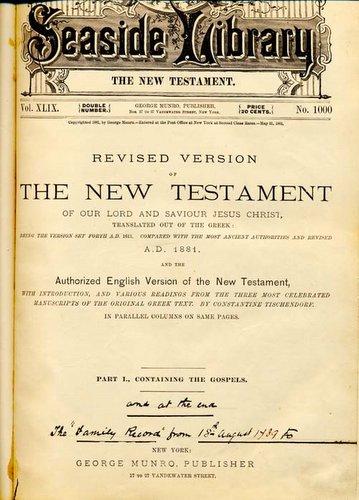 On this day in Christian History:
May 17, 1881 — The Revised Version (RV or ERV) of the New Testament was first published in England. The Old Testament was completed in 1885. In 1905 the American Standard Version (ASV) — based on the textual foundation of the ERV–was published in the U. S.
KING JAMES ONLYISTS, PUT ON YOUR SACKCLOTH AND ASHES!!!
Lately, I’ve been reading Kim Riddlebarger’s doctoral dissertation on B. B. Warfield, which partially discusses his interest in the burgeoning field of higher criticism. The “Lion of Princeton” was convinced that this methodology would help recover the original text of the Bible, and could also be useful in demonstrating the inerrancy of Scripture, if it’s used objectively!Warfield recognized, however, that due to the concurrent rise of evolutionary scientific naturalism, most European scholars were not using higher criticism objectively, and that goes, I’m sure, to some extent, for Westcott and Hort, the men who spearheaded the 1881 Revised Version’s “Critical New Testament,” but were, in fact, subjectively looking at the facts from their naturalistic viewpoint. In other words, having a prior committment to the idea that God has not inspired or preserved an inerrant canon of Scripture, the vast majority of liberal higher critics were too often using this inductive scientific method to destroy Christian orthodox confession regarding its Sacred Text. However, even as blind squirrels often find nuts, the advent of Westcott and Hort’s critical text did at least manage to break the Byzantine Text’s undue dominance in the church’s understanding of the transmission of the New Testament.
On this side of the pond, Warfield’s use of higher criticism contributed to his influence in the modern evangelical understanding of the inerrancy of Scripture! So you see, higher criticism is neutral and can aid us in the search for truth when used in an objective manner; at least that was Warfield’s conviction.
It is true that theories come and go, including some of the theories of Westcott and Hort and the liberal higher critics. But if we are committed to Christian orthodoxy, and with Anselm, “believe in order to understand,” we will find that, in part, through the ordinary means of higher textual criticism, God has providentially allowed us to arrive at a far closer proximity to the original text of Scripture than we’ve ever reached before!
Happy Birthday, Revised Version and all modern English translations!
Theological and Doxological Meditation #14
 Sin Defined
Q. What is sin?
A. Sin is any want of conformity unto,
or transgression of,
the law of God (1 John 3:4).
God, Be Merciful to Me
Music by Richard Redhead, 1853
#486, Trinity Hymnal (© 1990)
God, be merciful to me,
on thy grace I rest my plea;
plenteous in compassion thou,
blot out my transgressions now;
wash me, make me pure within,
cleanse, O cleanse me from my sin.
My transgressions I confess,
grief and guilt my soul oppress;
I have sinned against thy grace
and provoked thee to thy face;
I confess thy judgment just,
speechless, I thy mercy trust.
I am evil, born in sin;
thou desirest truth within.
Thou alone my Savior art,
teach thy wisdom to my heart;
make me pure, thy grace bestow,
wash me whiter than the snow.
Broken, humbled to the dust
by thy wrath and judgment just,
let my contrite heart rejoice
and in gladness hear thy voice;
from my sins O hide thy face,
blot them out in boundless grace.
Gracious God, my heart renew,
make my spirit right and true;
cast me not away from thee,
let thy Spirit dwell in me;
thy salvation’s joy impart,
steadfast make my willing heart.
Sinners then shall learn from me
and return, O God, to thee;
Savior, all my guilt remove,
and my tongue shall sing thy love;
touch my silent lips, O Lord,
and my mouth shall praise accord.
Stop and Smell the Limited Atonement!
 L — “In this was manifested the love of God toward us, because that God sent his only begotten Son into the world, that we might live through him. Herein is love, not that we loved God, but that he loved us, and sent his Son to be the propitiation for our sins. (1 John 4:9-11 KJV)
L — “And we have seen and do testify that the Father sent the Son to be the Saviour of the world” (1 John 4:14 KJV)
L — “We love him, because he first loved us.” (1 John 4:19)
One thing that is important to keep in mind when reading the apostles’ letters to the churches, most of what they write about the work of redemption, they put in terms that indicate the work was done for us. Now, the question is raised whether these references include the whole world, or is the apostle meaning to refer only to the audience to which he is writing? It has become my conviction that these references are directed to the church and not the world at large unless the context specifically demands such an interpretation.
Now, to highlight the doctrine of Limited Atonement in this passage:
The paragraph which contains verses 7-12 is basically about the fact that our love for one another is evidence that God’s Son indeed has saved us. But look at some of the atonement theology contained in this paragraph:
In verse nine, the love of God is manifested toward the elect because God sent his only begotten Son into the world, that the elect might live through him.
In verse ten, we are shown the logical order of Christian love. God did not send his Son to propitiate him for sinners because he foresaw who’d love him, but the kind of love God reveals in Scripture is the kind revealed in his Son’s propitiatory work on behalf of the sovereignly chosen elect. God takes the initiative from A-Z in the doctrine of salvation.
In verse eleven, there is some very simple application. Would that it were this easy to apply all of Scripture! We have a very clear redemptive focus, and we are aware of man’s fallen condition in his lack of love for others.
The redemptive focus is that God has loved the elect by sending his Son to redeem them, and since not only does the elect benefit spiritually from this work, but once Christ’s work as our Substitute has been planned by the Father, accomplished by the Son and applied by the Holy Spirit to the elect, they now have the great Example of our holy, covenant Head to follow toward others. God wants the elect to give themselves to others on the “horizontal” plane as Christ gave himself for them on the “vertical” plane.
Those who struggle with the fact of sovereign grace need to keep in mind that all we ever do is a response to God’s working in us to will and do according to his pleasure. We did not initiate our creation; yet Adam, our Head in the covenant of works, did (under God’s inscrutable foreordination) fall into sin of his own free will (and if we were in his shoes, we would’ve also), but everything after that is based on God’s promise; a promise he was not obligated to make. It would have been perfectly fair for him to leave us in the condition in which we find ourselves in Adam. All of God’s redemptive work for the elect is done to keep his promise, to show mercy to the elect for his glory, to not be “fair,” but gracious! Remember, fairness means death!
Now look at verse 14. This is one of the non-Calvinist’s proof texts of a general atonement. My semi-pelagian friend, stop and think about the world in which the apostle John is writing. The natural children of Abraham had the world classified in two categories: “us” and “them”; Jew and Gentile. John was a Jew. When a Jew in the first century talks about God doing something for “the whole world,” he means to emphasize the amazing truth that God’s not only doing something for the people he delivered from bondage in Egypt, but in the Lord Jesus Christ, he’s now delivering sinners from every nation from bondage to sin! This was a truly awe-inspiring thing going on in the world. It happened to Rahab, and Ruth, but now Gentiles were being brought into the Kingdom of God en masse! If a Jew as going to communicate clearly, he needed to specify about whom he’s speaking. Jesus came to save, not the Jews only, but elect sinners from the whole world!
“Finally, brethren” (insert preacher joke here), verse nineteen is a restatement of that simple application that we are to go and do for others what God has done for us. God demonstrated the greatest expression of love in Christ on behalf of the elect in his sinless life, propitiatory death and life-imparting resurrection, and now we are to obey not only the Great Commandment (love God with all your heart, mind, soul and strength), but the second as well, which is “like unto it” (love your neighbor as yourself). This love is the fruit of justification. R. C. Sproul once broadcast that the righteousness of God was imputed to us, but that when that justifying work took place, God’s love was imparted. If we’ve been justified by faith, then we, the believing elect, will love God and our brothers in Christ and the lost! So since the work of God is effectual, and we have his promise that it will happen, let’s get after it in the assurance that the gifts and calling of God are without repentance! As the English Standard Version translates verse nineteen, “We love (others) because he first loved us.”
Stop and Smell the TULIPS

A few years ago, when I was beginning my transformation from an “independent, fundamental, soul-winnin’, separated, premillennial, (semi-pelagian), King James Bible-believin'” Baptist, having come to learn “the way of God (specifically, the way of his grace) more perfectly,” I began to notice traces of those doctrines which have been most controversially affected by God’s sovereign grace throughout much of the New Testament in familiar places which I never dreamed I’d find them. As I noticed them, I began to mark them in the margin next to the verses or passages in which the doctrines evidenced themselves in varying degrees.
Of course, I’m speaking of what Calvinists call “The Doctrines of Grace,” and what most semi-pelagian, “independent, fundamental . . .” Baptist preachers mistakenly call “Hyper-Calvinism” (mostly in an attempt to commit the logical fallacy of “guilt by association”). As many of you are aware these are the doctrines which have been grouped together and given an acronym over the years (do any of you theologians out there know who it was that first popularized the acronym? I’m aware of its origins with the Synod of Dort, what about the acronym itself?), presumably to aid in memorization. The Doctrines of Grace are those doctrines which are radically God-centered, contrary to the way they are naturally and commonly understood by the “unlearned and unstable” (and I mean that charitably); they are those doctrines which eminently magnify God and humiliate man. Indeed, they so humiliate man, and sometimes so infuriate him, that even the Apostle Paul had to answer some of the very questions raised by these doctrines in Scirpture, which are always raised by non-Calvinists to this day, as well as defend them against the same charges which continue to be made against them to this day.
These “Doctrines of Grace” are:
Total Depravity (In other words, “How the doctrine of the sovereignty of the gracious God affects the biblical doctrine of human sinfulness”)
Unconditional Election (“How the doctrine of the sovereignty of the gracious God affects the biblical doctrine of election)
Limited Atonement (“How the doctrine of the sovereignty of the gracious God affects the biblical doctrine of the atonement”)
Irresistable Grace (“How the doctrine of the sovereignty of the gracious God affects the biblical doctrine of the gospel call and regeneration”)
Perseverance of the Saints (“How the doctrine of the sovereignty of the gracious God affects the biblical doctrine of the security of the believer”)
So as I noticed traces of these doctrines throughout Scripture, I’d mark a “T” or a “U” and so on, in the margin, until my New Testament was littered with them. These I intend to begin sharing one by one each week, with a few comments of my own so that these wonderful doctrines may be made more clear to those who continue to struggle with them, and likewise for the edification of those of us who already hold them so dear.
But this is just the introduction. Probably next week we’ll begin our stroll through the New Testament and occassionally “Stop and Smell the TULIPS!”


 The Misadventures of Captain Headknowledge