Jesus’ “Lost Years” Found In the New Testament

In my post last Sunday morning, I blogged about Lee Strobel’s book defending “the Real Jesus.” With this topic fresh in my mind, as well as the Sunday School lesson which I’d prepared for that morning, when class began, during our conversation with the children before the lesson, one of them asked out of the blue where Jesus was between the time he was a kid and the time he began his public ministry. I could tell immediately where he was going. Naturally, he followed up by saying his dad had been watching the History Channel and heard that people say Jesus went to India for some time between the ages of 12 and thirty. In the providence of God, my lesson for the day was from Luke 2:39-52, the account of “The Boy Jesus in the Temple,” as the heading over this passage in the English Standard Version describes it.
I’m not terribly familiar with the claims regarding Jesus’ reputed trip to India, spread by those outside the realm of orthodox Christianity. However, having perused the search engine and scanned a few sites (like this one, for example) and Wikipedia articles (like the one on the gnostic Acts of Thomas and the theosophical Aquarian Gospel), I’ve hit upon the apparent basis for the theory that Jesus went to India as a boy. I’d probably already be more clued in about it if I didn’t avoid History Channel programs of this nature and other popular sources of info on the secularized revisionist research on the “historical Jesus.” But I’m getting ahead of myself.
My immediate response to my student was that there are a lot of people who like Jesus, but who don’t believe the Bible. Often, they are people or groups from other religions that associate Jesus with their beliefs in an attempt to lend credibility to them, or for some other reason. In the middle of giving this summary of where stories like that come from, a verse from my lesson came to mind. “Now his parents went to Jerusalem every year at the Feast of the Passover” (Luke 2:41). After I glanced at the passage for a minute, it became clear to me that even though the verse doesn’t say, “Now Jesus and his parents went . . . ” the context indicates that when his parents went to Jerusalem every year, so did Jesus.
It seems I’ve found a piece of New Testament evidence that would indicate that Jesus of Nazareth did not, in fact, ever go to India, or on any fanciful “magical mystery tour” of eastern religions between the ages of 12 and 30, as suggested by the Aquarian Gospel, but was with his parents every year when they went to Jerusalem to celebrate the Feast of Passover.
Evangelical Defense of the Biblical Historical Jesus
 Many Reformed Christians often decry the glut of Evangelical literature on the market. We frequently wring our hands about how much literature available at your local Christian bookstore isn’t worth buying. For example, I have a friend who always says that you can find better Christian books at Barnes & Noble. I know what he means, and I don’t disagree. However, when those of us with high expectations for Christian books spend all of our time talking about the undesirable aspects of the Evangelical literature, we forget that with the bad comes the good.
I, for one, am glad that the Evangelical bookselling market is there to regularly defending the reliability of the Bible on a popular level against the constant onslaught of critical, skeptical, cynical and outright irreverent and disrespectful “search for the historical Jesus.” I added irreverent and disrespectful with Ann Rice’s comments about her opinion of the critical scholarship she’s read over the years in her historical research for her writings. When I find the article I read in which her opinion was cited, I’ll update this post. But I digress. I’m glad the Evangelical Booksellers market is there if only to provide on a popular level a defense of the reliability of the biblical account of Jesus of Nazareth. The Bible makes lots of historical and theological claims about Jesus, and we, as Evangelicals, are obligated to believe the Word of God on these issues. If we are willing to believe the spiritual revelation about Jesus in the Bible, we’d better be prepared to believe the historical revelation about him, too. After all, Jesus told Nicodemus in John chapter three, “If I have told you earthly things and you do not believe, how can you believe if I tell you heavenly things?” (John 3:12) The historical reliability of the Bible (“earthly things”) is part of the basis for the reliability of the theological reliability of the Bible (“heavenly things”).
That’s why, one day, I hope to get around to reading Lee Strobel’s book, The Case for the Real Jesus. You can check out Zondervan’s website with lots of promotional material about it. But right now, I’m having too much fun along the same lines with one of Zondervan’s other great recent releases, The NIV Archeological Study Bible!
Putting Myself In A Box
You may have noticed in the past few days that I’ve been experimenting with a new 
I’ll be featuring things to listen to now and then, like sermons I hear and want to share. Take for example, the one in my box today. It’s by my best friend’s pastor, Dr. Hamp Linehan of First Baptist Church of Richland Hills, Texas. Linehan is one of the greatest preachers in our area. I know you’ll enjoy and benefit from what you hear.
Here’s what it looks like when a shepherd lays down and rolls over for the wolves
If you’ve watched this video, did you notice Joel’s opinion of Mormons?
Joel believes Mormons (in general) are true Christians. Yes, you read that correctly. You have to see it to believe it. Watch the video. He accepts Mitt Romney as a “true Christian” because Romney says “Jesus is my Savior.” Joel may want his primary work to be motivating people to live better lives, but he must not focus on his moralistic message at the expense of evangelism and defense of the faith. To accept Mormons as true Christians just because he doesn’t want to be the one saying negative stuff about others is utter unfaithfulness to God.
When will modern evangelical Protestants regain their discernment? Turn this guy’s tv show off, brethren!
For a little more biblical bloviating on this issue, see Steve Camp’s post, “How wide is the narrow road at Lakewood Church?“on the subject which was written on the heels of Osteen’s FoxNews interview itself.
Outlining “The Love Chapter”
Love needed in my service
If I speak in the tongues of men and of angels, but have not love, I am a noisy gong or a clanging cymbal. And if I have prophetic powers, and understand all mysteries and all knowledge, and if I have all faith, so as to remove mountains, but have not love, I am nothing. If I give away all I have, and if I deliver up my body to be burned, but have not love, I gain nothing.
Affirmations and Denials on Love
Love is patient and kind;
 love does not envy or boast;
it is not arrogant or rude.
It does not insist on its own way;
It is not irritable or resentful;
It does not rejoice at wrongdoing, but rejoices with the truth.
Permanence of Love
Love bears all things, believes all things, hopes all things, endures all things.
Love never ends.
As for prophecies, they will pass away;
As for tongues, they will cease;
As for knowledge, it will pass away.
For we know in part and we prophesy in part, but when the perfect comes, the partial will pass away.
Maturity of Love
When I was a child, I spoke like a child, I thought like a child, I reasoned like a child.
When I became a man, I gave up childish ways.
For now we see in a mirror dimly, but then face to face.
Now I know in part;
Then I shall know fully, even as I have been fully known.
Relative Value of Love
So now faith, hope and love abide, these three; but the greatest of these is love.
Christmas Carol Nativity Story
Read the following story of the birth of Jesus and see how many Christmas carols you can circle. Those were the instructions for our Sunday School Class yesterday, but I’m sharing it with you for your listening and reading pleasure. The carols are highligthed and linked to MIDI files from various sources. You’ll find we may miss the mark in a couple of instances, but, hey, we’re amateurs!
Merry Christmas!
THE FAITHFUL OF ISRAEL
O come, O come, Emmanuel! We have been waiting for you for thousands of years! Since God promised our first parents, Adam and Eve, that the Seed of the woman would crush the serpent’s head. Come, thou long-expected Jesus!
All our prophets have spoken of you. We have been watching for you to be among the descendants of Abraham, Isaac and Jacob, through the tribe of Judah and the family line of King David. As for his birthplace, the prophets wrote that this honor goes to you, O little town of Bethlehem.
ANGELIC ANNOUNCEMENTS
Mary was engaged to a carpenter named Joseph. One day, an angel appeared to her and told her that she had been blessed and would have a baby that would be God’s Son and he would be named Jesus. Joseph was very upset about this until an angel visited him. Then he understood how special this baby would be. He realized that Mary would soon bear the Child that they had all been waiting for. The baby Jesus is the Messiah for which his people, the Israelites, had been waiting for a very, very long time.
ROYAL ROAD TRIP
 Before the baby was born, Caesar made a law that everyone had to return to the city of his family’s birth to be counted so he could pay taxes. Mary and Joseph had to travel to Bethlehem, the birthplace of King David. It was time for her son to be born. But the baby wasn’t a normal child. This baby, whose name would be Jesus, was the Son of God, not the son of Joseph, or any other man. He was God in the flesh. Mary and Joseph went to Bethlehem. There was no room for them because so many people had come to Bethlehem to be registered. A kind Inn keeper let them stay in his stable. It was a silent night, holy night and a very special night to remember. O holy night! Tonight, the Savior would be born!When Jesus was born, there was not a comfortable cradle in which to lay him. The baby Jesus rested in a manger, a feeding trough for cattle! It was right there, away in a manger, where Jesus spent his first night in the world which he created.
SHEPHERDS TOLD
In a nearby field, while shepherds watched their flocks by night, angels from the realms of glory, came down to speak to them. The angel told the shepherds about a Savior that was born in the City of David. They wondered, “What child is this?” How could one small child bring such joy to the world? They finally understood that it was the birthday of a king! God had sent his Son to deliver Israel! “Hark!” The herald angels sing, “Glory to God in the highest! Peace on earth, good will to men!” The shepherds thought, “How Great Our Joy!” to be visited by angels with this most wonderful news.
THE SHEPHERDS WORSHIP
The shepherds rushed to Bethlehem to find Jesus. They were so excited when they found Mary, Joseph and Jesus. They fell down and worshiped. They were so very joyful, joyful! “We adore thee!” the shepherds told the baby Jesus. The shepherds told Mary and Joseph about their visit from the angels. One of the shepherds explained. “Angels we have heard on high told us about your holy child!” The shepherds told Joseph and Mary how they had wondered, “What can I give him?” They also told them how they hurried to find the place where he was born, to find the Savior where the angels said he would be.
THE SHEPHERDS SPREAD THE WORD
They left the stable and spread out to tell everyone about the birth of the Messiah. They went in many directions. Some went to go tell it on the mountain, some went to the desert. As they found others that believed God’s promises, they told them, “O come, all ye faithful, and worship the Savior!”
THE SAVIOR OF THE WORLD
 But God wasn’t going to keep the Good News of the birth of the King of the Jews from the rest of the world. On the night when Jesus was born, in a land faraway to the east, a Wise Man was studying the stars, when he suddenly asked one of his friends, “Do you see what I see?” The Wise Men saw a star that they somehow knew was a sign that the King of the Jews had just been born. This was the way God got the Good News to the Gentiles on the night of Jesus’ birth. These men showed they were truly wise by selecting valuable gifts of gold, frankincense and myrrh to present to the King of the Jews after they follow the star to worship him. Today, wise men all over the world still seek to worship the King of the Jews. Are you one of them? What gifts would you give him? He deserves your whole life!
A Slow Holiday Season for the Historical Jesus
I just got home from the barber shop, where I perused the December 24 issue of U. S. News & World Report, which featured as its “holiday” cover story, not some new theory that threatens to change everything we’ve ever thought about Christianity, like we’ve been treated to for the last several years in a row, but an article on how Catholics,  Protestants and Jews are all alike seeing a return to ritual and liturgy among the younger generation which is so underwhelmed by the boomer generation’s attempts to relevantize (is that a word? I’ll look it up later.) their respective religious expressions. We evangelicals will certainly think instantly of the seeker-sensitive model of worship. This trend seems to be reflected in Bill Hybels’ recent change of heart about how his church has been weak on discipleship (or “self-feeding”); at least he’s publicly acknowledging a little self-critical reevaluation. Or is it just vying for some of the consumers to be had among the aforementioned younger generation that’s “seeking” more tradition-sensitive models of worship?
Here’s one interesting excerpt featuring the Evangelical version of this phenomenon:
Talk to Carl Anderson, the senior pastor of Trinity Fellowship Church, and you get an idea. “Seven or eight years ago, there was a sense of disconnectedness and loneliness in our church life,” he says. The entrepreneurial model adopted by so many evangelical churches, with its emphasis on seeker-friendly nontraditional services and programs, had been successful in helping Trinity build its congregation, Anderson explains. But it was less successful in holding on to church members and deepening their faith or their ties with fellow congregants. Searching for more rootedness, Anderson sought to reconnect with the historical church.
Connections. Not surprisingly, that move was threatening to church members who strongly identify with the Reformation and the Protestant rejection of Catholic practices, including most liturgy. But Anderson and others tried to emphasize the power of liturgy to direct worship toward God and “not be all about me,” he says. Anderson also stressed how liturgy “is about us—and not just this church but the connection with other Christians.” Adopting the weekly Eucharist, saying the Nicene Creed every two or three weeks, following the church calendar, Trinity reshaped its worship practices in ways that drove some congregants away. But Anderson remains committed, arguing that traditional practices will help evangelical churches grow beyond the dependence on “celebrity-status pastors.” (emphasis added)
Having looked over Trinity’s website, the only critique I have is in their fear of being divisive with a “detailed confession of faith,” favoring instead as their confession a combination of the Nicene Creed and the ankle-deep NAE Statement of Faith. A little too bare-bones for my taste, but the rest, I really like. But then, I’m part of that younger generation that isn’t into commercialized worship. Would that more “traditional” churches would seriously examine a more historical, liturgical worship that centers on the regulative principle of worship and actively encourages an appreciation of “the communion of saints,” our “connection” with the entire church in all times and places, as we worship God in the heavenly Jerusalem (Hebrews 12:22-24). Speaking of which, the current episode of The White Horse Inn which is featured in my sidebar, deals with this very kind of topic. I highly recommend your listening to it. It will expand your understanding of what’s going on spiritually in Sunday morning worship, and help you have an idea of where I’m coming from on all of this stuff.
Be that as it may, I was relieved that it so far seems to be a slow holiday season for debunkers of the historically orthodox understanding of Christianity in general, and Jesus in particular. As I was flipping through the pages of the magazine, the only thing of that kind of “historical Jesus” hand-wringing was a timely recycling of all the recent junk that had been polluting our airwaves for the past few years.
Yes, Virginia, There Is A St. Nicholas Movie (Or Will Be).
I was just thinking a couple of weeks ago that a movie about the life of St. Nicholas of Myra, source of the Santa Claus legend, ought to be made. I just learned today that someone is working on it. I, for one, will be counting the days, weeks and months until its release next year! Read and view more about it at http://www.nicholasofmyra-movie.com/.
My thanks to the Puritan Lad at his blog, Christianity in History, for bringing this to my attention. He includes a summary of the possible events in the ancient Bishop’s life which have survived to this day.
Merry Christmas!
Audio of Adrian and Dr. Tolar!
May I introduce to you our fascinating tour guide, Adrian?

This interesting little British guy was brought to Israel as a child by his devout, Jewish parents. He works primarily for the Israeli national parks service around the Dead Sea area, but also teaches English as a second language to his fellow Israeli citizens in addition to his brilliant career as a tour guide for eager American evangelicals like myself. He can speak Hebrew, Arabic, and Spanish in addition to his native tongue, the Queen’s English.
I have posted a few recordings of Adrian’s fascinating presentations on the bus and at various sites around Israel on my Box.net account, which can be accessed here, or in the future, from my CHK Multimedia page, on which you can click the “Audio for Mind and Heart” link and listen to the files posted December 12, 2007. Adrian’s talks include info regarding all sides of all issues (as much as he’s aware, anyway, which is quite a bit!), historical, geographical, economic, religious (often representing Christian, Jewish and Muslim views).
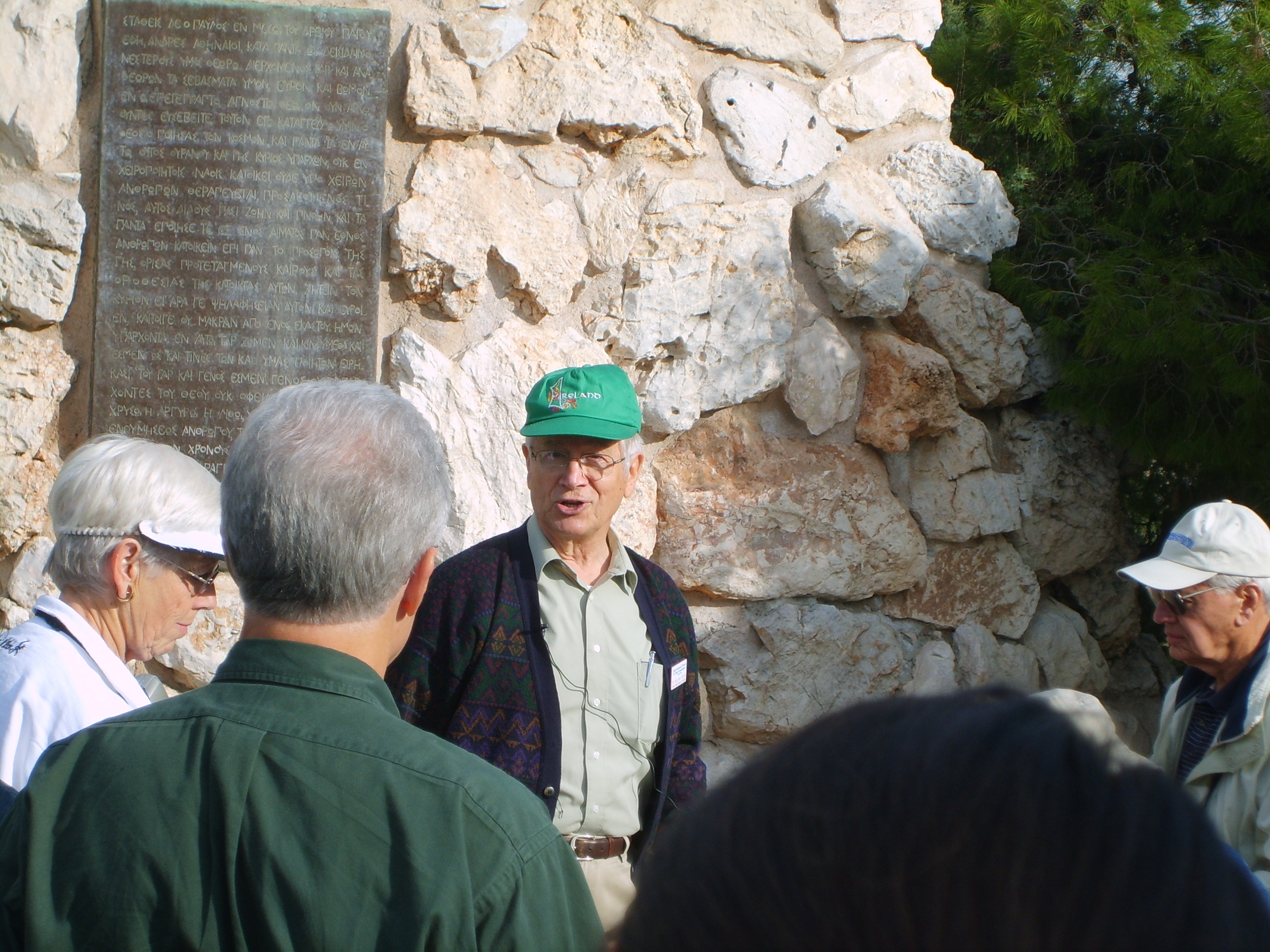
Some of the audio files also include recordings of Dr. William Tolar (more on his credentials later), interspersed throughout. He is equally interesting, considering he is a retired professor of Biblical Backgrounds from Southwestern Baptist Theological Seminary. In the image above, Dr. Tolar is standing at the foot of the Areopagus in Greece, the site where Paul preached the famous sermon about the “Unknown God” of the Athenians (Acts 17:16-34). The Greek text of Paul’s sermon is inscribed on the plaque over Dr. Tolar’s shoulder.
Here’s Where Jesus Cleansed the Temple
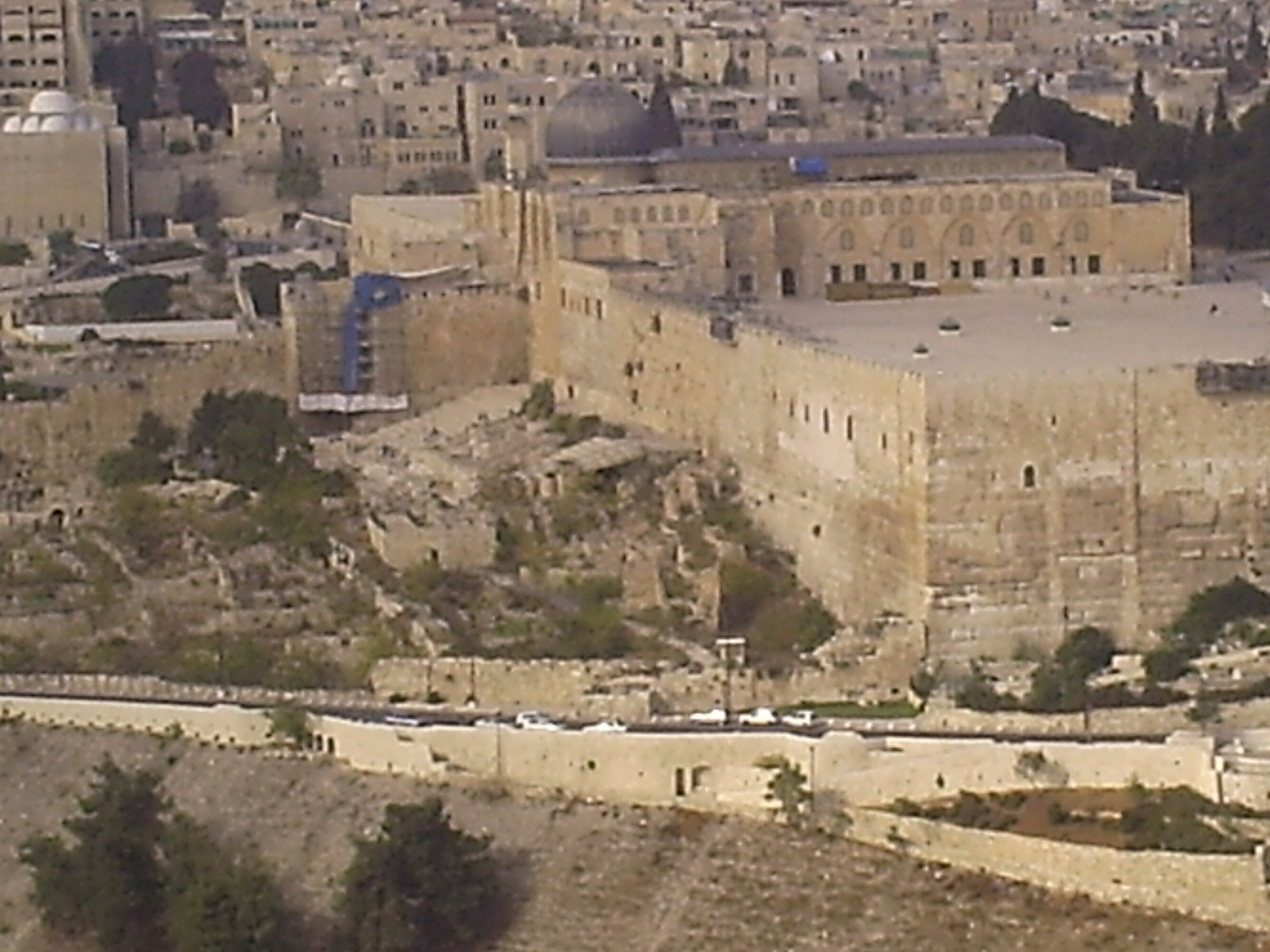
Do you see what appear to be the ruins of ramps outside that wall in the center of the picture? Our guide told us that used to be the porch leading to the temple complex where moneychangers gathered. Which means it’s the place where Jesus exhibited his zeal for his Father’s House and cleansed the Temple and dared them to crucify him, the True Temple, so that he may rebuild the Temple of his body on the third day, obtaining eternal redemption and assuring us who believe of our justification on the basis of the righteousness of Christ alone!
Jesus Cleanses the Temple (John 2:13-22)
13 The Passover of the Jews was at hand, and Jesus went up to Jerusalem. 14 In the temple he found those who were selling oxen and sheep and pigeons, and the money-changers sitting there. 15 And making a whip of cords, he drove them all out of the temple, with the sheep and oxen. And he poured out the coins of the money-changers and overturned their tables. 16 And he told those who sold the pigeons, “Take these things away; do not make my Father’s house a house of trade.” 17 His disciples remembered that it was written, “Zeal for your house will consume me.”
18 So the Jews said to him, “What sign do you show us for doing these things?” 19 Jesus answered them, “Destroy this temple, and in three days I will raise it up.” 20 The Jews then said, “It has taken forty-six years to build this temple, and will you raise it up in three days?” 21 But he was speaking about the temple of his body. 22 When therefore he was raised from the dead, his disciples remembered that he had said this, and they believed the Scripture and the word that Jesus had spoken.
Some good, and some not-so good pix
Herod’s Vaults at his Caesarea palace complex on the Mediterranean shore facing Rome, his own personal Mecca! Click the following images to enlarge.
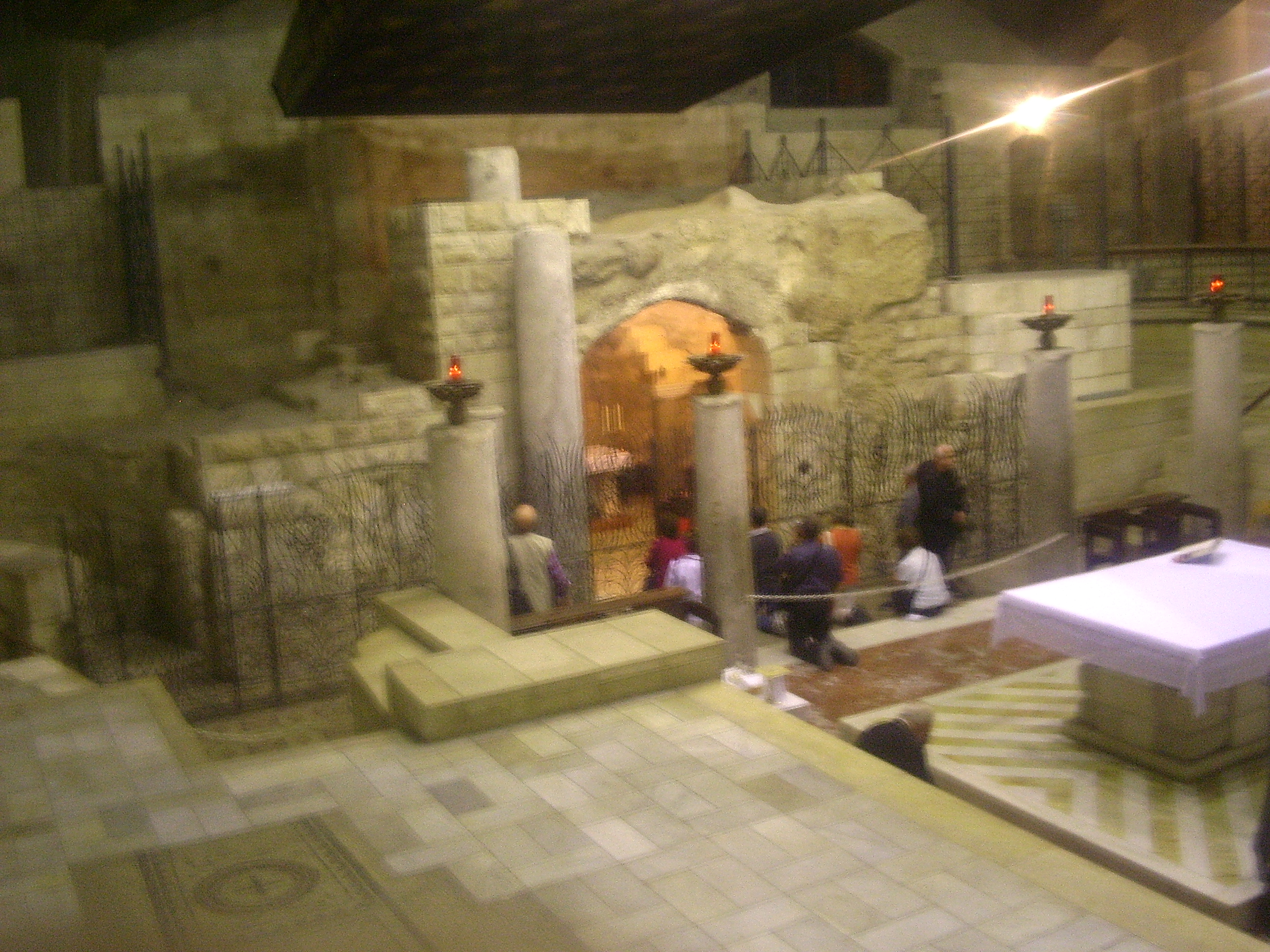
Mary’s Home, Church of the Annunciation in Nazareth
The Sea of Galilee, from our boat ride

Dr. William Tolar at Corinth part 2
Here’s a second excerpt from Dr. Tolar’s remarks at the ruins of Corinth in Greece.
Dr. William Tolar at Corinth part 1
I took this video at the Ancient Corinth Archaeological Site and Museum, the ruins of the New Testament city of Corinth. Dr. Tolar was lecturing on passages relevant to the city. Unfortunately, I didn’t get the entire lecture, but at least you can get a taste of what our group was treated to. Later I’ll post more on Dr. Tolar so you can get to know him better.
There are a couple of other good videos featuring more of the Ancient Corinth Archeological Site at AncientCorinth.net.
The Current Bethlehem Experience

Misadventures with Egyptians
 I have to get this off my chest before I can enjoy blogging about all the positive aspects of my Holy Land Tour. It’s appropriate that I should post about this early in my vacation blogging, because, when we finally got to Egypt after about 9 days of touring Greece and Israel, I found myself wishing we’d visited Egypt first. The reason I wished we’d toured Egypt first was because then I would have had the energy and enthusiasm to enjoy Egypt in spite of the Egyptians. I know, criticize me for complaining. I agree with you. But sure enough, our visit in Cairo, Egypt (boasting a citywide population of 20 million citizens!), for me, at least, was a two-day misadventure. I definitely dug the pyramids and the Sphinx and the boat rides on the Nile (accept of course for the sail boat without wind in which we spun around and around in circles!)

First of all, the border agents weren’t very patient with the little, old ladies who were chatting in the line waiting to show them their passports. If they weren’t paying attention when the agent was ready for them, he’d invariably slam his fist on the counter and snap at the women to get their attention and grouchily command them to approach the counter. I must say I found myself less than edified by this repeated experience.


 Second of all, once we got on our bus and entered the city, and noticed what a war zone the working class section of town looked like, and learned the reason for the dilapidated appearance of most of their otherwise functional buildings, I went from annoyed to appalled! Our Egyptian tour guide informed us that in the less affluent side of town, the city government doesn’t charge taxes on buildings that are being built until the building is completed. Naturally, since it is an economic law that taxing a behavior discourages that behavior, many of the builders lost all motivation to complete their buildings to avoid paying their taxes–much to the detriment of the Cairo skyline!
Then there was all the traffic! Did I mention there are twenty million people living in Cairo, Egypt? Did you know that there are only seven more than that living in the entire state of Texas? Twenty million Cairo citizens–and they’re all stuck in traffic everywhere you go. Which means they’re all laying on their horns and trying like the dickens to get around anything and everything in their way. To add excitement to the mayhem, because the traffic is so congested, no one can really go that fast anyway, so pedestrians feel free to jaywalk anywhere they please, weaving in and out between the sardine-packed parking lots full of cars they call streets. Plus, realizing there’s safety in numbers some of them would join arm in arm in groups of about five or so, and step out into traffic to do their jaywalking. Then there were the children chasing our bus down the street like a pack of dogs! But to pump a little sunshine into this post, at least many of them were very happy to see busfuls of Americans and their wallets coming into town. We did quite often see happy Egyptians waving enthusiastically at us everywhere we went.
Another group of Egyptians who were glad to see us were the extremely aggressive souvenir salesmen whom you simply couldn’t make eye contact with, let alone discuss the price of their wares, unless you’re ready to lay down some cash! If they can’t get your attention, some of them will assure you they aren’t looking for money when they offer to take your picture with your camera, only to then stick their hand out and start asking for money once they’ve provided their neighborly service. God is so gracious with me. Would that I could have founnd such compassion for my neighbors, the Egyptians!
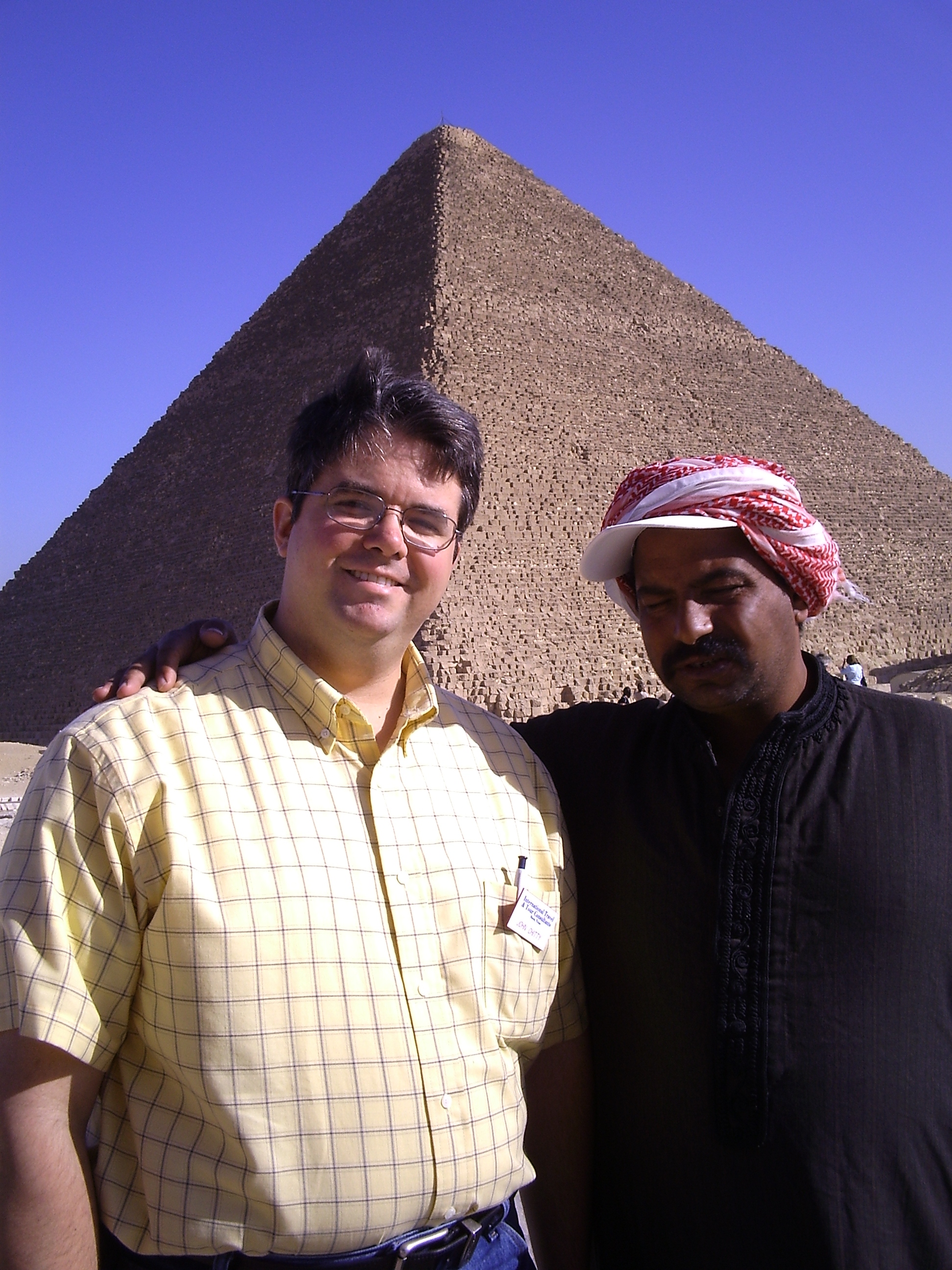


 The Misadventures of Captain Headknowledge