What Illuminates Your Path?
Mark Dever, pastor of Capitol Hill Baptist Church in Washington, D. C., the successor to Dr. Carl F. H. Henry, founder of 9Marks Ministries , and speaker at bi-annual “Together for the Gospel” conferences, has written a great post on “The Bondage of Guidance,” in which he bursts the bubble of those who don’t realize that waiting for God’s “still, small voice” to direct all of your decision making, is really a form of mysticism which can undermine the sufficiency of Scripture. Many have heard this practice prescribed from pulpits for so long, that even those who confess faith inthe sufficiency of Scripture are among its chief proponents and practitioners.
Subjectivism reigns among modern American Christians. Otherwise orthodox believers who grew up being taught the memory verse, “Thy word is a lamp unto my feet, and a light unto my path” (Psalm 119:105, KJV), even having grown up singing these words with Amy Grant, yea, and even the generations prior to ours, regularly turn from the objective divine guidance recorded for them in the Bible, praying for wisdom and acting on their “sanctified common sense,” and wait with Elijah to mystically hear God speak directly to them in the “still, small voice” to guide them in their daily decision-making process.
Nothing will do our systems better than to give them a good flushing out with some Bible-based objectivism. Read Dever’s post (linked above), and then go over to the blog of my buddy, Gage Browning’s church, Grace Community Presbyterian Church and read the helpful discussion of this same post in their post, “What To Do, What To Do . . . “
But first, here’s an excerpt from Dever’s sage counsel on seeking guidance from God’s will:
I do believe that God’s Spirit will sometimes lead us subjectively. So, for instance, I am choosing to spend my life here on Capitol Hill because my wife & I sensed in 1993 that that is what God wanted us to do. However, I realized then (and now) that I could be wrong about that supposition. Scripture is NEVER wrong.
There is also some interesting and relevant discussion about the general tendency of American Christianity toward gnostic-like mysticism in yesterday’s episode of the White Horse Inn to which I have linked in the sidebar. About twenty-one minutes into the program, host Michael Horton quotes the provocative words of a critic of American Christianity which we discount to our own discredit:
‘Whatever the stated doctrinal positions that stated American Evangelicalism shares with historic Christianity, Mormons and Southern Baptists call themselves Christians, but, like most Americans, they’re closer to ancient gnostics than to early Christians.
(Gulp!)
First Edition of the Daily Evangel Rolls Off the Press!
 Spider-Man has the Daily Bugle; Superman has the Daily Planet; now, your (all ten of you) favorite Reformed superhero, Captain Headknowledge features a newspaper of his own . . . The Daily Evangel!
That’s right: The Daily Evangel. I thought this would not only be a clever imitation of Clark Kent’s newspaper, but that it would also be a daily reminder to those of you who believe in Christ-Centered Preaching, and Living the Cross-Centered Life, to “preach the gospel to yourself.”
I know that a few days ago, I set up RSS feeds to Reformation Theology and Out of Ur, to direct you to more solid Reformed reading and to keep your finger on the pulse of “The State of Evangelicalism.” Well, the idea took root in that condition, but now it is bearing fruit in a different form.
Just under the list of pages in the sidebar, you’ll notice the Daily Planet-like logo of the Daily Evangel, under which will follow the ESV Daily Bible Verse, “Reformed News & Views,” featuring the RSS feed from Reformation21, and “Evangelical News & Views,” featuring that of Christianity Today Magazine. I’m toying with politics and sports (don’t get excited, guys, sports to me is arguing theology–hint-hint!), but those sections haven’t gelled just yet, so, to mix my metaphors, “stay tuned.” In the meantime, I hope you benefit from the daily short Scripture reading and from keeping up with current events and “commentary” on the Reformed and Evangelical fronts in the headlines of the Daily Evangel–and most of all, don’t forget to preach the gospel to yourself everyday to strengthen your faith and sanctification!
First Christmas, Easter and Halloween . . . now the pastorate?
 Look at the bottom of my sidebar. I’ve added a couple of RSS Feed widgets. One links to the blog, “Reformation Theology,” where you can find some pretty good reading on Reformed theology, by folks more experienced at expounding it to you than I am. With this feed I’m attempting to, as they say, “light a light.”
The other feed, conversely, is where I, if you will, “curse the darkness.” It’s a link to “Out of Ur,” the blog of “Christian Leadership” Magazine, a subsidiary of “Christianity Today”. It may help us keep our finger on the pulse of the spiralling state of evangelicalism. What I want you to see specifically are the links to “Pagan Christianity” and “Is the Pastorate Pagan?” These deal with a new book called Pagan Christianity?, that has recently been published, co-written by Frank Viola and George Barna, author of Revolution. If you look for them after today, it probably won’t be in my sidebar anymore, but you’ll have to search the archives at “Out of Ur” for these articles.
Since the release of Barna’s book, I’ve been concerned with how addicted most churches seem to be on Barna’s polling of Christianity. Knowing what we now know from his book, Revolution, about his belief that the institutional church is irrelevant, and individuals need to rather “be the church” individually (which is an oxymoron), I fear that his statistical research is actually used to promote this ideal. I submit, either evangelicals who are faithful to God’s Word and historic orthodoxy ought to find other sources for such statistical information, or give up entirely the need to tell us from the pulpit what the latest statistics are that relate to whatever it is that is being preached about on any given Sunday.
So the rolling snowball of Barna’s “Revolution” is growing; with the help of Frank Viola, not only is church irrelevant, traditional forms of church ministry are pagan! Or, so they would have you believe.
Evangelicals are living in perilous times (2 Timothy 3:1-17).
From “Feed My Sheep” to “Self-Feeders”

 The following is an excerpt of the concluding remarks of the White Horse Inn from yesterday’s program, “What Would Moses Do?” dated, Sunday, February 17, 2008 (see sidebar for link to program). About the modern evangelical tendency to do anything and everything but the one simple thing Jesus asked the church to do–feed his sheep the Word of God, which Peter would go on to write, “the Word of God is the Gospel which we preached to you” (1 Peter 1:25b)
Horton: Now, the Bible is God’s instruction book. And that’s how a lot of people talk about it. Or it’s the owner’s manual. Well, what is an owner’s manual? An owner’s manual is a guide you go to that tells you how to fix your car. Folks, that’s the wrong category. The Bible is not primarily God’s instruction book. It has instructions, and they need to be preached, but it is not primarily that. In fact, the Bible is silent about half of the things that preachers want to talk about on Sunday morning when it comes to the practical. I can get a lot more help from Susie Armand about my finances than Bill Hybels.
Jones: Or diets, or things of that nature.
Horton: Yeah! I don’t need a Christian diet—I need a Christian gospel if you’ve got that. Tell me something I can’t get from Oprah or Dr. Phil.
Jones: Preaching is feeding time for the whole family.
Horton: Boy, isn’t that the case?
Riddlebarger: It should be!
Horton: But according to the latest study by Willow Creek Community Church, they concluded because their most active members said they were dissatisfied with their church—they concluded, “We gotta wean people off of the church. What this tells us is, as you mature, you need the church less.” They didn’t take away from that, they actually were not providing the nutrients that those people needed, even though they actually said in their surveys, “Not deep enough Bible teaching or worship.” Willow Creek concluded from that, “Yep. We’ve gotta make people ‘self-feeders.’” We’ve got to make it where they don’t have to depend on the church, whereas, Jesus said, “Peter, before I go—I know it’s you—I know you can’t handle a lot—I’m asking you to do one thing and do it well. Feed my sheep.”
The one thing Jesus asked the church to do. And Willow Creek says we need to teach people to become self-feeders. That is, at the end of the day, what moralistic therapeutic deism does. When you preach the law as gospel, people can find their own good advice on the internet.
The Sign of Jonah: What Christ’s Resurrection Says About Jesus, Believers and Unbelievers
 Matthew 12:38 Then some of the scribes and Pharisees answered him, saying, “Teacher, we wish to see a sign from you.”
-
They just saw him cast a demon out of a blind and mute man, and they said he did it by the power of the devil. But it was really a sign that the kingdom of God has come, and they refused to believe it and will be judged. He also said they said bad things about him because they don’t believe and don’t want to repent. Like a bad tree bears bad fruit, so does a bad heart speak unbelieving, sinful words in response to God’s Word.
-
Having seen and denied a sign, they want one done on demand, wanting to condemn him if he doesn’t.
39 But he answered them, “An evil and adulterous generation seeks for a sign, but no sign will be given to it except the sign of the prophet Jonah.
-
They are not true children of Abraham, but of the devil (John 8:39-47). Abraham heard the gospel and believed, they hear it and deny it, because they are not of God.
-
Jesus won’t do tricks on demand, so the only sign they get is a reminder of a past prophet.
40 “For just as Jonah was three days and three nights in the belly of the great fish, so will the Son of Man be three days and three nights in the heart of the earth.
-
Jonah signifies Jesus in that he experienced a kind of death and resurrection over a three-day period just as Jesus would one day.
-
The resurrection is one of the most important teachings about Jesus there is in the Bible: 1) it tells us things about Jesus: a. His claims as Judge and Savior are true (Acts 17:31; 1 Cor. 15:1-11, 20) b.Jesus’ victory over death (Acts 2:24; 1 Cor. 15:54-57) c. Jesus’ righteousness (John 16:10) d. Jesus’ deity (Romans 1:4) e. Jesus’ resurrection leads to his ascension and enthronement, so identifies him as King (Acts 1:9-11; 2:33-34; Phil. 2:9-11; cf. Isa. 53:10-12) f. Jesus is our Great High Priest forever (Heb. 7:16-17) 2) it tells us things about believers: a. Signifies their forgiveness and justification (Romans 4:25; 1 Cor. 15:17;Heb.7:24-25) b.Signifies their hope of resurrection in the future (Romans 6:4-11; 1 Cor. 15:42-57) c. Signifies their life to God and death to sin, the power of which is defeated by the resurrection (Romans 6:11). Believers can resist temptation, if you remind yourself of the fact that Jesus’ resurrection means sin is not your lord anymore. d. Without it, their faith would be worthless, they’d still be condemned to suffer the consequences of their own sin, and have no hope of eternal life in resurrected bodies (1 Cor. 15:12-20).
3) it tell us things about unbelievers (See following verses):
41 “The men of Nineveh will rise up at the judgment with this generation and condemn it, for they repented at the preaching of Jonah, and behold, something greater than Jonah is here.
-
Jesus’ resurrection signifies that the unrepentant will suffer the consequences of their sins, because they rejected the preaching of the greatest Prophet, whereas the people of Ninevah repented at the preaching of Jonah.
42 “The queen of the South will rise up at the judgment with this generation and condemn it, for she came from the ends of the earth to hear the wisdom of Solomon, and behold, something greater than Solomon is here.
-
To add weight to this testimony, Jesus refers to another example of Gentiles gladly receiving from types of Christ, and this fact makes the scribes’ and Pharisees’ rejection of Jesus that much more dangerous to them.
-
Remember that when you hear the Word of God, God will judge you on whether you believe his promises, and whether you repent and obey when you hear his commands. If you love Jesus, you will believe what he says, like Abraham, and you will obey his commands.
Corinthian Creed Added to My Box
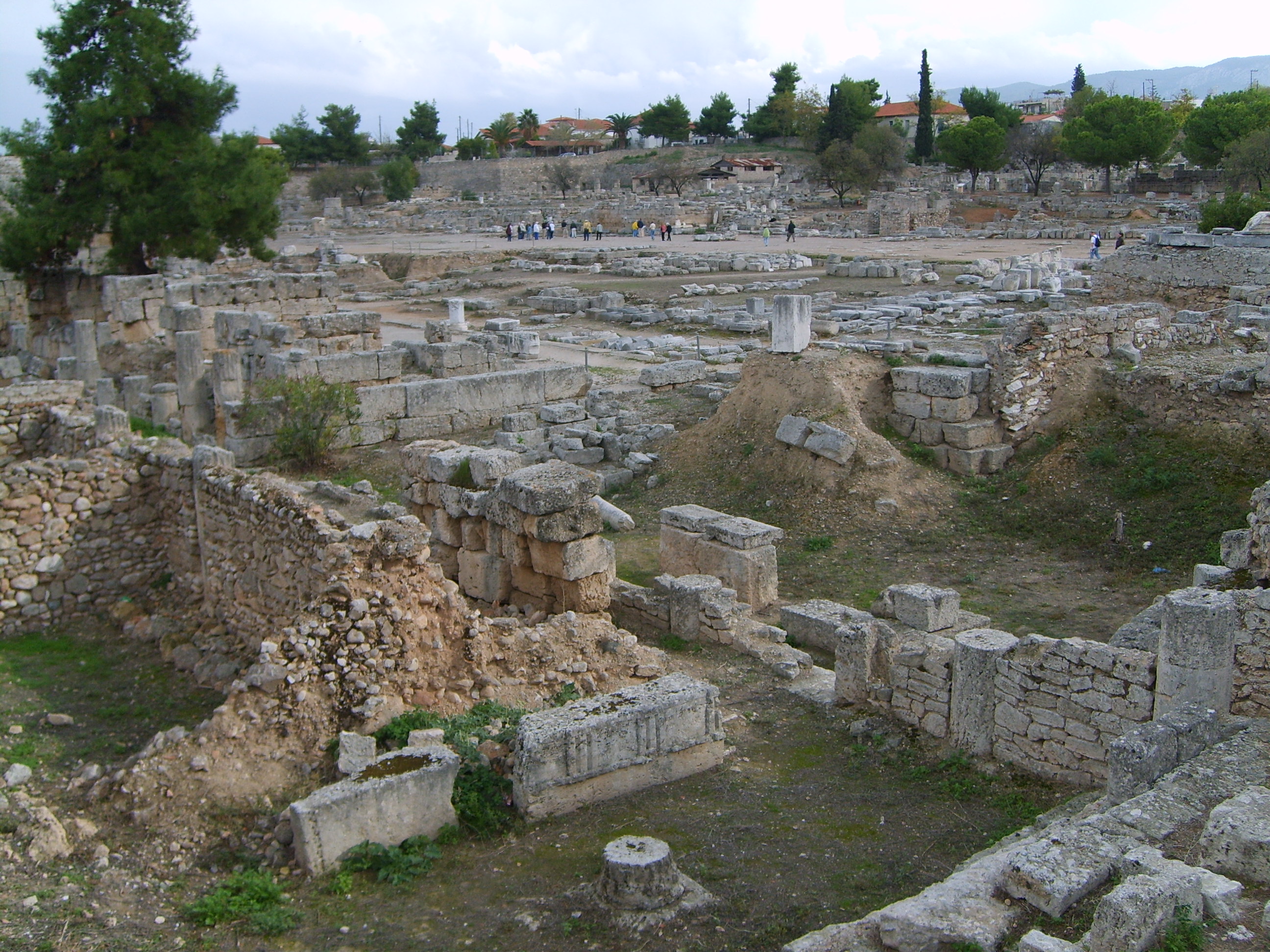
Over in my sidebar, you will find the recording made of the quartet who performed the song, “Corinthian Creed,” which I wrote to summarize the teaching of 1 Corinthians 15 on Paul’s defense of, teaching about and exhortations in light of the resurrection of Christ and our future resurrection at his Second Coming. Just find the black box on the lower right side of this page and select the file at the top of the list called “Corinthian Creed” and you’ll be able to hear our performance.
For a further introduction, read what I wrote about it back on September 30, 2006. Above, you may enjoy a view scanning across the ruins of Ancient Corinth which I shot on my Holy Land Tour in November of 2007, of which, more pictures are available for viewing in my Flikr photo box which is also in the sidebar to the right.
Theological & Doxological Meditation #43
 Decalogue’s Preface
 White Horse Inn “Webisodes” on YouTube
“One of the most urgent tasks facing Evangelical Christendom today is the recovery of the gospel.” – J.I. Packer
The quote above is featured under the title of a blog called, “Recover the Gospel.” Kim Riddlebarger, pastor of Christ Reformed Church in Anaheim, California, co-host of the White Horse Inn Radio Show, and Reformed Blogger extraordinaire, directed his readers to the Recover the Gospel website where they have prepared a series of videos featuring the past two weeks’ episodes of the White Horse Inn for viewing on YouTube.
For those who aren’t aware, The White Horse Inn is a “theological talk show” advocating a return to the solid doctrine and practice of the Calvinist and Lutheran traditions which were foundational to Protestantism. They’re call is for every believer to “Know What You Believe and Why You Believe It.” This is an important message for this generation for very obvious reasons.
What passes for Protestant Christianity nowadays is often hardly Protestant, and some of it does not even legitimately pass as Christian. Here in America, pragmatic and entertaining methods often trump and undermine the validity of the Christian message. Whether we know it or not, Christianity in America is experiencing a “Dark Ages” of its own, because biblical illiteracy and ignorance of Christian history is so rampant that most American Christians are adrift in a see of error which they cannot discern and which is endangering their very souls. The Gospel is in desparate need of recovery in our day, and I urge you to begin your own examination of your personal beliefs with Scripture and historically orthodox resources, making an effort to see how different yours and your church’s views may or may not be from the generations of faithful Protestant Christians who’ve gone before us (which era ended sometime early in the nineteenth century).
I have embedded part one of the YouTube presentation of The White Horse Inn’s recent episode called, “That’s Entertainment,” where the hosts discuss the history of the development of entertainment as a form of ministry in America. You will be introduced to such folks as Charles Finney, Aimee Semple McPherson and Billy Sunday and you will see how what passes for ministry nowadays comes from a long line of unorthodox ministers who were acting in a manner consistent with their unbiblical beliefs. It is simply unacceptable that churches with otherwise orthodox doctrine should emulate such people and attempt to glean so-called “wisdom” from the methods of “successful” “ministers” like these. But back at Recover the Gospel, you’ll find a similar YouTube presentation of the previous White Horse Inn episode which analyzed the errors of Joel Osteen, pastor of the largest church in America.
Pray for your church, pray for your family, and pray that the Lord will give you the wisdom to search the Scriptures daily to see whether the things you are being taught on an ongoing basis are so.
Reforming Your Best Life Now
 January 31, 2008 was the release date for J. I. Packer’s latest short book, Keeping the Ten Commandments, published by Crossway. I was notified by Amazon.com a few days before its release and immediately placed the order. Now that it’s in my hands, and I’ve begun reading it, I would like to recommend the book to you as a great introduction to the Reformed theology of the relevance of the Ten Commandments in the Christian life. At the same time, it will serve as a great antidote to the man-centered, motivational self-help pop-psychology that passes itself off nowadays as teaching on practical Christian living, or the victorious Christian life. In other words, set aside your “What Would Jesus Do” moralism, Osteen’s “Your Best Life Now,” and anything else that fits in that category and go straight to the source, the Ten Commandments, and learn how to properly apply it to your life as a Christian.
Some may wonder what place the Law has if Christ has fulfilled the Law, and the New Testament says simply to “love one another.” This book will explain it to you. The New Testament didn’t eliminate the Christian’s need to be regulated by God’s moral Law. True Christ-centered living involves a certain kind of reference to the Ten Commandments. I call it the “Law-Gospel Cycle”: The Law points to the Gospel that sinners may be justified by grace through faith; the Gospel points saints to the Law that they may be sanctified by grace through faith which works by love. But enough of my misadventures in exposition, I want you to see some excerpts from Packer himself.
Rightly, Reformation theology did not separate God’s law from God himself, but thought of it personally and dynamically, as a word that God is continually publishing to the world through Scripture and conscience, and through which he works constantly in human lives. Spelling out this approach, Reformed theologians said that God’s law has three uses or functions: first to maintain order in society; second, to convince us of sin and drive us to Christ for life; third, to spur us on in obedience, by means of its standards and its sanctions, all of which express God’s own nature (p. 110).
For the Commandments are God’s edict to persons he has loved and saved, to whom he speaks in “I-you” terms at each point. “I am the LORD your God, who brought you out . . . You shall . . . ” The ten directives, which embody the Creator’s intention for human life as such, are here presented as means of maintaining a redeemed relationship already given by grace. And for Christians today, as for the Jews at Sinai, law-keeping (that is, meeting the claims of our God, commandments 1-4, and our neighbor, commandments 5-10) is not an attempt to win God’s admiration and put him in our debt, but the form and substance of grateful, personal response to his love (pages 30-31).
Place your order soon. It’s a great eight-to-ten dollar investment in Reforming your best life now for God’s glory.
At Last! The Captain on Luther–Audio!

 On Reformation Sunday, 2004, which happened to be Reformation Day itself, my
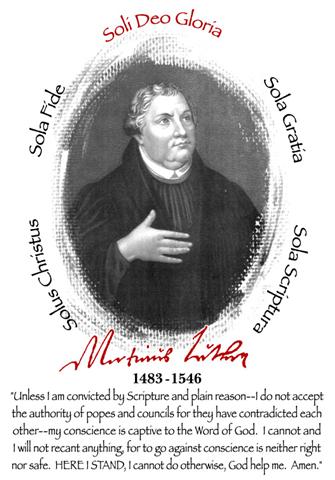 Southern Baptist pastor allowed me to give an oral presentation on Martin Luther at church. Not being a trained, or even talented, speaker, I desired a crutch, so I put together a Power Point slide show to illustrate my presentation. I thought it would also help me make it through my outline as well. I always hoped I’d be able to share it with you, but back when I did the show, I was even more green computer-wise than I am now, so I just recently figured out how to get one of those “My Public Box” thingies in my sidebar and uploaded it. If you’d like to listen, you are certainly invited.
Some of you Luther scholars out there may detect a less than accurate date or fact or two, but give me a break, I’m an amateur. I did what I could with what I had. So, without further ado, if you go over to the black box in the sidebar and click on the top selection, entitled “Reformation Sunday and Gideon Report” (that’s right those Gideons, remeber them?), then you can give it a listen. I know it’s not October or anything, but some of you may enjoy it, if you like mediocre speaking. You can also view the slide show below. . .
Theological & Doxological Meditation #42
The Decalogue’s Sum
Q. What is the sum of the ten commandments?
A. The sum of the ten commandments is, To love the Lord our God with all our heart, with all our soul, with all our strength, and with all our mind; and our neighbor as ourselves (Matthew 22:37-40).
Take Thou Our Minds, Dear Lord
#593, Trinity Hymnal (© 1990)
William Hiram Foulkes, 1918
SURSUM CORDA 10.10.10.10.
George Lomas, 1876
Take thou our minds, dear Lord, we humbly pray; give us the mind of Christ each passing day; teach us to know the truth that sets us free; grant us in all our thoughts to honor thee.
Take thou our hearts, O Christ, they are thine own; come thou within our souls and claim thy throne; help us to shed abroad thy deathless love; use us to make the earth like heav’n above.
Take thou our wills, Most High! Hold thou full sway; have in our inmost souls thy perfect way; guard thou each sacred hour from selfish ease; guide thou our ordered lives as thou dost please.
Take thou our selves, O Lord, mind, heart, and will; through our surrendered souls thy plans fulfill. We yield ourselves to thee—time, talents, all; we hear, and henceforth heed thy sov’reign call.
John Calvin’s Theology: The Rest of the Story
Those who disagree with the Calvinist view of election and reprobation,
 and object to “Calvinism,” per se, usually seem to not realize just how much more there is to Calvinism than his systematization of the Augustinian (i.e., from the 4th century) doctrine of grace versus the Pelagian notion of free will (which comes complete with its own false gospel of works-righteousness). Baptists in particular, who deny the “doctrines of grace,” don’t realize just how much leftover Calvinism there is in their current theology. Those that do, recognize that they are technically categorized as “moderate Calvinists.” Chief among these is what is nowadays called “eternal security.”
Also, there’s the doctrine of original sin, the Biblical doctrine that Adam’s guilt was imputed to all of his descendants, which sinful condition manifests itself in outward sinful acts. Most Baptists today affirm original sin, and they do so because the Baptists who migrated to America were originally Calvinists. Those “General Baptists,” whom modern anti-Calvinistic Baptists sometimes erroneously look back to as their forefathers in the faith, collectively fell away from the faith, and their theological descendants can be found today among modern Unitarianism.
As a proof for this claim, consider the following words from the Wikipedia entry on the General Baptists, to which I linked above: ” . . . traditionally non-creedal, many General Baptist congregations were becoming increasingly liberal in their doctrine, obliging the more orthodox and the more evangelical among them to reconsider their allegiance during this period of revival (Edward’s, Whitefield’s and Wesley’s 18th century First Great Awakening). Before this re-organisation, the English General Baptists had begun to decline numerically due to several factors linked to non-orthodox ‘Free Christianity’. Early Quaker converts were drawn from the General Baptists, and many other churches moved into Unitarianism. . . “
Those General Baptists denied original sin. For example, John Smyth, (first to pastor a church called “Baptist” shortly before he cast his lot with the Mennonites) wrote in his Confession of Faith in 1609 that, “there is no original sin (lit;, no sin of origin or descent), but all sin is actual and voluntary, viz., a word, a deed, or a design against the law of God; and therefore, infants are without sin.” Modern anti-Calvinistic Baptists generally (no pun intended) affirm original sin, and this is because the Baptists from which you descend were originally Calvinists.
Eternal security and original sin managed to stick around because they weren’t offensive enough to undermine the outward results of mass evangelism, the way the doctrines of grace seem to. We have “revivalism” to thank for that. Read Revival and Revivalism: The Making And Marring of American Evangelicalism, by Iain Murry of Banner of Truth Trust, and you’ll learn how the TULIP got plucked in the wake of the Second Great Awakening as otherwise orthodox Christians began to adopt the methods of arch-Pelagian Charles Finney’s “new measures” in order to maximize the effectiveness of their ginned-up revivals.
But enough introduction. What I wanted to point out was just how pervasive Calvinist theology defines modern Baptist and otherwise Evangelical theology. In my last post, I linked to an essay written by B. B. Warfield entitled “Calvin As A Theologian.” This essay was written to set the record straight about all the common misconceptions that have been fabricated by anti-Calvinists in order to not only disagree with the “five points of Calvinism” (aka, TULIP, the doctrines of grace, etc.) but make those under their spiritual care despise Calvin himself and just about everything he stood for. Read Warfield’s introductory remarks, and then go read the entire article:
I am afraid I shall have to ask you at the outset to disabuse your minds of a very common impression, namely, that Calvin’s chief characteristics as a theologian were on the one hand, audacity—perhaps I might even say effrontery—of speculation; and on the other hand, pitilessness of logical development, cold and heartless scholasticism. We have been told, for example, that he reasons on the attributes of God precisely as he would reason on the properties of a triangle. No misconception could be more gross. The speculative theologian of the Reformation was Zwingli, not Calvin. The scholastic theologian among the early Reformers was Peter Martyr, not Calvin. This was thoroughly understood by their contemporaries.
Among the things that we have inherited from Calvinist theology include the following (as Warfield reports):
-
“In one word, he [Calvin] was distinctly a Biblical theologian, or, let us say it frankly, by way of eminence the Biblical theologian of his age. Whither the Bible took him, thither he went; where scriptural declarations failed him, there he stopped short.”
-
“Calvin marked an epoch in the history of the doctrine of the Trinity, but of all great theologians who have occupied themselves with this soaring topic, none has been more determined than he not to lose himself in the intellectual subtleties to which it invites the inquiring mind; and he marked an epoch i the development of the doctrine precisely because his interest in it was vital (that means “spiritual,” or “devout”) and not merely or mainly speculative.”
-
“The fundamental interest of Calvin as a theologian lay, it is clear, in the region broadly designated soteriological. Perhaps we may go further and add that, within this broad field, his interest was most intense in the application to the sinful soul of the salvation wrought out by Christ, — in a word, in what is technically known as the ordo salutis. . . Its [Calvin’s Institutes]effect, at all events, has been to constitute Calvin pre-eminently the theologian of the Holy Spirit.”
-
“He also marks an epoch in the mode of presenting the work of Christ. The presentation of Christ’s work under the rubrics of the three-fold office of Prophet, Priest and King was introduced by him: and from him it was taken over by the entirety of Christendom, not always, it is true, in his spirit or with his completeness of development, but yet with large advantage.”
-
“In Christian ethics, too, his impulse proved epoch-making, and this great science was for a generation cultivated only by his followers.”
-
“It is probable, however, that Calvin’s greatest contribution to theological science lies in the rich development which he gives–and which he was the first to give–to the doctrine of the work of the Holy Spirit. “
-
Finally, here’s Warfield’s summary of Calvin as a theologian: “It has been common (among academic theologians, not pastors and laity who love to hate Calvin) to say that Calvin’s entire theological work may be summed up in this–that he emancipated the soul from the tyranny of human authority and delivered it from the uncertainties of human intermediation in religious things: that he brought the soul into the immediate presence of God and cast it for its spiritual health upon the free grace of God alone.”
-
And of Calvin’s masterpiece, The Institutes of the Christian Religion, Warfield summarizes: “The Institutes is, accordingly, just a treatise on the work of God the Holy Spirit in making God savingly known to sinful man, and bringing sinful man into holy communion with God.”
Far from being some cold, depressing, rigidly logical and academic murderer (we mustn’t forget Servetus!), Calvin was recognized by his peers and his entire generation as an eminently devout and spiritual biblicist whose development of Protestant theology built on the shoulders of Augustine, Anselm, Hus, Bradwardine, Wycliffe, and Luther and helped make Western Civilization what it became in its historical greatness. All by the grace of God, and for his glory alone!
Reformed Theology Coming to an SBC Church Near You!
On January 11, 2008, the Baptist Press posted a report by Michael Chute, entitled, 
-
“. . . ten percent of Southern Baptist pastors (currently) identify themselves as Calvinists.”
-
“. . . 29 percent of recent SBC seminary graduates espoused Calvinist doctrine.”
-
“. . . a minority of SBC churches are led by Calvinist-leaning pastors, but the number is increasing”
-
“. . . Calvinist-led churches are generally smaller in worship attendance and baptisms than non-Calvinist churches.”
-
“. . . baptism rates between Calvinist and non-Calvinist led churches are virtually identical.”
-
“. . . Calvinistic recent graduates report that they conduct personal evangelism at a slightly higher rate than their non-Calvinistic peers.”
-
A PDF file of the full report is posted here.
Also of interest in the report, Chute quoted Hal Poe, Charles Colson Professor of Faith and Culture at Union University in Jackson, Tennessee, who paints a picture for us of the recent historical trends within the SBC which have led to the current circumstances. “In a broad sense, it’s happening on Christian college campuses too, as Calvinism appeals to young people who are wanting a more intellectual approach to Christianity . . . . Southern Baptists neglected serious Christian education from the early 1960’s, and that’s when all the trouble started. From discipleship training we went to the amorphous youth groups, whose only real good was to keep kids happy until they graduated from high school and graduated from church. Now, you have a generation [of college students] who have come along and want something deeper and they have latched onto Calvinism.”
Poe goes on to site “John Piper, a Reformed Baptist theologian, preacher and author who currently serves as pastor for preaching and vision of Bethlehem Baptist Church in Minneapolis. . . . He’s effective because he’s so passionate. . . He holds huge, stadium-type events that are rip-roaring. There’s nobody else doing anything like this so he becomes [Calvinism’s] expositor. But John Piper’s version of Calvinism is not something John Calvin would espouse, or even that Charles Spurgeon [British reformed Baptist preacher] would espouse.”
It is true that Piper is cut from a different cloth from the great Reformer and the nineteenth-century Puritan “Prince of Preachers.” First of all, it must be noted that Piper is not a Southern Baptist, but a member of the Northern Baptist Convention (Bethlehem Baptist member and Reformed Baptist blogger, Bob Hayton, at Fundamentally Reformed, can correct me on that detail if I’m wrong), where he has been a leader in that denomination’s struggle with the modern heresy known as Open Theism. From my reading of his sermons, Piper may be categorized as a “charismatic Calvinist,” which is more of a doctrinal position than a weekly exhibition of extreme emotionalism in worship, or attempts at exercising the miraculous spiritual gifts of tongues, healing, prophecy, etc., images usually evoked by the term charismatic–though the appeal to emotion seems to be greater in his preaching than in typical Reformed preaching. His experiential emphasis on “desiring God” is in part an application of the answer to the first question in the Westminster Shorter Catechism, which states, “Man’s chief end is to glorify God and enjoy him forever.” But this seems to be little more than a perhaps pietistic reaction against the reputed cold-orthodoxy of many Reformed worship practices.
Another way Calvin would disagree with Piper is in his application of Baptistic principles to Reformed theology, of which, of course, Spurgeon is also guilty. But in this, Piper and Spurgeon are informed by the historic early Baptist confession of faith commonly known as the Second London Baptist Confession of Faith of 1689, which is in large part, a condensing of the Presbyterian Westminster Confession of Faith, with revisions on the statements regarding Baptism. On the other hand, Piper also is embracing the abberant postmodern “emerging” churches–at least the one’s that at least maintain Reformed theology, while seemingly applying seeker-sensitive pragmatic retooling of worship styles to appeal to an “emerging church” demographic. Thus, Piper’s twenty-first century expression of Calvinism does seem to differ from that of Calvin and Spurgeon; however, this Reformed blogger is grateful that such a figure has been able to influence so many Southern Baptists for the doctrines of grace, the biblical emphasis on the sovereignty of God, and his supremacy in all things, including the secular, sacred and even sinful activity of all men.
Joel Osteen: Love Thy Navel
You may or may not notice that I keep updated in my sidebar the
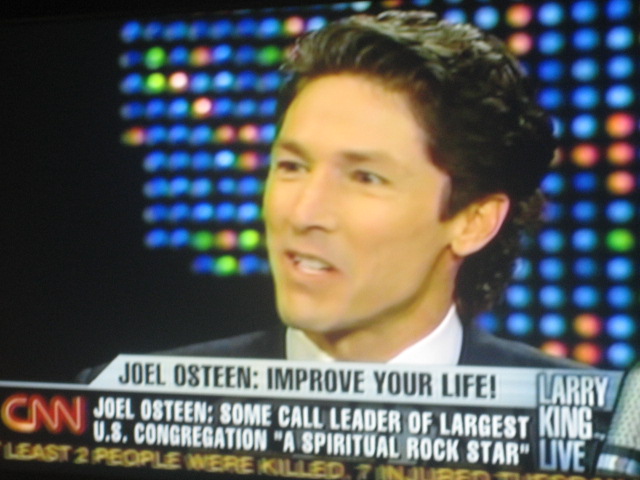


 of the White Horse Inn radio show. This week, I’m not satisfied to just update the sidebar, but I want to impress upon you that you really ought to listen to this week’s program on Joel Osteen, as he is examined as a case study in what Doctors Horton, Riddlebarger, Jones and Rosenblatt call “American Religion.” This is a topic and a problem that affects the way all of us approach our faith and our worship. This timely message needs to be heard and heeded. Don’t miss this week’s episode of the White Horse Inn, for the sake of your soul and the sake of your nation.
Theological & Doxological Meditation #41
Legal Summary
Q. Where is the moral law summarily comprehended?
A. The moral law is summarily comprehended in the ten commandments (Deuteronomy 10:4; Matthew 19:17).
The Ten Commandments
#724, Trinity Hymnal (© 1990)
Versified by Dewey Westra, 1899-1979
Alt. in Psalter Hymnal, 1987
Tune Name: LES COMMANDMENTS DE DIEU 9.8.9.8.
Genevan Psalter, 1547
Arranged by Claude Goudimel, 1564; rev.
My soul, recall with rev’rent wonder
how God amid the fire and smoke
proclaimed his law with thunder
from Sinai’s mountain when he spoke:
“I am the Lord, your God and Sovereign,
who out of bondage set you free,
who saved you from the land of Egypt.
Then serve no other gods but me.
“You shall not bow to graven idols,
for I, a jealous God, your Lord,
shall punish sin in those who hate me,
but love all those who keep my Word.
“The Lord is God; his name is holy.
Do not his holiness profane.
God surely will not hold them guiltless
who take his holy name in vain.
“Remember, keep the Sabbath holy,
the day God sanctified and blessed.
Six days you shall do all your labor,
but on the seventh you shall rest.
“Honor your father and your mother;
obey the Lord your God’s command,
that you may dwell secure and prosper
with length of days upon the land.
“You shall not hate or kill your neighbor.
Do not commit adultery.
You shall not steal from one another
nor testify untruthfully.
“You shall not covet the possessions
your neighbors value as their own;
home, wife or husband, all their treasures
you shall respect as theirs alone.”
Teach us, Lord God, to love your precepts,
the good commandments of your law.
Give us the grace to keep your statutes
with thankfulness and proper awe.


 The Misadventures of Captain Headknowledge