Subscribe To My Misadventures By Email
 I used to use Feedburner as my email subscription service, but now that WordPress has set up their own service, I’ve switched over. If you used to receive email notifications through Feedburner, you probably still will. Somehow, I’ve gotten my wires crossed and can’t access Feedburner anymore, so I can’t yet figure out how to discontinue it. If any of you who aren’t receiving Feedburner emails, and would like to subscribe, just look for the box not far below the Captain’s portrait at the top of the sidebar.
Better Than Thanksgiving Day Football (If You’re Me, That Is…)!

Dr. James R. White's Reformed Twin
As many of you know, and a few others may be disappointed to learn, I’m a life-long Independent Baptist (though currently a member of a Southern Baptist church, by God’s wise and inscrutable providence) who has adopted Presbyterian views. That includes the Presbyterian view of infant baptism. Ever since having adopted this view, in the interests of “givning God a chance” to “make my life easier,” I’ve from time to time done a little more reading on the case for believer’s baptism (aka, credobaptism) as opposed to the Reformed doctrine of infant baptism (aka, paedobaptism). I’ve done so with an open mind, knowing that I’m not the most brilliant theologian in the world, being, after all, an IFB Bible college drop-out. I may just want to believe in paedobaptism, because there’s so much I disagree with (and/or dislike) about the Baptist tradition, so if I’m going to expect my wife and kids to adopt the Reformed view of paedobaptism (which they’ve yet to do, again in God’s wise and inscrutable and gracious wisdom), I’d better be right. So far, every time I’ve entered into this debate with an open mind, I find myself

Dr. R. Scott Clark's Baptist Twin
becoming more and more thoroughly convinced that the Reformed view of paedobaptism is the more biblically consistent view. But, I keep reminding myself, I’ve yet to listen to one of my favorite Reformed Baptists, Dr. James White, debate the subject. Dr. White is one of the more relentless, aggressive and capable apologists and debaters I’ve ever seen. If anyone could dissuade me from the case for paedobaptism, it would likely be him.
It looks like I may soon get my chance.
I just finished reading Dr. James White’s post, entitled “R. Scott Clark and ‘Reformed,'” and Dr. Clark’s response, “Post-Thanksgiving Cartoons: Reply to James White.” White attempted to demonstrate the fallacy of Clark’s refusal to accept Baptists under the umbrella “Reformed” on the basis of his contention that paedobaptism is essential to being Reformed. Naturally, White believes for obvious reasons that he’s more thoroughly Reformed than his Presbyterian and Continental Reformed brethren. Clark believes Baptists may have an affinity for “the five heads of doctrine of the Synod of Dort” (popularly known as the five points of Calvinism), but denies they’re Reformed. For the record, having heard Dr. Clark’s teaching and gotten a glimpse of his personality from interviews and his Facebook page (for example, his status update at one point yesterday read, “I’m not passive-aggressive, I’m just aggressive”), leads me to believe that Dr. R. Scott Clark may just be Dr. James R. White’s Reformed twin (I’ve always contended that my friend, Gage Browning, is White’s Presbyterian twin–there is a difference). It’s all about personality and hairdo. I guess that would make Gage Dr. Clark’s Presbyterian twin, too–but I digress.
Anyway, having read both of these esteemed theologians’ posts, I just wanted to put out there that my appetite is officially whetted for a new debate on credobaptism versus paedobaptism between Drs. James R. White and R. Scott Clark. Who’s with me?
Reformation Day is Coming
A few years ago, I was invited to speak on Martin Luther at church. The following link is a Power Point presentation I made for the event. In the sidebar you can find the audio if you’d like to listen and follow along. Just right click on the slideshow link to open it in another tab or window so you can keep this window open to hear the audio, too. I’d make a bigger deal about it, but this being Calvin’s 500th anniversary year, I’m actually a little done with Reformer retrospectives. But I hope you enjoy mine!
If you prefer, however, you can view the slides and read the text here, and here.
Or just click on Luthermania in the category cloud in the sidebar and browse all my Luther posts and read whichever you prefer.
Happy Reformation Day!
“Prescriptive Retrospective”: Finding Your Way Forward By Looking Back
 “And what you have heard from me in the presence of many witnesses entrust to faithful men who will be able to teach others also.” 2 Timothy 2:2.
History lovers have to appreciate a book that charts the evangelical future by looking back on the life and legacy of a great theologian. Of course, such a strategy of turning back to find your way forward perfectly suits J. I. Packer. As an accomplished historian and theologian, Packer finds cures for what ails contemporary evangelicalism by exploring the contributions of spiritual giants such as the Puritans. So we expect nothing less than prescriptive retrospective from J. I. Packer and the Evangelical Future: The Impact of His Life and Thought, a new book edited by Timothy George.
Christian History Blog: J. I. Packer, Man of God’s Word
Posted using ShareThis
This opening paragraph of a post on the Christian History Blog is the kind of thing I’m all about. I’ve always said, “You can’t know where you are going until you learn where you’ve come from.” The state of the church can always benefit when her members learn that the name of the game is taking what was left them by previous generations and building on it–not in ways that will radically change and leave behind the sacred deposit of the truth of God’s Word (hello, theological liberalism and some emerging churches and other wayward brethren), but in ways that teach us to preserve the essentials of the faith on which we all stand (“catholicity”), while gaining deeper insight into the issues that divide us, that we might at least come to understand each other better, if not come to a place of outward confessional unity around agreement on the non-essentials of the faith.
Respect the faithfulness of past generations by allowing yourself to be guided by their light. Yes, that includes the ever-present call to be “Bereans,” always searching the Scriptures to see whether the things they taught are so.
Thinking Critically About Conspiracy Theories
 Conspiracy theories abound. The New World Order; the JFK assasination; Government cover-up of UFO’s; Government involvement in the 9/11 attacks; faking the moon landing; you name it. Saint and sinner alike is distracted by claims of nefarious activities going on behind the scenes of many important events and incidents in our country and around the world.
How can you discern whether the claims you’re hearing are misguided conspiracy theories or the unvarnished truth? Ken Samples explains how on a recent episode of the conservative Lutheran radio show and podcast, Issues, Etc. Listen and learn here.
Commemorative Coins From the Ancient Egyptian Mint?
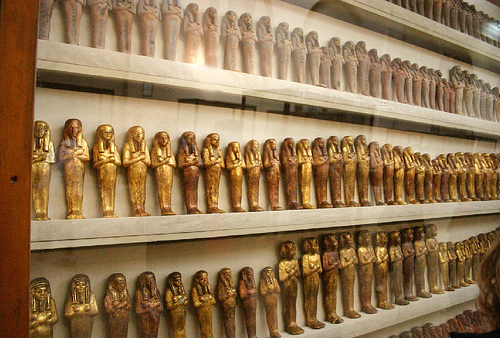
Just some of lots and lots of ancient artifacts in the Egyptian Museum, Cairo
Dr. Kim Riddlebarger recently posted a link to a story in The Jerusalem Post about a coin found in the Egyptian Museum in Cairo that bears the image and name of the Old Testament Joseph (Kim’s post). Such a find seems to sound like one of the more sensational on its face, but considering the fact that the claim comes from a Muslim archaeologist, reported in a Cairo newspaper, passed on by the Middle East Media Research Institute, carried by The Jerusalem Post lends at least an initial note of credibility. I’m sure lots of peer reviewing is afoot among Dr. Sa’id Muhammed Thabet’s colleagues, and who knows if any more will ever be heard about it, but, as Dr. Riddlebarger said, if it’s legitimate, it’s yet another piece of evidence that the Jews were where the Bible says they were when the Bible says they were. But you can also bet that if it is legitimate, you won’t be seeing any rush by the media to produce best-selling books and prime-time TV specials about it. For that reason, stay tuned to the Reformed blogosphere.
Be that as it may, I did a little more digging and found the MEMRI report that contains excerpts from the Cairo newspaper article about Dr. Thabet’s find. Thought a few of my readers would find this interesting reading. Here’s the link to the report entitled, “Leading Egyptian Daily ‘Al-Ahram’ Reports: Coins From Era of Biblical Joseph Found in Egypt.”
The report indicates that the coins turned up at the Egyptian Museum in Cairo, which is the primary resting place of so many of the most amazing arifacts of ancient Egypt, including those of King Tut. My wife and I visited this museum on our Holy Land Tour back in 2007 (see the category link in the sidebar for a few posts related to our trip, as well as some pictures on my Flikr page which is also linked to in the sidebar). One thing that struck us about the museum was that so many of the artifacts, especially statues and other large items were just out in the main thoroughfare where anyone and everyone could place their grimy hands all over them! I guess they figure if they’ve lasted this long, a few fingerprints aren’t going to hurt them the way they might harm other items from more recent times (they don’t make ancient artifacts like they used to). But the other thing that struck us about the museum was that there was so much stuff in the museum, we find it to be no surprise that something like this would turn up having been previously overlooked. But, boy, wouldn’t it be great if these coins not only proved that ancient Egyptians used money and didn’t only barter, which is the main significance the archaeological world seems to invest it with, but also was considered by scholars of Biblical archaeology to be tangible evidence of the existence of the biblical Joseph, truly lending further evidence to the historical reliability of the Bible.
The Masculine Mandate, part 3
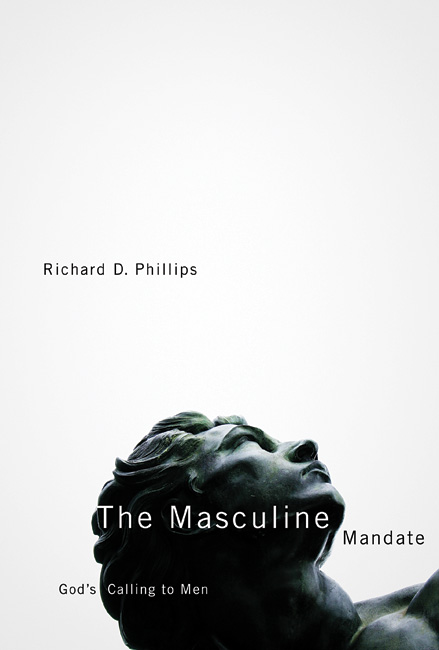
In this post, Richard Phillips gets into the details of his exposition and application of the “masculine mandate” in Genesis 2:15.
 Host: I was in a church where home men’s groups were reading this book (Wild at Heart) and going off on men’s trips. I remember thinking, “Well, what is distinctively Christian about this? I mean, it’s good that we want men to be men, and to be tough, and I actually expected to have more of that in your book since you’re a tank commander. And, you know, to have more of this emphasis on men being manly men, and that’s a good emphasis, and it’s right, but, I really liked how in the book you bring out the story of the professional dirt bike racer . . . Brian Deacon . . . talked about doing all of that before he was in Christ. He was doing all of those manly things, but that’s not what made him a man, but knowing what God’s will for him and knowing the Lord is.
Richard Phillips: A couple of years ago, I was speaking at a men’s conference. So I’m sitting at a barber shop, and I’m reading ESPN Magazine. They have an article about Brian Deacon, this hooligan, X-game, trick-bike jumper. He’s like the Michael Jordan of that quasi-sport. He has a near-death crash. He got his girlfriend pregnant, and she’s off living with her parents. Meanwhile, he has this nationally televised crash, and he loses half his blood, and he goes to his girlfriend’s house to be medically rehabilitated. Meanwhile, she’s been converted to Christ at her parents’ church. He starts going to the parents’ church, and he gets converted. He heals up, and he comes back to the Metal Militia and starts leading a Bible study, and, one by one, leads most of these guys … he leads them all, one by one, to Christ.
Then I read another interview, where the typical thing’s happening: some guys saying, you know, “Dude, you’ve change! What happened to you? You’re Brian Deacon!” And Deacon says, “You know what? I’ve realized that I’ve got to become a man.” Now, the last thing this guy needs to be told is that being a man is going off on ego trips (see parts 1 & 2). You know, what he needs to be told is what his duty is as a husband and father biblically and what biblical love is. And biblically, what it means to be a covenantally faithful man. And I’m reading all this stuff, and I’m thinking, “I gotta write a book on this.”
Host: So let’s talk about that. The mandate involves two aspects, working and keeping; that’s what man was placed in the garden to do. Could you help us to understand what you mean by “work”? What is man’s specific duty in working, and what is he supposed to do?
Richard Phillips: Yeah, thanks. The two in the Hebrew, the two verbs are abad and shamar. Very simple, basic Hebrew words appear hundreds of times in the Old Testament. They’re kind of, you know, building block common verbs.
Abad, in a construction context, means “to build.” In a Temple context, it’s used of the priests serving the Temple. And in an agricultural setting, such as the garden, it’s used as farming. You know, cultivating, causing things to grow. And, what we see is, the man is given the mandate by God–and this is all in the agricultural meaning–what God calls a man to do. The first thing is, that he is to engage in labor that is to have the result of causing good things to grow. Now that alone is paradigm shifting.
Now one thing that strikes me is that in American culture, we don’t think of the man as the nurturer. Biblically he is. I’m not saying women aren’t nurturers. But I am saying that it is the role of a man in a relationship to grow and cultivate and engage in activity and ministry and labor that will cause others to grow. It may be to cause a business to grow. In marriage, it means your job is to, your wife’s heart is the garden in which you’re to have a spade and you’re to minister in that garden so that she grows spiritually.
I mean, you know, as a pastor, how often do I have someone come into my office and say, “Help, pastor. I’ve got a lot of problems in my relationship with my mother.” The answer is, virtually never. It may happen once or twice, you know. But how often do I have someone come and say, “Oh, my relationship with my dad…” All the time. Why? Because the father is the one through whose ministry we gain so much of our identity and who we are, and the cultivation of character and faith and all those things result from the man’s role.
And so, it’s enormously helpful for Brian Deacon to be told, “Hey, Brian, if you want to be a man now, what you are to do is, like Adam, you’re put by God to work the garden. To engage in sacrifical ministry that would cause us to grow. You’re to do that in all your relationships. And so the book works that out. First in principle, that in various relationships–marriage, fatherhood, church, friendship, those kinds of things.
The other verb is shamar. Another very common word. It means “to watch over and protect.” In Psalm 121, “the LORD will keep you.” The LORD watches over you, he neither slumbers nor sleeps. He will keep your life. That’s shamar. And so, Adam was placed by God into his covenantal world of relationships and duties, to cause the garden to grow and to keep the garden safe. And likewise, godly men are to engage in a life of labor, the effect of which is that those under our care are to be kept safe, and their growth will be nurtured by our ministry.
That’s it. Isn’t that beautifully simple?
Host: It is. It’s profound as well….
Richard Phillips: Profoundly simple, but it requires the redeeming work of Jesus Christ in my life fully expressing itself for me to do it. It’s anything but easy. But to me that is so helpfully clear: I’m a husband–what am I to do? My wife is to feel safe in our relationship, and I’m to make her–I’m to make her safe, to promote her safety, and I am to engage in ministry to her so that she grows.
Now you read Ephesians 5:22 and following and 1 Peter 3:1-6 and that is a good summary of what the apostles are teaching. So it’s a profoundly simple, but powerful paradigm.
Listen to Christ the Center episode #87 on The Masculine Mandate today!
Daniel’s Place in the Canon and Among the Prophets
4. The position which the book of Daniel occupies in the Hebrew Canon seems at first sight remarkable. It is placed among the Holy writings between Esther and Ezra, or immediately before Esther (cf. Hody, De Bibl. Text. p. 614, 645), and not among the prophets. This collocation, however, is a natural consequence of the right apprehension of the different functions of the prophet and seer. It is not, indeed, certain at what time the triple division of the Scriptures which is preserved in the Hebrew Bibles was first made; but the characteristics of the classes show that it was not based on the supposed outward authority, but on the inward composition of the books. Daniel, as the truth has been well stated, had the spirit but not the work of a prophet; and as his work was a new one, so was it carried out in a style of which the Old Testament offers no other example. His Apocalypse is as distinct from the prophetic writings as the Apocalypse of St. John from the apostolic epistles. The heathen court is to the one seer what the isle of Patmos is to the other, a place of exile and isolation, where he stands alone with his God, and is not like the prophet active in the midst of a struggling nation (Auberlen, p. 34).
From, Daniel, Book of.
Dr. William Smith’s Dictionary of the Bible (Link on editor; Link on Dictionary)
Comprising its
ANTIQUITIES, BIOGRAPHY, GEOGRAPHY, AND NATURAL HISTORY.
Revised and Edited by Professor H. B. Hackett, D. D.
with the cooperation of Ezra Abbot, LL. D., Assistant Librarian of Harvard College
Copyright, 1868 and 1896, by HURD AND HOUGTON and HOUGHTON, MIFFLIN & CO.
Reprinted 1981 by Baker Book House Company
Four-volume Set ISBN: 0-8010-8211-0
The Masculine Mandate, part 2
The following is Q&A #2 from Christ the Center, episode 87 on Richard Phillips’ soon-to-be-released title The Masculine Mandate, published by Reformation Trust. In this discussion, Phillips explains the difference between his approach to applying Genesis 2:15 and that of John Eldridge in his best-selling book, Wild at Heart.
Host: I was intrigued by how you unpacked the mandate given to Adam to dress and keep the garden and how they work out in the physical realm of work and whatever labor you’re doing and in regard to your wife and children. It reminded me of the way Murray goes back in Principles of Conduct and roots everything in the creation ordinance. I had never heard that developed as much. Were these things you were reading, or was it just from your own study of Scripture that you were thinking about what was the principal work–what made a man a man, out of Genesis?
Richard Phillips: Well, you know, I mean, for the sake of the people who haven’t read the unpublished book, in Genesis 2:15, God says he placed Adam in the garden, and charged him to work it and keep it, and this book is an exposition of Genesis 2:15, which I’m describing as the masculine mandate. God put him in the garden to work it and keep it.
You know, what got me going on this was the book Wild at Heart. Because the first time I was asked to speak on this stuff, I got a copy of Wild at Heart, because I knew it was a massive best-seller, and I was absolutely mortified to read the first couple of chapters. He actually makes the statement that man was made out of the garden, and so he is undomesticated, and a male’s life is a life long quest to get in touch with your masculine side. Can you imagine Ronald Reagan making a statement like that?
No real men talk that way! “I’m on a quest for my masculinity.” That what life is, because Genesis 2:15 says–this is what he actually says–it’s a classic example of Bizarro hermeneutics–dominating today: God placed him in the garden, therefore he belongs out of the garden! And the way to get in touch with your masculine self is to get out of the place where God put you, and, as I put it in the book–I think you gotta think in these terms–you know, God placed Adam in the created, covenantal world with God-given relationships, duties and obligations. And Eldridge says, no no, you gotta go on a wilderness quest–ego trips, basically–self-quest. He actually goes so far as to say that Jesus’ forty days’ fast in the wilderness was Jesus seeking his masculine identity. I was just utterly horrified!
Well, I started reflecting on it, and I started thinking well he is right that this verse is paradigmatic. But it’s the exact opposite of what he’s teaching.
And I think, you know, two or three years ago, I did some men’s conferences, I just said, “Hey, let’s look at Genesis 2:15.” And I’m well aware that people are reading this book. I got my first copy of Wild at Heart, when an elder at my church (not this church) handed me a copy–how great the book was, and we need to buy the DVD curriculum of Wild at Heart to show all of our men.
Well, I read the book, and I go ballistic! But it occurs to me that he’s right that Genesis 2:15 is a very important statement. That’s what got me going in this direction. . .
. . . to be continued.
The Masculine Mandate, part 1
Episode #87 of Christ the Center, podcast by the Reformed Forum featured an interview with Dr. Richard Phillips regarding his new book The Masculine Mandate. Dr. Phillips says it’s primarily an exposition and application of Genesis 2:15, which reads, “The LORD God took the man and put him in the Garden of Eden to work it and keep it.” This verse, he says, is the foundational paradigm of the Scripture’s entire revelation of the male’s, or husband’s, role.
Since whenever I link to programs such as this, almost no one takes the time to go and listen, I’m transcribing the interview in a series of blog posts because I find this material to be especially needful for everyone. In this first post in the series, Dr. Phillips explains his reasons for writing the book.
Host: What did you see in men’s lives that needed to be addressed, which lead you to write this book? (Summary of the host’s actual wording)
Dr. Phillips: As is usually the case with books, there are several reasons why I wrote this book: one is, I was frustrated by the low quality of many evangelical books dealing with masculinity. Most especially, John Eldridge’s mega best-seller Wild at Heart, which is just unbiblical.
I was actually having dinner with Jerry Bridges, probably three or four years ago—and he lives out there in Colorado Springs—and we were lamenting this. I said, “Jerry, you ought to write a book on this.” And he didn’t have time, or whatever.
Meanwhile, I was asked by several conferences to speak on things like this. There was a group in Georgia two years ago who asked me to do a multi-day men’s conference.
Lig Duncan had me out to Jackson last year, to the Mid-South Men’s Rally. And so I was needing just for ministry requests, to put together biblical material. My own approach is always to exposit the Word, so if I’m asked to do a men’s conference, I’m going to exposit the Word. That got me dealing with these things.
And also, just as a pastor, I’m well aware, just as everybody is, today we’ve got a real masculinity problem in the culture and in the church. I mean, it is my view that, we talk about feminism, and all of those problems—look, we’ve got a far bigger problem with godly masculinity. In many of our churches we’ll have tlots more available, godly, marriageable women. Then we have . . . men in the church, but they’re not as mature so often. And I do believe that we have a great need for biblical instruction on masculinity.
Now, you start working on this stuff, and you start thinking about it, and you start becoming very impressed with the power of what the Bible says. As I say early on in the book, we know that when it comes to marriage and men in ministry and these sorts of things, that the New Testament directs us back to the early chapters of Genesis. If we’re going to say, “What does it mean to be a man? What is my calling as a man? What am I supposed to do to be a godly man? The answer is, go back and read Genesis 2. And what we’ll find is biblical teaching that is, in fact, a biblical paradigm.
What we read in Genesis 2 about God’s calling to Adam as the man, does in fact, have a paradigmatic influence that we will see pervading all of Scripture. And yet there’s very little teaching about the masculine mandate—that’s what I call Genesis 2:15. That there is a clear calling given to men, that will be seen playing out through the book of Proverbs, playing out through biblical examples of fatherhood, husband and Christian leadership. And it plays straight into the New Testament teaching. And I just came to believe that there is a need for some clear biblical teaching on this.
To be honest with you, it was a hard book to write, because most of my books will come out of my pulpit ministry. My working life is geared that way. I do a sermon on Sunday morning, I preach Sunday evening, I teach Wednesday night. I don’t have a lot of free time beyond that. So this book killed me. I mean, to write a book on the side—most of my books are biblical exposition flowing out of my pulpit ministry-but this one was a labor of love, because I just felt I had to get it done. Not that the world needs my book, but, I just felt an obligation to write this book.
It was not a book that I had time to do, but I just felt that there’s a great need for this, and I’m hopeful the Lord will bless it. You know, I ended up getting in about a year late, because you want to do it right.
But that’s why I wrote the book, just out of my own experiences, being asked to do work in it, and a profound sense that this material has to get out there.
The Outlined Book of Daniel
3. The book is generally divided into two nearly equal parts. The first of these (1-6) contains chiefly historical incidents, while the second (7-12) is entirely apocalyptic. This division is further supported by the fact that the details of the two sections are arranged in order of time, and that the commencement of the second section falls earlier than the close of the first, as if the writer himself wished to mark the division of suject. But on the other hand this division takes no account of the difference of language, nor of the change of person at the beginning of chapter 8. And though the first section is mainly historical, yet the vision of chapter 7 finds its true foundation and counterpart in chapter 2.
From these circumstances it seems better to divide the book (Auberlen, p. 36 ff.) into three parts. The first chapter forms an introduction. The next six chapters (2-7) give a general view of the progressive history of the powers of the world, and of the principles of the divine government as seen in events of the life of Daniel. The remainder of the book (8-12) traces in minuter detail the fortunes of the people of God, as typical of the fortunes of the Church in all ages.
The second section (2, 7) is distinguished by a remarkable symmetry. It opens (in chapter 2) with a view of the great kingdoms of the earth revealed to a heathen sovereign, to whom they appeared in their outward unity and splendor, and yet devoid of any true life (a metal colossus); it closes (in chapter 7) with a view of the same powers as seen by a prophet of God, to whom they were displayed in their distinct characters, as instinct with life, though of a lower nature, and displaying it with a terrible energy of action (thuria, four beasts). The image under which the manifestation of God’s kingdom is foreshown corresponds exactly with this twofold exhibition of the worldly powers. “A stone cut without hands,” “becoming a great mountain and filling the whole earth” (Dan. 2:34, 35)–a rock and not a metal–is contrasted with the finite proportions of a statue moulded by man’s art, as “the Son of man,” the representative of humanity, is the true Lord of that lower creation (Gen. 1:30) which symbolizes the spirit of mere earthly dominions (Dan. 7:13, 14).
The intermediate chapters (3-6) exhibit a similar correspondence, while setting forth the action of God among men. The deliverance of the friends of Daniel from the punishment to which they were condemned for refusing to perform an idolatrous act at the command of Nebuchadnezzar (ch. 3), answers to the deliverance of Daniel from that to which he was exposed by continuing to serve his God in spite of the edict of Darius (ch. 6); and in the same way the degradation, the repentance, and the restoration of Nebuchadnezzar (ch. 4), forms a striking contrast to the sacrilegious pride and death of Belshazzar (ch. 5:23-31).
The arrangement of the last section (8-12) is not equally distinct, though it offers traces of a similar disposition. The description of the progress of the Grecian power in ch. 8 is further developed in the last vision (10-12), while the last chapter appears to carry on the revelation to the first coming of Messiah in answer to the prayer of Daniel.
In summary, in this portion of the entry on the Book of Daniel from Smith’s Dictionary of the Bible, Bishop Westcott has suggested two ways to outline the material in the Book of Daniel. The first, and simpler, outline is something like as follows:
1. Historical Narratives of Daniel (1-6)
2. Apocalyptic Visions of Daniel (7-12)
In terms of chronology, according to Westcott, this two point outline works (see first paragraph above), but in terms of language and author, a more sophisticated outline seems in order. In this effort, Westcott follows the lead of Dr. Karl August Auberlen (I’ve linked to an online text of Auberlen’s book which seems to be the very one Westcott cites above) in dividing the book into a three point outline with several subpoints as follows:
1. Introduction (1:1-21)
2. Progressive History of World Powers and Principles of Divine Government (2-7)
A. Great Kingdoms of the Earth Revealed to a Heathen Sovereign (2)
B. Daniel’s Friends Delivered from Fiery Furnace (3)
C. Degredation, Repentance and Restoration of Nebuchadnezzar (4)
D. Handwriting on the Wall for Belshazzar (5)
E. Daniel Delivered from Lion’s Den (6)
3. Fortunes of the People of God, as Typical of the Fortunes of the Church in All Ages (8-12)
A. ( See paragraph 5 above for topical breakdown)
Also, don’t miss Pastor Kyle Oliphint’s exposition of Daniel Chapter 2 entitled, “A Bad Dream for a King, and Wisdom Sought from the King“
Tullian’s “Unfashionable” Book Tour
 The new pastor of Coral Ridge Presbyterian Church, Rev. Tullian Tchividjian (last name rhymes with “religion”), is making the rounds promoting his book, Unfashionable. Last week, he appeared on James Robison’s television talk show along with his wife, Kim.
This show is filmed not five miles from my house, but I missed when they were in town for the shooting several weeks ago, otherwise, you probably would have been able to spot my wife and me in the audience. Guess I need to put my name back on the Life Today email list so I’m prepared when people I’ll actually want to see are in town. It doesn’t happen often, but it does happen.
The episode was broadcast last week, but you can view it online here, and read about it at Tchividjian’s own blog here. Also, here’s the search results for “unfashionable” at his blog which lists the posts that contain more about the book.
It turns out that this Unfashionable author’s interview with the White Horse Inn was this Sunday morning as well. You can listen to this more in-depth interview here.
You can read about the book at the Multnomah Books website here.
On the Robison show, Tchividjian cites an anecdote from the life of his legendary grandfather, Billy Graham, who back in the 1950’s was approached by a Hollywood celebrity who gave him the kind of advice about which his grandson now writes. The celebrity told Graham: “Don’t ever try to do Hollywood, because Hollywood will always do it better than you. You give this world the one thing Hollywood can’t–the timeless truth of the Gospel.” That’s similar to one of my mottoes: Leave the entertainment to the entertainers, and leave the ministry to the ministers. The church and the world will both be the better for it.
The Multilingual Book of Daniel
 2. The language of the book, no less than its general form, belongs to an era of transition. Like the book of Ezra, Daniel is composed partly in the vernacular Aramaic (Chaldee), and partly in the sacred Hebrew. The introduction (1-2:4a) is written in Hebrew. On the occasion of the “Syriac” answer of the Chaldaeans, the language changes to Aramaic, and this is retained till the close of the seventh chapter (2:4b–7:28).
The personal introduction of Daniel as the writer of the text (8:1) is marked by the resumption of the Hebrew, which continues to the close of the book (8-12). The character of the Hebrew bears the closest affinity to that of Ezekiel and Habakkuk, or in other words to those prophets who lived nearest to the assumed age of Daniel; but it is less marked by peculiar forms and corruptions than that of Ezekiel.
The Aramaic, like that of Ezra, is also of an earlier form (cf. Maurer, Comm. in Dan. p. 87) than exists in any other Chaldaic document, but as the Targums–the next most ancient specimens of the language–were not committed to writing till about the Christian era, this fact cannot be insisted on as a proof of remote antiquity. It is, however, worthy of notice that J. D. Michaelis affirmed, on purely linguistic grounds, that the book was no late compilation though he questions the authenticity of some part of it (c. 3-7, cf. Keil, Lehr. d. Einl. §135, n. 4).
In addition to these two great elements–Aramaic and Hebrew–the book of Daniel contains traces of other languages which indicate the peculiar position of the writer. The use of Greek technical terms (cf. § 10) marks a period when commerce had already united Persia and Greece; and the occurrence of peculiar words which admit of an explanation by reference to Aryan and not to Semitic roots (Delitzsch, p. 274) is almost inexplicable on the supposition that the prophecies are a Palestinian forgery of the Maccabaean age.
Pastor Kyle Oliphint’s second sermon in his exposition of Daniel was preached last Sunday. The sermon title is “Life in Exile” based on Daniel 1:1-21. You can listen to it here. Here’s an excerpt:
“Daniel knew his God. And Daniel knew that his God was a God of grace. In the midst of circumstances that may beto the common observer look like God had abandoned him altogether. But Daniel knew that God had promised mercy and grace to a thousand generations. He had giant faith, even while feeling the discipline from his heavenly Father. Daniel knew he was loved; Daniel knew he was being cared for; Daniel knew that God was at work, even in the midst of not being able to point to evidence for it.
You remember when I said a minute ago that God is intricately and intimately involved in every aspect of our lives. I say that because I believe that’s what the Bible teaches. Now I wonder if we together know what that means. It means that those of us in this room, like me, who do not have the giant faith of Daniel–those of us in this room who can make a list of where and how we have lacked faith–and how that list, like mine, would be miles and miles long–those of us who fit in this category, have a God who is a part of your life, and determined through your life to bringing himself glory and to doing you good, even in the midst of your weak faith.”
“If You Want To Lead, You Must Read”
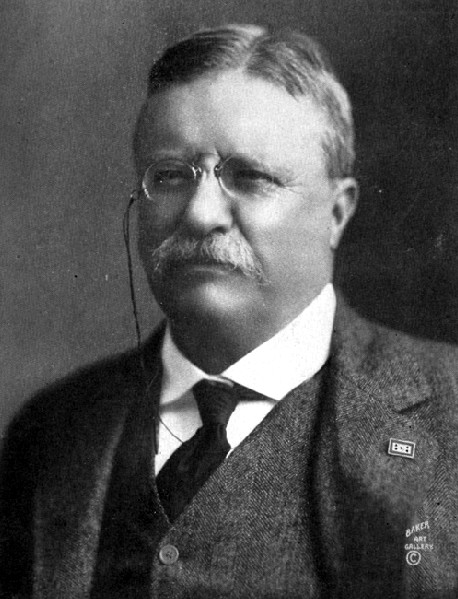 Just wanted to share this August 31 entry from George Grant’s Christian Almanac. Although most of us will never accomplish what today’s subject did, his example will benefit us all. May we all, grateful for the grace of God in Christ, strive to love him with our minds all the more (Matthew 22:37; Mark 12:30; Luke 10:27).
Theodore Roosevelt was a voracious learner and an avid reader throughout his extraordinary life. It is hard to imagine though, when he might have found the time–his record of public service and his private interests were astonishingly diverse. How he possibly squeezed reading into the crowded hours of his life was a matter of some substantial speculation among those that observed him flash across the stage of history.
Among his friends he counted the greatest writers, thinkers, scholars, and scientists of his day. And by all accounts he was the best read of them all–being readily conversant on everything from the traditional classics to the most recent philosophical, sociological, or technological musings. He usually read at least five books a week–unless he wasn’t too busy, in which case, he read more. And yet his attitude toward the torrid pace of his intellectual pursuit was refreshingly relaxed: “I am old-faschioned, or sentimental, or something about books. Whenever I read one I want, in the first place, to enjoy myself, and, in the next place, to feel that I am a little better and not a little worse for having read it.”
His son Quentin claimed that he read every book received at the Library of Congress–which of course, he surely did not. But many of his friends testified that however new the volume they recommended to him, he had always read it already. “His range of reading is amazing,” wrote the science fiction writer H. G. Wells. “He seems to be echoing with all the thought of the time, and he has receptivity to the pitch of genius.” Guglielmo Marconi, the great Italian physicist and inventor, was amazed by his knowledge in the specialized field of Italian history and literature. “That man actually cited book after book that I’ve never heard of, much less read. He’s going to keep me busy for some time just following his Italian reading.” And the English diplomat Lord Charnwood asserted, “No statesman for centuries has had his width of intellectual range.”
 As a result of his relentless studies and his near-perfect recall, his knowledge was highly integrated, and he was continually crossing boundaries, moving back and forth from one area of human knowledge to another. He was thus able to make connections that mere specialists were unable to make.
According to Viscount Lee, “Whether the subject of the moment was political economy, the Greek drama, tropical fauna or flora, the Irish sagas, protective coloration in nature, metaphysics, the technique of football, or post-futurist painting, he was equally at home with the experts and drew out the best that was in them.” Indeed, “In one afternoon,” said his son Archie, “I have heard him speak to the foremost Bible student of the world, a prominent ornithologist, an Asian diplomat, and a French general, all of whom agreed that Father knew more about the subjects on which they had specialized than they did.”
“If you want to lead, you must read,” was a maxim that Roosevelt took seriously. It was merely an extension of his whole philosophy of life: making the most of his mind was of a piece with making the most of his body. It was merely an exercise of good stewardship.


 The Misadventures of Captain Headknowledge
When “Whosoever” Misseth the Point
Some of us think the chorus in "Whosoever Meaneth Me" sounds like the theme to Hogan's Heroes. Visit http://free-loops.com/download-free-loop-3481.html to listen and compare to the hymn's midi below!
For God so loved the world, that he gave his only begotten Son, that whosoever believeth in him, should not perish, but have everlasting life. (John 3:16 KJV)
For God so loved the world, that he gave his only Son, that whoever believes in him should not perish, but have eternal life (ESV)
For God loved the world in this way: He gave his one and only Son, so that everyone who believes in him will not perish but have eternal life. (HCSB)
The first citation of John 3:16 is from the King James Version, which contains—and established—the traditional wording of this verse, no less in the case of the highlighted phrase in question, “whosoever believeth.” The second updates, but carries this traditional translation forward, while the third, from the Holman Christian Standard Bible (HCSB), seems to have come a little closer to the literal meaning of the verse.
This can be seen by examining the original Greek, from which all three versions are translated: pas o pisteuo. Pas means “all,” “any,” “each,” “everyone,” “all things,” etc., in individual contexts like this one, but it is usually found in collective contexts, where it means “some of all sorts.” This is the word that is translated “whosoever” in the King James Version, “whoever” in many modern translations like the ESV, and “everyone” in the HCSB. The NET Bible has some helpful notes in this regard, which may be accessed here.
In the great debate between Calvinists and Arminians about the extent of Christ’s atonement, the latter camp has, in an effort to emphasize the fact that Jesus died for everyone without distinction, turned the KJV’s “whosoever” into three words: “For God so loved the world, that he gave his only begotten Son, that Who … So … Ever (!). With often little regard for the context of this verse, Arminians will focus on this one little three letter Greek word, and seemingly make it the point of the passage, which it is not.
Pas is not the only word in this phrase. “Everyone” in this context does not stand alone. It is modified by the action taken by each member in the group of people so identified. The action they take is pisteuo: “believing.” So, the first thing we must clarify is that this verse is not intended to state or imply the number of people for whom Christ died; it merely expresses the purpose behind the Father’s giving of the Son to the world: to grant eternal life to pas (everyone) o (who, or that) pisteuo (believes).
On the Nov. 17 episode of The Dividing Line, Dr. James White explained why “whosoever,” “whoever,” and “everyone” are used to translate pas. He said that when pas is used with a singular participle (in this case, “believes”), what is being communicated is a group that is defined by the action in that participle. Since the emphasis of the verse is on the mutual activity of the group, rather than the indistinct universality of the group itself, perhaps it may help direct our attention to “believes” if translators rendered pas o pisteuo as “all those who believe,” or just “those who believe.” But I’m no scholar.
Therefore, pas o piteuo makes neither of the following Arminian emphases:
What this phrase does mean, though, is that God loved the world by sending his only Son in order to grant eternal life to those, and only those, who actually come to faith. If God sent his only Son to die for everyone indiscriminately, then everyone indiscriminately would come to faith, for he would have, with the atonement, granted faith to everyone indiscriminately. If everyone indiscriminately had the inherent moral ability to obey the command to believe, then God’s Word would be untrue (Romans 8:7; Ephesians 2:8,9).
Let us not read things into the Word of God which are not there. John 3:16 is not a proof text for general redemption (the doctrine that Christ died for everyone indiscriminately), nor a view of human sinfulness that leaves room for some amount of inherent righteousness that enables the self-determining sinner (which creature does not exist) the ability “of his own free will” to “decide to follow Jesus” without the prior work of the Holy Spirit’s effectual calling (Romans 8:30).
Are you one of those who’ve come to believe in the one and only Son of God? Then you have received the Father’s saving love in the gift of his Son who became incarnate for you, obeyed God’s Law perfectly for you, died suffering the consequences of your sin, and rose on the third day that you also might be raised up to eternal life spiritually now (regeneration), and physically upon his return (resurrection). I urge you to do what you can to reciprocate his love by Spirit-empowered love for him and your neighbor. We love because he first loved us.
“Whosoever Meaneth Me?” (audio) “Whosoever” means all those, and only those, who believe.
Share this: