Martin Luther and the Ninety-Five Theses, part 2/3
Tension rises between Martin and his father. Luther takes his monastic vows, and is loyal to the Augustinian order until his excommunication from the church of Rome. Ordained after a couple of years, and faced with conducting his first Mass, he expresses inordinate fear at the thought of the presence of God as he performs what he believed would be the miracle of transubstantiation.He rises through the ranks due to exemplary dedication. He is rewarded by being appointed to take a pilgrimage to Rome. This trip proves seriously disillusioning for Luther, as he witnesses many corruptions among the clergy there. He also sees the faithful coming to Rome and being taken advantage of by the hierarchy. Other accounts corroborate Luther’s claims of the rampant corruption in Rome, so although his account is written after his excommunication, his account is not entirely to be discounted. Among Luther’s concerns was that when the laity seek to do penance, their spiritual concerns should not be met with a sort of spiritual-monetary transaction. Sin is serious, Luther believed, and the Church ought to treat it as such.
A few years later he earns his doctorate, and is invited to be a professor of theology at a new university in Wittenberg, a small town in northeast Germany, quite out of the way of the more influential centers across the German provinces. Luther becomes quite a popular figure, and some time into this new phase of Luther’s life, the scandalous abuse of indulgences reaches Wittenberg. While they were not allowed to be sold in Wittenberg by the local prince, Wittenbergers crossed the river to purchase indulgences from the charismatic indulgence preacher, Johann Tetzel, who marketed them in an excessively crass way which even Catholic authorities today admit were not based in any teaching or practice commended by the Church of the day.
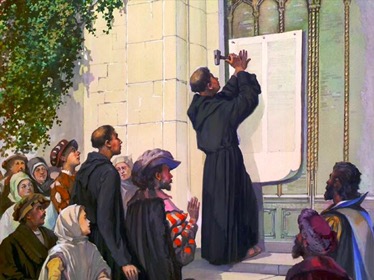
Luther’s response was to post ninety-five theses to organize a formal debate among scholars on the power and efficacy of indulgences. Written in Latin, Luther posted his theses to the door of the Castle Church in Wittenberg on the eve of All Saints’ Day, October 31, 1517. Luther’s theology has not at this point changed, and his theses were no revolutionary stance, although he does make some valuable statements that reflect the teaching of Scripture and are rooted in sound logic.
Martin Luther and the Ninety-Five Theses, part 1/3
It may be January 2018 now, but I am finally taking time to post the videos I made of our 2017 DFW Reformation Conference at Mid-Cities Presbyterian Church (OPC) in Bedford, TX the weekend prior to the 500th anniversary of the Protestant Reformation. The camera we used was borrowed from a generous member who did not attend the conference, and we were unable to prevent the camera from shutting off after about 15 or so minutes, so each lecture is uploaded in parts, with only a minute or so of material lost. Today, I am sharing part one of three of Dr. Jonathan Master’s opening lecture, “Martin Luther and the Ninety-Five Theses” along with my own summary which follows.
Background summary of church history.
Rise of Islam (7th-8th centuries) is the most significant event that changed the landscape of the church in history. All the most significant, influential churches, councils and debates, took place in the eastern half of the Roman Empire, centered in Constantinople in Asia Minor (modern day Istanbul, Turkey).
Rise of the Papacy With the fall of Constantinople to Islam, Rome in western Europe arises as the more prominent city among the five Patriarchates across the empire. It is only after this that the Roman Popes begin to assume and claim primacy over other bishops.
Rise of Purgatory Vague references in the ancient era of church history to an intermediate state develop in the Middle Ages to become the penitential system that deals with sins after death. Medieval papal pronouncements establish the teaching of a “treasury of merits” and offer “indulgences” by which the Papacy holds out the hope of a shortened time in Purgatory in exchange for acts of charity. By the time of Luther, this had degenerated to a crass exchange of spiritual benefits for oneself and his loved ones for money.
Background of Martin Luther
Luther’s Father a Successful Entrepreneur who intends to educate his son for a profitable law practice which will not only give Martin a comfortable life, but also benefit the family business. Luther wavers about this life plan before he reaches a crisis point during a lightning storm in a field as he walks one night, pledging to Saint Anne that if he survives, he’ll become a monk.
Our Reformation Party
It’s been a busy October for our little church in the Mid-Cities area of the Dallas/Fort Worth, Texas Metroplex. A few months prior, I spoke with a fellow church member in theory about showing the kids of our church the old 1953 film, Martin Luther, starring Niall MacGinnis. Then, a couple of weeks out, the friend with whom I’d previously spoken asked if we were going to do it. Naturally, I was inclined to do so, but I recalled that in addition to this black and white classic, I also have the brand new Torchlighters cartoon, The Martin Luther Story, produced by the partnership of the Christian History Institute and Voice of the Martyrs. I suggested this video would likely be a little more enjoyable than the older film, and my friend, my wife and our pastor’s wife got to work planning a Reformation party for the weekend prior to our annual Reformation Conference, the DFW Reformation Conference.
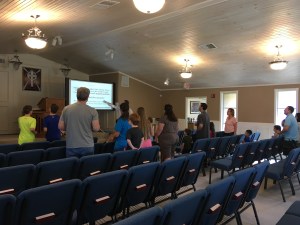 The ladies put together a plan to host a VBS-style party, opening with my own original children’s song about the Five Solas of the Reformation, set to the tune of “Father Abraham.”
Martin Luther nailed, his Ninety-Five!
Ninety-Five Theses, did Luther nail!
I am justified, through FAITH ALONE!
So let’s reform the church!
I’m a sinner and, a saint am I!
A saint and a sinner, at the same time!
I am justified, by GRACE ALONE!
So let’s reform the church!
A believer-priest, that’s what I am!
I can boldly go before the throne!
My only Great High Priest, is CHRIST ALONE!
So let’s reform the church!
Only 66, books in the Word!
39 Old, 27 New!
The Good News is in, SCRIPTURE ALONE!
So let’s reform the church!
I’m unable to, keep God’s commands!
What he wants, he gives me in his Son!
GLORY goes to God, and GOD ALONE!
So let’s reform the church!
Martin Luther nailed, his Ninety-Five!
Ninety-Five Theses, did Luther nail!
I am justified, through FAITH ALONE!
“The just shall live by faith!”
 After the kids got the “wiggle worms” worked out of them, we sat them down and fired up the video projector (and yes, we laid down the $80 for a CVLI license to show my DVD publicly). Then the kids moved on to the stations! One station featured a simple game of shooting a nerf gun to knock down five cups representing the Five Solas, another game was a version of pin the nail on the Theses, for my station, my wife decided that I should teach the kids about the Gutenberg press, and how the printing press was so instrumental in popularizing Luther’s reforms. We tried to locate a good model of the Gutenberg press, but on such short notice, the complex wooden and metal model would arrive with only 24 to prepare it. Of course, I bought it anyway, I just wasn’t able to demonstrate it for the kids. I’ll probably build it during my Christmas break .
 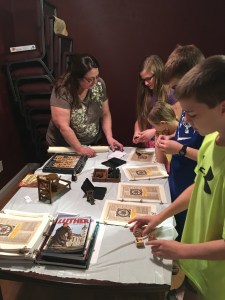 My wife did, however, locate a much simpler model of DaVinci’s modification of the Gutenberg press, and she also found a small, die-cast metal pencil sharpener in the form of the Gutenberg press. These I combined with my Playmobil Martin Luther figure to at least give them a nice arrangement for the children’s young eyes. I also laid out a few books with pictures of sixteenth-century print shops and summarized the process the original generations of printers went through to produce books and pamphlets. In a thrilling turn of providence, when shopping one day at Barnes & Noble, I encountered the Penguin publication, Brand Luther, by St. Andrews University scholar Andrew Pettegree. The first few chapters of this gave me a good grasp of the subject which I was able to boil down to a few salient points without going over the kids’ heads more than the subject matter otherwise would make it so easy to do.
 Finally, our pastor’s wife “voluntold” her husband to lead the final station, during which he donned a Geneva gown and spoke on the subject of the Diet of Worms, while the kids ate the ever-popular Diet of Worms cake—a dirt cake with gummy worms added. This they washed down with root beer, because, you know what a big advocate of the barley brew Dr. Luther was. Pastor Troutman summarized this council, read his famous “Here I Stand” speech, and also the Emperor Charles’ idle threat, the Edict of Worms,
  which called Luther “a notorious heretic.” According to some podcast which slips my mind at the moment, Charles hoped this edict alone would discourage Luther’s followers and end the spread of Luther’s teachings.
“Luther, the Cross & the Word” | DFW Reformation Conference 2017


Martin Luther (1483-1546)
On October 31, 1517, a German monk and professor of theology by the name of Martin Luther posted a notice proposing a public debate to discuss abuses on the part of his Church by which she was taking advantage of the poor, distorting her teachings, and potentially endangering the souls of the faithful. Little did he know that this simple act would spark one of the great historic movements in world history which played a role in bringing the Western world into the modern era, and plant the roots of what would come to be known as the Protestant branch of the Christian Church.
Your neighbors at Mid-Cities Presbyterian Church, along with Protestant churches around the world, are commemorating this event which happened exactly 500 years ago as of this October 31st, by hosting a conference presenting the life of Martin Luther, his posting of the famous “Ninety-Five Theses,” his teachings on the Cross of Christ, and the power of the Holy Scriptures in shaping the Christian life of the believer. We cordially invite you to join us at this special observance of our annual DFW Reformation Conference Friday through Sunday, October 20-22, 2017.

Dr. Jonathan Master
Cairn University Professor of Theology, Dr. Jonathan Master will introduce us to the historic life, theology and spirituality of the Father of the Protestant Reformation, Dr. Martin Luther (1483-1546).
Dr. Master teaches theology, church history, and New Testament at Cairn. He also oversees Cairn’s honors program, part of Cairn’s Center for University Studies.
Dr. Master also serves as executive editor of the online magazine Place for Truth, as well as host of the podcast Theology on the Go (both sponsored by the Alliance of Confessing Evangelicals). He has authored the book A Question of Consensus (Fortress Press) and a number of articles, in addition to editing The God We Worship (P&R). Prior to teaching, he served in pastoral ministry for ten years.
Conference Schedule
Friday 10/20 7:00PM “Martin Luther and the 95 Theses”
Saturday 10/21 9:00 AM “Martin Luther’s Theology of the Cross”
Saturday 10/21 10:30 AM “Martin Luther and a Life Shaped by the Word”
Sunday 10/22 10:30 AM Dr. Master preaches “A Mighty Fortress” in morning worship at Mid-Cities Presbyterian Church
Thanks, Hank. Sad to see you go.
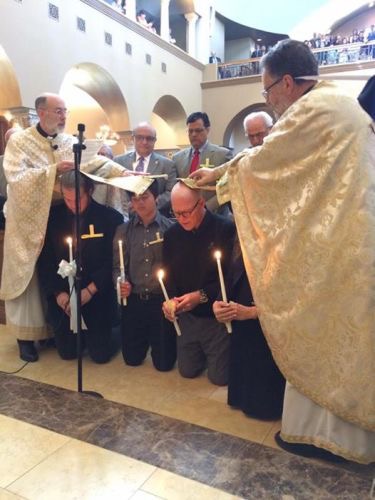
Hank Hanegraaff being chrismated into the Greek Orthodox Church on Palm Sunday, 2017.
In 1994, I was thrilled to discover a voice on Christian radio that dared critique the Word of Faith movement, of which the so-called “Prosperity preachers” are proponents. That lone voice belonged to Hank Hanegraaff, host of “The Bible Answer Man” radio show. At the time, Hank had authored an informative expose of the Word of Faith movement called Christianity in Crisis. This book became very helpful in breaking my addiction to watching the Trinity Broadcasting Network and searching the Scriptures to see whether their claims were true.
I have listened to his program less and less over the years, as I have become more and more Reformed, but I have been similarly grateful for much, if not all, of the work Hank and the Christian Research Institute (CRI) he runs have produced which helped me understand much about the pseudo-Christian cults like Mormonism, Jehovah’s Witnesses, etc., as well as other errant movements and world religions.
After about 30 years of defending orthodox Protestantism, I was saddened to learn today that yesterday, Hank, his wife and two of his twelve children were officially made members of the Greek Orthodox Church. His doing so means he has behind the scenes come to repudiate the essentials of the Christian faith which relate to justification before God and the sole authority of Scripture.
Former CRI colleague Rob Bowman has written on Hank’s conversion as the latest in a long line of Evangelical leaders who have converted to Orthodoxy as well as Roman Catholicism. He also defends Protestant distinctives against the errors of Eastern Orthodoxy by means of Reformed confessions which express the system of doctrine contained in the Scriptures. Read “Evangelical Apologist Hank Hanegraaff Converts to Eastern Orthodoxy” at The Religious Researcher blog
The Evangelical movement is in dire need of Reformation back to the foundational confessions of Protestantism, and away from its multi-faceted spectrum which embraces even Word of Faith errors and heresies, among other erroneous teachings and practices. Protestants need to pray that their churches become Reformed according to the Scriptures and the biblically-based practices of the ancient church.
The Doctrines of Sovereign Grace

Tulips are a major industry in the Netherlands, where a controversy over the doctrines of grace was settled by the Synod of Dort in 1619.
God is sovereign in his gracious salvation of sinners. These doctrines have been summarized by the popular acronym, TULIP.
T– The “Total Depravity” of the Sinner
Sinners are so completely sinful that they are unwilling and unable to do anything good to prepare themselves for salvation, let alone save themselves by good works. They do not always do the most sinful thing they possibly could, but no work of any kind that they perform can merit the righteousness they need to avoid eternal condemnation. This doctrine is also called “Radical Corruption.”
Romans 3:10-18
as it is written:
“None is righteous, no, not one;
no one understands;
no one seeks for God.
All have turned aside; together they have become worthless;
no one does good,
not even one.” (Psalm 14:1-3; 53:1-3)
“Their throat is an open grave;
they use their tongues to deceive (Psalm 5:9).”
“The venom of asps is under their lips (Psalm 140:3).”
“Their mouth is full of curses and bitterness (Psalm 10:7).”
“Their feet are swift to shed blood;
in their paths are ruin and misery,
and the way of peace they have not known (Proverbs 1:16; Isaiah 59:7-8)”
“There is no fear of God before their eyes (Psalm 36:1).”Romans 8:7
For the mind that is set on the flesh is hostile to God, for it does not submit to God’s law; indeed, it cannot.
U–The “Unconditional Election” of the Father
Before creation, God graciously chose a remnant of fallen humanity and gave them to his Son as his Bride. No righteous merit of any kind in them serves as the basis of God’s gracious choice of these sinners; only God’s own pleasure and will.
Acts 13:48
And when the Gentiles heard this, they began rejoicing and glorifying the word of the Lord, and as many as were appointed to eternal life believed.
Romans 9:11-13
…though they were not yet born and had done nothing either good or bad—in order that God’s purpose of election might continue, not because of works but because of him who calls— she was told, “The older will serve the younger.” As it is written, “Jacob I loved, but Esau I hated.”
Ephesians1:3-6
Blessed be the God and Father of our Lord Jesus Christ, who has blessed us in Christ with every spiritual blessing in the heavenly places, even as he chose us in him before the foundation of the world, that we should be holy and blameless before him. In love he predestined us for adoption to himself as sons through Jesus Christ, according to the purpose of his will, to the praise of his glorious grace, with which he has blessed us in the Beloved.
L–The “Limited Atonement” of the Son
On the cross Jesus Christ paid the ransom to the Father and effectually redeemed the remnant of fallen sinners which God graciously chose to give to him as his Bride. Sinners whom the Father has not graciously chosen are not redeemed by Christ on the cross. Christ’s atonement is necessarily “limited” in one way or the other: either it is limited in extent (Christ dying for the elect alone), or it is limited in power (only able to redeem sinners who by their own free will decide to receive this redemption). Also called “Particular Redemption.”
John 10:11
I am the good shepherd. The good shepherd lays down his life for the sheep.
Ephesians 5:25
…Christ loved the church and gave himself up for her…
John 17:2
…since you have given him authority over all flesh, to give eternal life to all whom you have given him…
I—The “Irresistible Grace” of the Spirit
Those fallen sinners whom the Father has graciously chosen according to his sovereign will and whom the Son has redeemed on the cross will not fail to come to faith in Christ. The Holy Spirit effectually gives spiritual life to the spiritually dead and in this way enables the chosen sinner to see the Kingdom of God (John 3:3), and enter it (John 3:5) through faith alone in Christ alone. Also called, “Effectual Calling” (see also 2 Peter 1:10; Romans 11:29)
1 Corinthians 1:9
God is faithful, by whom you were called into the fellowship of his Son, Jesus Christ our Lord.
John 6:44
No one can come to me unless the Father who sent me draws (literally, “drags”) him. And I will raise him up on the last day.
Acts 16:14b
The Lord opened her heart to pay attention to what was said by Paul.
P—The “Perseverance” of the Saints
Those whom the Triune God has saved in this effectual way according to his sovereign grace and power he will keep, and they will persevere in faith and repentance until the end, be it his own death or the return of Christ.
James 1:4
And let steadfastness have its full effect, that you may be perfect and complete, lacking in nothing.
Matthew 24:13
But the one who endures to the end will be saved.
Reforming–Not Rejecting!–My Love for Christmas

My sister and me enjoying Christmas in the late 1970’s.
I love Christmas! Mostly because I am an overgrown child. But judging by the look of this blog, you may have already picked up on that. No matter how old I get, or how much money we throw away, I still look forward to the big day–the hanging lights part, not so much. One thing my wife dislikes is the shortened period of daylight because it’s depressing to drive home from work after sundown. I love the earlier evenings, though, because it means that Christmas is coming!
My enthusiasm for the holiday is in no way deterred by the debate surrounding the origin of the Christmas holiday. Since my days in the Independent Fundamental Baptist (IFB) movement, I have seen some leaders advocate for December 25 as the true date of the birth of Jesus, while most I have seen take no position on the date, but certainly promote the celebration of the “official,” if not actual, anniversary of the incarnation and birth of our Lord Jesus Christ. Being the revivalists that they are, fundamentalists would never discourage church attendance by downplaying Christmas! In fact, part of my personal love for Christmas is probably rooted in the virtual show-and-tell encouraged by my beloved childhood pastor, who had the children bring their favorite Christmas gift to church to show it off and tell us about it.
Since about the year 2000, however, I have embraced Reformed theology, and since 2010, my wife, youngest daughter, and I have worshipped in a congregation of the Orthodox (as in, not liberal!) Presbyterian Church. The attitude and practice of my new denomination and theological tradition regarding Christmas is much more varied. I find a few who reject it entirely, many like myself who love and celebrate it with enthusiasm, and leaders who walk a very diplomatic public line between the varying opinions. The fact is that the Reformed wing of the Protestant Reformation is the historical source of the rejection of Christmas and Easter, although many sects and factions who reject these holidays often do so for reasons completely foreign to the Protestant Reformation.
So, the question of the true origin of Christmas continues to be an issue of interest for me. In the past I have promoted Touchstone Magazine‘s interesting article,” Calculating Christmas.” This article takes the “Mere Christianity” approach to defending the Christian origin of Christmas against claims of its pagan origin.In other words, it deals primarily with issues agreed on by each major branch of Christendom: Orthodox, Catholic and Protestant. Some details of Touchstone’s case remain a matter of debate; however, their full-throated affirmation of the Christian origin of Christmas appeals to a guy like me. Nevertheless, Touchstone’s ecumenical approach leaves a few issues outstanding as the issue of celebrating Christmas relates to a Reformed believer’s observance of the holiday.
Reformed theology subscribes to Scripture’s authority to regulate the worship of the church–a doctrine we call “the regulative principle of worship” (RPW). Nowadays, Reformed churches differ on how this principle applies to the observance of Christmas. Some, while rejecting the Catholic Church Calendar on the grounds of the RPW, retain the observance of Easter and Christmas. This view seems to predominate today among Reformed churches. Others reject even these two holidays in favor of only observing the Lord’s Day, applying the Old Covenant Sabbath principles to New Covenant worship. They say we celebrate 52 holidays on the Reformed “church calendar.” While the former agree with the latter on the primacy of the Lord’s Day, they do see a place for the commemoration of the anniversary of the incarnation and resurrection of the Lord Jesus Christ in the life of the church, even on the Lord’s Day. The goal of the Protestant Reformation was to reform the doctrine and practice of the church according to the Scriptures and the customs of the ancient church (Clary, Glen. The Eucharist in the Didache; Abstract, p. v).
This year, I thought to inquire into further reading by a more Reformed source on the subject. Who better to ask than my own presbytery’s scholar on the customs of the ancient church, Dr. Glen Clary, Pastor of Providence OPC in Pflugerville, Texas, and a regular contributor to the Reformed Forum through his Ancient-Reformed Worship blog. Pastor Clary, who studied under the great Hughes Oliphant Old, directed me to his post, “The Origins of the Church Calendar.” This lengthy piece features quotes by many early writers like Chrysostom, Clement and Jerome on the subject of the history of the Church Calendar and the Easter and Christmas traditions. There is much interesting content in this article, to which I would direct your attention. Allow me to whet your appetite for the details by sharing Clary’s nuanced conclusions regarding Christmas, and leave it to you to go back to his article yourself to work through the evidence he presents (emphasis mine):
“Those who argue for the derivation of Christmas from this festival [the Roman festival of the Invincible Sun, dies natalis solis invicti] lay great emphasis on the role of Constantine, who is known to have been a devotee of the Sun prior to his protection of Christianity.
“However, it should be noted that although we find several places in the Church fathers where Christmas is compared and contrasted with Sol Invictus, it does not necessarily follow that Christmas was instituted as its substitute.
“One manifest weakness of this theory is that Constantine did not institute the observance of Christmas on December 25 in Bethlehem after dedicating the Church of the Nativity.
“As we have just seen in Jerome’s sermon, Bethlehem continued to observe January 6 as the Nativity until the end of the fourth century or even the beginning of the fifth.
“Furthermore, Constantine does not institute the observance of Christmas in the new capital of his empire either. Christmas first came to Constantinople in 380 when it was introduced by the newly installed bishop, Gregory of Nazianzus.
“One conclusion that we may draw from this historical data is that the nativity of Christ was not widely observed in the church on December 25 until the late fourth or early fifth century.
“That is not to say that Christians did not celebrate the nativity of Christ before that time. They certainly did! But the point is that December 25 was not regarded as a holy day by most Christians until pretty late in church history.
“The church calendar is something that evolved over a very long period of time. Even after the first two or three ecumenical councils, the church calendar was still in a state of flux.
“As diligent students of the church fathers, the Reformers were well aware of that fact.
“The Reformers knew that there was an unbroken tradition of Lord’s Day worship handed down from the apostolic age. And they were eager to preserve that apostolic practice.
“But many of them had misgivings about the church calendar. One reason for those misgivings was the lack of evidence from the ancient church to substantiate its apostolic origins.“
Engaging Worldviews Video…well, most of it.

Dr. Bill Dennison speaks at Mid-Cities Presbyterian Church (OPC). Click image for AUDIO!
On a lark, as soon as the DFW Reformation Conference kicked off on Friday night, October 28, 2016, I figured I’d see how this new-fangled Facebook Live thing works. It works so well, it killed my phone battery the first night, filled my storage and shut off during the first Saturday morning lecture, but if I recall correctly, I may have gotten all of the second Saturday lecture. I know this is old news, but those of you who were not in attendace will still benefit greatly from Dr. Bill Dennison’s detailed interaction with classical apologetics and philosophers ancient and modern in these three lectures on our most common natural worldviews: Reason, experience, opinion and naturalism.
Lecture 1: “My Mind is Absolute; My Experience is Absolute.”
Lecture 2: “Nature is Absolute.”
Lecture 3: “My Opinion is Absolute.”
The Captain’s Eight Theses: On the Biblical Basis for Infant Baptism
1. Israel is the Church–the Church is Israel.
2. God commanded Israel to circumcise their households (believers, their children and anyone else of any status in the household).
3. Divine Commands remain in place if they are never rescinded.
4. Israel, by the plan of God, was a mixed multitude of believers whose circumcision signified the circumcision of their hearts (their faith and repentance), and unbelievers whose circumcision was a constant reminder to them of their need to circumcise their hearts (to repent and believe).
5. In Christ, the sign of circumcision–the sign and seal of faith (Romans 4:11)–was changed to baptism (see how the one is identified with the other in Colossians 2:11-12), and this sign continued to be given not only to individuals, but also to households in the New Testament.
6. The command to apply the sign and seal of faith to households is nowhere rescinded in the New Testament; therefore, the command remains in force.
7. For this reason, it is biblical to baptize the infant children of believers before they make a profession of faith.
8. In conclusion, the Bible teaches Christians to baptize their children with a view to raising them to repent and believe in the providential timing of the Lord.
RefCon 2016 | “Engaging Worldviews”w/ Bill Dennison
Engaging Worldviews: DFW Reformation Conference 2016 | Register Today!
Friday, October 28 and Saturday, October 29 at Mid-Cities Presbyterian Church (OPC)
Join us this year as we engage the worldviews which compete for the position of absolute authority in our lives. Human reason, personal experience, nature itself and subjective opinion all claim supremacy over what we believe.
- Human reason has placed the Christian God and his revelation on trial.
- “Unless I experience something for myself, it cannot be necessarily true for me.”
- If God is removed from the creation, then where do humans turn? By using their reason and experience often they will turn to Nature as their absolute guide in life.
- “That’s just your opinion!” Opinion has become the sign of relativism in our society since everyone’s opinion has equal value.
How do Christians respond to such pervasive subjective authorities surrounding us each day? How do Christians respond to the sovereign status of Nature and its confusing message in our day? In this world of relativism, do Christians have a basis for the truth of their assertions?
Reform your worldview as we commemorate the 499th anniversary of the Protestant Reformation.
Conference Schedule
Friday 7:00 PM–“My Mind is Absolute; my Experience is Absolute”
Saturday 9:30 AM–“Nature is Absolute”
Saturday 11:00 AM–“My Opinion is Absolute”
 Speaker: Dr. William D. Dennison, Ph.D.
Dr. Bill Dennison is an ordained minister in the OPC’s Presbytery of the Southeast, Professor of Interdisciplinary Studies atCovenant College, author of In Defense of the Eschaton: Essays in Reformed Apologetics (Wipf and Stock, 2015), A Christian Approach to Interdisciplinary Studies (Wipf and Stock, 1985) and other books, contributor to still other books, not to mention numerous journal articles.
National Tragedy and Repentance
Where is God during catastrophic events like the 9/11 attack? He’s calling sinners to tepent.

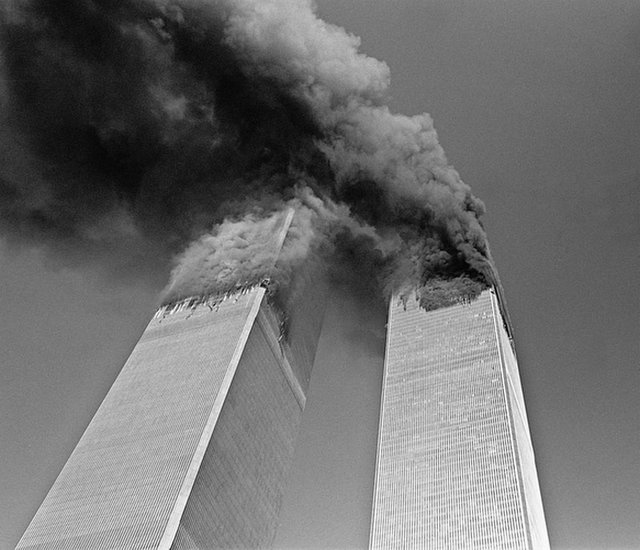 On September 11, 2001, four airliners were hijacked by Islamo-fascist terrorists, and two of them were piloted into the twin towers of the World Trade Center in New York City, killing 2,479 people. Tragedies such as this ofen move people to reflect and ask questions like, “Where is God when bad things happen to good people?” or “What can we learn from a tragedy such as this?”
In Luke 13:4-5, Jesus says, “Or those eighteen on whom the tower of Siloam fell and killed them: do you think that they were worse offenders than all the others who lived in Jerusalem? No, I tell you, but unless you repent, you will all likewise perish.”
What do we learn from a tragedy like the unexpected death of the eighteen in Siloam or the almost 2,500 in New York City? Are we to ask what sins did they commit to deserve such…
View original post 357 more words
“Christianity and Its Discontents”: Carl Trueman’s Day-Higginbotham Lecture Series

Dr. Carl Trueman speaks in Williams Reception Hall at the Naylor Student Center at Southwestern Baptist Theological Seminary
Southwestern Baptist Theological Seminary in Fort Worth, Texas, hosts the Day-Higginbotham Lectures each year. “…[E]stablished by an endowment fund in 1965 donated by Mrs. Edwin M. Reardon, III as a memorial to the late Paul Clanton Higginbotham and to Mr. and Mrs. Riley Day, Mrs. Reardon’s parents.” In 2014, when Southwestern Seminary President Dr. Paige Patterson introduced Carl Trueman (Paul Wooley Chair of Church History at Westminster Theological Seminary in Philadelphia, Pennsylvania) who preached on Elijah in a chapel service (see my post on that), Patterson said while he generally “has no use for Calvinists,” he does appreciate Carl Trueman’s work as “a critic of the culture.” The lectures Dr. Trueman delivered at the 2016 Day-Higginbothm Lectures certainly demonstrate what Patterson appreciates most about him.
In his introduction to the second lecture, Dr. Trueman explains that his denomination, the Orthodox Presbyterian Church, is known more for the “spirituality of the church”, rather than for “engaging the culture,” and that social commentary has not always been his focus, but that the rapid change in modern American culture toward the LGBTQ movement is a case of “the culture engaging the church,” making it a moral issue which stands to trigger important changes in the way the Christian church relates to the issues of sexual identity politics in the years to come.
The title for Trueman’s series of lectures is “Christiantiy and Its Discontents,” a title which alludes to Sigmund Freud’s Civilization and Its Discontents. He also cited much from another early twentieth century philosopher, Wilhelm Reich, and Trueman shows how much of what both writers thought about issues related to sexual identity so many decades ago is bearing fruit in today’s rapid change of attitudes about the definition of marriage and more recently with the issue of transgenderism. He also recommends Phillip Rieff’s book Triumph of the Therapeutic, now available in it’s 50th anniversary 2016 edition (couldn’t find a link to it, but here’s its 40th anniversary edition).
Dr. Trueman opened his first lecture on Thursday morning with a reading of Genesis 2:15-25, focusing on verse 24:
The LORD God took the man and put him in the garden of Eden to work it and keep it. And the LORD God commanded the man, saying, “You may surely eat of every tree of the garden, but of the tree of the knowledge of good and evil you shall not eat, for in the day that you eat of it you shall surely die.”
Then the LORD God said, “It is not good that the man should be alone; I will make him a helper fit for him.” Now out of the ground the LORD God had formed every beast of the field and every bird of the heavens and brought them to the man to see what he would call them. And whatever the man called every living creature, that was its name. The man gave names to all livestock and to the birds of the heavens and to every beast of the field. But for Adam there was not found a helper fit for him. So the LORD God caused a deep sleep to fall upon the man, and while he slept took one of his ribs and closed up its place with flesh. And the rib that the LORD God had taken from the man he made into a woman and brought her to the man. Then the man said,
“This at last is bone of my bones
and flesh of my flesh;
she shall be called Woman,
because she was taken out of Man.”Therefore a man shall leave his father and his mother and hold fast to his wife, and they shall become one flesh. And the man and his wife were both naked and were not ashamed. (Genesis 2:15-25 ESV)
In his second lecture Thursday night, Trueman explained that verse 24 was not a sentimental or emotional description of human sexuality, but that it focuses on the way sexuality serves as a social rite of passage to adulthood in the ancient world, and continued to do so even in the peasant societies of the late medieval and early modern eras of Western civilization, evidenced by the fact that marriage was consummated in the view of witnesses, if not put on public display as a means of making this formal relationship a matter of public record, so far from being some form of voyeurism.
Trueman helps us understand that when Christians argue that what it is they are against is homosexual activity, the broader culture still insists on seeing it as an attack on the very psychological identity of a segment of society, and therefore the Christian’s words fall on deaf ears at best, and are taken as a form of political oppression at worst. We aren’t conceding the presuppositions of the world, therefore the world rejects our attempts to explain our rejection of homosexual behavior.
Trueman discusses pornography, explaining that it is a perennial problem which has existed for as long as humans have had the capacity to convey images of sexuality, but that it’s recent sharp increase in accessibility by everyone who has internet access is unprecedented in history and is now the #1 pastoral problem in the Christian church, even seeing a sharp increase in usage among females.
I was unable to take down a precise outline of Dr. Trueman’s remarks, but the above is an introduction to the issues he describes as currently changing the modern world and challenging the Christian church.
Your Life is the Worship of Christ (John 1:1-18)
The Word Became Flesh
In the beginning was the Word, and the Word was with God, and the Word was God. He was in the beginning with God. All things were made through him, and without him was not any thing made that was made. In him was life, and the life was the light of men. The light shines in the darkness, and the darkness has not overcome it.
There was a man sent from God, whose name was John. He came as a witness, to bear witness about the light, that all might believe through him. He was not the light, but came to bear witness about the light.
The true light, which gives light to everyone, was coming into the world. He was in the world, and the world was made through him, yet the world did not know him. He came to his own, and his own people did not receive him. But to all who did receive him, who believed in his name, he gave the right to become children of God, who were born, not of blood nor of the will of the flesh nor of the will of man, but of God.
And the Word became flesh and dwelt among us, and we have seen his glory, glory as of the only Son from the Father, full of grace and truth. (John bore witness about him, and cried out, “This was he of whom I said, ‘He who comes after me ranks before me, because he was before me.’”) For from his fullness we have all received, grace upon grace. For the law was given through Moses; grace and truth came through Jesus Christ. No one has ever seen God; the only God, who is at the Father’s side, he has made him known.
(John 1:1-18 ESV)
Positivity Trumps Pauline Truth

Donald Trump, “Presbyterian” Positive Thinker? (Picture by Thomas Fluharty)
The January 25, 2016 issue of the Weekly Standard profiles “The Religion of Trump: Will evangelicals balk at pulling the lever for him?” In this article, Weekly Standard executive editor Terry Eastman reports that Trump calls himself a Presbyterian, appealing to his family’s long-time association with the Presbyterian Church (U.S.A.). Eastman reveals, however, that Trump personally attends Marble Collegiate Church every Christmas, Easter and “whenever he can.” Marble Collegiate is a congregation of the Dutch Reformed communion known as the Reformed Church in America (RCA).For 52 years, it was pastored by a man who had become a household name during my childhood in the 70’s, Dr. Norman Vincent Peale.
Peale’s claim to fame was his best-selling The Power of Positive Thinking (Prentice Hall Press, 1952; Touchstone, 2003). In 1945, Peale co-founded Guideposts Magazine with his wife Ruth Stafford Peale, a well-known magazine that is still in circulation and online. Fellow RCA minister, the late Dr. Robert H. Schuller, whose services at the Crystal Cathedral (now Christ Cathedral Catholic Church) were televised for decades on The Hour of Power, took the baton from Norman Vincent Peale to build his own ministry-empire on the power of positive thinking. In 1992, Dr. Schuller was interviewed on The White Horse Inn radio show, in which he had what proved to be a revealing and therefore necessarily contentious exchange with Dr. Michael S. Horton, a minister is the conservative Dutch Reformed denomination called the United Reformed Church of North America, on why he preaches positivity like Jesus did, rather than a negative message against sin the way Paul did (read excerpts here).
This positive-thinking distortion to the Reformed Faith is appreciated and affirmed by the infamous “prosperity gospel” televangelists in the Word of Faith movement like Paula White, who, along with a group of fellow televangelists laid hands on Trump, “believing for” success for his campaign. While the prosperity gospel of the Word of Faith movement descends from charismatic faith healer Kenneth Hagin (see A Different Gospel) through Kenneth Copeland to more popular and less obnoxiously money-fixated speakers like Joel Osteen, John Hagee, T.D. Jakes and Joyce Meyer, the Word of Faith movement bears an unmistakable family resemblance to the mainline positive thinking doctrines of Peale and Schuller. I used to watch the love fest between Robert Schuller and Trinity Broadcasting Network founders Paul and Jan Crouch on a regular basis in the late 1980’s.
In those days, Bible believing Christians used to affirm their orthodoxy, or at least their fundamentalism, and disassociate themselves from the American-made heresy of positive thinking with a play on words coined by Adlai Stevenson in 1952 in response to Peale’s criticism of his bid for President (HT: David Stokes): “I find Paul appealing, and Peale appalling!” This slogan calls for a modern re-popularization among Christians, in light of the candidacy of Donald Trump. The problem is that today, so many who consider themselves “Bible believers” are too biblically illiterate and thus uninformed on the false doctrine of positive thinking to know what’s so appalling about Peale and company, much less what’s so appealing about Paul.
What’s so “Appalling About Peale”?

Dr. Norman Vincent Peale (1898-1993). pinterest.com
The positive thinking teachings of Norman Vincent Peale and Robert Schuller, along with the Word of Faith theology of Hagin, Copeland, Jakes, Osteen and Meyer, focus on techniques for attracting success or prosperity to oneself, believing material prosperity to be as much the believer’s right as his spiritual “prosperity” in terms of peace with God by faith in Christ and spiritual growth in grace according to the Word of God with a view to bearing the fruit of the Spirit. Hank Hanegraaff, writing in Christianity in Crisis, characterizes this as “desiring what’s on the Master’s table, rather than the Master Himself.”
In the introduction to The Power of Positive Thinking, Peale points to the successful experimentation in his positive thinking techniques which he demonstrated during his ministry at the church which Trump now occasionally visits:
How can I be so certain that the practice of these principles will produce such results? The answer is simply that for many years in the Marble Collegiate Church in New York City we have taught a system of creative living based on spiritual techniques, carefully noting its operation in the lives of hundreds of people. It is no speculative series of extravagant assertions that I make, for these principles have worked so efficiently for so long a period of time that they are now firmly established as documented and demonstrable truth. The system outlined is a perfected and amazing method of successful living. (Peale, Power of Positive Thinking; Prentice-Hall, Inc., 1952, 1956; N.V.Peale, 1980; Fireside, 2003. Introduction, page xii.)
The closest I come to a thumb-nail sketch of Norman Vincent Peale’s power of positive thinking is drawn by Steven Hein on his website, EQI.org:
1. Picture yourself as succeeding.
2. Whenever a negative thought comes to mind, deliberately voice a positive thought to cancel it out.
3. Do not build up obstacles in your imagination. Instead tear them down by tearing them apart
4. Do not compare yourself to others.
5. Get a competent counselor to help you understand why you do what you do. Learn the origin of your inferiority and self-doubt feelings which often begin in childhood. Self-knowledge leads to a cure.
6. Practice self-affirmations, for example, Yes, I can. or I can do all things through belief in myself [sic]
7. List all the things you have going for you.
It’s not hard to see why billionaire casino tycoon and television personality, Donald Trump, would be attracted to the man-centered techniques of Norman Vincent Peale which view emotional, physical and fiscal success as a sign of spiritual vitality that are the results of pseudo-spiritual practices that amount to self-hypnosis according to some, and New Age occultism according to others.
What’s so “Appealing About Paul”?
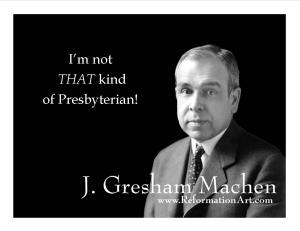
Princeton Seminary New Testament Scholar, Dr. J. Gresham Machen, defrocked by the PCUSA for forming a rival missions board to avoid supporting modernists who denied the fundamentals of the faith.
Contrary to this, the Apostle Paul taught and exemplified a life that majored on contentment regardless of one’s bottom line:
“Not that I am speaking of being in need, for I have learned in whatever situation I am to be content. I know how to be brought low, and I know how to abound. In any and every circumstance, I have learned the secret of facing plenty and hunger, abundance and need. I can do all things through him who strengthens me.” (Philippians 4:11).
The final sentence of this passage of Scripture draws a stark contrast with Peale’s man-centered paraphrase of it in step #6 of his techniques, as described above.
Paul decried those who taught that gain is godly, as do the positive thinking disciples of Peale, and instructed his son in the faith to separate from them:
“If anyone teaches a different doctrine and does not agree with the sound words of our Lord Jesus Christ and the teaching that accords with godliness, he is puffed up with conceit and understands nothing. He has an unhealthy craving for controversy and for quarrels about words, which produce envy, dissension, slander, evil suspicions, and constant friction among people who are depraved in mind and deprived of the truth, imagining that godliness is a means of gain. But godliness with contentment is great gain, for we brought nothing into the world, and we cannot take anything out of the world. But if we have food and clothing, with these we will be content. But those who desire to be rich fall into temptation, into a snare, into many senseless and harmful desires that plunge people into ruin and destruction. For the love of money is a root of all kinds of evils. It is through this craving that some have wandered away from the faith and pierced themselves with many pangs. But as for you, O man of God, flee these things. Pursue righteousness, godliness, faith, love, steadfastness, gentleness.” (1 Timothy 6:3-11)
The appealing doctrine of Paul follows the example of the Lord Jesus Christ, who, as God the Son had every right to hold onto his eternal power and glory he shares with the Father and the Holy Spirit in heaven, yet condescended to give it all up, taking on a human nature to suffer the deprivations of human poverty and suffering, calling his followers to take up their crosses of suffering as well. Paul writes in his great passage on the grace of giving, ““For you know the grace of our Lord Jesus Christ, that though he was rich, yet for your sake he became poor, so that you by his poverty might become rich.” (2 Corinthians 8:9) Paul meant this to be taken in the exclusively spiritual sense of forgiveness of sin and inheriting the Kingdom of God (which is not of this world).
It is not my goal to promote a presidential candidate. It is my goal to teach Christians to be discerning about what is and is not biblical. The modern doctrine of prosperity and positive thinking is not biblical. That’s why the gospel preached by Trump’s church is appalling. The teaching of Paul, our great Christian example, who eschewed prosperity for its own sake in this temporary life to gain an eternal life of reigning with Christ on the right hand of the Father, is much more appealing.


 The Misadventures of Captain Headknowledge