Introduction and Review: Heresy and Orthodoxy in the History of the Church
For I delivered to you as of first importance what I also received: that Christ died for our sins in accordance with the Scriptures, that he was buried, that he was raised on the third day in accordance with the Scriptures, and that he appeared to Cephas, then to the twelve. Then he appeared to more than five hundred brothers at one time, most of whom are still alive, though some have fallen asleep. Then he appeared to James, then to all the apostles.
(1 Corinthians 15:3-7 ESV)
Outcasts Accepted (John 9:8-41)
The neighbors and those who had seen him before as a beggar were saying, “Is this not the man who used to sit and beg?” Some said, “It is he.” Others said, “No, but he is like him.” He kept saying, “I am the man.” So they said to him, “Then how were your eyes opened?” He answered, “The man called Jesus made mud and anointed my eyes and said to me, ‘Go to Siloam and wash.’ So I went and washed and received my sight.” They said to him, “Where is he?” He said, “I do not know.”
They brought to the Pharisees the man who had formerly been blind. Now it was a Sabbath day when Jesus made the mud and opened his eyes. So the Pharisees again asked him how he had received his sight. And he said to them, “He put mud on my eyes, and I washed, and I see.” Some of the Pharisees said, “This man is not from God, for he does not keep the Sabbath.” But others said, “How can a man who is a sinner do such signs?” And there was a division among them. So they said again to the blind man, “What do you say about him, since he has opened your eyes?” He said, “He is a prophet.”
The Jews did not believe that he had been blind and had received his sight, until they called the parents of the man who had received his sight and asked them, “Is this your son, who you say was born blind? How then does he now see?” His parents answered, “We know that this is our son and that he was born blind. But how he now sees we do not know, nor do we know who opened his eyes. Ask him; he is of age. He will speak for himself.” (His parents said these things because they feared the Jews, for the Jews had already agreed that if anyone should confess Jesus to be Christ, he was to be put out of the synagogue.) Therefore his parents said, “He is of age; ask him.”
So for the second time they called the man who had been blind and said to him, “Give glory to God. We know that this man is a sinner.” He answered, “Whether he is a sinner I do not know. One thing I do know, that though I was blind, now I see.” They said to him, “What did he do to you? How did he open your eyes?” He answered them, “I have told you already, and you would not listen. Why do you want to hear it again? Do you also want to become his disciples?” And they reviled him, saying, “You are his disciple, but we are disciples of Moses. We know that God has spoken to Moses, but as for this man, we do not know where he comes from.” The man answered, “Why, this is an amazing thing! You do not know where he comes from, and yet he opened my eyes. We know that God does not listen to sinners, but if anyone is a worshiper of God and does his will, God listens to him. Never since the world began has it been heard that anyone opened the eyes of a man born blind. If this man were not from God, he could do nothing.” They answered him, “You were born in utter sin, and would you teach us?” And they cast him out.
Jesus heard that they had cast him out, and having found him he said, “Do you believe in the Son of Man?” He answered, “And who is he, sir, that I may believe in him?” Jesus said to him, “You have seen him, and it is he who is speaking to you.” He said, “Lord, I believe,” and he worshiped him. Jesus said, “For judgment I came into this world, that those who do not see may see, and those who see may become blind.” Some of the Pharisees near him heard these things, and said to him, “Are we also blind?” Jesus said to them, “If you were blind, you would have no guilt; but now that you say, ‘We see,’ your guilt remains.
(John 9:8-41 ESV)
Bezalel and Oholiab (Exodus 35:20-38:8)
Mid-Cities Presbyterian Church Adult Sunday School Teacher, Chuck Cain on his next to last lesson through a fifty-two-week study of the book of Exodus! Incredible detail!
The Bible and Homosexual Practice: Texts and Hermeneutics
“Gagnon’s book powerfully challenges attempts to identify love and inclusivity with affirmation of homosexual practice.”
Star Wars, Episode VII: The Force Awakens Theatrical Poster Released
 The jurisdiction of this blog just expanded. I know many Reformed blogs have always posted on personal interests that lay outside the realm of Reformed theology, but I had rarely, or never done so myself. This changes today.

Yours truly, nerding out.
Facebook friends of mine have become painfully aware of the fact that I have, in the past year, reverted to where I left off at about age nineteen, in my interest in comic books and Star Wars. I have been calling 2015 “The Year of Star Wars” since the announcement that George Lucas had decided to sell Lucasfilm to Disney and the joint announcement that Disney’s newly acquired company would begin a new trilogy of Star Wars feature films, along with a handful of spin-off films. There is also talk of a live-action Netflix series in the works (see this for the new canon). But, most significantly for myself, is the fact that now that both Marvel Comics and Lucasfilm are under the Disney umbrella, the twenty-plus year run of Dark Horse brand Star Wars comics is coming to an end, and Lucasfilm’s new sister company will resume publishing Star Wars comics, which they originally did since the 1977 release of the ground-breaking original Star Wars film when I was six years old, which somehow managed to wrap its tentacles around my brain.
Some of you may be aware that yesterday, the long-awaited official theatrical poster of Star Wars, Episode VII: The Force Awakens was released, as a fore-runner to the fashionably late debut of the first full trailer for the film, to be aired during half-time on Monday Night Football on ESPN tonight.

HT: Star Wars Episode VII: The Force Awakens Facebook Page
But, thank the Maker for DVR technology! I needn’t sit through a game I’m not interested in to catch the trailer. I’ll record it, watch my normal shows, probably check in on the progress of the game in order to catch it live, then back to my preferred viewing. Then I’ll protect it in my DVR so I can re-watch it as often as I like.
The infrequency of my blogging on theological issues may largely be explained by the fact that since 2010, when my family finally joined an Orthodox Presbyterian Church, my formerly frustrated need for sound theology began being met, and my compulsion to seek interaction with others who believe as I do–few and far between as we often find ourselves–has found relief in my enjoyment of weekly ministry of the ordinary means of grace at Mid-Cities Presbyterian Church in Bedford, Texas.
In 2013, we moved from our original rental facility, the Airport Area YMCA to a small building on 1.6 acres on Brown Trail in Bedford. With that move, the deacon in charge of the library asked me to take over directorship of our small collection of books, and also requested that I come up with a way to facilitate online discussion of our books among our library patrons. This lead to the launch of my second blog, the MCOPC Library Blog. I have been posting our titles on this blog, which will serve as an online card catalog in the hopes that one day I will learn how to provoke a church full of ordinary people who are not already avid bloggers to open up and review, comment, raise questions and engage in discussion or debate on our humble blog with other library patrons. This strikes me as a daunting task. But perhaps with time, more of that will begin to happen.
I will begin reblogging those posts here as well, if only to increase the frequency of Reformed-content blogging. I also have intentions to resume my devotional series I started in 2006, which broke down with the increased difficulty in pairing questions and answers from the Westminster Shorter Catechism on the Ten Commandments with hymns featuring related content from the Trinity Hymnal. But I have a source which will assist me in that, my pastor has managed to do so in his Sunday evening service teaching ministry on the catechism, and has invited me to benefit from his work in that area, for which I am grateful.
But in the meantime, I hope you will enjoy geeking out with me about Star Wars and Marvel Comics from time to time. Let me know what you think about the Force Awakens poster, speculate about why you think Luke is missing, and check back here for more forty-something fanboy misadventures.
With All Your Heart | DFW RefCon 2015!
Click here to registe
Dr. Craig Troxel, pastor of Bethel OPC in Wheaton, Illinois, will be speaking on the biblical meaning of the heart. He’s working on a book on this subject, so this conference will be a preview. The conference will take place at my church, Mid-Cities Presbyterian Church in Bedford, Texas (1810 Brown Trail, Bedford, TX, to be exact)
The subject of this conference is specially related to a major theme underlying this blog. There is a distinction assumed by fundamentalists and evangelicals between the head, where one supposedly only crams facts about the Bible, and the heart, where it is said, that knowledge of the Bible must move before one genuinely benefits from his knowledge of the Bible. Dr. Troxel will explain how this is a fallacious concept. I look forward to being enlightened on the biblical teaching on the heart, and passing it on to you.
If you live in the Dallas/Fort Worth area, I highly recommend you join us by registering by first clicking at the link in the sidebar. If you live outside this region of north Texas, I hope some of you will make the effort to come.
Event Details
“With All Your Heart:” Thinking (again) about What You Know, Love & Choose
If you are going to get at your real motives; if you want to grow in repentance and faith; if you desire true Spiritual renewal; if you are going to pursue sincerity and avoid the pitfalls of hypocrisy; if you need honest communication in your marriage; if you want to encourage believing friends with more clarity; if you long to pray and examine yourself with greater transparency—then you need to know what the heart is and where it is in your relationship with God. Interested? You should be. If you want to love God, obey God, seek God and know God, you must do so with “all your heart.”
Schedule
- Friday 7:00 p.m. #1 – Knowing: The Mind of the Heart
- Sat. 9:30 a.m. #2 – Loving: The Desires of the Heart
- Sat. 11:00 a.m. #3 – Choosing: The Will of the Heart
- Break for Lunch 12:00–1:30 (Free BBQ grilled on-site!)
- Sat. 1:30 p.m: #4 – Keeping: Preserving & Protecting the Heart

Bethel OPC Wheaton Pastor and Author Craig Troxel
Speaker Bio
A. Craig Troxel was born and raised in rural western Nebraska by the sixth generation of immigrants from Switzerland.
He is a graduate of Anderson University (B.A.), Gordon-Conwell Theological Seminary (M.A.T.S.), and Westminster Theological Seminary (Ph.D.).
He has served as the pastor of Bethel Orthodox Presbyterian Church in Wheaton, Illinois since 2007. He is Adjunct Professor of Systematic Theology at Westminster Theological Seminary in Philadelphia and an Adjunct professor of Ministerial Studies at Mid-America Reformed Seminary in Dyer, Indiana. He also serves on his denomination’s Committee on Christian Education. In addition he served as moderator of the 81st General Assembly of the Orthodox Presbyterian Church.
He has published scholarly articles in Trinity Journal, Calvin Theological Journal, Westminster Theological Journal, Fides et Historia,Presbyterion, and in popular publications like Ordained Servant, New Horizons, and Modern Reformation.
Pastor Craig’s interests lie in preaching, spirituality, the doctrine of the church, and he is currently writing a book on what the Bible teaches about the heart.
He and his wife Carolyn live in Wheaton together with three of their five children, Phil, Tommy and Maggie. The Troxel family enjoys playing all sports, taking excessively long road trips, reading books and growing the ingredients for salsa in their garden.
Lastly, and most relevant to this blogger, Pastor Troxel was my pastor’s pastor when he attended Westminster Theological Seminary! I am very much looking forward to learning from him on this much-misunderstood topic. Register today and do so along with me!
Craig Troxel on Trends and Biblical Reformation of the Church
Bethel OPC Wheaton Pastor and Author Craig Troxel
Craig Troxel, Pastor of Bethel Presbyterian Church (OPC) in Wheaton, Illinois, will be speaking at Mid-Cities Presbyterian Church’s 2015 DFW Reformation Conference (Nov. 13-14, 2015) on the subject of “With All Your Heart: Thinking (again) About What We Think, Love and Choose.”
Pastor Troxel has spoken on Reformed theology in Texas previously down in Pflugerville, Texas, at our sister congregation, Providence Presbyterian Church at their 2009 Calvin Conference.
 Perhaps a few of you who are thinking about attending this year’s conference in Bedford would enjoy sampling Pastor Troxel’s work.
Semper Reformanda: Under Renovation or Seeking
The Emerging Church: The New Voice in the Conversation
Every Member Matters: The Priesthood of All Believers
Presbyterian Salsa: Westminster Calvinism’s Recipe for “The Communion of the Saints”
Register for the 2015 DFW Reformation Conference (Nov. 13-14, 2015) at Mid-Cities Presbyterian Church (1810 Brown Trail, Bedford, TX 76021).
Today is J. Gresham Machen’s birthday
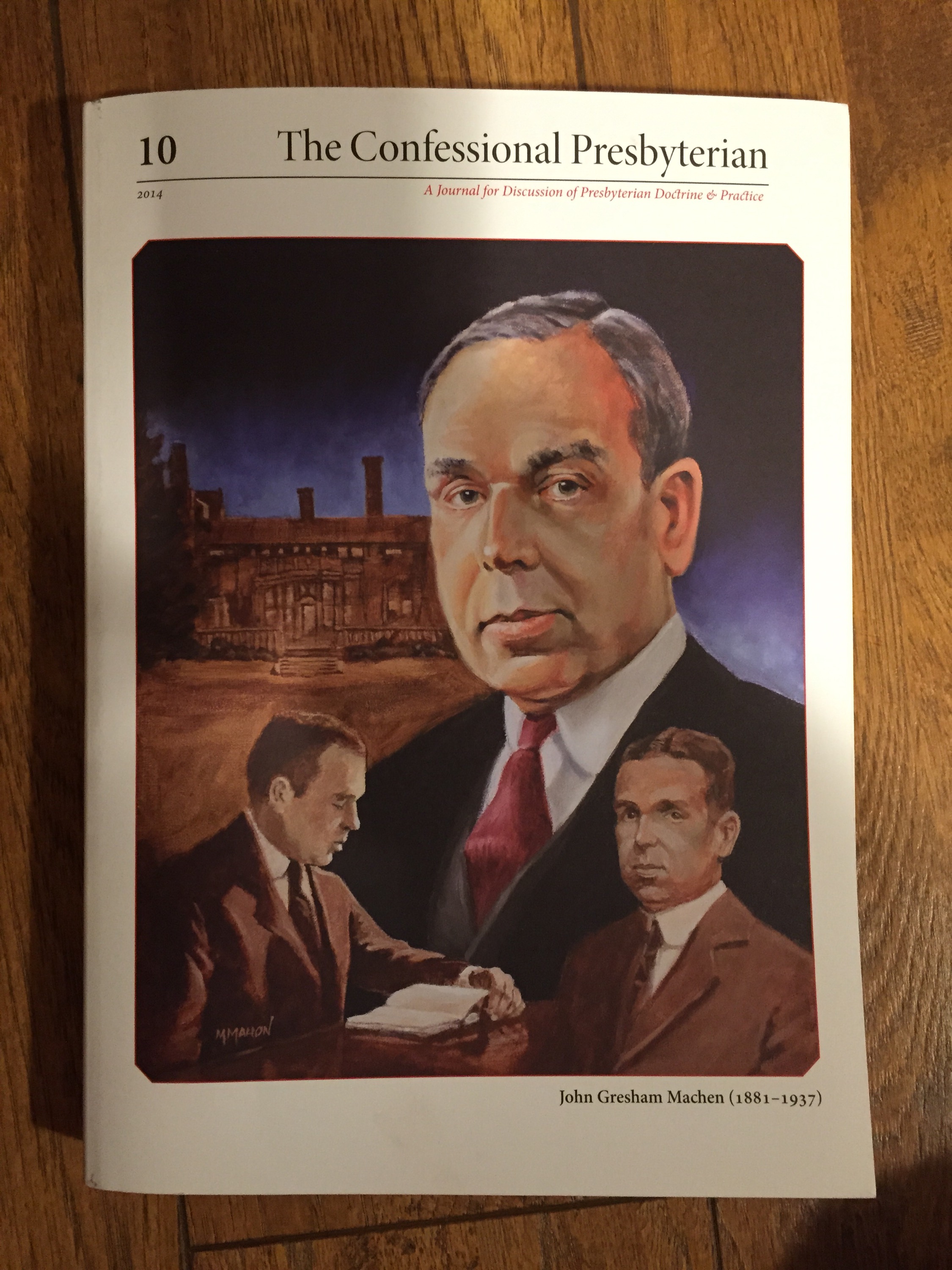
One hundred thirty four years ago today was the birth of Dr. J. Gresham Machen, Princeton Seminary Professor of New Testament, author of Christianity and Liberalism, co-founder of Westminster Theological Seminary (1929) and first moderator of the Orthodox Presbyterian Church (1936). Machen’s integrity as a defender of orthodox Christian doctrine and practice, and his leadership in exemplifying and declaring the same, are a legacy we as confessional Reformed Protestants (Presbyterian & Reformed Churches) build upon to this day.
The following link provides numerous resources on the life, ministry and legacy of J. Gresham Machen.
I also highly recommend the series on Machen by historian Darryl G. Hart, which were podcasted on Historian Ecclesia, a resource of ReformedForum.org:
My New Library Blog
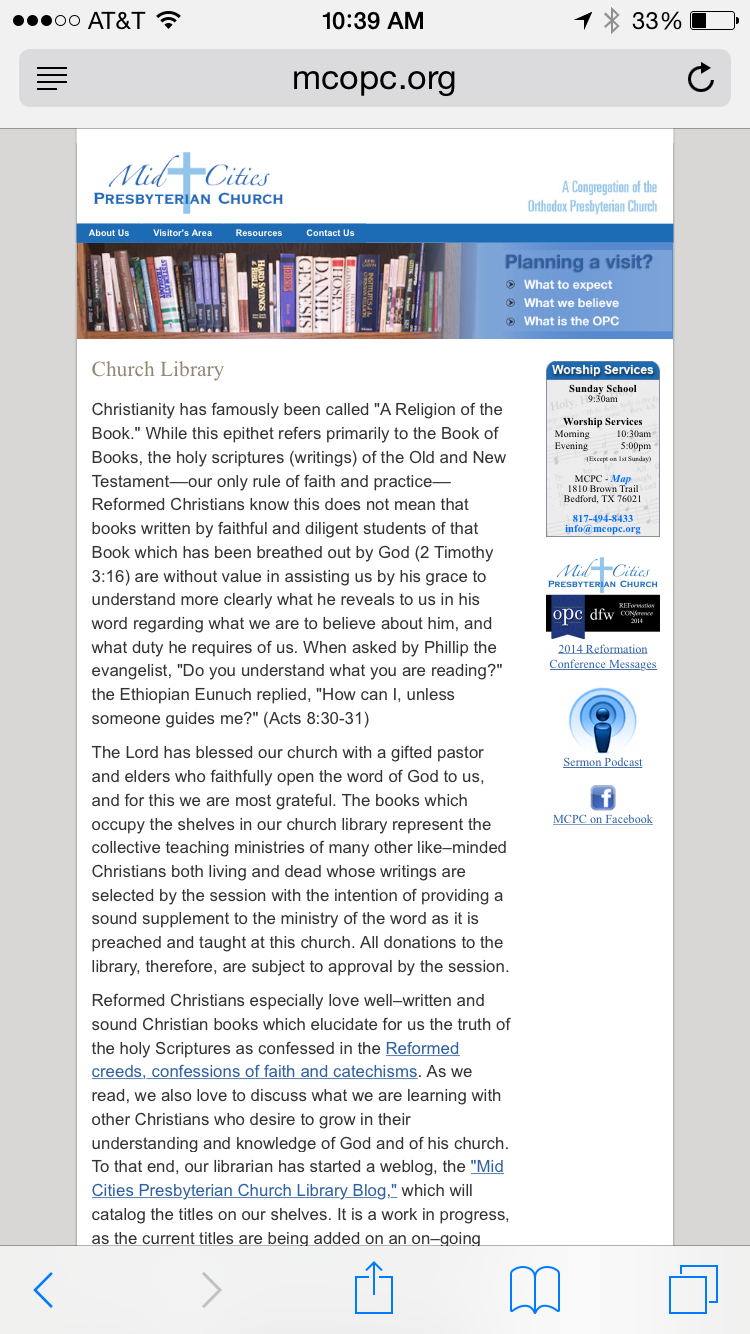
MCOPC Library Blog webpage
If you like Reformed books–and if you follow this blog, you probably do–then you may enjoy following the other blog that’s been dominating all of my blogging energy for the past few months. A deacon at my church asked me to take over our church library when we moved into our new building. More recently, we discussed putting the collection online for the use of members of our church who patronize our library to see what we have, and to serve as a resource to discuss, ask questions, review, recommend or criticize our titles. We thought about a few options, but I settled on using a blog for this purpose, given my nine years of experience at blogging.
First, you may enjoy reading my introduction to our church library which is posted at my church website. It will then link you to my library blog, Mid-Cities Presbyterian Church Library Blog (or more commonly, MCOPC Library). Even though you are not a member of my church, please feel free to subscribe and comment as you like. Thanks for your interest!
Humility, Prayer, Study and Meditation
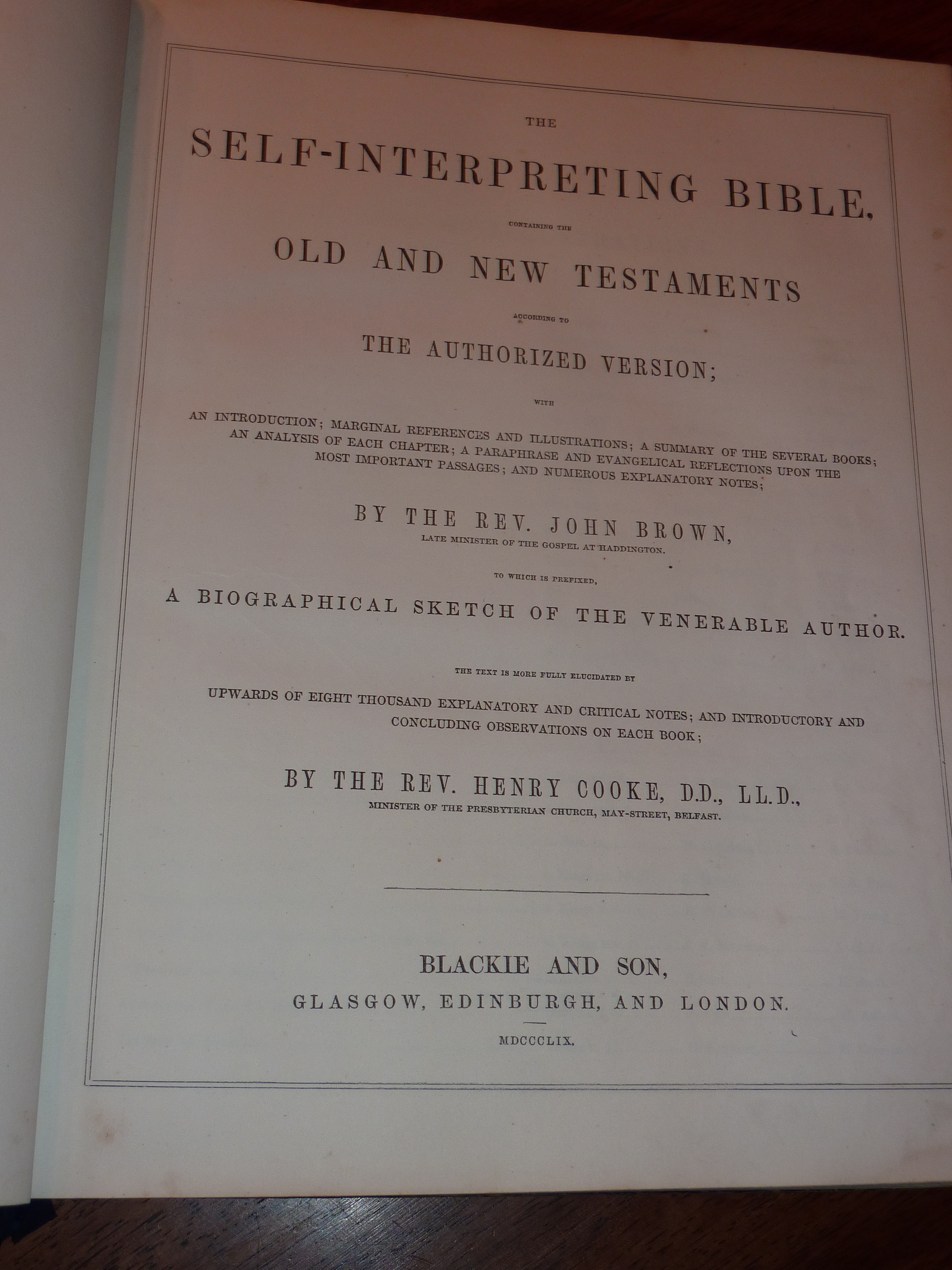
Title Page to Brown’s Self-Interpreting Bible
The following continues a series of excerpts from “An Introduction to the Right Understanding of the Oracles of God,” by the Rev. John Brown of Haddington, as published in his Self-Intepreting Bible (1859 edition). (Punctuation and Scripture references have been modernized).
Chapter II
OF RULES FOR UNDERSTANDING THE SCRIPTURES OF THE OLD AND NEW TESTAMENTS
- Let us labor, in much fervent prayer and supplication, for the powerful influence and inhabitation of the Holy Ghost (who perfectly understands the Scriptures, and indited and appointed them for our spiritual edification,) that he may effectually interpret and apply them to our heart. He is the Spirit of wisdom and revelation in the knowledge of Christ; He it is who searcheth all things, yea, the deep things of God:–He is the Anointing, that is Truth, and teacheth all things. He can enlighten our eyes, and make us to know things freely given us of God, and to see wondrous things out of God’s law; can make us by the Scriptures,–wiser than our teachers—wise unto salvation (Ephesians 1:17-18; 3:16-19; 1 Corinthians 2:10, 12; 1 John 2:20, 27; Psalm 119:18, 96-109; 2 Timothy 3:15-17).
- Being renewed in the spirit of our minds, and having in us the mind of Christ, we ought, under a deep sense of God’s presence and authority in the Scripture, earnestly, and with much self-denial, to search the Scriptures, by much serious reading and meditation thereon; chiefly that we may spiritually know the mind, behold the glory, and feel the effectual power of God therein, in order to our faith in, and obedience to them. The natural man receiveth not the things of the Spirit of God: it is the man who feareth God to whom he will teach his way, and reveal the secrets of his covenant;–it is the man who hat the Spirit of Christ, the mind of Christ–who hath seen the Lord, and tasted that he is gracious—the man who hath had his eyes opened, that can discern, judge of, and understand the matter or manner of Scripture revelations (1 John 2: 20, 27; Psalm 25:12, 14; 1 Corinthians 2:14-16; John 14:21-23; Luke 24:45; Psalm 114:18). A deep sense of our ignorance, and of our absolute need of Scripture influence, must animate us to the earnest study of knowledge. He, who thinks that of himself he knows divine things to any purpose, knoweth nothing as he ought to know—only with the lowly is wisdom. God, who resisteth the proud, giveth grace to the humble: the meek will he guide in judgment; the meek will he teach his way. The mysteries of the kingdom he hides from the self-conceited, wise, and prudent; and reveals them unto babes (1 Corinthians 8:2; Proverbs 11:2; James 4:6; Psalm 25:9; Matthew 13:11; 11:25). Scarcely can anything then more effectually to blind the mind, and harden the heart, than the searching of the Scriptures in a philosophical manner, regarding merely or chiefly the rational sense of the passage. Hence multitudes of preachers, who daily study the Scriptures for the sake of their external performances, are of all men the most ignorant how Christ’s words are spirit and life. The god of this world blinds their minds; so that hearing many things, they never open their eyes; and seeing many things, they never behold one truth, or the subject thereof, in its glory (Isaiah 6:9-10; 42:18-19; 56:9; 2 Corinthians 4:3-4).
“Heart knowledge” of Scripture’s Self-Attesting Evidences Persuades of Its Divine Inspiration and Authority

Brown’s Self-Interpreting Bible (1859 edition)
The following continues a series of excerpts from “An Introduction to the Right Understanding of the Oracles of God,” by the Rev. John Brown of Haddington, as published in his Self-Intepreting Bible (1859 edition).
X. Though the above arguments are sufficient to silence gainsayers, and to produce a rational conviction that the Scriptures are of divine original and authority, it is only the effectual application of them to our mind, conscience, and heart, in their SELF-EVIDENCEING DIVINE LIGHT and POWER, which can produce a cordial and saving persuasion that they are indeed the word of God. But, when thus applied, this word brings along with it such light, such authority, and such sanctifying and comforting power, that there is no shutting our eyes nor hardening our hearts against it; no possibility of continuing stupid and concerned under it: but the whole faculties of our soul are necessarily affected with it, as indeed marked with divine evidence, and attended with almighty power; 1 Thes. 1:5; 2:13; John 6:63.
Divine Inspiration Evidenced by the Exact Fulfillment of the Types and Predictions of Scripture

- Reverend John Brown of Haddington

The following continues a series of excerpts from “An Introduction to the Right Understanding of the Oracles of God,” by the Rev. John Brown of Haddington, as published in his Self-Intepreting Bible (1859 edition).
IX. Nothing more clearly demonstrates the divine authority of the Scriptures than the exact fulfillment of the typical and verbal predictions therein exhibited, in the most circumstantial manner, hundreds or thousands of years before that fulfillment took place, or there was the smallest appearance of it. Predictions (especially as above circumstantiated) necessarily imply a looking with certainty through an infinity of possible events, and seeing and determining what shall certainly happen, and what not. Such foresight and determination can only take place in the omniscient and almighty Governor of the world, who alone can declare the end from the beginning.—To mark the all-seeing JEHOVAH, the author of Scripture, its pages are crowded with predictions, the exact fulfilment of which is recorded in the inspired and other histories written since the events took place. Almost every historical passage in our Bible is a narrative of something antecedently foretold. The New Testament is little else than a representation of the fulfilment of the types and predictions of the Old, relative to Jesus Christ and his gospel church. Nay, the histories of churches and nations, from the beginning to the end of the world, do, to a judicious observer, represent little more than the fulfilment of Scripture predictions, as to the families of Adam and Noah; the Canaanites, Amalekites, Ammonites, Moabites, Edomites, Philistines, Egyptians, Ethiopians, Syrians, Assyrians, Chaldeans, Persians, Greeks, Romans, Saracens, Tartars including Goths, Huns, and Turks; and especially the Jews, Jesus Christ, the New Testament church, and Antichrist; as shall be hereafter manifested. This proof, drawn from the fulfilment of predictions, increases in evidence more and more as that fulfilment takes place, and is observed. The dispersion and misery of the Jewish nation, so long continued, or so often repeated; the progress and continuance of the gospel among the Gentiles; the long continued dominion of the popes, and the partial revolt from it at the Reformation; the past and present condition of the Turkish empire; the present state of Assyria, Chaldea, Arabia, Phenicia (sic), Canaan, Egypt, &c., in exact correspondence to Scripture predictions, are standing testimonies of the divine original of our Bibles, no less conclusive and striking than if we had miracles wrought every day.
Theological & Doxological Meditation #50
 Q. 50. What is required in the second commandment?
A. The second commandment requireth the receiving, observing, and keeping pure and entire, all such religious worship and ordinances as God hath appointed in his word.
Dt. 12:32 “Everything that I command you, you shall be careful to do. You shall not add to it or take from it.
Mt 28:20 teaching them to observe all that I have commanded you. And behold, I am with you always, to the end of the age.”
The Law of the Lord is Perfect
#152, The Trinity Hymnal (1990)
Psalm 19:7-11
Anonymous
THE LAW OF THE LORD, Irregular
Anonymous; alt. 1990
The Law of the Lord is perfect,
Converting the soul.
The testimony of the Lord is sure,
Making wise the simple.
More to be desired are they than gold,
Yea, than much fine gold.
Sweeter also than honey
And the honeycomb.
The statutes of the Lord are right,
Rejoicing the heart.
The commandments of the Lord are pure,
Enlight’ning the eyes.
More to be desired are they than gold,
Yea, than much fine gold.
Sweeter also than honey
And the honeycomb.
The fear of the Lord is clean,
Enduring forever.
The judgments of the Lord are true,
and righteous altogether.
More to be desired are they than gold,
Yea, than much fine gold.
Sweeter also than honey
And the honeycomb.
Divine Inspiration Evidenced by the Miracles of Scripture
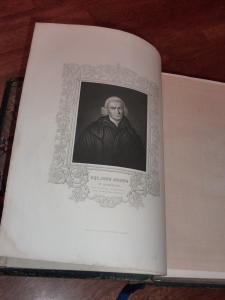
- Lithograph of the Reverend John Brown of Haddington

The following continues a series of excerpts from “An Introduction to the Right Understanding of the Oracles of God,” by the Rev. John Brown of Haddington, as published in his Self-Intepreting Bible (1859 edition).
VII. Multitudes of MIRACLES, which only the infinite power of God could effect, have been wrought for the confirmation of the doctrines and facts mentioned in the Scriptures, and for evincing the divine mission of the principal publishers thereof. The wisdom and goodness of God required him, especially when in the days of Moses and Christ he was establishing a new form of worship, to mark the important declarations of his will with some distinguishing characteristics, awakening to consideration. Nothing appears more proper for this end than a series of uncontrolled miracles, which no power could check, and which supported nothing but what was agreeable to reason, so far as it could conceive of it. Neither reason not experience can admit that the infinite wisdom and goodness of God could permit one, much less multitudes of uncontrolled miracles wrought in confirmation of the Scriptures have every favorable circumstance that could be wished. Their number was almost beyond reckoning, and all of them calculated to answer some great and benevolent end. According to the nature of the broken law, many of those wrought by Moses, Elijah, and Elisha, were tremendous and dreadful. According to the nature of the gospel which they published, the miracles wrought by Jesus Christ and his apostles were generally of a benevolent nature and tendency. Moreover most of the miracles mentioned in Scripture were performed in so public a manner that both friends and foes had the fullest access to a thorough examination of their nature and certainty. Most of them were wrought when the concurrent circumstances of Providence loudly called mankind to observe and examine them. Most of them—as the passage of the Hebrews through the Red Sea and through Jordan; the forty years’ sustenance of the people in the Arabian desert, by manna from heaven, and water from a rock; the stoppage or retrograde motion of the sun; the feeding of thousands with a few loaves and fishes; and the raising of dead persons—were of such a nature, that nothing less than absurdity itself can suppose the senses of the witnesses to have been deceived, or that any power less than divine could have produced them. Besides, all these miracles were wrought in confirmation of a religion the most holy, pure, and benevolent; and most of them by persons who were eminent patterns of virtue. And that such miracles were wrought, is in part attested by the inveterate enemies thereof, whether Jews or heathen.
An Introduction to the Right Understanding of the Oracles of God by Rev. John Brown of Haddington.


 The Misadventures of Captain Headknowledge
While I AM is Still Near (John 9:1-7)
As he passed by, he saw a man blind from birth. And his disciples asked him, “Rabbi, who sinned, this man or his parents, that he was born blind?” Jesus answered, “It was not that this man sinned, or his parents, but that the works of God might be displayed in him. We must work the works of him who sent me while it is day; night is coming, when no one can work. As long as I am in the world, I am the light of the world.” Having said these things, he spit on the ground and made mud with the saliva. Then he anointed the man’s eyes with the mud and said to him, “Go, wash in the pool of Siloam” (which means Sent). So he went and washed and came back seeing. (John 9:1-7 ESV)
Share this: