Taylor’s Theses on Anti-Intellectualism
Justin Taylor of Crossway Books has organized under the headings of five theses, or propositions, a useful collection of quotes by leading intellectuals whose words effectively call evangelical Christians to resist the temptation of anti-intellectualism.
Biblical Christianity is less about experience or works, and more about what one believes. By majoring on experience and works, Christians have unjustly condemned the Christian pursuit of knowledge, and so deserve many of the world’s accusations of ignorance and anti-intellectualism.
Delay on Part 3
It’s summertime and life is going to interfere with my blogging for the next week or so. Please be patient as you look forward to part 3 of my series on Gender Roles, dealing with liberal egalitarianism and hyper-conservative patriarchalism and the more genuinely biblical and evangelical movement known as complementarianism.
Why Reformed Churches Don’t Rebaptize
Why two baptisms are one too many.

 Confessional Reformed/Presbyterian churches don’t rebaptize a Christian who comes from another church to join theirs. The Westminster Confession of Faith (28:7) says “the sacrament of baptism is but once to be administered to any person.” For example, if a person was baptized in a Roman Catholic, Methodist, Brethren, or Baptist church, he or she would not have to be baptized again to join a Reformed/Presbyterian church.
Why not?
Well, there are quite a few historical and biblical answers to the question. I don’t have the space here to discuss how the Reformers spoke against the Anabaptists who began rebaptizing Christians during and after the Reformation. You can read Luther’s 1528 treatise, “Concerning Rebaptism” for more information on this. The (short) historical answer to the above question (Why not?) is simply this: because we’re not Anabaptists!
At the heart of the biblical answer is the fact that baptism is primarily God’s
View original post 386 more words
Mid-Cities OPC’s First Building

The most recent incarnation of the banner which announced the presence of a congregation of Orthodox Presbyterians at the YMCA in Bedford, Texas–for only a few hours each Sunday morning over a period of about eight years.

Dr. K. Scott Oliphint (left) with MCPC pastor, Rev. Joe Troutman (right) inside the YMCA.

My gifted daughter, Abigail, fills in as pianist during morning worship at the Bedford YMCA.

After years of shopping for buildings in a fairly full suburb, this sign is discovered.

Here’s the building which came with the sign.

After months of negotiating, inspecting, and work days, a date is set.

At long last, a place of our own to worship and glorify our faithful covenant God.
If any of my readers ever find themselves in the Dallas/Fort Worth Metroplex, please worship with us at…
Mid-Cities Presbyterian Church (OPC)
1810 Brown Trail
Bedford, Texas 76021
Today is Palm Sunday, 2013. Today’s post is a rerun of my notes on my pastor’s sermon on Christ’s Triumphal Entry. Don’t miss the discussion of the donkey in the comments thread.

Sermon Notes from Sunday, October 9, 2011. Delivered by Rev. Joe Troutman at Mid-Cities Presbyterian Church (OPC).Listen online.
Jesus comes into Jerusalem as king, but in a week’s time he will have been crucified and raised from the dead for sinners like you and me.
Westminster Shorter Catechism 26
Q. How doth Christ execute the office of a king?
A. Christ executeth the office of a king, in subduing us to himself, in ruling and defending us (Psalm 110:3; Matthew 28:18-20; John 17:2; Colossians 1:13), and in restraining and conquering all his and our enemies (Psalm 2:6-9; Psalm 110:1-2; Matthew 12:28; 1 Corinthians 15:24-26; Colossians 2:15).
“The Lord Has Need of Them” (Matthew 21:1-5) Now when they drew near to Jerusalem and came to Bethphage, to the Mount of Olives, then Jesus sent two disciples, saying to them, “Go into the village in front of…
View original post 1,118 more words
How Could God Command Genocide in the Old Testament?
Check out Justin Taylor’s explanation of a difficult and emotional, but important question…
Breaking News–None Dare Call It Heresy (But One)!

This just in to the Daily Evangel news desk from the Facebook front. Captain Headknowledge has been witnessed being ambushed by heresy-hunter hunters in response to a link on the Word of Faith teachings of Joyce Meyer shared by his alter-ego, the mild-mannered (in most cases) and otherwise swell guy, John D. Chitty. There is no film to air at eleven, but you may view the exchange at this link.
Is Captain Headknowledge a Judaizer for allegedly drawing the lines of orthodoxy too closely around the circumference of his own shoes? Is it right to turn our collective heads at Meyer’s Word of Faith blasphemous treatment of the gospel because some unassuming believers are encouraged or helped on a practical/emotional/thearpeutic level from her other teachings? See and judge (but not hypocritically) for yourself!
Captain Headknowledge is from Geneva, and he’s here to help–Rescuing vicitms of villainous theology since 2006.
Note to Subscribers
If you are a subscriber to this blog, you may have already noticed a number of notifications of new posts in your inbox today. I am currently preparing a new page featuring the Theological & Doxological Meditations and updating the posts. While in the editing process, I made a blunder which rendered about twenty of the posts as drafts, and the only way I could find to undo the mistake was to republish them, which automatically sent a notification to you. Either tonight or tomorrow, you will be receiving a few more until I have finished republishing these posts. Please accept my apologies for any inconvenience. Allow this to serve as your notice of a coming revival of my series of devotionals–in the near future, I will begin posting new ones until I have finally made it all the way through the Westminster Shorter Catechism (see Creeds, etc.).
Balm for Believing Victims of Christianity
The following is a sermon by Lutheran (Missouri Synod) Seminary professor, Dr. Rod Rosenbladt, who is also co-host of The White Horse Inn radio show. The title of the sermon is “The Gospel for Those Broken by the Church.” He addresses two kinds of believers who have given up on going to church: the “sad,” who feel they couldn’t measure up, so they quit trying; and the “mad,” who’ve been “used up and spit out” by the church, or who have been justly scandalized by Christianity’s many historic misdeeds. Dr. Rosenbladt’s premise is that the good news of Christ’s cross and blood shed for sinners will save not only the pagan unbeliever, but also the wounded believer who, for whatever reason, has given up on Christianity.
In some ways, Dr. Rosenbladt’s presentation may come off a bit academic, but if you hang with him, you’ll find that the heart of the message is clear as a bell. If you’ve got friends or relatives who are mad or sad at the church, please forward this post to them.
The End of the Romans Revolution 2006

7 What then shall we say? That the law is sin? By no means! Yet if it had not been for the law, I would not have known sin. I would not have known what it is to covet if the law had not said, “You shall not covet.” 8 But sin, seizing an opportunity through the commandment, produced in me all kinds of covetousness. Apart from the law, sin lies dead. 9 I was once alive apart from the law, but when the commandment came, sin came alive and I died. 10 The very commandment that promised life proved to be death to me. 11 For sin, seizing an opportunity through the commandment, deceived me and through it killed me. 12 So the law is holy, and the commandment is holy and righteous and good.
13 Did that which is good, then, bring death to me? By no means! It was sin, producing death in me through what is good, in order that sin might be shown to be sin, and through the commandment might become sinful beyond measure. 14 For we know that the law is spiritual, but I am of the flesh, sold under sin. 15 I do not understand my own actions. For I do not do what I want, but I do the very thing I hate. 16 Now if I do what I do not want, I agree with the law, that it is good. 17 So now it is no longer I who do it, but sin that dwells within me. 18 For I know that nothing good dwells in me, that is, in my flesh. For I have the desire to do what is right, but not the ability to carry it out. 19 For I do not do the good I want, but the evil I do not want is what I keep on doing. 20 Now if I do what I do not want, it is no longer I who do it, but sin that dwells within me.
21 So I find it to be a law that when I want to do right, evil lies close at hand. 22 For I delight in the law of God, in my inner being, 23 but I see in my members another law waging war against the law of my mind and making me captive to the law of sin that dwells in my members. 24 Wretched man that I am!
Again, for this revolutionary truth found in the book of Romans and the rest of the Bible, we can only give thanks to God through Jesus Christ our Lord, because “There is therefore now no condemnation for those who are in Christ Jesus.” (notice the period at the end of this sentence!)
Technical Difficulties–Please Stand By
For those of you who enjoyed my recent post on Harold John Ockenga, I want you to know that human error is to blame for its subsequent disappearance. I may replace it soon, but, not today.
Enjoyed all the comments it generated! Sorry for the inconvenience.
Thus concludes this misadventure . . .
The "Larger" and the "Shorter" of It: An Anniversary for the Westminster Catechisms
 September 15, 1648
The Larger and the Shorter Catechisms — both prepared by the Westminster Assembly the previous year — were approved by the British Parliament. These two documents have been in regular use among various Presbyterians, Congregationalists and Baptists ever since.
The following series of posts will be from,
“The Origins and Formation
of the Westminster Confession of Faith”
as published in,
The Constitution of the Presbyterian Church in the United States:
Containing the Confession of Faith,
the Larger and Shorter Catechisms,
as ratified by the General Assembly, at Augusta, Georgia, Dec. 1861,
with revised proof texts adopeted by the General Assembly of 1910.
Together with The Book of Church Order,
adopted by the General Assemblies of 1876-9 and 1893;
with amendments embodied up to and including the year 1910.
The Directory for the Worship of God, with Optional Forms, adopted 1894.
Rules of Parliamentary Order, adopted 1866.
I love those long titles!
My mother found this small tome at an estate sale a couple of years ago! (Yippie! I’m an old bibliophile!!!) Thanks to www.reformationart.com for all of the illustrations in this post.
“The Tendency Toward Thorough-Going Reform”:
Calvin and Luther through the work of the Puritans
As early as 1540, two great types of the reform of religion in northern Europe had made themselves manifest. Luther had moulded the one type. Calvin had moulded, or begun the moulding of, the other.
Luther was for retaining of Mediaeval doctrine, government, worship, many things — whatever seemed to him desirable and not forbiddn in the Word of God. Calvin was for bringing the Church into conformity with the pattern shown in the Word. He would have the Church hold the faith taught in the Word, govern itself according to the principles taught in the Word, and conduct its exercises of worship according to maxims derivable from the Word. He believed in the sufficiency of the Scriptures as a rule of faith and practice, and would have had the Church conform in all respects to Scripture teaching.
Lutheranism was the great type of moderate reform in northern Europe. Calvinism was the great type of thorough-going reform. Owing to the peculiar genius of the German people and to peculiar favoring providences, Lutheranism prevailed widely throughout north Germany and Scandinavia, but not a few in these regions craved a more thorough-going reform. Owing to the peculiar genius of the French, the Duth and south Germans, and to favoring providences, Calvinism prevailed in France, the Netherlands and in certain south German States and cities; among these peoples, however, there were some who had a greater love for features of the Mediaeval Church and would have retained them.
There were, thus, on the Continent two great types of reform movement, the one dominant in the one quarter, and the other dominant in other quarters. At the same time, in the sphere within which moderate reform prevailed, there was more or less demand for thorough-going reform; and in the sphere within which thorough-going reform prevailed there was more or less desire for merely moderate reform.
In England also, two types of reform were clearly manifest from the early days of Queen Elizabeth, the one a moderate, the other a type tending to thorough-going reform, each type indigenous, but each type strengthened by influences from beyond the Channel. The development of these two types of ecclesiastical reform in England was mightily influenced by the action of the crown, the one type being swerved by attraction, the other stimulated by opposition.
In no other country did the throne influence the character of reform so greatly. This was owing to this fact, amongst other forces, that the head of the English State had been made the head of the English Church. Henry VIII had, for personal, and, in the main, base reasons, revolted from the Papal rule; and had secured at the hands of Parliament in 1534, the “Act of Supremacy,” which ordered that the King “shall be taken, accepted and reputed the only supreme Head in earth of the Church of England, and shall have and enjoy annexed and united to the Imperial Crown of this realm as well the title and style thereof as all the honors, jurisdictions, authorities, immunities, profits and commodities to the said dignity belonging, with full power to visit, repress, redress, reform, and amend all such errors, heresies, abuses, comtempts and enormities, which by any manner of spiritual authority of jurisdiction might or may lawfully be reformed.”
While Henry vacillated somewhat in his attitude toward the reform movement, owing to political exigencies, and unwittingly furthered Protestantism at times, as in authorizing the publication of the Scriptures in the vernacular, he remained, at heart, a Romanist, in revolt against Papal rule, and was hostile to any representative of reform of either type who was bold enough steadily to maintain his convictions. During the reign of his son, Edward, moderate reform was favored.
During the reign of Mary, who succeeded Edward, every type of reform was bitterly and relentlessly persecuted, no less than two hundred and eighty persons were burned at the stake, and many hundreds of persons driven into exile. By the ruthlessness of her opposition Mary did much, however, to fertilize and stimulate the Protestant cause. She was succeeded, in 1558, by her half-sister, Elizabeth.
This last representative of the House of Tudor, though at heart holding a religion not very different from the Anglo-Catholicism of her father, so far as she had any religion, was forced by circumstances to favor Protestantism. Naturally, she favored moderate reform and fought thorough-going reform. This and her lust of power led her to resist constitutional changes that were proposed in the Church, jsut where she pleased. An aristocratic hierarchy, though with noble exceptions, naturally also, sided with her in repressing both the civil and religious liberties of the people.
With Elizabeth the Tudor dynasty became extinct. The Stuart dynasty succeeded to the throne in the person of James, VI of Scotland, I of England. Brought up under Presbyterian tutelage, but with the blood of tricksters in his veins, he knew and approved the better, but followed the worse way. The party of moderate reform was regarded by him as more in harmony with civil monarchy. Moreover, that party pleased him by approving his fatal theory of the divine right of kings, and by endless and unseemly flatteries.
His son Charles, who followed him on the throne, swung back toward Roman Catholicism–to Anglo-Catholicism. During these two Stuart reigns the party of moderate reform, enjoying the favor of the court, and tending toward Anglo-Catholicism, united with the court in a bitter effort at repression of the aprty of thorough-going reform. This persecution, together with the spread of Arminianism among the moderate reformers, stimulated into large vigor of life the party tending to thorough-going reform.
The party tending to thorough-going reform in England, finds its rootlets in the age of  Bloody Mary, in Ridley, Hooper, Latimer and others, and in part of the work of Cranmer. It finds rootlets reaching further back–to Tyndale, who, prior to his death in 1536, had spread widely his translation of the New Testament in Scotland as well as in England.
Some of its rootlets reach even further back–to the followers of Wycliffe and to Wycliffe 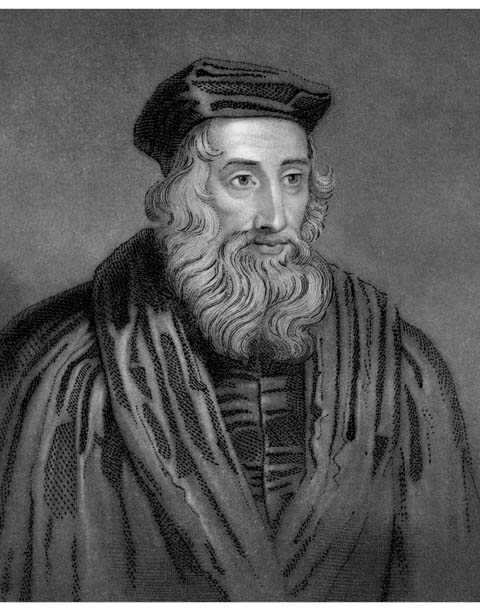 himself. But while thorough-going reform was thus indigenous to England, it received a mightly impulse from the Continent, and particularly from Geneva. Many of those driven from England by the Marian persecutions found a congenial exile at Geneva, and became apt and honest pupils of the great Calvin.
At the beginning of Elizabeth’s reign they returned thoroughly imbued with those views of Scripture truth, which he taught with a clarity and force elsewhere unparallelled. The Calvinistic Theology became the theology of the great men of the Anglican Church during the first forty years of Elizabeth’s reign. The most of these great men would willingly have tolerated a more thorough-going reform of the government and worship of the Church. Some of them positively and openly favored further reform in these departments. But Elizabeth stood in the way.
In 1563 the formularies of the Anglican Church were completed, containing Protestant doctrines along with a Mediaeval hierarchy and a partially Mediaeval cultus. In the following year the Queen began the attempt to enforce a rigid uniformity–an attempt resulting in the expulsion from the Established Church of many of the godliest ministers of all England.
Further trouble arose over the private meetings for worship in London at which Knox’s Book of  Common Order was used instead of the Liturgy, and over the more public meetings known as prophesyings–gatherings of ministers and pious laymen for the study and exposition of the Scriptures–very important meetings, as proven in their use in Zurich, Geneva and Scotland. Elizabeth commanded their suppression.
Before Elizabeth had been on the throne a score of years a consideable number of advocates of thorough-going reform, “who had been led on to substantially Presbyterian opinions, but, discouraged by friends abroad, and debarred by the authorities at home from overtly seceding from the national Church, begand to hold private meetings for mutual conference and prayer, and possibly also for the exercise of discipline over those who voluntarily joined their associations and submitted to their guidance.
It is even said that a Presbytery was formed at Wandsworth in Surrey, wherein eleven lay elders were associated with the lecturer of that congregation and certain leading Puritan clergymen. But if this was really a formal presbytery, it is probable that it was what was then called the lesser presbytery or session, not the greater presbytery or classis to which the name is now restricted. It is more certain that when Cartwright, the redoubled leader of this school of Puritans, was arrested in 1585 and his study searched, a copy was found of a Directory of Church Government, which made provision for synods, provincial and national, as well as for presbyteries, greater and lesser.
This, according to some authorities, had been subscribed by about five hundred Puritans of this School, and for some years–had to a certain extent been carried out, and a church withing the chuch virtually formed.” (Mitchell: The Westminster Assembly, pp. 51 and 52). These and all other expressions of thorough-going reform Elizabeth did her utmost to stamp out, using the despotic Courts of Star Chamber and High Commission without regard to the feelings and convictions of many of the most patriotic, learned and Christian of her subjects, but with disastrous failure, as the result. Her tyrannical measures called out and developed love for the more biblical form of religion which she persecuted. They multiplied the advocates of thorough-going reform, or Puritans, as they came early to be called in England. 
National Tragedy and Repentance
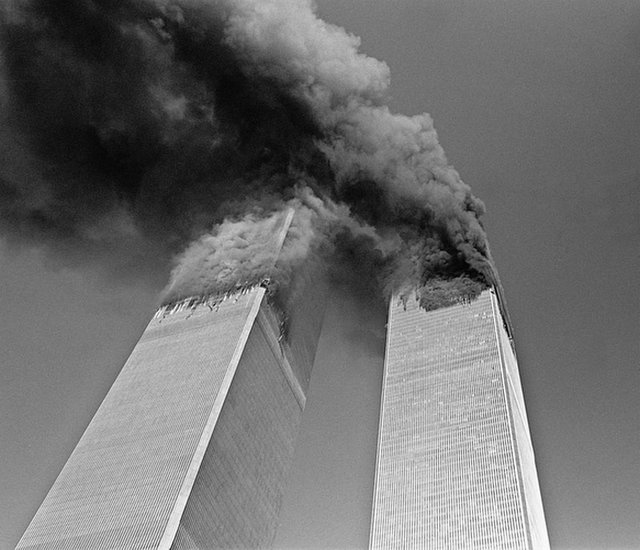 On September 11, 2001, four airliners were hijacked by Islamo-fascist terrorists, and two of them were piloted into the twin towers of the World Trade Center in New York City, killing 2,479 people. Tragedies such as this ofen move people to reflect and ask questions like, “Where is God when bad things happen to good people?” or “What can we learn from a tragedy such as this?”
In Luke 13:4-5, Jesus says, “Or those eighteen on whom the tower of Siloam fell and killed them: do you think that they were worse offenders than all the others who lived in Jerusalem? No, I tell you, but unless you repent, you will all likewise perish.”
What do we learn from a tragedy like the unexpected death of the eighteen in Siloam or the almost 2,500 in New York City? Are we to ask what sins did they commit to deserve such a horrible death? Are we to ask what national sins motivated God to punish the nation in such ways? Jesus takes the spotlight off the victims and the state of the nation and turns it one each and every one of us. What we are to remember in the event of the death of others is the fact that God is angry with sin and has decreed that the penalty for sin is death. But we are also called to remember that Godalso sent his Son, Jesus, to live a perfectly righteous life and earn eternal life, only to offer up himself to suffer the death penalty which sinners like all of us deserve, and to rise from the dead on the third day to declare that justification before God and eternal life has been purchased for all who trust Chrsit to save them from the wrath of God against their sin. This is where God is in tragedies such as this: he’s reminding us who survive that death is the result of sin; and the lesson we are to learn is that unless we turn from our sins to God who is angry with sin, and trust in Christ who died for sinners, we will die in our sins forever.
Examine your behavior in the light of the Ten Commandments, the holy Law of the holy God; have you kept each of these perfectly in thought, word and deed? If you are honest, you will recognize that you have not. This indicates that you are a sinner and you deserve to suffer the just wrath of the holy God and so you deserve to die. Now recall that the same just and holy God sent his Son, Jesus, to live a perfectloy righteous life, to keep God’s Law perfectly in thought, word and deed; then Jesus offered up himself to suffer the death that only sinners like you deserve so that God will give eternal life to sinners who turn from their sins and trust in Christ’s dath for sin.
Will you turn to God from your sins and trust Christ for forgiveness of your sins?
Why Memorize Scripture?
 I just received a beautiful email from Desiring God, which does a great job of encouraging believers to memorize Scripture. Click on the title above and it will take you to Desiring God’s newly redesigned website where you can read the message for yourself.
What a refreshing exercise it is to train your brain to store and meditate on, and your mouth to speak, the words God the Holy Spirit superintended as the Old Testament prophets and New Testament apostles wrote. In any responsible, well-made translation, this is truly a nourishing, cleansing, sanctifying and effective spiritual discipline.
As I was reading John Piper’s reasons to memorize Scripture, I was taken back to my days in the IFB movement. Boy, those King James Onlyists remain champions of the discipline of Scripture memorization! So many of the things John Piper writes are clear reflections of things I’d been taught all of my life. I had a similar experience when I read some of Leland Ryken’s The Word of God in English, written to promote the superiority of what is today becoming known as “essentially literal” translations of the Bible, over the decades long fad we’ve all gone through together in our lifetime known as “dynamic equivalent” or “thought-for-thought” translations. Ryken’s well-presented arguments for literal translation directly parallel much of what the King James Onlyists attempt to defend in their own way. Their way may be mixed with bad arguments defending other less compelling aspects of their position, but their stand on the superiority of literal translation as the most faithful way of rendering a text which happens to be the product of the breath of God cannot be faulted. Read Ryken’s book and compare it with Edward Hills’ arguments in The King James Version Defended.
Now, in case some of my overzealous former KJVonlyist readers are taking me the wrong way, no, I’m not promoting King James Onlyism, I’m promoting the time-honored tradition of literal translations of the Word of God, of which the KJV as well as the NKJV, NASB, ESV and several others are good examples. I’m also promoting the time-honored tradition of Scripture memorization. It’s true that with the advent of modern translations, especially in the case of the thought-for-thought variety, the discipline of Scripture memorization is a lost art. Yet another point on which KJV Onlyists are correct.
Find yourself a good, essentially literal translation of the Word of God. Being a brain-washed Reformed Christian, I recommend the English Standard Version. But any of them well suffice. Take that essentially literal translation of the Word of God and begin committing words, phrases, sentences, verses, chapters, books (you know, it has been done! ), to memory, and see if your Conformity to Christ, Daily Triumph over Sin, and Satan, Comfort and Counsel for People You Love, Communicating the Gospel to Unbelievers and Communion with God in the Enjoyment of His Person and Ways are not greatly fortified, strengthened, sanctified for the glory of God!


 The Misadventures of Captain Headknowledge

The Biblical Basis of the Reformed Confessions and Catechisms
As a member of a local confessional Presbyterian church and coming from my background as an Independent Baptist, I can’t help but notice how easy it is to confirm the common accusation that “Presbyterians often seem to cite the Confession more readily than they do the Bible.” As I listen to teaching (that of no one in particular, and this is not restricted to my own congregation), I often find myself listening to it as if I were a Baptist who was hearing this presentation for the first time. It doesn’t take long before all the biblicist defenses go up. A Reformed teacher will teach a vital biblical truth and then they will cite the Westminster Standards or something from the Three Forms of Unity (click on the “Creeds, Etc.” link at the top of this webpage for more information on these Reformed doctrinal standards). The response a self-respecting biblicist is trained to make to a presentation like this is, “That’s nice, now what does the Bible say about it?” or, more boldly, they might declare, “I don’t care what your confession or catechism says, what does the Bible say?”
It occurs to me that if Presbyterians and those of other confessional Reformed denominations want to persuade those from outside their tradition, like Baptists, to believe that what Reformed confessions and catechisms teach is based on the Bible, then perhaps it would be time well spent to express their biblically based confessional statements by first disclosing what the Bible says and working from this to showing how what the confession or catechism says is solidly based on what the Bible says.
After all, a “Confession” is not intended to be a rival for the Bible, but an expression of what Reformed churches believe the Bible teaches. To use the word “Confession” alone does not necessarily communicate this ultimate point to those from outside the tradition. That’s why when I personally explain things related to the Confession of Faith, I will put the word “Confession” in a sentence that attempts to fully express what a Confession of Faith is. For example, “This biblical truth (whatever it may be) is worded this way, or that way, in the Confession of what Reformed churches believe best summarizes the teaching of the Bible.”
Now I realize there are many good Reformed teachers who are careful to base their arguments on Scripture, but the stereotype that the Reformed in general have a bad habit of quoting the confession more than they do the Bible is grounded in verifiable reality. I love hearing an explanation of what the Confession teaches, but then, I have already gotten over the hurdle of being persuaded that what the Confession teaches is what the Bible teaches, although not infallibly, of course.
For this reason, I have decided to engage in a little exercise for a while, which I will share with my readers. In the spirit of how I would like to hear the teaching of the Reformed confessions and catechisms expressed, I’m simply going to take the Scripture Proofs cited for almost any given phrase in the Westminster Larger Catechism (which my church currently happens to being going through), summarize the point being highlighted in the verses, cite the verses themselves, then explain that this is the reason the Catechism reads the way it reads.
Sound like fun? I hope you’ll join me! In the following post, I will give this treatment to the first clause in Question and Answer #73 of the Westminster Larger Catechism.
Share this: