Harold Camping: Tune in Monday

(05-22) 19:18 PDT ALAMEDA — The man who said the world was going to end appeared at his front door in Alameda a day later, very much alive but not so well.”It has been a really tough weekend,” said Harold Camping, the 89-year-old fundamentalist radio preacher who convinced hundreds of his followers that the rapture would occur on Saturday at6 p.m.
Massive earthquakes would strike, he said. Believers would ascend to heaven and the rest would be left to wander a godforsaken planet until Oct. 21, when Camping promised a fiery end to the world.But today, almost 18 hours after he thought he’d be in Heaven, there was Camping, “flabbergasted” inAlameda, wearing tan slacks, a tucked-in polo shirt and a light jacket.
Birds chirped. A gentle breeze blew. Across the street, neighbors focused on their yard work and the latest neighborhood gossip.
“I’m looking for answers,” Camping said, adding that meant frequent prayer and consultations with friends. “But now I have nothing else to say,” he said, closing the door to his home. “I’ll be back to work Monday and will say more then.”
Camping’s followers will surely be listening. Read more
Gone Camping!
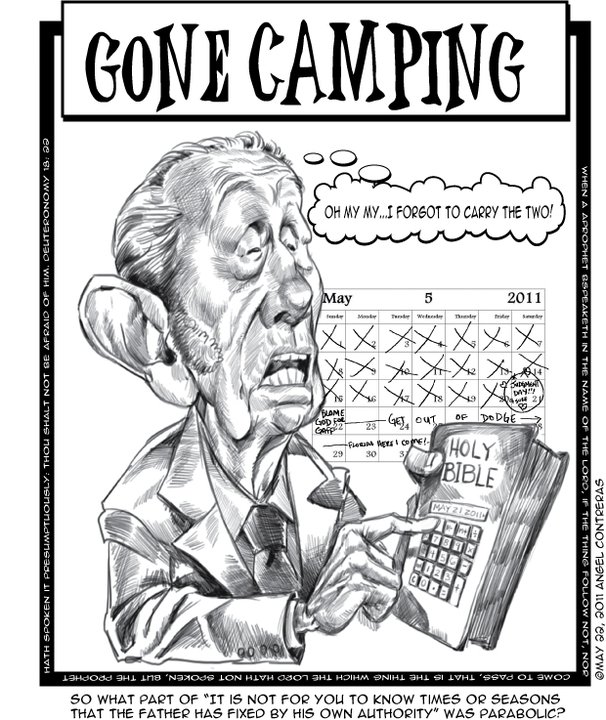
Click to "embiggen" and read the fine print
Allow me to recommend Redeemer Broadcasting

Don’t miss their program A Plain Answer! Today’s episode: “May 21 and Harold Camping’s Failed Prophecy.”
Update Rapture Fail Tomorrow

From the Rapture Fail website:
RaptureFail has been set up to allow people around the world to catalogue the failure of Harold Camping’s Rapture prophecy for the 21st of May 2011.
As Christians who take the Bible seriously we believe that “prophecies” like these demean the church’s witness in the world. The purpose of this site is to demonstrate very clearly (and to mock gently) that this is a false prophecy and that Harold Camping is a false prophet.
As 6pm on the 21st of May passes around the world, RaptureFail will show that the Rapture is not occurring by utilising the power of the internet and global user input. Everybody who participates in this project will be part of the undermining of this embarrassment to the Body of Christ.
The Bible is Not an Engineering Book

Harold Camping, Engineer
Several weeks ago, Dr. W. Robert Godfrey posted a 5-part series of blogs on Harold Camping from the perspective of one who knew this apocalyptic radio personality. When Godfrey was a child, he was a member of the same Christian Reformed congregation as Harold Camping—we’re talking, back in the ‘50’s! With this personal connection, Dr. Godfrey was able to introduce us to Camping and his teachings, not from a malicious and mocking point of view, but as one who grieves and prays for Harold Camping and his followers. I highly recommend his series, the links to which are given at the end of this post.
In part one, we learn how Camping reads the Bible.
Engineer
Camping was a bright and studious man who had been educated as an engineer. In the 1950s he owned a very successful construction company which built churches as well as other significant buildings. This educational background is critical to understanding Camping. His education was not in the liberal arts or theology. He had not been prepared to read literature or ancient texts. He knew no Greek or Hebrew. He was not formally introduced to the study of theology. His reading of the Bible, as it evolved over the decades, reflected his training in engineering. He reads the Bible like a mathematical or scientific textbook.
Yesterday, I downloaded the archived episodes of Harold Camping’s radio show “Open Forum” beginning with last Saturday’s episode, and I’ll continue downloading and listening through the time after his predicted date of the beginning of Judgment Day.On the May 15 episode of Open Forum, one caller points to Camping’s mathematical calculations as evidence that he’s not basing his prediction on what the Bible says but that he is instead “leaning on his own understanding.” The caller is correct, in that, just as Dr. Godfrey informs us, Camping’s presupposition about the Bible is that it is a precise mathematical text (Camping’s “own understanding”), when in fact, it is not. Sound interpretation of the literary genres of Scripture often involves the use of round numbers. But this is a fact which Camping denies. At minute 14:38 in the May 15 episode, we hear the following:
Caller: But you’ve had to apply these calculations…and-and-and with the calendars and adding. Nowhere does it say to do that, and that’s leaning to your own understanding. You would have to be perfect in your interpretation and unfallible (sic).
Camping: Well, first of all-first of all, when we developed the time in the Bible, we’re not looking at the calendars that have been developed by the various nations because sometimes they have dropped out some days or whatever. We work through the information that is all from God, namely, going from one year to the next, we go from 365.2422 days. We’re not looking at calendars, but when we come to talking about when in the Old Testament or whatever, we have to relate it to some kind of calendar, and so always—and archaeologists do the same thing—they coordinate it with our modern calendar, otherwise you’re neither coming or going, you don’t know where you are. You don’t pay any attention to all the different calendars that have been developed throughout time, only pay attention to the actuality. The astronomers have measured this again and again. It’s the way God has created the world, that there are 365.2422 days in a year. So if we multiply the number of years from one point to another, times that number, we can know exactly the number of days, and so on. So it’s all done with exquisite accuracy. And the Bible is a very, very analytical book. It is not—and when you’re working with the timeline in the bible and any evidence in the Bible, it has to be looked at very analytically, just like an engineering book, and that’s why we can come to such solid truths as what we’re talking about. But if we look at the Bible like the philosophers do [certainly by this he means seminary trained Bible scholars], they are not very careful in what they are using for their measurements. They can give an idea based on, “It could well be this…” and then they go ahead and they introduce some other information on that kind of a statement. “It could well be this.” No way! You can’t do that. It has to be, “It will be this because of what we read in the Bible,” and we go to our facts all the time. The Bible is dripping with facts, not with guesses. But thank you for calling and sharing and shall we take our next call, please? Welcome to Open Forum . . . (emphasis mine)
So, we see that according to Harold Camping, theological and hermeneutical expertise is “leaning on one’s own understanding,” but appealing to the laws of mathematics, astronomy and the practice of archaeologists, or looking at the Bible like an engineering book, will not make you misinterpret the Bible. This is the typical attitude of the rationalistic Biblicist.
Dr. Godfrey’s blog series is called, “The End of the World According to Harold Camping.” Read parts one, two, three, four, and five.
Those who’d like to read an introduction to the proper approach to Scripture can learn a lot by reading The Chicago Statement on Biblical Inerrancy which may be accessed from my “Creeds, Etc.” page.
So Glad I’m Not Alone…
…in writing hokey, mediocre music as an amateur, presuming it’ll edify others as much as it does me (see here for an example). Why am I not alone? Someone has done so by rewriting O Come, O Come Emmanuel in the light of Harold Camping’s soon-to-be-proven miscalculation of Judgment Day. You can listen to it here. (HT: James Swan)
What’s the Difference?
What’s the difference between the Jesus People of the 1970’s and the Postmodern Liberals of the Twenty-First Century?

Skeptical About Interpretation
I have an unbelieving friend with whom I’ve discussed much about the Christian faith. I admit that, having thoroughly proclaimed the fact of God’s holiness, my friend’s personal sinfulness for which he is accountable to that holy God, and the good news that God’s Son has volunteered to represent sinners like him on the cross so that those who would believe in him would have eternal life, and my friend’s subsequent and persistent resistance of that message in favor of his own relativistic and pluralistic form of non-Christian universalism, I have taken the liberty to go on discussing other matters of “religion and politics,” knowing that many of you would advise against such a practice. I’ve even discussed this point with him as well.
Perhaps I ought to wipe the dust from my feet, but for good or ill, in all the discussions in which we engage on the Bible, occasionally I’ll use the word “interpretation” in a sentence, to which my friend will object in so many words: “You’re not supposed to have to interpret the Bible!” I don’t know if this statement is based on some skeptical school of thought. My Googling has not helped me discover if the current trends in anti-Christian philosophizing and rhetoric, a la Hitchens, Dawkins, Maher, etc., make assertions like this (if any of you know, please comment!), but here are a couple of findings related to this question.
About five years ago, the blog Reformation Theology posted on the distinctive method of interpreting the Bible. In a post called “The Reformers’ Hermeneutic,” we read:
The exegesis and interpretation of the bible was the one great means by which the war against Roman corruption was waged; which is almost the same thing as saying that the battle was basically a hermeneutical struggle. In light of these observations, one could say that the key event marking the beginning of the Reformation occurred, not in 1517, when Martin Luther nailed his theses to the church door in Wittenberg; but two years prior to that, when he rejected Origin’s four-layered hermeneutic in favor of what he called the grammatical-historical sense. This one interpretive decision was the seed-idea from which would soon spring up all the fruits of the most massive recovery of doctrinal purity in the history of the Church. (read more)
Then the Lord, through Google, directed me to this Power Point presentation on “Exegetical Skepticism.” Here’s a bit of what it has to say:
There are so many different ways of interpreting the Bible, how can we be confident that our interpretation is correct?Skeptical Answer: We cannot be confident of our ability to interpret. There probably is one correct interpretation, but we won’t know it even if we have it. . . .So, if we can’t be for sure regarding interpretation, we must deal with probabilities rather than certainty.What kind of interpretation is more likely to represent the text’s original meaning?Answer: The most probable interpretation is the one that is consistent with language and literary genre similar to the ways that people typically used and understood them at the time the texts were written. . . .What are some ways to ‘break-out’ of our own cultural and psychological restraints?a.Ways to ‘breakout’ of our limitationsi.Discussion with other Christiansii.Church Historyiii.Approach the scriptures with humility.iv.Learn more about the history surrounding the Biblical texts.Conclusion:Although interpreting the Bible can be, at times, difficult (just as math, psychology, etc. can be difficult), this doesn’t mean we need to be skeptical about interpretation as a whole. Rather, interpretative difficulties should simply encourage humility and hard work.
Don’t Engage in Anabaptist Handwringing Over Osama bin Laden
There is quite a debate underway online regarding how Christians should respond to the death of Osama bin Laden. Are we to rejoice over the justice in the death of one who is responsible for the deaths of tens of thousands, most notably the three thousand souls lost on September 11, 2001? Or are we supposed to so major on the fact that “God is not pleased by the death of the wicked” (Ezekiel 33: 11 ) that we should stoically stand by and not “rejoice with those who rejoice,” even though we’ve been previously weeping with them (Romans 12:15)?
The book of Proverbs does read, “When it goes well with the righteous, the city rejoices, and when the wicked perish there are shouts of gladness” (Proverbs 11:10). Furthermore, “When justice is done, it is a joy to the righteous, but a terror to evildoers” (Proverbs 21:15). Methinks the instinct to worry about being too happy over Osama bin Laden’s death is a reflection of the influence of Anabaptist pacifism. It’s pervasive in Western Christianity nowadays. Try not to let it unduly influence you. For an example of what I mean, compare this blogger’s dilemma over how to react. Should he listen to the Anabaptist on the one shoulder, or the red-blooded American patriot chanting “U-S-A!” on the other? That he attributes his angst over the death of a mass-murdering terrorist to Anabaptism shows how this is the application of Anabaptist pacifism. For you Star Wars fans, remember Alderaan? They were a peaceful planet with no weapons, weren’t they? Look what happened to them.
While it is regrettable that Osama bin Laden never repented of his sins and trusted Christ for salvation from sin and the wrath of God—none of us are glad because he’s now suffering eternal conscious torment in hell. We’re relieved with the loved-ones of bin Laden’s and al Qaida’s victims that justice is served. There is no contradiction here.
At Underdog Theology, Warren Cruz takes the approach that our deceitfully depraved hearts may take us down the slippery slope of rejoicing in bin Laden’s eternal destiny though we intended to only rejoice in the temporal justice in his demise. Be that as it may, I’m inclined to take Luther’s approach (HT: Wikiquote):
If you are a preacher of mercy, do not preach an imaginary but the true mercy. If the mercy is true, you must therefore bear the true, not an imaginary sin. God does not save those who are only imaginary sinners. Be a sinner, and let your sin be strong (sin boldly), but let your trust in Christ be stronger and rejoice in Christ who is the victor over sin, death and the world. We commit sins while we are here, for this life is not a place where justice resides. We however, says Peter (2 Peter 3:13), are looking forward to a new heaven and a new earth where justice will reign.
Letter 99, Paragraph 13. Erika Bullmann Flores, Tr. from:Dr. Martin Luther’s Saemmtliche Schriften Dr. Johann Georg Walch Ed. (St. Louis: Concordia Publishing House, N.D.), Vol. 15, cols. 2585-2590
In other words, don’t let the fact that you may imperfectly rejoice in the justice of bin Laden’s death keep you from so rejoicing. Christ’s perfect righteousness covers the imperfect righteousness of those who trust him.
U-S-A! U-S-A!
Update: For a tad more balanced and scholarly approach to making the same point, try Michael Horton writing for Christianity Today today in “The Death of Osama bin Laden: What Kind of Justice Has Been Done?” Here’s the second of Horton’s three implications of the so-called Reformation doctrine of the Two Kingdoms as it relates to the only event in today’s headlines:
Second, it means that we cannot rejoice in the death of the wicked any more than does God (Ezek. 18:23). We may take satisfaction that temporal justice has been served, but Christians should display a sober restraint. When Christ returns, bringing infinite justice in his wake, his saints will rejoice in the death of his enemies. For now, however, he calls us to pray for our enemies, even for those who persecute us (Matt. 5:44). This is the day of salvation, calling sinners to repent and believe the gospel. We may delight in the temporal justice shown to evildoers, but leave the final justice to God. (HT: Riddleblog).
Reformed Concept of the Means of Grace

The final question of the April 27, 2011 episode of the Office Hours podcast by Westminster Seminary California, “Ask the Profs,” provided a good summary of the Reformed concept of the means of grace. Precisely at the 22 minute mark, the question was raised by a listener and the helpful answer was provided by Dr. John Fesko. Below I have appropriated some of his summary with a little of my own reflection on the topic in light of the teaching of Scripture.
“Means of grace” was originally a medieval Roman Catholic technical term for the sacraments, teaching that they are the means by which we receive the grace of God. Baptism was the means by which the infused righteousness of Christ was received, and the Lord’s Supper was the means by which the physical body and blood of Christ were received for eternal life.
The Reformers reformed the doctrines, but retained the terminology. First, they emphasized the centrality and priority of the Word of God preached by which God’s grace was received by those who believe, and condemnation received by those who do not believe. The sacraments were likewise means which confirm the grace received by those who believe the Word or condemnation by those who do not believe.
Contrary to Romanism, Reformed theology teaches justification by the imputed righteousness of Christ which is receied by faith alone; thus baptism does not convey the grace by merely submitting to the rite regardless of the recipient’s spiritual condition. Furthermore, Reformed theology agrees with Rome that Christ is present in the elements of the Lord’s Supper, but they disagree on how he is present–Reformed theology teaches that Christ is present via the Holy Spirit, not physically. Thus the efficacy of both sacraments is the work of the Spirit, and not the magical work of a human priest. The benefits of Christ’s redeeming work on the cross are given by the gracious work of the Spirit alone and received by faith alone.
It is interesting to note that Scripture clearly presents the dual truth that grace is received by the believer in the sacramental means of grace, while condemnation is received by the unbeliever who presumes to participate in the sacraments. Consider the following passages:
One may legitimately argue against the use of this passage, due to its questionable manuscript evidence, nevertheless Mark 16:16 emphasizes the necessity of faith for the efficacy of baptism: “Whoever believes and is baptized will be saved, but whoever does not believe will be condemned.” This shows how the believer who is baptized receives the grace by faith, but the one who is baptized but never finally comes to faith in Christ will be condemned.
First Corinthians 10:16 shows the blessings received by those who believe the Word and partake in faith in terms of communion or participation in the body and blood of Christ: “the cup of blessing that we bless, is it not a participation in the blood of Christ? The bread which we break, is it not a participation in the body of Christ?” The following chapter then shows how condemnation is received by those who partake of the Supper unworthily: “Whoever therefore eats the bread or drinks the cup in an unworthy manner will be guilty concerning the body and blood of the Lord” (1 Cor. 11:27).
Thus we see that the Reformed concept of the means of grace is centered around the centrality of the Word of God preached and received through faith alone by the grace of God the Holy Spirit alone. This grace is signified and sealed to the one who believes in the sacraments of baptism and the Lord’s Supper, but condmenation comes to the one who does not believe, even if he is baptized or partakes of the Lord’s Supper.
The Reformed Approach to Holidays
As my family experiences its first Easter together as regular attenders of a Reformed church, we are experiencing a distinct difference from the approach our former non-Reformed fundamentalist and evangelical churches have approached it. Following is a couple of paragraphs from an entry on Calvinism from the Encyclopedia of the Early Modern World, by the Gale Group, Inc. This should help us (and you) put the Reformed approach to holidays in general into historical context.
This morning our family is celebrating the resurrection of the Lord Jesus Christ. May this Easter Sunday find you worshiping the risen Lord in your house of worship.
Another distinctive feature of Reformed Protestantism was its remarkably small number of official holidays. Calvin himself saw no need and no scriptural basis for any holiday other than Sunday, and Reformed Protestants usually celebrated extremely few of them. Their most austere churches,GenevaandScotland(or seventeenth-centuryNew England), observed none at all—not untilGeneva’s magistrates overruled their pastors and finally declared Christmas an official holiday in 1694. Such situations were, however, exceptional. The mainstream of established Calvinism, the Reformed churches ofZurich,Bern,France, theNetherlands, and thePalatinate, celebrated four holidays besides Sundays: Christmas, Easter, Ascension Day, and Pentecost; the Dutch and thePalatinatealso added New Year’s Day. Keeping only a handful of holy days marked an enormous departure from Catholic practices, which in most places celebrated anywhere from forty to sixty holidays each year. Other mainstream Protestants were far less radical than Calvinists: Lutherans kept a large number of holy days, while the Church of England became a target for Puritan scorn by observing a total of twenty-seven holidays. Early Massachusetts went further and took the most extreme Calvinist position about the Christian calendar: not only did the colony ban all holidays, but its General Court briefly reformed the “pagan” names of the months as well, dating by “first month,” “second month,” and so forth.
Many Calvinists compensated for this paucity or absence of other holidays with a strict observance of Sunday, almost in an exact correlation.ScotlandbecameEurope’s most notorious example in 1579, when serious punishments were first threatened for Sabbath-breakers; by 1649, they had forbidden such practices as fishing on Sunday.Scotland’s extremely rigid taboos about Sabbath observance lasted far into modern times; it has been suggested that “Thou Shalt Not” made the best title for a history ofScotland, with its longest chapter called “Never on Sunday.” Another specifically Calvinist ritual was the special day of community fasting, proposed by pastors and decreed by secular authorities, usually intended to divert God’s wrath at times of extraordinary danger. We find fast days observed as early as the 1560s by the beleaguered churches of theLow CountriesorFrance, and later in seventeenth-centuryNew England; they remained a feature of Genevan life until the nineteenth century.
Return of the ICBI!

At the 2011 Twin Lakes Fellowship, Dr. Ligon Duncan announced the re-constitution of the International Council on Biblical Inerrancy (ICBI). Chief among their concerns is first to introduce the emerging generation of evangelicals to the true doctrine of the inerrancy of Scripture. So much slander and misrepresentation of this doctrine has been made by those “emerging” and Emergent church leaders that a re-affirmation of what historic orthodoxy has always believed about inerrancy must be broadcast far and wide. The blogger at Green Baggins is in attendance at the Twin Lakes Fellowship and is the one who has alerted me to Duncan’s announcement. He writes,
Some highlights: “If God is a Spirit, then the only way we can know him is if he speaks to us. And if he does not speak truth to us, we have no way of knowing him truly.” [Duncan’s] advice to pastors on how to be of help to our younger brothers and sisters:
- Re-read the classics on the doctrine of inerrancy.
- Walk with seminarians and others through the arguments of the current critics of inerrancy.
- Don’t assume Young Evangelicals own this tradition. Instead, persuade them into it by boht your understanding of the arguments from the critics and the biblical defense against those arguments.
You can read the rest of his comments on Duncan’s announcement in his post, “Twin Lakes and Inerrancy.” You can link to and read the original Chicago Statement on Biblical Inerrancy from my Creeds, etc. page.
Did I mention that I’m excited about this?
Divine Inspiration Required by the Character of the Penmen of the Scriptures

Lithograph of the Reverend John Brown of Haddington
The following continues a series of excerpts from “An Introduction to the Right Understanding of the Oracles of God,” by the Rev. John Brown of Haddington, as published in his Self-Intepreting Bible (1859 edition).
V. The manifest CHARACTER OF THE PENMEN further evinces the divine original of the Scriptures.
They everywhere discover the utmost candour and disinterestedness: they everywhere candidly publish the infirmities, or even faults of themselves, their friends, and nation. None of them ever gained anything in this world by their work but trouble and vexation; and, according to their own principles, they could obtain nothing in the next but everlasting destruction, if they indulged themselves in any imposture.
The matter and mannerof their work infinitely transcended their abilities. Setting their predictions aside for a moment, how could men of the best education, and especially men of no education, form such exalted schemes of sense, piety, and virtue? Or how could wicked men, inspired by Satan, publish and prosecute such a scheme of mystery, holiness, and morality?
Such is the character of Jesus Christ, drawn by the four evangelists, with every mark of simplicity and candour, and in which ignominious suffering is made a leading article, that the delineation thereof—and that too by persons of no uncommon knowledge—without a real and exactly answerable model, would, to every unbiased free-thinker, appear more incredible and impossible than even the incarnation, obedience, and death of the Son of God, therein attested, however astonishing. (emphasis mine)
Machen “Concerning the Times and Seasons”

Notice the similar color schemes? Interesting match!
I just finished reading “Encouragement for New Converts,” chapter 17 of The New Testament: An Introduction to its Literature and History (1976, 2009 Banner of Truth Trust) by J. Gresham Machen. This book makes a concise introduction to the major themes in the New Testament and clearly and effectively makes a positive presentation of orthodox New Testament scholarship, while at the same time providing textually based correctives to the academically popular theories of modernist liberal scholarship. Dr. Machen was, above all else, a New Testament scholar. While most known for both his New Testament Greek for Beginners, which is still used in many seminaries, and his popularly written Christianity and Liberalism, New Testament scholarship is his specialty.
Each chapter in Machen’s New Testament Introduction first assigns a selection of New Testament readings on which the following chapter is based. In this case, I read both 1 and 2 Thessalonians out of my ESV Study Bible before taking in Machen’s seven-page chapter on both books. While reading this chapter, which summarized the occasion, contents and issues related to the these earliest of Paul’s epistles, I was struck while reading the section on “The Second Coming of Christ,” in which he expounds “the second advent, with the events which are immediately to precede it” (p. 119). Machen interacts with the dominant modernist theory that Paul actually expected Christ to return during his lifetime.

Date-Setter, Harold Camping
But there is also a bit of timeliness to Machen’s exposition of 1 Thessalonians 5:1-11, specifically in the light of the current prediction by Harold Camping that Judgment Day has been calculated by him to be soon to occur on May 21, 2011. That’s 51 days and counting! Despite the fact that Jesus himself said, “But concerning that day and hour no one knows, not even the angels of heaven, nor the Son, but the Father only” (Matthew 24:36 ESV), Camping, not to mention all other date-setters, appeal to verses such as 1 Thessalonians 5:4-6, which read, “But you are not in darkness, brothers, for that day to surprise you like a thief. For you are all children of light, children of the day. We are not of the night or of the darkness. So then let us not sleep, as others do, but let us keep awake and be sober.” Machen’s introductory commentary also puts these words in perspective for us in the light of Camping’s millennial madness. Following is Machen’s section on “The Second Coming of Christ,” from pages 119-121 in The New Testament: An Introdcution to its Literature and History. Enjoy!
The Second Coming of Christ
Undoubtedly the second advent, with the events which are immediately to precede it, occupies a central position in the Thessalonian Epistles. Evidently the expectation of Christ’s coming was a fundamental part of Paul’s belief, and had a fundamental place in his preaching. ‘Ye turned unto God from idols, to serve a living and true God, and to wait for his Son from heaven’–these words show clearly how the hope of Christ’s appearing was instilled in the converts from the very beginning, I Thess. 1.9, 10. To serve the living God and to wait for his Son–that is the sum and substance of the Christian life. All through the Epistles the thought of the Parousia–the ‘presence’ or ‘coming’–of Christ appears as a master motive. I Thess. 2.19; 3.13; 4.13 to 5.11, 23, 24; II Thess. 1.5 to 2.12.
This emphasis upon the second coming of Christ is explained if Paul expected Christ to come in the near future. The imminence of the Parousia for Paul appears to be indicated by I Thess. 4.15: ‘For this we say unto you by the word of the Lord, that we that are alive, that are left unto the coming of the Lord, shall in no wise precede them that are fallen asleep.’ This verse is often thought to indicate that Paul confidently expected before his death to witness the coming of the Lord. Apparently he classes himself with those who ‘are left unto the coming of the Lor’ as over against those who will suffer death. In the later epistles, it is further said, Paul held a very different view. From Second Corinthians on, he faced ever more definitely the thought of death, II Cor. 5.1, 8; Phil. 1.20-26. A comparison of I Cor. 15.51 with II Cor 5.1, 8 is thought to indicate that the deadly peril which Paul incurred between the writing of the two Corinthian Epistles, II Cor. 1.8, 9, had weakened his expectation of living until Christ should come. After he had once despaired of life, he could hardly expect with such perfect confidence to escape the experience of death. The possibility of death was too strong to be left completely out of sight.
Plausible as such a view is, it can be held only with certain reservations.
In the first place, we must not exaggerate the nearness of the Parousia according to Paul, even in the earliest period; for in II Thess. 2.1-12 the Thessalonians are reminded of certain events that must occur before Christ would come. The expression of the former Epistle, I Thess. 5.2, that the day of the Lord would come as a thief in the night, was to be taken as a warning to unbelievers to repent while there was yet time, not as a ground for neglecting ordinary provision for the future. In Second Thessalonians Paul finds it necessary to calm the overstrained expectations of the Thessalonian Christians.
Furthermore, it is not only in the earlier epistles that expressions occur which seem to suggest that the Parousia is near: Rom. 13.11; Phil. 4.5. And then it is evident from II Cor. 11.23-29 and from I Cor. 15.30-32 that Paul had undergone dangers before the one mentioned in II Cor. 1.8,9, so that there is no reason to suppose that that one event caused any sudden change in his expectations.
Lastly, in I Cor. 6.14 Paul says that ‘God both raised the Lord, and will raise up us throught his power.’ If that refers to the literal resurrection, then here Paul classes himself among those who are to die; for if he lived to the Parousia, then there would be no need for him to be raised up.
It is therefore very doubtful whether we can put any very definite change in the apostle’s expectations as to his living or dying between First Corinthians and Second Corinthians. A gradual development in his feeling about the matter there no doubt was. During the early part of his life his mind dwelt less upoon the prospect of death than it did after perils of all kinds had made that prospect more and more imminent. But at no time did the apostle regard the privilege of living until the Parousia as a certainty to be put at all in the same category with the Christian hope itself. Especially the passage in First Thessalonians can be rightly interpreted only in the light of the historical occasion for it. Until certain members of the church had died, the Thessalonian Christians had never faced the possibility of dying before the second coming of Christ. Hence they were troubled. Would the brethren who had fallen asleep miss the benefits of Christ’s kingdom? Paul writes to reassure them. He does not contradict their hope of living till the coming of Christ, for God had not revealed to him that that hope would not be realized. But he tells them that, supposing that hope to be justified, even then they will have no advantage over their dead brethren. He classes himself with those who were still alive and might therefore live till Christ should come, as over against those who were already dead and could not therefore live till Christ should come.
Certain passages in the epistles of Paul, which are not confined to any one period of his life, seem to show that at any rate he did not exclude the very real possibility that Christ might come in the near future. But such an expectation of the early coming of Christ was just as far removed as possible from the expectations of fanatical chiliasts. It did not lead Paul to forget that the times and the seasons are entirely in the hand of God. It had no appreciable effect upon his ethics, except to make it more intense, more fully governed by the thought of the judgment seat of Christ. It did not prevent him from laying far-reaching plans, it did not prevent his developing a great philosophy of future history in Romans, chapters 9 to 11. How far he was from falling into the error he combated in Second Thessalonians! Despite his view of the temporary character of the things that are seen, how sane and healthy was his way of dealing with practical problems! He did his duty, and left the details of the future to God. Hence it is hard to discover what Paul thought as to how soon Christ would come–naturally so, for Paul did not try to discover it himself. [emphasis mine, highlighting Machen’s correction of Camping-like date-setting].
The “Origen” of Rob Bellion

HT: Sola Sisters
Bound up in the recent controversy over Rob Bell’s popularization of universal reconciliation is the New Testament term, apokatastasis. This word is found in Acts 3:21:
whom heaven must receive until the time for restoring (apokatastasis) all the things about which God spoke by the mouth of his holy prophets long ago (Acts 3:21 ESV).
Orthodoxy defines this term in accordance with the context of the word in its passage, its book, and the broader context of the Bible’s history of the redemptive work of God. The ESV Study Bible, therefore, illuminates this usage of the word in the following way:
the time for restoring all the things looks forward to when Christ will return and his kingdom will be established on earth, and the earth itself will be renewed even beyond the more abundant and productive state it had before Adam and Eve’s fall (see note on Rom. 8:20–21).
Universalists like Origen and those who buy into his notion of universal reconciliation, however, prefer to read ancient Hellenistic philosophy into the term in order to wrest it from its biblical context. In Quodlibet Journal, an apparent proponent of Origen’s view, Edward Moore, writes in “Origen of Alexandria and apokatastasis: Some Notes on the Development of a Noble Notion“,
This term occurs in only a single New Testament passage; its provenance is not intrinsically Christian or even Jewish, but Hellenistic, and bound up with the cosmology and anthropology of the era–a system of belief which Origen, in his day, was obliged to undermine in the interest of Christian teaching.

In my humble opinion, Origen wasn’t terribly successful at undermining the Hellenistic associations of the word. It would be more accurate to conclude that what he actually did was reconcile the Bible’s usage with its prior usage by pagan Greek philosophers (that went on a lot in the ancient church, with greater and lesser degrees of success). Origen basically (and I do mean basic) believed in the pre-existence of absolutely free souls as springing originally from God, freely falling into our current state of relative goodness or its antithesis (see Moore’s article), being guided by the instructive providence of God to relearn how to embrace “the Good,” even if this means some time in hell under God’s pedagogical judgment until such a time in the distant future, in which that free soul ultimately embraces the Good and is finally reconciled, or returned to the deified state from which he fell. As I read the many reviews of Rob Bell’s book (here’s Kevin DeYoung’s review, for example) that are now all over the interwebs, I couldn’t help but recognize some of these themes as being reflected in their citations of Bell’s teaching. It was kind of creepy.
I wonder how long it’ll take for the rest of Origen’s views regarding apokatastasis to be released by HarperOne under Bell’s name.
Remember, students, “Rob Bellion is as the sin of witchcraft.”


 The Misadventures of Captain Headknowledge
Harold Camping Preached Judgment, Not Christ
This is the day proclaimed by false teacher Harold Camping as the beginning of Judgment Day. According to him, May 21, 2011 begins a five month period in which earthquakes will destroy those of us who do not believe his false gospel of God’s wrath. But God will rapture those, and only those, believers in him who have believe that Satan is in control of all the churches (and has been since 1988), have left them and have embraced the message, not of Christ’s sinless life, propitiatory death and glorious resurrection for sinners, but of the coming of Judgment Day on this day, May 21, 2011. Camping and his followers see themselves, not as the apostles bearing witness to the death and resurrection of Christ and proclaiming the forgiveness of sins through repentance and faith in his name, but as the Old Testament prophets, principally like Jonah, who are sent with a message of impending judgment, calling on all to “cry mightily unto God for mercy.”
This is nothing but a simple case of losing focus on the centrality of the cross of Christ in Christian proclamation. The apostle Paul writes that the gospel is “the power of God for salvation to everyone who believes” (Romans 1:16). Elsewhere, he writes, “But what does it say? “The word is near you, in your mouth and in your heart” (that is, the word of faith that we proclaim); because, if you confess with your mouth that Jesus is Lord and believe in your heart that God raised him from the dead, you will be saved. For with the heart one believes and is justified, and with the mouth one confesses and is saved. For the Scripture says, “Everyone who believes in him will not be put to shame” (Romans 10:8-11). What is the principal work of Christ in focus in this call to faith? His resurrection on the third day after his death for sinners. Verse seventeen of this very passage points out that it this word of Christ, his death and resurrection for sinners, through which faith comes, and no other. If we lose focus on the cross of Christ, even in favor of his other works, like his promised return in glory, we will not be preaching the message through which the Holy Spirit will impart faith, and those to whom we preach will not be saved. This is just one of Harold Camping’s numerous errors, not to mention heresies, in his so-called “radio ministry.”
For this reason, I want to survey the Acts of the Apostles and see how that they who were called to lay the foundation of the church (see Eph. 2:20) bore witness to Christ throughout the world in order to be reminded of the centrality of the cross in our testimony before the lost world.
With this introduction of Christ’s call to bear witness to him throughout the world to an ever-widening extent, our focus in this survey will be upon a selected few of the ten major speeches recorded in the Acts. Three are preached by Peter, one by Stephen, and six by Paul, of whose consist of one from each of his missionary journeys (the first addressing Jews, the second Gentiles, the third Christians, followed by three defense speeches before authorities).
Peter’s Witness (Acts 2:14-36)
In Peter’s sermon on the Day of Pentecost after Christ’s Ascension, he first explains how that the disciples’ speaking in tongues is a fulfillment of Joel’s apocalyptic prophecy (Joel 2:28-32) emphasizing not the coming of Judgment Day, but salvation through faith (Acts 2:14-21). In verse 22, he transitions from the miraculous to the subject of his sermon by the fact that Jesus’ miracles attested to his divine sanction, and immediately proclaims the death of Christ as being the predetermined plan of God (v. 23), and proclaims his resurrection, explicitly stating that it is this to which they bear witness: “This Jesus God raised up, and of that we all are witnesses” (Acts 2:32).
Stephen’s Witness (Acts 7:1-53)
After preaching Christ as the promised prophet who is like Moses in that he would mediate a better covenant than that which Moses mediated (Acts 7:37; cf. 2 Cor. 3), although explicit reference is not made to Christ’s death and resurrection, it is at least assumed (his audience were Jews who were well aware of the death of Jesus), and his resurrection and ascension are implied by his declaring his vision of the exalted Christ, sitting on the right hand of God the Father (Acts 7:56). Then Luke, the human author of Acts, portrays Stephen’s death as an allusion to the propitiatory nature of Christ’s crucifixion (that it renders God favorable toward sinners) as the martyr prays that his executioners’ sins would be forgiven, just as Christ also prayed (see Luke 23:34), and his very death is thus a testimony to the cross of Christ itself (cf. Col. 1:24). The word “martyr” in fact means “witness,” and such witness Stephen indeed bears to his death. Saul of Tarsus held the coats of those who stoned Stephen, but he would not come to faith until he himself would come face to face with the risen Christ.
Paul’s Witness (Acts 17:22-31)
Contrary to Harold Camping’s emphasis that the cross and resurrection need not be preached, but exclusively the coming judgment, Paul preaches God’s judgment as signified and assured to come due to Christ’s resurrection from death (v. 31). The response of the Athenians to Paul’s preaching of the resurrection shows its central character in his sermon (v.32) and we see that as a result of such preaching, faith was granted to Dionysius the Areopagite and Damaris (v.34).
Conclusion
If I’ve learned one thing in my past teaching ministry, it is that the easiest thing in the world to do is to forget to tie that which you teach or apply to the cross and resurrection of Christ. We must redouble our efforts to make sure the gospel is kept central in all of our preaching and teaching because it, and only it is the message by which God promises to save those who believe (1 Peter 1:25; James 1:21). If we learn anything from the tragedy playing out before our eyes this weekend, let it be the importance of the cross of Christ. Pray for your friends and loved ones who may have been deceived by Camping’s false gospel of Judgment Day that they might lose faith in Camping, but that their faith in Christ crucified and risen for them may not fail.
Share this: