Watchman Fellowship Profiles Rob Bell

Arlington, Texas-based “Watchman Fellowship is an independent, non-denominational Christian research and apologetics ministry focusing on new religious movements, cults, the occult and the New Age.”
I just received a notification that they have just completed a profile on Rob Bell, Emergent (read: “Postmodern Liberal”) rock star and author of the controversial book Love Wins. The profile summarizes Bell’s personal and ministry history, and his doctrinal stand on issues such as “God’s Immanence in Other Religions” and “No One Reaches a Point of No Return“, “Hell Leads to Restoration” and “A Violent God is not the God of the Gospel” and provides a Biblical Response to “Inclusivistic Universalism“, on how “Reconciliation of ‘All Things’ does not mean All People“, and points out that the “Final Judgment is not Redemptive.”
Read Watchman Fellowship’s Profile on Rob Bell here.
Read their other profiles here.
Notice that Watchman Fellowship is one of my “Featured Sites” to the right. Their logo in my list links to their website. I highly recommend their informative work to you.
Theological & Doxological Meditation #46
 The First Requirement
Q. What is required in the first commandment?
A. The first commandment requireth us to know and acknowledge God to be the only true God, and our God; and to worship and glorify him accordingly (1 Chronicles 28:9; Isaiah 45:20-25; Matthew4:10).
O People Blest, Whose Sons in Youth
(play file 362 in “T&D mp3″ sidebar widget)
 #362, Trinity Hymnal (© 1990)
From Psalm 144:12-15
The Psalter, 1912; alt. 1961
SHORTLE 8.8.6.D rep.
Charles G. Goodrich, 1905
O people blest, whose sons in youth,
in sturdy strength and noble truth,
Like plants in vigor spring;
Whose daughters fair, A queenly race,
are like the cornerstones that grace
the palace of a king, the palace of a king.
O people blest, when flock and field
Their rich, abundant increase yield,
And blessings multiply;
When plenty all thy children share,
And no invading foe is there,
And no distressful cry, and no distressful cry.
O happy people, favored land,
To whom the Lord with lib’ral hand
Has thus his goodness shown;
Yea, surely is that people blest
By whom Jehovah is confessed
To be their God alone, to be their God alone.
Theological & Doxological Meditation #45
The First Commandment: Worship the Right God
Q. Which is the first commandment?
A. The first commandment is, Thou shalt have no other gods before me (Exodus 20:3; Deuteronomy 5:7).
God Is Known Among His People
(play file 066 in “T&D mp3″ sidebar widget)
#66, Trinity Hymnal (© 1990)
From Psalm 76
The Psalter 1912; alt. 1990, mod.
God is known among his people,
every mouth his praises fill;
From of old he has established
his abode onZion’s hill;
There he broke the sword and arrow,
bade the noise of war be still.
Excellent and glorious are you,
With your trophies from the fray;
You have slain the mighty warriors,
Wrapped in sleep of death are they;
When your anger once is risen,
Who can stand in that dread day?
When from heav’n your sentence sounded,
All the earth in fear was still,
While to save the meek and lowly
God in judgment wrought his will;
e’en the wrath of man shall praise you,
your designs it shall fulfill.
Vow and pay unto Jehovah,
Him your God forever own;
All men, bring your gifts before him,
Worship him, and him alone;
Mighty kings obey and fear him,
Princes bow before his throne.
Theological & Doxological Meditation #44
Teaching of the Decalogue’s Preface
44. What doth the preface to the Ten Commandments teach us?
A. The preface to the Ten Commandments teacheth us, that because God is the Lord, and our God, and Redeemer, therefore we are bound to keep all of his commandments (Luke 1:74-75; 1 Peter1:14-19).
Blest Are the Undefiled
(play file 557 in “T&D mp3″ sidebar widget)
#557, Trinity Hymnal (© 1990)
From Psalm 119
Isaac Watts, 1719; mod.
DOWNS C.M.
Lowell Mason, 1832
Blest are the undefiled in heart,
Whose ways are right and clean,
Who never from the law depart,
But fly from ev’ry sin.
Blest are the men who keep your word
And practice your commands;
With their whole heart they seek the Lord,
And serve you with their hands.
Great is their peace who love your law;
How firm their souls abide!
Nor can a bold temptation draw
Their steady feet aside.
Then shall my heart have inward joy,
And keep my face from shame,
When all your statutes I obey,
And honor all your name.
A True Presbyterian Hymnal for “A True Presbyterian Church”

1961 Edition of the Trinity Hymnal
One of the many factors that won me over to embrace Reformed theology and practice was the fascinating Trinity Hymnal (c. 1990). Back when I worked at what I endearingly call “The Reformation Station,” the print shop where God cornered me after years of on-again, off-again confrontation by the TULIP and other aspects of Reformed belief and behavior, I had the opportunity to print the bulletins for a local PCA church, which would include in its liturgy hymns selected from the Trinity Hymnal, printed in the bulletin, music and all! For this reason, there was a copy of the hymnal in the office, which they could use to prepare those bulletins, and which I could peruse from time to time and thereby enter the world of Reformed psalmody and English hymnody, and further tie my heart to my future spiritual and theological home in the Reformed tradition.
Due to my abundance of affection for the Trinity Hymnal, I was very pleased to notice that I wouldn’t have to wait long to learn its history in Daryl Hart’s OPC history, Between the Times: The Orthodox Presbyterian Church in Transition, 1945-1990 (c. 2011, The Committee for the Historian of the Orthodox Presbyterian Church). The reader of this volume is treated to the story of the hymnal in chapter two, under the simple title, “Trinity Hymnal, 1944-1961.” Here’s a synopsis of what you’re in for if you purchase Hart’s history.
In 1933, the PCUSA revised their hymnal, dropping 400 traditional hymns in favor of songs that reflect the liberalizing trend in the mainline denomination. J. Gresham Machen knew this was a problem. Reasoning from the old adage that the laity learn more theology from singing hymns than from systematic theology, he resolved that something had to be done about it. In the Lord’s providence, from the seed of this thought process on the part of Machen in response to the PCUSA’s threat to further corrupt the doctrine of rank and file Presbyterians, until the final publication of the Trinity Hymnal, a truly orthodox Presbyterian hymnal, 28 years would come and go. But what a glorious harvest of sound theology and biblical doxology would result from such a careful process of cultivation and fertilization.
With this opening anecdote, Dr. Hart surveys the history of American Presbyterian hymnals. Since the first one rolled off the press in 1831 there had been an average of one new hymnal per decade due to the number of controversies and divisions within the PCUSA between 1831 and 1961 (the date of Trinity Hymnal’s eventual publication). Although it would not be published under the auspices of the liberal mainline denomination, the Trinity Hymnal shares this common origin with its predecessors in the crucible of theological controversy. For this reason, it would be compiled with a commitment to aid the worship of the church in accordance with eternal truths, not contemporary trends.
American Presbyterians also produced so many hymnals so frequently because Reformed and Presbyterian practice regarding the Word of God sung as an element of corporate worship was undergoing a transformation from the Scottish and Dutch commitment to exclusive psalmody, to embrace the English hymnody of Isaac Watts, Charles Wesley and others, in order to better respond to the gospel of Christ in terms of the full revelation of Christ in both Testaments.
Much discussion among the members of the Committee on Song in the Public Worship of God over the propriety of this historic move away from the stance of earlier Reformed churches would consume a number of General Assemblies between 1944 and 1961. Dr. Hart reports for us the discussions between the “foreign” element of “psalm-singers” on the committee lead by the Scottish John Murray and his cadre of Scottish and Dutch dissenters and the more Americanized majority who would eventually prevail in the appropriation of English hymn into the practice of not only orthodox Presbyterians in general, but the OPC in particular.

1990 edition of Trinity Hymnal in three colors
With the conclusion of this discussion would arise more rubber-meets-the-road problems like financing the hymnal. We learn the various ideas considered and how the Lord would provide just in time, enabling them to pay off the loans obtained to supplement the giving of Orthodox Presbyterians toward this end, neither too soon, nor too late.
Finally, the reader is pleased to learn just how successful the hymnal was once it hit the market. There really was a need for just such a hymnal among many conservative Protestants outside the OPC.
Chapter two of Hart’s Between the Times is a joy to read, especially if you love the Trinity Hymnal as much as this reviewer does. But with the recent 78th General Assembly of the OPC, we learn that the work of compiling psalms, hymns and spiritual songs to aid the worship of the Reformed is to march forward as it was announced that the OPC will be teaming up with the URCNA to publish a new Psalter-Hymnal in the years to come. I believe there will be enough love in my heart for both of these hymnals to share!
How “Doctrinal Indifferentism” Leads to Works Righteousness
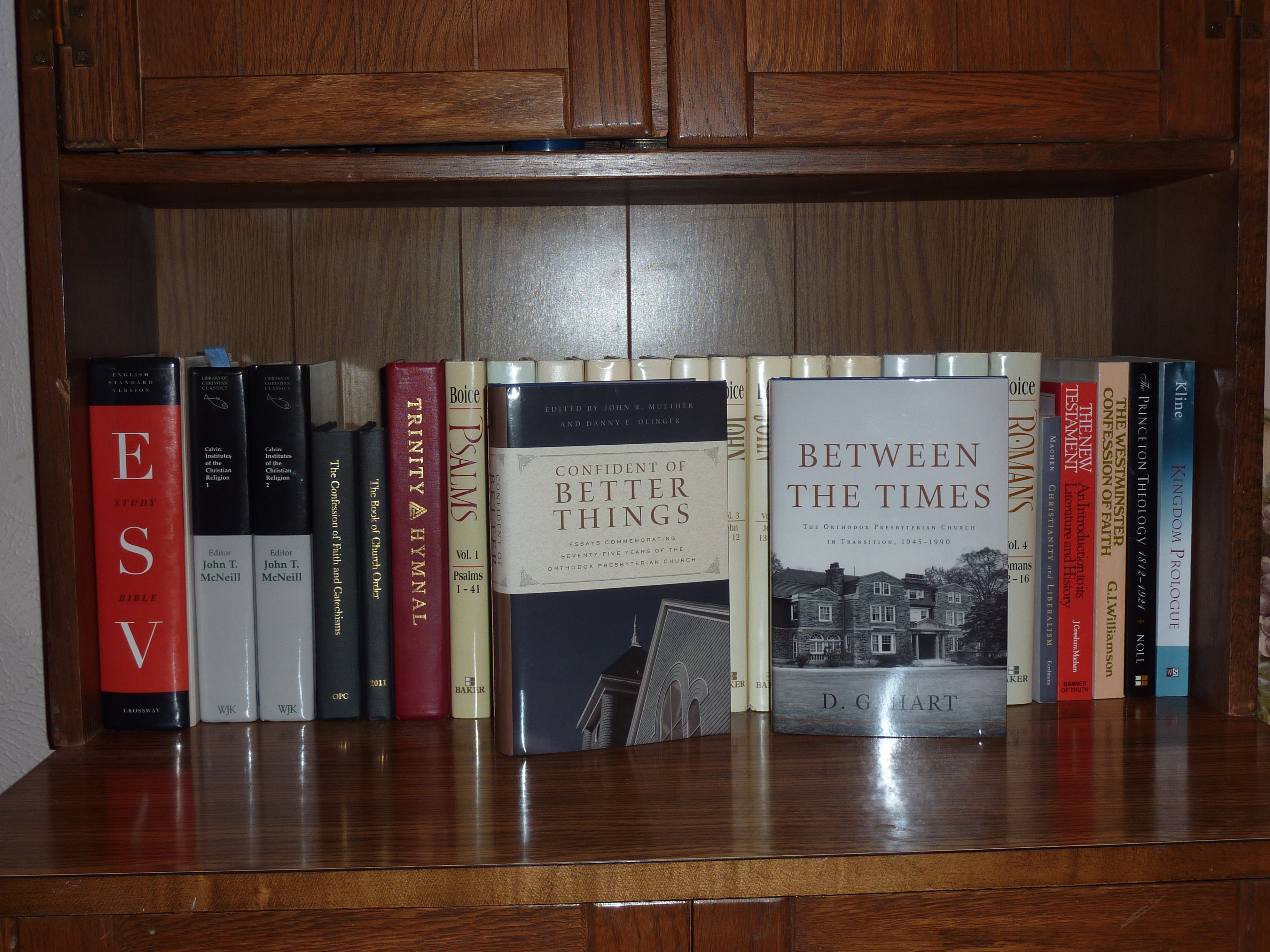
OPC 75 Titles--Confident of Better Things/Between the Times
Here’s a helpful paragraph from D. G. Hart’s new history of the Orthodox Presbyterian Church (OPC), released at the 78th General Assembly of the OPC two weeks ago in celebration of the OPC’s 75th anniversary. Here, Hart describes J. Gresham Machen’s reasons for objecting to Princeton Seminary President, J. Ross Stevensons proposal at the 1920 General Assembly of the PCUSA “for a grand plan to unite the largest Protestant denominations into one denomination” (p. 16). Hart writes:
The disadvantage of the plan for union, as Machen and most of his Princeton colleagues pointed out, was that by entering into a united church, Presbyterians would be abandoning those aspects of Protestantism that made them Presbyterian. If predestination, infant baptism, and Presbyterian polity, for instance, were actually revealed in God’s word as true and necessary for faithful witness, how could Presbyterians give away their teaching and practice to join with Baptists, Methodists, Lutherans, and Episcopalians in a generic Protestant church? The other problem with organic union, as Machen argued in a series of articles for church periodicals, was that it was based upon doctrinal indifferentism. Union turned away from serious doctrinal and ecclesiastical differences among Protestants and implied that these were less important than the greater good that a united church could achieve by transforming American society. Opposition to this sort of ecumenism, which was directly linked to the Social Gospel’s goal of ushering in the kingdomof God, was precisely the impetus for Machen’s important book, Christianity and Liberalism (1923). Not only did he argue that Christianity and liberalism were two different religions, and so liberalism needed to be excluded from the church. Machen also showed how American Protestant interdenominational cooperation stemmed from an indifference to Christian teaching and so distorted the gospel into a message of works righteousness.
D. G. Hart, Between the Times: The Orthodox Presbyterian Church in Transition, 1945-1990 (2011, The Committee for the Historian of the Orthodox Presbyterian Church,Willow Grove,PA), pp. 16-17. opc.org/publications.html Check out Hart’s blog, Old Life: Reformed Faith and Practice.
Confessional Creationism
In all my searching and discussing the issue of the interpretation of the days of creation in Genesis 1, Google directed me to a statement from Westminster Theological Seminary declaring the results of their research into the history of how this issue has been treated by the leaders of the Augustinian and Reformed traditions going all the way back to Augustine himself. The statement is called, “Westminster Theological Seminary and the Days of Creation.“
The discussion among Presbyterians revolves around the reasons the Westminster Divines selected the language they did in when they framed the chapter on Creation in the Westminster Confession of Faith. The phrase in question will be highlighted in the following citation:
I. It pleased God the Father, Son, and Holy Ghost, for the manifestation of the glory of His eternal power, wisdom, and goodness, in the beginning, to create, or make of nothing, the world, and all things therein whether visible or invisible, in the space of six days; and all very good.
The question is raised as to why the wording “in the space of six days.” Why not simply “in six days”? The statement explains:
“The paraphrase view is doubtful because if the Standards had intended simply to utilize biblical language, “in six days” would have sufficed and been a more natural choice. The words “the space of,” as the other view above recognizes, seem deliberately chosen as an interpretive or clarifying addition that functions both to affirm and to exclude or negate.
To make the long story short, the statement concludes that the divines intended to exclude Augustine’s view that God created everything instantaneously inspiring the six days, as Calvin described the view (which he did not hold), “for the mere purpose of conveying instruction.” You can read more about this discussion in the statement itself. You can link to it from the title above, and I have also added a link to the page on my “Recommended Sites” page for future reference.
Finally, here’s a quote that sums up the entire issue as they see it. I find it rather helpful:
With Augustine and E. J. Young, the revered teacher of our senior faculty members, we recognize that the exegetical question of the length of the days of Genesis 1 may be an issue which cannot be, and therefore is not intended by God to be, answered in dogmatic terms. To insist that it must comes dangerously close to demanding from God revelation which he has not been pleased to bestow upon us, and responding to a threat to the biblical world view with weapons that are not crafted from the words which have proceeded out of the mouth of God.
Theological & Doxological Meditation #43
The Decalogue’s Preface
Q. What is the preface to the ten commandments?
A. The preface to the ten commandments is in these words, I am the LORD thy God, which have brought thee out of the land of Egypt, out of the house of bondage (Exodus 20:2).
O God, Most Holy Are Your Ways
(play file 039 in “T&D mp3” sidebar widget)
#39, The Trinity Hymnal (© 1990)
Psalm 77:13-20
The Psalter, 1912; alt. 1990, mod.
VATER UNSER 8.8.8.8.8.8.
V. Schumann’s Geistliche Lider, 1539
O God, most holy are your ways,
and who like you deserves my praise?
You only do such wondrous things,
The whole wide world your glory sings;
Your outstretched arm your people saved,
Though sore distressed and long enslaved.
O God, from you the waters fled,
The depths were moved with mighty dread,
The swelling clouds their torments poured,
And o’er the earth the tempest roard;
‘mid lightning’s flash and thunder’s sound
great trembling shook the solid ground.
Your way was in the sea, O God,
Through mighty waters, deep and broad.
None understood but God alone,
To man your footsteps were unknown;
But safe your people you did keep,
Almighty Shepherd of your sheep.
Won’t We Leave Behind the Litmus Test of Wooden Literalism?
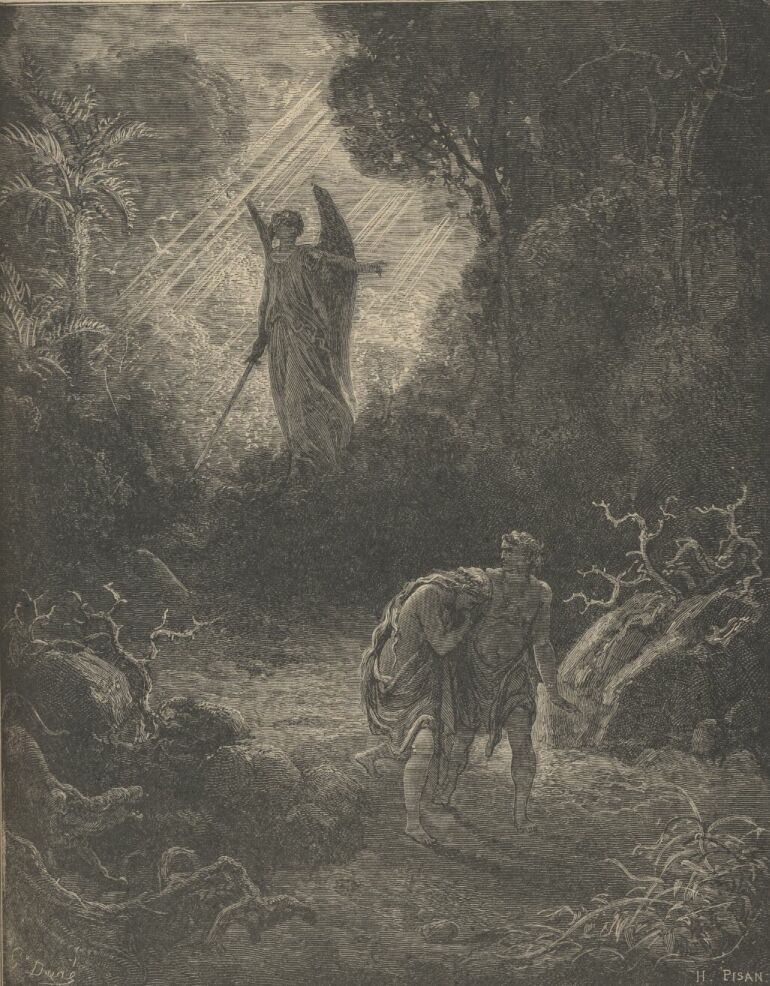
Nothing tickles me like Hank Hanegraaff’s affinity for alliteration! You remember Hank–he’s the host of The Bible Answer Man (BAM) radio show. I like Hank because he believes that “Truth Matters,” even if he disagrees with the doctrines of grace and is an evidentialist apologist. Some of my more hard core Reformed brethren may think that because of these two issues alone, I shouldn’t waste any more time listening to his show.
Despite occasional disagreements, there are many strengths to BAM and the Christian Research Institute that keep me coming back for more. Hank isn’t politically (or is that “religiously”?) correct–back in 1999, he suffered the slings and arrows of the Evangelical community who were capitalizing on what Hank in his inimitable way called “sensationalism and selling” as they geared up for Y2K for denying it was a danger; much more recently, he broke many hearts by refusing to bow to the golden idol of dispensational premillennialism expounding what he calls “Exegetical Eschatology.”
Well, now he’s cast his lot against the populist view again–this time the issue is the Genesis creation days. I found Hank’s remarks from his introduction to the Friday Bible Answer Man broadcast especially helpful in encouraging us to remember that not everything is a fundamental over which Bible believing Christians must divide. How to interpret Genesis chapter one is one such, in Hank’s words, “in house debate which Christians can debate vigorously without dividing over.”
A couple of comments and then right to our callers. I’ve been getting a lot of questions at the CRI, through social media, through the Bible Answer Man broadcast and otherwise regarding the Genesis creation days. Are they literal? Are they long? Or, are they literary? Of course, there are three dominant schools of thought within Evangelical Christianity regarding the Genesis days of creation.
First, the popular 24 hour view that posits that God created the heavens and the earth in 6 sequential literal days. Therefore a majority of young earth creationists view the earth to be approximately 6,000 years old and consider all death, including animal death, to be a direct function of Adam’s Fall.
Furthermore, there’s a day-age perspective. That perspective posits that God created the heavens and the earth in 6 long sequential day-ages which total billions of years. So, in contrast to the 24 hour perspective, the day-age perspective posits that “nature, red in tooth and claw” is the result of God’s very good creation prior to Adam’s Fall to a life perpetuated by sin and terminated by death.
And then there’s a very noteworthy framework perspective, which holds the seven days of creation are non-literal, non-sequential but nonetheless historical. In concert with the day-age perspective, they view animal death as consistent with the goodness of God’s creation and believe that the age question is settled by natural revelation, in other words, by reading God’s Book of Nature, as opposed to settling it by reading special revelation, in other words, the Bible.
All three perspectives hold to essential Christian doctrine, thus they commonly debate non-essential differences without dividing over them. And I want to park on that for just a second. There are essentials, and as Christians we stand shoulder to shoulder with respect to essential Christian doctrine. The problem is, I think, that a divisiveness has crept into the Body of Christ whereby this age issue has become an acid test for orthodoxy. Therein lies, I think, a substantial problem.
Better that we adhere to the maxim: “In essentials unity; in non-essentials, liberty; in all things, charity.” And then learn—“Iron sharpens iron.”I’ve learned a great deal by reading the presuppositions of the framework hypothesis. I’ve learned a great deal by reading the literature of old earth creationists; I’ve learned a great deal, in fact, my own conversion was radically affected by, the literature of young earth creationism.
Now I have disagreements with old earth creationism, because of the concordism that is apparent there, where you try to take science–modern cosmology, as an example–and fit it into the biblical text such that “he stretches out the heavens” becomes a pretext for Big Bang cosmology. I may agree with Big Bang cosmology, but I certainly don’t think the texts that are used as pretexts should be used in that sense.
I think the same thing is going on by a lot of the texts used by young earth creationism. But at the end of the day this is still an issue that involves debate, not division, so let’s not make it an acid test for orthodoxy, and divide unnecessarily, when, no matter how much time modern cosmologies posit for the age of the earth, or the universe, we don’t have enough time to form a simple protein molecule by random processes much less a living cell. So the real enemy is the evolutionary paradigm which is not only not tenable in an age of scientific enlightenment, but flies in the face of common sense—nothing cannot produce everything. The only logical thing we can say in an age of scientific enlightenment, is “In the beginning God”—an uncaused First Cause is the reason we have the effect of a universe finely tuned for human life.
What To Do? Ten Days After Camping’s Failed Prediction
 So it has been ten days since Harold Camping’s prediction failed to come to pass as “guaranteed” by himself, rather than the Bible (as he falsely claimed). In the wake of this failure, many people around the world are left in various states of loss. For some, it is a loss of pets who were euthanized in preparation of last Saturday; for others, the loss of money; and for many more, the loss of pride in their teacher’s genius and their own “inside scoop” about the end of the world.
There are various ways people respond to anti-climactic events such as this one: some may (please grant it, Lord!) repent of their blasphemous repudiation that the institutional church is under Satan’s control (Matthew 12:31) and resubmit themselves to the ministry of the Word of the gospel preached and the administration of the sacraments of baptism and the Lord’s Supper along with the oversight of biblically faithful elders who are watching out for the souls of those entrusted to their care (Hebrews 13:17). This is the ideal result, but may sadly be the minority report barring the grace and mercy of God, and the loving care of the Christians around them who come along side them to help in this matter. If you are a believer who reads Scripture and confesses the essential truths of the faith along with the rest of the universal church as expressed in the ancient catholic creeds and the historic Protestant confessions, please stand by ready to pray for and with these imperiled souls, graciously ready to assist those around you who were victimized by Camping’s false teachings.
It has been reported, regrettably, that for others, deliverance didn’t come, but their own deaths, whether at their own hands, or the hands of others (don’t neglect to read these two previous links!). Responsibility for tragic unintended consequences such as these have been denied by Harold Camping, who minimizes his role (listen to his callous responses from last week’s press conference).
Whatever the circumstances in the lives of Camping’s followers, it would behoove all of the surviving ones to take a half an hour and give a thoughtful listen to Redeemer Broadcasting’s recent episode of A Plain Answer, entitled, “One Week After Harold Camping’s May 21 Date.” Those of you who ought to be watching for opportunities to minister to Camping’s bewildered followers will also be equipped by it. If nothing else, encourage them to stop listening to Family Radio altogether and seek the greener pastures of Redeemer Broadcasting. This page will explain why.
Horton on Modern Israel

Don’t miss Dr. Michael Horton’s great blog post responding to many Evangelicals’ negative reaction to President Obama’s recent comments about the borders of Israel. Many Evangelicals react negatively because, due to a largely Dispensationalist method of interpreting Scripture, they see the modern state of Israel in identical terms as the Bible views ancient Israel back when they were actually in covenant with God. Dr. Horton presents a more biblical approach to what happened with ancient Israel and the Mosaic covenant, and applies it to how we ought to view modern Jews in modern Israel in light of the cross of Christ. Read, “Biblical Foreign Policy?“
By the way, I dug Benjamin Netanyahu’s speech before both houses of Congress yesterday!
Short of Repentance, Camping to Spare Us?
 “The online apologetics and discernment work Apprising Ministries” has posted a good survey of Monday’s press conference on Harold Camping’s hopefully final episode of Open Forum. Short of apologizing and repenting of his errors, it seems Camping may at least spare us of five more months of hand wringing about the supposed judgment to come on October 21, 2011.
I haven’t listened to the entire program personally, but what little I have heard leads me to conclude that Camping’s bottom line is that he wasn’t wrong about something happening on May 21, 2011, but that he forgot to interpret it spiritually. You can download the Open Forum press conference here, however, and listen for yourself.
A “spiritual” rapture and five “spiritual” months of “spiritual” rolling earthquakes?
Camping also continues to insist that God is still to destroy the world by fire in five months. So, perhaps he’s made a note to himself to more quickly announce that if the world isn’t destroyed by fire in October, then he has a handy out that God…”spiritually” destroyed the earth by fire? Uh huh.
Apprising Ministries’ Ken Silva fills in a few more blanks:
It seems, rather than humbly admitting his error, Camping now speculates he “misinterpreted the Bible” and rather than May 21st beginning “the end of the world” supposedly we’re to believe that it was actually “the spiritual beginning of the physical end” not too unlike the eschatology of the non-Christian cult of the Jehovah’s Witnesses. Camping is quoted as dreaming:
“Were not changing a date at all; we’re just learning that we have to be a little more spiritual about this,” he said in a rambling 90-minute radio broadcast that was part sermon, part press conference. “But on Oct. 21, the world will be destroyed. It won’t be five months of destruction. It will come at once.” (Online source)
Sort of reminds one of the Pathological Liar, an old SNL character of Jon Lovitz, “this isn’t changing a date…um, I’ve had a new revelation from God—yeah, that’s the ticket—er, an invisible thing happened, see. So, you can’t say I’m wrong; trust me, yeah, it happened. Really, it did.” Cabanatuan continues:
The good news, for those dreading five more months of talk about the rapture, is that Family Radio will be taking down its billboards, ceasing distribution of Bible tracts and literature about Judgment Day and focusing its programming on religious music and God’s word, not on a countdown to the end.
“We don’t need to talk about it anymore,” Camping said. “The world has been warned – my it has been warned. We have done our share and the media picked it up. The world has been warned that it is under judgment.” (Online source)
Yes, it has; in Scripture, and now we’re in the position of having to warn the world about false prophets like Harold Camping, whom the Lord did not send, that are in reality prophesying to you a lying vision, worthless divination, and the deceit of their own minds (Jeremiah 14:14) and are not repentant for the damage they cause . . . . (read more)


 The Misadventures of Captain Headknowledge
A Case Study in Sin
The following long, tedious post is a small way of demonstrating just how comprehensively God’s law condemns the sin of man. It highlights the depth and breadth of our fallen nature that is bent on violating God’s law in every conceivable manner, and shows just how much we all, believer and unbeliever alike, deserve God’s eternal anger and torment.
The following extensive description of what it means to keep God’s law also shows us just how thoroughly successful the Lord Jesus Christ was in keeping God’s law in every conceivable manner for his elect—those who come to believe.
Finally, it shows the many-faceted way in which we who believe and have been forgiven for such egregious, heinous sin, can express our gratitude for the active obedience of Christ in perfectly keeping God’s law for us, and for his passive obedience in suffering the penalty of divine wrath which such deep, dark, extensive sin deserves.
The church my family has been attending for the past year or more, has recently been going through the Heidelberg Catechism. Last Lord’s Day evening we recited, received instruction on, and discussed Lord’s Day 40, which consists of Question & Answer numbers 105-107, regarding what is required in the sixth commandment, “You shall not murder.”
Last night, the Lord showed me just how easy it is to violate the spirit of God’s command against murder. Several ladies converged on my house to carpool to a ladies meeting. One of those ladies brought her husband with her to stay with me and share a pizza and a movie while they are away. My wife and I used to attend another church with this couple, which church has a distinct reputation for hurting many of its members, and used to be a little more legalistic than it is today. In fact, in some ways, it appears to be changing into the very kind of church it used to stand against. Being a wounded former member of such a church provides many temptations to violate the spirit of God’s command against murder, namely by “dishonoring” and “hating” it in our “thoughts,” “words,” and “gestures” and “deeds,” as we neglect to “lay aside all desire of revenge.”
This kind of sin has become such a habit for me, in particular, that it didn’t dawn on me that this was what we were doing, not even when one of the other members who were in attendance last Sunday evening during the catechism discussion walked in, and I felt compelled to jokingly explain that we were having a little fun at our former church’s expense. It didn’t dawn on me until several hours later. Hence the occasion for the following post.
While it may appear so, this is not an exercise in self-flagellation, but, as I explained above, an amplification of the Heidelberg Catechism’s explanation of what the Bible teaches about what all God requires of us in the sixth commandment. May it open your eyes to the depth of your sin, the extent of Christ’s righteousness and grace, and may it guide you in expressing your loving gratitude for his free gift of righteousness which can only be received by faith in Christ.
Question 105. What does God require in the sixth commandment?
Answer: That neither in thoughts, nor words, nor gestures, much less in deeds, I dishonour, hate, wound, or kill my neighbour, by myself or by another: (Matt. 5:21-22;26:52; Gen. 9:6) but that I lay aside all desire of revenge: (Eph. 4:26; Rom. 12:19; Matt. 5:25; 18:35) also, that I hurt not myself, nor wilfully expose myself to any danger. (Rom. 13:14; Col. 2:23; Matt. 4:7) Wherefore also the magistrate is armed with the sword, to prevent murder. (Gen. 9:6; Ex. 21:14; Matt. 26:52; Rom. 13:4)
Question 106. But this commandment seems only to speak of murder?
Answer: In forbidding murder, God teaches us, that he abhors the causes thereof, such as envy, (Pr. 14:30; Rom. 1:29) hatred, (1 John 2:9,11) anger, (James 1:20; Gal. 5:19-21) and desire of revenge; and that he accounts all these as murder. (1 John 3:15)
Question 107. But is it enough that we do not kill any man in the manner mentioned above?
Answer: No: for when God forbids envy, hatred, and anger, he commands us to love our neighbour as ourselves; (Matt. 7:12; 22:39; Rom. 12:10) to show patience, peace, meekness, mercy, and all kindness, towards him, (Eph. 4:2; Gal. 6:1-2; Matt. 5:5,7,9; Rom. 12:18; Luke 6:36; 1 Peter 3:8; Col. 3:12; Rom. 12:10,15) and prevent his hurt as much as in us lies; (Ex. 23:5) and that we do good, even to our enemies. (Matt. 5:44-45; Rom. 12:20-21)
What does God require in the sixth commandment?
In the sixth commandment, God requires that I not dishonor my neighbor in my thoughts, but that I rather lay aside all desire of revenge;
In the sixth commandment, God requires that I not hate my neighbor in my thoughts, but that I rather lay aside all desire of revenge;
In the sixth commandment, God requires that I not wound my neighbor in my thoughts, but that I rather lay aside all desire of revenge;
In the sixth commandment, God requires that I not murder my neighbor in my thoughts, but that I rather lay aside all desire of revenge;
In the sixth commandment, God requires that I not dishonor my neighbor in my words, but that I rather lay aside all desire of revenge;
In the sixth commandment, God requires that I not hate my neighbor in my words, but that I rather lay aside all desire of revenge;
In the sixth commandment, God requires that I not wound my neighbor in my words, but that I rather lay aside all desire of revenge;
In the sixth commandment, God requires that I not murder my neighbor in my words, but that I rather lay aside all desire of revenge;
In the sixth commandment, God requires that I not dishonor my neighbor in my gestures, but that I rather lay aside all desire of revenge;
In the sixth commandment, God requires that I not hate my neighbor in my gestures, but that I rather lay aside all desire of revenge;
In the sixth commandment, God requires that I not wound my neighbor in my gestures, but that I rather lay aside all desire of revenge;
In the sixth commandment, God requires that I not murder my neighbor in my gestures, but that I rather lay aside all desire of revenge;
In the sixth commandment, God requires that I not dishonor my neighbor in my deeds, but that I rather lay aside all desire of revenge;
In the sixth commandment, God requires that I not hate my neighbor in my deeds, but that I rather lay aside all desire of revenge;
In the sixth commandment, God requires that I not wound my neighbor in my deeds, but that I rather lay aside all desire of revenge;
In the sixth commandment, God requires that I not murder my neighbor in my deeds, but that I rather lay aside all desire of revenge;
In the sixth commandment, God requires that I not be a party to another who would dishonor my neighbor in his thoughts, but that I rather lay aside all desire of revenge;
In the sixth commandment, God requires that I not be a party to another who would hate my neighbor in his thoughts, but that I rather lay aside all desire of revenge;
In the sixth commandment, God requires that I not be a party to another who would wound my neighbor in his thoughts, but that I rather lay aside all desire of revenge;
In the sixth commandment, God requires that I not be a party to another who would murder my neighbor in his thoughts, but that I rather lay aside all desire of revenge;
In the sixth commandment, God requires that I not be a party to another who would dishonor my neighbor in his words, but that I rather lay aside all desire of revenge;
In the sixth commandment, God requires that I not be a party to another who would hate my neighbor in his words, but that I rather lay aside all desire of revenge;
In the sixth commandment, God requires that I not be a party to another who would wound my neighbor in his words, but that I rather lay aside all desire of revenge;
In the sixth commandment, God requires that I not be a party to another who would murder my neighbor in his words, but that I rather lay aside all desire of revenge;
In the sixth commandment, God requires that I not be a party to another who would dishonor my neighbor in his gestures, but that I rather lay aside all desire of revenge;
In the sixth commandment, God requires that I not be a party to another who would hate my neighbor in his gestures, but that I rather lay aside all desire of revenge;
In the sixth commandment, God requires that I not be a party to another who would wound my neighbor in his gestures, but that I rather lay aside all desire of revenge;
In the sixth commandment, God requires that I not be a party to another who would murder my neighbor in his gestures, but that I rather lay aside all desire of revenge;
In the sixth commandment, God requires that I not be a party to another who would dishonor my neighbor in his deeds, but that I rather lay aside all desire of revenge;
In the sixth commandment, God requires that I not be a party to another who would hate my neighbor in his deeds, but that I rather lay aside all desire of revenge;
In the sixth commandment, God requires that I not be a party to another who would wound my neighbor in his deeds, but that I rather lay aside all desire of revenge;
In the sixth commandment, God requires that I not be a party to another who would murder my neighbor in his deeds, but that I rather lay aside all desire of revenge;
In the sixth commandment, God requires that I not hurt myself;
In the sixth commandment, God requires that I not willfully expose myself to any danger;
For this reason, God has granted the right to human government alone to put murderers to death, as the just punishment of murder, and as a deterrent to murder by others.
But this commandment seems only to speak of murder?
In forbidding murder, God teaches us that he abhors envy as the cause of murder, and that he accounts it as murder;
In forbidding murder, God teaches us that he abhors hatred as the cause of murder, and that he accounts it as murder;
In forbidding murder, God teaches us that he abhors anger as the cause of murder, and that he accounts it as murder;
In forbidding murder, God teaches us that he abhors desire of revenge as the cause of murder, and that he accounts it as murder;
But is it enough that we do not kill any man in the manner mentioned above?
No: for when God forbids envy, he commands us to love our neighbor as ourselves;
No: for when God forbids envy, he commands us to to show patience towards our neighbor;
No: for when God forbids envy, he commands us to to show peace towards our neighbor;
No: for when God forbids envy, he commands us to to show meekness towards our neighbor;
No: for when God forbids envy, he commands us to to show mercy towards our neighbor;
No: for when God forbids envy, he commands us to to show all kindness towards our neighbor;
No: for when God forbids envy, he commands us to to prevent his hurt as much as lies in us;
No: for when God forbids envy, he commands us to to do good to our neighbor, even to our enemy;
No: for when God forbids hatred, he commands us to love our neighbor as ourselves;
No: for when God forbids hatred, he commands us to to show patience towards our neighbor;
No: for when God forbids hatred, he commands us to to show peace towards our neighbor;
No: for when God forbids hatred, he commands us to to show meekness towards our neighbor;
No: for when God forbids hatred, he commands us to to show mercy towards our neighbor;
No: for when God forbids hatred, he commands us to to show all kindness towards our neighbor;
No: for when God forbids hatred, he commands us to to prevent his hurt as much as lies in us;
No: for when God forbids hatred, he commands us to to do good to our neighbor, even to our enemy;
No: for when God forbids anger, he commands us to love our neighbor as ourselves;
No: for when God forbids anger, he commands us to to show patience towards our neighbor;
No: for when God forbids anger, he commands us to to show peace towards our neighbor;
No: for when God forbids anger, he commands us to to show meekness towards our neighbor;
No: for when God forbids anger, he commands us to to show mercy towards our neighbor;
No: for when God forbids anger, he commands us to to show all kindness towards our neighbor;
No: for when God forbids anger, he commands us to to prevent his hurt as much as lies in us;
No: for when God forbids anger, he commands us to to do good to our neighbor, even to our enemy.
Share this: