Gender Roles, part 2–Patriarchalism
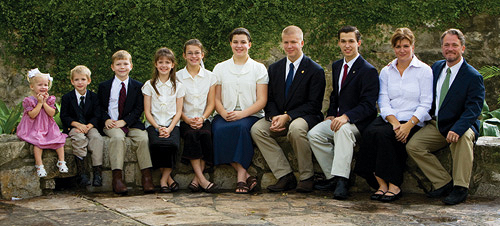
Vision Forum founder Doug Phillips and family
I’ve been aware of Vision Forum (VF) ever since I began searching the internet for Reformed websites back in the late 1990’s into the early years of the first decade of the twenty-first century. What I saw in Vision Forum was a site promoting traditional, conservative Americana of all kinds. Cool reprints of things like Of Plymouth Plantation and the writings of John Quincy Adams, the sixth American President who dabbled with Calvinism in his early adulthood, but would ironically return to the Unitarianism of his father and the intellectual elite of his day. Fun stuff, if you are into strident third party ultra-conservatism (for the record, VF founder Doug Phillips is son of Nixon-era figure and third party founder, Howard Phillips, whom I was providentially prevented from voting for in the 1992 election, but that’s another post!).
But then I found Phil Johnson’s Hall of Church History and any fledgling interest in Vision Forum fell by the wayside. My initial introduction to Vision Forum and its association with homeschooling and conservative politics raised no red flags. To me, it was what it was.
It was not until more recent years that I grew in my familiarity with the details of Vision Forum’s vision for families by their promotion of concepts like patriarchalism among others like the so-called family-integrated church (FIC), quiverfull and multi-generational faithfulness movements. Classified under these headings we find the dark side of the homeschooling movement. At the time of this writing, I have nothing against homeschooling, per se, but these movements which find their origin within the homeschool movement leave much to be desired, in my humble opinion. For more information on the latter movements, see here, here, and here.
Please recall that in the last post, I summarized my understanding of egalitarianism as practiced among “mainline” liberal Protestant denominations and an increasing number of Evangelical denominations and movements, and noted that there have been two major responses to this movement: namely, patriarchalism and complementarianism. The former is an extreme response, the latter is more moderate, unless you’re an egalitarian.
Complementarianism agrees with patriarchalism that:
(1) Eve was created to serve as “an help meet”(KJV) for Adam, or a “helper suitable” (NASB) for him, and that this is a creation ordinance binding on all human marital relationships; that a relationship of loving leadership by example and sacrificial protection on the part of the husband, and of respectful and voluntary submission on the part of the wife typifies the relationship between Christ and the church for which he died (Ephesians 5:22-33),
(2) and that consistent with this state of affairs, the New Testament explicitly limits offices of ordained church leadership to men (1 Timothy 3:1-7, notice candidates for church office are assumed to be male, and evidence to the contrary is lacking elsewhere in the New Testament).
Nevertheless, complementarianism disagrees with patriarchalism that wives, or women in general, should therefore necessarily refrain from seeking work or leadership roles in civic or commercial society outside the home. In short, complementarianism respects a greater degree of liberty for women than does its more extremist counterpart, patriarchalism.
In what ways does patriarchalism restrict the Christian liberty of women in the name of following the teaching of Scripture? To answer this question, let us consult a Vision Forum Ministries-published semi-creedal statement, “The Tenets of Biblical Patriarchy” drafted by Phil Lancaster, in consultation with Doug Phillips and R.C. Sproul, Jr. This statement lists 26 points under the following headings:
(1) God as Masculine (point 1)
(2) The Image of God and Gender Roles (points 2-4)
(3) The Authority of Fathers (points 5-7)
(4) Family, Church and State (points 8-11)
(5) Men & Women: Spheres of Dominion (points 12-14)
(6) Procreation (point 15)
(7) Education and Training of Children (points 16-21)
(8) A Father and His Older Children (points 22, 23)
(9) The Sufficiency and Application of Scripture (points 24-26)
Let’s look at point 11, under the heading of “Family, Church and State”:
11. Male leadership in the home carries over into the church: only men are permitted to hold the ruling office in the church. A God-honoring society will likewise prefer male leadership in civil and other spheres as an application of and support for God’s order in the formative institutions of family and church.(1 Tim. 3:5) (emphasis mine)
By this statement, patriarchalists cannot state that the Bible teaches that women shouldn’t work outside the home (among other things, like vote, for instance!), but appeals to the biblical mandates of male leadership in the home and the church and asserts that a society can only honor God if it “prefers” male leadership in societal spheres. By implication, this means that a society actively dishonors God if it allows women to vote, work outside the home and lead in other societal venues. They do allow for exceptions in the case of single women—“unmarried women may have more flexibility” (point 14), but I submit that in patriarchal circles, this exceptional circumstance will likely be discouraged, if not frowned upon. They only concede the possibility that single women may have more flexibility, which means, when in doubt, see point 11.
While we’re on this point, let us consider the Tenets’ reference to “a God-honoring society.” Did I mention that Vision Forum is postmillennial (not necessarily a problem) and theonomist (a big problem!)? Political liberals commonly refer to theonomy as “Dominionism,” which is a movement among interdenominational charismatic churches. The fact is, dominionism is based on theonomy, aka Christian Reconstructionism. Vision Forum’s vision for patriarchalism is a means to the end of taking dominion over the nations of the world and subjecting them all to the Law of God, and it is in this way that they believe Christ’s Millennial Kingdom will be established in the earth. These facts are implicit in their notion of a “God-honoring society.” In the radical patriarchalist’s perfect world, therefore, all women will be restricted to the domestic vocation of housewife, barring the undesirable exception of singleness. But in a future glorious Kingdom of Christ, would not He be willing to provide a husband to provide for and protect every woman? In the meantime we have to make due with conceding the possibility that single women may have the flexibility to work outside the home, and perhaps even vote.
Then there is the matter of “A Father and His Older Children,” points 22 and 23. Notice the extra restriction on adult daughters as compared to adult sons.
22. Both sons and daughters are under the command of their fathers as long as they are under his roof or otherwise the recipients of his provision and protection. Fathers release sons from their jurisdiction to undertake a vocation, prepare a home, and take a wife. Until she is given in marriage, a daughter continues under her father’s authority and protection. Even after leaving their father’s house, children should honor their parents by seeking their counsel and blessing throughout their lives. (Gen. 28:1-2; Num. 30:3ff.; Deut. 22:21; Gal. 4:1,2; Eph. 6:2-3) (emphasis mine)
23. Fathers should oversee the process of a son or daughter seeking a spouse. While a father may find a wife for his son, sons are free to take initiative to seek and “take a wife.” A wise son will desire his parents’ involvement, counsel, and blessing in that process. Since daughters are “given in marriage” by their fathers, an obedient daughter will desire her father to guide the process of finding a husband, although the final approval of a husband belongs to her. Upon a Marriage taking place, a new household with new jurisdiction is established, separate from that of the father. (Gen. 24:1ff.; 25:20; 28:2; Ex. 2:21; Josh. 15:17; Jdg. 12:9; 1 Sam. 18:27; Jer. 29:6; 1 Cor. 7:38; Gen. 24:58)
The implication is that an adult daughter of a Christian patriarch ought not move out of her father’s home until she has been “given” by him in marriage. There is a dangerous wooden-literalism in patriarchalist biblical hermeneutics which leads to imposing this aspect of Ancient Near Eastern culture on twenty-first century Christians. Here is one of the other problems with patriarchalism as a response to egalitarianism: it looks back fondly on the way things were done in the past and makes some of the customs of that era moral absolutes for the present.
Another era which patriarchalists mine for unbiblical moral absolutes is the ante-bellum American South. This era is considered by Phillips, and other patriarchalist leaders as the greatest form of Christian culture ever experienced on earth, and patterns much of its ideals accordingly. Arch patriarchalist Doug Phillips is a huge fan of southern Presbyterian theologian R.L. Dabney, who was in many ways a fine Reformed theologian, with the exception that he was a bitter opponent of emancipation for slaves, and is a poster-child for the use of the Bible in support of the institution of chattel slavery. You can read more about the inherent racism and sexism of patriarchalism in a blog post entitled “Patriarchy, Christian Reconstruction and White Supremacy” at the blog Diary of an Autodidact. The fact that Southern idealism is a strong influence on this movement is further evidence of the extra- and unbiblical nature of the patriarchalist movement as directed and informed by Vision Forum.
For these and other reasons, it would be unwise for an Evangelical Christian to resist the cultural pressures of liberal egalitarianism by subjecting one’s self and one’s family to the so-called “Tenets of Biblical Patriarchy.” In the gracious providence of God, complementarianism is the name of the more biblical approach to the roles of husbands and wives in the family, the church and society. Keeping in mind what we’ve discussed about it above in contrast with patriarchalism, we’ll look at complementarianism in more detail in the next post.
Gender Roles, part 1–Egalitarianism

As the father of a young lady who is growing in her understanding of Reformed theology, I have had to wrestle with the relative merits of “patriarchalism” versus “complementarianism.” What are the definitions of these fifty cent words, you ask? How glad I am that you asked!
Allow me to preface these definitions with yet another term—egalitarianism–and the environment in which these three terms have become points around which various parties rally. With the advent of feminism in the late nineteenth and twentieth centuries, efforts to free women from all forms of tyranny, real or perceived, in society, the home and the church have sparked a two-pronged response. Feminism promotes the ideal of egalitarianism, which asserts the absolute equality of men and women in every way, so that the institution of marriage is often disparaged, women are encouraged to work outside the home and pressured to refrain from the honorable vocation of domestic engineering (that is, being a housewife), and to answer an unbiblical call to pastoral ministry in the Christian church. This movement became part and parcel of the ideals of liberal Protestant theology and practice throughout the twentieth century. Toward the end of that century, however, the movement began making inroads into otherwise conservative Evangelical churches.
Throughout the history of the development of Christian theology, orthodoxy was commonly believed among the whole church, and remained generally agreed upon and largely unwritten, since there was little to no disagreement about the orthodox interpretation of Scripture. This is why we see in church history how that it is the aggressive assertion of heresy which forces the orthodox to go back to the drawing board and more carefully work out and put into writing the correct understanding of the Bible. In theology as well as commerce, competition forces one to work harder to increase the quality of their philosophical principles, goods and services.
How, in this environment, are Christian families to insulate their children from the erroneous claims of modern feminist egalitarianism? In the next post, we’ll deal with conservative Evangelical responses to egalitarianism which have resulted in the spectrum with which we must deal today.
Thinking through the Campbellite Denial of Original Sin
If you are a Campbellite, a former Campbellite, or otherwise knowledgable about the nuances of Campbellite doctrine and logic, please critique the following syllogism I have devised in my attempt to think through the reason Campbellites would deny the doctrine of original sin.

Alexander Campbell
It is my understanding that Campbellism does affirm that Adam’s posterity inherited a natural predisposition to commit sins, so the only distinction between Augustinians and Campbellites with which I’m dealing lies in the Campbellite denial of the imputation of the guilt of Adam’s sin to his posterity.

Augustine of Hippo
I am also prepared for the possibility that Campbellites might object to my assertion in the first proposition “that baptism literally washes away sin.” It would also be good if anyone could help me articulate this proposition more precisely.
Here is my working syllogism:
Campbellites agree with Augustine that baptism literally washes away sin;
Campbellites disagree with Augustine that baptism is for infants;
Therefore, Campbellites conclude that infants are not affected by original sin, but are rather born innocent.
ACE and WHI Remember Dr. C. Everett Koop (1916-2013)
Yesterday I tweeted a request to Reformed bloggers in the know to post on the Reformed side of American medical icon, the late Dr. C. Everett Koop, who died Monday at the age of 96. Dr. Koop’s medical and public service bonafides are a matter of public record. One quick and easy summary may of course be accessed, where else? Wikipedia! Here also is a press release from HHS Secretary, Kathleen Sabelius, detailing his legacy from the point of view of the federal government. But in addition to his service to the City of Man, Dr. C. Everett Koop was an accomplished lay leader in the City of God, serving as a Presbyterian church elder, and until the day of his death, a board member of the Alliance of Confessing Evangelicals (ACE), the para-church organization which was so instrumental in introducing me to and cultivating in me the Reformed faith and theology.
Incidentally, tomorrow afternoon, my pastor and I depart for ACE’s Texas Hill Country Bible Conference in Boerne, Texas. It’ll be interesting to see what kind of tribute they put together for him there. For now, though, the ACE website offers a “Koop Classic”: Life, Bioethics and Christianity (2010, ACE).
But in answer to my (“all about me”–apologies to Dr. D.G. Hart 😉 request, two of my favorite Reformed bloggers has indeed posted remembrances of Dr. C. Everett Koop: Drs. Michael Horton and Kim Riddlebarger. You may read Dr. Horton’s at the White Horse Inn blog, and Dr. Riddlebarger’s post at the Riddleblog. Horton gives a nice summary of meeting Dr. Koop and his service to his church, Tenth Presbyterian Church in Philadelphia, PA and the Alliance of Confessing Evangelicals, featuring the audio of a 2001 interview and a link to Dr. Koop’s contribution (“Faith-Healing and the Sovereignty of God”) to Horton’s out of print 1990 expose of televangelism, The Agony of Deceit–download it as soon as possible! Riddlebarger adds an amusing anecdote of Dr. Koop’s sobering reaction to his sense of humor. Both posts are great reads.
Be sure to peruse the other links I tweeted yesterday regarding the late Dr. C. Everett Koop from Christianity Today and Banner of Truth magazines and the Gospel Coalition blog featuring both compliment and criticism. Finally, in search of an image of Dr. Koop inside the building of Tenth Pres, I ran across a video of his 2010 marriage to Cora Hogue (pray comfort for her in her loss), officiated by former pastor, Phil Ryken, who is now the President of Wheaton College, whose sermons are still featured on ACE’s broadcast, Every Last Word. For those who are interested in viewing this heartwarming moment, the service begins about 30 minutes into the video, after the beautiful music of Westminster Brass.
Koop-Hogue Wedding Ceremony from Tenth Presbyterian Church on Vimeo.
Hearing Frame’s Side of the Story

Dr. John Frame, Professor of Theology and Philosophy at RTS, Orlando
As one who was first introduced to Reformed theology by Dr. Michael Horton in a televised interview promoting his first book, I have a great affection and appreciation for the work of those who are, in Reformed circles, associated with what Dr. John Frame (RTS, Orlando) calls “The Escondido Theology.” Frame and others seem to think that for Reformed folks to interact with Lutheran theology on the things with which they agree is some sort of compromise of the integrity of Reformed theology. As a layman who hasn’t read it all on this controversy, that’s the impression I get. Frame’s book is promoted as a discussion primarily of the Two Kingdom approach to Christ and culture, but I’ve just learned that there is more to Dr. Frame and the Escondido Theology that this one issue.
In terms of coming to a greater understanding of the broader controversy myself, I was pleased to find that Scott Oakland interviewed Dr. Frame on a recent episode of ReformedCast. Agree or disagree, it is important to understand Frame’s point of view on the matter. Looking back to the days in which he helped found Westminster Seminary California, Dr. Frame portrays himself as not fitting in with any of the “parties” that formed among the faculty there. I also found it helpful to hear him express his concerns with how closely many among the faculty wanted to stick to the Reformed confessions, while he, in my opinion, thought the Reformed principle of sola scriptura was better honored by not “turning biblical and systematic theology into historical theology” (or something like that–it’s been a few days since I heard the interview). This helped me understand why Dr. Frame was willing to be a little more “progressive” in his approach to worship, and became a veritable whipping boy among many in the so-called “worship wars” (see, for example, how Frame’s writing is treated in Hart and Muether’s With Reverence and Awe: Returning to the Basics of Reformed Worship.) While I do not doubt Dr. Frame’s commitment to the Reformed interpretation of Scripture, it does seem to me that he has a more moderate approach. Neither side of this Escondido debate deny that the Reformed Confessions are subject to the authority of Scripture, but I perceive that in some ways Dr. Frame seems so much more openly self-conscious of highlighting the authority of Scripture over the Confessions that he runs the risk of coming off more broadly evangelical than Reformed on the issue of worship. I could be wrong, but this is my initial impression.
Many of you have read more Frame than I have, and have a more informed opinion of his approach to Reformed theology. Feel free to enlighten and correct my impressions in the comments. I simply wanted to share my thoughts on the interview as I recommend it to you. If any of you have wondered about the back and forth that sometimes takes place online about the so-called “Escondido Theology,” this interview is an important resource for gaining some insight into both sides of the debate.
Christian Knowledge | East of Eden

Jonathan Edwards Tee by ReformationShirts.com (click image to see more)
The following episode of the Reformed Forum’s new podcast, East of Eden, was tailor-made for the readers of this blog! East of Eden is a podcast devoted to discussing all things Jonathan Edwards. Not the recent politician with good hair and a bad reputation, but the eighteenth century preacher of the First Great Awakening who became known as the theologian of revival. In this week’s episode, the co-hosts interview a guest to be named below as they discuss Edwards’ sermon on “The Importance and Advantage of a Thorough Knowledge of Divine Truth.” One comment made by Nick Batzig sums up nicely both the sermon and the theme of this blog: “You can have truth in the mind without godliness in the heart, but you can’t have godliness in the heart without truth in the mind.”
Later, I will update this post with a transcript of the context of the preceding quote. In the meantime, listen to the entire episode, “Christian Knowledge,” to be challenged to inform your godliness with a thorough understanding of the truth which accords with godliness (Titus 1:1).
From Demand to Free Gift
Listen to Lutheran Church Missouri Synod minister, Dr. Rod Rosenbladt, talk about what drove Luther’s hammer…
R.C. Sproul on the Current State of the Catholic/Protestant Divide
The contemporary spirit of the Evangelical movement is to lower the historic bar on the differences between Protestantism and Roman Catholicism. Since the 1994 statement Evangelicals and Catholics Together, things have gone from bad to worse. Enter R. C. Sproul, probably the premier Reformed and Protestant apologist of the 20th and early 21st century to stem the tide, and remind us all that not only are the historic distinctions between Protestantism and Roman Catholicism still there, but many more issues have further complicated the matter. Get informed on all the issues so that you may retain the courage to be Protestant (with apologies to David F. Wells)
In recent years, some evangelical Protestant leaders have signed statements pledging themselves to joint social action with Roman Catholics. Others have refused to participate, declaring that, in their view, the statements went too far, touching on the gospel, which remains a point of disagreement between Protestants and Roman Catholics. Many evangelical Christians have found themselves confused by the different directions taken by their leaders.
In Are We Together? A Protestant Analyzes Roman Catholicism, Dr. R.C. Sproul takes his stand for the cardinal doctrines of Protestantism in opposition to the errors of the Roman Catholic Church. Sproul, a passionate defender of the gospel of justification by grace alone through faith alone in Christ alone, cites the historic statements of the Protestant Reformers and the Roman Catholic authorities, then references modern doctrinal statements to show that the Roman Catholic Church has not altered its official positions. In light of this continuing gap, he writes, efforts by some in the evangelical camp to find common ground with Rome on matters at the heart of the gospel are nothing short of untrue to biblical teaching. In Sproul’s estimation, the Reformation remains relevant.
Are We Together? is a clarion call to evangelicals to stand firm for the gospel, the precious good news of salvation as it is set forth in Scripture alone.
HT: Ligonier Store
Theological & Doxological Meditation #48

Theology in the First Commandment
Q. 48. What are we specially taught by these words before me in the first commandment?
A. These words before me in the first commandment
teach us that God,
who seeth all things,
taketh notice of,
and is much displeased with,
the sin of having any other god (Deuteronomy 30:17-18; Psalm 44:20-21; Ezekiel 8:12) .
Jesus, Priceless Treasure
#656, Trinity Hymnal (© 1990)
Johann Franck, 1655
Tr. By Catherine Winkworth, 1863
JESU, MEINE FREUDE
Johann Crüger, 1649
Jesus, priceless treasure,
Source of purest pleasure,
Truest Friend to me:
Ah, how long in anguish
Shall my spirit languish,
Yearning, Lord, for thee?
Thine I am, O spotless Lamb!
I will suffer naught to hide thee,
Naught I ask beside thee.
In thine arms I rest me;
Foes who would molest me
Cannot reach me here.
Though the earth be shaking,
Ev’ry heart be quaking,
Jesus calms my fear.
Lightnings flash and thunders crash;
Yet, though sin and hell assail me,
Jesus will not fail me.
Satan, I defy thee;
Death, I now decry thee;
Fear, I bid thee cease.
World, thou shalt not harm me
Nor thy threats alarm me while I sing of peace.
God’s great pow’r
Guards ev’ry hour;
Earth and all its depths adore him,
Silent bow before him.
Hence, with earthly treasure!
Thou art all my pleasure,
Jesus, all my choice.
Hence, thou empty glory!
Naught to me thy story,
Told with tempting voice.
Pain or loss or shame or cross
Shall not from my Savior move me,
Since he deigns to love me.
Hence, all fear and sadness!
For the Lord of gladness,
Jesus, enters in.
Those who love the Father,
Though the storms may gather,
Still have peace within.
Yea, whate’er I here must bear,
Thou art still my purest pleasure,
Jesus, priceless treasure.
Dynamics of Church Planting | Christ the Center Podcast

Church planting is one way the Lord expands his kingdom on earth. Christ called his disciples to go forth and make disciples of men, baptizing them in the name of the Father, Son, and Holy Spirit. Faithful discipleship is connected with the local church. That point has been debated in and of itself, but the proper means of church planting has been a much more contentious subject.
In this episode, Andrew Moody and Eric Watkins work through several dynamics of church planting. Rev. Moody serves as Evangelist at San Antonio Reformed Church in San Antonio, Texas, and Rev. Watkins is Pastor of Covenant Presbyterian Church in St. Augustine, Florida. Both Eric and Andrew bring experience to this interesting discussion on planting Reformed churches.
Participants: Andrew Moody, Camden Bucey, Eric Watkins, Jim Cassidy
HT: Reformed Forum
An Example of Scholarly Restraint?
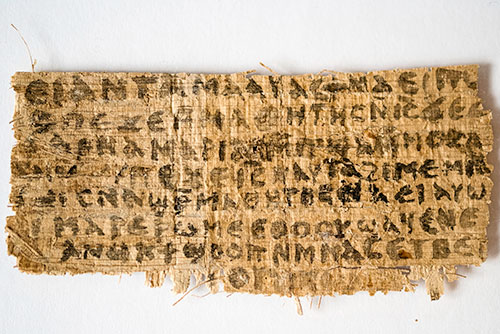
Maybe you’ve seen the news about the Coptic fragment which contains writing which has Jesus referring to “My wife…” It was amusing to see how many people at work today had to ask me, “Hey, Chitty! Did Jesus have a wife?” My answer was that during his first coming, he came to purchase a people whom Scripture calls “The Bride of Christ,” and when he returns, he and his Bride will enjoy the marriage Supper of the Lamb” (Rev. 21:9). So, no, he didn’t marry an
individual during his earthly ministry 2,000 years ago because he is saving himself for his Bride, the church.
There was one curious thing about this fragment making news today: what major Christian holiday is coming up? It’s not Christmas or Easter. Monday did mark Rosh Hashanah for the Jews, but stories like this don’t usually coincide with Jewish holidays.
The timing may be evidence that this fragment is genuine. Don’t get me wrong–I don’t think the apparent assertion of the fragment reflects the truth of the matter. But a serious scholar presented it to a conference of peers, submitting it for peer review, besides the fact that it is not being publicized in conjunction with any major Christian holiday.
Here’s what Michael Heiser, who blogs at PaleoBabble, has to say about it:
Now, to be clear, this discovery isn’t PaleoBabble — at least not yet. Karen King is a good scholar. She teaches on the history of early Christianity (which would include Gnostic sects) at Harvard. I don’t believe for a minute she’s faking anything.
UPDATE: Although it is true that this “Jesus’ Wife” papyrus was not heralded in the sensationalistic way which is usually case with the stories breaking the week of Christmas and Easter, questions are being raised about the propriety of the anonymous owner’s intentions in allowing Harvard scholar Karen King to introduce it to the world as she has. After all, according to the NYT article, Dr. King is interested in giving other scholars a chance to “upend (her) conclusions.” Yahoo News informs us of the discussion in progress
Reformed Forum: Nature and Scripture
I just thought I’d share the video of one of my favorite podcasts, if you’ve got the time.
Reformed Forum is a reformed theology media network, which seeks to serve the church by providing content dedicated to issues in reformed theology. (Link)
The flagship podcast of the Reformed Forum media network is the weekly program, Christ the Center. Hosted by Camden Bucey, a doctoral student at Westminster Theological Seminary in Philadelphia, Pennsylvania, who is often joined by a panel of other students, Christ the Center features interviews of authors and theologians, as well as discussions among the panelists themselves. While accessible and engaging, these guys are not afraid of dealing with the technical and academic aspects of Reformed theology, but I know everyone will find something that will benefit them.
The most recent episode posted at the Reformed Forum YouTube channel deals with the issue of “Nature and Scripture”:
In 1946, the faculty of Westminster Theological Seminary published a symposium on the doctrine of Scipture titled The Infallible Word. Cornelius Van Til’s contribution, an essay titled “Nature and Scripture,” is an important work describing the relationship of general and special revelation. In this episode, Dr. K. Scott Oliphint, Professor of Apologetics and Systematic Theology at Westminster, expounds on this essay and connects it to contemporary issues in philosophy and theological methodology. (Link)
Taking the Bible “Seriously,” Not Literally
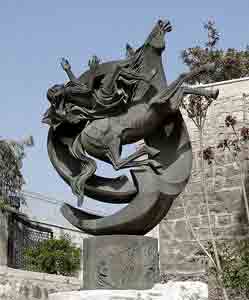
Syrian statue of Saul of Tarsus falling from his horse at the appearance of Jesus
Here’s another example of how people are incapable of absolute objectivity. As you know, I’m currently reading Oxford Church Historian, Diarmaid MacCulloch’s 2009 book, Christianity: The First Three Thousand Years (© 2009, Viking). Fortunately, the author makes no pretense to absolute objectivity. In his telling of the history of Christianity (or, more fashionably, “Christianities”), he explains that at times his own opinion will show through. Boy, does it ever! In some cases, these opinions appear in the form of his own imaginative theory for how something fundamental to Christianity may have developed in a way other than how the Bible explicitly states that it did. What scholar worth his salt is going to take the Bible’s historical claims at face value? Especially those involving supernatural experiences.
In his introduction, MacCulloch calls “modern neurosis” the presupposition that the Bible is authoritative. The “scholarly” approach is to take the Bible “seriously” in a way that disregards the literal interpretation of the Bible.
“The Bible’s authority for Christians lies in the fact they have a special relationship with it that can never be altered, like the relationship of parent and child. This does not deny relationships with other books which may be both deep and long-lasting, and it does not necessarily make the parental relationship easy or pleasant. It is simply of a different kind, and can never be abrogated. Once we see this, much modern neurosis about the authority of the Bible can be laid aside. Maybe the Bible can be taken seriously rather than literally” (MacCulloch, page 8).
In what way might we take the Bible seriously without taking it literally? I suppose the answer is to simply admire and attempt to follow the Bible’s moral teachings, receiving them as wrenched from their presumably mythological context. In other words, orthodox Christians need to become theological liberals. We should bravely affirm that the Bible can be wrong about history, but right about morality and spirituality. In other endeavors, if one is wrong in one area, it undermines his credibility in other areas. If the Bible is historically untenable, then it is spiritually untenable. Why, then, bother with the Bible’s morality, when we can change our morals with the times—which is precisely what theological liberals do with biblical morality. They lay it aside, along with their neurosis about the authority of the Bible. MacCulloch’s own unrepentant homosexuality is a prime example of this fact.
In chapter one, “Greece and Rome (c. 1000 BCE-100 CE),” MacCulloch gives us an example of how he takes the Bible seriously, though not literally. In his description of imperial Rome’s racial inclusivity, and generous granting of citizenship to foreigners of all kinds, he finds the possible origin of the preaching of the Christian gospel among Gentiles. MacCulloch suggests that “pride” in Paul’s own Roman citizenship could have been the real source of his desire to invite Gentiles into the number of God’s chosen people. If we took the Bible seriously, then we, too, could confidently make up our own reasons to explain away the Bible’s historical narratives! MacCulloch leads by example:
Why was Rome’s expansion so remarkably successful? Plenty of other states produced dramatic expansion, but survived for no more than a few generations or a couple of centuries at most. The western part of the Roman state survived for twelve hundred years, and in its eastern form the Roman Empire had a further thousand years of life after that. The answer probably lies in another contrast with Greece: the Romans had very little sense of racial exclusiveness. They gave away Roman citizenship to deserving foreigners—by deserving, they would mean those who had something to offer them in return, if only grateful collaboration. Occasionally whole areas would be granted citizenship. It was even possible for slaves to make the leap from being non-persons to being citizens, simply by a formal ceremony before a magistrate, or by provision in their owners’ wills.32
Where this highly original view of citizenship came from is not clear; it must have evolved during the struggle for power between the patricians and the plebeians after the fall of the kings. In any case, the effect was to give an ever-widening circle of people a vested interest in the survival of Rome. That became clear in one dramatic case in the first century of the Common Era, when a Jewish tent-maker called Paul, from Tarsus, far away from Rome in Asia Minor, could proudly say that he was a Roman citizen, knowing that this status protected him against the local powers threatening him. It might have been his pride in this status of universal citizen which first suggested to Paul that the Jewish prophet who had seized his allegiance in a vision had a message for all people and not just the Jews (MacCulloch, p. 42).
If we only had the scholarly authority to associate things that are historically verifiable–like the extent of Roman citizenship–with fundamental elements of Christianity–like their proclaiming to Gentiles the life, death, resurrection and royal ascension of the Jewish Messiah–then we wouldn’t have to suspend our disbelief enough to take the Bible literally when Paul’s physician-associate, Luke–himself a careful historian (cf. Luke 1:1-3)–records in the sequel to his gospel, The Acts of the Apostles, Paul’s conversion on his way to Damascus, and divine calling to be the apostle to the Gentiles:
[9:1] But Saul, still breathing threats and murder against the disciples of the Lord, went to the high priest [2] and asked him for letters to the synagogues at Damascus, so that if he found any belonging to the Way, men or women, he might bring them bound to Jerusalem. [3] Now as he went on his way, he approached Damascus, and suddenly a light from heaven shone around him. [4] And falling to the ground he heard a voice saying to him, “Saul, Saul, why are you persecuting me?” [5] And he said, “Who are you, Lord?” And he said, “I am Jesus, whom you are persecuting. [6] But rise and enter the city, and you will be told what you are to do.” [7] The men who were traveling with him stood speechless, hearing the voice but seeing no one. [8] Saul rose from the ground, and although his eyes were opened, he saw nothing. So they led him by the hand and brought him into Damascus. [9] And for three days he was without sight, and neither ate nor drank.
[10] Now there was a disciple at Damascus named Ananias. The Lord said to him in a vision, “Ananias.” And he said, “Here I am, Lord.” [11] And the Lord said to him, “Rise and go to the street called Straight, and at the house of Judas look for a man of Tarsus named Saul, for behold, he is praying, [12] and he has seen in a vision a man named Ananias come in and lay his hands on him so that he might regain his sight.” [13] But Ananias answered, “Lord, I have heard from many about this man, how much evil he has done to your saints at Jerusalem. [14] And here he has authority from the chief priests to bind all who call on your name.” [15] But the Lord said to him, “Go, for he is a chosen instrument of mine to carry my name before the Gentiles and kings and the children of Israel. [16] For I will show him how much he must suffer for the sake of my name.” [17] So Ananias departed and entered the house. And laying his hands on him he said, “Brother Saul, the Lord Jesus who appeared to you on the road by which you came has sent me so that you may regain your sight and be filled with the Holy Spirit.” [18] And immediately something like scales fell from his eyes, and he regained his sight. Then he rose and was baptized; [19] and taking food, he was strengthened.
For some days he was with the disciples at Damascus. (See also Acts 22:1-21)
I mean, seriously!
Understanding Law & Gospel
 On this episode of the White Horse Inn, Michael Horton addresses the topic, “Understanding Law and Gospel.”
There he goes again… 🙂


 The Misadventures of Captain Headknowledge
The Hermeneutics of Insider Syncretism
On this week’s episode of the Christ the Center podcast (#263, “Insider Movements“), Dr. David Garner is interviewed about his recent article in Themelios, “High Stakes: Insider Movement Hermeneutics and the Gospel,” analyzing the hermeneutics underlying the Insider Movement, a sociological and anthropological approach to contextualizing evangelism without calling on people whose identities are tied to other world religions like Judaism, Islam and Hinduism to disassociate themselves from those religious, cultural and family ties, but to work inside them and transform their approach to those religions in light of the teachings of Jesus. While it is noble to attempt to find a way to minimize the risk of loss or danger a Jew, Muslim or Hindu (for example) may face upon becoming a Christian, it is unfaithful to the Jesus they claim to follow if they would settle for living to distort their new-found faith with the teachings and practices of the religion with which they have previously been associated. Living to syncretize Christianity with non-Christian world religions is not a faith worth living for or dying for.
This movement is clearly in contradiction with the teachings of Jesus to those who would follow him. Jesus carried his cross and died on it for those who believe, and he calls on believers to take up their cross, follow him, and be willing to live publicly for him and, if need be, accept rejection by leaders of other religions, communities and families, even if such rejection includes dying for him.
I know it’s easy for me to say, and to criticize those who would find a way around it, but I too have a cross of self-denial to carry if I am to follow Jesus. I must kill my own sin (a struggle which involves suffering and risk of social rejection on my part), and publicly acknowledge Jesus as my Lord and Savior and associate myself formally with his people, the Church (Hebrews 10:25), serving him with my time, talent and treasure–loving, forgiving and giving to my brothers until it hurts. Should the time come that the culture or community in which I live demands that I deny my Lord Jesus Christ, I am called upon to defy such a demand and willingly suffer the consequences in reliance upon the grace and goodness of God, knowing that if such is happening to me, it is no more than what he sacrificed for me.
One of the interesting things about this movement which Dr. Garner points out in the article and the interview is that the intellectual source of such innovation in world missions comes from the same root as the church growth movement–Donald McGavran (d. 1990) and his School of Intercultural Studies at Fuller Theological Seminary (formerly the famous School of World Mission).
While McGavran’s efforts in his time were more theologically conservative and a reaction against liberal missionary trends, a student of his named C. Peter Wagner built on McGavran’s principles and create the church growth movement which has brought us such phenomena as seeker-sensitive worship and the modern megachurch. Incidentally, he is also the one who coined the phrase New Apostolic Reformation for the worldwide sweep of Charismatic and Word of Faith theology with a special emphasis on the restoration of the apostolic office, which movement in America has recently frightened the political Left because so many who would fall under this umbrella have modified the theonomist views of R. J. Rushdoony (for more on that, see this) and declared that they would “take dominion” over every sphere of influence in America.
Syncretism in the name of saving one’s life is no way to spread Christianity. A new generation around the world must hear the age-old truism: “The blood of the martyrs is the seed of the church” [paraphrasing Tertullian, Apology chapter 50].
Share this: