“Should We Exclusively Use the King James Version?”
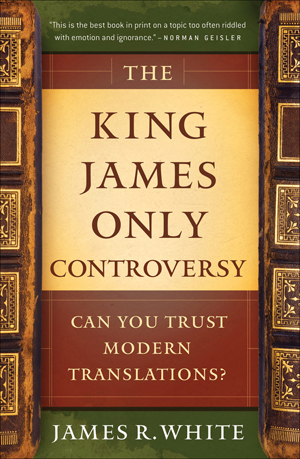 How appropriate that during the year of the quadricentennial of the King James Version of the Bible, a debate on the question of King James Onlyism should be held. Reformed Baptist apologist Dr. James White of Alpha and Omega Ministries is just on his way to London, England. RevelationTV in London is hosting a debate Wednesday night at 9pm GMT (if I’m not mistaken, that should be 3 pm CST), between Dr. White and Dr. Jack Moorman, an American fundamentalist Independent Baptist missionary in England, pastoring Bethel Baptist Church, Wimbeldon, London. The subject of the debate is, “Should we exclusively use the King James Version?” To my knowledge, it has been quite a while since a KJV Onlyist has stepped forward willing to debate Dr. White, author of The King James Only Controversy: Can You Trust Modern Translations?
This should be good. Dr. White never disappoints.
Listen To This…
Here are the programs I’ve been following this week. If you’ve got the time, it would benefit you to check some of them out:
- “Machen’s Warrior Children” on Christ the Center
- “Gospel-Focused” on White Horse Inn
- January 11 Episode of Dividing Line
- “The Legacy of the King James Bible” on ReformedCast
A Question for Presuppositionalists
 For those who may not be familiar with what “presuppositionalism” is, it can be described simply as the Reformed approach to apologetics (defense of the Christian faith). The New Dictionary of Theology explains: “The presuppositionalist endeavors to convince the unregenerate first by demonstrating that, on unregenerate presuppositions of chance occurrence in an impersonal universe, one cannot account for any sort of order and rationality. Next, he tries to show that life and reality make sense only on the basis of Christian presuppositions.” (see this link for citation)
I have not studied presuppositional apologetics personally to any extent whatsoever, yet. However, based on short definitions like the ones above, it occurred to me once upon a time, that since Edward F. Hills, author of The King James Version Defended is a graduate, not only of Yale, but also of Westminster Theological Seminary, and that much of Hills’ defense of the Textus Receptus (the popular name of the Greek text that underlies the King James Version New Testament) is written from a characteristically Reformed standpoint, that when he further makes his defense from what he calls “The Logic of Faith,” that this must be his way of applying presuppositional apologetics to the defense of the superiority of the Greek Text underlying the King James Version, as well as that translation itself.
My question for presuppositionalists who’ve read The King James Version Defended, therefore, is: Am I right? Was Hills a presuppositionalist, and is his so-called “Logic of Faith” a fair representation of the presuppositionalist apologetic, and is belief in the inherent superiority of the Textus Receptus therefore the consistently Reformed answer to the question, “Which New Testament text is closest to the original manuscripts?”
My personal short answer is, “I hope not.” I don’t really think the conclusion necessarily follows from the premise. I’m sure most presuppositionalists agree with me on this, and could probably give a better explanation as to why, and I’d like to see what you’d have to say on this topic. I’d also be interested in any King James Onlyist presuppositionalists out there (or perhaps more accurately, Textus Receptus Onlyist) who would answer yes to the question as stated in the previous paragraph.
Independent Baptist defender of the King James Version, Dr. David Cloud, has posted “The Testimony of Dr. Edward F. Hills,” in which Hills explains his journey to the position he defends. He writes that he was puzzled by Dr. B.B. Warfield, who was simultaneously perhaps the premier champion of the Westminster Confession of Faith, and an avid proponent of what Hills considered the textual criticism of theological liberalism. Hills explains that Warfield must have fallen prey to the false dichotomy between faith and reason, which he says Cornelius van Til taught him was begun by the medieval scholastic theologians. In this testimony, Hills does not state explicitly that he applied van Til’s presuppositional apologetic to this question, but what he does state explicitly does seem to say, at least implicitly, in my opinion, that this is just what he did.
What say you, Reformed presuppositionalists? Pro KJV/TR onlyists, or pro-modern textual criticism/modern versionists? I’m ready to learn.
Discovery of Biblical Manuscripts Goes On
 The Yahoo! News site is featuring an article on the recent reunion of two portions of an ancient Hebrew scroll containing “The Song of the Sea,” otherwise known as Exodus 15:9-10. You can read all about it here. If you’re curious about what sorts of New Testament manuscript discoveries are ongoing, read this post and/or check out the website for the Center for the Study of New Testament Manuscripts.
Twenty-first Century New Testament Textual Criticism
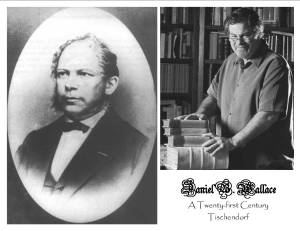
Constantin Von Tischendorf (r); Daniel B. Wallace (l)
Will the 21st century go down as another great age of discovery when it comes to our knowledge of the transmission of the text of the Greek New Testament? While many skeptical and liberal scholars like Bart Ehrman are busy using their expertise in the Biblical Studies to destroy faith in God’s revealed Word in the Scriptures, others, like Dr. Daniel B. Wallace of Dallas Theological Seminary, founder of The Center for the Study of New Testament Manuscripts, is using modern technology to “discover” ancient manuscripts which have until now been inaccessible due to their fragile condition. According to an interview of him on Friday’s edition of Christ the Center, in the past year, about 36 manuscripts have been discovered and are in line behind about 75 others to be catalogued at the place in Munster, Germany where the knowledge of such manuscripts are warehoused for use by scholars the world over.
No time to finish this post. But I want you to listen to the program. Here’s the link: http://reformedforum.org/ctc70/
James White on Faithful Scholarship
Here’s the video of Dr. White’s call for “believing Biblical Studies.” In case you had any trouble following my transcription of his monologue in the previous post, now you can watch it and hear it as well. Using as many senses as possible will always help your comprehension. If there were some way we could touch, taste and smell it, I’d post that, too, but for now the technology remains limited. Of course, if you really want to touch your monitor screen be my guest, just don’t press too hard if you’ve got one of those gel screen type set ups.
Also worthy of note is how Dr. White is sporting the sharp “Sola Conference” shirt that he mentioned in the previous video of him I posted. Like the Bible says, “You have not because you ask not.” If you like to see more videos by Dr. James White, Reformed Baptist apologist extraordinaire, you can view his YouTube page here.
A Call to Believing Biblical Studies
On the Tuesday, February 17th edition of Dr. James White’s The Dividing Line webcast (here’s the link), he read a scathing review (read it here) of evangelical scholar Dr. J. Harold Greenlee’s, book, The Text of the New Testament, by Dr. J. K. Elliott of the University of Leeds, U. K. Dr. White takes this opportunity to demonstrate how that so often, secular scholars of Biblical Studies do not engage their evangelical counterparts with dispassionate scholarly restraint, simply answering their scholarship with superior argumentation, but rather tend to resort to ridicule and derision. This review prompted a veritable eruption from Dr. White, who, in the wake of his debate with agnostic Religious Studies professor, Dr. Bart Ehrman (his website) had already been considering this phenomenon, and apparently just needed to get it off his chest. Dr. White winds up calling on enthusiastic young Reformed scholars to consider entering the field of Biblical Studies, learning all the truthful facts that the secularist academics have to teach, but, as Dr. White said, “combining it with faith.”
This is exactly the kind of call I wish to see get out, so in the interest of doing so, I have transcribed Dr. White’s monologue below. My request to you is, if you know a Christian young man who may fit this profile, pass this message on to him, and I will be in your debt.
“I was really bothered . . . I read this review. And those of you who have the RSS Feed to the Evangelical Textual Criticism blog may have read it as well. This is a review by J. K. Elliott, of the University of Leeds in the U. K. of J. Harold Greenlee’s Text of the New Testament: From Manuscript to Modern Edition. Now, I do not have this edition of Greenlee–it’s on it’s way, it’ll probably arrive today–but this is an update of the books I do have, and that was his original work on textual criticism, which then became updated I think in the eighties or nineties, to Scribes, Scrolls and Scripture, and now has a new name with Hendricksen’s publishers.
“There are things that are said by Elliott in this–I want to check them out and make sure they’re accurate–I don’t have any reason to question that they are. For example, he goes after Greenlee for a bad Scripture Index. I understand how that happens, especially if you’re updating an older book. I can understand how Scripture Index issues can arise, to be perfectly honest with you. And some of the other statements he makes here, I would take some issue with Greenlee on, but I want you to listen to the voice of modern scholarship.
“This bothers me. . . and I hope it will bother you as much, because it really has prompted me to do a lot of thinking about how to avoid the irrationality of those who are scared of scholarship. . . And who are afraid of tackling truth. Dan Wallace has a good point: he talks about people who are more desirous of having certainty than of having the truth. And I’ve met many people who are very certain of untruths. So I don’t want to go there. But, at the same time, I don’t want to be J. K. Elliott. Listen to what he says. I’m just reading two paragraphs. This is from his review–this is from SBL. The Society of Biblical Literature. This is the RBL of January of 2009, so this is brand new. . . .
“One of his ways to answer readers’ concerns is to offer palliative platitudes. Among such pacifying remarks are “The great majority of textual variants involve little or no difference in meaning” (83), and “The vast majority of the most theologically significant passages of the New Testament have no significant textual variations” (117), a blatantly unsustainable assertion that tests the gullibility of the readership. Also to be endured are his quoting Bengel’s pabulum that “the variations between the manuscripts did not shake any article of evangelical doctrine” (76) and his repeating Sir Frederic Kenyon’s words “we have in our hands, in substantial integrity, the veritable Word of God” (120), despite his not drawing attention to the unsettling get-out phrase “in substantial [i.e., not complete] integrity.” The fact that the majority of the text is secure may well be true, but what disturbs conservative readers is not the total percentage of variants that are insignificant as regards matters theological but that minority of readings that are indeed theologically important. More on these below.
“Another means used to placate the fundamentalists is to appeal to divine protection of the text. Surprisingly, in a book by a respected academic, is his appeal on more than one occasion to the Holy Spirit (although why the index has a reference to the Holy Spirit on 46–47 eludes this reviewer). On page 37 we do find: “we believe that the Holy Spirit guided the authors of the New Testament books so that their message would be protected from error” and “We likewise believe that the Holy Spirit operated providentially in the copying and preservation of the MSS through the centuries.” Oh! That is not the sort of presupposition one would find in works of textual criticism of the Greek or Latin classics or of other ancient literature. Nor is it warranted here. In any case, such a view is a hostage to fortune—the vast quantity of textual variants is hardly suggestive of providential preservation. It were better had Greenlee avoided such peculiar obiter dicta. Even Greenlee himself tells us in a prelude to a description of scribal habits that “we should not think that it was only by supernatural preservation that the New Testament was kept from being lost or hopelessly confused during those centuries” (37) Perversely, Greenlee allows (103) that Mark’s original ending has been lost. Mainly, though, Greenlee is concerned to show how the frail human agency of scribal copying resulted in accidental and deliberate change (and even he points to places such as 1 Thess 2:7 and 1 Cor 13:3 [!] where he is not certain which reading came from the “inspired” biblical author).”
“Now–ahem–listening to this was like chewing on aluminum foil for me. Here is someone who is, indeed, speaking the presuppositions of the modern Academy, represented by Bart Ehrman. It is not an argument to mock a position. It would be better to provide a meaningful interaction. But we do need to understand that this is the language of the modern Academy. Now I’ve never figured out why people who don’t believe in the inspiration of the Bible would spend their time studying the Bible, but there are a lot of people who do.
“Just a couple of things. He identifies as ‘pacifying remarks’, the statement, ‘the vast majority of textual variants involve little or no difference in meaning.’ I don’t know how many times I’ve heard Bart Ehrman say that. That is not even a disputable assertion. Given that the largest textual variant in the New Testament–and I don’t mean largest as in number of verses–but the most number of times this textual variant comes up–has to do with the “movable NU (watch this how to video on the movable NU).” The movable NU does not impact meaning. So, that’s a fact. How is that a pacifying thing? Or are we just not supposed to mention that? Does J. K. Elliot so live in the realm of variation that he can’t admit these facts?
Then the next quote: “The vast majority of the most theologically significant passages in the New Testament have no significant textual variation. Okay. I’ve got to agree with Elliott on that one. I wouldn’t say it that way. He says, “A blatantly unsustainable assertion that tests the gullibility of the readership.” I think Elliott is following Ehrman in his book review methodology, here, to be perfectly honest with you. But I wouldn’t say that. I think that there– any theologically significant is going to have either minor or major textual variation in it. Most of it is going to be minor . . . But the things that bug me– he identifies Bengel’s statement as “pabulum.”
If a conservative were writing about someone else–a liberal, they would be dismissed for this kind of clearly biased presentation. It’s amazing! But then, here’s what really hit me. . . .
“Another means used to ‘placate the fundamentalists.” That’s just bias. That’s bigotry. That’s prejudice. “To placate the fundamentalist” is to appear. . . face it folks, if you wanted to “placate the fundamentalists,” you’d be using the King James Version of the Bible, and you wouldn’t be writing the stuff that Greenlee’s writing in the first place! Trust me, I know!
“Another means used to placate the fundamentalist is to appeal to divine protection of the text.” See, it’s as if that can’t even be a possibility. It’s not even allowed on the table now. But how do you keep it off the table? You just mock the people who don’t believe it. You don’t argue against it. You don’t demonstrate any type of consistent worldview that would give you a reason for doing that. You just simply dismiss it. That’s how liberalism works, folks; it’s how it works in politics, that’s how it works in religion. That’s how it works in our seminaries. And this is what’s coming into the seminaries. This is the kind of attitude that’s producing the kind of literature that’s out there today.
“I think what we’ve got to realize is, we’ve got a bunch of unbelievers who have hijacked the “leading edge” of this discipline, and we need to start identifying that. What that also means is, those who are believers, who, by the work of the Spirit in their heart, have had the rebellion against God’s Word removed, and, I believe, a part of regeneration, a part of the change of the heart, is to cause a person to bow the knee before God’s Speech; before God’s Word.
“The men of old who have changed this world have been people who gave clear evidence of obedience to the Word of God. And those in whose lives the Spirit has moved in that way, I challenge you, I plead with you: if you’re a young man and you feel called to the ministry, you feel called to study, I challenge the young men of this generation–go into this field. Learn what these people have to say, yes, but don’t imitate their unbelief. Take the truth that they say, yes, but combine it with faith, and begin providing the kind of believing scholarship that goes beyond the circularity–I submit to you, secular humanism is no foundation for dealing with God’s universe–it will always result in the stunted viewpoints that we see in a Bart Ehrman. It can give us no reason for life, no reason to get up in the morning and do what is right. I call upon those young people, as you go into this field, don’t just dodge this, don’t dodge this area, dive into it in trust and faith that God’s Word is true, and let’s begin producing a kind of believing Biblical Studies. We have so much given the field over to the unbelievers, so they can say, “Look at all we write. We run SBL, and we do this and we do that.”
“There is such danger when the Christian Academy is so in love with the acceptance of the world that we are no longer willing to stand up and say, “I operate under the Lordship of Christ; you operate under the Lordship of your own mind. You are a rebel against Christ.” And that simply isn’t allowed in the Academy any longer. I hope there’s some listening right now, I know young Reformed men, they have a lot of zeal, they have a lot of desire. They desire to learn, they desire to study. I call you. Give consideration. Do you want to be a scholar? Do you want to teach? I’m not saying it’s going to be easy. You’re going to have to go against the flow. Anybody who believes in the Lordship of Christ, anyone who believes God is their Creator today has to go against the flow. But we need good, sound scholarship being produced out there. I’m not saying lower the level of scholarship, I’m saying go to a higher level of scholarship. Because I say to you, to do scholarship under the Lordship of Christ is the highest calling. To do scholarship under the lordship of Secular Humanism is not a high calling. We need to delve into this area and “give an answer for the hope that’s within us.”
Did the Bible Misquote Jesus?
Back in 2005, Dr. Bart D. Ehrman wrote Misquoting Jesus: The Story Behind Who Changed the Bible And Why, and it became a bestseller. Ehrman’s works are often appealed to by the skeptical in the media to undermine the traditional, orthodox view of Scripture. A Princeton grad, Ehrman studied under the leading light Bruce Metzger, with whom I’m familiar because when he was alive he so often appeared in programs produced by Evangelicals in defense of the reliability of the New Testament, although he himself ran in the circles of the theologically liberal. Ehrman was originally a student at Moody Bible Institute, but began to lose his faith in the preservation of Scripture, then the inspiration of Scripture, and now I think he has even become an agnostic.
Last week, Reformed Baptist elder and Christian apologist James White faced off with Dr. Ehrman in a debate on the claims of his book. You can read a little about the debate here, and you can purchase the debate for $15.00 on CD here, and for $6.00 on mp3 here. Sometimes you have to listen fast, but it’s well worth the effort. While Ehrman seems to hold his own pretty well, later, on White’s webcast, The Dividing Line (haven’t found the link to the program yet), he points out how much of Ehrman’s defense is based on the logical fallacy of appeal to authority, which authority, of course, would be Ehrman’s own credentials. You gotta check this out, and pass the info on to those who spend too much time listening uncritically to the History Channel and the Discovery Channel and other popular forms of skepticism in the media.


 The Misadventures of Captain Headknowledge
Should 1 John 5:7 Be In The Bible?
Interested in learning more? Select from this list of articles relevant to 1 John 5:7 at Bible.org.
Share this: