Revisiting “The Right Story”

- (The following was originally posted on March 3, 2006. It reappears here in a slightly edited form.)
“You can’t help nobody if you can’t tell ‘em the right story.” Jack Cash, brother of Johnny Cash, as portrayed in the movie, Walk the Line.
Every story is about fall and redemption in one way or another. There would be no plot if there were no problem to solve or conflict to resolve. The story of the entire human race is that of its fall and redemption. Your story is about your fall and your redemption. The mission of the church is to tell this story; to introduce the characters to the plot: they’ve fallen and they can’t get themselves up on their own, their problem is so bad, they can’t solve it themselves, they need Another to solve it for them, the conflict that has entered their life has killed them, and they need Another to return them to life.
Stories are often considered mere entertainment. And to be sure, the church in this Laodicean (Revelation 3:14-22) generation has caught on to the idea that entertainment will help them tell the Story. Even if at times they’re telling the right story, that of the fall of man into sin and the sinless Christ who was crucified and raised for sinners, they’ve wrapped it up in so much entertainment that many are in danger of overlooking the Gift because they’re so fascinated by the wrapping paper. If sinners are distracted from the Story by trappings geared toward appealing to their interests, or meeting their felt needs, the church can’t help them. At other times, the church forgets to get around to the Story at all because they’re so aware of all the other stories in the Bible. “Christians don’t need to hear the Story this week, they’ve already heard and believed and received it, now they need to hear what they need to do,” and thus the Story is placed on the shelf in the interest of relevance or practicality. But no matter how much they mean to help, they “can’t help nobody if [they ain’t tellin’ ’em] the right story.”
The church seeks to tell a story, but all too often it’s not the Story they were commissioned to tell (Matthew 28:19-20). Many times they tell their own story. A story about how they’ve picked themselves up by their own bootstraps, a story about what a great example they are. When this is the story they tell, the Holy Spirit won’t bring sinners to life, nor will he empower believers to serve. All applications and all examples, and all pastoral autobiography are not to stand alone. They are to be built on the firm foundation of the Story, explicitly told each week.
We’ve fallen into sin so there’s nothing we can do to redeem ourselves:
the sinless Christ was crucified because we are sinners who deserve to die;
Christ rose from the dead on the third day because God has accepted Christ’s death in the place of sinners who come to believe and repent of their sins;
saved sinners are called to be holy and to serve others, which brings them into conflict with the sin that yet remains in their natures and they aren’t always able to be holy and serve others (Romans 7).
That’s why the Right Story must remain central: The Gospel is for Christians, too!
They must be reminded that even though they’ve been saved they still need to hear the Gospel addressed to them (1 John 1:9) to cleanse them so they can progress on the journey to glorification by way of sanctification (Proverbs 4:18).
When the preacher neglects to tell the church the Right Story, he can’t help the church grow in grace.
- (Dr. R. Scott Clark gives a fuller, more Christ-centered summary of the Right Story at Westminster Seminary California’s Valiant for Truth blog. Read his post, “The Christian Life.”)
Gospel Coalition Interviews Michael Horton
 If you’re anything like me, you’re looking forward to your copy of Michael Horton’s new systematic theology, The Christian Faith: A Systematic Theology for Pilgrims on the Way (published by Zondervan), to arrive, if you haven’t already received it. If you aren’t like me, then perhaps this interesting interview of Horton by John Starke, of the Gospel Coalition, promoting his systematic theology, will make you more like me (but only in this one way).
Listen to This. . .
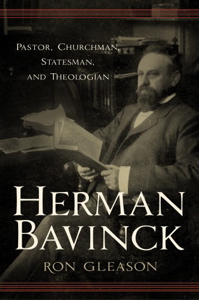
Cover of Herman Bavink: Pastor, Churchman, Statesman, and Theologian by Ron Gleason
Don’t miss these great podcasts this week.
- The White Horse Inn— “Exile, Exodus and Conquest“: On this program the hosts will explore the themes of exile, exodus and conquest showing how they each culminate in the great announcement that Jesus Christ has been given “all authority in heaven and earth” to judge, to save, and to reign forever.
- Christ the Center— “The Life and Thought of Herman Bavink“: Dr. Ron Gleason discusses his new intellectual biography, Herman Bavink: Pastor, Churchman, Statesman, and Theologian.
- Mid-Cities OPC Sermon—“Cleaning House in the Family of God” (Matthew 12:43-50). Preached by Pastor Joe Troutman on January 16, 2011. This is the church plant my family is visiting. I think you’ll appreciate Rev. Troutman’s preaching.
Listen To This…
Here are the programs I’ve been following this week. If you’ve got the time, it would benefit you to check some of them out:
- “Machen’s Warrior Children” on Christ the Center
- “Gospel-Focused” on White Horse Inn
- January 11 Episode of Dividing Line
- “The Legacy of the King James Bible” on ReformedCast
Balm for Believing Victims of Christianity
The following is a sermon by Lutheran (Missouri Synod) Seminary professor, Dr. Rod Rosenbladt, who is also co-host of The White Horse Inn radio show. The title of the sermon is “The Gospel for Those Broken by the Church.” He addresses two kinds of believers who have given up on going to church: the “sad,” who feel they couldn’t measure up, so they quit trying; and the “mad,” who’ve been “used up and spit out” by the church, or who have been justly scandalized by Christianity’s many historic misdeeds. Dr. Rosenbladt’s premise is that the good news of Christ’s cross and blood shed for sinners will save not only the pagan unbeliever, but also the wounded believer who, for whatever reason, has given up on Christianity.
In some ways, Dr. Rosenbladt’s presentation may come off a bit academic, but if you hang with him, you’ll find that the heart of the message is clear as a bell. If you’ve got friends or relatives who are mad or sad at the church, please forward this post to them.
Gospel-Driven: From Doctrine to Discipleship

Dr. Michael Horton and me
New St. Peter’s Presbyterian Church in Dallas hosts an annual Reformation Conference the weekend before Reformation Sunday. This year saw their fourth such conference, “Gospel-Driven: From Doctrine to Discipleship,” featuring the teaching of Dr. Michael Scott Horton, Associate Pastor of Christ United Reformed Church of Santee, CA (see Dr. Horton’s Adult Bible Class page), J. Gresham Machen Professor of Systematic Theology and Apologetics at Westminster Seminary California, host of the White Horse Inn radio show (and podcast), Editor-In-Chief of Modern Reformation Magazine, and author of an ever-growing number of books, three of which were the subject of this year’s conference (see his Wikipedia entry for more info).
Two of the three books have already been published, but the third, on which Dr. Horton spoke, is to be published in the coming months. These books are (in order), Christless Christianity, The Gospel-Driven Life, and I think the title of book three will be The Gospel Commission. The first volume addresses the heart of the problem with all of contemporary evangelical, even Reformed, Christianity–an exchange of preaching the gospel of the Lord Jesus Christ for the preaching of self-salvation by self-improvement in a variety of manifestations–preaching “good advice” at the expense of preaching the good news. The Gospel-Driven Life addresses why preaching the gospel (along with regularly receiving the Lord’s Supper) is essential for Christian growth and sanctification, not just evangelism. Finally, The Gospel Commission (if that is it’s actual title) will go into how the church is to obey the imperative Great Commission out of a conscious response to the gospel indicative of the complete authority over heaven and earth given to the Lord Jesus Christ by his Father (Matthew 28:18).
This was an exciting opportunity for me to meet the man who first introduced me to Reformed theology. Back in 1991 Dr. Horton published his first book, Mission Accomplished (later revised and republished as Putting Amazing Back Into Grace). In the providence of God, Dr. Horton was invited to promote the book on a morning talk show on, of all places, the Trinity Broadcasting Network! During this interview, Dr. Horton had the unique opportunity to introduce Calvinism to the constituents of the Word of Faith heresy of Kenneths Hagin and Copeland, Benny Hinn, Oral Roberts, and more recently Joyce Meyer, John Hagee and Joel Osteen, myself among them. I recall mostly his emphasis on how the doctrine of election and predestination, far from squashing evangelism, actually motivates it. I found my introduction to Reformed theology and its benefits fascinating and exciting. At the time Dr. Horton was leading a ministry called Christians United for Reformation (CURE). I subscribed to CURE’s newsletter for a short time–I found it equally fascinating and really cool, but I also found it to be waaay over my head. So I got on with my life, marrying my first wife, moving off to Missouri to study to be an Independent Baptist missionary (which plan would change), living life between my initial and later providential and interesting encounters with Reformed theology.
I brought my copy of Mission Accomplished with me to the conference to get it autographed by Dr. Horton, along with the copy of The Gospel-Driven Life which I purchased at the conference. It was my joy to be able to personally thank him for his introducing me to Reformed theology, and when I mentioned that I saw him on TBN, he grimaced with shame as if a deep, dark secret had been exposed, and we all enjoyed a laugh at the stark irony of his television debut. Then as he opened my book and began writing on the first page, he informed me that the host of that talk show was fired not long after that episode. He assured me that the fact that he had been a guest on the show “was not unrelated” to his firing–WOW! But it makes perfect sense, considering that it would not be long before Dr. Horton would edit an expose of the Word of Faith movement, The Agony of Deceit. But just think, that TBN host’s firing may have just been one of the best things to ever happen to him. I consider it a noble sacrifice for the cause on his part. I just wish I could remember that host’s name so I could search for videos of his interviews on YouTube in the hopes of finding his interview of Michael Horton. Now that would be a blast!
If you’ve never listened to the White Horse Inn, then you are not aware of just what a heady, yet eminently edifying and motivating speaker Dr. Horton is. The way he helped us understand the covenantal nature of God’s relationship to Old Testament Israel and the New Testament Church simply boggles the mind with how it brings together so many aspects of the biblical revelation of redemption and also highlights the importance of the doctrine of justification by grace alone (sola gratia) that is received by faith alone (sola fide). He even mentioned how Pope Benedict XVI has admitted that the Bible’s use of the form and content of ancient Near Eastern Suzerainty/Vassal treaties in his covenantal dealings with his people makes it understandable that the Reformers taught what they did about justification. Horton observed that when the Pope sounds more like the Reformers than contemporary Evangelical theologians, you know you are living in a Salvador Dali painting!
You can download the audio of the messages below (PS–I hear there’s a video in the works, but haven’t heard if and when it’ll be released):
- Christless Christianity: The Problem
- Gospel-Driven Life: The Solution
- Gospel Commission: The Application
- Questions and Answers with Dr. Horton
- The Missionary Servant: The Sermon
Understanding KJV-Onlyism
 Understanding Our Times with Kevin Thompson has invited Bob Hayton of the blogs Fundamentally Reformed, KJV-Only Debate, and RE:Fundamentals to guest host the show tomorrow night at 5pm central time. It will be a call-in discussion hosted by Bob and his compatriot in Debating KJV-Onlyism, Damien Garofalo. Bob has been interviewed before about Fundamentalism and his journey to Calvinism on Understanding Our Times as well as Iron Sharpens Iron (a traditional radio show out of Long Island, NY–listen here).
Here’s Bob’s announcement if you desire more information.
WHI on the Effects of eDistraction
This week’s episode of the White Horse Inn radio show featured an interview with Grove City College Media Ecology professor T. David Gordon. Gordon is the author of two books that are of special interest to this blogger and will be hopefully to his readers also. The books are Why Johnny Can’t Preach (2009) and Why Johnny Can’t Sing Hymns (2010).
Why Johnny Can’t Preach is “an analysis of shifts in dominant media forms and their effects on the sensibilities of the culture as a whole. Many of those shifts have profound, and unfortunate, effects on preaching.” About Gordon’s newer book, Why Johnny Can’t Sing Hymns, the publisher’s website has this to say:
Changes in music have affected the way we think, the way we worship—even the way we are able to worship. We are steeped in a culture of pop music that makes other genres seem strangely foreign and unhelpful. Worship has become a conflict area, rather than a source of unity.
T. David Gordon looks at these changes in worship and not only examines the problems, but also provides solutions. They are solutions of great importance to us all—because how we sing affects how we live. Dr. Gordon not only shows the problems, he also provides solutions – it’s important, because how we sing affects how we live.
The White Horse Inn blog has also posted additional resources on the current phenomenon of media distraction and its effect on our minds, as Christians or otherwise, let alone culture at large (see blogpost here).


 The Misadventures of Captain Headknowledge
Finding Your Way
I’ve frequently repeated the saying of apparently unknown origin, “you can’t know where you’re going until you know where you’ve been.” I, however, usually modify it this way: “When you learn where you’ve been, you can see where you are, and know where you’re going.” In other words, as this applies to the visible church, when we’re informed by church history, we learn from many of the valuable lessons learned in the past, and it helps us figure out how to avoid those mistakes in the future. But if we ignore the past lessons learned, we in the present are doomed to repeat the mistakes of the past (an allusion to a better known saying). Dr. Riddlebarger assists us by appropriately moving us further back into our formative collective past by summarizing the history of redemption as progressively revealed in the Bible. His article helps us see where the church has been from the very beginning, the book of Genesis, and the promise and fulfillment of redemption in the Person and Work of Christ. But especially, we learn how to better interpret those signs of the times which we recognize in the present, and the portions of Scripture that reveal them, and how they point forward to the future coming of the Lord Jesus Christ. If you want the theological terminology, Dr. Riddlebarger helps the Dispensational-Premillennialist see how the Amillennial view of eschatology interprets end-times prophecy. If you’d like to learn more about Amillennial eschatology, I’d like to recommend Dr. Riddlebarger’s audio series “Amillennialism 101” located in the sidebar of his Riddleblog, and his books, A Case for Amillennialism, and Man of Sin. If you give this position some thought, I think you’ll find it makes clear some things that remain fuzzy for the average Dispensationalist.
In “You Are Here,” His synopsis of the article is as follows:
Dr. Kim Riddlebarger (Left) and myself (Right) after services at Christ Reformed Church, Anaheim, CA.
Dr. Riddlebarger illustrates the history of redemption and the end times by the image of a Mall Directory with it’s “You Are Here” sign. He writes:
We are also introduced to the so-called “Already/Not Yet” approach to the Kingdom of God in the New Testament:
But what about the signs of the times? Here’s an excerpt of Dr. Riddlebarger’s treatment of them:
Although it would behoove you to invest in a subscription to Modern Reformation Magazine to read the entire article for yourself, and benefit from the other helpful features, I’ve pretty much given you the heart of the article. I don’t want you to wonder as you wander, unnecessarily fearing things you shouldn’t as you look forward to the return of Christ. Reformed theology in general, and Reformed Amillennial eschatology in particular, is a liberating, comforting and most importantly, Biblical approach to our redemption in Christ from “In” (see Genesis 1:1) to “Amen” (see Revelation 22:21).
Share this: