First Christmas, Easter and Halloween . . . now the pastorate?
 Look at the bottom of my sidebar. I’ve added a couple of RSS Feed widgets. One links to the blog, “Reformation Theology,” where you can find some pretty good reading on Reformed theology, by folks more experienced at expounding it to you than I am. With this feed I’m attempting to, as they say, “light a light.”
The other feed, conversely, is where I, if you will, “curse the darkness.” It’s a link to “Out of Ur,” the blog of “Christian Leadership” Magazine, a subsidiary of “Christianity Today”. It may help us keep our finger on the pulse of the spiralling state of evangelicalism. What I want you to see specifically are the links to “Pagan Christianity” and “Is the Pastorate Pagan?” These deal with a new book called Pagan Christianity?, that has recently been published, co-written by Frank Viola and George Barna, author of Revolution. If you look for them after today, it probably won’t be in my sidebar anymore, but you’ll have to search the archives at “Out of Ur” for these articles.
Since the release of Barna’s book, I’ve been concerned with how addicted most churches seem to be on Barna’s polling of Christianity. Knowing what we now know from his book, Revolution, about his belief that the institutional church is irrelevant, and individuals need to rather “be the church” individually (which is an oxymoron), I fear that his statistical research is actually used to promote this ideal. I submit, either evangelicals who are faithful to God’s Word and historic orthodoxy ought to find other sources for such statistical information, or give up entirely the need to tell us from the pulpit what the latest statistics are that relate to whatever it is that is being preached about on any given Sunday.
So the rolling snowball of Barna’s “Revolution” is growing; with the help of Frank Viola, not only is church irrelevant, traditional forms of church ministry are pagan! Or, so they would have you believe.
Evangelicals are living in perilous times (2 Timothy 3:1-17).
From “Feed My Sheep” to “Self-Feeders”

 The following is an excerpt of the concluding remarks of the White Horse Inn from yesterday’s program, “What Would Moses Do?” dated, Sunday, February 17, 2008 (see sidebar for link to program). About the modern evangelical tendency to do anything and everything but the one simple thing Jesus asked the church to do–feed his sheep the Word of God, which Peter would go on to write, “the Word of God is the Gospel which we preached to you” (1 Peter 1:25b)
Horton: Now, the Bible is God’s instruction book. And that’s how a lot of people talk about it. Or it’s the owner’s manual. Well, what is an owner’s manual? An owner’s manual is a guide you go to that tells you how to fix your car. Folks, that’s the wrong category. The Bible is not primarily God’s instruction book. It has instructions, and they need to be preached, but it is not primarily that. In fact, the Bible is silent about half of the things that preachers want to talk about on Sunday morning when it comes to the practical. I can get a lot more help from Susie Armand about my finances than Bill Hybels.
Jones: Or diets, or things of that nature.
Horton: Yeah! I don’t need a Christian diet—I need a Christian gospel if you’ve got that. Tell me something I can’t get from Oprah or Dr. Phil.
Jones: Preaching is feeding time for the whole family.
Horton: Boy, isn’t that the case?
Riddlebarger: It should be!
Horton: But according to the latest study by Willow Creek Community Church, they concluded because their most active members said they were dissatisfied with their church—they concluded, “We gotta wean people off of the church. What this tells us is, as you mature, you need the church less.” They didn’t take away from that, they actually were not providing the nutrients that those people needed, even though they actually said in their surveys, “Not deep enough Bible teaching or worship.” Willow Creek concluded from that, “Yep. We’ve gotta make people ‘self-feeders.’” We’ve got to make it where they don’t have to depend on the church, whereas, Jesus said, “Peter, before I go—I know it’s you—I know you can’t handle a lot—I’m asking you to do one thing and do it well. Feed my sheep.”
The one thing Jesus asked the church to do. And Willow Creek says we need to teach people to become self-feeders. That is, at the end of the day, what moralistic therapeutic deism does. When you preach the law as gospel, people can find their own good advice on the internet.
White Horse Inn “Webisodes” on YouTube
“One of the most urgent tasks facing Evangelical Christendom today is the recovery of the gospel.” – J.I. Packer
The quote above is featured under the title of a blog called, “Recover the Gospel.” Kim Riddlebarger, pastor of Christ Reformed Church in Anaheim, California, co-host of the White Horse Inn Radio Show, and Reformed Blogger extraordinaire, directed his readers to the Recover the Gospel website where they have prepared a series of videos featuring the past two weeks’ episodes of the White Horse Inn for viewing on YouTube.
For those who aren’t aware, The White Horse Inn is a “theological talk show” advocating a return to the solid doctrine and practice of the Calvinist and Lutheran traditions which were foundational to Protestantism. They’re call is for every believer to “Know What You Believe and Why You Believe It.” This is an important message for this generation for very obvious reasons.
What passes for Protestant Christianity nowadays is often hardly Protestant, and some of it does not even legitimately pass as Christian. Here in America, pragmatic and entertaining methods often trump and undermine the validity of the Christian message. Whether we know it or not, Christianity in America is experiencing a “Dark Ages” of its own, because biblical illiteracy and ignorance of Christian history is so rampant that most American Christians are adrift in a see of error which they cannot discern and which is endangering their very souls. The Gospel is in desparate need of recovery in our day, and I urge you to begin your own examination of your personal beliefs with Scripture and historically orthodox resources, making an effort to see how different yours and your church’s views may or may not be from the generations of faithful Protestant Christians who’ve gone before us (which era ended sometime early in the nineteenth century).
I have embedded part one of the YouTube presentation of The White Horse Inn’s recent episode called, “That’s Entertainment,” where the hosts discuss the history of the development of entertainment as a form of ministry in America. You will be introduced to such folks as Charles Finney, Aimee Semple McPherson and Billy Sunday and you will see how what passes for ministry nowadays comes from a long line of unorthodox ministers who were acting in a manner consistent with their unbiblical beliefs. It is simply unacceptable that churches with otherwise orthodox doctrine should emulate such people and attempt to glean so-called “wisdom” from the methods of “successful” “ministers” like these. But back at Recover the Gospel, you’ll find a similar YouTube presentation of the previous White Horse Inn episode which analyzed the errors of Joel Osteen, pastor of the largest church in America.
Pray for your church, pray for your family, and pray that the Lord will give you the wisdom to search the Scriptures daily to see whether the things you are being taught on an ongoing basis are so.
Reforming Your Best Life Now
 January 31, 2008 was the release date for J. I. Packer’s latest short book, Keeping the Ten Commandments, published by Crossway. I was notified by Amazon.com a few days before its release and immediately placed the order. Now that it’s in my hands, and I’ve begun reading it, I would like to recommend the book to you as a great introduction to the Reformed theology of the relevance of the Ten Commandments in the Christian life. At the same time, it will serve as a great antidote to the man-centered, motivational self-help pop-psychology that passes itself off nowadays as teaching on practical Christian living, or the victorious Christian life. In other words, set aside your “What Would Jesus Do” moralism, Osteen’s “Your Best Life Now,” and anything else that fits in that category and go straight to the source, the Ten Commandments, and learn how to properly apply it to your life as a Christian.
Some may wonder what place the Law has if Christ has fulfilled the Law, and the New Testament says simply to “love one another.” This book will explain it to you. The New Testament didn’t eliminate the Christian’s need to be regulated by God’s moral Law. True Christ-centered living involves a certain kind of reference to the Ten Commandments. I call it the “Law-Gospel Cycle”: The Law points to the Gospel that sinners may be justified by grace through faith; the Gospel points saints to the Law that they may be sanctified by grace through faith which works by love. But enough of my misadventures in exposition, I want you to see some excerpts from Packer himself.
Rightly, Reformation theology did not separate God’s law from God himself, but thought of it personally and dynamically, as a word that God is continually publishing to the world through Scripture and conscience, and through which he works constantly in human lives. Spelling out this approach, Reformed theologians said that God’s law has three uses or functions: first to maintain order in society; second, to convince us of sin and drive us to Christ for life; third, to spur us on in obedience, by means of its standards and its sanctions, all of which express God’s own nature (p. 110).
For the Commandments are God’s edict to persons he has loved and saved, to whom he speaks in “I-you” terms at each point. “I am the LORD your God, who brought you out . . . You shall . . . ” The ten directives, which embody the Creator’s intention for human life as such, are here presented as means of maintaining a redeemed relationship already given by grace. And for Christians today, as for the Jews at Sinai, law-keeping (that is, meeting the claims of our God, commandments 1-4, and our neighbor, commandments 5-10) is not an attempt to win God’s admiration and put him in our debt, but the form and substance of grateful, personal response to his love (pages 30-31).
Place your order soon. It’s a great eight-to-ten dollar investment in Reforming your best life now for God’s glory.
At Last! The Captain on Luther–Audio!

 On Reformation Sunday, 2004, which happened to be Reformation Day itself, my
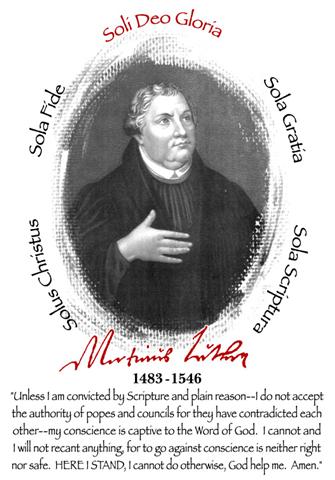 Southern Baptist pastor allowed me to give an oral presentation on Martin Luther at church. Not being a trained, or even talented, speaker, I desired a crutch, so I put together a Power Point slide show to illustrate my presentation. I thought it would also help me make it through my outline as well. I always hoped I’d be able to share it with you, but back when I did the show, I was even more green computer-wise than I am now, so I just recently figured out how to get one of those “My Public Box” thingies in my sidebar and uploaded it. If you’d like to listen, you are certainly invited.
Some of you Luther scholars out there may detect a less than accurate date or fact or two, but give me a break, I’m an amateur. I did what I could with what I had. So, without further ado, if you go over to the black box in the sidebar and click on the top selection, entitled “Reformation Sunday and Gideon Report” (that’s right those Gideons, remeber them?), then you can give it a listen. I know it’s not October or anything, but some of you may enjoy it, if you like mediocre speaking. You can also view the slide show below. . .
John Calvin’s Theology: The Rest of the Story
Those who disagree with the Calvinist view of election and reprobation,
 and object to “Calvinism,” per se, usually seem to not realize just how much more there is to Calvinism than his systematization of the Augustinian (i.e., from the 4th century) doctrine of grace versus the Pelagian notion of free will (which comes complete with its own false gospel of works-righteousness). Baptists in particular, who deny the “doctrines of grace,” don’t realize just how much leftover Calvinism there is in their current theology. Those that do, recognize that they are technically categorized as “moderate Calvinists.” Chief among these is what is nowadays called “eternal security.”
Also, there’s the doctrine of original sin, the Biblical doctrine that Adam’s guilt was imputed to all of his descendants, which sinful condition manifests itself in outward sinful acts. Most Baptists today affirm original sin, and they do so because the Baptists who migrated to America were originally Calvinists. Those “General Baptists,” whom modern anti-Calvinistic Baptists sometimes erroneously look back to as their forefathers in the faith, collectively fell away from the faith, and their theological descendants can be found today among modern Unitarianism.
As a proof for this claim, consider the following words from the Wikipedia entry on the General Baptists, to which I linked above: ” . . . traditionally non-creedal, many General Baptist congregations were becoming increasingly liberal in their doctrine, obliging the more orthodox and the more evangelical among them to reconsider their allegiance during this period of revival (Edward’s, Whitefield’s and Wesley’s 18th century First Great Awakening). Before this re-organisation, the English General Baptists had begun to decline numerically due to several factors linked to non-orthodox ‘Free Christianity’. Early Quaker converts were drawn from the General Baptists, and many other churches moved into Unitarianism. . . “
Those General Baptists denied original sin. For example, John Smyth, (first to pastor a church called “Baptist” shortly before he cast his lot with the Mennonites) wrote in his Confession of Faith in 1609 that, “there is no original sin (lit;, no sin of origin or descent), but all sin is actual and voluntary, viz., a word, a deed, or a design against the law of God; and therefore, infants are without sin.” Modern anti-Calvinistic Baptists generally (no pun intended) affirm original sin, and this is because the Baptists from which you descend were originally Calvinists.
Eternal security and original sin managed to stick around because they weren’t offensive enough to undermine the outward results of mass evangelism, the way the doctrines of grace seem to. We have “revivalism” to thank for that. Read Revival and Revivalism: The Making And Marring of American Evangelicalism, by Iain Murry of Banner of Truth Trust, and you’ll learn how the TULIP got plucked in the wake of the Second Great Awakening as otherwise orthodox Christians began to adopt the methods of arch-Pelagian Charles Finney’s “new measures” in order to maximize the effectiveness of their ginned-up revivals.
But enough introduction. What I wanted to point out was just how pervasive Calvinist theology defines modern Baptist and otherwise Evangelical theology. In my last post, I linked to an essay written by B. B. Warfield entitled “Calvin As A Theologian.” This essay was written to set the record straight about all the common misconceptions that have been fabricated by anti-Calvinists in order to not only disagree with the “five points of Calvinism” (aka, TULIP, the doctrines of grace, etc.) but make those under their spiritual care despise Calvin himself and just about everything he stood for. Read Warfield’s introductory remarks, and then go read the entire article:
I am afraid I shall have to ask you at the outset to disabuse your minds of a very common impression, namely, that Calvin’s chief characteristics as a theologian were on the one hand, audacity—perhaps I might even say effrontery—of speculation; and on the other hand, pitilessness of logical development, cold and heartless scholasticism. We have been told, for example, that he reasons on the attributes of God precisely as he would reason on the properties of a triangle. No misconception could be more gross. The speculative theologian of the Reformation was Zwingli, not Calvin. The scholastic theologian among the early Reformers was Peter Martyr, not Calvin. This was thoroughly understood by their contemporaries.
Among the things that we have inherited from Calvinist theology include the following (as Warfield reports):
-
“In one word, he [Calvin] was distinctly a Biblical theologian, or, let us say it frankly, by way of eminence the Biblical theologian of his age. Whither the Bible took him, thither he went; where scriptural declarations failed him, there he stopped short.”
-
“Calvin marked an epoch in the history of the doctrine of the Trinity, but of all great theologians who have occupied themselves with this soaring topic, none has been more determined than he not to lose himself in the intellectual subtleties to which it invites the inquiring mind; and he marked an epoch i the development of the doctrine precisely because his interest in it was vital (that means “spiritual,” or “devout”) and not merely or mainly speculative.”
-
“The fundamental interest of Calvin as a theologian lay, it is clear, in the region broadly designated soteriological. Perhaps we may go further and add that, within this broad field, his interest was most intense in the application to the sinful soul of the salvation wrought out by Christ, — in a word, in what is technically known as the ordo salutis. . . Its [Calvin’s Institutes]effect, at all events, has been to constitute Calvin pre-eminently the theologian of the Holy Spirit.”
-
“He also marks an epoch in the mode of presenting the work of Christ. The presentation of Christ’s work under the rubrics of the three-fold office of Prophet, Priest and King was introduced by him: and from him it was taken over by the entirety of Christendom, not always, it is true, in his spirit or with his completeness of development, but yet with large advantage.”
-
“In Christian ethics, too, his impulse proved epoch-making, and this great science was for a generation cultivated only by his followers.”
-
“It is probable, however, that Calvin’s greatest contribution to theological science lies in the rich development which he gives–and which he was the first to give–to the doctrine of the work of the Holy Spirit. “
-
Finally, here’s Warfield’s summary of Calvin as a theologian: “It has been common (among academic theologians, not pastors and laity who love to hate Calvin) to say that Calvin’s entire theological work may be summed up in this–that he emancipated the soul from the tyranny of human authority and delivered it from the uncertainties of human intermediation in religious things: that he brought the soul into the immediate presence of God and cast it for its spiritual health upon the free grace of God alone.”
-
And of Calvin’s masterpiece, The Institutes of the Christian Religion, Warfield summarizes: “The Institutes is, accordingly, just a treatise on the work of God the Holy Spirit in making God savingly known to sinful man, and bringing sinful man into holy communion with God.”
Far from being some cold, depressing, rigidly logical and academic murderer (we mustn’t forget Servetus!), Calvin was recognized by his peers and his entire generation as an eminently devout and spiritual biblicist whose development of Protestant theology built on the shoulders of Augustine, Anselm, Hus, Bradwardine, Wycliffe, and Luther and helped make Western Civilization what it became in its historical greatness. All by the grace of God, and for his glory alone!
Reformed Theology Coming to an SBC Church Near You!
On January 11, 2008, the Baptist Press posted a report by Michael Chute, entitled, 
-
“. . . ten percent of Southern Baptist pastors (currently) identify themselves as Calvinists.”
-
“. . . 29 percent of recent SBC seminary graduates espoused Calvinist doctrine.”
-
“. . . a minority of SBC churches are led by Calvinist-leaning pastors, but the number is increasing”
-
“. . . Calvinist-led churches are generally smaller in worship attendance and baptisms than non-Calvinist churches.”
-
“. . . baptism rates between Calvinist and non-Calvinist led churches are virtually identical.”
-
“. . . Calvinistic recent graduates report that they conduct personal evangelism at a slightly higher rate than their non-Calvinistic peers.”
-
A PDF file of the full report is posted here.
Also of interest in the report, Chute quoted Hal Poe, Charles Colson Professor of Faith and Culture at Union University in Jackson, Tennessee, who paints a picture for us of the recent historical trends within the SBC which have led to the current circumstances. “In a broad sense, it’s happening on Christian college campuses too, as Calvinism appeals to young people who are wanting a more intellectual approach to Christianity . . . . Southern Baptists neglected serious Christian education from the early 1960’s, and that’s when all the trouble started. From discipleship training we went to the amorphous youth groups, whose only real good was to keep kids happy until they graduated from high school and graduated from church. Now, you have a generation [of college students] who have come along and want something deeper and they have latched onto Calvinism.”
Poe goes on to site “John Piper, a Reformed Baptist theologian, preacher and author who currently serves as pastor for preaching and vision of Bethlehem Baptist Church in Minneapolis. . . . He’s effective because he’s so passionate. . . He holds huge, stadium-type events that are rip-roaring. There’s nobody else doing anything like this so he becomes [Calvinism’s] expositor. But John Piper’s version of Calvinism is not something John Calvin would espouse, or even that Charles Spurgeon [British reformed Baptist preacher] would espouse.”
It is true that Piper is cut from a different cloth from the great Reformer and the nineteenth-century Puritan “Prince of Preachers.” First of all, it must be noted that Piper is not a Southern Baptist, but a member of the Northern Baptist Convention (Bethlehem Baptist member and Reformed Baptist blogger, Bob Hayton, at Fundamentally Reformed, can correct me on that detail if I’m wrong), where he has been a leader in that denomination’s struggle with the modern heresy known as Open Theism. From my reading of his sermons, Piper may be categorized as a “charismatic Calvinist,” which is more of a doctrinal position than a weekly exhibition of extreme emotionalism in worship, or attempts at exercising the miraculous spiritual gifts of tongues, healing, prophecy, etc., images usually evoked by the term charismatic–though the appeal to emotion seems to be greater in his preaching than in typical Reformed preaching. His experiential emphasis on “desiring God” is in part an application of the answer to the first question in the Westminster Shorter Catechism, which states, “Man’s chief end is to glorify God and enjoy him forever.” But this seems to be little more than a perhaps pietistic reaction against the reputed cold-orthodoxy of many Reformed worship practices.
Another way Calvin would disagree with Piper is in his application of Baptistic principles to Reformed theology, of which, of course, Spurgeon is also guilty. But in this, Piper and Spurgeon are informed by the historic early Baptist confession of faith commonly known as the Second London Baptist Confession of Faith of 1689, which is in large part, a condensing of the Presbyterian Westminster Confession of Faith, with revisions on the statements regarding Baptism. On the other hand, Piper also is embracing the abberant postmodern “emerging” churches–at least the one’s that at least maintain Reformed theology, while seemingly applying seeker-sensitive pragmatic retooling of worship styles to appeal to an “emerging church” demographic. Thus, Piper’s twenty-first century expression of Calvinism does seem to differ from that of Calvin and Spurgeon; however, this Reformed blogger is grateful that such a figure has been able to influence so many Southern Baptists for the doctrines of grace, the biblical emphasis on the sovereignty of God, and his supremacy in all things, including the secular, sacred and even sinful activity of all men.
Joel Osteen: Love Thy Navel
You may or may not notice that I keep updated in my sidebar the
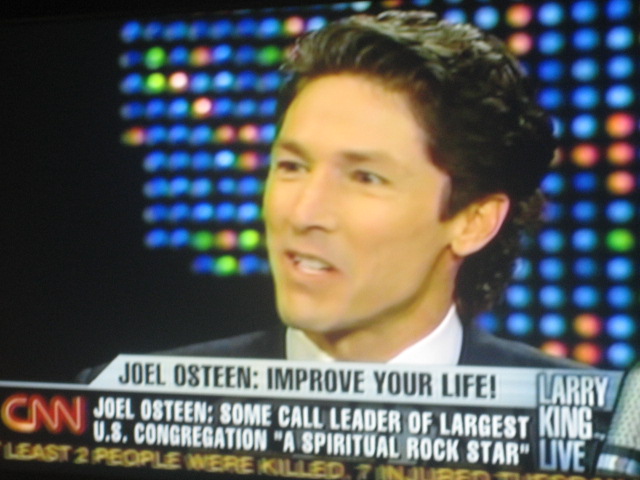


 of the White Horse Inn radio show. This week, I’m not satisfied to just update the sidebar, but I want to impress upon you that you really ought to listen to this week’s program on Joel Osteen, as he is examined as a case study in what Doctors Horton, Riddlebarger, Jones and Rosenblatt call “American Religion.” This is a topic and a problem that affects the way all of us approach our faith and our worship. This timely message needs to be heard and heeded. Don’t miss this week’s episode of the White Horse Inn, for the sake of your soul and the sake of your nation.
A Slow Holiday Season for the Historical Jesus
I just got home from the barber shop, where I perused the December 24 issue of U. S. News & World Report, which featured as its “holiday” cover story, not some new theory that threatens to change everything we’ve ever thought about Christianity, like we’ve been treated to for the last several years in a row, but an article on how Catholics,  Protestants and Jews are all alike seeing a return to ritual and liturgy among the younger generation which is so underwhelmed by the boomer generation’s attempts to relevantize (is that a word? I’ll look it up later.) their respective religious expressions. We evangelicals will certainly think instantly of the seeker-sensitive model of worship. This trend seems to be reflected in Bill Hybels’ recent change of heart about how his church has been weak on discipleship (or “self-feeding”); at least he’s publicly acknowledging a little self-critical reevaluation. Or is it just vying for some of the consumers to be had among the aforementioned younger generation that’s “seeking” more tradition-sensitive models of worship?
Here’s one interesting excerpt featuring the Evangelical version of this phenomenon:
Talk to Carl Anderson, the senior pastor of Trinity Fellowship Church, and you get an idea. “Seven or eight years ago, there was a sense of disconnectedness and loneliness in our church life,” he says. The entrepreneurial model adopted by so many evangelical churches, with its emphasis on seeker-friendly nontraditional services and programs, had been successful in helping Trinity build its congregation, Anderson explains. But it was less successful in holding on to church members and deepening their faith or their ties with fellow congregants. Searching for more rootedness, Anderson sought to reconnect with the historical church.
Connections. Not surprisingly, that move was threatening to church members who strongly identify with the Reformation and the Protestant rejection of Catholic practices, including most liturgy. But Anderson and others tried to emphasize the power of liturgy to direct worship toward God and “not be all about me,” he says. Anderson also stressed how liturgy “is about us—and not just this church but the connection with other Christians.” Adopting the weekly Eucharist, saying the Nicene Creed every two or three weeks, following the church calendar, Trinity reshaped its worship practices in ways that drove some congregants away. But Anderson remains committed, arguing that traditional practices will help evangelical churches grow beyond the dependence on “celebrity-status pastors.” (emphasis added)
Having looked over Trinity’s website, the only critique I have is in their fear of being divisive with a “detailed confession of faith,” favoring instead as their confession a combination of the Nicene Creed and the ankle-deep NAE Statement of Faith. A little too bare-bones for my taste, but the rest, I really like. But then, I’m part of that younger generation that isn’t into commercialized worship. Would that more “traditional” churches would seriously examine a more historical, liturgical worship that centers on the regulative principle of worship and actively encourages an appreciation of “the communion of saints,” our “connection” with the entire church in all times and places, as we worship God in the heavenly Jerusalem (Hebrews 12:22-24). Speaking of which, the current episode of The White Horse Inn which is featured in my sidebar, deals with this very kind of topic. I highly recommend your listening to it. It will expand your understanding of what’s going on spiritually in Sunday morning worship, and help you have an idea of where I’m coming from on all of this stuff.
Be that as it may, I was relieved that it so far seems to be a slow holiday season for debunkers of the historically orthodox understanding of Christianity in general, and Jesus in particular. As I was flipping through the pages of the magazine, the only thing of that kind of “historical Jesus” hand-wringing was a timely recycling of all the recent junk that had been polluting our airwaves for the past few years.
Hybels Still Mistaken
 The Christianity Today Blog, Out of Ur, posted on Willow Creek Pastor Bill Hybels’ recent remarks that his seeker-sensitive research led them to make a “mistake.”
Here’s Hybels’ newsmaking confession:
We made a mistake. What we should have done when people crossed the line of faith and become Christians, we should have started telling people and teaching people that they have to take responsibility to become ‘self feeders.’ We should have gotten people, taught people, how to read their bible between service, how to do the spiritual practices much more aggressively on their own.
Can you see why I say Hybels is still mistaken? The answer to seeker-sensitive Christian consumerism isn’t “self-feeding.” I hear that this has already been the common advice given to attendees of the seeker-sensitive megachurches in my community. What many tell their consumers is that since we’re not going to talk a lot of doctrine from the stage (I can’t say, “from the pulpit”), you need to make sure you study on your own or among yourselves in your small groups. The star (aka, the pastor) is here to inspire us with motivational principles for living and entertain us with humorous autobiographical stories and illustration upon illustration, sandwiched between P&W sessions with the amps turned up to “11.”
Yes, I submit that Bill Hybels’ mea culpa is an example of a blind leader falling into a ditch. Up on the narrow road, were God to graciously grant him reformation, lies a neglected Bible, preached from a neglected pulpit, signified and sealed by neglected sacraments. The answer to seeker-sensitive demographic polling is what the Reformed call, “The Ministry of Word and Sacrament.”
Allow me to give you an idea of what I mean by introducing to you something I wrote several years ago as I was wrestling with this concept. It’s called “The Worshipers’ Creed and Prayer.”
We believe that sinners are justified by grace alone through faith alone
by means of the proclamation of Christ’s death for our sins
and his resurrection because of our justification (Romans 4:25),
signified and sealed to us in our baptism.
Likewise, we believe saints are sanctified by grace alone through faith alone
by means of the proclamation of Christ’s death for our sins
and resurrection unto our sanctification (Romans 6:4),
signified and sealed to us in the corporate observance of the Lord’s Supper.
Therefore, we believe the gospel is the agent of spiritual birth
by which the sinner comes to faith,
and also the agent of spiritual growth
by which his faith is nourished and strengthened.
So may we confess our sin in response to the application of the Law of God;
likewise may the gospel of Christ be thus proclaimed,
signified and sealed to us for our justification
and our sanctification until our glorification;
And so may we, out of gratitude for our justification,
and in hope of the glory of God,
glorify and praise our Savior,
as we gather for worship this Lord’s Day,
being afterward mindful to love one another, and our neighbor,
in the name of him who died for our sins,
that we might live in the power of his resurrection.
AMEN.
Since you’ll probably need further clarification, you may like to consult Part III of the PCA’s Book of Church Order, entitled, “The Directory for the Worship of God” (beginning on page 143 of the PDF file).
Sean Michael Lucas’ Reformation Sunday Sermon Posted!

Go to the “Sermons” page at the website for New St. Peter’s Presbyterian Church to listen to Dr. Sean Michael Lucas, professor of Church History at Covenant Theological Seminary, preach on “The Heart of the Reformation: The Glory of God,” from the text Isaiah 6: 1-7.
Is Reformed Important? Saturday Night Outline
At long last, now that the Sean Michael Lucas conference is a week’s worth of history, here’s the outline he allowed me to publish from his presentation.
Why bother being Reformed as a way of being Christian?
- It is not possible to live a “generic” Christian life
- Historically not possible
- Logically not possible
- The Christian life must be embodied through a particular identity
- Even “Bible churches” communicate a particular identity (beliefs, practices, stories)
- Genuine conversations with others must be rooted in a real sense of knowing who we are.
During this portion of the outline, Dr. Lucas gave the example of the Cane Ridge Revival, explaining how Barton Stone desired to reduce his denominational identity to “Christian.” Out of this revival emerged the Christian denomination (Disciples of Christ), Cumberland Presbyterianism, and others I forgot before I could jot them down. Now back to the outline . . .
- The question becomes, then,
- Which beliefs and practices are most biblical?
- And which communion most closely holds to those beliefs and engages in those practices?
- In the end, the reason it is important to be Reformed (and specifically, Presbyterian) is
- Because Presbyterian beliefs and practices are the closest to the biblical material, and,
- Because they provide the most workable identity for engaging life in this postmodern world.
Presbyterian beliefs
- God is King (the sovereignty of God)
- The Priority of Grace (in salvation, sanctification, consummation)
- God’s story, promises, and reign (covenant and kingdom)
- The nature of the Church (visible/invisible)
- The nature of the sacraments (baptism and Supper)
Presbyterian practices
- Piety
- Centering on worship [corporate, family, and private], stewardship, and service
- Worship
- Centering on its biblical, covenantal, and gospel-driven nature
- Polity
- Centering on a proper balance of church authority and liberty of conscience
Presbyterian stories
- These beliefs and practices make sense to us, in part, because of the stories (positive and negative) that we tell:
- Calvin, Knox and the Westminster divines
- Scots and Scots-Irish Presbyterianism
- Early American Presbyterianism
- 19th Century Presbyterianism
- 20th Century Presbyterianism
- North (PCUSA, OPC, BP, EP, RPCES)
- South (PCUS, PCA)
- Identity
- It is out of this particularly Presbyterian way of speaking the Gospel that we must speak.
- Catholicity
- In order to confess “one holy catholic church,” we must desire relationship and even partnership with other Christians.
- Our relationships with other Christians must be guided by the Gospel and must serve the Gospel.
- Humility
- The most productive partnerships come from recognizing the importance of others in imaging forth the Kingdom of God (Romans 1:11-12).
Check back periodically . . . I’ll post Dr. Lucas’ Reformation Sunday Sermon link when the church posts it.
Is Reformed Important? Friday Night Outline
Dr. Sean Michael Lucas
New St. Peters PC, Dallas, TX
October 26-27, 2007
Who Are You?: Understanding Identity
When you think about who you are, what comes to mind?
- Son, upper middle class, suburbs, two parents married 38 years, one sister
- Moved many times, mainly up an ddown the I-95 corridor between Washingong DC, and NYC.
- Husband, married nearly 14 years, four children
- Became a believer when a teenager–unusual religious journey
- Pastor with scholarly bent; historian with a pastor heart
- Writer and reader–love Mark Twain and Wendell Barry
- Gardner
- Avid sports fan–Indiana sports teams
- Springsteen, U2, country music
- Trucks, Fords, but when I follow NAsCAR, I am a Gordon fan.
Three Key Aspects to identify.
Belierfs
- the core understandings that form and motivate what and how I practice; they are also reinforced by these practices and by my stories.
Practice
- The regular activities that I engage in shape my understanding of myself and the world.
Stories
- narratives that help to make sense of what I believe and what I do.
“Identity Crisis”
- When someone is having an “identity crisis,” he/she has become disillusioned or is experiencing dissonance within her core.
- Perhaps produced through a lengthy questionaing of previously held beliefs.
- Perhaps caused through an interruption of key practices that reinforced identity.
- Perhaps result of a disillusionment with the master story
- A version of this identity crisis would be the “mid-life crisis.”
Identity Formation in “Modernity” and “Post-Modernity”
Pre- and Early Modernity
- Social relations and family connections
- Trade generally passed on through generatons.
- Church connections more by birth than over belief.
- Identity fairly stric==pre-determined by others and before birth.
Late and Post-Modernity
- Social mobility, loss of extended and nuclear family.
- Trades determined through interest,
- Church connections determined by belief less than birt; challenge to lay on any type of denominationalism
- Identity radically dynamic-self-created through choices
Forging Christian identity
The transition from “non-religious” [non-Christian] to “religious” (Christian] identity.
- New Beliefs–from Idolatry to faith in Father, Sond, Spirit (1 Thessalonians 1:9)
- New Practices–from non-observent to observant (Ephesians 4:17-24)
- New Stories—from “self-determined” to divinely determined within the story of Israel and the Church as found in the Bible.
- The forging of Christian Identity is varied and common
- Varied:
- No two transitions are exactly the same
- No two experiences of sin, grace, faith, repentance are exactly the same
- Common:
- The need experience by all human beings is the same
- The Gospel embraced by all believers is the same
- The grace granted to believers is the same
- Varied:
- The means for forging Christian identity (Acts 2:42-47)
- Word
- Sacraments
- Prayer
- Fellowship
Tomorrow, I’ll post Saturday night’s outline.
Is Reformed Important?
 A friend of mine (actually, my old boss), is a member of New St. Peter’s (NsP)
  Presbyterian Church in Dallas, Texas. Over this past “Reformation Weekend,” as I call it, NsP hosted a conference by Dr. Sean Michael Lucas of Covenant Theological Seminary in St. Louis, Missouri. The topic of the conference, “Is Reformed Important?” was a Power Point presentation summarizing the material from Dr. Lucas’ book, On Being Presbyterian, which I have not read. I found the conference very interesting, for his approach does not start with a defense of all of the Reformed and Presbyterian controversial, distinctive doctrines. The approach Dr. Lucas took was to deal with what it means to be Presbyterian as a facet of one’s personal identity. In this I think he’s attempting to appeal to, or at least converse with a postmodern worldview, which seems, by and large, skeptical of evangelical theologizing.
The sum of the conference was that a person’s identity is the result of one’s beliefs, practices and stories (bps), which colors his perspective on life, the universe and everything (to borrow from the British theologian, Douglas Adams). Therefore, the basic outline of “Is Reformed Important?” is a look at the beliefs, practices and stories of confessional, Reformed Presbyterianism in particular, rather than merely Reformed in general.One benefit of the format of the two day conference, followed by a Reformation Sunday sermon at NsP (which I did not attend, but the link to which I’ll post if and when it becomes available) lies in the fact that the first night really helps a non-Reformed, non-Presbyterian (like my beloved wife) not have to immediately endure all the stuff he disagrees with, but gently points out that one’s beliefs andpractices are worth taking a critical look at. Dr. Lucas did this by sharing much of his own bps in a rather disarming manner. This is definitely user-friendly material, not fodder for theology geeks, but down-to-earth and practical stuff.
At one point during the second lecture, Dr. Lucas brought up the prospect of what he’d do were he to notice that someone had published a book with the same title as his, On Being Presbyterian, yet noticed that the table of contents seems an awful lot like the one in his own work, and not only that, but that the other author happens to mention that he comes from the same hometown as Dr. Lucas. He said the first thing he’d probably do is punch the guy in the nose. This compelled me to approach him after the lecture to request permission to post his outline on my blog, which permission, Christian man that he is, he graciously granted. Thus, in my next post, I’ll give you Lecture Number One of “Is Reformed Important?”
Hope you all had a pleasant Reformation Sunday!
Reformata Semper Reformanda (”Reformed, Always Reforming”)
update
I just took a look at http://www.newstpeters.org/ and noticed that they give their members something called “Rooster Tracks” which provides short, weekday theological and devotional items to think through and/or study. The one for this week, naturally, introduces us to the Reformers and asks its readers to think through a topic related to the contribution of each individual Reformer which is treated, namely, Luther, Melancthon, Zwingli, Calvin, and Knox.
The Delusion of Extreme KJV Onlyism

In this simple paragraph from the Massachusetts General School Law of 1647, aka “The Old Deluder Satan Law”
Yt being one cheife piect of ye ould deluder, Satan, to keepe men from the knowledge of ye Scriptures, as in formr times by keeping ym in an unknowne tongue, so in these lattr times by pswading from ye use of tongues, yt so at least ye true sense & meaning of ye originall might be clouded by false glosses of saint seeming deceivers, yt learning may not be buried in ye grave of or fathrs in ye church & comonwealth, the Lord assisting or endeavors,—
lt is therefore ordred yt evry towneship in this jurisdiction, aftr ye Lord hath increased ym to ye number of 50 householdrs, shall then forthwth appoint one wthin their towne to teach all such children as shall resort to him to write & reade, whose wages whall be paid eithr by ye parents or mastrs of such children, or by ye inhabitants in genrall, by way of supply, as ye maior pt of those yt ordr ye prudentials of ye towne shall appoint; pvided, those yt send their children be not oppressed by paying much more ytn they can have tm taught for in othr townes; & it is furthr ordered, yt where any towne shall increase to ye numbr of 100 families or househouldrs, they shall set up a gramer schoole, ye mr thereof being able to instruct youth so farr as they may be fited for ye university, pvided, yt if any towne neglect ye pformance hereof above one yeare, yt every such towne shall pay 5 Ito ye next schoole till they shall pforme this order.
Now, let me revise the above highlighted clause in order to make it easier to read.
“. . . so in these latter times by persuading from the use of tongues, that so at least the true sense and meaning of the original [Old Testament Hebrew & New Testament Greek, that is] might be clouded by false glosses of saint-seeming deceivers . . . ”
What is the moral of this story? If you simply prefer the use of the King James Version of the Holy Scriptures for your own personal study and devotional reading, or even if you believe after a considerate examination of the issues of textual criticism, that it is best to retain the Byzantine readings of the New Testament, and therefore ought to not revise the King James Version with a modern, eclectic, critical Greek text, this post does not criticize your view (even though I certainly disagree with your view). But if you believe that the King James Version of the Bible was given by the special inspiration of God, and that it’s English text is superior to the lost original Hebrew and Greek manuscripts for the simple reason that we can hold the KJV in our hands, while we cannot hold the original manuscripts in our hands, and that therefore, we need not bother burdening our congregations with recourse to the original languages to properly interpret the words of the KJV, the Massachusetts General School Law of 1647 identifies those who would undermine the need to understand the Word of God in the original languages as “saint-seeming deceivers” whose efforts would in effect, bury learning in the graves of our fathers in the church. If only you would see the error of your ways, and stop deceiving unlearned believers under your care that it’s dangerous to “correct the King James” with anything, even the sense of the original Hebrew and Greek languages.


 The Misadventures of Captain Headknowledge