Full Confidence Conference Photo Gallery
The folks at the Full Confidence Conference didn’t know they had a representative from the shallow end of the Refomred blogosphere covering them until I stuck my camera in their faces. When the audio of the messages are made available, I’ll provide summaries and links, but for now, here are a few photos of some of the folks involved:
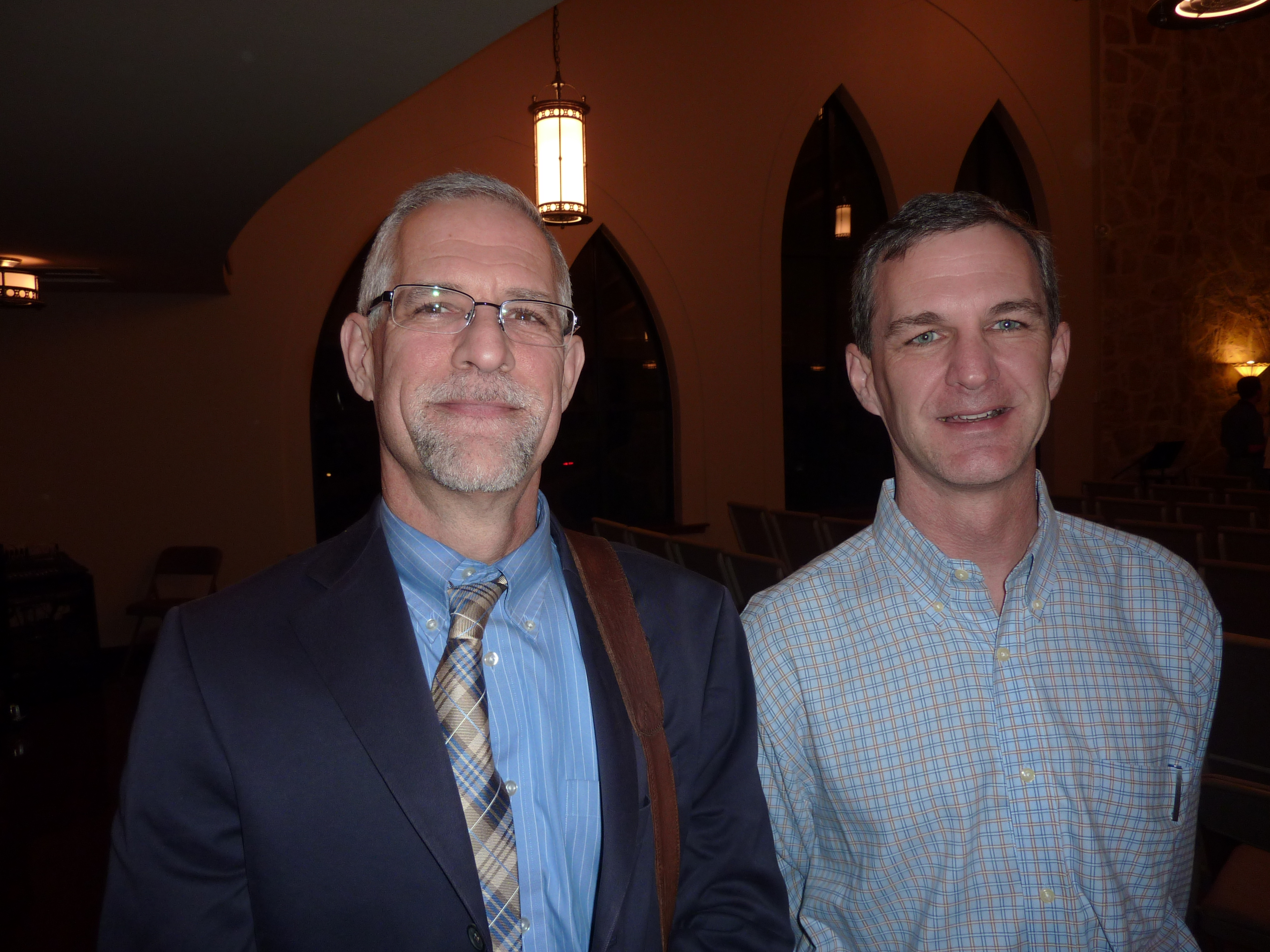
Dr. K. Scott Oliphint (left), with brother Pastor Kyle (right).
Here’s a blooper I just can’t resist sharing with you. Here are Pastor Kyle Oliphint and Dr. David Garner losing focus and starting to chat and look around just as I snap their picture…Hey Kyle! I’m over here! 🙂

Kyle (right) with Conference organizer, Dr. David Garner.
Next is a look at the “emerging” Westminster generation–Jonathan Brack with Dean of Admissions and son of Dr. K. Scott Oliphint, Jared Oliphint. I hope they enjoyed their little family reunion.
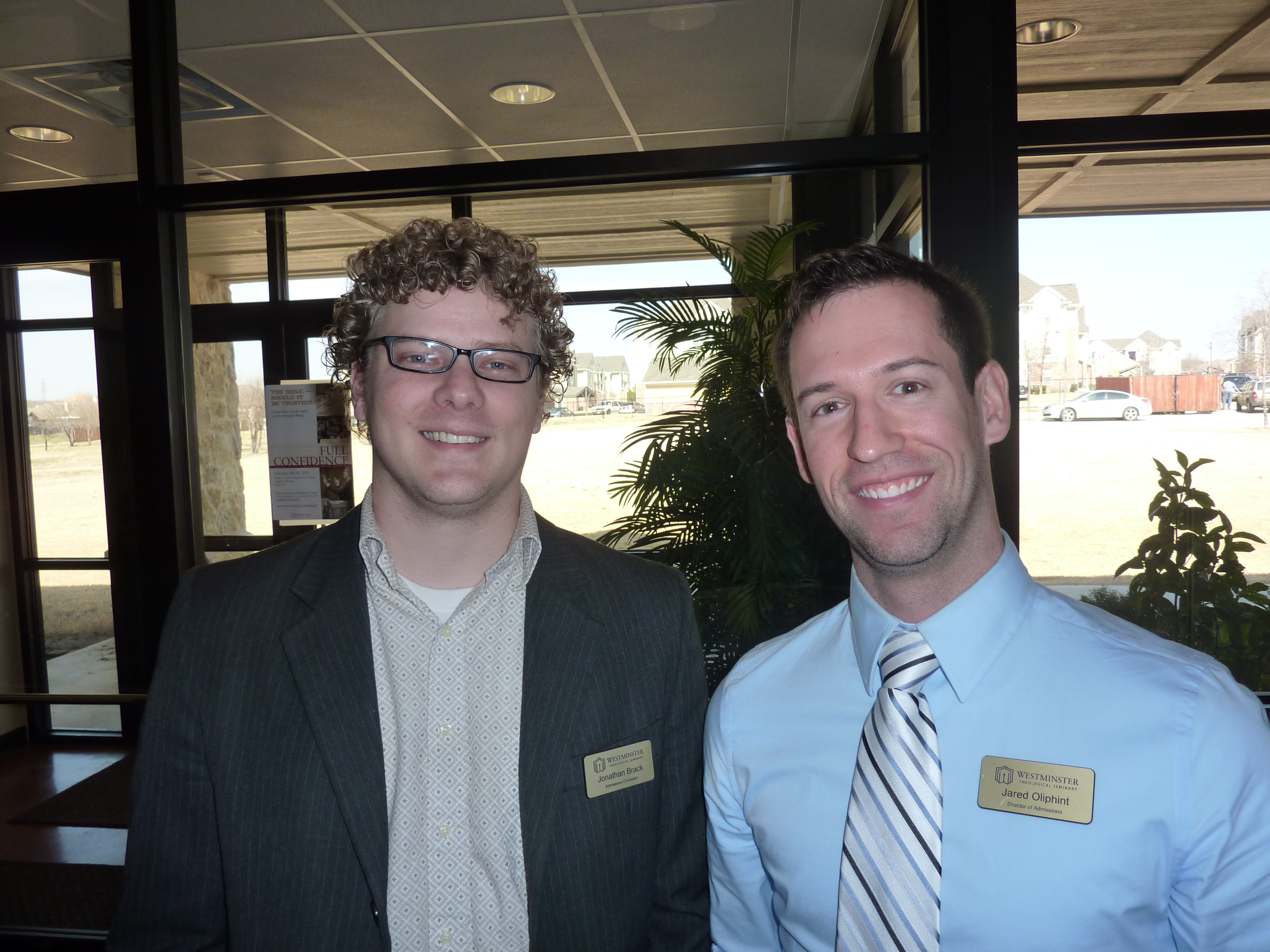
Jonathan Brack (left) with Jared Oliphint (right)
And finally, I took the opportunity to get a snapshot with one of my heroes of the faith, a man who successfully lead his family out of fundamentalism and into the Reformed faith intact, Dr. Thomas R. Browning (Hey, Bob Hayton! Here’s a real, live “Fundamentalist Reformer” for you!). He is the Assistant Pastor of Grace Community Presbyterian Church, and can be found teaching the adult Bible study in the sanctuary most Sunday mornings. In many ways, I am indirectly a product of his influence, in that he taught the guys who, after years of on-again, off-again considering of the doctrines of grace, lovingly latched onto my ankle (like the Calvinist bulldogs they are) and didn’t let up until I said “Uncle!” Every time I think of this guy, I recall the touching tribute once spoken by his son, Gage (a former co-worker): “My dad is my favorite preacher.” Learn more about Dr. Browning and his ministry of preaching and teaching here and here.

John Chitty (left) with Dr. Thomas R. Browning (right)
The Words of Life
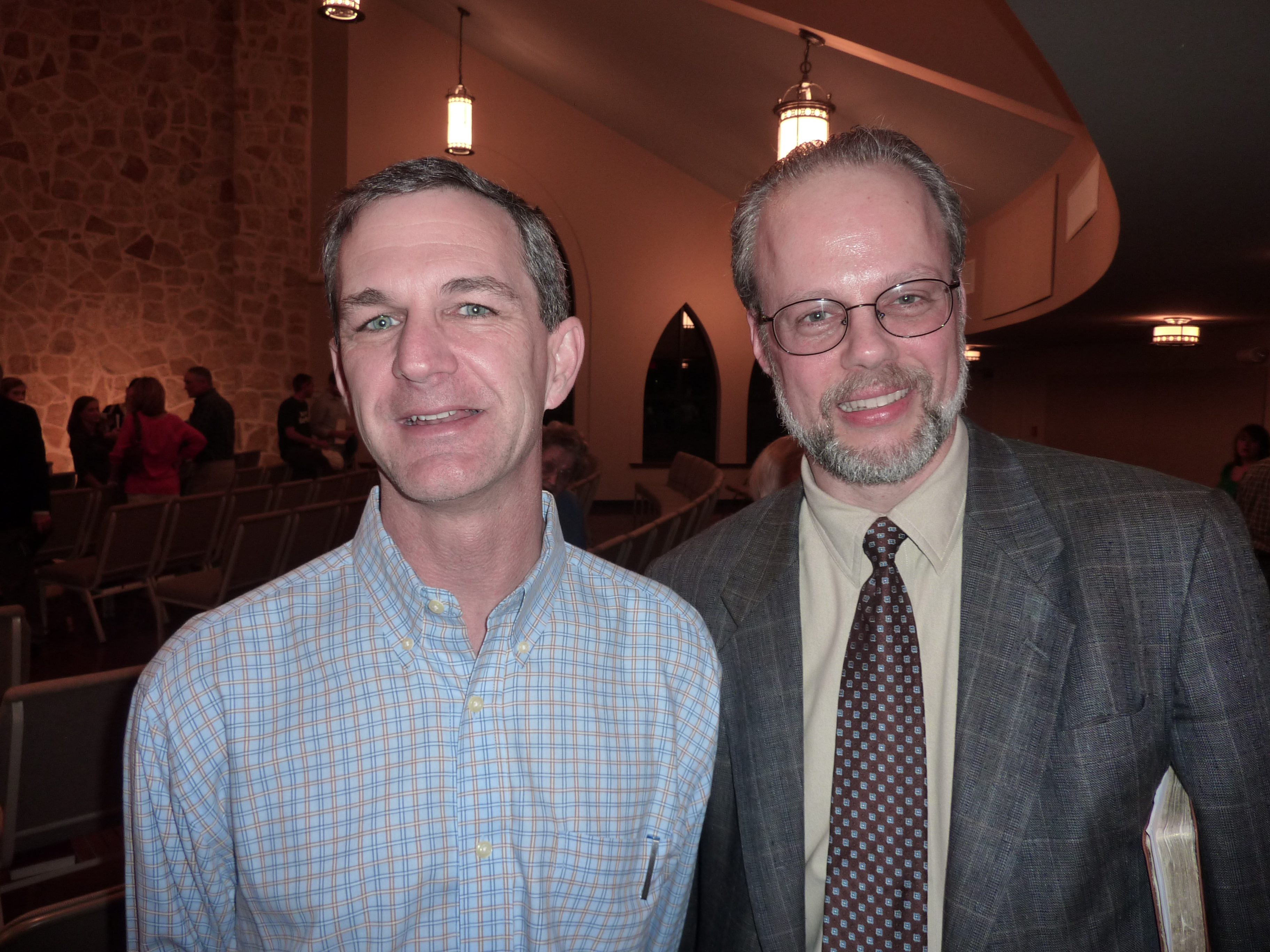
GCPC Pastor Kyle Oliphint (left) with Dr. David Garner (right)
Thought I’d tease you with a Luther quote given by Dr. David Garner in his message, “The Gospel From Above,” last night at the Full Confidence Conference at Grace Community Presbyterian Church in Ft. Worth, Texas. The highlighted portion is the portion to which Dr. Garner made reference, the rest shows a little context of what Luther was discussing:
“The neglect of Scripture, even by spiritual leaders, is one of the greatest evils in the world. Everything else, arts or literature, is pursued and practiced day and night, and there is no end of labor and effort; but Holy Scripture is neglected as though there were no need of it. Those who condescend to read it want to absorb everything at once. There has never been an art or a book on earth that everyone has so quickly mastered as the Holy Scriptures. But its words are not, as some think, mere literature (Lesewort); they are words of life (Lebewort), intended not for speculation and fancy but for life and action. By why complain? No one pays any attention to our lament. May Christ our Lord help us by His Spirit to love and honor His holy Word with all our heart. Amen.” (LW 14:46)
More to come next week…
A Review of Dr. John Fesko’s Lecture on Word, Water and Spirit, part 1
 On Friday, January 21st, 2011, Dr. John Fesko, Academic Dean and Associate Professor of Systematic Theology at Westminster Seminary California, was the featured speaker at Christ Reformed Church in Anaheim, California, pastored by Dr. Kim Riddlebarger. He was invited to speak on his comprehensive new book, Word, Water and Spirit: A Reformed Perspective on Baptism (© 2010 by J. V. Fesko, published by Reformation Heritage Books). The link to Dr. Fesko’s lecture may be downloaded from this post at the Riddleblog. First, Dr. Fesko describes the background to his book, then he summarizes respectively the history of the doctrine of infant baptism (paedobaptim–Part I of his book), the Biblical-Theological Survey of the Doctrine (Part II), and finally he briefly describes Part III: Systematic-Theological Construction of the Doctrine. This first in a series of posts will review Dr. Fesko’s discussion of the background to his writing of the book.
The background, we learn, is ultimately connected to his upbringing. As an infant, Dr. Fesko was baptized in the mainline denomination of the Presbyterian Church (USA). His parents apparently held nominal ties to this Reformed heritage, and the Fesko family wound up attending a number of churches over the years, landing among the Baptists in the end. While in college, Dr. Fesko listened to R. C. Sproul tapes on his Walkman, which lead him to realize that he was more Reformed than he was Baptist, and so he resolved to examine the outstanding Reformed doctrines he’d yet to deal with to be sure they were true–issues like infant baptism, so that, were he to minister in a Reformed church one day, he would not have to “hold his breath” as he administered the sacrament.
After seminary, while attending the University of Aberdeen in Scotland, Dr. Fesko read a book by Paul Jewett which he says is called, A Case Against Infant Baptism, which inadvertently impressed upon him the indispensability of covenant theology and laid the groundwork to his finally embracing paedobaptism. In searching the web for this title, however, I was unsuccessful in tracking it down, but found instead a book by the same author called Infant Baptism and the Covenant of Grace: An Appraisal of the Argument That As Infants Were Once Circumcised, So They Should Now Be Baptized, which apparently argues for the practice. Unfortunately, Dr. Fesko has a little trouble with recall on this and another title below, but, we can afford to forgive him this minor oversight. I share a marginally similar experience to the one Dr. Fesko describes, in my own examination of the issues related to the biblical doctrine of baptism. Over the past several years since my transition to theologically Reformed convictions, including the truth of infant baptism, I would periodically revisit the case for the Baptist view of believer’s baptism (credobaptism). Each time, after re-exposing my newfound paedobaptistic persuasion to the critique of the Baptist doctrine, I would come away with new reasons to believe that Scripture in fact does command and exemplify infant baptism, although not in a manner that satisfies the Baptistic hermeneutic (method of interpretation) which emphasizes as central the differences between the Mosaic Covenant and the New Covenant, rather than their points of continuity.
The Reformed covenantal hermeneutic emphasizes how the nature, promises and signs of the Covenant of Grace outweigh the various administrative changes between the Mosaic and New Covenants. Big-picture issues like these bring into sharper relief the seemingly unclear Biblical testimony to infant baptism. In other words, with all due respect to my Baptist friends, when it comes to the Mosaic and New Covenant administrations of the overarching Covenant of Grace, they seem unable to see the whole covenantal forest for the New Covenant trees.
The second element in the background to Dr. Fesko’s writing of Word, Water and Spirit comes from his ministerial environment in the South. He says, “if you cannot throw a rock in the Bible without hitting a covenant, in the South, you cannot throw a rock without hitting a Baptist church.” Many Baptists, who, in the providence of God, come to embrace Reformed theology and appreciate so much about the doctrine and practice of a Reformed Presbyterian church will hold out on the Reformed practice of infant baptism. In his ministry to such believers in his congregation, Dr. Fesko tried to provide comprehensive evidence to help his converted Baptist congregants understand and believe in infant baptism, and the degree to which he would prepare such material for their benefit also facilitated his desire to publish on the subject of the Biblical and historical case for infant baptism.
Dr. Fesko was also interested in making sure his congregants understood the Biblical doctrine of baptism as a whole, not just the aspect of it that related to its administration to the infant children of believers. He observes that there is a troubling trend toward church growth by downplaying more objectionable doctrines, like paedobaptism. He desired not only to help people understand infant baptism, he wants them to understand what a sacrament is, what Biblical covenants are, and even the true nature of God’s grace itself. Many struggle to understand what grace is. I, too, struggled to understand the classical definition of grace as “unmerited favor” until I was introduced to the Reformed doctrines of grace. Once I came to grips with the fact that a sinner is unwilling to believe because as one who is dead in sin, he cannot (“Total Depravity”); that God’s election of him is not conditioned on God’s foreknowing or foreseeing that he would receive Christ (“Sovereign Election”); that the atonement of Christ for the elect in particular is properly understood in terms of his mercy, rather than his resentfully seeing such an act as inherently unjust of God’s part (“Particular Redemption”); that when the Holy Spirit enables a sinner who was dead in sin to believe and to willingly embrace Christ as his own crucified and risen Lord (“Effectual Calling”); and that God will not only prevent me from “losing my salvation,” but will graciously preserve me in such a way that I will, by his grace, persevere in my faith in him (“Perseverance of the Saints”–for more biblical testimony on these doctrines of grace, see the link in my Featured Sites widget in the sidebar), then and only then did it make sense to me how it is that grace is God’s favor for me which I in no way earned. It is in this way that God’s grace is truly unmerited favor. Just as Reformed theology helps one truly understand the nature of grace, so does Reformed covenant theology as a whole help the believer understand the Bible’s full teaching on the significance, proper candidates and proper attitude toward the mode of baptism.
God’s progressive revelation of his redemption of the elect in Christ was something Dr. Fesko often found insufficiently treated in the typical book or essay promoting the Reformed doctrine of baptism. Why is redemptive history important in relation to baptism? It helps us to better understand the nature of circumcision and baptism, the connection between the two, and why the sign of the Covenant of Grace is changed from the former to the latter with the transition from the Mosaic to the New Covenant at the first advent of Christ. Dr. Fesko finds that Reformed presentations of infant baptism often focus more on the New Testament in defense of infant baptism, and not quite enough on the Old Testament revelation of the subject. He would remind his readers that as important as the New Testament witness to infant baptism is, Christians ought not to build their doctrines on only half of the Bible, but on the entirety of the Scriptures. Too many do not realize that indeed the doctrine of baptism is, in fact, found in the Old Testament. Pierre Marcel’s book, Baptism and the Covenant of Grace (actually, Marcel wrote Biblical Doctrine of Infant Baptism), which was possibly re-titled Infant Baptism (again, we’re apparently relying on Dr. Fesko’s memory), writes, for example, that for Karl Barth, the Old Testament matters little when it comes to most doctrines, with the possible exception of the doctrine of the atonement.
Dr. Fesko finds that theological journals provide perhaps some of the most helpful information on any doctrinal question, baptism among them. He therefore desired the readers of Word, Water and Spirit, who ordinarily have no access to such information, to benefit from such journals and show them where they can go to learn more on the subject of baptism. This was another compelling reason for him to write the book.
In the next post, we’ll follow Dr. Fesko’s summary of the historical-theological section of the book, which makes up roughly half of its contents.
Christianity and Liberalism Revisited
 This past weekend, Westminster Seminary California’s (WSC) annual conference was held. It was called, “Christianity and Liberalism Revisited,” referring to the title of a book by the founder of Westminster Theological Seminary in Philadelphia, PA, and “the principal figure in the founding” of the Orthodox Presbyterian Church (OPC) in 1936, which in 2011 is celebrating its 75th anniversary. This conference is WSC contribution toward that celebration.
The conference was webcast live on Ustream and the videos are still posted there for your viewing pleasure, and audio is posted at the WSC Resource Center, but I’ll link to them below for your convenience.
- Christianity and Liberalism Today “Michael Horton shows the prophetic insight of Machen’s most famous book in Christianity today.”
- The Perennial (Problem with) Machen “Daryl Hart critiques evangelicals’ use of Machen today.”
- Machen and the Bible “Joel Kim explains the relevance of Machen’s view of the inspiration and authority of the Bible.”
- Machen and the Gospel “J. V. Fesko gives a summary of Machen’s view of the gospel and its relevance today.”
- Machen and Ethics “David VanDrunen explains how Liberalism, in its day, was fundamentally dishonest.”
- Machen, Christianity and the Church “W. Robert Godfrey explains how the church is the mission of God to carry his doctrines to the ends of the earth.”
- Question and Answer Session “The question and answer session from the 2011 Conference ‘Christianity and Liberalism Revisited’”
Bonus! If you’d like to know more about J. Gresham Machen and the Orthodox Presbyterian Church (a local congregation of which denomination my family is currently attending, Mid-Cities OPC), then start with conference speaker Daryl Hart’s page at the OPC website, called, “Machen and the OPC.”
Also, the Rev. Jason Stellman has posted a thought-provoking reflection on Hart’s lecture at his blog Creed, Code, Cult, called, “Catholicity and Liberalism.”
Listen To This…
Here are the programs I’ve been following this week. If you’ve got the time, it would benefit you to check some of them out:
- “Machen’s Warrior Children” on Christ the Center
- “Gospel-Focused” on White Horse Inn
- January 11 Episode of Dividing Line
- “The Legacy of the King James Bible” on ReformedCast
Meet Dr. Liam Goligher
Tenth Presbyterian Church is truly one of the flagship churches of the Reformed tradition in America. Two especially prominent ministers have pastored it, namely, Donald Grey Barnhouse, more recently James Montgomery Boice and finally, Dr. Philip Ryken, who has recently moved to the presidency of Wheaton College. If you’ve never heard any of these men preach, you have missed a great blessing.
Justin Taylor blogged on the announcement of the new candidate to follow in these great preachers’ footsteps, Glasgow, Scotland native, Dr. William “Liam” Goligher. You can read his post here, and the announcement published by the Pastoral Selection Committee of Tenth Presbyterian may be found at the following link here.
Christianity and Liberalism Revisited
Here’s a conference I wish I could attend. Believe it or not, I first discovered J. Gresham Machen’s book Christianity and Liberalism in a catalog for Peter Ruckman’s bookstore in the mid-nineties (see also here and here), but I only read it about two years ago. Growing up I was conscious of my fundamentalist pastor talking about “modernism,” but only had a very vague notion of what that might be. So vague, in fact, I couldn’t then, nor could I now define with any certainty just how much I understood about it then.
It is so important that Christians understand that the most basic and foundational thing about Christianity is not how you live, it is what you believe. This is not a denial of the importance of how you live, just a denial that it is what makes you a Christian. Actually, how you live is the product or fruit of what you believe. If you live the cleanest life in the most loving and charitable way, yet deny the deity of Christ, the trinitarian nature of God, or the virgin birth of Christ, etc., then you are not a Christian. This is what liberalism is, although it is so much more at the same time. It exalts the necessity of works over the necessity of orthodox doctrine. That’s why Machen said liberalism is not another form of Christianity, it is an entirely different religion.
Memoir of the Rev. John Brown, part 5

Lithograph of the Reverend John Brown of Haddington
In his employment as a shepherd–a calling so much ennobled in the patriarchal age, and so universally celebrated both in the ancient and modern pastoral–he enjoyed more leisure, and better opportunities, for prosecuting his favourite studies, than could have fallen to his share in almost any other business; nor did he neglect to improve such promising circumstances. In a very short time he left far behind him many who had the advantage of every thing calculated to quicken their progress,–proper books, leisure to study them, and the best masters for their instructors. Left to his own resources, however, he acquired the knowledge of the Latin, Greek, and Hebrew languages, with a rapidity that attraced the attention of the neighbourhood, and became the general topic of conversation. But while this procured him many friends, it at the same time hurt the pride, and excited the malice, of some of his outstripped rivals in the race of literary fame. It was, accordingly, whispered, that the progress he was making in his studies, in the absence of all instruction, bearing no proportion to the powers of the human mind, could only be accounted for by supposing that his unaccountable progress was effected by the agency of the devil; who, with a similar temptation, had seduced the mother of mankind, and has, in all ages, taken the advantage of the studious and scholastic habits of individuals to entangle them in his snares.–“Report ye, and we will report: come, let us smite him with the tongue.” Notwithstanding that this malevolent slander had absurdity deeply imprinted on its forehead, it was eagerly laid hold of by the ignorant and credulous, and so widely circulated, that the innocent victim felt it extremely distressing, and more especially since even Mr. Moncrieff appeared, for a season, to be influenced by it, and withdrew his countenance from him–a thing which, he afterwards admitted, was very cruel and unkind. For although the charge of diabolical intercourse was no longer admissible in the criminal courts of the country, yet the superstitious notions and prejudices handed down from the dark ages of popery were, at that period, so far from being eradicated from the minds of the people, especially in sequestered corners of the country, that such surmises were still capable of ruining a man’s peace, and inflicting a serious wound on a mind of even the most ordinary feeling. To one so ardent in the prosecution of knowledge, and so anxious to attain the qualifications necessary for a minister of the gospel, it must have been no common affliction to have all his pleasing anticipations thus cruelly blighted in a moment; for, as he apprehended, the immediate tendency of this foul reproach was to blast his religious character, and counteract his whole purpose, by shutting against him the door of the divinity hall. On those who were best acquainted with him (the members of a praying society with which he was connected,) the slander had no impression; they continued his steady friends, and their attachment seemed to strengthen in proportion to the anguish he suffered from such an unmerited calumny. In the narrative already quoted we find him speaking thus: “The reproach was exceedingly distressing to me; however, God was gracious, for I enjoyed remarkable mixture of mercy and affliction. At the beginning of the trial these words, ‘The Lord will command his loving-kindness in the day-time, and in the night his song shall be with me, and my prayer unto the God of my life,’ were peculiarly sweet to my soul.”
Memoir of the Rev. John Brown, part 4

Brown’s Self-Interpreting Bible (1859 edition)
We resume our biography of the Reverend John Brown of Haddington (1722-1787), as he joins the Scottish Secession Church and teaches himself Latin and Greek while a humble, rural shepherd, preparing himself to one day become a shepherd of souls. We are also treated to a providential encounter that wins the young Brown the gift of a Greek New Testament.
To this party (the Secession Church) our shepherd considered it his duty to join himself; and, anxious to become a shepherd of souls in their communion, he prosecuted his studies with incredible ardour and perseverance, and soon acquired a considerable acquaintance with the Latin and Greek languages. In these difficult studies he had no instructor, excepting that, on some occasions of rare occurrence, he could find an hour to call on one or other of two neighbouring clergymen, namely, Mr. Moncrieff of Abernethy, and Mr. Johnston of Arngask, father of the late Dr. Johnston of North Leith, who kindly assisted him in surmounting any formidable difficulty that threatened to arrest the progress of literary pursuits. Having now obtained such an acquaintance with the Greek language as enlivened his hopes that he should ultimately succeed in his darling object of acquiring the necessary qualifications for preaching the blessed gospel of our Lord and Saviour Jesus Christ, he pressed forward with renovated vigour and growing confidence. But amongst the many things wanting to accelerate his motion, he was, at this time, anxious to obtain a Greek Testament, that he might have the satisfaction of reading, in the original language, the character and work, the holy life and vicarious death, of Him who feedeth his flock like a shepherd, and laid down his life for his sheep. Buoyed up with these hopes, and excited by this anxiety, after folding his flock one summer evening, and procuring the consent of his fellow-shepherd to watch it next day, he made a nocturnal trip to St. Andrews, distant about twenty-four miles, where he arrived in the morning. He called at the first bookseller’s shop that came in his way, and having inquired for the article in question, the shopman, on observing his apparent rusticity and mountain habiliments (dress characteristic of his occupation), told him that he had Greek Testaments and Hebrew Bibles in abundance, but suspected an English Testament would answer his purpose much better. In the mean time some gentlemen, said to have been professors in the university, happened to enter the shop, and learning what was going on, seemed much of the shopman’s opinion. One of these, however, ordered the volume to be produced, and, taking it in his hand, said, “Young man, here is the Greek Testament, and you shall have it at the easy charge of reading the first passage that turns up.” It was too good an offer to be rejected: the shepherd accepted the challenge, and performed the conditions to the satisfaction and astonishment of the party; and Mr. Brown very modestly retired with his prize.
Memoir of the Rev. John Brown, part 2
 About the eleventh year of his age his father was removed by death; and in some short time after, his loss was doubled in the death of his mother, and he left a poor orphan, without friends who could render him any essential service in his forlorn situation. But another ingredient was still wanting to fill up the bitter cup of adversity. About four months after the death of his mother, he was seized with a fever, four attacks of which rapidly succeeding each other, rendered his recovery almost hopeless: but his Master had employment assigned for him in his church; and having, by a series of afflicting circumstances, impressed his mind with the ineffable importance of eternal things, and rescued him from the jaws of the grave, provided the homeless orphan with a friend and protector. An elder in the parish of Abernethy—an aged shepherd and an eminent Christian, respectable also for his intelligence, though so destitute of education that he could not so much as read—cheerfully embraced the opportunity of supplying the deficiency under which he laboured, by engaging the homeless orphan, to assist him in tending his flock, and in reading for him as opportunity allowed. It will appear strange to many, that men, of considerable talents and religious intelligence, should have been so utterly neglected in their education, particularly in a country so famed for her public seminaries as Scotland has long been. To account for this, we have only to consult the history of the reigns of Charles II and his brother James, where we find that, during that persecuting period, the laws and social regulations of the country were greatly deranged; and that, under the then prelatic ascendancy, the parochial schools, established by our forefathers, were utterly neglected—a fact which shows how nearly allied the prelacy of the times was to popery—nor were they restored by law till eight years after the Revolution of 1688. The young generations, rising during that long period, must, therefore, have been either partially or totally deficient in point of instruction, with the exception merely of those who could afford a very uncommon expense. John Ogilvie, the elder, whose kindness to young Brown we have just mentioned, had felt the privation of parochial instruction. But the connexion with the orphan boy was peculiarly advantageous to both parties, who, well pleased with one another, set to work and constructed a small hut amongst the hills, to protect them from the rain and the storm, where they read and conversed with one another, and sent up their joint supplications to him who fills the hungry with good things, while the rich are sent empty away. During this reciprocity of kind offices and congenial feelings, by a strict attention to the dispensations of Providence, by pondering over the books he read, and the sermons he heard, the young man was brought under very impressive apprehensions of the majesty of God, the hatefulness of sin, the love of Christ, and the utter insignificance of all earthly enjoyments, when contrasted with the glories of heaven; so that the pleasure of his secret devotions was greatly augmented, while he felt his conscience daily becoming more tender, and his walk and conversation more assimilated to that of his Lord and Master. His mountain was now strong, and his state prosperous; but sun and shade are not more vacillating, in the natural world, than hope and fear, joy and sorrow, are in that of the spiritual. His pastoral friend and companion relinquished his mountain occupation, and settling in Abernethy, Mr. Brown was again out of employment; and wishing to provide for himself things honest in the sight of all men, he found it necessary to enter into the service of a neighbouring farmer, whose premises were much more extensive, and his domestics more numerous, and, as it would appear, whose lives were less exemplary than that of his former friend. Here he soon began to feel a sensible decline in his spiritual attainments, and a general lukewarmness and indifference in the exercise of religious duties, though his external deportment was still distinguished by manifold virtues, and particularly by the ornamental grace of meekness, patience, and Christian forbearance, under the most irritating provocations, with a spirit of Christian charity, ever ready to forgive.—A fellow shepherd, who, in his youthful gaiety, had taken a malicious pleasure in ridiculing and otherwise annoying the young man in his devotions, after observing for some time the unalterable serenity and interminable patience with which he endured the unprovoked insult, blushed himself into repentance; nor could he find rest in his own mind till he had acknowledged his fault, expressed the shame and sorrow he felt for what he had done, and had received an assurance of a frank forgiveness. This led to an intimate and cordial friendship, which lasted during life; and the same individual, when on his death-bed, declared that the admonitions and religious instructions he received from Mr. Brown, during their intercourse as fellow-servants, had laid him under obligations which no language could express.
Memoir of the Rev. John Brown, part 1
Brown’s Self-Interpreting Bible (1859) contains an extensive biography of the editor. It’s a great story, but it’s going to take quite a while to get the entire thing transcribed and posted. In the meantime, I’ll be mixing it up a little with other features from my new favorite study Bible. The author of this biography is not credited. But you can download Robert Mackenzie’s 1918 biography, John Brown of Haddington, in a 178 page PDF file from Still Waters Revival Books for 99 cents at this link.
The REV. JOHN BROWN was born in the year 1722, at Carpow, a small village in the parish of Abernethy, and county of Perth. His parents ranked in that class of society who earn their bread by the sweat of their brow. His father could boast of no rent-rolls, nor had he any title of honour, save that of an honest man and an industrious mechanic, who, during the greater part of his life, laboured in the profession of an operative weaver. Though destitute of all the advantages arising from a regular education, he was nevertheless a man of considerable intelligence, moral worth, and Christian sincerity. He made conscience of keeping up the worship of God in his family, and set a Christian example before them, though living in a neighbourhood remarkably careless of these things. His external circumstances were so narrow, that it was little he could afford to promote the intellectual improvement of his son; so that the subject of this momoir found his situation in this respect but little superior to that of his father. He was sent to school; but the time allowed him to acquire the elements of reading, writing, and arithmetic, was so very short, that nothing but an excellent genius, and the most intense application, could have enabled him to attain the ordinary education of the lowest orders in the country. This, however, with one solitary month which he bestowed on the Latin, and that without the consent of his parents, appears to have been all the regular education he ever received, till we find him studying philosophy and divinity under the superintendence of the Rev. Ebenezer Erskine and James Fisher. It does not appear that his father ever intended him for the church, or even contemplated the possibility of his accomplishing such a design; though the strong propensity of his mind to learning, and particularly to that species of learning the nearest allied to divinity, seems to have suggested to his mother the possibility, that the day might come when his literary predilection might find room for its gratification in the service of the church; and often and again has she pictured to herself that happy day, when her darling child should emerge from his obscurity, clothed in the emblems of the most honourable employment—an ambassador of the Prince of Peace. In the mean time, his personal piety, the most important of all the prerequisite qualifications for an office so sacred, afforded her the lively hope that his labours, should her ardent wishes be ever realized would not be in vain in the Lord. In a short narrative of his experiences written by himself, Brown acknowledges the delight which he had while at school, in committing to memory the Catechisms of Vincent, Flaw, and the Westminster Assembly; and the profit he afterwards derived while yet a boy, from the perusal of the Bible, Rutherford’s Letters, and Gouge’s Directions how to Walk with God, His God was preparing him inconsciously for the service of Christ. He had separated him from the womb, and was even now calling him by his grace, (Gal. i. 15.) that he might reveal his Son in him, and send him to preach. In the same memoir he records the solemn impressions made on his young mind, by witnessing the dispensation of the Sacrament, and listening to the addresses delivered during the service; and, from his experience of profit argues against the impropriety of excluding children from witnessing a service so calculated to engage the affections. This exclusion appears to have been practiced in the Church of Scotland at the commencement of last century; and was perhaps a remnant of Episcopal feeling, remaining after the restoration of Presbytery. “About the eighth year of my age,” says he, “I happened, in a crowd, to push into the church at Abernethy, on a sacrament Sabbath. Then it was common for all but intended communicants to be excluded. Before I was excluded I heard one or two tables served by the minister, who spake much to the commendation of Christ, which in a sweet and delightful manner so captivated my young affections, as has since made me think that children should never be kept out of the church on such occasions.”
“Bunyan, Brown and Boston”

John Brown's Self-Interpreting Bible (1859)
“For now I’m grown sae cursed douce
I pray and ponder butt the house;
My shins, my lane, I there sit roastin’,
Perusing Bunyan, Brown, an’ Boston,”
These lines are from a Robert Burns poem of 1789 entitled, “Epistle To James Tennant of Glenconner.” (The rest of his poetry is linked to from this page) The final line of this excerpt features the names of three figures from church history: John Bunyan, John Brown, and Thomas Boston. This poem references these writers in passing, highlighting what household names these three were in the eighteenth century.
Many of us are already familiar with the first, John Bunyan, seventeenth century Baptist preacher, who penned Pilgrim’s Progress during a twelve year sabbatical in jail. The third figure, Thomas Boston, may be less familiar nowadays, but he still has currency among readers within the Reformed tradition. He’s the author of The Fourfold State of Man. But the least familiar of these to modern Americans (perhaps even most Presbyterian and Reformed Americans) is the second figure, the Reverend John Brown of Haddington. The volume that elevated John Brown to household name status was his then-widely read Self-Interpreting Bible. Originally published in 1778, it went through at least 26 known editions.
 I recently came into possession of the 1859 edition. It’s in very good shape, and I hope I’m able to preserve that condition as I regulary mine it’s pages for it’s amazing lithographs and it’s even more amazing Reformed study notes, devotional applications and indices. I found it at a local antique store, and purchased it for my wife (and, of course, myself) as a gift for a significant milestone birthday that shall remain confidential. This is an appropriate gift for her because we share a love of old books and lithographs. The extensive study notes are more of interest to me, but she enjoys listening to them as I read them aloud to her on occasion.
So far, I’ve found little online about the book, but there was one very informative article that will make many of you desire along with me that this Reformed study Bible would find a publisher that would reintroduce it to the modern world during this period of renewed interest in Reformed theology. Since I’m not a publisher, and since this book is so old it’s bound to not be under any copyright restrictions, I’ll begin posting freely from it from now on for who knows how long. There’s so much wonderful material in here that I want to share with you, so subscribe to this blog either by email or RSS feed, and keep up with every entry. I know I’m not the most regular blogger, but now that I’ve got an antiquarian Bible full of stuff you’ve likely never read, I’ll be doing so more regularly.
The article “John Brown’s Bibles” may be read at this link; John Brown of Haddington’s Wikipedia entry may be read here, but I’ll be posting even more detailed biographical information about him in the days and weeks to come from the pages of his claim to fame. Banner of Truth Trust sells Life of John Brown with Select Writings.
If you browse through online Reformed booksellers, you will encounter a later theologian named John Brown who wrote many exegetical commentaries. I ordered his commentary on Galatians recently thinking it was the Brown of Haddington, only to be disappointed upon its arrival. But that’s alright, it looks like it’ll be a useful help itself. You can read an interesting article about the later John Brown here.
A Question for Presuppositionalists
 For those who may not be familiar with what “presuppositionalism” is, it can be described simply as the Reformed approach to apologetics (defense of the Christian faith). The New Dictionary of Theology explains: “The presuppositionalist endeavors to convince the unregenerate first by demonstrating that, on unregenerate presuppositions of chance occurrence in an impersonal universe, one cannot account for any sort of order and rationality. Next, he tries to show that life and reality make sense only on the basis of Christian presuppositions.” (see this link for citation)
I have not studied presuppositional apologetics personally to any extent whatsoever, yet. However, based on short definitions like the ones above, it occurred to me once upon a time, that since Edward F. Hills, author of The King James Version Defended is a graduate, not only of Yale, but also of Westminster Theological Seminary, and that much of Hills’ defense of the Textus Receptus (the popular name of the Greek text that underlies the King James Version New Testament) is written from a characteristically Reformed standpoint, that when he further makes his defense from what he calls “The Logic of Faith,” that this must be his way of applying presuppositional apologetics to the defense of the superiority of the Greek Text underlying the King James Version, as well as that translation itself.
My question for presuppositionalists who’ve read The King James Version Defended, therefore, is: Am I right? Was Hills a presuppositionalist, and is his so-called “Logic of Faith” a fair representation of the presuppositionalist apologetic, and is belief in the inherent superiority of the Textus Receptus therefore the consistently Reformed answer to the question, “Which New Testament text is closest to the original manuscripts?”
My personal short answer is, “I hope not.” I don’t really think the conclusion necessarily follows from the premise. I’m sure most presuppositionalists agree with me on this, and could probably give a better explanation as to why, and I’d like to see what you’d have to say on this topic. I’d also be interested in any King James Onlyist presuppositionalists out there (or perhaps more accurately, Textus Receptus Onlyist) who would answer yes to the question as stated in the previous paragraph.
Independent Baptist defender of the King James Version, Dr. David Cloud, has posted “The Testimony of Dr. Edward F. Hills,” in which Hills explains his journey to the position he defends. He writes that he was puzzled by Dr. B.B. Warfield, who was simultaneously perhaps the premier champion of the Westminster Confession of Faith, and an avid proponent of what Hills considered the textual criticism of theological liberalism. Hills explains that Warfield must have fallen prey to the false dichotomy between faith and reason, which he says Cornelius van Til taught him was begun by the medieval scholastic theologians. In this testimony, Hills does not state explicitly that he applied van Til’s presuppositional apologetic to this question, but what he does state explicitly does seem to say, at least implicitly, in my opinion, that this is just what he did.
What say you, Reformed presuppositionalists? Pro KJV/TR onlyists, or pro-modern textual criticism/modern versionists? I’m ready to learn.
My “Perfect Church” (With Apologies to My Current Church)

Redeemer Pres Exterior
I know the old saying, “If you find the perfect church, it’ll stop being perfect because you’re there,” or something like that. Well, I’ve been around the block a few too many times to think that there is such a thing as a church full of perfectly consistent Christians who always forgive each other, are loving, generous and caring, while at the same time utterly devoted to offering the purest, most biblically ordered and sincere worship of God. I may be a bit naive about some things, but when it comes to church, I’m . . . well, not so naive. But that doesn’t keep me from getting enthusiastic about church from time to time.
Perhaps a little closer to what I have in mind is the way people talk about “your own hell.” You know, some conceptualize hell by making it an infinite and eternal punishment of enduring whatever any given individual finds the most unpleasant or distasteful. Like hell for some people is lying on a bed of nails for eternity, for others it’s having to watch Family Matters reruns (I never did like that show), and still others may dread an eternity of reading poorly written blog posts, or something. But you get the idea. This is more analogous to what I have in mind when I say that this past Sunday, I visited what I consider to be “my perfect church.” It had just about everything I could ever ask for in a church (with very few exceptions).
In the world of debating the Reformed notion of the “Regulative Principle of Worship,” the matters that come under discussion are usually categorized in two ways: elements of worship (mandatory things the Bible requires:preaching, prayer, sacraments, etc.), and circumstances of worship (optional things utilized for practical reasons: choice of musical instruments, sound systems, carpet color, etc.). I think I’ll try to categorize the elements and circumstances of my own personal concept of the perfect church, which I discovered in Overland Park, Kansas at Redeemer Presbyterian Church.

Redeemer's Sanctuary (Not "Auditorium" or "Worship Center")
- Preaching that explicitly centers all exposition and application on the good news of Christ’s life, death and resurrection, with a minimum of autobiography, corny jokes, illustrations and sundry other rabbit trails.
- Weekly communion
- Long-winded prayers full of Scripture
- The predominance of classical, historic hymnody (I can tolerate a dose of contemporary music, as long as it’s done tastefully)
Circumstances (Icing on the Cake!)–
- Big, beautiful church architecture and a really cool pulpit (not a glorified music stand)
- Pipe organ accompaniment of at least the primary psalms and hymns sung by the congregation (okay, there were no pipes–just giant speakers, but the organ had the sound!)
- A book table full of Reformed literature
- A pastor who runs a Reformed blog
- Members who demonstrably care about me
Anyway, that gives you a pretty good idea of what gets me all giddy and makes me start speaking in terms of “the perfect church.” These were all to greater and lesser degrees present at Redeemer Presbyterian. I was even impressed by the hospitality of the couple in the pew in front of us with whom we “passed the peace” (my first time for that practice, but I’d heard of it from an Episcopal friend before). When they learned that we were from out of town to visit our daughter who attends UMKC, they gave us their name, phone number and address with an invitation to crash with them whenever we return to Kansas City.
Then there was the pastor and the preaching. First of all, when I was searching online for a church to visit last Sunday morning, I noticed on Redeemer’s webpage that their pastor is the man who runs the blog called “Reepicheep,” which I’d seen a few times before in the blogrolls of other blogs, but had yet to begin regularly following. Well that’s changed. When I shook his hand at the door on my way out, I told him I’d add him to my blogroll (see sidebar). As for the preaching, a thorough exposition and application of Philippians 2:9-11 on God’s and man’s response to the supreme humility of Christ sealed the deal (listen here). It was obvious by it’s predominance that the gospel is a priority for the preaching ministry of this church. If I lived in Kansas (or Kansas City, this would be the church for me). But I don’t, so it isn’t. But this is the heart of what I consider to be my “perfect” church.
P.S.–I would’ve taken more pictures like the tourist I was, but I was embarrassing my wife. 🙂


 The Misadventures of Captain Headknowledge
Rev. John Brown’s Original Preface
Title Page to Brown's Self-Interpreting Bible
The following is the original preface to Rev. John Brown’s Self-Interpreting Bible, in which he explains the various features he’s included, and shows how they will aid the reader in understanding and profiting spiritually from the Word of God. I’ve highlighted the features as they occur throughout. The rest is original to the editor.
My intention in the coming posts will be to demonstrate to varying degrees, each of these features, along with pictures of the numerous beautiful lithographs that are found along the way.
PREFACE TO THE ORIGINAL EDITION
Not to depreciate the valuable commentaries of Pool, Patrick, Clarke, Henry, Burkitt, Gill, and Doddridge, &c., but to exhibit their principal substance with all possible advantage, in a manner that might best comport with the ability and leisure of the poorer and labouring part of mankind; and especially to render the oracles of God their own interpreter, and enable every serious reader to judge for himself what doctrines ought to be believed, and what duties practiced by the Christian, are the avowed aims of this publication.
In the copious INTRODUCTION, the principal proofs of the Divine Authority of the Old and New Testaments, and the rules necessary to promote the profitable perusal of the oracles of God therein contained, are largely exhibited. The connected scheme of the Hebrew Laws, and their evangelical signification,–and of the fate of nations, narrated or predicted in Scripture, as subservient to the glorious work of our redemption,–together with the large Chronological Index,–form a summary of the most celebrated labours of the learned world on these diversified subjects. An accurate attention thereto will, through the blessing of God, greatly assist in searching the Scriptures with success.
The contents of the sacred books, and their respective chapters, are an accurate, full and explicatory representation of their subject. Properly attending to these, the reader must discern of whom, or of what, the Holy Ghost there speaks, and understand the passage accordingly. He may easily fix in his mind a general, but distinct view of the whole system of inspiration; and thus be capable, with the utmost readiness, to find out or compare whatever passages of Scripture he may desire.
The EXPLANATORY NOTES are chiefly confined to the figurative, the prophetic, and the practical parts. Here the obscurity of Scripture, or the importance of faith and holiness, chiefly required them.
In our Saviour’s delightful discourses, and the epistles of his inspired Messengers, our holy religion is most fully delineated; and there the explication is peculiarly extensive, and attempts to exhibit the substance of many learned and expensive commentaries, in a manner which, attending to the beautiful connexion, clearly unfolds the scope and meaning of the Spirit of God.
A particular and lively application of divine truth to the heart, and an unspotted holiness of conversation, being the immediate end of God’s revelations to men, the contents of each chapter, which are often in an explicatory manner, are in the Reflections practically summed up, and directed home to the reader himself, for enlightening his understanding, awakening his conscience, warming his heart, and for directing and animating his practice.
An exact knowledge of the seasons in which the oracles of God were delivered, or the events mentioned in them took place, being of no small importance for obtaining a distinct perception of their meaning, the dates before and after our Saviour’s incarnation have been adjusted from the best chronologers, and marked in the margin.
Lithograph of the Reverend John Brown of Haddington
But, as every Protestant must allow the Scripture itself to be its own best interpreter—as God, to oblige men to a diligent search of his word, comparing spiritual things with spiritual, has seldom fully unfolded any of his more important truths in one particular passage—the uncommon collection of Parallel Scriptures, such as is not to be found anywhere else that I know of, has formed the most laborious, and will, to the diligent peruser, be found by far the most valuable part of the work. Some of these are similar in phrase, others in meaning, and, in fine, others in their scope and design. In these, and others which may be added, we have a delightful view of the harmony of the Scripture, and multiplied proofs of every article of our Christian faith; we have a real Concordance, which may abundantly furnish preachers and others with their desired quotations; we have, in little room, a large Commentary, infinitely more certain than any dictates of men; and of which the very words are, as nails and as goads, pointed and fastened by the great Master of assemblies. In a truly diligent comparison of them, many texts all at once explain, and are explained by each other. Nor, unless at first, will the careful reader find much trouble in comparing the texts: but the mere view of the marginal quotations will direct his memory to that part of them which corresponds with the sentence to which they are annexed for explication. And, for his encouragement, I can only say, that my labour, in collecting the parallel texts in this work, has afforded me much more pleasant insight into the oracles of God than all the numerous commentaries which I ever perused.
Thus we may listen to, and converse with God, and lay our consciences open to the inspired arrows of our all-conquering Redeemer;–we find his words, and eat them, to the joy and health of our soul; we hide them in our heart, that we may not sin against him; we become mighty in the Scriptures, and expert in handling this sword of the Spirit, in opposition to every enemy of our soul: in fine, we are made wise unto salvation; are reproved, corrected, and instructed in righteousness, and perfectly furnished for every good work. May the Lord himself prosper it for these ends!
J. BROWN
Share this: