Calvinism, Coming to a Young Christian Near You!

Click image to purchase at WTS Books
There’s a book out chronicling the resurgence of Calvinism among the, pardon the expression (keep in mind, I’m using it correctly), emerging generation of teens, twenty-, and thirty-somethings (including myself) who are disillusioned with the shallow theology and over-emphasis on you name it, revivalism, pietism, experientialism, commercialism of the twentieth century. As you know, the list of misguided varieties could go on.
So many of us who’ve grown up as a either a fundamentalist or evangelical Christian have come to the conclusion that what is needed is for the church to get back to the basics of what it means to be a Christian. The basics of Christianity as understood in a broader way than just re-examining my Bible and reconstructing my own version of what I think is the clear teaching of Scripture regarding faith and practice (which is what most of the previous generation think it means to get back to the basics).
Such a tactic is part of the problem–it’s too self-centered and individualistic and often far too reductionistic. It’s not a matter of just throwing out current traditions and starting over with a clean slate. It’s not about reinventing the wheel–those are the kinds that never turn out round. What I’m talking about is getting on the right track–yes, the most biblical track, the most Christian track, the most Protestant track, the most truly evangelical track–a track I didn’t lay myself, but was laid by the faithful followers of Christ who genuinely changed the world in their generation as did the first century apostolic generation.
What generation am I talking about? I’m talking about the generation that laid the tracks of conservative evangelical, confessionally Reformed, Christ-centered Protestant theology. The generation identified in the history books as the Reformers.
I read once that Socrates is known for saying, “Sometimes regress is progress.” The bill of goods that we were sold in the 20th century told us that what’s happening now is better than what happened back then. The present is always preferable to the past. The new is more relevant than the old. Well, some of us have learned that sticking “new and improved” on something doesn’t mean a thing. Some of us have learned that if conservative evangelical, or fundamentalist Christianity is going to make any progress, we’re going to have to regress back to a time when things were genuinely being done right and learn from both their successes and mistakes, receiving the faith in tact as handed down by them and not as re-imagined by modern philosophical influences, be they pragmatism, modernism or post-modernism. Progress will only come through this kind of regress.
Second Timothy 2:2 puts it best: “and what you have heard from me in the presence of many witnesses entrust to faithful men who will be able to teach others also.” But lots of people are entrusting lots of things to lots of “faithful men.” Which version of Christianity is best? There’s a number of us in this new generation who are firmly convinced that what the apostolic churches passed on to faithful men who led the post-apostolic generation, got deformed in the medieval era and was reformed in the sixteenth and seventeenth centuries is the “basics” to which the 21st Century generation of Christians needs to get back to. So much that has transpired since the Reformation era leaves so much to be desired that we don’t trust much of it at all. That’s why we’re turning to Calvinism, also known as Reformed theology.
Journalist Collin Hansen has written Young, Restless, Reformed: A Journalist’s Journey with the New Calvinists. It tells our story. Martin Downes has reviewed the book over at Reformation21.org. Read all about it, then find your place in the 21st Century Reformation.
“Reforming” the TULIP?

This one Calvinized me once and for all!
One thing that has always puzzled me since I began reading and listening to Reformed theologians and writers deal with the TULIP, is that they almost unanimously seem to lament the fact that there is a “Five Points of Calvinism” in the first place. They complain that it raises more questions and seems to cause more confusion and more problems than it solves, but they just keep on referring to it and using it anyway. But when they use it they often rename the points in the acronym.
For those who may not know, the letters in TULIP are the first letters to a list of doctrines which reveal how God in his sovereignty saves sinners by his grace. These doctrines are:
T-Total Depravity
U-Unconditional Election
L-Limited Atonement
I-Irresistable Grace
P-Perseverance of the Saints
These doctrines are a summary of the five part document from the seventeenth century called the Canons of Dort, which were published upon the completion of the Synod of Dort, a council consisting of many Reformed churches throughout Europe at the time which had to convene in order to respond to the theological challenges within the Dutch Reformed Church by a formerly Reformed minister by the name of Jacob Arminius. He had originally published a five-point list of his own which denied certain teachings of Scripture which too clearly evidence the sovereignty of God in showing mercy to, and hardening, whomever he wills (Romans 9:18).
Arminius’ modified doctrines tended to limit God’s sovereignty in favor of the unlimited freedom of man’s will. Mimicking the TULIP acronym, I’ve noticed that some modern writers similarly outline the five points of Arminius with another flower acronym, DAISY. The titles consist of Diminished Depravity, Abrogated Election, Impersonal Atonement, Sedentary Grace, Yielding Eternal Uncertainty.
For some reason, the complaints Reformed writers make usually leave me wondering if they’re making a mountain out of a mole hill. Perhaps too many Reformed writers distrust homiletical mnemonic devices more than I thought? There’s no telling. However, when Seth McBee updated his Facebook status, registering his complaints against J. I. Packer’s views on Limited Atonement in his famous introduction to John Owen’s masterpiece, The Death of Death in the Death of Christ, for his supposed arrogance in condemning the Arminian general atonement view in no uncertain terms, I was intrigued. What? Someone claiming to be Reformed, yet disagreeing with Packer’s view of the atonement? That’s when we began the discussion over at his blog to which I directed you a couple of days ago (see the previous post).
So, anyway, I printed out the online copy of Packer’s intro, to read up on his “objectionable” views on Limited Atonement. It wasn’t far into the essay that he began to list the deficiencies in the TULIP, just like all the lower lights in Reformed theology. For the first time, I finally got it. Or at least I finally found a claimed deficiency in the TULIP that actually made sense and didn’t leave me wondering. Here’s what he wrote:
There is a fifth way in which the five-point formula is deficient. Its very form (a series of denials of Arminian assertions) lends color to the impression that Calvinism is a modification of Arminianism; that Arminianism has a certain primacy in order of nature, and developed Calvinism is an offshoot from it. Even when one shows this to be false as a matter of history, the suspicion remains in many minds that it is a true account of the relation of the two views themselves. For it is widely supposed that Arminianism (which, as we now see, corresponds pretty closely to the new gospel of our own day) is the result of reading the Scriptures in a ‘natural’, unbiased, unsophisticated way, and that Calvinism is an unnatural growth, the product less of the texts themselves than of unhallowed logic working on the texts, wresting their plain sense and upsetting their balance by forcing them into a systematic framework which they do not themselves provide.
An epiphany! The TULIP can tend to encourage people to assume that the answer to “which came first?” is Arminianism, when in reality, the reverse is the case. The five points of Calvinism are mostly stated in a negative form because they are denying claims the Arminians made when they were trying to modify Calvinism, the doctrine that arises the more legitimately from the text of Scripture.
Okay, now I’ll play ball. Like I said, one of the funny things about all the Calvinist critics of the five points is that they like to try to rewrite the points. Again, I was always left dissatisfied. For example, R. C. Sproul likes to retitle Total Depravity as “Radical Corruption” (as if that clears anything up). Some others recast Limited Atonement as “Definite Atonement.” Again, another loser in my book. Recalling these misadventures in homiletics, I decided I’d enter the realm of “Reforming” the TULIP with my own list of titles that, in my estimation, do not state things in the form of denials of someone else’s view, but positively presents the doctrines of grace. Here’s what I came up with. I hope you find them enlightening:
The Spiritual Death of the Sinner(formerly, Total Depravity)
The Electing Grace of the Father(formerly, Unconditional Election)
The Redeeming Grace of the Son(formerly, Limited Atonement)
The Saving Grace of the Spirit(formerly, Irresistable Grace)
Persevering Grace for the Saint(formerly, Perseverance of the Saints).
Earnest Contention for Limited Atonement

A Tulip
This morning I logged into Facebook and was intrigued by Seth McBee’s status that he is frustrated with J. I. Packer’s view of the atonement. I just had to track this down on his blog and discovered that he was complaining about Packer’s exaltation of Puritan John Owen’s definitive work on Limited Atonement, The Death of Death in the Death of Christ. Seth didn’t appreciate Packer’s characterization of those who deny Limited Atonement as believing in a “self-esteem gospel.” This gave me an opportunity to explain some of the logic of Reformed theology in relation to God-centeredness versus Man-centeredness in the comments thread at his website devoted to his book reviews, Contend Earnestly Books. Some of you may enjoy receiving an introduction to the logic of Limited Atonement, and others of you may enjoy assissting me in contending earnestly for Limited Atonement. All are invited. Read my comments here.
Update
Our discussion has moved from Contend Earnestly Books to his post to his duplicate post at Contend Earnestly. The post is entitled, “J. I. Packer’s View on the Atonement.” Seth is going to attempt to fill in the “holes” in my argument. Let’s see what we all learn together, as a couple of “irons” commence to “sharpening” each other. Be sure to enter the fray with your two cents worth.
Compromising the Full Humanity of Christ, part 2: Heavenly Flesh
In part one I established that the orthodox interpretation of Scripture regarding the two natures of the Lord  Jesus Christ is that “He is of the same reality as God as far as his deity is concerned and of the same reality as we ourselves as far as his humanness is concerned; thus like us in all respects, sin only excepted” (from the Definition of Chalcedon). I attempted to make the case that if Christ’s blood is “divine” and not the product of Mary’s reproductive system, then his humanity is not of the same reality as we ourselves. Hebrews 2:14-18 makes this clear, for those not looking to read exceptions into the text:
“Since therefore the children share in flesh and blood, he himself likewise partook of the same things, that through death he might destroy the one who has the power of death, that is, the devil, and deliver all those who through fear of death were subject to lifelong slavery. For surely it is not angels that he helps, but he helps the offspring of Abraham. Therefore he had to be made like his brothers in every respect, so that he might become a merciful and faithful high priest in the service of God, to make propitiation for the sins of the people. For because he himself has suffered when tempted, he is able to help those who are being tempted” (Hebrews 2:14-18 ESV).
The first sentece of this passage specifies that Christ partook of the same flesh as humans and that he partook of the same blood as humans. Adding to this it goes on in verse 17 that his partaking of human flesh and blood was the way in which he could be a merciful and faithful priest who can propitiate God for the sins of the people, specifically, “his brothers” “the offspring of Abraham” (other parts of the New Testament would call these people “the elect,” but that’s a whole ‘nuther post–on Limited Atonement!!!). This means that if his flesh and his blood aren’t entirely human–specifically, not the product of Mary’s reproductive system, then he couldn’t truly empathize with us. The writer of Hebrews even underscores this by saying that Jesus didn’t come to help angels, but humans. If his blood was divine, then it could be said that Christ may not have been made “a little lower than the angels.” At the very least, if it was divine blood and heavenly flesh, he would have been somewhere between angels and humans and not genuinely on the human level and exception could then have been taken against his attempt to propitiate God on behalf of the elect children of Abraham.
I hope you can see now how important it is that Christ be regarded by Christians as one hundred percent human–utterly human right down to the last drop of Abrahamic, Judaic, Davidic, Marian blood. The full divinity and full humanity of Christ joined in one person is a doctrine so important that it has bearing on Christ’s ability to reconcile God to sinners, and this is the reason that in the fifth century, an ecumenical council had to be convened in Chalcedon to search the Scriptures more closely as a worldwide church to settle once and for all just how divine and how human Christ is. But naturally, just because a council rules against a heresy, that doesn’t mean the errant tendency is forever universally squashed. Those who refuse to learn the lessons of history repeat its mistakes in every generation; in the post-apostolic era, the medieval era, the Reformation era, as well as the modern era. Such is the case with the divine blood error, and such is also the case with the heavenly flesh error.
The Reformation era Anabaptistic doctrine of the heavenly flesh of Christ enters the history books due to the influence of arch-Anabaptist, Melchior Hoffman. The Elwell Evangelical Dictionary gives a concise summary of Hoffman’s distinctive doctrines as well as his several historic misadventures. The Anabaptists in general, called the radical reformers, thought Zwingli, Luther and Calvin didn’t go far enough in reforming the catholic faith because they insisted on making sure the doctrine they reformed was consistent with the ecumenical catholic creeds of the first 500 years of church history. The Anabaptists opted to reinvent the wheel from scratch with their Bible and their inner light or divine spark within. That’s why a man like Melchior Hoffman could go blur the line between Christ’s two natures and help preserve such unorthodox interpretation for future generations.
I’m not aware if the Independent Baptists with which I spent the first twenty years of my spiritual life taught the modern fundamentalist concept of the heavenly flesh of Christ or not, but during the nine years I spent at CBC, the doctrine was repeated early and often. One proof text provided the spring board for propagating this doctrine: Hebrews 10:5; specifically, the phrase, “a body thou hast prepared me.” The idea went something like this: God’s “preparing a body” for Christ means that God specially created the body of Jesus in heaven and the Holy Spirit inserted it in Mary’s womb, which body she carried to term, much like a modern surrogate mother. I can’t say with certainty who it was that passed this interpretation on to the leadership of CBC, but my suspicion is that the source is someone like Peter S. Ruckman. However, there is no way for me to know now. But writers of his persuasion revel in the unhistorical assertion that Baptists aren’t Protestants, so when they find a proof text for a teaching that differs from the historic orthodox Protestant view, promoted by someone with whom they presume a link due to their doctrine of Baptist successionism, they are liable to take full advantage of it. Having this doctrine taught out of this text, I could tell they weren’t doing justice to it, but at the time I couldn’t figure out how to compete with the interpretation, so I left all criticism of it on the back burner.
But for starters, let’s think about the immediate context. The first ten verses of Hebrews 10 constitute one section, or pericope. The big idea of this pericope is the temporary nature of Old Covenant animal sacrifices and the once-for-all-time effectiveness of the sacrifice of the body of Christ. When verse five quotes Psalm 40:6, it is quoting the reading that is found in the Septuagint, as you will notice a difference in the wording of your English Old Testament, a translation of the Masoretic Text, In the KJV, the phrase is translated “mine ears hast thou opened,” and in the ESV, it reads, “but you have given me an open ear (the more literal alternate reading in the footnote is, “ears you have dug for me.”). “In the Septuagint . . . , which Hebrews follows, this psalm speaks of the readiness of the whole person (‘the body’), not just a part (the ‘ears’) of the person. Thus, the ‘body prepared for me’ refers to Jesus’ readiness to become human and to suffer death on our behalf. (2:14; 5:8). See WSC 22” (NIV Spirit of the Reformation Study Bible footnote on Hebrews 10:5). The main idea of verse 5 is Christ’s readiness to offer himself, rather than information regarding the constituent nature of Christ’s human body.
After I adopted Reformed theology, and came to the conclusion once and for all that the Baptist Successionist view is incapable of accurately handling the facts of history, and is not the true history of the Baptist tradition, I was searching the web one day for reading on Baptist history and found an interesting essay called “A Primer on Baptist History: The True Baptist Trail,” by Chris Traffanstedt. In this essay, under the heading of “Anabaptist Influence,” Traffanstedt writes, “They [the Anabaptists] also believed that Christ did not take His flesh from Mary but held to a heavenly origin for His flesh.”
This naturally reminded me of my former pastor’s frequent flawed exposition of Hebrews 10:5. This is what lead me to the conclusion that he was following this doctrine because it is not the view of the “Protestant” reformers, but of the “baptistic” ones. For example, if you were to ask an ordinary, non-Reformed Baptist nowadays, whether they thought Christians ought to give any credence to the early ecumenical catholic creeds which deal with Trinitarian or Christological issues, many will likely say no. Others, who are more on the ball, may say that they would affirm its trustworthiness as long as it squared with Scripture, but, of course, being Baptist, they would accept no obligation to recognize it as authoritative in any, not even a secondary, way. Either response exhibits a willingness to completely disregard statements such as the Definition of Chalcedon, much like the Anabaptists did.
Primitive Baptist E. A. Green, has posted a helpful article called, “Heavenly Flesh,” drawing from Harold O. J. Brown’s book, Heresies: Heresy and Orthodoxy in the History of the Church. The following excerpt from Green’s essay brings into focus the historical and theological issues:
The novel Heavenly Flesh concept, known also as Celestial Flesh, emerged among independent groups. In retrospect it could be argued that their apparent lack of interest in the creeds left them vulnerable to old errors. Harold O. J. Brown observes:
“Abandoning the distinctive two-natures formula of Chalcedon, the radicals were free to deal with the implications either of humanity or of deity without having to worry about the other. A smaller number reverted to an Arian or adoptionistic view of Christ, and the first stirrings of the modern heresy of Unitarianism began. A larger group emphasized the deity of Christ’s being to such an extent that the humanity seemed to disappear; in this they had much in common with the early Monophysites, although they usually lacked their theological sophistication.” [HERESIES; pg. 327]
The Heavenly Flesh concept emerged as a Reformation-era explanation to the theological problem of the sinlessness of Christ. Centuries earlier the Catholics had responded to the same problem with the doctrine of The Immaculate Conception of Mary. The radicals argued, like the Roman Catholics, that if Jesus was born of a mother tainted with sin, he could not himself have been sinless. Their argument went on to explain that while Jesus was begotten and carried “in” Mary’s womb, he was not born “of” her; he did not derive his flesh from her. Hence, the heavenly origin of Jesus’ flesh.
And hence, the source of Christ’s sinlessness. This is the concern of modern fundamentalists and evangelicals who hold to modern forms of the divine blood and heavenly flesh teachings. How unfortunate it is that they would rather go outside the bounds of orthodoxy to protect Christ’s sinlessness, than remain in it and risk being called “catholic.” That’s what I call falling out of the frying pan into the fire.
Jesus, the First Resurrection!
We interrupt the mundane theological debates at hand to proclaim to you Jesus, Our Resurrection! Those who believe will share, not only in his death, but also in his resurrection! Jesus is the First Resurrection (Revelation 20:4-5)! For more on this odd refernce, see Kim Riddlebarger’s sermon, “They Came To Life And Reigned With Christ For A Thousand Years”
Don’t forget, Easter–or “Resurrection Sunday,” if you prefer–is only two weeks away!
Christ is Risen!!! In John 11, we learn about Jesus our resurrection: let’s read about it together . . .
The Death of Lazarus
· Jesus’ ministry coming to an end; his greatest sign about to be given by which Jesus revealed the glory of God the Father (see John 17:1-6).
· Jesus and his disciples are on their way to Jerusalem for the last time, to keep Jesus’ last Passover feast, the meal in which the Jews took part in the great work of redemption in the Old Testament, the exodus from bondage in Egypt. This last Passover will become Jesus’ Last Supper where he will update some of the symbols in the meal to communicate his ultimate work of redemption for not only Jews, but also for Gentiles from every nation.
11:1 Now a certain man was ill, Lazarus of Bethany, the village of Mary and her sister Martha. 2 It was Mary who anointed the Lord with ointment and wiped his feet with her hair, whose brother Lazarus was ill. 3 So the sisters sent to him, saying, “Lord, he whom you love is ill.” 4 But when Jesus heard it he said, “This illness does not lead to death. It is for the glory of God, so that the Son of God may be glorified through it.”
· Jesus had some friends in Bethany, where Mary and Martha would take care of Jesus whenever he came that way. Mary will become famous for how she prepares Jesus for his burial in chapter 12.
· The sisters send word that their brother is sick, but Jesus, by the Holy Spirit, knows that this is not the last anyone will see of Lazarus. But that what is about to happen will help Jesus glorify his Father in heaven.
5 Now Jesus loved Martha and her sister and Lazarus. 6 So, when he heard that Lazarus was ill, he stayed two days longer in the place where he was. 7 Then after this he said to the disciples, “Let us go to Judea again.” 8 The disciples said to him, “Rabbi, the Jews were just now seeking to stone you, and are you going there again?” 9 Jesus answered, “Are there not twelve hours in the day? If anyone walks in the day, he does not stumble, because he sees the light of this world. 10 But if anyone walks in the night, he stumbles, because the light is not in him.” 11 After saying these things, he said to them, “Our friend Lazarus has fallen asleep, but I go to awaken him.” 12 The disciples said to him, “Lord, if he has fallen asleep, he will recover.” 13 Now Jesus had spoken of his death, but they thought that he meant taking rest in sleep. 14 Then Jesus told them plainly, “Lazarus has died, 15 and for your sake I am glad that I was not there, so that you may believe. But let us go to him.” 16 So Thomas, called the Twin, said to his fellow disciples, “Let us also go, that we may die with him.”
· (5-6) Normally, if we call for someone to help, and if they are slow to come, we think they don’t like us much; but John wrote that because Jesus loved Lazarus and his sisters, he put off showing up for two days! That means God has a plan!
· (7-10) When Jesus is ready he calls his disciples to follow him to Judea. Bethany is in Judea, as is Jerusalem, where the Jews wait to kill Jesus. The disciples fear the danger and remind Jesus, hoping he’ll just let Lazarus recover on his own, so they can stay safe. But Jesus tells them plainly that Lazarus is dead and Jesus is to go raise him to give them a sign that will strengthen their faith in him. Finally, Thomas speaks for the whole group when he resolves to follow Jesus even to the cross! This is how far God calls us to follow Jesus, too, and when that time comes, he gives us the grace to be willing to do so, if we believe (Hebrews 12:1-4).
I Am the Resurrection and the Life
17 Now when Jesus came, he found that Lazarus had already been in the tomb four days. 18 Bethany was near Jerusalem, about two miles off (15 stadia), 19 and many of the Jews had come to Martha and Mary to console them concerning their brother. 20 So when Martha heard that Jesus was coming, she went and met him, but Mary remained seated in the house. 21 Martha said to Jesus, “Lord, if you had been here, my brother would not have died. 22 But even now I know that whatever you ask from God, God will give you.” 23 Jesus said to her, “Your brother will rise again.” 24 Martha said to him, “I know that he will rise again in the resurrection on the last day.” 25 Jesus said to her, “I am the resurrection and the life. [4] Whoever believes in me, though he die, yet shall he live, 26 and everyone who lives and believes in me shall never die. Do you believe this?” 27 She said to him, “Yes, Lord; I believe that you are the Christ, the Son of God, who is coming into the world.”
· (17-22) When Jesus and the disciples get to Bethany, they find that dead Lazarus has been buried for four days, and many people from Jerusalem had come to console Martha and Mary. When the sisters hear of Jesus’ arrival, Martha hurries to greet Jesus and reaffirm her faith in him, even though he didn’t do what she had originally asked for. We can rest assured that when we pray for something, if we don’t get it, we can know that it’s only because God plans to do something even better for your good and his glory (Romans 8:26-30)!
· (23-27) When Jesus promises Lazarus will rise from the dead, Martha misunderstands, thinking that Jesus is talking about the end of the world when everyone will rise from the dead. But, again, Jesus plans to do something better than we expect! Jesus proclaims that he is resurrection himself, and we who believe in him will experience a spiritual resurrection, because of which, though we may die physically one day, we can be sure we will live in God’s presence forever (Romans 6:5)! Now I ask you what Jesus asked Martha: “Do you believe this?” Do you believe that Jesus is the Christ, whom God sent to die because of your sins and to rise from the dead that you may live forever because God has justified you by giving you Jesus’ rigteousness?
Jesus Weeps
28 When she had said this, she went and called her sister Mary, saying in private, “The Teacher is here and is calling for you.” 29 And when she heard it, she rose quickly and went to him. 30 Now Jesus had not yet come into the village, but was still in the place where Martha had met him. 31 When the Jews who were with her in the house, consoling her, saw Mary rise quickly and go out, they followed her, supposing that she was going to the tomb to weep there. 32 Now when Mary came to where Jesus was and saw him, she fell at his feet, saying to him, “Lord, if you had been here, my brother would not have died.” 33 When Jesus saw her weeping, and the Jews who had come with her also weeping, he was deeply moved in his spirit and greatly troubled. 34 And he said, “Where have you laid him?” They said to him, “Lord, come and see.” 35 Jesus wept. 36 So the Jews said, “See how he loved him!” 37 But some of them said, “Could not he who opened the eyes of the blind man also have kept this man from dying?”
· Now Martha fetches Mary so she may greet Jesus and be comforted by her. Jesus felt sorry for Mary when she came and complained to him in tears. Jesus asks to see Lazarus’ tomb, and when he sees it, he weeps with Mary (Romans 12:15) over Lazarus’ death. This, as usual, serves to divide the people who witness Jesus’ works: some admire his love for Lazarus, while others complain that Jesus’ tears aren’t good enough.
Jesus Raises Lazarus
38 Then Jesus, deeply moved again, came to the tomb. It was a cave, and a stone lay against it. 39 Jesus said, “Take away the stone.” Martha, the sister of the dead man, said to him, “Lord, by this time there will be an odor, for he has been dead four days.” 40 Jesus said to her, “Did I not tell you that if you believed you would see the glory of God?” 41 So they took away the stone. And Jesus lifted up his eyes and said, “Father, I thank you that you have heard me. 42 I knew that you always hear me, but I said this on account of the people standing around, that they may believe that you sent me.” 43 When he had said these things, he cried out with a loud voice, “Lazarus, come out.” 44 The man who had died came out, his hands and feet bound with linen strips, and his face wrapped with a cloth. Jesus said to them, “Unbind him, and let him go.”
· When Jesus commands the stone be removed, Martha reminds him Lazarus’ decomposing body will stink, but Jesus reminds her of his words to her about trusting Jesus so she can see how he will glorify God the Father. Then Jesus prays for the Father to raise Lazarus, and he prays for this so that those who witness this sign will believe that Jesus is the Christ, sent by God the Father.
The Plot to Kill Jesus
45 Many of the Jews therefore, who had come with Mary and had seen what he did, believed in him, 46 but some of them went to the Pharisees and told them what Jesus had done. 47 So the chief priests and the Pharisees gathered the Council and said, “What are we to do? For this man performs many signs. 48 If we let him go on like this, everyone will believe in him, and the Romans will come and take away both our place and our nation.” 49 But one of them, Caiaphas, who was high priest that year, said to them, “You know nothing at all. 50 Nor do you understand that it is better for you that one man should die for the people, not that the whole nation should perish.” 51 He did not say this of his own accord, but being high priest that year he prophesied that Jesus would die for the nation, 52 and not for the nation only, but also to gather into one the children of God who are scattered abroad. 53 So from that day on they made plans to put him to death.
· Some of the Jews who saw the resurrection of Lazarus believed and so received a spiritual resurrection of their own in Jesus! They were raised to life by God and believed in Jesus! But others went and reported this miracle to the Pharisees, who, with the chief priests, gathered the Council to determine what to do next about this trouble-maker, Jesus. They feared that if they left Jesus alone, and everyone receives him, then the Romans would consider it a threat and would send troops to punish the nation of Israel. But John points out that the high priests words also prophesied about Jesus’ mission: it is better that one sinless man should die on behalf of sinners, than it is for the large group of sinners to die themselves. John uses the high priest’s words to teach us that by his death, Jesus would save not only Jews, but Gentiles from all around the world, too! Gentiles like me and you, who believe (Romans 9:22-26)! Out of hatred for Jesus, and fear of the Romans, they meant evil toward Jesus, but God meant good for his chosen people from all around the world (cf. Genesis 50:20).
54 Jesus therefore no longer walked openly among the Jews, but went from there to the region near the wilderness, to a town called Ephraim, and there he stayed with the disciples.
· Jesus knew how much the Jews in Jerusalem hated him, but he desired to keep the Passover, so he waited in Ephraim to keep safe until the time of the Feast.
55 Now the Passover of the Jews was at hand, and many went up from the country to Jerusalem before the Passover to purify themselves. 56 They were looking for [5] Jesus and saying to one another as they stood in the temple, “What do you think? That he will not come to the feast at all?” 57 Now the chief priests and the Pharisees had given orders that if anyone knew where he was, he should let them know, so that they might arrest him.
· Although the Jews want to arrest Jesus and kill him for their own good, God sent Jesus to die for sin, so that through believing in Jesus, sinners like you and me could be brought to life in Jesus, Our Resurrection!
John Calvin’s Theology: The Rest of the Story
Those who disagree with the Calvinist view of election and reprobation,
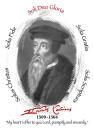
 and object to “Calvinism,” per se, usually seem to not realize just how much more there is to Calvinism than his systematization of the Augustinian (i.e., from the 4th century) doctrine of grace versus the Pelagian notion of free will (which comes complete with its own false gospel of works-righteousness). Baptists in particular, who deny the “doctrines of grace,” don’t realize just how much leftover Calvinism there is in their current theology. Those that do, recognize that they are technically categorized as “moderate Calvinists.” Chief among these is what is nowadays called “eternal security.”
Also, there’s the doctrine of original sin, the Biblical doctrine that Adam’s guilt was imputed to all of his descendants, which sinful condition manifests itself in outward sinful acts. Most Baptists today affirm original sin, and they do so because the Baptists who migrated to America were originally Calvinists. Those “General Baptists,” whom modern anti-Calvinistic Baptists sometimes erroneously look back to as their forefathers in the faith, collectively fell away from the faith, and their theological descendants can be found today among modern Unitarianism.
As a proof for this claim, consider the following words from the Wikipedia entry on the General Baptists, to which I linked above: ” . . . traditionally non-creedal, many General Baptist congregations were becoming increasingly liberal in their doctrine, obliging the more orthodox and the more evangelical among them to reconsider their allegiance during this period of revival (Edward’s, Whitefield’s and Wesley’s 18th century First Great Awakening). Before this re-organisation, the English General Baptists had begun to decline numerically due to several factors linked to non-orthodox ‘Free Christianity’. Early Quaker converts were drawn from the General Baptists, and many other churches moved into Unitarianism. . . “
Those General Baptists denied original sin. For example, John Smyth, (first to pastor a church called “Baptist” shortly before he cast his lot with the Mennonites) wrote in his Confession of Faith in 1609 that, “there is no original sin (lit;, no sin of origin or descent), but all sin is actual and voluntary, viz., a word, a deed, or a design against the law of God; and therefore, infants are without sin.” Modern anti-Calvinistic Baptists generally (no pun intended) affirm original sin, and this is because the Baptists from which you descend were originally Calvinists.
Eternal security and original sin managed to stick around because they weren’t offensive enough to undermine the outward results of mass evangelism, the way the doctrines of grace seem to. We have “revivalism” to thank for that. Read Revival and Revivalism: The Making And Marring of American Evangelicalism, by Iain Murry of Banner of Truth Trust, and you’ll learn how the TULIP got plucked in the wake of the Second Great Awakening as otherwise orthodox Christians began to adopt the methods of arch-Pelagian Charles Finney’s “new measures” in order to maximize the effectiveness of their ginned-up revivals.
But enough introduction. What I wanted to point out was just how pervasive Calvinist theology defines modern Baptist and otherwise Evangelical theology. In my last post, I linked to an essay written by B. B. Warfield entitled “Calvin As A Theologian.” This essay was written to set the record straight about all the common misconceptions that have been fabricated by anti-Calvinists in order to not only disagree with the “five points of Calvinism” (aka, TULIP, the doctrines of grace, etc.) but make those under their spiritual care despise Calvin himself and just about everything he stood for. Read Warfield’s introductory remarks, and then go read the entire article:
I am afraid I shall have to ask you at the outset to disabuse your minds of a very common impression, namely, that Calvin’s chief characteristics as a theologian were on the one hand, audacity—perhaps I might even say effrontery—of speculation; and on the other hand, pitilessness of logical development, cold and heartless scholasticism. We have been told, for example, that he reasons on the attributes of God precisely as he would reason on the properties of a triangle. No misconception could be more gross. The speculative theologian of the Reformation was Zwingli, not Calvin. The scholastic theologian among the early Reformers was Peter Martyr, not Calvin. This was thoroughly understood by their contemporaries.
Among the things that we have inherited from Calvinist theology include the following (as Warfield reports):
-
“In one word, he [Calvin] was distinctly a Biblical theologian, or, let us say it frankly, by way of eminence the Biblical theologian of his age. Whither the Bible took him, thither he went; where scriptural declarations failed him, there he stopped short.”
-
“Calvin marked an epoch in the history of the doctrine of the Trinity, but of all great theologians who have occupied themselves with this soaring topic, none has been more determined than he not to lose himself in the intellectual subtleties to which it invites the inquiring mind; and he marked an epoch i the development of the doctrine precisely because his interest in it was vital (that means “spiritual,” or “devout”) and not merely or mainly speculative.”
-
“The fundamental interest of Calvin as a theologian lay, it is clear, in the region broadly designated soteriological. Perhaps we may go further and add that, within this broad field, his interest was most intense in the application to the sinful soul of the salvation wrought out by Christ, — in a word, in what is technically known as the ordo salutis. . . Its [Calvin’s Institutes]effect, at all events, has been to constitute Calvin pre-eminently the theologian of the Holy Spirit.”
-
“He also marks an epoch in the mode of presenting the work of Christ. The presentation of Christ’s work under the rubrics of the three-fold office of Prophet, Priest and King was introduced by him: and from him it was taken over by the entirety of Christendom, not always, it is true, in his spirit or with his completeness of development, but yet with large advantage.”
-
“In Christian ethics, too, his impulse proved epoch-making, and this great science was for a generation cultivated only by his followers.”
-
“It is probable, however, that Calvin’s greatest contribution to theological science lies in the rich development which he gives–and which he was the first to give–to the doctrine of the work of the Holy Spirit. “
-
Finally, here’s Warfield’s summary of Calvin as a theologian: “It has been common (among academic theologians, not pastors and laity who love to hate Calvin) to say that Calvin’s entire theological work may be summed up in this–that he emancipated the soul from the tyranny of human authority and delivered it from the uncertainties of human intermediation in religious things: that he brought the soul into the immediate presence of God and cast it for its spiritual health upon the free grace of God alone.”
-
And of Calvin’s masterpiece, The Institutes of the Christian Religion, Warfield summarizes: “The Institutes is, accordingly, just a treatise on the work of God the Holy Spirit in making God savingly known to sinful man, and bringing sinful man into holy communion with God.”
Far from being some cold, depressing, rigidly logical and academic murderer (we mustn’t forget Servetus!), Calvin was recognized by his peers and his entire generation as an eminently devout and spiritual biblicist whose development of Protestant theology built on the shoulders of Augustine, Anselm, Hus, Bradwardine, Wycliffe, and Luther and helped make Western Civilization what it became in its historical greatness. All by the grace of God, and for his glory alone!
Reformed Theology Coming to an SBC Church Near You!
On January 11, 2008, the Baptist Press posted a report by Michael Chute, entitled, 
-
“. . . ten percent of Southern Baptist pastors (currently) identify themselves as Calvinists.”
-
“. . . 29 percent of recent SBC seminary graduates espoused Calvinist doctrine.”
-
“. . . a minority of SBC churches are led by Calvinist-leaning pastors, but the number is increasing”
-
“. . . Calvinist-led churches are generally smaller in worship attendance and baptisms than non-Calvinist churches.”
-
“. . . baptism rates between Calvinist and non-Calvinist led churches are virtually identical.”
-
“. . . Calvinistic recent graduates report that they conduct personal evangelism at a slightly higher rate than their non-Calvinistic peers.”
-
A PDF file of the full report is posted here.
Also of interest in the report, Chute quoted Hal Poe, Charles Colson Professor of Faith and Culture at Union University in Jackson, Tennessee, who paints a picture for us of the recent historical trends within the SBC which have led to the current circumstances. “In a broad sense, it’s happening on Christian college campuses too, as Calvinism appeals to young people who are wanting a more intellectual approach to Christianity . . . . Southern Baptists neglected serious Christian education from the early 1960’s, and that’s when all the trouble started. From discipleship training we went to the amorphous youth groups, whose only real good was to keep kids happy until they graduated from high school and graduated from church. Now, you have a generation [of college students] who have come along and want something deeper and they have latched onto Calvinism.”
Poe goes on to site “John Piper, a Reformed Baptist theologian, preacher and author who currently serves as pastor for preaching and vision of Bethlehem Baptist Church in Minneapolis. . . . He’s effective because he’s so passionate. . . He holds huge, stadium-type events that are rip-roaring. There’s nobody else doing anything like this so he becomes [Calvinism’s] expositor. But John Piper’s version of Calvinism is not something John Calvin would espouse, or even that Charles Spurgeon [British reformed Baptist preacher] would espouse.”
It is true that Piper is cut from a different cloth from the great Reformer and the nineteenth-century Puritan “Prince of Preachers.” First of all, it must be noted that Piper is not a Southern Baptist, but a member of the Northern Baptist Convention (Bethlehem Baptist member and Reformed Baptist blogger, Bob Hayton, at Fundamentally Reformed, can correct me on that detail if I’m wrong), where he has been a leader in that denomination’s struggle with the modern heresy known as Open Theism. From my reading of his sermons, Piper may be categorized as a “charismatic Calvinist,” which is more of a doctrinal position than a weekly exhibition of extreme emotionalism in worship, or attempts at exercising the miraculous spiritual gifts of tongues, healing, prophecy, etc., images usually evoked by the term charismatic–though the appeal to emotion seems to be greater in his preaching than in typical Reformed preaching. His experiential emphasis on “desiring God” is in part an application of the answer to the first question in the Westminster Shorter Catechism, which states, “Man’s chief end is to glorify God and enjoy him forever.” But this seems to be little more than a perhaps pietistic reaction against the reputed cold-orthodoxy of many Reformed worship practices.
Another way Calvin would disagree with Piper is in his application of Baptistic principles to Reformed theology, of which, of course, Spurgeon is also guilty. But in this, Piper and Spurgeon are informed by the historic early Baptist confession of faith commonly known as the Second London Baptist Confession of Faith of 1689, which is in large part, a condensing of the Presbyterian Westminster Confession of Faith, with revisions on the statements regarding Baptism. On the other hand, Piper also is embracing the abberant postmodern “emerging” churches–at least the one’s that at least maintain Reformed theology, while seemingly applying seeker-sensitive pragmatic retooling of worship styles to appeal to an “emerging church” demographic. Thus, Piper’s twenty-first century expression of Calvinism does seem to differ from that of Calvin and Spurgeon; however, this Reformed blogger is grateful that such a figure has been able to influence so many Southern Baptists for the doctrines of grace, the biblical emphasis on the sovereignty of God, and his supremacy in all things, including the secular, sacred and even sinful activity of all men.
Is Reformed Important? Saturday Night Outline
At long last, now that the Sean Michael Lucas conference is a week’s worth of history, here’s the outline he allowed me to publish from his presentation.
Why bother being Reformed as a way of being Christian?
- It is not possible to live a “generic” Christian life
- Historically not possible
- Logically not possible
- The Christian life must be embodied through a particular identity
- Even “Bible churches” communicate a particular identity (beliefs, practices, stories)
- Genuine conversations with others must be rooted in a real sense of knowing who we are.
During this portion of the outline, Dr. Lucas gave the example of the Cane Ridge Revival, explaining how Barton Stone desired to reduce his denominational identity to “Christian.” Out of this revival emerged the Christian denomination (Disciples of Christ), Cumberland Presbyterianism, and others I forgot before I could jot them down. Now back to the outline . . .
- The question becomes, then,
- Which beliefs and practices are most biblical?
- And which communion most closely holds to those beliefs and engages in those practices?
- In the end, the reason it is important to be Reformed (and specifically, Presbyterian) is
- Because Presbyterian beliefs and practices are the closest to the biblical material, and,
- Because they provide the most workable identity for engaging life in this postmodern world.
Presbyterian beliefs
- God is King (the sovereignty of God)
- The Priority of Grace (in salvation, sanctification, consummation)
- God’s story, promises, and reign (covenant and kingdom)
- The nature of the Church (visible/invisible)
- The nature of the sacraments (baptism and Supper)
Presbyterian practices
- Piety
- Centering on worship [corporate, family, and private], stewardship, and service
- Worship
- Centering on its biblical, covenantal, and gospel-driven nature
- Polity
- Centering on a proper balance of church authority and liberty of conscience
Presbyterian stories
- These beliefs and practices make sense to us, in part, because of the stories (positive and negative) that we tell:
- Calvin, Knox and the Westminster divines
- Scots and Scots-Irish Presbyterianism
- Early American Presbyterianism
- 19th Century Presbyterianism
- 20th Century Presbyterianism
- North (PCUSA, OPC, BP, EP, RPCES)
- South (PCUS, PCA)
- Identity
- It is out of this particularly Presbyterian way of speaking the Gospel that we must speak.
- Catholicity
- In order to confess “one holy catholic church,” we must desire relationship and even partnership with other Christians.
- Our relationships with other Christians must be guided by the Gospel and must serve the Gospel.
- Humility
- The most productive partnerships come from recognizing the importance of others in imaging forth the Kingdom of God (Romans 1:11-12).
Check back periodically . . . I’ll post Dr. Lucas’ Reformation Sunday Sermon link when the church posts it.
Is Reformed Important? Friday Night Outline
Dr. Sean Michael Lucas
New St. Peters PC, Dallas, TX
October 26-27, 2007
Who Are You?: Understanding Identity
When you think about who you are, what comes to mind?
- Son, upper middle class, suburbs, two parents married 38 years, one sister
- Moved many times, mainly up an ddown the I-95 corridor between Washingong DC, and NYC.
- Husband, married nearly 14 years, four children
- Became a believer when a teenager–unusual religious journey
- Pastor with scholarly bent; historian with a pastor heart
- Writer and reader–love Mark Twain and Wendell Barry
- Gardner
- Avid sports fan–Indiana sports teams
- Springsteen, U2, country music
- Trucks, Fords, but when I follow NAsCAR, I am a Gordon fan.
Three Key Aspects to identify.
Belierfs
- the core understandings that form and motivate what and how I practice; they are also reinforced by these practices and by my stories.
Practice
- The regular activities that I engage in shape my understanding of myself and the world.
Stories
- narratives that help to make sense of what I believe and what I do.
“Identity Crisis”
- When someone is having an “identity crisis,” he/she has become disillusioned or is experiencing dissonance within her core.
- Perhaps produced through a lengthy questionaing of previously held beliefs.
- Perhaps caused through an interruption of key practices that reinforced identity.
- Perhaps result of a disillusionment with the master story
- A version of this identity crisis would be the “mid-life crisis.”
Identity Formation in “Modernity” and “Post-Modernity”
Pre- and Early Modernity
- Social relations and family connections
- Trade generally passed on through generatons.
- Church connections more by birth than over belief.
- Identity fairly stric==pre-determined by others and before birth.
Late and Post-Modernity
- Social mobility, loss of extended and nuclear family.
- Trades determined through interest,
- Church connections determined by belief less than birt; challenge to lay on any type of denominationalism
- Identity radically dynamic-self-created through choices
Forging Christian identity
The transition from “non-religious” [non-Christian] to “religious” (Christian] identity.
- New Beliefs–from Idolatry to faith in Father, Sond, Spirit (1 Thessalonians 1:9)
- New Practices–from non-observent to observant (Ephesians 4:17-24)
- New Stories—from “self-determined” to divinely determined within the story of Israel and the Church as found in the Bible.
- The forging of Christian Identity is varied and common
- Varied:
- No two transitions are exactly the same
- No two experiences of sin, grace, faith, repentance are exactly the same
- Common:
- The need experience by all human beings is the same
- The Gospel embraced by all believers is the same
- The grace granted to believers is the same
- Varied:
- The means for forging Christian identity (Acts 2:42-47)
- Word
- Sacraments
- Prayer
- Fellowship
Tomorrow, I’ll post Saturday night’s outline.
Is Reformed Important?
 A friend of mine (actually, my old boss), is a member of New St. Peter’s (NsP)
  Presbyterian Church in Dallas, Texas. Over this past “Reformation Weekend,” as I call it, NsP hosted a conference by Dr. Sean Michael Lucas of Covenant Theological Seminary in St. Louis, Missouri. The topic of the conference, “Is Reformed Important?” was a Power Point presentation summarizing the material from Dr. Lucas’ book, On Being Presbyterian, which I have not read. I found the conference very interesting, for his approach does not start with a defense of all of the Reformed and Presbyterian controversial, distinctive doctrines. The approach Dr. Lucas took was to deal with what it means to be Presbyterian as a facet of one’s personal identity. In this I think he’s attempting to appeal to, or at least converse with a postmodern worldview, which seems, by and large, skeptical of evangelical theologizing.
The sum of the conference was that a person’s identity is the result of one’s beliefs, practices and stories (bps), which colors his perspective on life, the universe and everything (to borrow from the British theologian, Douglas Adams). Therefore, the basic outline of “Is Reformed Important?” is a look at the beliefs, practices and stories of confessional, Reformed Presbyterianism in particular, rather than merely Reformed in general.One benefit of the format of the two day conference, followed by a Reformation Sunday sermon at NsP (which I did not attend, but the link to which I’ll post if and when it becomes available) lies in the fact that the first night really helps a non-Reformed, non-Presbyterian (like my beloved wife) not have to immediately endure all the stuff he disagrees with, but gently points out that one’s beliefs andpractices are worth taking a critical look at. Dr. Lucas did this by sharing much of his own bps in a rather disarming manner. This is definitely user-friendly material, not fodder for theology geeks, but down-to-earth and practical stuff.
At one point during the second lecture, Dr. Lucas brought up the prospect of what he’d do were he to notice that someone had published a book with the same title as his, On Being Presbyterian, yet noticed that the table of contents seems an awful lot like the one in his own work, and not only that, but that the other author happens to mention that he comes from the same hometown as Dr. Lucas. He said the first thing he’d probably do is punch the guy in the nose. This compelled me to approach him after the lecture to request permission to post his outline on my blog, which permission, Christian man that he is, he graciously granted. Thus, in my next post, I’ll give you Lecture Number One of “Is Reformed Important?”
Hope you all had a pleasant Reformation Sunday!
Reformata Semper Reformanda (”Reformed, Always Reforming”)
update
I just took a look at http://www.newstpeters.org/ and noticed that they give their members something called “Rooster Tracks” which provides short, weekday theological and devotional items to think through and/or study. The one for this week, naturally, introduces us to the Reformers and asks its readers to think through a topic related to the contribution of each individual Reformer which is treated, namely, Luther, Melancthon, Zwingli, Calvin, and Knox.
Augustine on the Decrees of God: Roman or Reformed?
 I had to look up what the Roman Catholics claim about Augustine’s views on the sovereign grace of God, and I was surprised by what I found. But not entirely. One, “Albert,” posted the first comment to Bob Hayton’s Fundamentally Reformed post, “Legacy of Sovereign Joy: Augustine,” reviewing John Piper’s book, Legacy of Sovereign Joy, focusing on Piper’s reflections of Augustine, and Albert asked Bob if he was aware of what Augustine believed about grace and free will, and asserted that what he did believe was consistent with present, official Roman Catholic teaching. That’s why I wanted to see what the online Roman Catholic encyclopedia, New Advent, had to say about the matter. The entry entitled, “Teaching of St. Augustine of Hippo,” section II on “His System of Grace,” got into some interesting reading about some details regarding free will which differs from the traditional Reformed view, but what really astounded me was what the online encyclopedia reports was Augustine’s view of how God determined his decrees regarding election and reprobation:
Here is how the theory of St. Augustine, already explained, forces us to conceive of the Divine decree: Before all decision to create the world, the infinite knowledge of God presents to Him all the graces, and different series of graces, which He can prepare for each soul, along with the consent or refusal which would follow in each circumstance, and that in millions and millions of possible combinations. Thus He sees that if Peter had received such another grace, he would not have been converted; and if on the contrary such another Divine appeal had been heard in the heart of Judas, he would have done penance and been saved. Thus, for each man in particular there are in the thought of God, limitless possible histories, some histories of virtue and salvation, others of crime and damnation; and God will be free in choosing such a world, such a series of graces, and in determining the future history and final destiny of each soul. And this is precisely what He does when, among all possible worlds, by an absolutely free act, He decides to realize the actual world with all the circumstances of its historic evolutions, with all the graces which in fact have been and will be distributed until the end of the world, and consequently with all the elect and all the reprobate who God foresaw would be in it if de facto He created it.
If Augustine taught this imaginitive concept of God’s determinate counsel, then he would have gone beyond what is written in order to come up with it. This reminds me of an anecdote of Augustine which is intended to warn of the danger of attempting to explain that which is not revealed in Scripture about spiritual realities, in which someone asks Augustine, “What was God doing before he created the world?” to which Augustine replied, “Creating Hell for the curious.” I think, if Augustine taught what is contained in the paragraph cited above, then he failed to heed his own anecdotal warning. Another thing I found interesting about the presence of this concept in Augustine’s thought is the fact that the first time I’d ever heard of such a concept, it came from someone near and dear to me, who was taking exception to the Reformed view of God’s decrees of election and reprobation, claiming that this divine consideration of all possible realities and settling on the ones that come to pass, leaving folks free (in the sense Adam was) to choose between good and evil as effectually influenced by the particular circumstances and graces God places in the individual’s path, was the more biblical view.
In my opinion, this extra-biblical view is just a more elaborate form of the prescient view of foreknowledge, about which, long before I’d become a Calvinist, when thinking it through, I concluded that in this semi-pelagian system, God was leaving man free to determine his own election, but having looked forward from before the creation in order to ordain it before man made his free choice, thereby cutting man off at the pass for the glory. You could probably say I persuaded myself in favor of Calvinism when I came to that conclusion, but it would be a couple of more years before God would force me to deal with the issues once and for all.
But the final observation I want to make about Augustine’s view of grace and free will, election and reprobation, is that I don’t think the Reformers needed to adopt exactly what Augustine speculated about the doctrine, because, after all, the Reformers were in the business of double checking writers like Augustine with the Scriptures, practicing that more noble virtue of searching the Scriptures to see whether what he taught was so. The Reformation may not have been a pure Augustinian revival, but the Reformers certianly did stand on the shoulders of this theological giant from Africa, Augustine of Hippo.
The Connection Between Election And Apostacy
 Here’s my transcription of a listener’s telephone comment on the Sunday, August 12 edition of The White Horse Inn, “Grace & Election in the Book of Ephesians.” On the one hand, the following conversation includes an anecdote which well portrays a “fightin’ fundamentalist” standing his ground against election in a way he may assume is as bold as Paul declaring that if resurrection didn’t really happen, then Christ died in vain and we’re dead in our sins. But on the other hand, it can really make you nervous about the danger to which professing believers expose themselves when they stubbornly deny the Word of God on the doctrines of grace. No, I don’t think dedicated Christians who love and serve Jesus and otherwise believe the Bible and sound conservative theology are apostate if they disagree with election–I mean those who go to the extreme and deny the faith because they refuse to accept the clear teaching of Scripture because of election. The kind to which I’m referring are the kind who understand exactly what the Bible says about election and reject the faith because of it.
Be afraid. Be very afraid.
Horton: Greg in Littleton, Colorado, good evening.
Greg: Hello. This is providential that you’re discussing this tonight, because my uncle who’s an Independent Baptist, to his disappointment, discovered that Spurgeon actually taught this.
Riddlebarger: (while other hosts laugh) Oh boy, did he ever!
Greg: . . . and he really is quite hostile to this teaching, and I really think, for one thing, I said to him, “If I could show you in Scripture where election is clearly taught, wouldn’t you have to give in and believe it?” And I was disappointed at his response–he said, “well, I would have to question the authenticity of the Scriptures.”
Rosenblatt: Holy smokes!
Riddlebarger: Oh, boy!
Horton: Wow. You know, this does bring up an important point. I’ve been in situations where I’ve been talking about this and people have said–even older folks, people who’ve been lifelong Christians, committed to the authority of Scripture, and Bible-believing Christians, and you go through this, and, uh, I remember throwing my Bible across the room when I read Romans 9.
Riddlebarger: Oh, I remember listening to a Donald Grey Barnhouse tape on election, up all night with my Bible going through all the passages he mentioned, just sick in the pit of my stomach. But, you know, that’s just like John chapter 6, when Jesus utters the hard words, “Unless the Father draws you, you can’t come,” and the crowd starts grumbling, so he says it again, and they all walk away.
Horton: Tough words. Even his own disciples: “This is a hard teaching and who can hear it?”
The God-Given Righteousness of Noah

The God who promised to send the Seed of the Woman to crush the Serpent’s head (Genesis 3:15) gave Noah the faith to believe this promise. God was the ultimate basis of Noah’s righteousness. The way in which the Seed of the Woman would crush the Serpent’s head, destroying Satan’s power through sin over God’s chosen, had not yet been revealed. Noah did not know how God’s promised Seed would save him from sin, he just believed that he would. As we study through the Old Testament, we’ll learn that God reveals his plan to save sinners progressively, a little bit at a time.
Our lives are like that. We set goals, but we don’t know everything we’ll need to do yet, or what will happen to us before we reach our goal, but these details become clear to us day by day. This is the way it works with the history of God’s work of redemption from sin. First we learn the big picture: God had announced his plan to send Someone to defeat the great enemy of our souls; then, bit by bit, who this Someone is, and how he’s going to defeat this enemy slowly became clear to people like Adam, Seth, Enoch and Noah one detail at a time. A few of these details are revealed to us in the righteous life of Noah.
By his grace, God promised to deliver Noah from the flood of judgment which he and the entire world deserved (Genesis 6:18), and Noah believed God’s promise, so one of the factors of Noah’s righteous life was faith. This faith in God’s promise was the basis for Noah’s righteous life, but it was not his faith that saved him, it was the gracious, promise-keeping God who chose to save him that was the ultimate basis of his righteousness and his salvation. Noah was a righteous man because God made Noah a righteous man.
The other factor that adds up to righteousness for Noah was his obedience to God’s commands. God gave Noah very specific instructions to build an ark (Genesis 6:14-16), what size to build it, what to build it with, how to build it and how many of the various beasts, birds and bugs to gather into the ark (Genesis 6:19-20). The testimony of Moses was that Noah obeyed all that God commanded him to do (Genesis 6:22). Yet this obedience by itself did not earn for Noah his status as a righteous man. Remember he was righteous by God’s grace through the faith granted to him by God (see Ephesians 2:8-9) with which he believed the God of the promise of salvation from sin, Satan and the flood. Noah’s faith was the root of Noah’s obedience. Noah’s obedience was the fruit of Noah’s faith. Therefore Noah’s faith evidenced by his obedience was what Moses was talking about when he wrote that Noah was a righteous man (Genesis 6:9).
God saves us the same way. All of us were born with Adam’s guilt legally imputed to us (Romans 5:12-14) by virtue of the fact that Adam represented us in the covenant with God which he violated when he ate the fruit of the tree of the knowledge of good and evil (Genesis 3; cf. Hosea 6:7). In addition to this, we were born, having inherited a corrupt human nature that wants nothing but sin (Romans 3:10-18), unable to do anything (Romans 8:7) that will please him (Hebrews 11:6) and save ourselves. As things stand, we deserve death and an eternity of suffering the wrath of God.
But out of the mass of condemned humanity, a remnant finds favor with God (Genesis 6:8; cf. Romans 11:5-7). Because of Jesus’ crucifixion and resurrection for sinners, God looks on this remnant with grace and gives them the faith (Acts 13:48; 18:27) to trust the work of Christ that is preached to everybody (Mark 16:15). We then rely on his grace to give us the obedience with which we show our thanks and love for the work of Christ on the cross (John 14:15). So we learn how God saved us in the Bible, and we also learn how to respond to this good news in grateful love by learning the commands of God—because true faith works by love (Galatians 5:6). That’s how we can be remembered as a righteous man or a righteous woman after our story has been told, just like Noah, by a God-given faith in Christ that obeys God’s commands.
In The Even You Are Seated Next To A Calvinist

Click on the image above and you can read your anti-Calvin safety procedures. . .
“‘I have made you a light for the Gentiles,that you may bring salvation to the ends of the earth.’”
48 And when the Gentiles heard this, they began rejoicing and glorifying the word of the Lord, and as many as were appointed to eternal life believed.
7 What then? Israel failed to obtain what it was seeking. The elect obtained it, but the rest were hardened, 8 as it is written,
“God gave them a spirit of stupor,eyes that would not seeand ears that would not hear,down to this very day.”
9 And David says,
“Let their table become a snare and a trap,a stumbling block and a retribution for them;10 let their eyes be darkened so that they cannot see,and bend their backs forever.”

Are Calvinists Treating Arminians Fairly? You Be The Judge!


 The Misadventures of Captain Headknowledge