“Should We Exclusively Use the King James Version?”
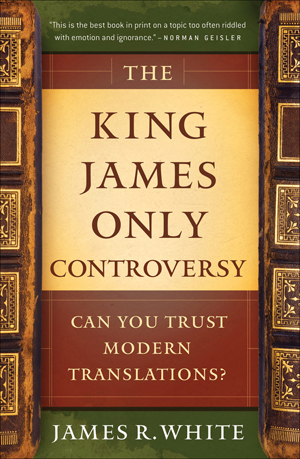 How appropriate that during the year of the quadricentennial of the King James Version of the Bible, a debate on the question of King James Onlyism should be held. Reformed Baptist apologist Dr. James White of Alpha and Omega Ministries is just on his way to London, England. RevelationTV in London is hosting a debate Wednesday night at 9pm GMT (if I’m not mistaken, that should be 3 pm CST), between Dr. White and Dr. Jack Moorman, an American fundamentalist Independent Baptist missionary in England, pastoring Bethel Baptist Church, Wimbeldon, London. The subject of the debate is, “Should we exclusively use the King James Version?” To my knowledge, it has been quite a while since a KJV Onlyist has stepped forward willing to debate Dr. White, author of The King James Only Controversy: Can You Trust Modern Translations?
This should be good. Dr. White never disappoints.
A Review of Dr. John Fesko’s Lecture on Word, Water and Spirit, part 1
 On Friday, January 21st, 2011, Dr. John Fesko, Academic Dean and Associate Professor of Systematic Theology at Westminster Seminary California, was the featured speaker at Christ Reformed Church in Anaheim, California, pastored by Dr. Kim Riddlebarger. He was invited to speak on his comprehensive new book, Word, Water and Spirit: A Reformed Perspective on Baptism (© 2010 by J. V. Fesko, published by Reformation Heritage Books). The link to Dr. Fesko’s lecture may be downloaded from this post at the Riddleblog. First, Dr. Fesko describes the background to his book, then he summarizes respectively the history of the doctrine of infant baptism (paedobaptim–Part I of his book), the Biblical-Theological Survey of the Doctrine (Part II), and finally he briefly describes Part III: Systematic-Theological Construction of the Doctrine. This first in a series of posts will review Dr. Fesko’s discussion of the background to his writing of the book.
The background, we learn, is ultimately connected to his upbringing. As an infant, Dr. Fesko was baptized in the mainline denomination of the Presbyterian Church (USA). His parents apparently held nominal ties to this Reformed heritage, and the Fesko family wound up attending a number of churches over the years, landing among the Baptists in the end. While in college, Dr. Fesko listened to R. C. Sproul tapes on his Walkman, which lead him to realize that he was more Reformed than he was Baptist, and so he resolved to examine the outstanding Reformed doctrines he’d yet to deal with to be sure they were true–issues like infant baptism, so that, were he to minister in a Reformed church one day, he would not have to “hold his breath” as he administered the sacrament.
After seminary, while attending the University of Aberdeen in Scotland, Dr. Fesko read a book by Paul Jewett which he says is called, A Case Against Infant Baptism, which inadvertently impressed upon him the indispensability of covenant theology and laid the groundwork to his finally embracing paedobaptism. In searching the web for this title, however, I was unsuccessful in tracking it down, but found instead a book by the same author called Infant Baptism and the Covenant of Grace: An Appraisal of the Argument That As Infants Were Once Circumcised, So They Should Now Be Baptized, which apparently argues for the practice. Unfortunately, Dr. Fesko has a little trouble with recall on this and another title below, but, we can afford to forgive him this minor oversight. I share a marginally similar experience to the one Dr. Fesko describes, in my own examination of the issues related to the biblical doctrine of baptism. Over the past several years since my transition to theologically Reformed convictions, including the truth of infant baptism, I would periodically revisit the case for the Baptist view of believer’s baptism (credobaptism). Each time, after re-exposing my newfound paedobaptistic persuasion to the critique of the Baptist doctrine, I would come away with new reasons to believe that Scripture in fact does command and exemplify infant baptism, although not in a manner that satisfies the Baptistic hermeneutic (method of interpretation) which emphasizes as central the differences between the Mosaic Covenant and the New Covenant, rather than their points of continuity.
The Reformed covenantal hermeneutic emphasizes how the nature, promises and signs of the Covenant of Grace outweigh the various administrative changes between the Mosaic and New Covenants. Big-picture issues like these bring into sharper relief the seemingly unclear Biblical testimony to infant baptism. In other words, with all due respect to my Baptist friends, when it comes to the Mosaic and New Covenant administrations of the overarching Covenant of Grace, they seem unable to see the whole covenantal forest for the New Covenant trees.
The second element in the background to Dr. Fesko’s writing of Word, Water and Spirit comes from his ministerial environment in the South. He says, “if you cannot throw a rock in the Bible without hitting a covenant, in the South, you cannot throw a rock without hitting a Baptist church.” Many Baptists, who, in the providence of God, come to embrace Reformed theology and appreciate so much about the doctrine and practice of a Reformed Presbyterian church will hold out on the Reformed practice of infant baptism. In his ministry to such believers in his congregation, Dr. Fesko tried to provide comprehensive evidence to help his converted Baptist congregants understand and believe in infant baptism, and the degree to which he would prepare such material for their benefit also facilitated his desire to publish on the subject of the Biblical and historical case for infant baptism.
Dr. Fesko was also interested in making sure his congregants understood the Biblical doctrine of baptism as a whole, not just the aspect of it that related to its administration to the infant children of believers. He observes that there is a troubling trend toward church growth by downplaying more objectionable doctrines, like paedobaptism. He desired not only to help people understand infant baptism, he wants them to understand what a sacrament is, what Biblical covenants are, and even the true nature of God’s grace itself. Many struggle to understand what grace is. I, too, struggled to understand the classical definition of grace as “unmerited favor” until I was introduced to the Reformed doctrines of grace. Once I came to grips with the fact that a sinner is unwilling to believe because as one who is dead in sin, he cannot (“Total Depravity”); that God’s election of him is not conditioned on God’s foreknowing or foreseeing that he would receive Christ (“Sovereign Election”); that the atonement of Christ for the elect in particular is properly understood in terms of his mercy, rather than his resentfully seeing such an act as inherently unjust of God’s part (“Particular Redemption”); that when the Holy Spirit enables a sinner who was dead in sin to believe and to willingly embrace Christ as his own crucified and risen Lord (“Effectual Calling”); and that God will not only prevent me from “losing my salvation,” but will graciously preserve me in such a way that I will, by his grace, persevere in my faith in him (“Perseverance of the Saints”–for more biblical testimony on these doctrines of grace, see the link in my Featured Sites widget in the sidebar), then and only then did it make sense to me how it is that grace is God’s favor for me which I in no way earned. It is in this way that God’s grace is truly unmerited favor. Just as Reformed theology helps one truly understand the nature of grace, so does Reformed covenant theology as a whole help the believer understand the Bible’s full teaching on the significance, proper candidates and proper attitude toward the mode of baptism.
God’s progressive revelation of his redemption of the elect in Christ was something Dr. Fesko often found insufficiently treated in the typical book or essay promoting the Reformed doctrine of baptism. Why is redemptive history important in relation to baptism? It helps us to better understand the nature of circumcision and baptism, the connection between the two, and why the sign of the Covenant of Grace is changed from the former to the latter with the transition from the Mosaic to the New Covenant at the first advent of Christ. Dr. Fesko finds that Reformed presentations of infant baptism often focus more on the New Testament in defense of infant baptism, and not quite enough on the Old Testament revelation of the subject. He would remind his readers that as important as the New Testament witness to infant baptism is, Christians ought not to build their doctrines on only half of the Bible, but on the entirety of the Scriptures. Too many do not realize that indeed the doctrine of baptism is, in fact, found in the Old Testament. Pierre Marcel’s book, Baptism and the Covenant of Grace (actually, Marcel wrote Biblical Doctrine of Infant Baptism), which was possibly re-titled Infant Baptism (again, we’re apparently relying on Dr. Fesko’s memory), writes, for example, that for Karl Barth, the Old Testament matters little when it comes to most doctrines, with the possible exception of the doctrine of the atonement.
Dr. Fesko finds that theological journals provide perhaps some of the most helpful information on any doctrinal question, baptism among them. He therefore desired the readers of Word, Water and Spirit, who ordinarily have no access to such information, to benefit from such journals and show them where they can go to learn more on the subject of baptism. This was another compelling reason for him to write the book.
In the next post, we’ll follow Dr. Fesko’s summary of the historical-theological section of the book, which makes up roughly half of its contents.
Revisiting “The Right Story”

- (The following was originally posted on March 3, 2006. It reappears here in a slightly edited form.)
“You can’t help nobody if you can’t tell ‘em the right story.” Jack Cash, brother of Johnny Cash, as portrayed in the movie, Walk the Line.
Every story is about fall and redemption in one way or another. There would be no plot if there were no problem to solve or conflict to resolve. The story of the entire human race is that of its fall and redemption. Your story is about your fall and your redemption. The mission of the church is to tell this story; to introduce the characters to the plot: they’ve fallen and they can’t get themselves up on their own, their problem is so bad, they can’t solve it themselves, they need Another to solve it for them, the conflict that has entered their life has killed them, and they need Another to return them to life.
Stories are often considered mere entertainment. And to be sure, the church in this Laodicean (Revelation 3:14-22) generation has caught on to the idea that entertainment will help them tell the Story. Even if at times they’re telling the right story, that of the fall of man into sin and the sinless Christ who was crucified and raised for sinners, they’ve wrapped it up in so much entertainment that many are in danger of overlooking the Gift because they’re so fascinated by the wrapping paper. If sinners are distracted from the Story by trappings geared toward appealing to their interests, or meeting their felt needs, the church can’t help them. At other times, the church forgets to get around to the Story at all because they’re so aware of all the other stories in the Bible. “Christians don’t need to hear the Story this week, they’ve already heard and believed and received it, now they need to hear what they need to do,” and thus the Story is placed on the shelf in the interest of relevance or practicality. But no matter how much they mean to help, they “can’t help nobody if [they ain’t tellin’ ’em] the right story.”
The church seeks to tell a story, but all too often it’s not the Story they were commissioned to tell (Matthew 28:19-20). Many times they tell their own story. A story about how they’ve picked themselves up by their own bootstraps, a story about what a great example they are. When this is the story they tell, the Holy Spirit won’t bring sinners to life, nor will he empower believers to serve. All applications and all examples, and all pastoral autobiography are not to stand alone. They are to be built on the firm foundation of the Story, explicitly told each week.
We’ve fallen into sin so there’s nothing we can do to redeem ourselves:
the sinless Christ was crucified because we are sinners who deserve to die;
Christ rose from the dead on the third day because God has accepted Christ’s death in the place of sinners who come to believe and repent of their sins;
saved sinners are called to be holy and to serve others, which brings them into conflict with the sin that yet remains in their natures and they aren’t always able to be holy and serve others (Romans 7).
That’s why the Right Story must remain central: The Gospel is for Christians, too!
They must be reminded that even though they’ve been saved they still need to hear the Gospel addressed to them (1 John 1:9) to cleanse them so they can progress on the journey to glorification by way of sanctification (Proverbs 4:18).
When the preacher neglects to tell the church the Right Story, he can’t help the church grow in grace.
- (Dr. R. Scott Clark gives a fuller, more Christ-centered summary of the Right Story at Westminster Seminary California’s Valiant for Truth blog. Read his post, “The Christian Life.”)
Mary’s Declaring Women’s Liberation from Feminism!

There’s another great post I am compelled to share with you over at the Gospel Coalition. Dr. Mary Kassian, Distinguished Professor of Women’s Studies at Southern Baptist Theological Seminary is the author of Girls Gone Wise and The Feminist Mistake (I love that title! In case you missed the in-your-face pun, there was a leading feminist book of bygone days called The Feminine Mystique). Dr. Kassian says we’re in a “Post-Feminist” society. But don’t rejoice yet–unlike Francis Schaeffer’s past declaration that America has moved into the “Post-Christian” era, this does not mean that Feminism has lost its influence. It’s simply moved from a movement to an institution. Says Kassian,
“Virtually everyone is a feminist. Yet virtually no one would identify him/herself as such. Feminism has seeped into people’s systems like intravenous drugs into the veins of an unconscious patient. The majority of people in today’s churches are feminists—and they don’t even know it.”
If this doesn’t ring true to you, you’re not paying attention. Our endemic feminism has taken a toll on American local church ministry and American marriages in the past several decades. In the shameful “glory days” when feminism was a movement, all the ideals of feminism were heralded by activists and educators in a counter-cultural push toward so-called “progress,” and not without resistance from the establishment culture. In other words, back then it had to be taught. Nowadays, we and our children of both sexes are so regularly exposed to feminist ideals that feminism is simply caught. Today, it’s the Biblical ideal of manhood and womanhood that has to be purposefully and energetically cultivated.
But thank the Lord that a new counter-cultural movement has arisen in the American church to do just that, teach the complementarian nature of Biblical manhood and womanhood. Feminism has brought America into an age of what is called “egalitarianism,” where the most obvious distinctions between men and women are no longer assumed. Professor Kassian heralds this positive trend and appears resolved to promote it, but not without a caveat. The last thing we need, according to Kassian, and I agree, is to move from this lifestyle of feminist license, declare liberty from feminism for the sake of the Christian family’s faithfulness to God’s Word, and allow it to degenerate into a legalism in which our focus is removed from the cross and onto an over-emphasis on the Biblical roles of manhood and womanhood that would inevitably facilitate yet another swing of the pendulum back in the direction of the radical anti-Scriptural feminism of the 1960’s and ’70’s.
Christian ladies, and gentlemen, check out the Gospel Coalition’s interview with Professor Kassian and learn that more and more Christian women are breathing the air of liberation from the cultural tyranny of feminism!
Gospel Coalition Interviews Michael Horton
 If you’re anything like me, you’re looking forward to your copy of Michael Horton’s new systematic theology, The Christian Faith: A Systematic Theology for Pilgrims on the Way (published by Zondervan), to arrive, if you haven’t already received it. If you aren’t like me, then perhaps this interesting interview of Horton by John Starke, of the Gospel Coalition, promoting his systematic theology, will make you more like me (but only in this one way).
Listen to This. . .
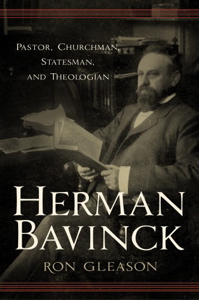
Cover of Herman Bavink: Pastor, Churchman, Statesman, and Theologian by Ron Gleason
Don’t miss these great podcasts this week.
- The White Horse Inn— “Exile, Exodus and Conquest“: On this program the hosts will explore the themes of exile, exodus and conquest showing how they each culminate in the great announcement that Jesus Christ has been given “all authority in heaven and earth” to judge, to save, and to reign forever.
- Christ the Center— “The Life and Thought of Herman Bavink“: Dr. Ron Gleason discusses his new intellectual biography, Herman Bavink: Pastor, Churchman, Statesman, and Theologian.
- Mid-Cities OPC Sermon—“Cleaning House in the Family of God” (Matthew 12:43-50). Preached by Pastor Joe Troutman on January 16, 2011. This is the church plant my family is visiting. I think you’ll appreciate Rev. Troutman’s preaching.
Christianity and Liberalism Revisited
 This past weekend, Westminster Seminary California’s (WSC) annual conference was held. It was called, “Christianity and Liberalism Revisited,” referring to the title of a book by the founder of Westminster Theological Seminary in Philadelphia, PA, and “the principal figure in the founding” of the Orthodox Presbyterian Church (OPC) in 1936, which in 2011 is celebrating its 75th anniversary. This conference is WSC contribution toward that celebration.
The conference was webcast live on Ustream and the videos are still posted there for your viewing pleasure, and audio is posted at the WSC Resource Center, but I’ll link to them below for your convenience.
- Christianity and Liberalism Today “Michael Horton shows the prophetic insight of Machen’s most famous book in Christianity today.”
- The Perennial (Problem with) Machen “Daryl Hart critiques evangelicals’ use of Machen today.”
- Machen and the Bible “Joel Kim explains the relevance of Machen’s view of the inspiration and authority of the Bible.”
- Machen and the Gospel “J. V. Fesko gives a summary of Machen’s view of the gospel and its relevance today.”
- Machen and Ethics “David VanDrunen explains how Liberalism, in its day, was fundamentally dishonest.”
- Machen, Christianity and the Church “W. Robert Godfrey explains how the church is the mission of God to carry his doctrines to the ends of the earth.”
- Question and Answer Session “The question and answer session from the 2011 Conference ‘Christianity and Liberalism Revisited’”
Bonus! If you’d like to know more about J. Gresham Machen and the Orthodox Presbyterian Church (a local congregation of which denomination my family is currently attending, Mid-Cities OPC), then start with conference speaker Daryl Hart’s page at the OPC website, called, “Machen and the OPC.”
Also, the Rev. Jason Stellman has posted a thought-provoking reflection on Hart’s lecture at his blog Creed, Code, Cult, called, “Catholicity and Liberalism.”
Sister Aimee and the “Anabaptist Nation”

"Sister Aimee" McPherson
I heard an interesting description of how American Christianity effectively developed into a form of Anabaptism. Dr. R. Scott Clark, Professor of Church History and Historical Theology at Westminster Seminary California (WSC), was interviewed this past week on Christ the Center podcast episode #157 regarding his contribution to Always Reformed, a festschrift that has recently been published in honor of WSC President and Professor of Church History, Dr. Robert Godfrey (see Dr. Clark’s post here). From what I’ve been able to gather over the past couple of years, Dr. Godfrey is an earnest student of the phenomenon of Sister Aimee McPherson’s ministry in the 1920’s, and holds her up as an example of what American Christianity is. Clark’s chapter is entitled, “Magic and Noise: Reformed Christianity in Sister’s America.” To some extent, it seems that this very subject of the Anabaptistic flavor of American Christianity is at the heart of this chapter, as may be inferred by the chapter’s title itself.
About twenty-two minutes into the interview, Clark introduces this topic by urging the study of “Sister” (as she is wont to be called) on Reformed believers. He does this because, according to Clark, in many ways McPherson’s type of Christianity is more indicative of the nature of American Christianity than the Reformed faith can lay claim to anymore. America has come a long way since the faith of the pilgrims of Plymouth Rock and the Salem witch trials (which is probably all Americans remember about those early Christian settlers (for help with that, listen to this and this). Clark believes that the Reformed would be aided in reaching America for Christ, and American evangelicals for the Reformed faith if they would see themselves more as cross-cultural missionaries, rather than natives.
Dr. Clark offers the disclaimer that his Anabaptist diagnosis of American Christianity is largely due to the fact that his primary field of research is the sixteenth and seventeenth century Reformation, rather than early twentieth century Christianity. He admits that in part he is interpreting the McPherson phenomenon and the nature of “native” American Christianity in the light of the sixteenth century Anabaptist movement, but he does attempt to support his conclusion with appeals to others who have written more extensively on Christianity in the nineteenth and twentieth centuries.
There are parallels between the Anabaptist movement of the sixteenth century and current American Christianity. Clark explains that people tend to think of the Anabaptist movement as just another facet of the Protestant Reformation, but he points out that the Anabaptists (also known as “Radical Reformers”) more or less “rejected all of the key doctrinal commitments” of the Protestant Reformation in favor of much more radical positions. Clark’s thesis is that the way American Christians commonly think about the nature of authority, epistemology (how we know what we know), Scripture and its authority, the church and eschatology (the doctrine of the end times) often bears strong resemblance to sixteenth and seventeenth century Anabaptism. Dr. Clark goes into a little more detail on this in the interview between minutes 33:15 and 42:06.
This portion of the interview caught my attention because Clark’s comparison is consistent with a conclusion I came to in my own personal pilgrimage from independent Baptist fundamentalism to Reformed theology and practice. After learning that the ultimate source of the bulk of historic Baptist theology comes from the Reformed Westminster Confession of Faith (see my newly updated “Creeds, etc.” page), and the parallels I saw between Baptist distinctives and the historic Anabaptist movement, I concluded that everything that’s right in the Baptist tradition was learned from the Reformed tradition, and everything that’s wrong in the Baptist tradition was learned, or “caught,” if you will, from Anabaptism. I realize that the 1689 Baptist Confession disclaims any formal connection between their doctrines and those of the Anabaptists, but the parallels are just too striking to Reformed paedobaptists.
This is why I encourage you to take time to listen to at least this section of the interview, if you don’t have the time or inclination to enjoy all of it. It’ll be thought-provoking time well-spent, if you ask me.
Listen To This…
Here are the programs I’ve been following this week. If you’ve got the time, it would benefit you to check some of them out:
- “Machen’s Warrior Children” on Christ the Center
- “Gospel-Focused” on White Horse Inn
- January 11 Episode of Dividing Line
- “The Legacy of the King James Bible” on ReformedCast
The BBC is celebrating KJV400.
 The BBC is promoting the 400th anniversary of the publication of the Authorized “King James” Version of the Bible. In order to do so, they are airing a series of radio reports entitled, “King James Bible–History and Readings.” Here’s how they introduce the series:
The King James Bible is one of the great English literary works. On the 400th anniversary of its publication, a series of documentaries and readings explore its history and enduring appeal. Features James Naughtie, Simon Schama, Rowan Williams, Emilia Fox, Toby Stephens and others.
The first installment aired today, but you can subscribe to a podcast that follows this series by visiting their site at the link below:
BBC – Podcasts – King James Bible – History and Readings.
For your reading pleasure, peruse this site’s blogs posted under the category of “King James Version.”
Meet Dr. Liam Goligher
Tenth Presbyterian Church is truly one of the flagship churches of the Reformed tradition in America. Two especially prominent ministers have pastored it, namely, Donald Grey Barnhouse, more recently James Montgomery Boice and finally, Dr. Philip Ryken, who has recently moved to the presidency of Wheaton College. If you’ve never heard any of these men preach, you have missed a great blessing.
Justin Taylor blogged on the announcement of the new candidate to follow in these great preachers’ footsteps, Glasgow, Scotland native, Dr. William “Liam” Goligher. You can read his post here, and the announcement published by the Pastoral Selection Committee of Tenth Presbyterian may be found at the following link here.
Christianity and Liberalism Revisited
Here’s a conference I wish I could attend. Believe it or not, I first discovered J. Gresham Machen’s book Christianity and Liberalism in a catalog for Peter Ruckman’s bookstore in the mid-nineties (see also here and here), but I only read it about two years ago. Growing up I was conscious of my fundamentalist pastor talking about “modernism,” but only had a very vague notion of what that might be. So vague, in fact, I couldn’t then, nor could I now define with any certainty just how much I understood about it then.
It is so important that Christians understand that the most basic and foundational thing about Christianity is not how you live, it is what you believe. This is not a denial of the importance of how you live, just a denial that it is what makes you a Christian. Actually, how you live is the product or fruit of what you believe. If you live the cleanest life in the most loving and charitable way, yet deny the deity of Christ, the trinitarian nature of God, or the virgin birth of Christ, etc., then you are not a Christian. This is what liberalism is, although it is so much more at the same time. It exalts the necessity of works over the necessity of orthodox doctrine. That’s why Machen said liberalism is not another form of Christianity, it is an entirely different religion.
Heresy in Defense of the Fundamentals
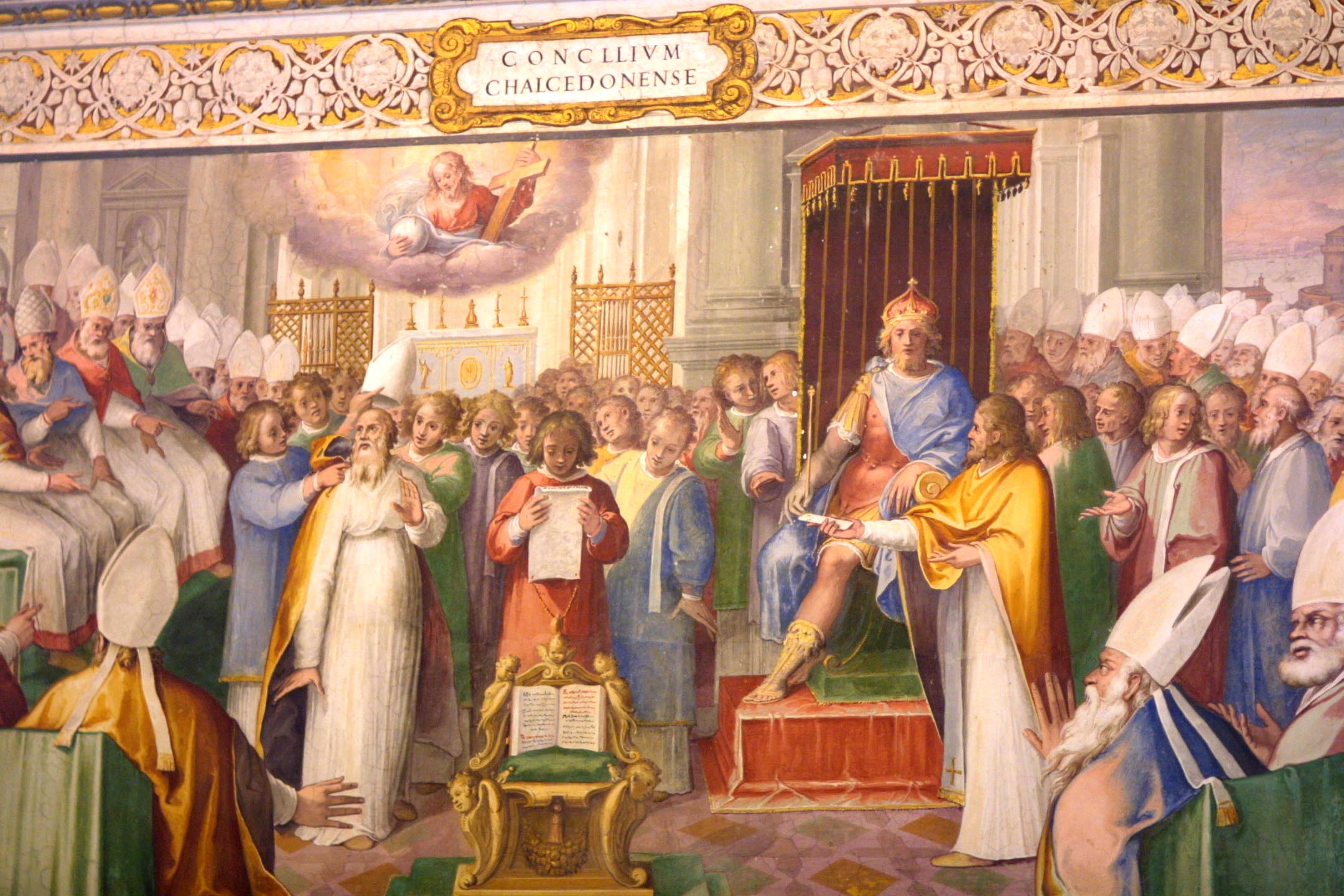
Council of Chalcedon, AD 451
“Since therefore the children share in flesh and blood, he himself likewise partook of the same things, that through death he might destroy the one who has the power of death, that is, the devil, and deliver all those who through fear of death were subject to lifelong slavery” (Hebrews 2:14-15 ESV).
Recently, I heard an Independent Fundamental Baptist preacher comment that he believes in salvation “by the blood of Christ, not his death.” One who heard this comment with me registered his shock at the statement. Having discussed this issue with this particular preacher in the past, I knew what he meant by it, and was able to fill in my companion. The following bullet points are a summary of the things I shared with him.
Suffice it to say that there is a segment of Independent Baptist Fundamentalism that so wants to defend the “literal” interpretation of Scripture that it will often deny simple figures of speech in Scripture to the extent that it begins to distort the very fundamentals it intends to defend. One such fundamental of the faith that has suffered such distortion is that of the hypostatic union of Christ’s human and divine natures, of which the historic conciliar statement produced by the Council of Chalcedon (AD 451) expresses the Biblical doctrine quite thoroughly and has served the church well in defining the orthodox position. Although an appeal to the so-called “Definition of Chalcedon” as an expression of Scriptural teaching on the matter falls on deaf fundamentalist ears, it does not change the fact that, historically speaking, for the Protestant as well as the Roman Catholic, to dissent from this Ecumenical Council on the hypostatic union is to be led by blind guides into the ditch of formal heresy. Sad to say, this is the fate of the kind of irresponsible Biblicism that often goes on in the Fundamentalist movement.
I’ve posted on this topic before here and here. The names I’ve used for this fundamentalist heresy are “Divine Blood” and “Celestial Flesh.” These titles describe the ways in which fundamentalists blur the distinction between Christ’s human and divine natures to a possibly heretical extent. This explains the use of these terms in the following bullet points:
- Divine Blood proponents believe a biological myth that the male seed provides the blood to the conceived egg (see this post).
- Divine Blood proponents believe in the seminal headship of Adam to the neglect of his federal headship. The Reformed affirm that seminal headship conveys actual moral corruption by means of “ordinary generation” (WCF 6.3), and that federal headship is the imputation of Adam’s guilt to all of his posterity (aka, “original sin”).
- Divine Blood proponents therefore conclude that sin itself is actually transmitted in human blood from Adam through the father to his offspring, and that therefore Christ was sinless primarily because he did not have a human father who would transmit his sin-tainted blood to him, thus making him a sinner.
- Divine Blood proponents misinterpret Heb 10:5 to teach that God the Father specially created an embryo and implanted it in Mary’s womb, so that Jesus was not the result of the supernatural fertilization of one of Mary’s eggs. This Christological error dates back to the radical reformation of the Anabaptist movement in a teaching called the “Celestial Flesh of Christ” (see this post).
- Divine Blood proponents believe that the references in Hebrews to a “greater and more perfect tabernacle” (Heb. 9:11-10:14) mean that Christ had to actually transport this divine blood shed on the cross into the presence of God after his resurrection, but before his appearance to the apostles, in a “literal” heavenly temple to pour it on a “literal” mercy seat. Little do they realize that Scripture elsewhere reveals Christ as the true Temple (see John 2:18-22; Heb. 10:20). Thus his sacrificial death, associated with and proclaimed as the fulfillment of the Old Testament sacrificial system by metonymous reference to his blood, is his offering of this ultimate sacrifice “once for all (time)” on the cross (Heb. 7:27; 9:12, 26; 10:10). His ascension and heavenly session actually serves as the anti-type to the references to the yearly repetition of the Aaronic priesthood which is contrasted with Christ’s sitting down at the right hand of the Father after making his ultimate once for all sacrifice (Heb. 10:11-14).
- Thus, Divine Blood proponents confuse the human and divine natures of Christ. If his blood isn’t ordinary human blood derived from a human conception, albeit overshadowed by the Holy Spirit, then his blood is less than fully human, a compromise of the historic orthodox interpretation of Scripture, which is exemplified by the Chalcedonian Definition. The confusion of Christ’s human and divine natures repeats the kind of mistake made by the monophysites of ancient church history. The “hypostatic union” of a completely human nature and a completely divine nature without confusing them or so separating them that they are no longer united in one person, Jesus of Nazareth, is the orthodox, biblical teaching on the God-Man. One should not define Christ’s human nature in terms of his divine attributes, nor define his divine nature in terms of his human attributes. To hold to a “celestial flesh” and “divine blood” view of Christ’s nature is just such an error.
I found an excellent, but lengthy, treatment of this doctrine by an Irish Reformed minister. If you’ve ever heard of this doctrine before, and are the least bit concerned about it, please invest the time in reading “Fundamentalists and the ‘Incorruptible’ Blood of Christ” by Martyn McGeown of Covenant Protestant Reformed Church in Ballymena, North Ireland. Although it’s by an Irish writer, much of his essay interacts with American fundamentalist contributions to the controversy as well.
Balm for Believing Victims of Christianity
The following is a sermon by Lutheran (Missouri Synod) Seminary professor, Dr. Rod Rosenbladt, who is also co-host of The White Horse Inn radio show. The title of the sermon is “The Gospel for Those Broken by the Church.” He addresses two kinds of believers who have given up on going to church: the “sad,” who feel they couldn’t measure up, so they quit trying; and the “mad,” who’ve been “used up and spit out” by the church, or who have been justly scandalized by Christianity’s many historic misdeeds. Dr. Rosenbladt’s premise is that the good news of Christ’s cross and blood shed for sinners will save not only the pagan unbeliever, but also the wounded believer who, for whatever reason, has given up on Christianity.
In some ways, Dr. Rosenbladt’s presentation may come off a bit academic, but if you hang with him, you’ll find that the heart of the message is clear as a bell. If you’ve got friends or relatives who are mad or sad at the church, please forward this post to them.


 The Misadventures of Captain Headknowledge
A Review of Dr. John Fesko’s Lecture on Word, Water and Spirit, part 3
Read parts 1 and 2.
In Part II of Dr. John Fesko’s book, Word, Water and Spirit: A Reformed Perspective on Baptism (2010, Reformation Heritage Books), he, in 3 chapters deals with the Biblical data related to baptism as “New Creation” (chapter 8), “Covenant Judgment” (9) and as “Eschatalogical Judgment” (10). The following is my summary of his remarks on this material at the Christ Reformed Church Friday Night Author’s Forum in Anaheim, California last Friday, January 21, 2011.
When you look at New Testament texts that teach about baptism, not merely the occurrences of the event, but which present the theology behind the event, the passages tend to point back to Old Testament passages and concepts. In 1Peter 3, the apostle shows the correspondence between the flood and baptism:
Elsewhere, the apostle Paul mentions the Israelites were baptized while crossing the Red Sea.
Notice that not only did the adults of the nation of Israel cross the sea and so become baptized into Moses, but so did the entire households of those adults, which necessarily includes any and all infants that were present at the time. Even the cloud, we learn, typifies the Holy Spirit in 1 Corinthians 10, says Dr. Fesko (see Isaiah 63:10-14).
Colossians 2:11-12 has been the field of a pitched battle between credobaptists and paedobaptists:
Critical of the paedobaptist appeal to such a correspondence between circumcision and baptism based on this text, some Baptists argue that circumcision is a physical, national rite–the “Jewish passport,” if you will–whereas baptism is entirely spiritual. To this, Fesko responds by pointing out that water of baptism is physical. Old Testament circumcision had spiritual connotations as well as baptism. For example, in Deuteronomy 10:16, the Israelites are commanded to circumcise their hearts. “Circumcise therefore the foreskin of your heart, and be no longer stubborn” (Deuteronomy 10:16). Later, we find that in chapter 30, this command becomes a promise, when Moses proclaims that the LORD will circumcise their hearts. “And the LORD your God will circumcise your heart and the heart of your offspring, so that you will love the LORD your God with all your heart and with all your soul, that you may live” (Deuteronomy 30:6). Paul in Romans 2:28-29 says the true Jew has had his heart circumcised.
Thus Fesko describes the spiritual referent of circumcision.
But why was the act of circumcision chosen to serve as the sign of the covenant in the first place? Remember the first gospel promise in Genesis 3:15?
It is the seed of the woman who will bruise the serpent’s head. Elsewhere in the Old Testament, it is the seed of Abraham who will be “cut off.” The prophets applies the terminology of circumcision to the cross of Christ. Consider Isaiah’s great 53rd chapter alludes to circumcision in the sacrificial death of the Servant of the LORD: “By oppression and judgment he was taken away; and as for his generation, who considered that he was cut off out of the land of the living, stricken for the transgression of my people?” (Isaiah 53:8)
In Genesis 17, those who are circumcised are included in the covenant, and those who are not are said to be “cut off” from covenantal relationship with the LORD.
Finally, the sex of the recipient of circumcision was significant in its allusion to the fact that the Seed of Abraham to come, who would be cut off for his people, would be a male—the Lord Jesus Christ. These are some of the reasons that the act of circumcision is the appropriate sign of the Covenant of Grace. Therefore it makes sense that when we go to the New Testament, we find in Colossians 2 that when Paul makes reference to the “circumcision of Christ,” it is to his crucifixion, when Christ was cut off for his people, that he refers.
But why is it, then, that circumcision is replaced as the sign of the Covenant of Grace by a rite such as water baptism? What is it about the application of water that so well fulfills in the New Testament the significance of Old Testament circumcision? In the opening of the Gospels, John the Baptist announces:
Did John simply pull this ceremony out of thin air? Did he appropriate the immersion ceremonies of the Qumran community with whom he is considered to have possibly resided for a time? Was he simply applying Jewish proselyte baptism to repentant Jews? In the case of Jewish proselyte baptism, Dr. Fesko’s research seemed to indicate that, in fact, this baptism may have been devised only sometime after Christians began baptizing in the name of Jesus, and it may have been that they did so in imitation of Christian baptism. Instead, Dr. Fesko affirms that the true point of origin of John’s baptism is found in the Old Testament itself.
Joel refers to an outpouring of the Spirit (Joel 2:28); again, the Genesis flood corresponds to baptism in Peter (1 Peter 3:18-22); Ezekiel’s vision of the Temple features water flowing out from underneath it which makes fruitful everything it touches (Ezekiel 47:1-12); in Isaiah, the Spirit is poured out, making the desert bloom like the garden of Eden (Isaiah 51:3; cf. 35:5-7). John, then, would have concluded from passages like these that the Messiah would come and would baptize his people in the Spirit. Therefore, now, under the New Covenant, we baptize young and old, male and female to testify to the fact that the Christ has come and fulfilled circumcision by being cut off for his people and he has baptized his people in the Spirit.
For the most part, baptism is presented as a blessing, but what about the baptized who apostatize? Is baptism somehow neutralized, or rendered ineffective? Dr. Fesko declares that there are no neutral encounters with the living God, according to the Word of God. You do not enter God’s presence and leave unchanged. The professing believer, and his household, receives the visible sign of the baptism of the Spirit either to their blessing or to their cursing. When Christ was crucified between two thieves, was the thief who asked him to remember him the only one affected by his encounter with the Son of God? No, the other thief, who mocked Christ, went to his doom. Scripture identifies Christ either as the Rock on which the believing fall upon, or he is the Rock which crushes those on whom it falls (Matthew 21:44). Thus, the revelation of Christ is double-edged.
Ministers often fear that when they see no tangible results to their preaching in terms of conversion, that perhaps the preaching of the Word is an ineffective enterprise. But the faithful minister who sees no results isn’t a failure, for the unresponsive will be judged. Just as the Old Testament prophets preached with no prospect of positive response. Isaiah was called to preach a message of judgment. Paul, in 2 Corinthians 2:14-16 says that ministers are either the fragrance of life to some, and the fragrance of death to others. Consider the warnings for unworthy reception of the Lord’s Supper—Paul indicated that for this reason, some were sick and dead among the Corinthians (1 Corinthians 11:27-32). Likewise, water baptism is either the water of new creation, or it is the water of judgment. Again, during the flood, those sealed in the ark were saved through the waters (1 Peter 3:20), while those outside of the ark were lost in judgment. Similarly, the Israelites in the exodus were saved through their Red Sea baptism, while their Egyptian pursuers were drowned (Exodus 14:26-29).
Subjecting the New Testament doctrine of baptism to the classical Protestant hermeneutic of the analogy of faith, by interpreting unclear passages in light of the clear parallel passages, demonstrates how it corresponds in many of its particulars to circumcision. I find it especially helpful to see how the connection between the two is found ultimately in the Lord Jesus Christ himself. The Great Seed of Abraham has been cut off from the covenant for the transgressions of his people, and he now baptizes his redeemed with cleansing influence of the Holy Spirit, but false professors who receive the sign of the Spirit’s cleansing will instead be burned with unquenchable fire (Matthew 3:11b-12).
Share this: