Shooting Salvationist Author’s Video Interview

2011 Steerforth Press--Foreword by Bob Scieffer of CBS News
You’ll see in my blogroll a link to The Shooting Salvationist Blog. In case you missed my post a few weeks ago, there’s a book on the verge of being released focusing on the murder trial of Texas Independent Fundamental Baptist leader and former pastor of First Baptist Church of Fort Worth, J. Frank Norris. My faith in Christ began and was early nurtured in a church founded by a pastor who studied under Norris, and so did David Stokes, the author of the upcoming The Shooting Salvationist–I here in Ft. Worth, and Stokes up in Detroit, Michigan, where Norris would eventually co-pastor Temple Baptist Church with Baptist Bible College founder G. Beauchamp Vick.
Anyway, I just noticed at The Shooting Salvationist site that author David Stokes has posted a video interview about his book. This post is primarily to share the link to this interview which may be watched here. Stokes also just posted today that on July 18, just a few days after the book is released on July 12, 2011, he will be at Book People in Austin for a speaking/signing event which will be broadcast on C-SPAN Book TV (I’ll update this post when I get a date for the broadcast).
This book had been previously released under a different title, which is no longer available. But if you’d like to see what I wrote about Norris and the story of his notorious public ministry (celebrated by many “Old Fashioned Fundamental Baptists”) and murder trial, click on the category “J. Frank Norris” in my sidebar or here.
A True Presbyterian Hymnal for “A True Presbyterian Church”

1961 Edition of the Trinity Hymnal
One of the many factors that won me over to embrace Reformed theology and practice was the fascinating Trinity Hymnal (c. 1990). Back when I worked at what I endearingly call “The Reformation Station,” the print shop where God cornered me after years of on-again, off-again confrontation by the TULIP and other aspects of Reformed belief and behavior, I had the opportunity to print the bulletins for a local PCA church, which would include in its liturgy hymns selected from the Trinity Hymnal, printed in the bulletin, music and all! For this reason, there was a copy of the hymnal in the office, which they could use to prepare those bulletins, and which I could peruse from time to time and thereby enter the world of Reformed psalmody and English hymnody, and further tie my heart to my future spiritual and theological home in the Reformed tradition.
Due to my abundance of affection for the Trinity Hymnal, I was very pleased to notice that I wouldn’t have to wait long to learn its history in Daryl Hart’s OPC history, Between the Times: The Orthodox Presbyterian Church in Transition, 1945-1990 (c. 2011, The Committee for the Historian of the Orthodox Presbyterian Church). The reader of this volume is treated to the story of the hymnal in chapter two, under the simple title, “Trinity Hymnal, 1944-1961.” Here’s a synopsis of what you’re in for if you purchase Hart’s history.
In 1933, the PCUSA revised their hymnal, dropping 400 traditional hymns in favor of songs that reflect the liberalizing trend in the mainline denomination. J. Gresham Machen knew this was a problem. Reasoning from the old adage that the laity learn more theology from singing hymns than from systematic theology, he resolved that something had to be done about it. In the Lord’s providence, from the seed of this thought process on the part of Machen in response to the PCUSA’s threat to further corrupt the doctrine of rank and file Presbyterians, until the final publication of the Trinity Hymnal, a truly orthodox Presbyterian hymnal, 28 years would come and go. But what a glorious harvest of sound theology and biblical doxology would result from such a careful process of cultivation and fertilization.
With this opening anecdote, Dr. Hart surveys the history of American Presbyterian hymnals. Since the first one rolled off the press in 1831 there had been an average of one new hymnal per decade due to the number of controversies and divisions within the PCUSA between 1831 and 1961 (the date of Trinity Hymnal’s eventual publication). Although it would not be published under the auspices of the liberal mainline denomination, the Trinity Hymnal shares this common origin with its predecessors in the crucible of theological controversy. For this reason, it would be compiled with a commitment to aid the worship of the church in accordance with eternal truths, not contemporary trends.
American Presbyterians also produced so many hymnals so frequently because Reformed and Presbyterian practice regarding the Word of God sung as an element of corporate worship was undergoing a transformation from the Scottish and Dutch commitment to exclusive psalmody, to embrace the English hymnody of Isaac Watts, Charles Wesley and others, in order to better respond to the gospel of Christ in terms of the full revelation of Christ in both Testaments.
Much discussion among the members of the Committee on Song in the Public Worship of God over the propriety of this historic move away from the stance of earlier Reformed churches would consume a number of General Assemblies between 1944 and 1961. Dr. Hart reports for us the discussions between the “foreign” element of “psalm-singers” on the committee lead by the Scottish John Murray and his cadre of Scottish and Dutch dissenters and the more Americanized majority who would eventually prevail in the appropriation of English hymn into the practice of not only orthodox Presbyterians in general, but the OPC in particular.

1990 edition of Trinity Hymnal in three colors
With the conclusion of this discussion would arise more rubber-meets-the-road problems like financing the hymnal. We learn the various ideas considered and how the Lord would provide just in time, enabling them to pay off the loans obtained to supplement the giving of Orthodox Presbyterians toward this end, neither too soon, nor too late.
Finally, the reader is pleased to learn just how successful the hymnal was once it hit the market. There really was a need for just such a hymnal among many conservative Protestants outside the OPC.
Chapter two of Hart’s Between the Times is a joy to read, especially if you love the Trinity Hymnal as much as this reviewer does. But with the recent 78th General Assembly of the OPC, we learn that the work of compiling psalms, hymns and spiritual songs to aid the worship of the Reformed is to march forward as it was announced that the OPC will be teaming up with the URCNA to publish a new Psalter-Hymnal in the years to come. I believe there will be enough love in my heart for both of these hymnals to share!
How “Doctrinal Indifferentism” Leads to Works Righteousness
OPC 75 Titles--Confident of Better Things/Between the Times
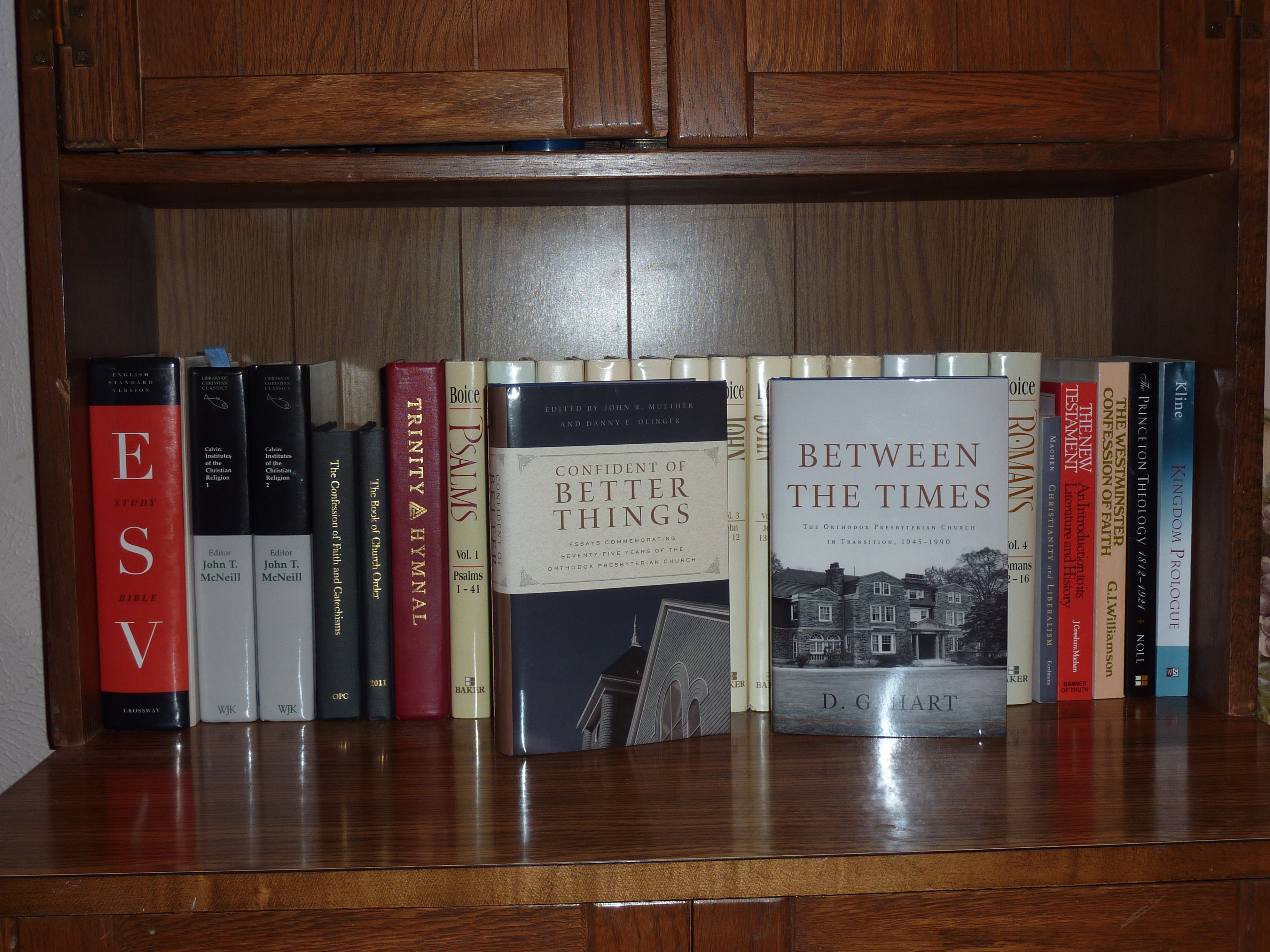
Here’s a helpful paragraph from D. G. Hart’s new history of the Orthodox Presbyterian Church (OPC), released at the 78th General Assembly of the OPC two weeks ago in celebration of the OPC’s 75th anniversary. Here, Hart describes J. Gresham Machen’s reasons for objecting to Princeton Seminary President, J. Ross Stevensons proposal at the 1920 General Assembly of the PCUSA “for a grand plan to unite the largest Protestant denominations into one denomination” (p. 16). Hart writes:
The disadvantage of the plan for union, as Machen and most of his Princeton colleagues pointed out, was that by entering into a united church, Presbyterians would be abandoning those aspects of Protestantism that made them Presbyterian. If predestination, infant baptism, and Presbyterian polity, for instance, were actually revealed in God’s word as true and necessary for faithful witness, how could Presbyterians give away their teaching and practice to join with Baptists, Methodists, Lutherans, and Episcopalians in a generic Protestant church? The other problem with organic union, as Machen argued in a series of articles for church periodicals, was that it was based upon doctrinal indifferentism. Union turned away from serious doctrinal and ecclesiastical differences among Protestants and implied that these were less important than the greater good that a united church could achieve by transforming American society. Opposition to this sort of ecumenism, which was directly linked to the Social Gospel’s goal of ushering in the kingdomof God, was precisely the impetus for Machen’s important book, Christianity and Liberalism (1923). Not only did he argue that Christianity and liberalism were two different religions, and so liberalism needed to be excluded from the church. Machen also showed how American Protestant interdenominational cooperation stemmed from an indifference to Christian teaching and so distorted the gospel into a message of works righteousness.
D. G. Hart, Between the Times: The Orthodox Presbyterian Church in Transition, 1945-1990 (2011, The Committee for the Historian of the Orthodox Presbyterian Church,Willow Grove,PA), pp. 16-17. opc.org/publications.html Check out Hart’s blog, Old Life: Reformed Faith and Practice.
Confessional Creationism
In all my searching and discussing the issue of the interpretation of the days of creation in Genesis 1, Google directed me to a statement from Westminster Theological Seminary declaring the results of their research into the history of how this issue has been treated by the leaders of the Augustinian and Reformed traditions going all the way back to Augustine himself. The statement is called, “Westminster Theological Seminary and the Days of Creation.“
The discussion among Presbyterians revolves around the reasons the Westminster Divines selected the language they did in when they framed the chapter on Creation in the Westminster Confession of Faith. The phrase in question will be highlighted in the following citation:
I. It pleased God the Father, Son, and Holy Ghost, for the manifestation of the glory of His eternal power, wisdom, and goodness, in the beginning, to create, or make of nothing, the world, and all things therein whether visible or invisible, in the space of six days; and all very good.
The question is raised as to why the wording “in the space of six days.” Why not simply “in six days”? The statement explains:
“The paraphrase view is doubtful because if the Standards had intended simply to utilize biblical language, “in six days” would have sufficed and been a more natural choice. The words “the space of,” as the other view above recognizes, seem deliberately chosen as an interpretive or clarifying addition that functions both to affirm and to exclude or negate.
To make the long story short, the statement concludes that the divines intended to exclude Augustine’s view that God created everything instantaneously inspiring the six days, as Calvin described the view (which he did not hold), “for the mere purpose of conveying instruction.” You can read more about this discussion in the statement itself. You can link to it from the title above, and I have also added a link to the page on my “Recommended Sites” page for future reference.
Finally, here’s a quote that sums up the entire issue as they see it. I find it rather helpful:
With Augustine and E. J. Young, the revered teacher of our senior faculty members, we recognize that the exegetical question of the length of the days of Genesis 1 may be an issue which cannot be, and therefore is not intended by God to be, answered in dogmatic terms. To insist that it must comes dangerously close to demanding from God revelation which he has not been pleased to bestow upon us, and responding to a threat to the biblical world view with weapons that are not crafted from the words which have proceeded out of the mouth of God.
The 78th General Assembly of the Orthodox Presbyterian Church Report – Sunday, June 12, 2011
Joe Coker of Pilgrimage to Geneva passes on information about the 75th anniversary OPC General Assembly:
The 78th General Assembly of the Orthodox Presbyterian Church Report – Sunday, June 12, 2011.
Won’t We Leave Behind the Litmus Test of Wooden Literalism?
Nothing tickles me like Hank Hanegraaff’s affinity for alliteration! You remember Hank–he’s the host of The Bible Answer Man (BAM) radio show. I like Hank because he believes that “Truth Matters,” even if he disagrees with the doctrines of grace and is an evidentialist apologist. Some of my more hard core Reformed brethren may think that because of these two issues alone, I shouldn’t waste any more time listening to his show.
Despite occasional disagreements, there are many strengths to BAM and the Christian Research Institute that keep me coming back for more. Hank isn’t politically (or is that “religiously”?) correct–back in 1999, he suffered the slings and arrows of the Evangelical community who were capitalizing on what Hank in his inimitable way called “sensationalism and selling” as they geared up for Y2K for denying it was a danger; much more recently, he broke many hearts by refusing to bow to the golden idol of dispensational premillennialism expounding what he calls “Exegetical Eschatology.”
Well, now he’s cast his lot against the populist view again–this time the issue is the Genesis creation days. I found Hank’s remarks from his introduction to the Friday Bible Answer Man broadcast especially helpful in encouraging us to remember that not everything is a fundamental over which Bible believing Christians must divide. How to interpret Genesis chapter one is one such, in Hank’s words, “in house debate which Christians can debate vigorously without dividing over.”
A couple of comments and then right to our callers. I’ve been getting a lot of questions at the CRI, through social media, through the Bible Answer Man broadcast and otherwise regarding the Genesis creation days. Are they literal? Are they long? Or, are they literary? Of course, there are three dominant schools of thought within Evangelical Christianity regarding the Genesis days of creation.
First, the popular 24 hour view that posits that God created the heavens and the earth in 6 sequential literal days. Therefore a majority of young earth creationists view the earth to be approximately 6,000 years old and consider all death, including animal death, to be a direct function of Adam’s Fall.
Furthermore, there’s a day-age perspective. That perspective posits that God created the heavens and the earth in 6 long sequential day-ages which total billions of years. So, in contrast to the 24 hour perspective, the day-age perspective posits that “nature, red in tooth and claw” is the result of God’s very good creation prior to Adam’s Fall to a life perpetuated by sin and terminated by death.
And then there’s a very noteworthy framework perspective, which holds the seven days of creation are non-literal, non-sequential but nonetheless historical. In concert with the day-age perspective, they view animal death as consistent with the goodness of God’s creation and believe that the age question is settled by natural revelation, in other words, by reading God’s Book of Nature, as opposed to settling it by reading special revelation, in other words, the Bible.
All three perspectives hold to essential Christian doctrine, thus they commonly debate non-essential differences without dividing over them. And I want to park on that for just a second. There are essentials, and as Christians we stand shoulder to shoulder with respect to essential Christian doctrine. The problem is, I think, that a divisiveness has crept into the Body of Christ whereby this age issue has become an acid test for orthodoxy. Therein lies, I think, a substantial problem.
Better that we adhere to the maxim: “In essentials unity; in non-essentials, liberty; in all things, charity.” And then learn—“Iron sharpens iron.”I’ve learned a great deal by reading the presuppositions of the framework hypothesis. I’ve learned a great deal by reading the literature of old earth creationists; I’ve learned a great deal, in fact, my own conversion was radically affected by, the literature of young earth creationism.
Now I have disagreements with old earth creationism, because of the concordism that is apparent there, where you try to take science–modern cosmology, as an example–and fit it into the biblical text such that “he stretches out the heavens” becomes a pretext for Big Bang cosmology. I may agree with Big Bang cosmology, but I certainly don’t think the texts that are used as pretexts should be used in that sense.
I think the same thing is going on by a lot of the texts used by young earth creationism. But at the end of the day this is still an issue that involves debate, not division, so let’s not make it an acid test for orthodoxy, and divide unnecessarily, when, no matter how much time modern cosmologies posit for the age of the earth, or the universe, we don’t have enough time to form a simple protein molecule by random processes much less a living cell. So the real enemy is the evolutionary paradigm which is not only not tenable in an age of scientific enlightenment, but flies in the face of common sense—nothing cannot produce everything. The only logical thing we can say in an age of scientific enlightenment, is “In the beginning God”—an uncaused First Cause is the reason we have the effect of a universe finely tuned for human life.
What’s the Difference?
What’s the difference between the Jesus People of the 1970’s and the Postmodern Liberals of the Twenty-First Century?

Skeptical About Interpretation
I have an unbelieving friend with whom I’ve discussed much about the Christian faith. I admit that, having thoroughly proclaimed the fact of God’s holiness, my friend’s personal sinfulness for which he is accountable to that holy God, and the good news that God’s Son has volunteered to represent sinners like him on the cross so that those who would believe in him would have eternal life, and my friend’s subsequent and persistent resistance of that message in favor of his own relativistic and pluralistic form of non-Christian universalism, I have taken the liberty to go on discussing other matters of “religion and politics,” knowing that many of you would advise against such a practice. I’ve even discussed this point with him as well.
Perhaps I ought to wipe the dust from my feet, but for good or ill, in all the discussions in which we engage on the Bible, occasionally I’ll use the word “interpretation” in a sentence, to which my friend will object in so many words: “You’re not supposed to have to interpret the Bible!” I don’t know if this statement is based on some skeptical school of thought. My Googling has not helped me discover if the current trends in anti-Christian philosophizing and rhetoric, a la Hitchens, Dawkins, Maher, etc., make assertions like this (if any of you know, please comment!), but here are a couple of findings related to this question.
About five years ago, the blog Reformation Theology posted on the distinctive method of interpreting the Bible. In a post called “The Reformers’ Hermeneutic,” we read:
The exegesis and interpretation of the bible was the one great means by which the war against Roman corruption was waged; which is almost the same thing as saying that the battle was basically a hermeneutical struggle. In light of these observations, one could say that the key event marking the beginning of the Reformation occurred, not in 1517, when Martin Luther nailed his theses to the church door in Wittenberg; but two years prior to that, when he rejected Origin’s four-layered hermeneutic in favor of what he called the grammatical-historical sense. This one interpretive decision was the seed-idea from which would soon spring up all the fruits of the most massive recovery of doctrinal purity in the history of the Church. (read more)
Then the Lord, through Google, directed me to this Power Point presentation on “Exegetical Skepticism.” Here’s a bit of what it has to say:
There are so many different ways of interpreting the Bible, how can we be confident that our interpretation is correct?Skeptical Answer: We cannot be confident of our ability to interpret. There probably is one correct interpretation, but we won’t know it even if we have it. . . .So, if we can’t be for sure regarding interpretation, we must deal with probabilities rather than certainty.What kind of interpretation is more likely to represent the text’s original meaning?Answer: The most probable interpretation is the one that is consistent with language and literary genre similar to the ways that people typically used and understood them at the time the texts were written. . . .What are some ways to ‘break-out’ of our own cultural and psychological restraints?a.Ways to ‘breakout’ of our limitationsi.Discussion with other Christiansii.Church Historyiii.Approach the scriptures with humility.iv.Learn more about the history surrounding the Biblical texts.Conclusion:Although interpreting the Bible can be, at times, difficult (just as math, psychology, etc. can be difficult), this doesn’t mean we need to be skeptical about interpretation as a whole. Rather, interpretative difficulties should simply encourage humility and hard work.
Reformed Concept of the Means of Grace

The final question of the April 27, 2011 episode of the Office Hours podcast by Westminster Seminary California, “Ask the Profs,” provided a good summary of the Reformed concept of the means of grace. Precisely at the 22 minute mark, the question was raised by a listener and the helpful answer was provided by Dr. John Fesko. Below I have appropriated some of his summary with a little of my own reflection on the topic in light of the teaching of Scripture.
“Means of grace” was originally a medieval Roman Catholic technical term for the sacraments, teaching that they are the means by which we receive the grace of God. Baptism was the means by which the infused righteousness of Christ was received, and the Lord’s Supper was the means by which the physical body and blood of Christ were received for eternal life.
The Reformers reformed the doctrines, but retained the terminology. First, they emphasized the centrality and priority of the Word of God preached by which God’s grace was received by those who believe, and condemnation received by those who do not believe. The sacraments were likewise means which confirm the grace received by those who believe the Word or condemnation by those who do not believe.
Contrary to Romanism, Reformed theology teaches justification by the imputed righteousness of Christ which is receied by faith alone; thus baptism does not convey the grace by merely submitting to the rite regardless of the recipient’s spiritual condition. Furthermore, Reformed theology agrees with Rome that Christ is present in the elements of the Lord’s Supper, but they disagree on how he is present–Reformed theology teaches that Christ is present via the Holy Spirit, not physically. Thus the efficacy of both sacraments is the work of the Spirit, and not the magical work of a human priest. The benefits of Christ’s redeeming work on the cross are given by the gracious work of the Spirit alone and received by faith alone.
It is interesting to note that Scripture clearly presents the dual truth that grace is received by the believer in the sacramental means of grace, while condemnation is received by the unbeliever who presumes to participate in the sacraments. Consider the following passages:
One may legitimately argue against the use of this passage, due to its questionable manuscript evidence, nevertheless Mark 16:16 emphasizes the necessity of faith for the efficacy of baptism: “Whoever believes and is baptized will be saved, but whoever does not believe will be condemned.” This shows how the believer who is baptized receives the grace by faith, but the one who is baptized but never finally comes to faith in Christ will be condemned.
First Corinthians 10:16 shows the blessings received by those who believe the Word and partake in faith in terms of communion or participation in the body and blood of Christ: “the cup of blessing that we bless, is it not a participation in the blood of Christ? The bread which we break, is it not a participation in the body of Christ?” The following chapter then shows how condemnation is received by those who partake of the Supper unworthily: “Whoever therefore eats the bread or drinks the cup in an unworthy manner will be guilty concerning the body and blood of the Lord” (1 Cor. 11:27).
Thus we see that the Reformed concept of the means of grace is centered around the centrality of the Word of God preached and received through faith alone by the grace of God the Holy Spirit alone. This grace is signified and sealed to the one who believes in the sacraments of baptism and the Lord’s Supper, but condmenation comes to the one who does not believe, even if he is baptized or partakes of the Lord’s Supper.
Misadventures in Fundamentalism
2011 Steerforth Press--Foreword by Bob Scieffer of CBS News
The following is best read aloud in a booming announcer voice 😉
Allow me to introduce you to the book I’ve been anticipating most for the past year–The Shooting Salvationist: J. Frank Norris and the Murder Trial That Captivated America (2011, Steerforth Press–Distributed by Random House. Foreword by Ft. Worth native Bob Schieffer of CBS News). Perhaps you’ll recall how last year I went on and on about a book about J. Frank Norris‘ murder trial. Well, that caterpillar quickly entered its cocoon and the butterfly is soon to be released! July 12 is the scheduled date for Pastor David Stokes’ thorough narrative non-fiction work on one of the most colorful fundamentalists of the early 20th century.
A rising star in the Southern Baptist Convention, J. Frank Norris resolved to spread God’s Word in a populist and sensationalist manner–taking on every villain, real or perceived, that crossed his path–doing battle royal in the most public manner as he could to make a big name, not only for himself, but also for the Savior whose cause he strove to promote. Norris’ tactics however, epitomized the very definition of “misadventure.” A burr in the saddle of local Fort Worth, Texas powerful elites, a sworn enemy of the “liquor interests” and self-appointed defender of the faith against the liberalizing tendencies at his alma mater, Baylor University, almost all agree that J. Frank Norris generated more heat than light. The growing crescendo of sensational exploits on these and other fronts would culminate in devastating tragedy and make headlines across the country when Norris shot an infuriated opponent to his death.
The murder trial of J. Frank Norris in the 1920’s was literally the “OJ Trial” of that generation. A relentless media circus hung on every detail of the trial as they kept the country buying paper after paper to learn the fate of this ambitious religious ringleader. You’ll never believe that a story like this is true. You simply have to read it for yourself!
The Shooting Salvationist: J. Frank Norris and the Murder Trial That Captivated America is available for pre-order at the book’s new website. I’ll also be adding The Shooting Salvationist Blog to my blogroll so we may all keep up with it.
The Reformed Approach to Holidays
As my family experiences its first Easter together as regular attenders of a Reformed church, we are experiencing a distinct difference from the approach our former non-Reformed fundamentalist and evangelical churches have approached it. Following is a couple of paragraphs from an entry on Calvinism from the Encyclopedia of the Early Modern World, by the Gale Group, Inc. This should help us (and you) put the Reformed approach to holidays in general into historical context.
This morning our family is celebrating the resurrection of the Lord Jesus Christ. May this Easter Sunday find you worshiping the risen Lord in your house of worship.
Another distinctive feature of Reformed Protestantism was its remarkably small number of official holidays. Calvin himself saw no need and no scriptural basis for any holiday other than Sunday, and Reformed Protestants usually celebrated extremely few of them. Their most austere churches,GenevaandScotland(or seventeenth-centuryNew England), observed none at all—not untilGeneva’s magistrates overruled their pastors and finally declared Christmas an official holiday in 1694. Such situations were, however, exceptional. The mainstream of established Calvinism, the Reformed churches ofZurich,Bern,France, theNetherlands, and thePalatinate, celebrated four holidays besides Sundays: Christmas, Easter, Ascension Day, and Pentecost; the Dutch and thePalatinatealso added New Year’s Day. Keeping only a handful of holy days marked an enormous departure from Catholic practices, which in most places celebrated anywhere from forty to sixty holidays each year. Other mainstream Protestants were far less radical than Calvinists: Lutherans kept a large number of holy days, while the Church of England became a target for Puritan scorn by observing a total of twenty-seven holidays. Early Massachusetts went further and took the most extreme Calvinist position about the Christian calendar: not only did the colony ban all holidays, but its General Court briefly reformed the “pagan” names of the months as well, dating by “first month,” “second month,” and so forth.
Many Calvinists compensated for this paucity or absence of other holidays with a strict observance of Sunday, almost in an exact correlation.ScotlandbecameEurope’s most notorious example in 1579, when serious punishments were first threatened for Sabbath-breakers; by 1649, they had forbidden such practices as fishing on Sunday.Scotland’s extremely rigid taboos about Sabbath observance lasted far into modern times; it has been suggested that “Thou Shalt Not” made the best title for a history ofScotland, with its longest chapter called “Never on Sunday.” Another specifically Calvinist ritual was the special day of community fasting, proposed by pastors and decreed by secular authorities, usually intended to divert God’s wrath at times of extraordinary danger. We find fast days observed as early as the 1560s by the beleaguered churches of theLow CountriesorFrance, and later in seventeenth-centuryNew England; they remained a feature of Genevan life until the nineteenth century.
John D. Davis on the “Sons of God”

A Dictionary of the Bible, 2nd Edition (1903), John D. Davis, editor
The following is a fascinating Bible Dictionary entry of the biblical useage of the phrase “Sons of God,” with a special treatment on the various interpretations thereof in Genesis 6. The editor of this Bible Dictionary, John D. Davis, was a member of the faculty of the “Old Princeton.” B.B. Warfield himself even contributed a few of the entries in this dictionary as well. It’s written on a very accessible level for laymen to grasp, and now that I have an antiquarian copy of the 1903 Second edition, I’ll be consulting it in my own Bible study, and most likely, this will not be the last you read from it on this blog, as well.
Sons of God
A Dictionary of the Bible by John D. David, Ph.D. D.D., LL.D.
Professor of Oriental and Old Testament Literature in the Theological Seminary, Princeton, N. J.
1898, 1903 by The Trustees of the Presbyterian Board of Publication and Sabbath-School Work.
Pages 701-702
Worshipers and beneficiaries of God…Such was its common Semitic meaning in early times. There is abundant reason to believe that this is its signification in the celebrated passage where it first appears in the Bible. “It came to pass, when men began to multiply on the face of the ground, and daughters were born unto them, that the sons of God saw the daughters of men that they were fair; and they took them wives of all that they chose” (Gen. 6:1-2).
Three interpretations have been proposed. The Sons of God are:
- The great and noble of the earth, and the daughters of men are women of inferior rank (Samaritan version; Greek translation of Symmachus; Targums of Onkelos and Jonathan).
- Angels, who left their first estate and took wives from among the children of men (Book of Enoch, Philo, Josephus, Justin Martyr, Clement of Alexandria, Tertullian).
- Pious men, worshipers of God, who were especially represented by the descendants of Seth. They were attracted by the beauty of women who did not belong to the godly line, married with them, and became secularized (Julius Africanus, Chrysostom, Cyril of Alexandria, Augustine, Jerome).
The first interpretation has no longer any advocates.
In favor of the second, it is asserted that the term denotes angels everywhere else in the O.T. (Job 1:6; 2:1; 38:7; cf. a similar expression Ps. 29:1; 89:6; RV margin; but not Dan. 3:25); that the designation describes angels according to their nature, whereas the ordinary word for angels,mal’akim, messengers, refers to their official employment; and that this interpretation is confirmed by Jude 6 and 2 Pet. 2:4. But that the term relates to the nature of angels lacks proof; it is quite as natural that it should describe angels as worshipers of God. As to the passages in Jude and Peter, to cite them is begging the question, since exegetes point out other references, as Is. 24:21-23. And unless the title be restricted to the special form which it has in the passage under discussion, it is not true that the term denotes angels in all other places where it occurs in the O.T.
- The worshipers of the heathen deity Chemosh are called the people of Chemosh, and his sons and daughters (Num. 21:29; Jer. 48:46).
- When the men of Judah, professed worshipers of Jehovah, took heathen women to wife, Judah was said to have married the daughter of a strange god (Mal. 2:11).
- Moses was directed to say to Pharaoh: “Thus saith the Lord, Israel is my son . . . . . Let my son go” (Ex. 4:22-23).
- “Ye are the children [or sons] of the Lord your God” (Deut. 14:1).
- “They have dealt corruptly with him, they are not his children.” (Deut. 32:5)
- “Is not he [the Lord] thy father?” (Deut. 32:6)
- “The Lord saw it, and abhorred them, because of the provocations of his sons and his daughters” (Deut. 32:19)
- “Ye are the sons of the living God” (Hos. 1:10).
- “When Israel was a child …I…called my son out of Egypt” (Hos. 10:1).
- “Bring my sons from far, and my daughters from the end of the earth; every one that is called by my name, and whom I have created for my glory” (Is. 43:6-7).
- The pious are the generation of God’s children (Ps. 73:15), and Ephraim is his dear son (Jer. 31:20).
Taking a broader survey, and examining Semitic literature other than Hebrew, one observes the same fact. Many a Babylonian styled himself the son of the god whom he worshiped and upon whom he relied for protection and care.
Furthermore, the opinion that the title in Gen. 6:2 means angels is not the earliest view, so far as the records go. The earliest attested interpretation, that of the Samaritan version, regarded the sons of God as men; and later when the angelic theory arose, it was the opinion of a particular school among the Jews, while the more influential party in religious matters still taught that the sons of God were men.
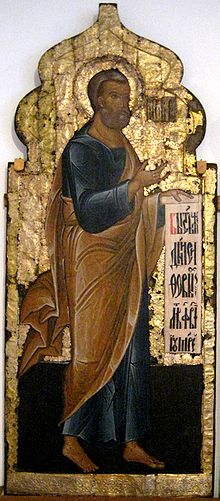
Icon of Seth
The interpretation that the sons of God in Gen. 6:2 were pious people, the worshipers of the true God, more especially that they were the godly descendants of Adam through Seth, whose genealogy is given in Gen. 5, is not only in accordance with Semitic, and particularly biblical, usage of the designation, as already shown, but it is consistent with the context. The sons of God are contrasted with the daughters of men, that is of other men. So Jeremiah says, “God did set signs in Israel and among men;” and the English version supplies the word other before men, in order to bring out the sense (Jer. 32:20). Likewise the psalmist says that the wicked “are not in trouble as men; neither are they plagued like men;” and again the English version supplies the word other (Ps. 73:5). After the same manner Gen. 6:1-2 may be read: “When mankind began to multiply on the face of the ground, and daughters of other men that they were fair; and they took them wives of all that they chose.” The meaning of the writer is that when men began to increase in number, the worshipers of God so far degenerated that in choosing wives for themselves they neglected character, and esteemed beauty of face and form above piety. The offspring of these marriages were perhaps stalwart and violent. Mixture of race in marriage often produces physical strength in the descendants, and lack of religion in the parents is apt to be reproduced in the children. The intermarriage of the sons of God and the daughters of men was offensive in the sight of God. Sentence was pronounced against the wrongdoers. The penalty is not denounced on angels, who were not only implicated, but were the chief sinners, if the sons of God were angels. The punishment is pronounced against man only. Man, not angels, had offended.
Sons of God everywhere in Scripture, from the earliest to the latest times, means the worshipers and beneficiaries of God, both among mortal in immortal beings. But the content of this idea did not remain the same through the ages. It became larger with increasing knowledge of the riches of God. It enlarged, for example, at the time when the Israelites were delivered from Egypt.
- God said: “I have seen the affliction of my people” (Ex. 3:7);
- and again: “Say unto Pharaoh, Israel is my son, my firstborn; who is as dear to me,” so the following words imply, “as Pharaoh’s firstborn is to him” (Ex. 4:22 with 23);
- and again: “I will take you to me for a people, and I will be to you a God” (Ex. 4:7).
Heretofore the title had emphasized a filial relation of men to God, their dependence upon him for protection and care, and their duty of reverence and obedience. Now God formally accepts the obligations which implicitly devolve on him. The content of the title was further enlarged through the teaching of Jesus Christ. He took truths already known, shed light on them, and connected them with this designation.
- He exhibited the fact that God is an actual father and that his people are actual children of God. They are such by the new birth (John3:3,5-6,8; cf. Rev. 11:11),
- begotten of God (John 1:12-13; v.21; and so Eph. 2:5; Jas. 1:18; 1 Pet. 1:23),
- made partakers of the divine nature through the mediation of the indwelling Spirit (John6:48-51; 15:4-5; and so 1 John 3:9),
- and possessing a like character with God, resembling him in holiness, love and elevation above the illusions of earth (1 John 3:9; 4:7; 5:4),
- although falling far short of the divine character in this life (I John 1:8,10).
- They have been adopted as sons (Gal. 4:5), are taught by the Spirit to say Abba, Father (Gal. 6; Rom 8:15), and are led by the Spirit (Rom. 8:14).
Return of the ICBI!

At the 2011 Twin Lakes Fellowship, Dr. Ligon Duncan announced the re-constitution of the International Council on Biblical Inerrancy (ICBI). Chief among their concerns is first to introduce the emerging generation of evangelicals to the true doctrine of the inerrancy of Scripture. So much slander and misrepresentation of this doctrine has been made by those “emerging” and Emergent church leaders that a re-affirmation of what historic orthodoxy has always believed about inerrancy must be broadcast far and wide. The blogger at Green Baggins is in attendance at the Twin Lakes Fellowship and is the one who has alerted me to Duncan’s announcement. He writes,
Some highlights: “If God is a Spirit, then the only way we can know him is if he speaks to us. And if he does not speak truth to us, we have no way of knowing him truly.” [Duncan’s] advice to pastors on how to be of help to our younger brothers and sisters:
- Re-read the classics on the doctrine of inerrancy.
- Walk with seminarians and others through the arguments of the current critics of inerrancy.
- Don’t assume Young Evangelicals own this tradition. Instead, persuade them into it by boht your understanding of the arguments from the critics and the biblical defense against those arguments.
You can read the rest of his comments on Duncan’s announcement in his post, “Twin Lakes and Inerrancy.” You can link to and read the original Chicago Statement on Biblical Inerrancy from my Creeds, etc. page.
Did I mention that I’m excited about this?
The Bible’s Inconvenient Truth

Dr. K. Scott Oliphint (left) with Rev. Joe Troutman (right)
The following was preached on March 6, 2011 by Rev. Joe Troutman, pastor of Mid Cities Presbyterian Church, in Bedford, Texas. This just happened, in the providence of God, to be the weekend after the controversy about which I’ve been posting for the past couple of weeks. The heresy of some becomes an opportunity for the orthodox to proclaim the truths of the Bible with all the more clarity. I hope you find the following words at the same time edifying and challenging.
“Again, the kingdom of heaven is like a net that was thrown into the sea and gathered fish of every kind. When it was full, men drew it ashore and sat down and sorted the good into containers but threw away the bad. So it will be at the close of the age. The angels will come out and separate the evil from the righteous and throw them into the fiery furnace. In that place there will be weeping and gnashing of teeth.” (Matthew 13:47-50 ESV)
The third parable, which is found in verses 47-50, is the longest of the four. There is some similarity here to the first two, but overall it is different. Some commentators group it with the parable of the wheat and the tares because it describes a harvest–a harvest of the sea, as opposed to a harvest of the field. In this parable, Jesus says again, “The Kingdom of heaven is like a net that was thrown into the sea, and gathered fish of every kind. Like the second parable, there is a great search taking place. But instead of a search for a precious pearl, it is a search for fish. This search is being done, it says, by angels.
The first two parables describe men who find the Kingdom, but this parable is about the Kingdom finding men. We may think we found God. We may think that in some way we stumbled across him; that in our search in the marketplace, we have found the pearl of great price. But in reality, the parable shows, Jesus is continuing to tell us that it is God who found us. It is God, the Lord Jesus Christ himself—who sought us out. Jesus said in Luke 19:10, “The Son of Man came to seek and to save the lost.” The value of God’s Kingdom, and the place of God’s elect in it, are so great that the purchase price was nothing less than Jesus Christ himself. It is, in fact, more than you and I could pay. More than we could ever pay. It is a debt that is too great for us. Because God made a covenant with himself to save a people for himself, he was willing to go to any length to procure his people’s salvation. He was willing to give his Son as a ransom for lost sinners like you and me. This is what the Lord was willing to do for all who truly believe.
In this parable, the Kingdom of heaven is compared to a net. Don’t think of a fishing net, don’t think of a net that’s at the end of a pole, that people use to scoop up a fish at the end of a fishing line. Don’t necessarily even think of a net that is cast out into the water. This is a large net. This is a dragnet. This is what may be termed a seine. One of the things my dad, my grandfather, my brother and I would do when we were younger, we had a creek running through the property of our farm, and every so often we would take a seine and we would go, men on one side and men on the other, and go up the creek and catch whatever we could find–turtles, snakes, fish–whatever it was, we would try to catch it. This is the kind of thing that Jesus is describing here in this parable. The angels, the reapers, are catching whatever they can get, and the sorting of the good fish from the bad ones would take place on the shore, which is what Jesus says in verse 48. He says, “When it was full, men drew it ashore, and sat down and sorted the good into containers, and threw away the bad.”
Then he explains this part of the parable in verses 49-50. He says, “So it will be at the close of the age. The angels will come out and separate the evil from the righteous, and throw them into the fiery furnace. In that place there will be weeping and gnashing of teeth.” What is Jesus talking about? He’s talking about the final judgment. He’s talking about when he returns; when he returns as the Savior of his people and the Judge of those who have rejected him. What is he saying will happen? He is saying that some will be kept, and some will be thrown away. There will be a final sorting that takes place: some will be welcomed into glory by their Savior, and others will be cast into hell by their Judge.
This is what Jesus is teaching. Yet if we affirm this, we are in danger, we need to know, as being regarded as radical fundamentalists by most of the people in our society–even by fellow evangelicals. Yet there is an inconvenient truth for those who would deny the existence of hell and eternal punishment in it by the Lord. And this is it: Scripture says it exists! Scripture repeatedly talks about the existence of hell. The weeping and the gnashing of teeth, the casting of those who refuse to believe into hell, Jesus himself–regarded by many on the more liberal side of the church as just a friendly and nice guy, a lovable teddy-bear type of Savior–Jesus himself talks about hell. It is inescapable.
Now we are not to revel in it; it should sadden us that some are lost. And yet, in God’s casting unbelievers into hell, he is glorified. This may be difficult for us, but just because it is difficult does not give us the right to throw this doctrine away. In so doing, we are throwing portions of Scripture away. In Matthew 10:28, Jesus warned his followers not to fear someone who could kill the body but not the soul; he says instead to fear him who can destroy both the body and the soul in hell. In other words, fear God.
The book of Revelation also has something to say about that. It is the place where Satan and his angels and everyone whose name is not written in the Lamb’s Book of Life. It is described in Revelation 21:8 as the lake that burns with fire and sulfur, which is the Second Death. There are many today who are challenging Jesus’ teaching in our passage, and many others that say he will save some and send others to hell, but they are denying God’s Word. If they’re denying that he sends some to hell, they are denying his Word, and they have nothing left to stand on when they make their own pronouncements.
In the photo above, Rev. Troutman is posing with Dr. K. Scott Oliphint, professor of Apologetics and Systematic Theology at Westminster Theological Seminary in Philadelphia, Pennsylvania. He came to town as a speaker at the recent Full Confidence Conference, about which I posted a few weeks ago. In the Q & A Session at the end of the conference, Dr. Oliphint concludes the entire event with some very compelling words on the nature of hell as eternal, conscious torment. I highly recommend you give it a listen as well.


 The Misadventures of Captain Headknowledge
Don’t Engage in Anabaptist Handwringing Over Osama bin Laden
There is quite a debate underway online regarding how Christians should respond to the death of Osama bin Laden. Are we to rejoice over the justice in the death of one who is responsible for the deaths of tens of thousands, most notably the three thousand souls lost on September 11, 2001? Or are we supposed to so major on the fact that “God is not pleased by the death of the wicked” (Ezekiel 33: 11 ) that we should stoically stand by and not “rejoice with those who rejoice,” even though we’ve been previously weeping with them (Romans 12:15)?
The book of Proverbs does read, “When it goes well with the righteous, the city rejoices, and when the wicked perish there are shouts of gladness” (Proverbs 11:10). Furthermore, “When justice is done, it is a joy to the righteous, but a terror to evildoers” (Proverbs 21:15). Methinks the instinct to worry about being too happy over Osama bin Laden’s death is a reflection of the influence of Anabaptist pacifism. It’s pervasive in Western Christianity nowadays. Try not to let it unduly influence you. For an example of what I mean, compare this blogger’s dilemma over how to react. Should he listen to the Anabaptist on the one shoulder, or the red-blooded American patriot chanting “U-S-A!” on the other? That he attributes his angst over the death of a mass-murdering terrorist to Anabaptism shows how this is the application of Anabaptist pacifism. For you Star Wars fans, remember Alderaan? They were a peaceful planet with no weapons, weren’t they? Look what happened to them.
While it is regrettable that Osama bin Laden never repented of his sins and trusted Christ for salvation from sin and the wrath of God—none of us are glad because he’s now suffering eternal conscious torment in hell. We’re relieved with the loved-ones of bin Laden’s and al Qaida’s victims that justice is served. There is no contradiction here.
At Underdog Theology, Warren Cruz takes the approach that our deceitfully depraved hearts may take us down the slippery slope of rejoicing in bin Laden’s eternal destiny though we intended to only rejoice in the temporal justice in his demise. Be that as it may, I’m inclined to take Luther’s approach (HT: Wikiquote):
In other words, don’t let the fact that you may imperfectly rejoice in the justice of bin Laden’s death keep you from so rejoicing. Christ’s perfect righteousness covers the imperfect righteousness of those who trust him.
U-S-A! U-S-A!
Update: For a tad more balanced and scholarly approach to making the same point, try Michael Horton writing for Christianity Today today in “The Death of Osama bin Laden: What Kind of Justice Has Been Done?” Here’s the second of Horton’s three implications of the so-called Reformation doctrine of the Two Kingdoms as it relates to the only event in today’s headlines:
Share this: