Hell Still Exists, Despite Popular Opinion
“No doctrine stands alone. There is no way to modify belief in hell without modifying the Gospel itself,  for hell is an essential part of the framework of the Gospel and of the preaching of Jesus. Hell cannot be remodeled without reconstructing the Gospel message.
“Here is a sobering thought: Hell may disappear from the modern mind, but it will not disappear in reality. God is not impressed by our surveys.”
That’s what Dr. Albert Mohler wrote in his blogpost from Monday, August 18th, entitled, “Remodeling Hell: Americans Redefine the Doctrine.” Yesterday, he followed this up by featuring the topic on The Albert Mohler Program.
As he was introducing the topic, he told a story about a conversation he overheard in a bookstore recently between a customer and a cashier. The customer was purchasing a book by Jonathan Edwards and the cashier registered his recognition of the author by saying, “That’s the guy who preached that sermon on hell.” Then both of them simply, “laughed it off,” to quote Dr. Mohler, who found this a rather striking and telling experience. It is indicative of what recent surveys are telling us about the rate at which Americans in general, and Christians in particular, are losing faith in, or a concept of, the biblical doctrine of hell. Back at his blog, you can link to the Pew Forum’s findings and compare them to another recent Gallup poll.
Here’s an excerpt of Dr. Mohler’s remarks from the program which highlight how hell is “part of the superstructure of Christian truth.” Indeed, hell is part of the bad news of which sinners must be convinced before the good news of redemption by God’s grace through faith in Christ will do them any good.
“We all deserve hell. Adam’s sin–the Fall–explains why we are all sinners, and every sin is an infinite insult against the infinite holiness of God. We are all deserving of hell. Now you see, that is where the modern mentality misleads us. The average person does not believe that he deserves hell. And that’s the problem. If we start from the assumption that we don’t deserve hell, and that our neighbors don’t deserve hell, and that God would be wrong to send us to hell, then we have a fundamental misunderstanding about ourselves, a fundamental misunderstanding about God, and inevitably we will fundamentally misunderstand the gospel. But here is the reality: it is God’s grace to be told you are going to hell. It’s God’s grace; it’s God’s love and mercy that you would be warned of hell and furthermore it is ultimately God’s grace and his mercy demonstrated in the cross of Christ where God made provision for us in his own Son, to provide the just penalty for our sin, so that all who come to Christ by faith, would receive, yes, the gift of everlasting life, will be adoped as sons and daughters of God himself, and, will avoid hell.”
With this in mind, I thought it would be beneficial to review some of the biblical revelation of hell. Let’s start with the biblical vocabulary. In the Old Testament, the Hebrew word Sheol (e.g., Psalm 139:8 ) indicates the grave or the place where all of the dead, righteous or wicked, go. When the Old Testament was translated into Greek in Alexandria, Egypt, the resulting Septuagint translation rendered Sheol with the Greek word Hades, the pagan Greek parallel that made an essentially similar reference to the place where the dead go.
The prophet Jeremiah prophesied in Jeremiah 7:30-34 that Judah would one day be judged in the Valley of the Son of Hinnom, which formed the basis for the New Testament concept of Gehenna as a place of judgment. The International Standard Bible Encyclopedia informs us that “As the concept of the afterlife developed in the intertestamental period, the Valley of Hinnom came to represent the eschatological place of judgment (1 En. 27:1f; 54:1-6; 90:25-27; etc.) or hell itself (2 Esd. 7:36; 2 Bar 85:13)” (p. 423).
The Lord Jesus himself is the source of New Testament revelation about the place the unrepentant dead will suffer the consequences of their sin. Jesus alludes to the Valley of Hinnom in the Sermon on the Mount in Matthew 5 while teaching on anger. “You have heard that it was said to those of old, ‘You shall not murder; and whoever murders will be liable to judgment.’ But I say to you that everyone who is angry with his brother [2] will be liable to judgment; whoever insults [3] his brother will be liable to the council; and whoever says, ‘You fool!’ will be liable to the hell [4] of fire” (Matthew 5:21-22–emphasis mine).
Then again, he refers to it while encouraging his disciples to endure persecution in Matthew 10:28 (cf. Luke 12:5). “And do not fear those who kill the body but cannot kill the soul. Rather fear him who can destroy both soul and body in hell [6]” (emphasis mine). Matthew 18 and Mark 9 contain parallel passages in which Christ urges us in very graphic terms to resist temptation. “And if your eye causes you to sin, tear it out and throw it away. It is better for you to enter life with one eye than with two eyes to be thrown into the hell [3] of fire (Matthew 18:9, emphasis mine). Likewise, James tells us that the tongue is “set on fire by hell” in his epistle as well (James 3:6, emphasis mine). In each of these passages, hell translates the Greek word Gehenna, an allusion to the Valley of HInnom where in New Testament times they were continually burning their trash.
Hades makes a few appearances in the New Testament as well (Matt. 11:23; 16:18; Luke 10:15; 16:23; Acts 2:27, 31; Revelation 1:18; 6:8; 20:13-14). Finally, the Greek word Tartarus shows up in Peter’s second letter describing the deep, dark place where God confined the angels who fell. This term is likewise borrowed from a pagan Greek concept of the underworld, demonstrating how God reveals spiritual truth in terms to which we can relate.
Which raises the question: Is hell a literal place?
Well, of course it is, but literal in which sense? Shall we conceive of hell in the wooden literal sense with which I was raised? Is there a geographical place below the surface of the earth where the souls of the wicked departed are suffering as we speak? This sense actually may contribute in some way to the modern embarrassment about the doctrine of hell. Many excessive things are said and done in the name of a wooden literal sense of hell.
One example I can share from my own youth. Years ago on TBN, someone called the studio from overseas and told Paul and Jan Crouch that his local newspaper reported that some scientists had drilled several miles into the earth’s crust to discover that the drill bit began to spin wildly, indicating that the drill had hit a hollow spot. Then it was said that some of them could hear something intriguing, so the team sent down a microphone to see what they could learn. What they claimed to hear were agonizing and terrifying screams. The scientists feared that they had opened up hell! I happened to subscribe to TBN’s newsletter in which they printed the story from the overseas newspaper. One Sunday morning, my associate pastor was planning to preach on hell, and he wished aloud before the service that he had a copy of that sensational story. I told him that I did, so he asked me if I would mind running home to get it so he could share it with the congregation. Naturally, I was thrilled by the opportunity! It was not until a couple of years later that I would learn on the radio that the newspaper from which the story came was actually a tabloid (you can read more about this popular urban legend at Snopes). Now, not all wooden literalists will be this gullible–this is admittedly an extreme example, but where there are extreme examples, there are also less extreme examples. The wooden literal interpretation of hell is a liability, and may have contributed to the modern embarrassment about hell.
Or shall we conceive of it in the literary sense, allowing the allusions to the fires of the Valley of Hinnom and the Greek references to the deep dark abyss of Tartarus and Hades, the place where the dead go, to be symbols of God’s final, eternal conscious judgment of unbelievers? Would the literary sense undermine the truth of a “literal” hell?
Not in the least. R. C. Sproul, in Essential Truths of the Christian Faith (pages 215-218), suspects that these New Testament references to Gehenna, Hades and Tartarus are symbols (the literary sense), but assures us that this fact gives us no relief from the torment threatened by the symbols. “The function of symbols is to point beyond themselves to a higher or more intense state of actuality than the symbol itself can contain. that Jesus used the most awful symbols imaginable to describe hell is no comfort to those who see them simply as symbols.” Sproul gives a good definition of hell: “Hell, then, is an eternity before the righteous, ever-burning wrath of God, a suffering torment from which there is no escape and no relief. Understanding this is crucial to our drive to appreciate the work of Christ and to preach His gospel.”
Please don’t forget this.
Compromising the Full Humanity of Christ, part 2: Heavenly Flesh
In part one I established that the orthodox interpretation of Scripture regarding the two natures of the Lord  Jesus Christ is that “He is of the same reality as God as far as his deity is concerned and of the same reality as we ourselves as far as his humanness is concerned; thus like us in all respects, sin only excepted” (from the Definition of Chalcedon). I attempted to make the case that if Christ’s blood is “divine” and not the product of Mary’s reproductive system, then his humanity is not of the same reality as we ourselves. Hebrews 2:14-18 makes this clear, for those not looking to read exceptions into the text:
“Since therefore the children share in flesh and blood, he himself likewise partook of the same things, that through death he might destroy the one who has the power of death, that is, the devil, and deliver all those who through fear of death were subject to lifelong slavery. For surely it is not angels that he helps, but he helps the offspring of Abraham. Therefore he had to be made like his brothers in every respect, so that he might become a merciful and faithful high priest in the service of God, to make propitiation for the sins of the people. For because he himself has suffered when tempted, he is able to help those who are being tempted” (Hebrews 2:14-18 ESV).
The first sentece of this passage specifies that Christ partook of the same flesh as humans and that he partook of the same blood as humans. Adding to this it goes on in verse 17 that his partaking of human flesh and blood was the way in which he could be a merciful and faithful priest who can propitiate God for the sins of the people, specifically, “his brothers” “the offspring of Abraham” (other parts of the New Testament would call these people “the elect,” but that’s a whole ‘nuther post–on Limited Atonement!!!). This means that if his flesh and his blood aren’t entirely human–specifically, not the product of Mary’s reproductive system, then he couldn’t truly empathize with us. The writer of Hebrews even underscores this by saying that Jesus didn’t come to help angels, but humans. If his blood was divine, then it could be said that Christ may not have been made “a little lower than the angels.” At the very least, if it was divine blood and heavenly flesh, he would have been somewhere between angels and humans and not genuinely on the human level and exception could then have been taken against his attempt to propitiate God on behalf of the elect children of Abraham.
I hope you can see now how important it is that Christ be regarded by Christians as one hundred percent human–utterly human right down to the last drop of Abrahamic, Judaic, Davidic, Marian blood. The full divinity and full humanity of Christ joined in one person is a doctrine so important that it has bearing on Christ’s ability to reconcile God to sinners, and this is the reason that in the fifth century, an ecumenical council had to be convened in Chalcedon to search the Scriptures more closely as a worldwide church to settle once and for all just how divine and how human Christ is. But naturally, just because a council rules against a heresy, that doesn’t mean the errant tendency is forever universally squashed. Those who refuse to learn the lessons of history repeat its mistakes in every generation; in the post-apostolic era, the medieval era, the Reformation era, as well as the modern era. Such is the case with the divine blood error, and such is also the case with the heavenly flesh error.
The Reformation era Anabaptistic doctrine of the heavenly flesh of Christ enters the history books due to the influence of arch-Anabaptist, Melchior Hoffman. The Elwell Evangelical Dictionary gives a concise summary of Hoffman’s distinctive doctrines as well as his several historic misadventures. The Anabaptists in general, called the radical reformers, thought Zwingli, Luther and Calvin didn’t go far enough in reforming the catholic faith because they insisted on making sure the doctrine they reformed was consistent with the ecumenical catholic creeds of the first 500 years of church history. The Anabaptists opted to reinvent the wheel from scratch with their Bible and their inner light or divine spark within. That’s why a man like Melchior Hoffman could go blur the line between Christ’s two natures and help preserve such unorthodox interpretation for future generations.
I’m not aware if the Independent Baptists with which I spent the first twenty years of my spiritual life taught the modern fundamentalist concept of the heavenly flesh of Christ or not, but during the nine years I spent at CBC, the doctrine was repeated early and often. One proof text provided the spring board for propagating this doctrine: Hebrews 10:5; specifically, the phrase, “a body thou hast prepared me.” The idea went something like this: God’s “preparing a body” for Christ means that God specially created the body of Jesus in heaven and the Holy Spirit inserted it in Mary’s womb, which body she carried to term, much like a modern surrogate mother. I can’t say with certainty who it was that passed this interpretation on to the leadership of CBC, but my suspicion is that the source is someone like Peter S. Ruckman. However, there is no way for me to know now. But writers of his persuasion revel in the unhistorical assertion that Baptists aren’t Protestants, so when they find a proof text for a teaching that differs from the historic orthodox Protestant view, promoted by someone with whom they presume a link due to their doctrine of Baptist successionism, they are liable to take full advantage of it. Having this doctrine taught out of this text, I could tell they weren’t doing justice to it, but at the time I couldn’t figure out how to compete with the interpretation, so I left all criticism of it on the back burner.
But for starters, let’s think about the immediate context. The first ten verses of Hebrews 10 constitute one section, or pericope. The big idea of this pericope is the temporary nature of Old Covenant animal sacrifices and the once-for-all-time effectiveness of the sacrifice of the body of Christ. When verse five quotes Psalm 40:6, it is quoting the reading that is found in the Septuagint, as you will notice a difference in the wording of your English Old Testament, a translation of the Masoretic Text, In the KJV, the phrase is translated “mine ears hast thou opened,” and in the ESV, it reads, “but you have given me an open ear (the more literal alternate reading in the footnote is, “ears you have dug for me.”). “In the Septuagint . . . , which Hebrews follows, this psalm speaks of the readiness of the whole person (‘the body’), not just a part (the ‘ears’) of the person. Thus, the ‘body prepared for me’ refers to Jesus’ readiness to become human and to suffer death on our behalf. (2:14; 5:8). See WSC 22” (NIV Spirit of the Reformation Study Bible footnote on Hebrews 10:5). The main idea of verse 5 is Christ’s readiness to offer himself, rather than information regarding the constituent nature of Christ’s human body.
After I adopted Reformed theology, and came to the conclusion once and for all that the Baptist Successionist view is incapable of accurately handling the facts of history, and is not the true history of the Baptist tradition, I was searching the web one day for reading on Baptist history and found an interesting essay called “A Primer on Baptist History: The True Baptist Trail,” by Chris Traffanstedt. In this essay, under the heading of “Anabaptist Influence,” Traffanstedt writes, “They [the Anabaptists] also believed that Christ did not take His flesh from Mary but held to a heavenly origin for His flesh.”
This naturally reminded me of my former pastor’s frequent flawed exposition of Hebrews 10:5. This is what lead me to the conclusion that he was following this doctrine because it is not the view of the “Protestant” reformers, but of the “baptistic” ones. For example, if you were to ask an ordinary, non-Reformed Baptist nowadays, whether they thought Christians ought to give any credence to the early ecumenical catholic creeds which deal with Trinitarian or Christological issues, many will likely say no. Others, who are more on the ball, may say that they would affirm its trustworthiness as long as it squared with Scripture, but, of course, being Baptist, they would accept no obligation to recognize it as authoritative in any, not even a secondary, way. Either response exhibits a willingness to completely disregard statements such as the Definition of Chalcedon, much like the Anabaptists did.
Primitive Baptist E. A. Green, has posted a helpful article called, “Heavenly Flesh,” drawing from Harold O. J. Brown’s book, Heresies: Heresy and Orthodoxy in the History of the Church. The following excerpt from Green’s essay brings into focus the historical and theological issues:
The novel Heavenly Flesh concept, known also as Celestial Flesh, emerged among independent groups. In retrospect it could be argued that their apparent lack of interest in the creeds left them vulnerable to old errors. Harold O. J. Brown observes:
“Abandoning the distinctive two-natures formula of Chalcedon, the radicals were free to deal with the implications either of humanity or of deity without having to worry about the other. A smaller number reverted to an Arian or adoptionistic view of Christ, and the first stirrings of the modern heresy of Unitarianism began. A larger group emphasized the deity of Christ’s being to such an extent that the humanity seemed to disappear; in this they had much in common with the early Monophysites, although they usually lacked their theological sophistication.” [HERESIES; pg. 327]
The Heavenly Flesh concept emerged as a Reformation-era explanation to the theological problem of the sinlessness of Christ. Centuries earlier the Catholics had responded to the same problem with the doctrine of The Immaculate Conception of Mary. The radicals argued, like the Roman Catholics, that if Jesus was born of a mother tainted with sin, he could not himself have been sinless. Their argument went on to explain that while Jesus was begotten and carried “in” Mary’s womb, he was not born “of” her; he did not derive his flesh from her. Hence, the heavenly origin of Jesus’ flesh.
And hence, the source of Christ’s sinlessness. This is the concern of modern fundamentalists and evangelicals who hold to modern forms of the divine blood and heavenly flesh teachings. How unfortunate it is that they would rather go outside the bounds of orthodoxy to protect Christ’s sinlessness, than remain in it and risk being called “catholic.” That’s what I call falling out of the frying pan into the fire.
Compromising the Full Humanity of Christ, Part 1: Divine Blood
 One of the benefits of broadening one’s theological horizons is that he can learn where the boundaries of orthodoxy lie and can begin to discern when the doctrine he’s being taught remains safely within, or begins to cross, the orthodox boundaries.
Case in point: Heavenly Flesh & Divine Blood.
What am I talking about? Does this have something to do with the Lord’s Supper? No, it does not. It has to do with parallels with ancient Christological heresies as well as the Radical Reformation in some corners of modern fundamentalism. Namely, the corner from which I emerged into Reformed theology.
The independent fundamental Baptist (IFB) church to which I used to belong supported a small Bible institute based in my home town. A close family friend from this church is a graduate of this school. He now pastors another church, and I have regular contact with the associate pastor. This associate once told me that his church no longer fellowships with the Bible institute in question since it merged with another more established Bible college for two reasons: one, the school’s getting taken over by so-called “Hyper-Calvinists“; and two, one of the instructors teaches that Christ got his body from Mary. Some of you may be wondering, “And the problem with this is . . .?” But others of you may know where I’m going.
Where I am going is to the teachings in vogue among some independent Baptists, among others, I suppose, regarding the source of the body of Christ, and the nature of the blood of Christ.
The Chemistry of the Blood
One popular teaching was popularized by Dr. M. R. DeHaan, founder of Radio Bible Class (now RBC Ministries), a physician turned pastor and radio preacher, who applied his medical knowledge to his doctrine of the sinlessness of Christ to promote what he called, “The Chemistry of the Blood.” Here’s an excerpt from sermon four in his book of the same title:
“THE VIRGIN BIRTH
“Passing strange, is it not, that with such a clear record anyone can deny that the BIBLE TEACHES THE VIRGIN BIRTH. We can understand how men can reject the Bible record, but how men can say that the Bible does not teach the VIRGIN BIRTH is beyond conception.
“The Bible teaches plainly that Jesus was conceived in the womb of a virgin Jewish mother by a supernatural insemination of the Holy Ghost, wholly and apart from any generation by a human father. This the Bible teaches so plainly that to the believer there is no doubt. The record cannot be mistaken by the enlightened and honest student of the Word.
“JESUS SINLESS
“The Bible teaches in addition that Jesus was a SINLESS man. While all men from Adam to this day are born with Adam’s sinful nature, and, therefore, are subject to the curse and eternal death, the Man Jesus was without sin and, therefore, DEATHLESS until He took the sin of others upon Himself and died THEIR death. Now while Jesus was of Adam’s race according to the flesh yet He did not inherit Adam’s nature. This alone will prove that sin is not transmitted through the flesh. It is transmitted through the blood and not the flesh, and even though Jesus was of the “Seed of David according to the flesh” this could not make him a sinner.
“God has made of ONE BLOOD ALL THE NATIONS of the earth. Sinful heredity is transmitted through the blood and not through the flesh. Even though Jesus, therefore, received His flesh, His body from a sinful race, He could still be sinless as long as not a drop blood of this sinful race entered His veins. God must find a way whereby Jesus could be perfectly human according to the flesh and yet not have the blood of sinful humanity. That was the problem solved by the virgin birth.
“ORIGIN OF THE BLOOD
“It is now definitely known that the blood which flows in an unborn babies arteries and veins is not derived from the mother but is produced within the body of the fetus itself only after the introduction of the male sperm. An unfertilized ovum can never develop blood since the female egg does not by itself contain the elements essential for the production of this blood. It is only after the male element has entered the ovum that blood can develop. As a very simple illustration of this, think of the egg of a hen. An unfertilized egg is just an ovum on a much larger scale than the human ovum. You may incubate this unfertilized hens egg but it will never develop. It will decay and become rotten, but no chick will result. Let that egg be fertilized by the introduction of the male sperm and incubation will bring to light the presence of LIFE IN THAT EGG. After a few hours it visibly develops. In a little while red streaks occur in the egg denoting the presence of Blood. This can never occur and does never occur until THE MALE SPERM HAS BEEN UNITED WITH THE FEMALE OVUM. The male element has added life to the egg. Life is in the blood according to scripture, for Moses says: “For the life of the flesh is in the blood. . . For it is the life of all flesh; the blood of it is for the life thereof” (Leviticus 17:11, 14).
“Since there is no life in the egg until the male sperm unites with it, and the life is in the blood, it follows that the male sperm is the source of the blood, the seed of life. Think it through.”
DeHaan’s logic can be summarized in the following syllogism:
The life of the flesh is in the blood; there is no life or blood in the unfertilized female egg until the introduction of male sperm; Mary conceived Jesus by the Holy Spirit without the introduction of human male sperm; Jesus was sinless; therefore, sin is transmitted through the blood which comes from the human father.
Christian Orthodoxy and the Full Humanity of Christ
I submit that modern medical science bolstering a superficial interpretation of Scripture in the name of proclaiming the sinlessness of Christ compromises the historically orthodox doctrine of the full humanity of Christ. The orthodox interpretation of Scripture regarding the full humanity of Christ was encapsulated in 451AD at the Council of Chalcedon. This council was convened to correct two errors in vogue at the time which compromised the full humanity and the full deity of Christ. One was Nestorianism, which saw Christ’s divine and human natures as so separate that they constituted two separate persons; the other, the Monophysite heresy, taught that Christ’s two natures were so united that they were one single divine/human nature, two varieties of which are Eutychianism and Apollonarianism (for links, see below). Nestorianism and Eutychian Monophysitism both led the church in the fifth century to return to the drawing board of Scripture and look more closely at the passages relevant to the two natures of Christ, and they published their conclusion in a document called “the Definition of Chalcedon.” It’s only a two paragraph statement, so I’ll cite it in full from Phil Johnson’s Hall of Church History:
Definition of Chalcedon (451 AD)
“Following, then, the holy fathers, we unite in teaching all men to confess the one and only Son, our Lord Jesus Christ. This selfsame one is perfect both in deity and in humanness; this selfsame one is also actually God and actually man, with a rational soul <meaning human soul> and a body. He is of the same reality as God as far as his deity is concerned and of the same reality as we ourselves as far as his humanness is concerned; thus like us in all respects, sin only excepted. Before time began he was begotten of the Father, in respect of his deity, and now in these “last days,” for us and behalf
of our salvation, this selfsame one was born of Mary the virgin, who is God-bearer in respect of his humanness.
“We also teach that we apprehend this one and only Christ-Son, Lord, only-begotten — in two natures; and we do this without confusing the two natures, without transmuting one nature into the other, without dividing them into two separate categories, without contrasting them according to area or function. The distinctiveness of each nature is not nullified by the union. Instead, the “properties” of each nature are conserved and both natures concur in one “person” and in one reality <hypostasis>. They are not divided or cut into two persons, but are together the one and only and only-begotten Word <Logos> of God, the Lord Jesus Christ. Thus have the prophets of old testified; thus the Lord Jesus Christ himself taught us; thus the Symbol of Fathers <the Nicene Creed> has handed down to us.”
As long as Christians have interpreted Scripture within the bounds of the definition of Chalcedon, it has historically been regarded as orthodox: Christ’s humanity must be regarded as completely human. But if the Lord Jesus’ blood wasn’t the product of Mary, but was “divine blood” as DeHann heads a later subset in his sermon, then the Lord Jesus isn’t fully human, but his full humanity is compromised when his blood is put in a category distinct from that which flows through all of our veins. If his full humanity is brought into question, then so can his ability to represent us before the Father, being “man to God” as well as “God to man.” Someone posted a theological article in the NIV Spirit of the Reformation Study Bible which does a good job of presenting the importance of Christ’s full humanity.
Repeating the Mistake of Apollinarianism
The other Monophysite heresy which compromises the full humanity of Christ is called Apollinarianism. Since I’ve already written an excessively long post, I’ll just link you to some helpful reading on this heresy and how modern fundamentalist notions about the blood of Christ which compromise his full humanity parallel the spirit, if not the letter, of Apollinarianism. I recommend “Divine Blood” by E. A. Green; “Apollinaris of Laodicea” by Wikipedia; and finally, “Apollinarianism” from the Catholic Encyclopedia, featured at New Advent. To be clear, modern indpendent Baptists do not go to the extremes to which Apollinarianism and Eutychianism go in confusing Christ’s divine and human natures. But the fact remains that by their general refusal to consult the ancient ecumenical creeds which define the orthodox biblical Christology, they doom themselves to repeating the mistakes of history, having not learned from the correction of these mistakes at Chalcedon.
In part two, I’ll discuss how some Independent Baptists repeat the Anabaptist error known as the Heavenly Flesh of Christ.
Preach the Word!
- Preach the Word!
The following is a Captain Headknowledge rerun from February 12, 2006.
The Scriptures just handed me another blade with which to continue my ongoing crusade to reintroduce the Gospel to Evangelicalism. I was listening to the book of 1 Peter on CD, when I heard that Peter writes that we were born again through the living and abiding word of God, he ended the passage clarifying what the “word” is that gave us new life: “And this word is the good news that was preached to you” (1 Peter 1:25b).
“And this word is the good news that was preached to you” (1 Peter 1:25b)
I’ve been amazed in the past couple of years how deaf the ears are on which this message falls. The constant reply to my constant pleas that every sermon should always be explicitly built on the foundation of the Gospel of the sinless life of Jesus, the death of Jesus because of our sins and the resurrection of Jesus because those who come to faith are justified is that “we are to preach ‘the Word’.
“And this word is the good news that was preached to you” (1 Peter 1:25b)
What my dear brethren mean is that we should preach the “whole counsel of God.” We should preach more than just the Gospel, the Bible talks about all kinds of other things than just the Gospel, if we always preach the Gospel, we won’t have time to preach the rest of the Bible. What they miss is that I’m not talking about preaching the Gospel instead of the rest of the Bible, I’m talking about (and so did the Reformers, who recovered the Gospel out of the ash heap of Romanism, the “Founding Fathers” of “Evangelicalism”) preaching all of the Bible in context.
What is the context? The Gospel.
Everything that comes before the sinless Christ crucified and risen for sinners points to and reaches its pinnacle and therefore its ultimate point in the sinless Christ crucified and risen for sinners; likewise, everything that is revealed in Scripture after the sinless Christ crucified and risen for sinners (you know, all that “practical” and “relevant” stuff) flows out of and is built on the foundation of the sinless Christ crucified and risen for sinners.
If we talk about everything that leads up to the Gospel but leave out any explicit reference to the Gospel as the point of that material, and get off on things other than that ultimate point, then we are not preaching the Word.
“And this word is the good news that was preached to you” (1 Peter 1:25b)
If we talk about all that practical stuff that is built on the foundation of the Gospel and flows from the source of the Gospel, assuming everyone understands that the Gospel is the source, foundation and reason we do these things, then we are not preaching the Gospel, because I don’t care how long people have been involved in church, if they don’t get reminded constantly (in every sermon) that all that stuff they are to do which is taught in Scripture is founded on, has it source in, and is done because of, and by the power of the Gospel, the Power of God for Salvation to Everyone who Believes, then they’re going to wind up doing it by their own power and for their own reasons. And therefore, the Word hasn’t been preached.
“And this word is the good news that was preached to you” (1 Peter 1:25b).
Theological Word of the Day
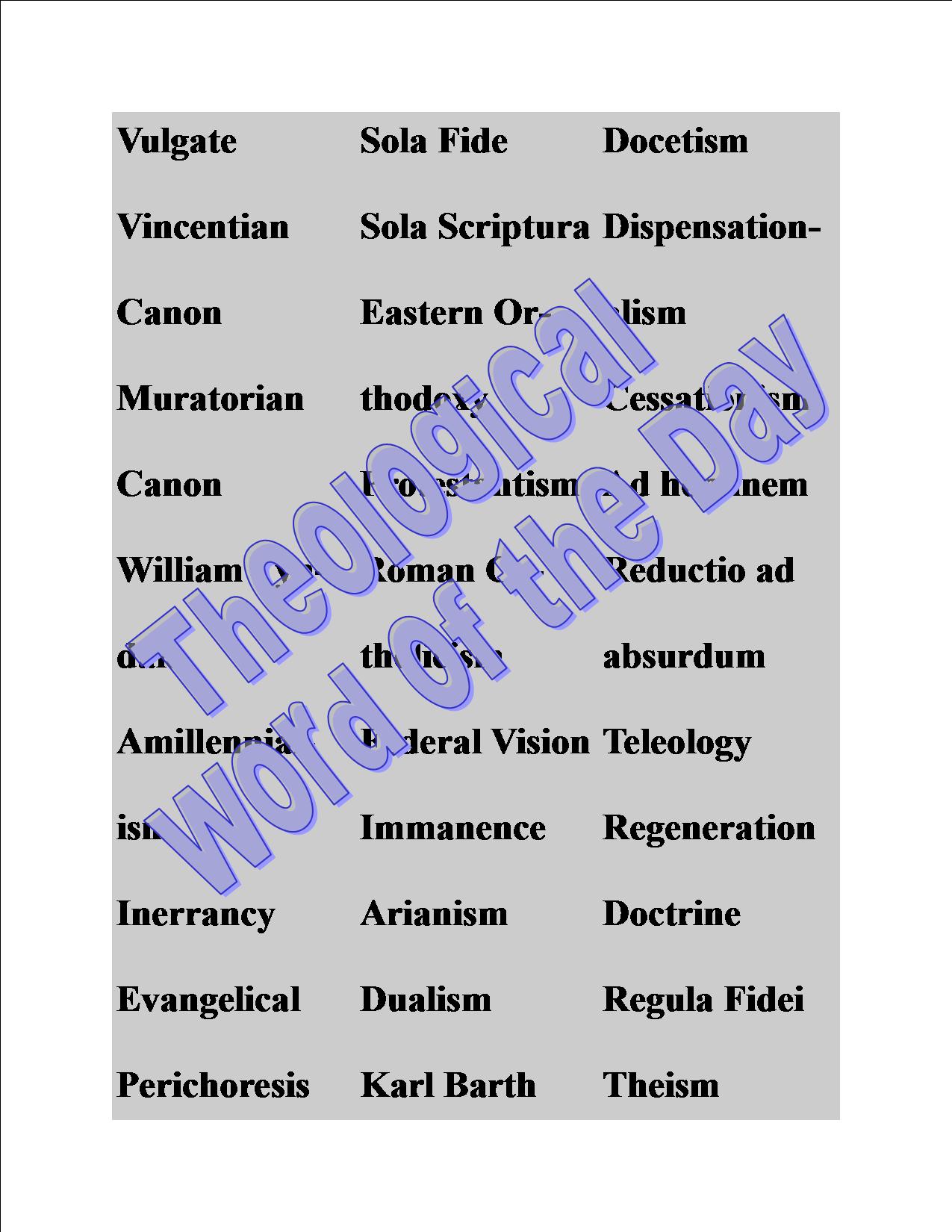 A new feed has been added to the Daily Evangel in the sidebar: The Theological Word of the Day, brought to you by Reclaiming the Mind Ministries and Christians in Context. Just another service to keep the world safe for theological literacy.
I’m from Geneva, and I’m here to help!
Chinese Christian Headknowledge

Christian History & Biography, Spring 2008
Read the feature article from the Spring 2008 issue of Christian History & Biography, called, “Christianity Fever.” It’s about how “Through a century of political turmoil and disillusionment, waves of Chinese intellectuals have come to Christ.” We Western Christians must remember we’re losing our central post in global Christiainity. Learn a little about what’s going on elsewhere in terms of revival, and begin praying for reformation.
Happy Birthday, John Calvin

On this day, July 10, in 1509, John Calvin was born.
I wasn’t aware until I noticed Justin Taylor’s link to John Piper’s blog in which he recognizes Calvin’s 499th birthday with a focus on Calvin’s prodigious output of Scriptural exposition (on which, see here), from which all Protestant Christians have benefited immensely (whether they realize it or not).
You may also find something to enjoy from the Calvin College website. The Calvin Alumni Association recognizes Calvin’s birthday each year. Here’s the archives of their celebrations.
Do what you can to raise awareness of John Calvin and the amazing theology he represents (not invented out of whole cloth!). You might start by buying this T-Shirt from my friend, David Jacks at Theological Pursuits Bookstore in the shadow of Southwestern Baptist Theological Seminary in Fort Worth, Texas. David’s Reformation Shirts are the classiest Reformed Ware on the web, in my humble opinion. He’s got a great selection!
Historical Revisionism in Defense of the Prosperity Gospel
 Ever heard of H. Vinson Synan? He’s an important Pentecostal historian, according to Wikipedia. He earned his credentials by being the first to conclude based on the facts of history that the Pentecostal movement is rooted in Wesleyan Holiness theology. This conclusion has apparently been affirmed by his peers who have checked his sources and found a there there. This is the view I’ve always heard about Pentecostal origins. I guess Synan is a scholarly force to be reckoned with.
This past week, however, on Kenneth Copeland’s daily television show, the Prosperity preacher extraordinaire has been interviewing Doug Wead, former member of George H. W. Bush’s staff, a presidential and religious historian who has written a few books and earned some experience researching history for himself. Wead is speaking out against Senator Grasseley’s investigation into the financial goings on of six major Prosperity Gospel ministries, which may have some basis, considering this is the nation built in part on the ideal of absolute religious liberty. Of course, it’s not the theology the government’s worried about, but rather the extravagent lifestyles of the heads of these supposedly non-profit organizations.
Well, as Wead was discussing issues related to the above, he blew my mind with a little historical revisionism, apparently hoping to legitimize the prosperity gospel by being able to say this doctrine doesn’t come from Copeland or Hagin or Creflo Dollar (which is the greatest last name for a prosperity preacher, if you ask me!) He said there is historical precedent for the prosperity gospel in the wealth of the medieval Roman Catholic church until St. Francis began teaching something a little less prosperity-minded. This fascinated me, because I recall in Hank Hanegraaff’s book, Counterfeit Revival, how that the Holy Laughter revivalists pointed to ecstatic outbursts of laughter and barking and what not in the revival meetings of the First Great Awakening to legitimize the same phenomena among their number nowadays. Hanegraaff pointed out in his book, though, that there was a little detail overlooked by the Holy Laughter crowd–how that Wesley and Edwards and Whitefield, et al, viewed these phenomena as inappropriate, and made efforts to curtail such disorderly outbursts.
So, the tradition continues in relation to the prosperity gospel! I looked up Doug Wead’s website and contacted him by email to inquire into more detail about such claims. After all, he just touched on it on Copeland’s show. Wead told me he read an article by Synan which mentioned this association. So, naturally, my first trip was to Wikipedia, to find out what information the online community has collected there about this seemingly important historian. You can read all about him here.
So, after reading up on Synan, I went back to one of Wead’s blogs, and did a search for Synan or prosperity theology related blogging, and I hit paydirt. Wead had recently posted on his blog an article by H. Vinson Synon on “What’s so attractive about the Prosperity Gospel?” If you haven’t had your credulity stretched lately, I recommend this read as a good opportunity to catch up for lost incredulity. Suffice it to say, medieval Romanism is just the tip of the iceberg of prosperity preaching in church history, if you ask Synan. Read the article and then join me in telling Doug and his readers what you think and then come back here and share your thoughts with me, too. I only wish I could snap a picture of the look on your face when you see what Prosperity history has in store for you!
A New Project to Assist the Global Church!
 I just read a great post over at Ligonier Ministries’ blog and viewed a promotional video about Gospel Translations, a wikipedia-like resource by Open Source Mission translating donated theological materials into many foreign languages in an attempt to make sound theology more accessible to the majority of Christians nowadays–the ones who happen to currently reside outside the European and North American realm. I’ve been concerned about this for some time, and am excited to see a new effort underway! Another seemingly worthwhile effort is Third Millennium Ministries. See what your church can do to support such worthwhile efforts, and save the growing Christian world from the pernicious influence of Word of Faith theology that is pumped into developing nations through TBN and their brood of false teachers!
Theological & Doxological Meditation #45
 Q. Which is the first commandment?
A. The first commandment is, You shall have no other gods before me (Exodus 20:3).
Holy, holy, holy! Lord God Almighty!
Early in the morning our song shall rise to thee.
Holy, Holy, holy! Merciful and mighty
God in three Persons, blessed Trinity!
Holy, holy, holy! All the saints adore thee,
casting down their golden crowns around the glassy sea;
cherubim and seraphim falling down before thee,
who wert, and art, and evermore shalt be.
Holy, holy, holy! Though the darkness hide thee,
though the eye of sinful man thy glory may not see,
only thou art holy; there is none beside thee
perfect in pow’r, in love, and purity.
Holy, holy, holy! Lord God Almighty!
All thy works shall praise thy name in earth and sky and sea.
Holy, holy, holy! Merciful and mighty!
God in three Persons, blessed Trinity!
#100 Trinity Hymnal; Reginald Heber, 1783-1826; NICEA 11.12.12.10.; John B. Dykes, 1861
John MacArthur Makes the Rounds
Last year I heard John MacArthur on his radio show, Grace to You, talk about his philosophy of preaching. He believes that the deeper he goes in exposition, the higher it can lift up the hearers in worship of God. MacArthur has dug until he hit paydirt in his latest book, A Tale of Two Sons: The Inside Story of a Father, His Sons, and a Shocking Murder. This book is an exposition of the most famous of Jesus’ parables: The Prodigal Son (Luke 15:11-32). In his exposition, MacArthur goes into the background cultural implications of the words of the parable to show that at every point in the action, the story is geared to offend the sensibilities of the original Jewish hearers. Being a culture steeped in their focus on honor and shame, this parable stirs up the Jews, interrupts them in their honorable comfort zones and forces them to grapple with a concept of God that is willing to suffer the shame of filthy, worthless sinners who come to repentance. In fact, he takes great joy in doing so!
To make the long story short, MacArthur points out that the Father represents Jesus in the parable, the Prodigal Son represents the tax collectors and sinners who’d just gathered to hear Jesus speak (Luke 15:1), and the older brother represents the Pharisees (v. 2). In the two parables preceding that of the Prodigal Son, Jesus highlights the joy God takes in recovering lost sinners. MacArthur points out that Pharisees, by contrast, take no joy in the repentance of shameful sinners, but rather, take joy in the recovery of lost sheep and coins ($$$!). These themes show up in spades in Jesus’ “Inside Story of a Father, [and] His Sons.”
The worship begins when, after hearing how the son’s shameful demad for his inheritance, his subsequent prodigal living and his rock bottom experience communing with shameful swine and his eventual determination to return to his Father, MacArthur compares the compassionate, watchful father who runs through the village in the most shameful way possible [by (1) lifting his robe so he can (2) run (!)] to protect his repentant son from the violent mistreatment he would have certainly received from the honorable local citizenry, to Jesus, who, being the most Honorable of them all, suffered the shame which my shameful behavior has incurred, so he could rejoice over my repentance and return to his loving embrace! You gotta read this book, or at least look up the series on the radio show, repent of your sins and worship Christ who has given and suffered so much for you.
Now that this book is available, naturally, MacArthur has to promote the book. That’s what brought him last Friday to Crossroads Christian Church in Grand Prairie, Texas. I took the opportunity of accompanying my wife to the event to hear him preach all of the above, and then some, for just over an hour (as is his usual habit). Following, are a few pictures from the event:



The Church of Oprah, Nineteenth Century
 With all the hubbub about Oprah and her latest guru, Eckhart Tolle (personally, I prefer, “Tolle Lege“), I’ve been doing a little digging about “spirituality.” If you’ve read Christianity in Crisis by Hank Hanegraaff, then you’ve heard of Phineas Parkhurst Quimby. He is likely the ultimate source of the errors and heresies of the Word of Faith theology of T. L. Osborn, Kenneths Hagin & Copeland, Oral Roberts, John Avanzini, Robert Tilton, Creflo Dollar, T. D. Jakes, Joel Osteen, Joyce Meyer and John Hagee.
He’s also the ultimate source of the theologies of the New Thought Movement. Wikipedia summarizes New Thoughts basic beliefs as follows:
By the end of the 19th century, the chief tenets of New Thought had become stabilized:
- Infinite Intelligence or God is omnipotent and omnipresent.
- Spirit is the ultimate reality.
- True human self-hood is divine. (Christ Consciousness)
- Divinely attuned thought is a positive force for good.
- Most disease is mental in origin.
- Right thinking has a healing effect.
From its initial emphasis on the healing of disease, New Thought had developed into an intensely individualistic and optimistic philosophy of life and conduct.
Can you see the ties between New Thought and Word of Faith?
 Had Oprah been around back in the nineteenth century, she’d’ve had Phineas Parkhurst Quimby on her show. . .
Does It Take A Village?
 Yesterday, I subscribed to the podcast for The Village Church. I had noticed their statement of faith was adopted from that of Sovereign Grace Ministries, the network of Charismatic Calvinist churches founded by C. J. Mahaney, author of Living the Cross-Centered Life, (a book I highly recommend) among other titles. The Village Church is not listed among the Texas Sovereign Grace churches at the network’s website, so I suppose it’s safe to say that to look at one is not necessarily to look at the other, if you know what I mean. But, then again, that may not necessarily be so, either.
After I subscribed to the podcast, I took a long walk and listened to a “talk” explaining the philosophy of ministry at The Village Church. Before Josh delved into the “philosophy” he attempted to lay a theological foundation for it. I’ll give you the passages in the theological foundation:
- The Incarnation of the Word John 1:1-2, 14
- The Mission:
- It’s Authority Matthew 28:19-20
- It’s Scope Acts 1:8
- How The Gospel Spreads “. . . and in chapter 7, a man named Stephen comes before the courts and they are trying him and he preaches a fantastic sermon as they pelt him with rockds. And Stephen is killed; he’s the first martyr of the church. But by God’s plan, He uses the suffering and the fear and the martyrdom that transpired after that to spread the church. . . Acts ends in chapter 28, and chapter 29 is for you and me to write. You see, the reality is those guys told some guys, who told some guys, who told somebody, who told somebody, who told somebody, who told somebody, who told Tom Bailey, who told me in 1996. That’s how it happens. . . This is how the gospel has spread. It’s viral. It joust goes and it inundates people, it infiltrates culture, it gets in the hears of humanity and it changes us. This is the church. The church is a group of redeemed people who sit under the proclamation of the word in fellowship as they share life with one another.”
Attraction Versus Incarnation (translation: traditional architecture vs. personal evangelism)
Next, Josh attempts to unpack the role of The Village Church in this viral spread of the gospel. First he describes a few approaches to church ministry: 1) “an attraction based approach to ministry . . . In the Old Testament, it was more of a ‘come and see’ type of religion. They built the temple. They made pilgrimages to the temple. That’s where sacrifices were made. It was a central type of religion. And so the temple was ornate, it was lavished with gold and all the jewels and all of these things because the people would come. And it was through that that you would see the beauty and majesty of God. but when Christ came, it was no longer a ‘come and see.’ Christ says, ‘Go and tell.'” This is what Josh calls an “incarnational approach to ministry.”
“You see, when Chrsit incarnates, He gives something not just to celebrate but to imitate. He is showing us how life is to be done, how ministry is to be done. Christ comes here, he dwells among us. So in one word, our philosophy of ministry is incarnational.” By this he intends that the way people are drawn to the church is not by the impressive church architecture, but in response to being told about the place by a friend, co-worker, family member, etc.
Now I’ll pause for a moment and make a comment. This dichotomy is drawn between church architecture and personal evangelism as if architecture were the primary draw in traditional churches. This is a misrepresentation. And I humbly submit that it is an excuse, in classic charismatic style, to promote their lack of worship enriching externals by putting down traditional “religion” (this word is to be pronounced with a shudder). Again, in classic charismatic style, the Village Church is not going after those who believe in retaining some sense of communion with the saints of all ages, but they are instilling the same old contemporary, “au nauturaul”, organic, reductionistic form of worship.
The next aspect of the “incarnational” philosophy is a little more encouraging. To quote Josh, “And so our hope is that we would fight against [American-style competition among churches] and what we would bring to center stage would be the gospel. But the reality is, what you win them with, you keep them with. So if we win you with some glitz and glamor and high technology and an unbelieveable building, then we’ve got to keep that up. But if we win you with the gospel, then you won’t be surprised when you realize that’s what we try to keep you with.” This I’m all for. But I still object to pitting personal evangelism against architecture alone. Some have grown up in non-traditional churches and it’s what they expect. What if God called the Village Church to build a traditional style building in the future? They’d lose some folks the same way they assume traditional churches lose traditional worshipers when they start singing praise choruses, or installing a smaller pulpit, or getting rid of it altogether. The problem works both ways, if you ask me.
Width vs. Depth
Another encouraging aspect of Village’s philosophy is that they state a desire for deep preaching and deep believers over a desire for buildings full of shallow believers with deep pockets. “. . . He clearly gave us the commission which was to make disciples . . . not even converts, not to put skins up on the wall and say, ‘Look how many converts we have.’ He says, ‘I want disciples, and discipleship is a lifelong, difficult, painful, suffering process, then you die. That’s it.’ And if you and I are not willing to be transformed and beaten and molded and shaped into the image of Christ, then we have no idea what His will is for His church. He wants to take us deep, and if we get wide during the process, hallelujah. But if we take width over depth, we have sold out the gospel.”
Humility
The final aspect of the Village’s stated philosophy of ministry is that believers are to shun a “spirit of entitlement” for a “spirit of humility and sacrifice.” This should probably be a subset of the previous paragraph. Part of going deep as a believer is learning to love others more than oneself. Josh says, “I need you to help me slay me, and you need me to help you slay you. Because it’s not about us. And when we get that, that’s the most freeing reality, because we will exhaust ourselves on ourselves.”
A Question Raised
One thing that would be instructive to note in this regard is how much width has come to the church in so few years. I can tell that it is probably due in part to megachurch contemporary trimmings with actual Word-based preaching (or “talk”-ing). For this I rejoice. But, when will the church get deep enough to not need solely contemporary disregard for the regulative principle of worship? I’m sure the Villagers think they’re abiding by the Word by reducing Christianity to the interpersonal part of it. But there has been not one single word about a Reformed concept of the “ordinary means of grace” approach to ministry. They seem to have divorced, or as usual, put on the back burner the importance of the sacraments in worship. They’ve got prayer, they’ve got praise and they’ve got proclamation. But nobody seems to know how to work the sacraments into their “approach to ministry.” For those who claim to be Reformed, and if these guys are organizing around the Sovereign Grace Ministries statement of faith, then they must be claiming to be Reformed, this contemporary, organic, “Spirit-filled” kind of worship makes you forget about “rituals” like baptism and the Lord’s Supper. Oh, sure, they’ll get around to them, but only because they know they’d be in hot water without them. But, when it comes to the Village’s philosophy of ministry, you’d think there were no such things as sacraments. At least not the Lord’s Supper. Fortunately, Jesus managed to wedge baptism into the commission so it wouldn’t be neglected, too–except, of course, for neglecting to baptize the households of believers and not individuals alone. . .
Theological & Doxological Meditation #44
Preface’s Teaching
Q. What does the preface to the ten commandments teach us?
A. The preface to the ten commandments teaches us, that because God is the Lord, and our God, and Redeemer, therefore we are bound to keep all his commandments (Luke 1:74-75; 1 Peter 1:15-18).
What shall I render to my God for all his kindness shown? My feet shall visit thine abode, my songs address thy throne.
How much is mercy thy delight, thou ever-blessed God! How dear thy servants in thy sight! How precious is their blood!
How happy all thy servants are! How great thy grace to me! My life, which thou hast made thy care, Lord, I devote to thee.
Now I am thine, forever thine, nor shall my purpose move; thy hand hath loosed my bonds of pain, and bound me with thy love.
Here in thy courts I leave my vow, and thy rich grace record; witness, ye saints who hear me now, if I forsake the Lord.
#637, Trinity Hymnal; from Psalm 116:12-19; Isaac Watts, 1719; DOWNS C.M.; Lowell Mason, 1832
Worshiping With the Mind
 I started reading Paul S. Jones’ 2006 publication, Singing and Making Music: Issues in Church Music Today. I’m enjoying it very much. Having scanned ahead, I must concur with J. Ligon Duncan’s endorsement which is emblazoned across the front cover. He says, “Theologically astute, musically adept, construcively provocative.” Provocative, indeed. There are some thought-provoking preferences publicshed and recommendations made, of which only someone of Jones’ level of training would ever get around to thinking. But that shouldn’t make us shy away from considering the value of those opinions, but lead us to think a little more thoroughly about all facets of the way we worship God through music in corporate worship.
I thought I’d share an interesting excerpt with you from chapter six, “Leading in Worship as Accompanist.” Jones writes a few paragraphs that reminds us of the importance of spiritual, theological and biblical depth in the words we sing as a church, as well as the fact that accompanists can help highlight the lyrical content of the music in an effort to aid us in comprehending and understanding (and thus properly participating in) what we sing. Jones writes the following on pages 42-44 of his book:
The Accompanist’s Role
The accompanist directly influences singing. This is true not only of congregations, but of choirs and soloists. An accompanist can influence the singer as much as the choir director can (and often more). Why? Because we respond naturally in music to what we hear more than to what we see, read, or are told. For example, in a band or orchestra, the percussion section must be especially attentive to the conductor. If the snare drum moves a little faster or slower than the baton, the entire ensemble will move with the drummer. The percussive nature of the piano has a similar rhythmic effect. The choir or congregation will typically move along with what it hears. The organ, if it is a good one, has sufficient sound capacity to lead with force; but even here it is articulation that provides much of the rhythmic clarity.
So, then, if the accompanist influences the way in which a congregation sings, in what ways is this true? In addition to tempo and rhythm, which have already been mentioned, the accompanist influences volume and dynamic. Pacing (time between verses and how long chords are held), style, and articulation can also be included in the list, as can breathing and ensemble (togetherness/unity). Most significantly, through these various parameters one can affect people’s thinking as well as their connection to the truths being sung.
This last sphere of influence–thought–is the most important, and all the others are connected to it. Thought is missing more and more in worship today. Apparently we are more concerned about our emotional connection and what we are “getting” out of the worship experience than in being cognitively engaged or spiritually awakened. This mindset is one of the primary reasons that hymns have fallen out of popularity and use in many churches. It is because they require thought; and as a people, we do not want to think. Not many years ago I read a short article by a seminary professor in a prominent Christian periodical. He wrote something along the lines of, “Let’s stop being enslaved to the present rationalistic, intellect-centered approach to church that characterizes much of evangelicalism.” Well, he got his wish. Today most evangelicals come to church to be refreshed, not to work or think.
Yet proper worship does take work. It also takes thought, preparation, and action. If we understood that our singing is not for ourselves or directed principally to each other, but to and for God, that understanding would make a difference in how we engage in it. If we were more conscious of the fact that when we sing we are praising God and praying to him, that we are in the presence of the King of Glory, we would realize how important it is to know what we are singing.
Congregational music should deliver Christian doctrine, quote Scripture, or offer a message of challenge or encouragement to fellow believers while pointing all to Christ. Often, congregational song is prayer. How we think about these songs and how we sing them matters. The accompanist has a lot to do with that. I would venture that it is the single most important thing that one does as an accompanist. Such responsibility demands preparation on our parts. It requires practice. . . . “
Presbyterian & Reformed Publishing currently has this listed among their “Bargain Books” going for $8.50, if you’re interested in obtaining a copy. I recommend it for those who want to learn more about how to worship God well through the gift of music.


 The Misadventures of Captain Headknowledge